
Home » Posts tagged 'Iloilo'
Tag Archives: Iloilo
The unfinished Ungka flyover in Iloilo City
The Ungka flyover generated much controversy in Iloilo not just because it remain unfinished but the reasons why it is not completed. I assume that since this is a government project, budget is not really an issue. Projects like this can always have allocations as long as it sticks to the budget or any reasonable and justifiable adjustments (read: additional funds) for its completion. However, there are technical rather than budget issues that need to be addressed and which have major implications on the budget if retrofitting is required and undertaken. Otherwise, the capacity of the overpass is compromised and it will not function as originally planned. Following are photos I took last year coming from the airport to the city.
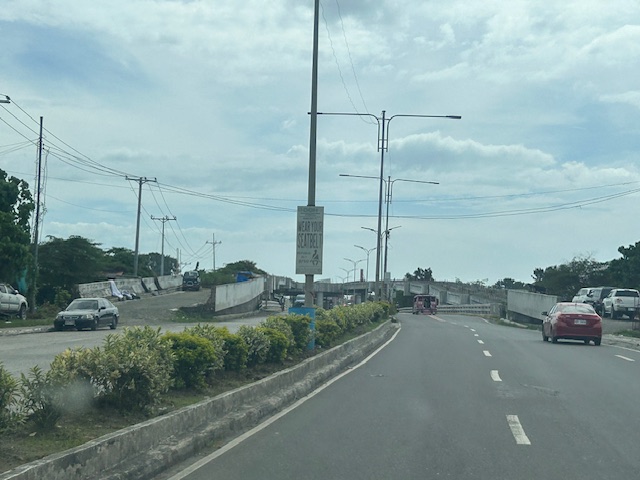
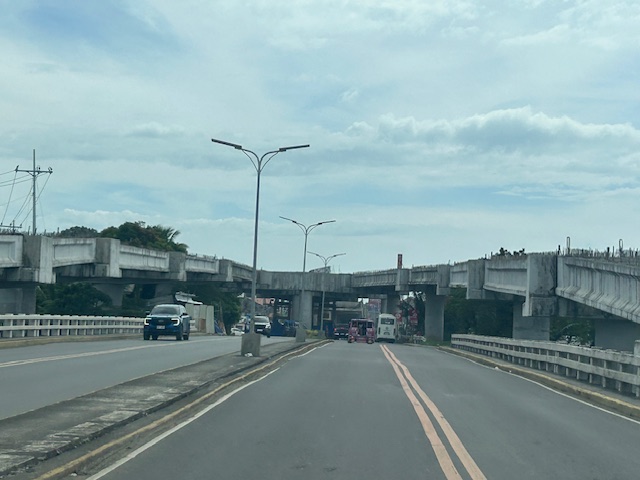
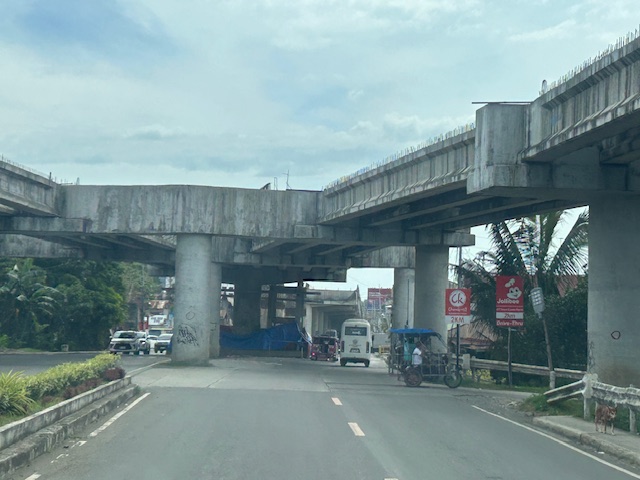
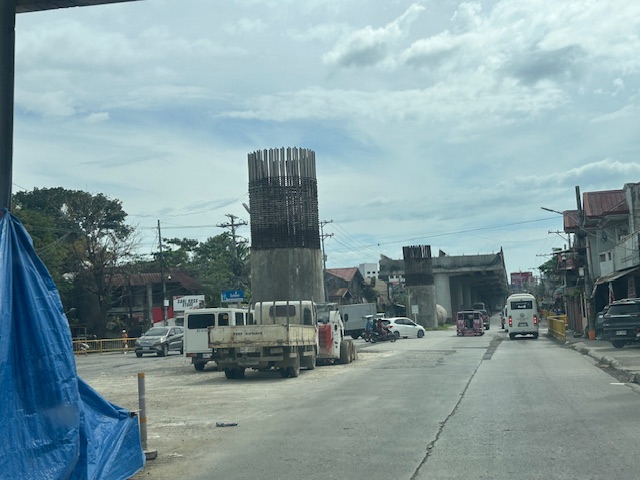
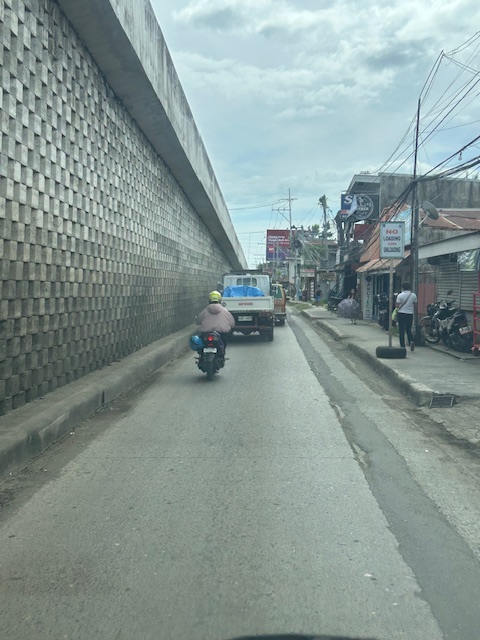
I decided to finish and publish this now as there is news that construction recently resumed. Hopefully, the issues have been addressed and this long delayed project can be completed to help alleviate congestion in the area.
–
Public transport in Iloilo
I took some snapshots of public transportation on my recent travel to Iloilo. These are typical PUVs you would find in most towns across the country. Iloilo’s have some distinct features that they also share with other towns in other provinces.
 A typical tricycle along the Iloilo-Antique road seats 8 to 9 passengers. Sometimes passengers even sit on top of the sidecar. Sidecars here and other provinces often have roofs designed to carry heavy loads including agricultural products. Usual trike sidecar seating have passengers facing front. This one has them “talikuran” or “back to back” with some passengers facing back – not really a nice view when traveling along a highway and vehicles tailing or bearing down on the trike.
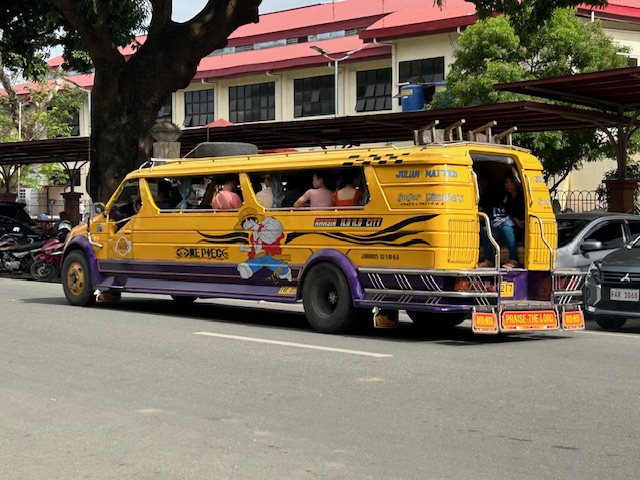 The typical jeepney in Iloilo is stretched whether it’s for inter-town or city operations. Instead of having the ‘face’ of the jeep (from which jeepneys evolved from), they use the front of the Toyota Fortuner or Mitsubishi Montero. These seat 20 to 24 passengers not counting those who are seated on the bench along the aisle. I wonder what engines they now use for these vehicles.
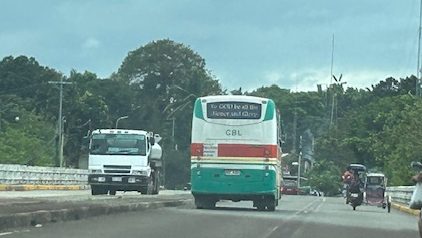 I took this fleeting photo of a bus. For me it wasn’t just a regular bus like the Ceres buses that now dominate the inter-provincial routes. This was a Calinog Bus Line (CBL) bus. We used to take their buses whenever we traveled from Cabatuan town proper to Tigbauan Road. One of my aunts also rode on these buses going to work as a teacher in another town along its route.
–
Back in Iloilo
I’m finally back in Iloilo after a very long while. It’s a quick visit so I won’t be able to go to our ancestral home in Cabatuan. The visit to the city though will still be a sentimental one and perhaps update me on the developments there.
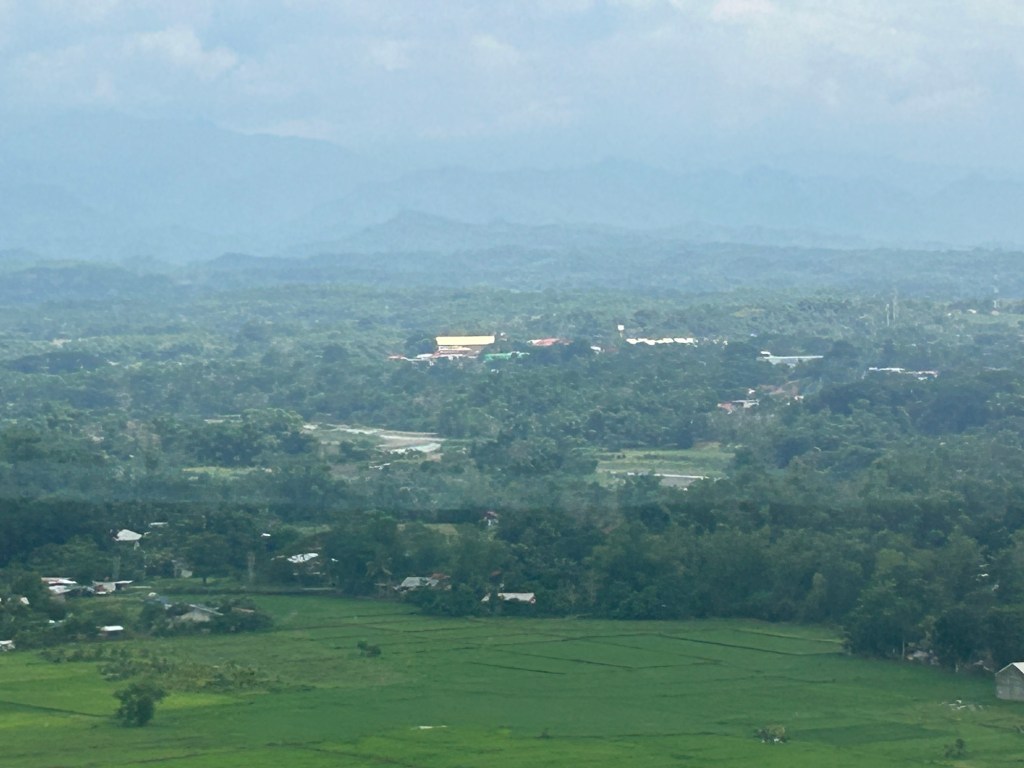
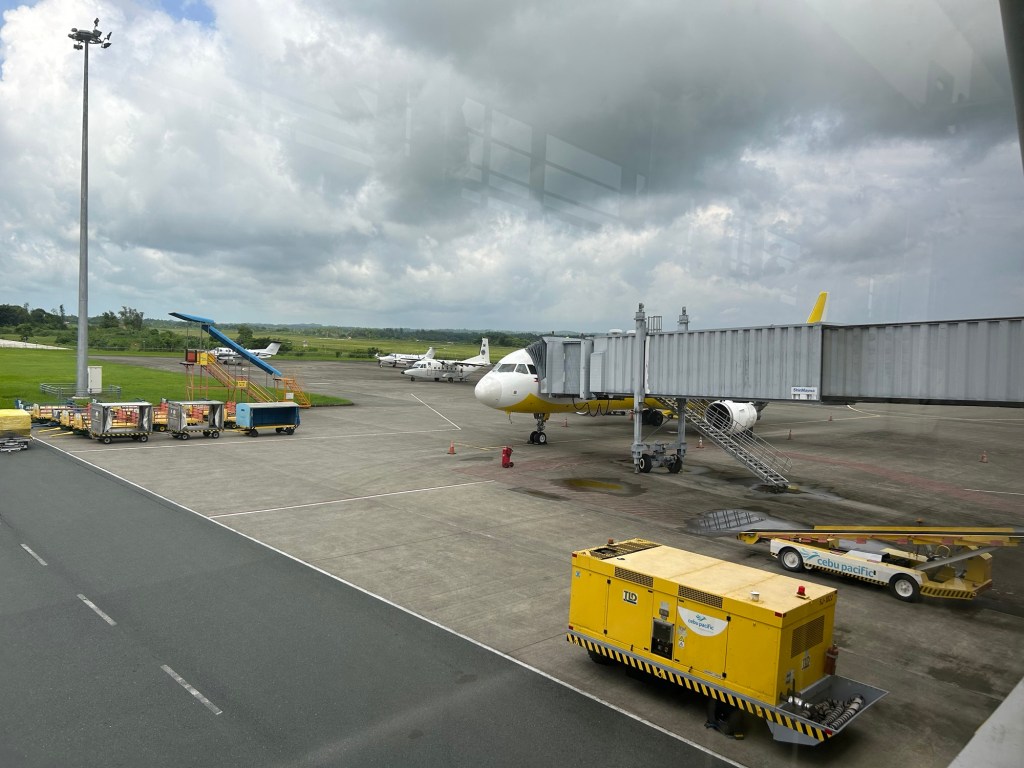
I will be posting on this trip soon as I plan to take photos of the bike facilities along the Diversion Road and walk along the Esplanade.
–
Fare rates for the Antipolo – Iloilo bus service
I found these information on fare rates for the newly opened Antipolo – Iloilo bus service:

The information above indicates that there are three routes to Iloilo:
1) On the left is the route via the central roads of Panay Island (i.e., via Passi City, Iloilo);
2) In the middle is the route to the east of Panay Island to Kalibo, Aklan and Roxas City, Capiz, and terminates at Estancia, Iloilo; and
3) On the rights is the route along the west and crossing the province of Antique. This terminates at Oton, Iloilo and will pass through the town of Miag-ao, which is famous for its church recognized as a UN Heritage Site.
To book a seat on the bus, here is the step-by-step procedure shared on social media on the official Facebook page of Robinsons Antipolo:

–
Antipolo to any point of the Philippines
I wrote several times in the past about every road leading to Antipolo. Recently, a new route opened between Antipolo and Iloilo. This is interesting for me since my father’s hometown, which I also consider mine, is Cabatuan, Iloilo. We usually flew to the province though we also rode on inter-island ferries when I was a child. I have memories riding on the ships operated by the now defunct Negros Navigation and Sulpicio Lines. I had never used the SuperFerry ships that now connect the major islands of Luzon, Visayas and Mindanao.
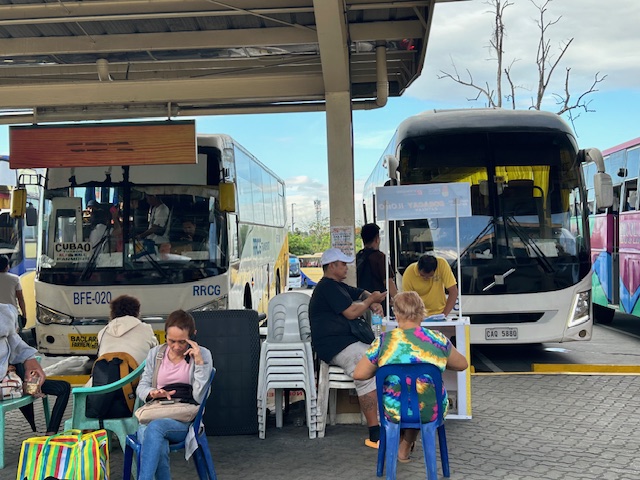 Buses at the public transport terminal at Robinsons Antipolo include those regularly dispatched to Cubao and Quiapo. There are many provincial and RORO buses including those bound for the Bicol Region and Eastern Visayas (i.e., Samar and Leyte). The latter are operated by several bus companies including RRCG whose buses are shown in the photo.
 RRCG bus bound for Iloilo via Batangas, Mindoro, Aklan (Caticlan), and Antique. The fare to Iloilo City is 2,700 pesos. It’s 2,400 pesos until Caticlan.
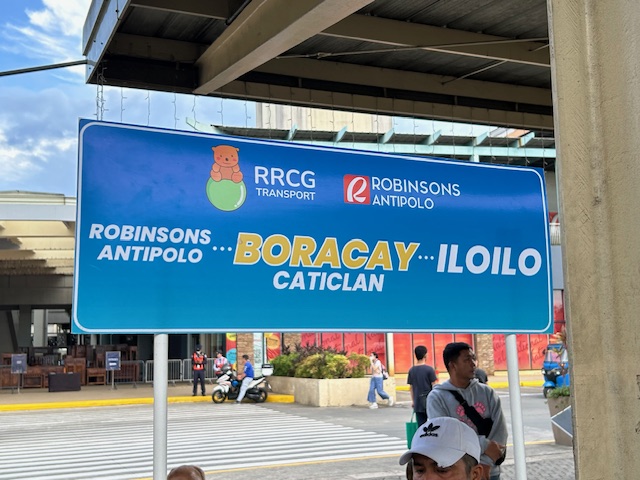 New sign for the route connecting Antipolo City and Iloilo City. Caticlan in the province of Aklan is along the way. I estimate the travel time to be roughly a day considering the bus will still go to Marikina’s transport terminal across from SM City Marikina. From there, the bus will proceed to Batangas Port via C5, SLEX and STAR Tollway. The bus will queue to be loaded unto a RORO ferry bound for Mindoro. It will travel by land to cross Mindoro Island before being transported via ferry from Mindoro to Caticlan.
 One bus company provides services to destinations in the Bicol Region. Both air-conditioned and ordinary (non-aircon) buses are available.
–
Bicycle traffic in comparison with motorised vehicle traffic – a case in Iloilo City
I believe that there is a need to have numbers to guide planners and engineers in designing suitable bicycle facilities. It is not enough to claim there is demand since an important requirement for facilities to be provided (i.e., funded and constructed) are numbers for the facilities’ justification. You don’t build mass transit systems, for example, without a valid estimate of ridership. For one, the ridership allows for the determination of revenues. Roads cannot be built without at least a number like the population of communities that will be given accessibility via that road.
Not too long ago, we were able to obtain traffic counts for the Benign S. Aquino Avenue that is also knows as the Iloilo City Diversion Road. The road includes an exclusive bikeway constructed along its airport-bound side that is supposed to benefit cyclists and encourage more people to use bicycles for commuting within the city and between the city and towns along the national highway. The following figures show the AM and PM peak hour traffic at the intersection of the diversion road and Jalandoni Street across from SM City Iloilo. Another figure shows 16-hour traffic at the same location.
 Fig. 1 – AM peak hour traffic along the Iloilo City Diversion Road including bicycle traffic along the exclusive bikeways constructed along the airport-bound side of the highway.
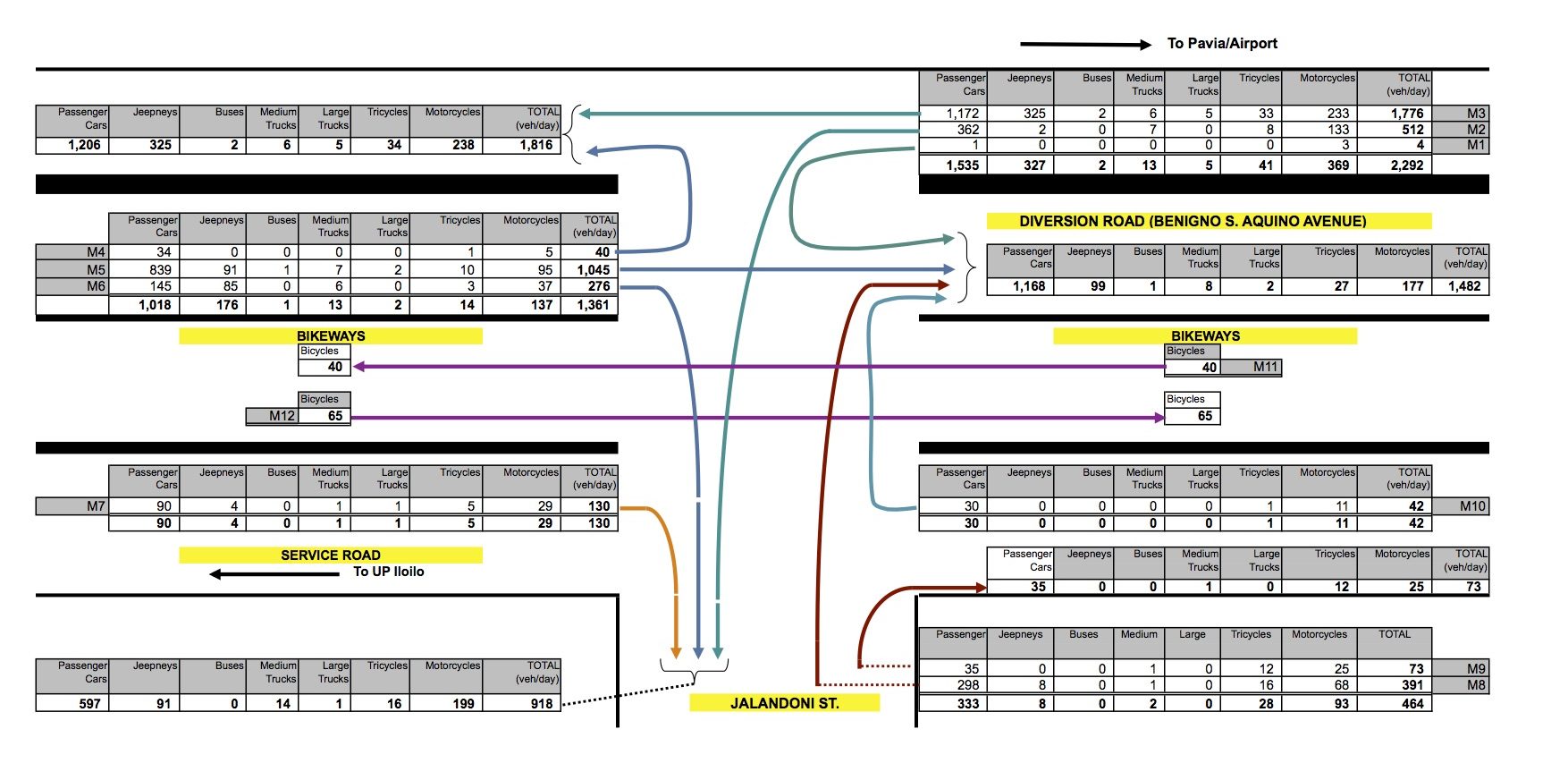 PM peak hour traffic along the Iloilo City Diversion Road including bicycle traffic along the exclusive bikeways constructed along the airport-bound side of the highway.
 16-hour traffic along the Iloilo City Diversion Road including bicycle traffic along the exclusive bikeways constructed along the airport-bound side of the highway.
The numbers clearly show the current low volume of bicycles along the bikeways in comparison to motor vehicle traffic. Since bicycles are also presumed to carry only 1 passenger per vehicle, then the volume also translates into an even lower share in terms of mode of choice by travellers/commuters. For comparison, jeepneys will likely carry an average of 14 passengers while cars may have an occupancy of 1.5 passengers per vehicle. Perhaps a more direct comparison can be made with motorcycles, which are two-wheeled vehicles like bicycles. Only, motorcycles may typically carry 2 passengers.
I am aware that at least one NGO is employing crowd-sourcing in order to obtain bicycle traffic counts along major corridors. Neither the MMDA nor the DPWH have bicycle counts with both agencies’ traffic counts only covering motorized vehicles. Few, if any, local government units would have their own bicycle traffic counts (Perhaps Marikina has data of bicycle traffic in their city that is well known for having the country’s first and most comprehensive bikeways network?). As such, there is generally a dearth of useful data for planning bikeways. One option that advocates for the “if you build it, they will come” approach is not something that is applicable to many cases especially those that do not yet require exclusive bikeways. The folly is to allocate funding for facilities that will not be utilised by their proposed users.
–
On Iloilo’s taxis
The talk about Uber vs taxi is a hot topic in many cities around the world and also in Metro Manila where Uber has gained a foothold and a strong following among mostly ‘former’ taxi goers. Many have stated that Uber provides the service that taxis should have been providing. Uber vehicles are supposed to be of newer models and drivers are supposed to be screened carefully. Uber even has a feedback mechanism not just for drivers but for passengers as well. Basically, Uber provides the quality of service everyone wants to have on regular taxis. The irony of course is that regular taxis are supposed to provide a higher quality of service compared to other public transport modes considering it is basically a for hire car short of a limousine service. But then this begs the question: If you had good taxi services in your city, would you still consider Uber? Or perhaps would Uber have a lot of demand in a city with good taxi services? Perhaps there will still be a demand for Uber but the clamor will not be like that in Metro Manila. And there are few cities with ‘good enough’ taxi services that can compare with Uber in terms of quality of service.
A good example of where there are ‘good enough’ taxis and there is a healthy competition not between Uber and conventional taxis but among taxi operators themselves is in Iloilo City. We have discovered many years ago that Iloilo City had one Light of Glory taxi company that is very popular among Ilonggos and visitors as the drivers were generally more honest than others and they had an efficient dispatching system including desks at the airport and a major shopping mall.
 Light of Glory Taxi at the airport parking lot
 Light of Glory has its own app, which you can get for free and install on your smartphone. It is not as sophisticated as Uber’s or Grab’s apps in terms of features but it gets the job done (i.e., getting you a taxi).
 Dispatch sheet – note the attributes the company is trying to promote among its taxis: “Clean, Safe, Reliable, Comfortable, Drug Free” These are attributes we all want of our public utility vehicles whether these are taxis, jeepneys, buses or tricycles.
 Light of Glory taxi that dropped us off at the venue of our meeting straight from the airport
The Light of Glory taxis is a well run company. Their drivers seem to be treated very well by the operator (drivers claim they have a better compensation system) and generally drive better than other taxis. Their vehicles are also seem to be better maintained compared to others except a few of the larger companies like GDR. Everyone knows about the best taxi company in Iloilo and would most likely prefer their taxis over others if the choice is given to the taxi-going commuter. To compare, I remember the Comfort taxis of Singapore and how many Singaporeans and foreigners living in SG prefer these taxis over others. Comfort taxis have a good dispatching system and you can make reservations for trips in advance. Of course, there are additional fees for on-demand services including arrangements for pick-ups and drop-offs (e.g., your residence to the airport).
–
Another look at Iloilo’s main bikeway
Much has been written and said about Iloilo’s bikeways and particularly about the grander one built along the main highway that is Ninoy Aquino Avenue. This bikeway is already usable but is being extended along with the road widening works for the national road that connects major towns in central Iloilo province including Sta. Barbara and Cabatuan, which host the international airport. Here are some photos and commentaries on the bikeway.
 Iloilo City’s wide bikeway along Ninoy Aquino Ave (formerly the Iloilo Diversion Road) – the building on the left is SM City’s recently opened expansion. The photos were taken from the pedestrian overpass across the diversion road.
 A closer look of the traffic conflicts at the intersection with Jalandoni Street – the 3-leg intersection is not as simple as it initially looks because of traffic coming from/going to the service road on the right. It is quite obvious in the photo that the alignment of the service road changes abruptly, affecting the trajectory of flow along the road.
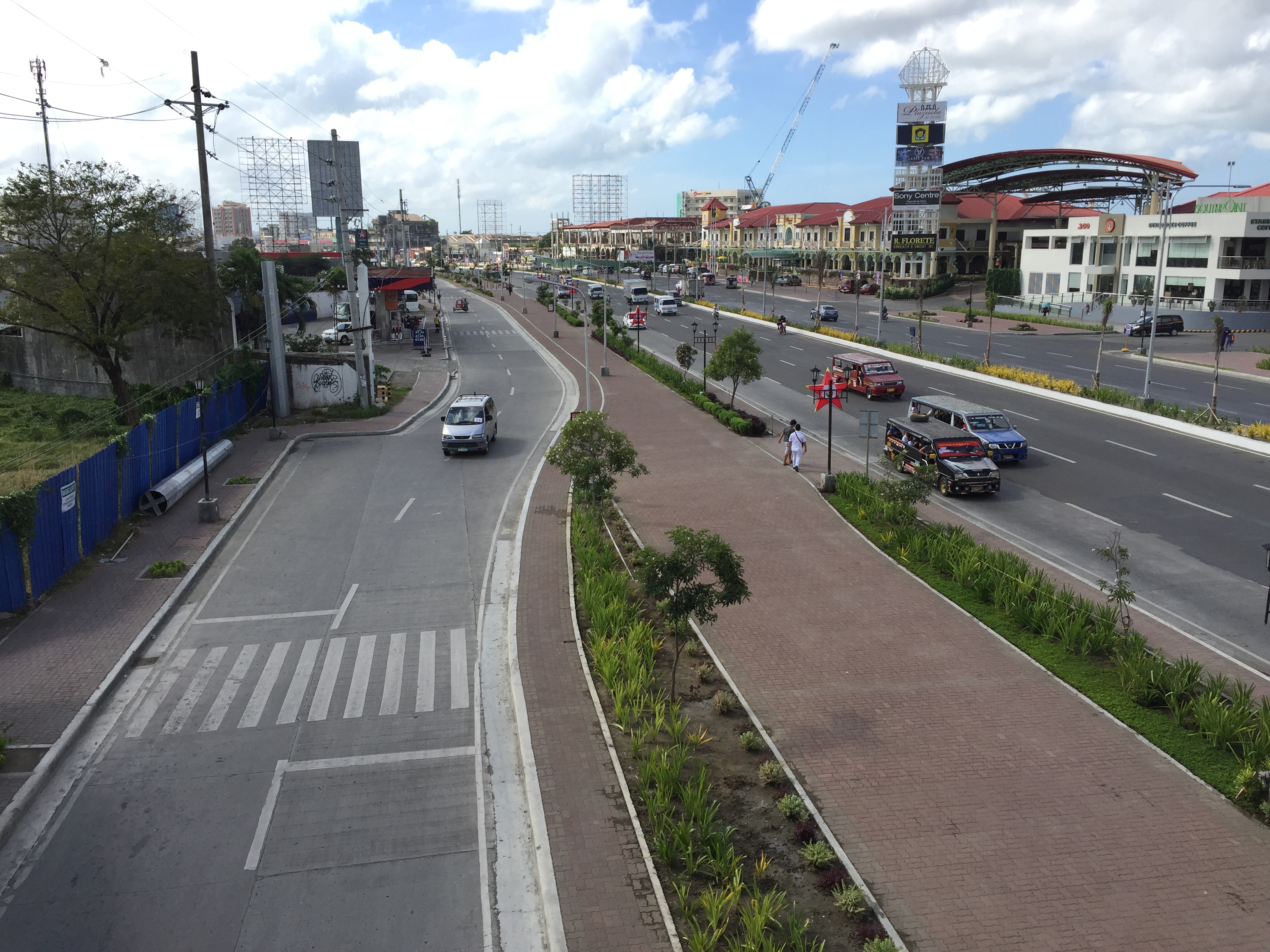 The photos were taken around 9:30 AM and there was practically no bicycle traffic to be seen. To be fair, perhaps there is significant bicycle traffic, particularly the commuting kind, earlier in the morning and later in the afternoon. Bicycle volumes need to be measured and monitored to determine if the bikeways indeed have encouraged more people to take up cycling as a mode for their regular commutes. That’s the Plazuela in the background on the right.
 Another look at the bikeway shows it emanating from Iloilo City proper where it ultimately connects to the bikeways at the Promenade along Iloilo River. There are no bikeways within Iloilo’s CBD itself.
 The photo above shows the bikeway and beyond (towards Jaro and Pavia) with the new SM annex at left and the Injap Tower Hotel on the right.
–
“Sharing the road” – bandwagons and fads? Let’s hope not!
There seems to be a lot of talk about “sharing the road” and the initiatives to have more bikeways. I hope I am proven wrong but it seems to me as if these current programs and projects are more of a fad. A lot of people (and local governments) join the bandwagon with little understanding of what needs to be done. It’s usually because of the good PR they get out of these that they agree to coming up with the token carless street or the haphazardly implemented bicycle lanes. More than PR, some cities are aware of the opportunities that come with such initiatives as international agencies and groups are willing to spend money to support such programs and projects. The question really is on sustainability and doing the right thing not only on initiating things or coming up with programs but on the substance itself. And by substance I mean that programs should also go into the details of designs. Too often, the “pwede na yan” approach is taken and this just won’t do.
 The MMDA painted the sidewalks in White Plains and designated them as bikeways, in a way alienating pedestrians.
A vision for what people want to have is there but it is ultimately how the achieve the vision that needs a lot of work. For example, bills are being filed in congress to force the creation of bicycle lanes along major highways. (And mind you there are a lot of similar bills filed in congress that upon closer inspection actually have little substance.) The premise here seems to be that if you build them then people will start cycling. That was not the experience in Marikina, which boasts of the country’s only bikeways network that includes many off-street sections. These bikeways were built at a time when the perception and analysis pointed to a critical mass of cyclists in that city that was thought to be surely the tipping point in terms of non-motorised transport. Nowadays, the same bikeways are used by motorcycles and tricycles and most cyclists we see are not commuters (e.g., cycling between home and work/school) but recreational cyclists. It would take Marikina some effort to promote commuting by bicycles and much effort in enforcement to correct the misuse of the bikeways. The “new” bikeways in Quezon City appear to be poorly conceptualised as the MMDA decided to paint the sidewalks along EDSA northbound without addressing the obstacles like electric posts. Still, it is an effort to put NMT in the consciousness or awareness of the general public (thanks in part to media’s making these news worthy items).
Cities like Pasig and Taguig like to show-off Ortigas Center and Bonifacio Global City, respectively, as their faces when in fact the cities have not done much in their original cores. The running joke is that the real Taguig is not the areas to the west of C-5 but the old Taguig, which is to the east. This Taguig is the one plagued by narrow streets and the proliferation of tricycles. It was not so long ago that a former mayor imposed e-tricycles on BGC (where they were not suitable) while not doing much to lift a finger in the mayhem of tricycles in old Taguig (e.g., along Gen. Luna). As for Pasig, you just have go along the Pasig River and the Manggahan Floodway to see what it has accomplished so far in those areas.
There are no quick fixes to the transport and traffic problems our cities are facing. In the case of Metro Manila, much is at stake for the long-delayed mass transit projects. And the DOTC’s announcements of projects being formulated or proposed are no longer taken seriously as they have not delivered on any of these despite 4 years of this current administration. For other cities, it is important to learn the hard lessons from the experience of Metro Manila. There is also a need for a drastic change in transport and traffic policies in our cities. Iloilo, for example, has built an expensive bike lane along Ninoy Aquino Avenue (Diversion Road) and has marketed its Esplanade as a haven for pedestrians and cyclists. Yet the city has not acted on the clamour to revisit the overpasses along Gen. Luna (Infante and Jalandoni flyovers). The latest information I got from the city is that there are issues in the design of the bikeway along the Diversion Road as the surface (they used pavers) is not suitable for cycling. It seems, also, that the city and cyclists were not consulted by the DPWH when the bikeway was designed and constructed resulting in many cyclists using the Diversion Road itself for traveling. This last example is a lesson for our local governments and national agencies that they need to cooperate with each other and turfing has no place in transport and traffic if we are really serious about bringing solutions to problems we encounter everyday.
–
Another look at the Iloilo airport – departure
I took the first flight out of Iloilo back to Manila during a recent trip to the city. I also took an opportunity to take some pictures of the terminal including the part when we lined up to enter the terminal. Security was strict (as is necessary for such facilities) so there was a single line to control the inflow of passengers. There’s nothing really new for departures except a few new cafes inside the pre-departure area. The shops prior to the final security check were still closed at the time so I could not do some final pasalubong shopping. I can only imagine that passengers directly bound for international destinations would need to pass through the immigration booths at the terminal.
 Queue of passengers entering the terminal – there was a single file for the initial inspection by airport security. Well-wishers are not allowed inside the airport unless there is prior clearance from the airport authorities.
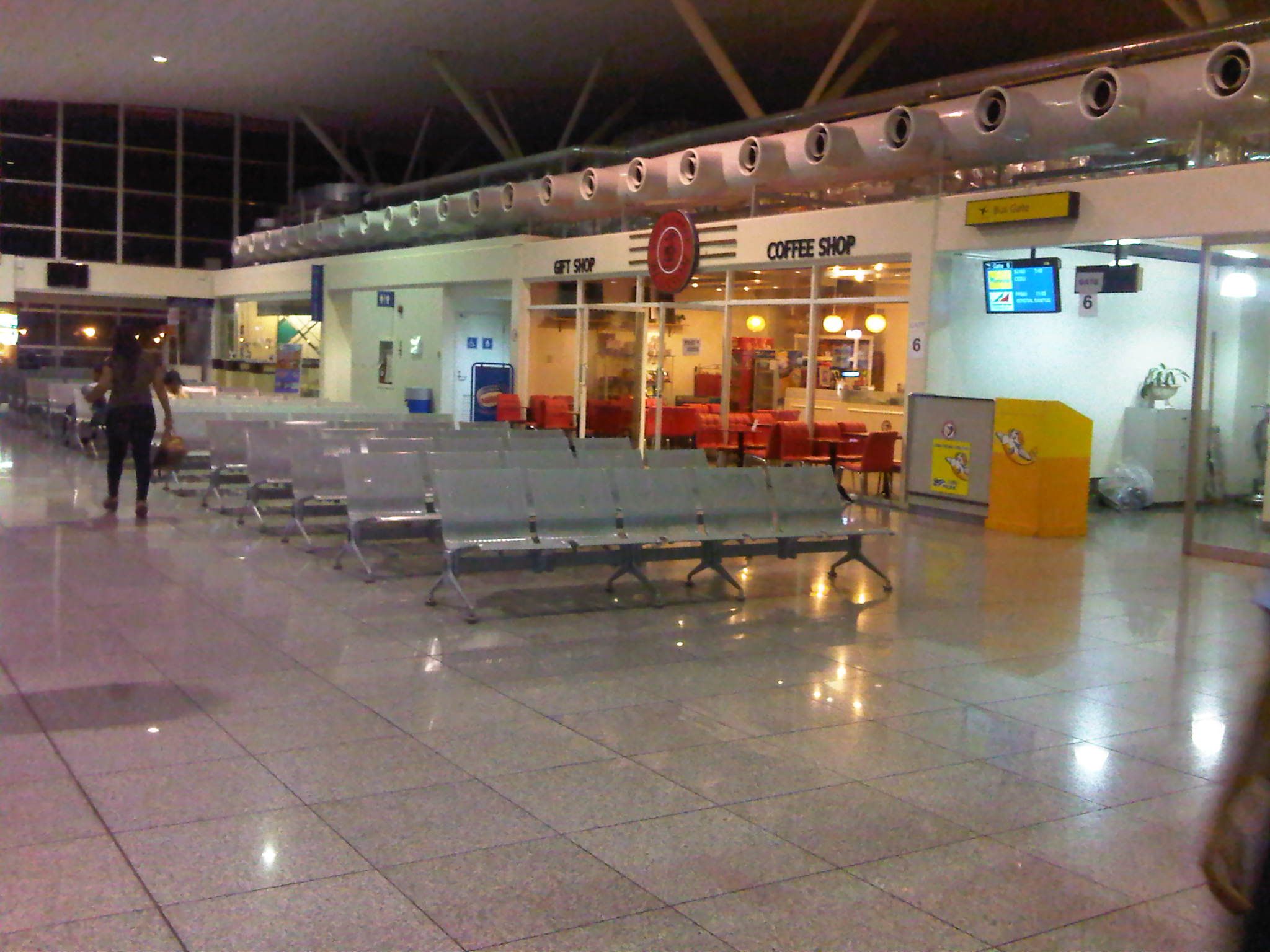 North wing pre-departure area – the shops were already open early in the morning
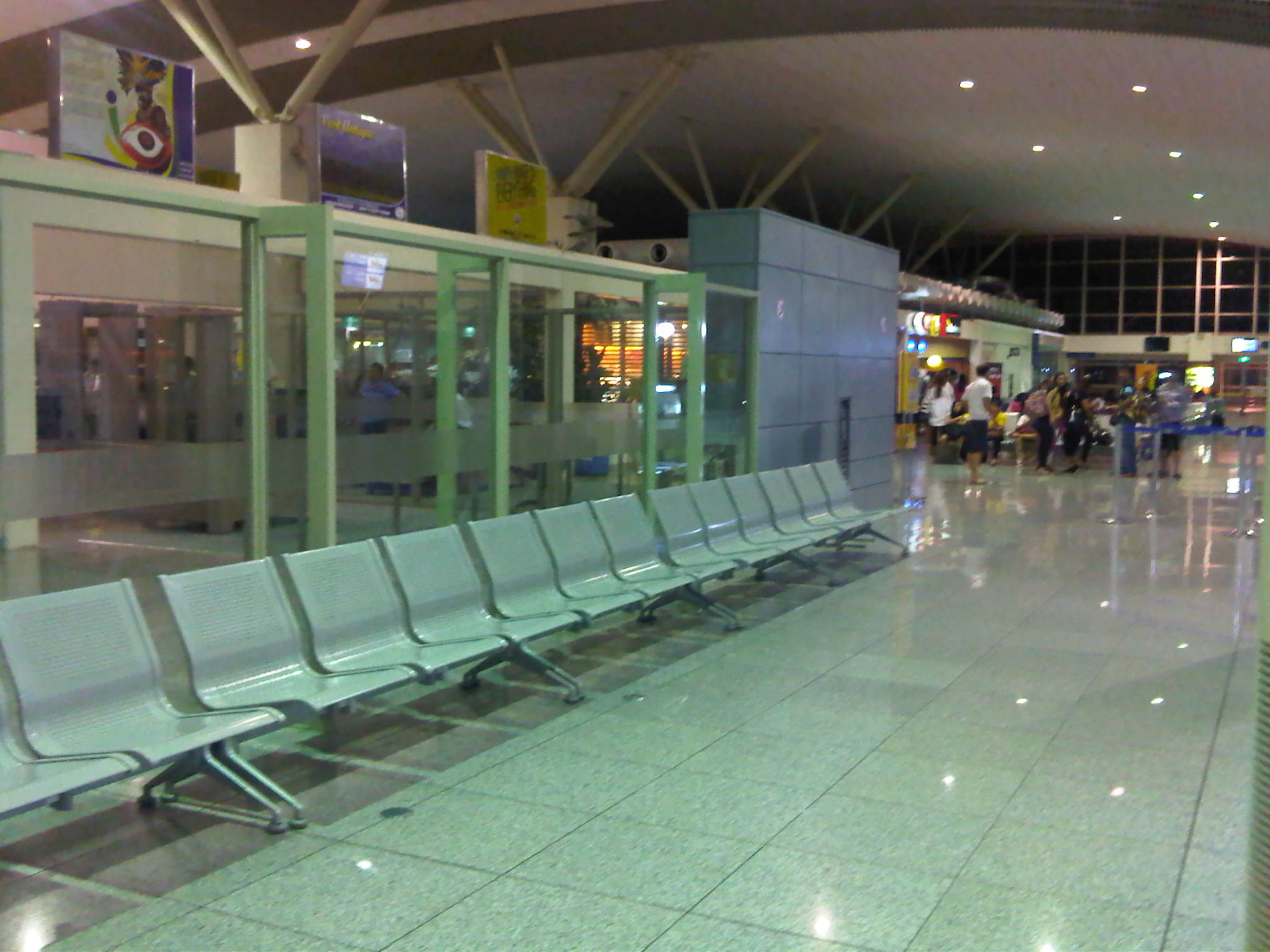 A glance back to the center of the terminal where passengers emerge from the final security check.
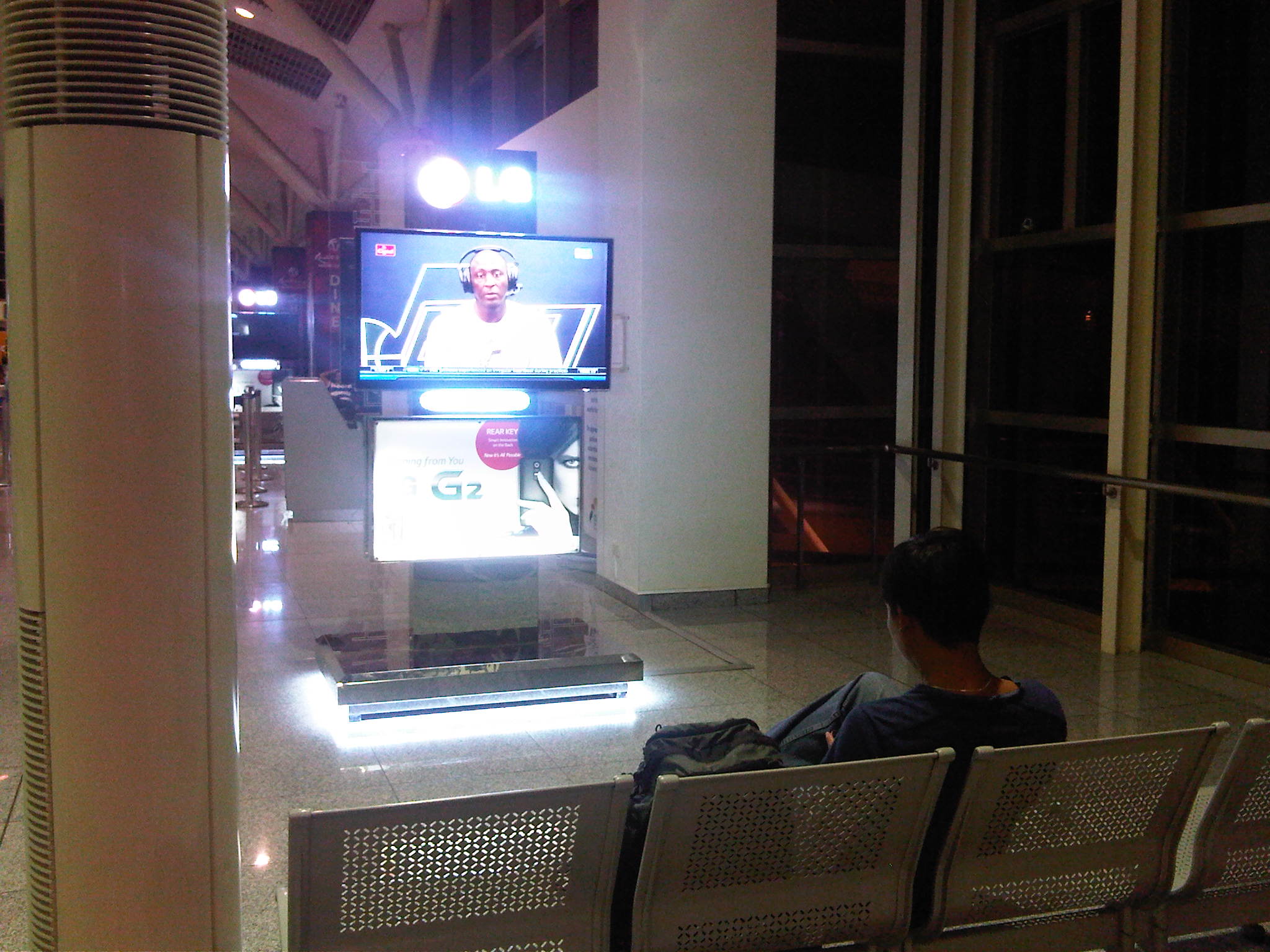 Passengers catching an NBA post-game interview while waiting for the boarding call.
 We were initially assigned to board at Gate 3 of the airport terminal.
 Cafe near Gate 3 that is also designated as a smoking area.
 Later, we were transferred to Gate 5 at the other end of the terminal.
 Waiting passengers seated facing Gate 5. There are also cafes and fast food line along this terminal wing.
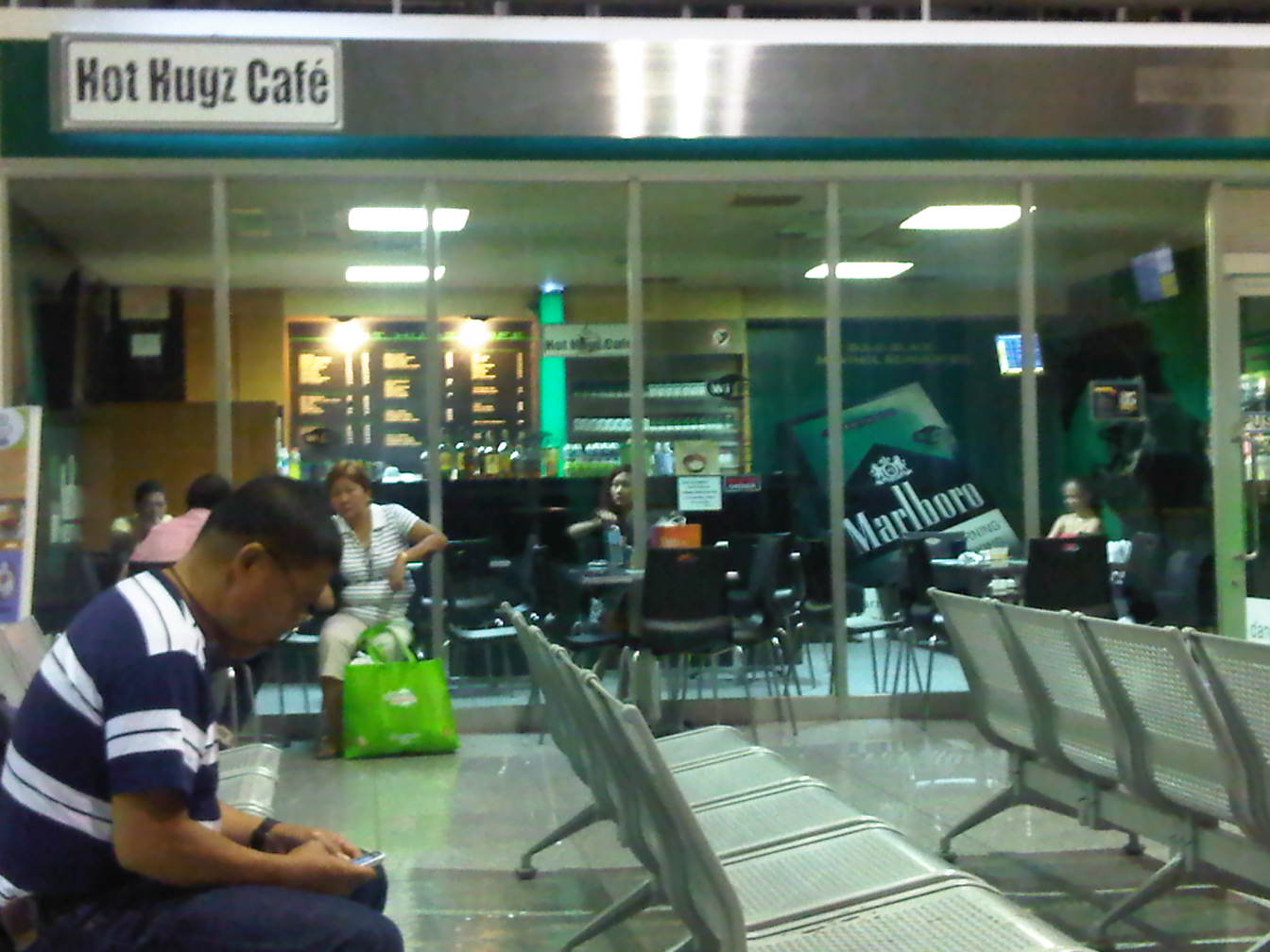 Designated enclosed smoking area near Gate 5.
 Fellow passengers walking on the bridge towards our aircraft.
 The first flight out of Iloilo to Manila is via Cebu Pacific. The second flight is via Philippine Airlines whose plane is shown unloading baggage as it arrived as we were boarding our aircraft.
 View inside the tube as we proceeded to board our aircraft.
–
 Caught (up) in traffic