
Home » Posts tagged 'jeepneys' (Page 5)
Tag Archives: jeepneys
Public transport fare hikes
Bus and jeepney groups often demand for an increase in the fares every time there is an increase in the prices of fuel. The latest one is mentioned in this article via Rappler, where a jeepney group is to hold a protest caravan as they seek a discount on diesel for all public utility vehicles. The reaction from readers is an overwhelming “Annoyed.” And rightly so because while these protests appear to be noble and are often linked by jeepney groups to petitions for fare hike increases (i.e., asking for fare increases if they cannot be given fuel or petroleum product discounts), closer scrutiny of operating costs will reveal flaws in their arguments for fare hikes and discounts. These same flaws also reveal why government agencies charged with public transport franchising and regulation (i.e., DOTC and LTFRB) should have the data and tools for a fair assessment of fares (pun intended).
Data from field surveys conducted quite recently (NCTS, 2012) show us that jeepneys typically average around 3 to 4 km/L on diesel fuel. This is a very low value that is comparable to the income from passengers for one trip over a distance of say 4 km. A fully-loaded jeepney with an average of 20 passengers (9 on each bench plus 2 beside the driver) operating a 4-km route will 160 pesos. However, there are limited reliable information or data on other costs such as maintenance costs and other items including “boundary” and “dispatching.” The boundary is basically a rental fee for the use of the vehicle while jeepney groups charge a fee for dispatching vehicles from the terminal or stop. In a day’s operation, such costs could easily accumulate into a significant total that would eat up a day’s income, usually leaving the driver with just enough to bring home to his family.
This brings us back to the argument against transport being treated as livelihood rather than a service. Many operators or owners of public utility vehicles, whether they have one or more units, tend to scrimp on the maintenance of their vehicles. Poor maintenance manifests in the form of smoke-belching and frequent breakdowns. While smoke-belching contributes to the deterioration of the environment and health costs, breakdowns often lead to road crashes (e.g., tires flying off, problems with brakes, etc.) like the recent bus crash in the Mountain Province where faulty breaks were blamed for the crash.
Jeepney groups often raise issues on the plight of small operators who are usually the drivers of the jeepneys themselves. Many of these people should not even be operating or driving jeepneys in the first place because safe and efficient service is not their priority. Service is second only to the desire to generate income, to earn a living, which makes them drive the way they currently do (i.e., recklessly) and improperly and haphazardly maintain their vehicles. There is seldom serious talk and little done to protect the interests of people who take public transport. These are the same people who are often shortchanged with the poor quality of public transport in our cities and have long suffered for this. Let us hope that the LTFRB will be guided as they decide on this matter of fares and furthermore for the agency to study the state of road public transport franchising in order to weed out people and groups who do not deserve to be operators. I believe there is more than enough data or evidence against such operators if the LTFRB truly wants to reform the system.
–
Harbinger of change for public transport?
Comets have been viewed as signs, omens or harbingers of something that will happen. I like the word “harbinger” more than “omen.” It brings about a certain mystery to it that does not necessarily imply something bad or evil. In this case, the comet is a vehicle and “Comet” stands for City Optimized Managed Electric Transport, an electric jitney that is being touted as a replacement for the ubiquitous jeepney that has evolved from its WW2 ancestor. It does have the potential of being a game changer if there is an enabling environment for it and if (a big “if”) it addresses fundamental issues with electric vehicles such as those that are technical (battery life, range, speed, etc.), pertaining to after sales (maintenance, technical support) and operational (suitable routes, fares, charging stations, etc.).
[All photos taken by Engr. Sheila Javier of the National Center for Transportation Studies]
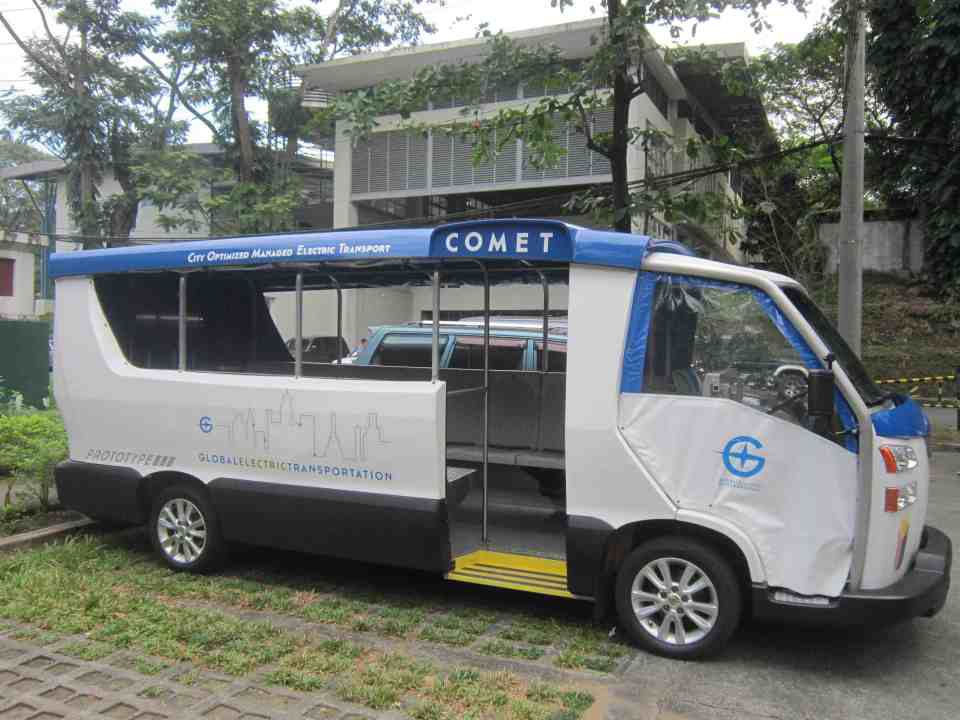 Prototype Comet at the NCTS parking lot – notice that it is larger than the AUV on the other side of the vehicle. The Comet will utilize a tap card for fares, similar to the card that is proposed for use in the Automated Fare Collection System for the LRT/MRT system.
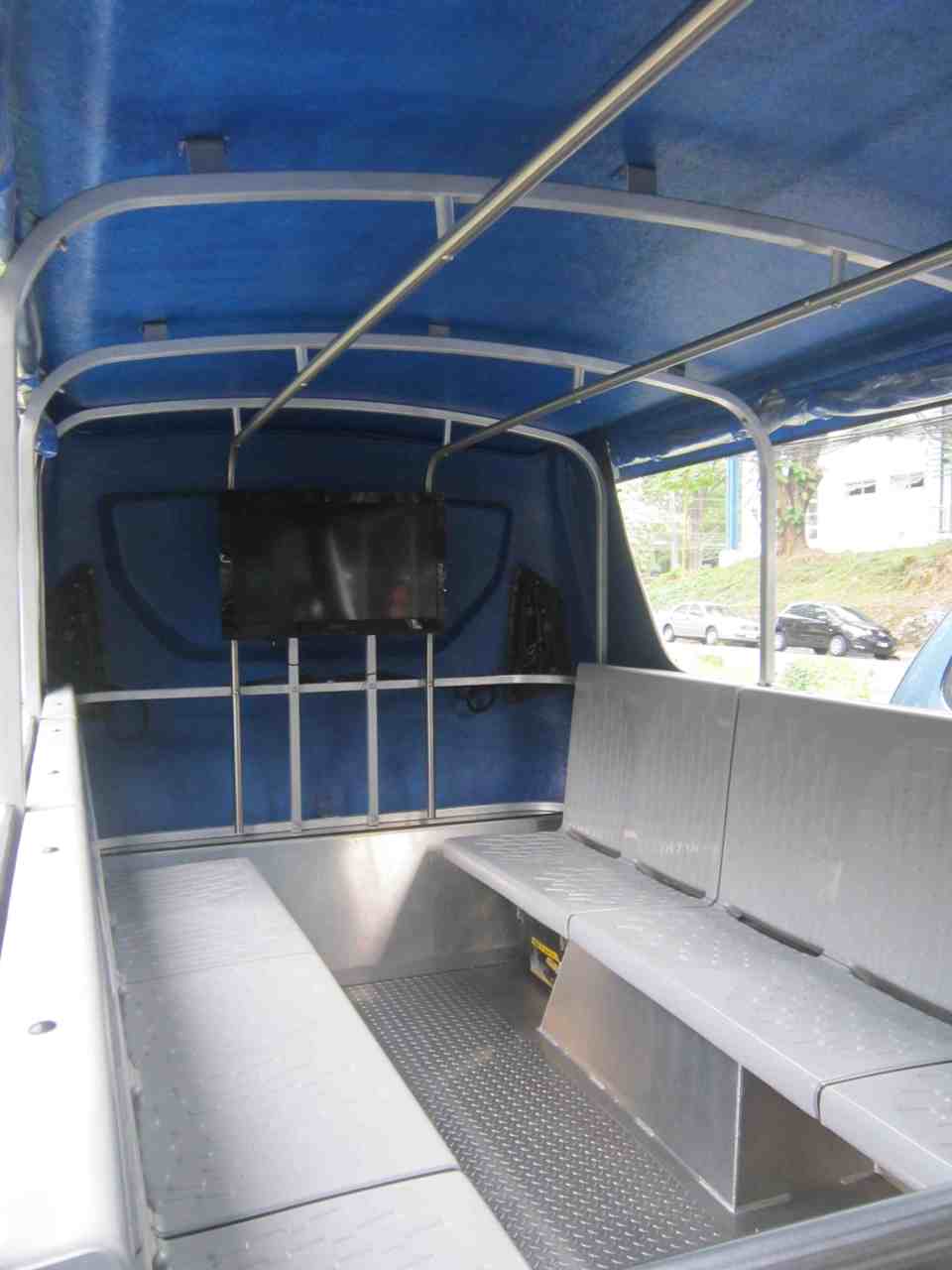 Inside the vehicle, one immediately gets a feeling of space. In fact, a person can stand inside the vehicle unlike the case of jeepneys where people need to bend so as not to bump their heads at the ceiling.
 The vehicle has a side entrance and exit unlike the rear doors of typical jeepneys.
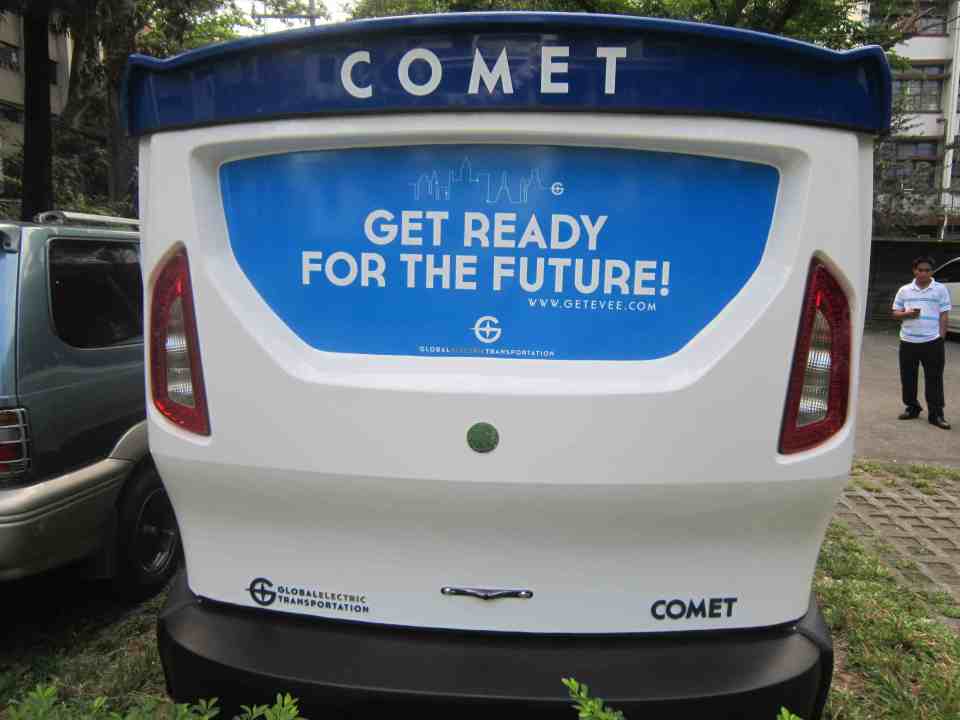 The Comet looks like a mini-bus from behind. Proponents have stated that drivers will be trained for road safety as well as operations for designated stops and scheduled services.
The Comet is being touted as a replacement for the jeepney and is being promoted via an initial route that would connect SM Megamall in Ortigas Center, Pasig City to SM City North EDSA in Quezon City. The route will be counter-clockwise from SM Megamall to SM North EDSA via Circumferential Road 5 including E. Rodriguez Avenue and Katipunan Avenue, UP Diliman, Commonwealth Avenue, Elliptical Road and North Avenue. From SM North to SM Megamall, it will take EDSA. While I am not sure if the Comet has been granted a franchise and how many units they can deploy, this proposed route will overlap with existing jeepney and bus routes including direct competition with UP-Katipunan and UP-North EDSA routes, and buses plying routes that cover the stretch from North EDSA to Ortigas Center. I think that this route is mainly for publicity considering there are probably other, more suitable routes for the Comet. It has not been subject to rigorous tests (just like the e-jeepneys before it), which is not a good thing, considering the experiences of the e-tricycle in Taguig and the e-jeepneys in Makati. Hopefully, they have learned the lessons from these past efforts and that they already have the answers hounding EVs as applied to public transport.
–
On commuting and jeepneys
There is an online petition calling for public officials to take public transportation instead of traveling in their own cars (with or without chauffeurs). The assumption seems to be that our so-called leaders, particularly those tasked to come up with solution to our transport and traffic problems, do not themselves used public transportation. As such, they are basically oblivious to the daily frustrations of many commuters who have to suffer the uncomfortable, inefficient and, in many cases, unsafe transport that we have in most if not all our cities and towns.
But who’s afraid of riding public transport and jeepneys in particular? I would like to think that many if not most or all Filipinos had to ride a jeepney at one point in their lives. After all, the jeepney is second only to the motor tricycle in terms of being the most widespread mode of transport in the country. [Yes, that’s right. The jeepney is not really the king of the road in the Philippines. That title is perhaps more suitable to the tricycle, and I’ve explained this in past posts about the tricycle.] Why do people continue to ride the jeepney despite it being perceived as unsafe and not an environment-friendly mode of transport? Why are these aspects not being corrected by the responsible agencies? These are questions that are difficult to answer only because of the social implications that the government does not want to deal with head-on.
–
The way jeepneys are designed all over the country, drivers have to deal with the cramped space of the front seat that have implications personal health as well as road safety. The cramped space and overall design of the vehicle affects the driver’s posture as he is forced to stoop in order to have a good view through the windshield. In some cases, those with longer legs would have to orient their seated bodies in a position that is not ergonomic. Such practices or positions may contribute to injury over the long term as well as affect the way the driver operates the vehicle.
 I’m not into taking photos inside jeepneys (quite risky as it invites attention to you and to your phone) so there’s few (and not so good) photos of my commutes. This one is a good one inside a jeepney bound for Quiapo, Manila from Philcoa, Quezon City.
I think that for visitors from other countries, a trip to the Philippines would not be complete without experiencing a jeepney ride. When we do have visitors at the university and if they have the time, we take them around the campus on a jeepney. Of course, this is an easy and relatively safe ride for them considering the “Ikot” and “Toki” jeepneys have routes within the campus and do not pass through busy streets or wide highways that tend to invite speeding.
It’s a different thing and quite an experience when you ride the “patok” jeepneys usually plying the longer distance routes like Cubao-Montalban or Cubao-Antipolo. The drivers of these jeepneys are generally risk takers and many are reckless to the point that a slight mistake in driving would likely lead to a serious if not fatal crash. It’s a wonder that they don’t make mistakes often enough for authorities to clamp down on them. Despite this, many people take such jeepneys because they have no choice or if they did, they opt for the aggressive drivers because of the perception that these will get you to your destination faster (Jokingly, it is said that hopefully your destination is not the afterlife.).
–
Manila’s jeepney experiment
A few months ago, and almost right after the local elections, the City of Manila embarked on a campaign to reduce the number of colorum or illegal buses plying along the streets of the city. The result was confusion and mayhem as commuters and authorities were unprepared to deal with the sudden decrease in the number of buses (some companies even restrained all of their buses from entering Manila to protest the city’ move) and the jeepneys and UV express couldn’t handle the demand. Much of that seems to have been resolved and buses are now back in Manila; although whether all these buses are legal ones is still unclear. The city, it seems to some quarters, was only after buses with no formal terminals in the city and appeared to have made the drive to show bus companies who’s in-charge there.
Now comes a drive against jeepney drivers, particularly those undisciplined ones that are often found violating traffic rules and regulations, and endangering their passengers with their brand of driving. The result was a one-day strike (tigil pasada) of jeepneys belonging to the Federation of Jeepney Operators and Drivers Associations in the Philippines (FEJODAP), one of several organized jeepney groups in the country. Others like operators and drivers from Pasang Masda, PISTON and ACTO, opted not to join the transport strike. The result was a transport protest that had little impact on most people’s commutes though the group did manage to attract media attention and gave interviews to whoever cared to listen.
Not to judge Manila as I believe it has made huge strides by confronting the many urgent issues in transport in the city. Not many cities take these problems head on as Manila has done this year. However, the jury is still out there if their efforts have been effective and if these will be sustainable and not the ningas cogon kind that we have seen so much of in the past. For definitely, there are a lot of other transport issues that Manila needs to contend with including how to make the city more walkable and bicycle-friendly (not an easy task!) and how to address the excessive number of pedicabs (non-motorized 3-wheelers) and kuligligs (motorized 3-wheelers using generator sets or pumpboat motors for power) in the city. Hopefully, again, the city will be up to the task of addressing these problems along with the persistent congestion along its roads.
–

