
Home » Posts tagged 'Katipunan' (Page 2)
Tag Archives: Katipunan
What’s causing traffic congestion along Katipunan?
An article came out today on a popular online news site stating that the Metropolitan Manila Development Authority (MMDA) blames the Land Transportation Franchising and Regulatory Board (LTFRB) for the severe traffic congestion that is experienced daily along Katipunan Avenue (part of Circumferential Road 5). The article may be found in the following link:
MMDA: LTFRB to blame for Katipunan traffic
Reading the article, I would like to think that the MMDA likely misunderstood the advisory from the LTFRB extending the “non-apprehension policy” for trucks that have not renewed their franchises. This policy is not the same as the truck ban scheme being implemented in Metro Manila by the MMDA and LGUs. The trucks using Katipunan Avenue during the prescribed period that they are allowed travel along this and other roads are not violating any laws or regulations. Meanwhile, the increase in the volume of trucks can only be attributed to an increasing demand for goods that translate into freight movement. There are very limited alternatives to Katipunan Ave., which is a truck route (note: most of EDSA is not a truck route), and there are few wide roads that can accommodate the volume of trucks carried by C5.
I use Katipunan everyday as it is the main road between my home and my office. I can say that traffic has worsened along this stretch of C5 and one can always see the long queue of vehicles caught in traffic along the northbound side of Katipunan especially from the afternoon to night periods. There are many causes of traffic congestion along Katipunan Ave. and during times when trucks are banned from traveling, it is still congested due to the sheer number of private vehicles using the road. C5, after all, is a major road connecting Quezon City with Pasig, Makati and Taguig, which host major CBDs (Ortigas, Makati and Bonifacio Global City).
In the mornings, much private vehicle traffic is generated by the exclusive schools along Katipunan and the northbound side of the road is usually congested from C.P. Garcia all the way to Blue Ridge. Meanwhile the southbound side is full of vehicles from B. Gonzales (across Miriam College’s main gate) to Tandang Sora. In the afternoons and evenings, traffic congestion is caused mainly by traffic returning from Ortigas, Makati, BGC, etc. to Quezon City and elsewhere where their passengers reside. Road capacity is usually reduced by the parked and standing vehicles that usually occupy a couple or more lanes along Katipunan southbound.
I guess the MMDA would just have to do a better job of managing traffic along this corridor. However, they can only do so much given the sheer volume of private and freight traffic using Katipunan and the limited options for reducing traffic over the immediate to short terms. Only an efficient mass transit system (including walking and cycling for short trips) and a significant mode shift from private to public transport can provide a long term solution to traffic congestion along Katipunan. Until then, congestion along Katipunan will continue to worsen and this will further be exacerbated by the full development and operation of the U.P. Town Center and other high rise developments along the road. Good luck to all of us using Katipunan Ave.!
–
Tales from a jeepney ride
Jeepneys get a lot of flak these days for the poor services they provide including many cases of reckless driving that could cause (if not already have caused) road crashes. Many of these crashes do not involve serious injuries or fatalities. Often, these are sideswipes or rear-end collisions, the latter being the result of aggressive drivers not being able to brake in time partly as they like to tail-gate (tutok) other vehicles. The social side of a jeepney ride is often the subject of many tales that illustrate typical human behaviour. There are the body language involved in passing fares between passengers and the driver or conductor. There are the scents and smell of different passengers. There’s music and there’s talk among people riding the jeepney (e.g., friends or colleagues commuting together). There are even cases of PDA or public displays of affection, including among students who go home together. I think it is still common for males to show their affection by taking their partners home (to make sure they get home safely).
One time during a ride home, I was fortunate to get a jeepney whose driver wasn’t reckless and whose conductor was a jolly fellow who engaged passengers in small talk while we were on our way to Antipolo from Katipunan. One passenger asked him how come it was more expensive to go to Antipolo Simbahan via Sumulong compared to the older route via Junction. He answered correctly that the former was a longer route (Google maps will tell you that the route via Sumulong Highway is 16.1 km while the one via Cainta Junction is 15.0 km.) but quickly added that the route via Junction usually took more time to travel along due to the congestion along Felix Avenue, Junction and Ortigas Extension. The other passengers agreed and joined the conversation, commenting on how many Antipolo-Sumulong jeepney drivers and conductors often try to choose passengers or attempt to cheat passengers on their fares (e.g., not giving back the right change or in some cases not even returning change). The good conductor offered his own observations in an accent that seemed to me as one for a native of Rizal. I wanted to join the candid discussion but decided to just listen in and be a spectator in this exchange.
 This jeepney conductor was honest and engaged passengers in conversation. The driver was not reckless unlike many others of jeepneys I have rode on. (He was at least middle-aged but nearing senior status based on his looks.) I thought this was quite rare given the many “patok” jeepneys operating these days and the younger drivers and conductors who don’t care about safety or passengers’ rights like senior citizens’ and students’ discounts.
I think it wouldn’t have been like this where conductor and passengers were interacting the way they did if this were a “patok” jeepney. “Patok” or “popular” jeepneys often feature loud music (though many people will regard this as noise and no longer music) and passengers can hardly hear themselves talk. Often the loud music is an excuse for the driver or conductor not giving back the right change or any change at all to passengers despite the latter shouting at the driver/conductor. We were also lucky that our driver drove safer than your average driver. That meant a somewhat longer trip but I guess the interaction among passengers and conductor allowed for us not to notice the time. I guess these types of trips and interactions are what distinguished jeepneys from other transport. This is very much how commuting can be romanticised and is certainly something we will perhaps miss should the jeepney be phased out. Will it be phased out and is it necessary to remove jeepneys from our roads? I don’t think it will be phased out completely, and I believe that there is a need for the jeepney to be modernised but at the same time operate within a sustainable framework and hierarchy. And we need more of this conductor and his driver to be part of this system while purging out the reckless, abusive and disrespectful kind who make commuting unsafe and uncomfortable for many.
–
U.P. Town Center
Passing along the University of the Philippines’ part of Katipunan, one will see a new development at the area where the UP Integrated School (UPIS) is currently located. The UP Town Center is being promoted as part of a university town center concept and is the second major Ayala development on UP land after the Technohub in the north side of the 493-hectare campus. The surrounding area to the newly built Town Center will most likely host business process outsourcing (BPO) including call centers that currently populate Technohub.
I learned that the development’s design was reviewed on the UP side by a team that included faculty members from UP Diliman’s College of Architecture and School of Urban and Regional Planning. I assume that they were able to cover most if not all the aspects of the design for this particular development and the rest that will follow once UPIS moves to the main campus and the entire lot is developed much like into what Technohub is at present. I would assume that they provided recommendations to Ayala and that these recommendations were used to improve on potential issues with the development. However, my worry is that the transport or traffic component of the design (i.e., transport impact assessment) was not sufficient for the traffic that will be generated by the development. While Technohub had no serious problems regarding traffic as it was along the wide Commonwealth Avenue, the Town Center was located in the narrower C-5 that is the route for much private traffic as well as trucks.
Let us look at the potential problems for the UP Town Center in relation to transport and traffic. For one, the development is close to a major intersection, the junction of Katipunan-CP Garcia. The current traffic signal cycle for the intersection allows for continuous through traffic for the northbound side of Katipunan. Thus, traffic in front of the development, which is along this same northbound side of C-5 will be continuous. Vehicles slowing down to enter the parking lots at either end of the building will likely slow down traffic along C-5. Meanwhile, there are no driveways or bays for transport to load/unload passengers in front of the building. Instead, the driveway is right after Katipunan-C.P. Garcia intersection and does not appear to be designed for jeepneys, taxis and cars will, instead, likely stop on the road and such will mean one lane of C-5 will be occupied, contributing to a decrease in the capacity of the roadway.
Another thing is the parking. Currently, there are limited spaces as understandably the area is still being developed and the lots are temporary facilities. I presume that there will be more spaces available soon considering the parking generation characteristics of such types of developments that tend to attract car-owning people though perhaps the target is a broader range of customers.
And then there are the issues regarding walking and cycling. One friend was asking if there were bicycle racks at the Town Center. I saw none (yet?) but perhaps there will be facilities for cyclists. As for walking, this section of Katipunan is more walkable compared to the segments in front of Ateneo and Miriam where cars seemed to be parked or standing everywhere and pedestrians are forced to walk on the road. Along the side of the U.P. Diliman campus, there are sidewalks where pedestrians can safely walk. On the Town Center’s side, there are also sidewalks and we hope these can still be improved once construction is at full swing. Perhaps what requires attention for both pedestrians and cyclists are crossings. With the increased traffic along C-5 due to the opening of the Luzon Avenue overpass crossing Commonwealth, it has become more dangerous to cross C-5. As such, there is a need to address such issues as surely there will be significant pedestrian traffic crossing to and from the Town Center.
 No driveways or bays for public transport? Construction work continues for the soon to open UP Town Center even as the fences are taken down to reveal a modern building that will host restaurants and shops.
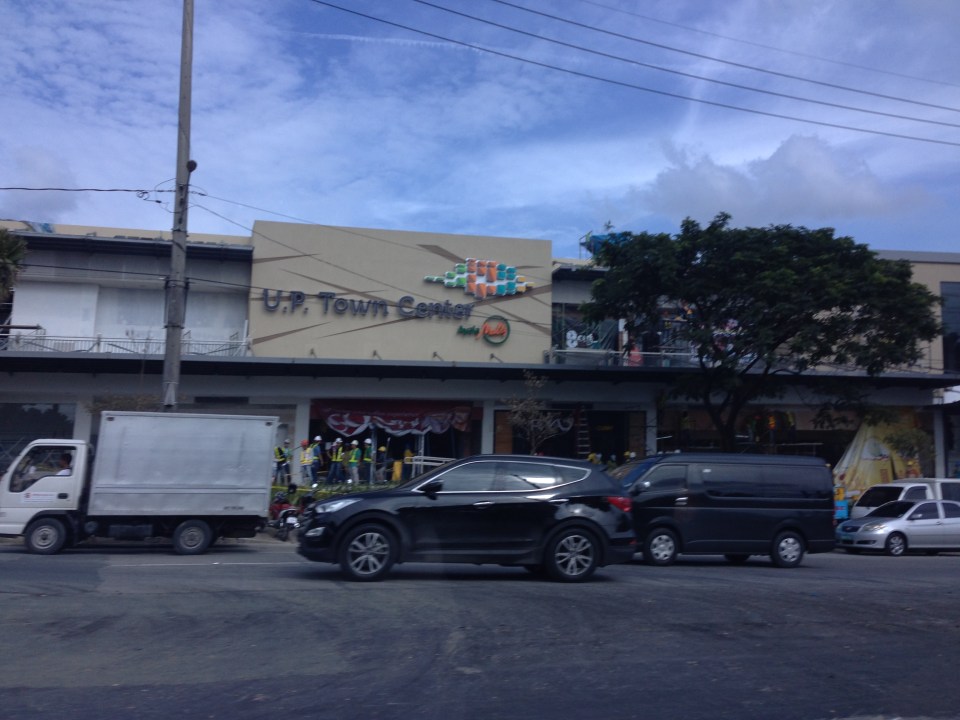 The UP Town Center is already attracting traffic as some restaurants and shops have already made “soft” openings.
A colleague once made the comment that the Town Center was not really for UP but, like the Alabang Town Center, was for the posh residential subdivisions in the area. These include nearby La Vista, Loyola Grand Villas and Ayala Heights subdivisions. Also, it will likely attract more car users than public transport users as locator restaurants and shops are mainly upper-middle to upper class. There are no Jollibees, Chowkings or McDos here. For now, the developer and UP Diliman deserves to be given the benefit of the doubt in as far as the development’s design is concerned. Perhaps the issues I mentioned above will be addressed once the entire area leased to Ayala would have been fully developed. And until then, there would be opportunities to check and ascertain if the development is indeed people friendly and something that can be called a university town center and not just another commercial development that attracts traffic.
–
 Caught (up) in traffic