
Home » Posts tagged 'micromobility'
Tag Archives: micromobility
Shared article on shared mobility
Here’s is a nice short read on a Sunday about shared mobility. The article is of particular interest to me because it tackles the needs of persons with disabilities, senior citizens and those in low income households.
Seruga, K. (April 14, 2025) “Shared mobility: Making travel easier for all,” Knowable Magazine, https://knowablemagazine.org/content/article/society/2025/increasing-access-to-shared-transportation [Last accessed: 27/04/2025]
“But if you’re disabled or elderly, living in a low-income area or — imagine! — without a smartphone or credit card, using these shared mobility services becomes a lot more difficult. They tend to cluster in more affluent urban areas, and are often inaccessible to people with reduced mobility or those traveling with young children needing child seats. In part because of these factors, users are disproportionately younger, wealthier, able-bodied, white and male.
Shared mobility could be a key part of a more sustainable transportation system. But to be most effective, it needs to include everyone. For-profit shared mobility providers have largely failed to deliver on this, but various initiatives and projects are finding creative solutions to reach underserved communities.
The potential benefits are large. On-demand shared mobility that feeds into well-developed public transportation systems could reduce the number of vehicles in some cities by 90 percent and cut transportation emissions by 50 percent — but only if it largely replaces private car use. “The car has to be a guest, not the main actor,” says Luis Martinez, lead modeler at the International Transport Forum, who coauthored a paper on shared mobility and sustainability in the 2024 Annual Review of Environment and Resources.”
There is a cautionary tale on ‘for-profit’ shared mobility here but a major difference in countries like the Philippines from those in western countries is the presence motorcycle taxis and the surge in the ownership of electric three-wheelers. These have changed the way people travel though their impacts are only now being assessed.
–
Mobility options in BGC
I haven’t been to Bonifacio Global City (BGC) in Taguig in a while. Unlike before (during the pandemic) when we could just stay at the condo some days to chill at our unit and explore BGC for lunch or dinner. We have high speed internet at our condo unit so we can work from there. I can do my lectures via Zoom and the wife could have her meetings online. Fast forward and we decided to have our unit leased so we couldn’t go there as frequently as before. The lease ended last month and we’re using the condo unit for ourselves while we refurbish the unit for future use, whether for our purposes or for leasing again.
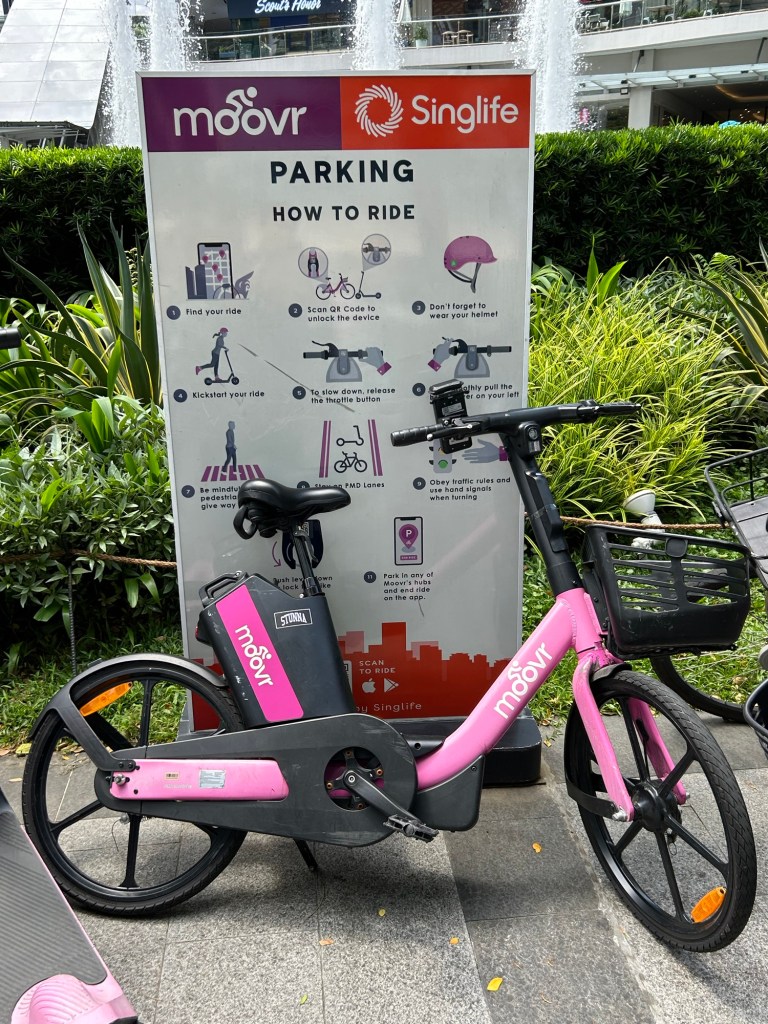
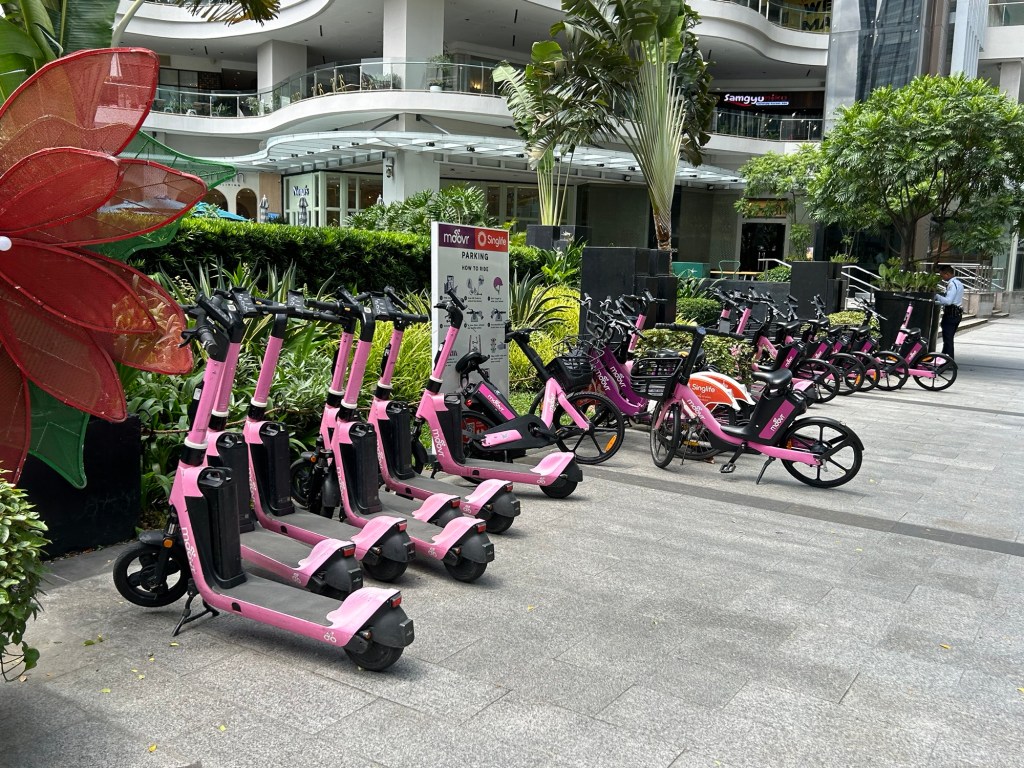
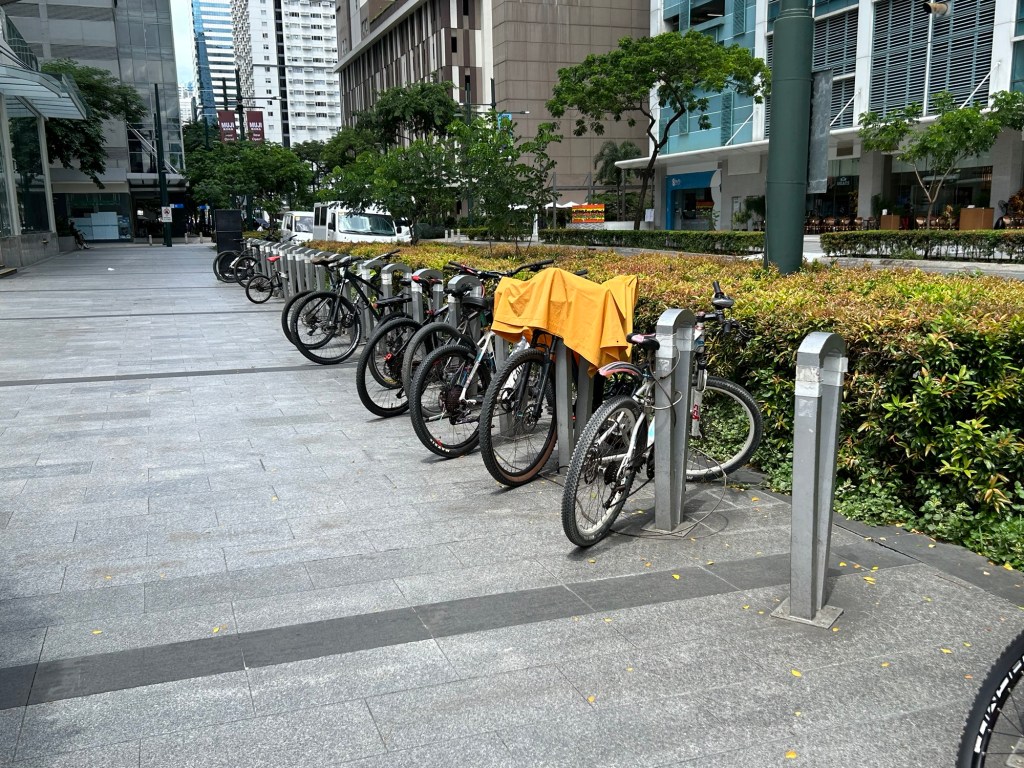
It’s good to know that there are now active transport options for going around BGC. The previous bike share closed shop before the pandemic and it took a while for moovr to set up. Here are a few photos of the station near our condo.
–
On micro transit covering for regular public transport services
I am sharing this very interesting (to me) article on microtransit making up for the conventional public transportation:
Zipper, D. (December 19, 2023) “On-Demand Microtransit Can’t Escape This Big Problem,” Bloomberg, https://www.bloomberg.com/news/articles/2023-12-19/the-inflexible-problem-with-flexible-microtransit?utm_source=website&utm_medium=share&utm_campaign=copy [Last accessed: 12/22/2023]
To quote from the article:
“Fixed-route service on large buses also offers the economies of scale that microtransit lacks. As long as empty bus seats are available, each new rider brings new revenue to the transit agency while incurring minimal added costs, thereby reducing the subsidy required for each trip. Public dollars can then be reallocated to expand service, which will make transit more useful, thus attracting more riders — and the virtuous cycle continues.
For microtransit, that flywheel effect is missing; the cost of service keeps rising as more people use it. “It would be great to have anywhere-to-anywhere connectivity for the price of transit,” said Goldwyn. ”But it’s just not possible.””
I think this article also touches on motorcycle taxis though perhaps there are also differences between the western and Asian contexts for micro mobility. Surely though, such transport modes cannot approximate transit capacities and require so many more vehicles (e.g., motorcycles) that probably means more chaos and compromised safety along our roads.
–
On micro mobility use of low-income people
We conclude September 2023 with another article share. This time it is about how low-income people use micro mobility.
Wilson, K. (September 20, 2023) “Study: How Low-Income People Really Use Micromobility,” StreetsBlog USA, https://usa.streetsblog.org/2023/09/20/study-how-low-income-people-really-use-micromobility [Last accessed: 9/30/2023]
To quote from the article:
“Low-income people are using shared micromobility a lot like they use public transit, a new study finds — and researchers think cities should thoroughly embrace (and subsidize) the mode as part of the larger ecosystem of buses and trains.
Researchers at Monash University, using survey data from micromobility giant Lime users across all income levels in the U.S., Australia, and New Zealand, dug deeper into how low-income people uniquely use the company’s vehicles.
Participants in the Lime Access program, which grants discounts of around “70 or 80 percent” to riders who qualify, were significantly more likely to list essential reasons like “shopping” for groceries (35 percent) and “commuting” (31 percent) than non-Access riders, 11 and 21 percent of whom rode to complete errands or go to work, respectively.
The discount recipients were also highly unlikely to go use bikes and scooters for non-essential reasons like social outings (12 percent), “joy-riding” (9 percent) or exploring (2 percent), quashing the stereotype that all micromobility trips are spontaneously generated. And a whopping 44 perccent of their trips connected to a traditional transit ride, compared to just 23 percent of people who paid full price.ago
Perhaps the most surprising findings, though, were riders’ qualitative responses about what micromobility meant to them, and how their lives were made better by having access to affordable ways to get around without a car. Calvin Thigpen — director of policy research for Lime and co-author of the report — says he was particularly moved by the number of riders with invisible disabilities who said Lime Access helped them get where they needed to go, even when local transit schedules didn’t meet their needs.”
The study was made in the First World (i.e., US, Australia and New Zealand) so while the methodology is sound, the subjects (i.e., what they defined as low-income) are not quite the same as low-income people in low to medium-income countries. The poor in the latter countries have more difficult lives but then these countries may already have the modes for them to be mobile – paratransit. Motorized tricycles, pedicabs and motorcycle taxis have been operating in these countries way before the arrival (or definition) of micromobilities.
–
On modified, fossil fuel kick scooters
You’ve probably seen one of these micromobility modes but take a closer look and you will notice a more spruced-up version of what you thought was an electric kick scooter (EKS). No, this one in the photos is not electric-powered but running on an internal combustion engine. It is a modified, fossil fuel-powered scooter.
 You can see the modifications on the scooter – the engine and the gas tank.
 These can be hard to detect for drivers or riders and can be risky at night time when visibility is a major factor for those using these vehicles.
I’ve seen these modified scooters along my typical commuting routes. They seem to be faster than the regular EKS. They also appear to have more power for uphill or climbing as I’ve seen these having no trouble ascending to Antipolo via Sumulong Highway or Ortigas Avenue Extension. As for maneuverability, I cannot really make an assessment except for what I’ve observed. But what worries me is that there are also reckless riders of these vehicles who tend to weave in traffic whether its congested or free flowing. If it’s difficult to anticipate the movement of motorcycles and bicycles along highways and streets, it’s even more with these scooters. But before you react and say that drivers and riders need to be slowing down (and all that jazz), remember that it takes two to tango. Even if you do slow down or practice safe driving or riding, if that other person will be reckless then there will be an increased likelihood for a crash to happen.
–
Counting cars…and other vehicles as well
I saw a couple of these counting instruments set-u by the DPWH, one along Ortigas Avenue Extension and another along Sumulong Highway. These are mobile counting machines that are used to count vehicles along both directions of the roads. These are supposed to be calibrated to be able to distinguish among the various types of vehicles using the roads. I assume the classifications would be according to the types used by the DPWH and not simply a general count of the number of vehicles. I wonder though if these can accurately count smaller vehicles like motorcycles, bicycles and PMD’s like the one in the photo below.

If these can be calibrated to count bicycles and PMDs, it would allow for the establishment of baseline numbers and expansion or seasonal factors for what are now termed as micromobility modes. The recent bicycle counts done through volunteers and during peak hours cannot be expanded simply because there are no reference factors that can be used for this purpose. The available expansion or seasonal factors with DPWH derived from 24-hour counts at strategic locations along national roads only account for motor vehicles. These cover the variations of motor vehicle traffic over long periods of time (e.g., 24/7) that allows one to determine Annual Average Daily Traffic (AADT) as well as typical traffic during certain days of a week (e.g., traffic on a Monday or a Sunday).
–
How can e-scooters become a safer way to travel?
I’ve shared some articles and opinions about electric scooters. Here is another one that delves into the safety about these vehicles that have become quite popular in the US. Here in the Philippines, they still seem to be in infancy in terms of popularity and to some, are seen as more a novelty and touristy rather than a mode of transport for the typical work trips.
Donahue, B (June 11, 2022) “How to Make Electric Scooters Become a Safer Way to Travel,” Bloomberg, https://www.bloomberg.com/news/features/2022-06-11/how-to-make-electric-scooters-safer [Last accessed: 6/18/2022]
To quote from the article:
“Dediu believes that in time micromobility will attain critical mass, as other modes of transit have already done, and that infrastructure will come as the user base grows. “We didn’t build airports and then have airplanes show up,” he’s said. “I’m confident, given the history, that we’ll see things like more safe roadways for micromobility vehicles.” “
 Scoot-to-work at BGC, Taguig, Metro Manila
It is not really about the vehicle but the environment in which it is being used. One can say a lot about walking, for example, being dangerous but without touching on the why and the how its become a dangerous or risky mode of travel. It’s the lack of infrastructure or facilities as well as the car-oriented environment (that includes archaic laws and other regulations) that make active mobility and micro mobility modes dangerous or risky. If we can address these basic issues, then perhaps we can entice more people to use these modes more often and for the most trips we make everyday.
And don’t forget that these modes are the most fuel efficient! Saves you from the every increasing prices of fuel!
–
Micromobility anyone?
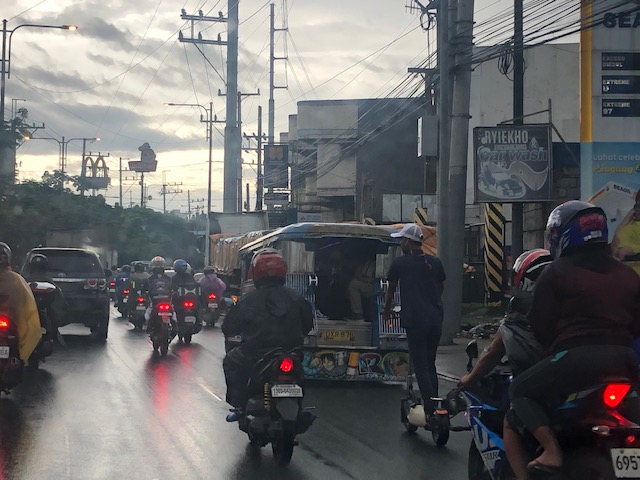
I just wanted to share a couple of photos I took en route to BGC last week. Yes, the traffic is already terrible and yes, I drove to BGC (or more accurately, I was driven as we were hauling stuff to our home away from home at BGC). I couldn’t help but take photos of the motorcycles and bicycles passing our vehicles. These were definitely more efficient forms of travel considering they require less space and likely incur less travel times. In addition to these modes (and walking, of course), there seems to be an increasing popularity for other micro mobilities. I wouldn’t define and enumerate these emerging modes but you’ve probably seen some of them along your commutes – electric kick scooters (EKS), gas-powered versions of these scooters, other forms of electric vehicles including trikes, etc. Here are a couple of examples I captured in photos last week.
 Cyclists and micro mobility users slugging it out with motor vehicles
E-scooter in BGC: comfy clothes-check! backpack-check! helmet-check! Commuting to work should be something like this rather than most people using their cars.
On the future on urban transportation
I’m sharing the following article on the idea of mobility hubs in cities:
Descant, S (March 16, 2022) “Are mobility hubs the future of urban transportation?” Government Technology, https://www.govtech.com/fs/are-mobility-hubs-the-future-of-urban-transportation [Last accessed: 3/18/2022]
To quote from the article:
“As cities reimagine transportation and transit, they’re turning toward innovative attempts to bring multiple modes together, with the essential aim of making it easier for residents and others to choose a mode of travel other than the single-occupancy car.”
Though I support this idea, I think it only implies that housing issues are already covered. In reality, there should be clear-cut and simultaneous initiatives covering both housing and transport. In Metro Manila’s case, for example, the sprawl is over a much wider area and covers at least 4 provinces surround the metropolis where people have chosen to settle/reside due to the high and rising cost of housing in the MM. While the example of Tokyo and its railway lines may be used as inspiration, it will take a lot for Metro Manila to have such a transit network to carry so many people around MM+.
–
Some thoughts on mobility in Metro Manila
I spotted these two riding what appears as monocycles in Bonifacio Global City (BGC). I was taking a walk between our our building to get to another when I saw them crossing the intersection ahead of me.
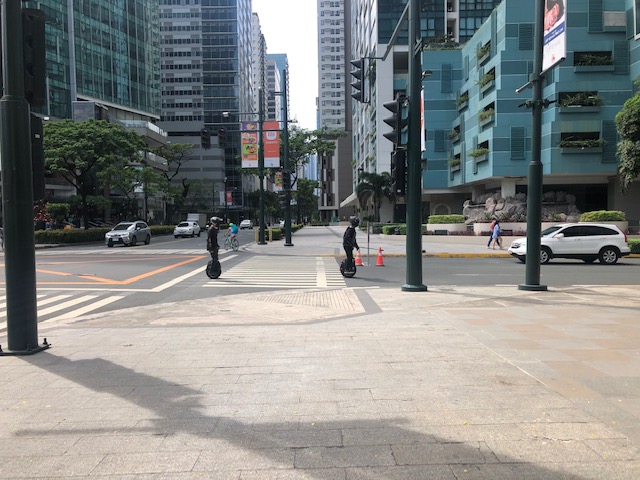
I thought these were cool modes of transport but I am unsure I can balance myself on these. I would more likely use a bicycle like the other guy in the photo (far side of the intersection crossing). I would also most likely use a bike on the sidewalk if this were allowed and also considering how wide the sidewalks there are. BGC also has protected bike lanes along certain roads so that’s another option if its prohibited to use your bike on sidewalks.
I keep mentioning sidewalks and how wide they are (at least in the photo) because we do need wide sidewalks that we can use for walking or cycling (basically moving about). It is always mentioned in various threads that we should plan and build our cities for the most vulnerable among us. That means a shift from the current car-centric set-up to a more people-oriented system. The latter requires more infrastructure for walking and cycling that includes wide sidewalks and protected bike lanes and paths. This also means more effort and resources will be required to improve public transport services since these have the most synergy and impact.
–
 Caught (up) in traffic