
Home » Posts tagged 'policy'
Tag Archives: policy
On how delivery culture is influencing policy and urban design
While discussing on-street parking policies and schemes with Naga City LGU officials, one comment was on providing parking space for delivery riders. Truly, delivery riders have become a significant consideration especially where they have no parking spaces to wait or sort their items. The following articles expounds on how the rise of delivery culture is influencing policy and urban design:
Franco, A. (November 14, 2025) “From edge to epicenter: How the curb became a key piece in modern cities,” Public Square, https://www.cnu.org/publicsquare/2025/11/05/edge-epicenter [Last accessed: 11/14/2025]
To quote from the article:
“Urban designers need to recognize that while our streets were once built exclusively for car movement and storage, they are inherently adaptable. The opportunity now is to make these spaces more equitable, accessible, and efficient for everyone, not just car owners with parking privileges. After all, the street and the curb are public spaces and should serve the diverse needs of all citizens.”
Article share: In Defence of Vision Zero — a Traffic Engineer’s Perspective
On weekends, I try to catch up on reading articles that I have deferred indulging on during busy weekdays. One such article that I have repeatedly put off reading is this one on road safety:
Source: In Defence of Vision Zero — a Traffic Engineer’s Perspective
To quote from the article:
“For years, success in transportation was measured in level of service, vehicle throughput, and reduced delay times. But Vision Zero forced the industry to confront a difficult truth. The more we prioritized speed and volume, the more we endangered the most vulnerable users of the road: pedestrians and cyclists, with particular emphasis on children and older adults. Those who sit in decision-making positions must recognize the realities of physics, namely that the human body is frail and vulnerable to a transportation system that prioritizes throughput over safety.”
The article is a really good read and one that I would recommend for my students in Traffic Engineering to read.
–
Needed: MMDA Transport Authority similar to Transport for London
I am sharing this article from Business World about the idea (or is it already a proposal) for an MMDA Transport Authority. I seem to recall there were already proposals for something like this but I have to check for references and sources. In the meantime, I am content with sharing the following:
On Nov. 11, 1999, the British Parliament established the Greater London Authority. Prior to that, there was no single entity managing the entirety of London. The governance of the city was fragmented, and responsibilities for planning, transport, and other city-wide matters were divided between local boroughs and national authorities. The Greater London Authority was established […]
Source: Needed: MMDA Transport Authority similar to Transport for London
Is it possible to have zero traffic deaths in a year?
Is it possible to have zero traffic deaths in a year? Is it even probable? As it turns out, yes. Here’s an article on what Helsinki did in order to make this a reality:
Andrei, M. (August 1, 2025) “Helsinki went a full year without a traffic death. How did they do it?” ZME Science, https://www.zmescience.com/science/news-science/helsinki-went-a-full-year-without-a-traffic-death-how-did-they-do-it/ [Last accessed: 8/19/2025]
To quote from the article:
“A lot of factors contributed to this, but speed limits are one of the most important,” said Roni Utriainen, a traffic engineer with the city’s Urban Environment Division.
More than half of Helsinki’s streets have a speed limit of 30 km/h (approximately 20 mph). Half a century ago, the city barely had half of its area with a 50 km/h limit (30 mph). They gradually worked to reduce the speed limit, especially around schools and kindergartens.
Smarter street design also played a key role. Pedestrian and cycling infrastructure was prioritized for upgrades in recent years. More and more people started using public transit or bikes, or just walking. Substantial investments also made public transit more efficient and reliable.“Public transport in Helsinki is excellent, which reduces car use, and with it, the number of serious accidents,” Utriainen noted.
Another key component was bringing the police on board. Helsinki introduced automated traffic cameras and enforcement systems, which also helped bring down reckless driving.”
Examples of congestion pricing as applied in major cities
Here is a quick share of an article on cities that have been successful with congestion pricing:
Zukowski, D. (August 8, 2025) “5 cities with congestion pricing,” Smart Cities Dive, https://www.smartcitiesdive.com/news/5-cities-with-congestion-pricing/756987/ [Last accessed: 8/15/2025]
Quoting from the article:
“As cities around the world continue to see increased traffic delays, some have implemented congestion pricing programs to ease gridlock. Congestion pricing acts as a market-based mechanism: increasing the cost to drive in certain areas may encourage drivers to take alternate means of transport or travel at different times. Toll revenues can go to improving roadways and public transit or reducing other vehicle-related taxes.”
Indeed congestion pricing has been around and yet few cities have actually implemented congestion pricing schemes and have had success with it. In the Philippines, the discussions are basically on and off or intermittent. I recall there were already mention of congestion pricing in Metro Manila transport studies back in the 1970s but nothing really came out of those. Fast forward to the present and Baguio City in the northern Philippines implemented their version of number coding, which was supposedly a prelude to some form of congestion pricing but apparently is more of a travel demand management (TDM) scheme along the lines of Metro Manila’s UVVRP. Will we have our own proof of concept sometime soon even for a smaller area or district in any Philippine city? That will also be dependent on whether our so-called leaders can engage their constituents in meaningful discussions on the benefits of congestion pricing.
–
Quick comments on the NCAP
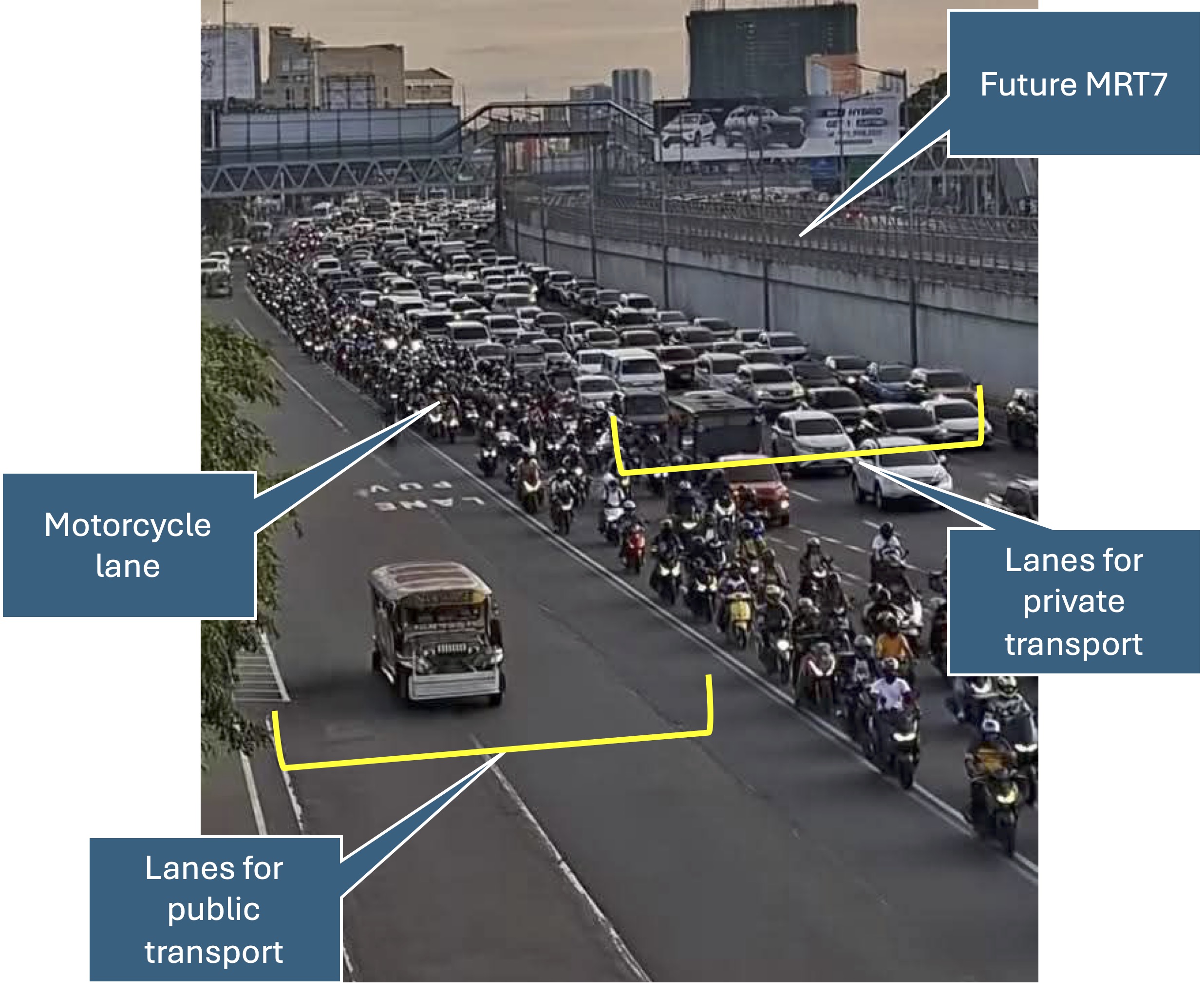
The No Contact Apprehension Policy (NCAP) is finally being implemented in Metro Manila. The results so far has been dramatic in terms of the number of violations recorded and the images being shared so far about how motorists are behaving. Below is one of those photos being shared on social media to which I added some annotations. I will use this later to comment on the NCAP and how we can use the outcomes to assess the transportation situation and determine what interventions can be done. Some are already obvious from the photo – the lack of public transport options lead to people depending on private motor vehicles like cars and motorcycles for their commutes. MRT7 is yet to be operational and road public transport has not been rationalized.
More on this topic soon!
–
Let’s act on road safety crisis!
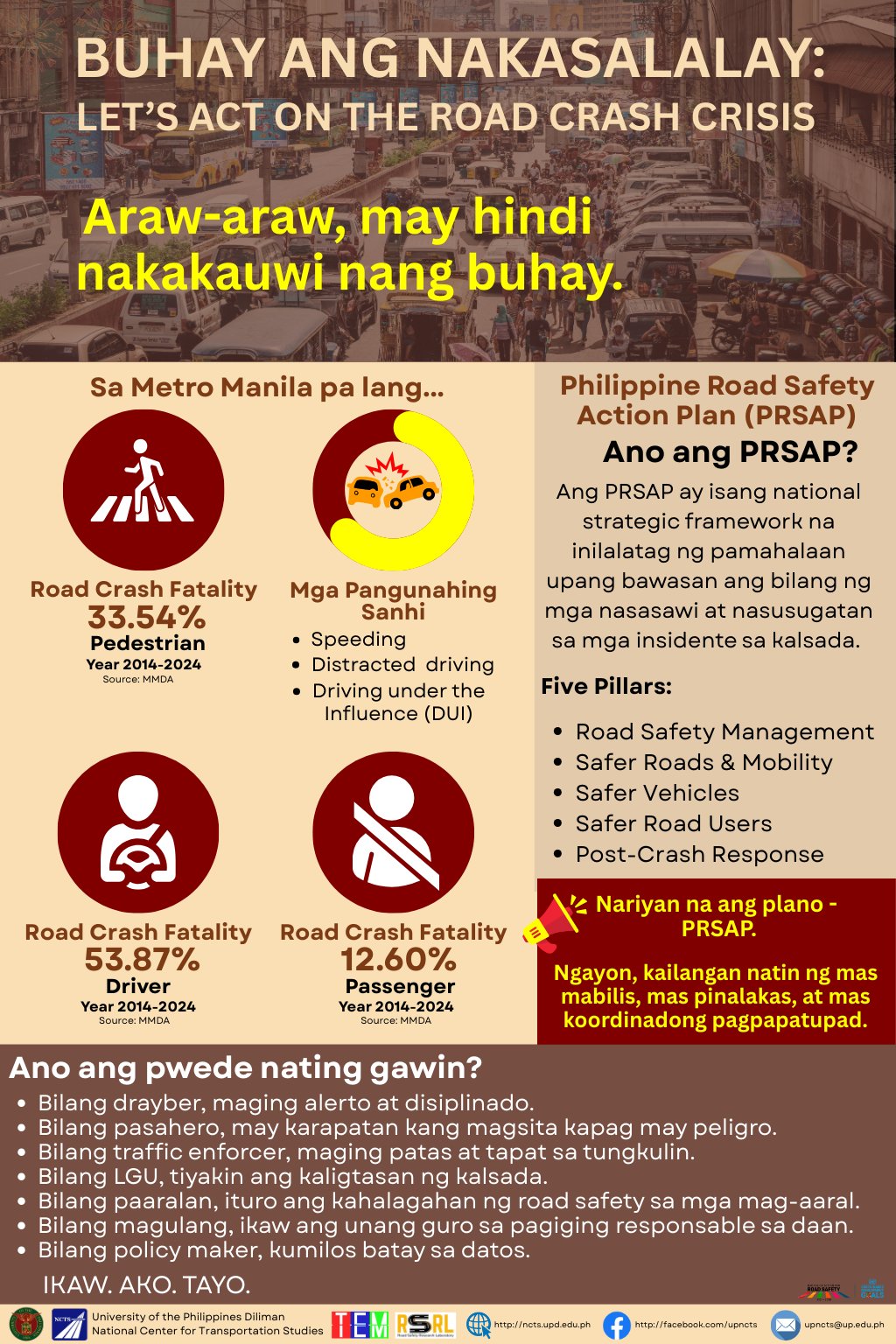
May is Road Safety Month. It’s quite ironic that we started the month with some of the most gruesome crashes including one at SCTEX and another at NAIA. There is indeed a crisis on road safety but many are in denial or perhaps insensitive to the impacts of these crashes. We need to act and only together can we be most effective in reducing the risks for all road users.
So what can one do? How can one contribute to making roads safer? Sharing this poster from the Road Safety Research Laboratory (RSRL) of the National Center for Transportation Studies (NCTS) of the University of the Philippines:
–
On the pushback vs. bike lanes
I saw this short article at Planetizen that linked to another article that was the original one about cities dismantling or removing bike lanes. This is a very concerning trend in the US but something that’s also happening here. The Department of Public Works and Highways (DPWH) has always been lukewarm to bike lanes (parang napipilitan lang), the Metro Manila Development Authority (MMDA) seemed never to understand it (even during BF’s time as Chair), and many local government units that jumped on the bike lane bandwagon during the COVID-19 pandemic have reneged on their declared commitments. Currently, it seems that only cities like Quezon City and Iloilo City have sustained bike lanes development. Others have removed protected bike lanes or have not enforced vs. motor vehicles encroaching on the bike lanes.
Johnson, R. (February 18, 2025) “Cities Start to Backpedal on Bike Lanes: A Growing Crisis for Cyclists,” Momentum Mag, https://momentummag.com/cities-start-to-backpedal-on-bike-lanes-a-growing-crisis-for-cyclists/ [Last accessed: 3/2/2025]
To quote from the article:
“Bike lanes have become a culture war where those in favor are seen as “woke” or some other terrible conservative slur. But, most who use bike lanes are just regular people who want to save some money, and get the mental and health benefits to cycling to work.
Urban cyclists, bike commuters, and advocates for safer streets, have all noticed a troubling trend. What was once a symbol of progress toward sustainable transportation and safer roads for all is being reversed in multiple cities across North America.”
Will bike lanes and cyclists suffer similar setbacks here? Will the Department of Transportation (DOTr) continue to champion bike lanes? Will the agency be more aggressive and assertive of bike lanes development? Your guess is as good as mine!
–
“Coding exempt” vehicles and the demise of the coding scheme
I saw this car ahead of me during my commute. I knew this was an electric vehicle and these as well as hybrid ones were given an incentive in Metro Manila. They are “coding exempt” meaning these vehicles can be driven any day and ay hour during the weekdays.
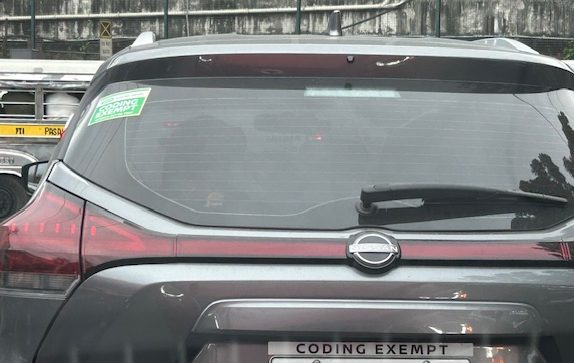 Are they selling these ‘coding exempt’ accessories or do these go free when you buy these cars?
People ask if the number coding scheme (UVVRP) in Metro Manila is still effective or relevant. Well, the answer is a ‘no’ and that is because over time, people have adjusted to it. Car owners have bought a second, even third vehicle that they call their ‘coding’ vehicle. Others opted to purchase motorcycles. And so that’s what we generally see along most roads in Metro Manila. It didn’t help that hybrid and electric vehicles are given exemption from the coding scheme. Those who can afford to buy yet another vehicle or perhaps replace their conventional ones are already buying these as evident from their increasing presence along our roads. While there is the perceived benefits with less emissions and air pollution, we still lose with congestion and its derivatives. Perhaps we should already have a congestion pricing scheme implemented for Metro Manila like the one in New York City. And proceeds should go to the improvement of public transportation to help arrest the erosion of its mode share in favor of private vehicles.
–
 Caught (up) in traffic