
Home » Posts tagged 'policy' (Page 4)
Tag Archives: policy
Opinion: The Arrogance of Social Media Urbanists
Here’s a quick share of an interesting article. It’s basically a reaction (I prefer not to call it a rant as the author refers to it.) and a fair one for those who are exasperated with the generalizations and criticisms often posted on social media that are thrown vs. planners. I would extend this observation about engineering as well. I suddenly remember discussing in one of my classes about how unreinforced concrete pavements are legit and not because a contractor or highway agency settled for inferior design or were corrupt that they decided not to use steel bars. It is very easy these days to post your opinion or criticism without understanding all the other (and probably essential) factors that come into play.
Source: Opinion: The Arrogance of Social Media Urbanists
Quoting from the article:
“What is the point of this rant, besides easing my frustration with my social media feed? It’s to hopefully educate those who think that changing close to a century of development patterns should happen overnight and that anyone who is not in lock-step agreement with the right way to develop is too ignorant to know better. No opinion has ever been changed by a snarky meme. Change happens through education, outreach, and time. Planners are not ‘afraid’ to build good things; they’re constrained by obsolete regulations and policies, deeply embedded political values, financial barriers, and the momentum of existing patterns of behavior. The goal should be to address those things and make it just as easy to build dense, mixed-use, walkable communities as it is currently to build single-use sprawl. If we get to that point, consumers will have equal access to the products they want, whether it be a single-family home on a cul-de-sac or a townhome with a coffee shop on the corner.
That is how we effect change. Arrogant and condescending posts on social media will not win converts to your cause, only harden their resistance.”
–
Reference share – study on transport equity
Here is a quick share of a study report on equity in public transportation from the Mineta Transport Institute:
Defining and Equity in Public Transportation, https://transweb.sjsu.edu/research/2100-Public-Transit-Equity-Metrics-Measurement
Perhaps income, physical ability/disability, age and gender are the more applicable aspects of equity in our case. However, the concepts and methodology in the report may still be applicable and can be customized or contextualized for the Philippine setting.
–
Tricycle policies in Zamboanga City
I forgot about these photos I took at the driveway of a shopping mall in Zamboanga City. The tarps state the penalties for erring tricycle drivers in the city under a couple of City Ordinances (185 and 485, series or year not stated in the tarp) and the fare matrix based on City Ordinance 416 (series or year also not stated).
 Penalties for erring tricycle drivers in Zamboanga City. As stated in the tarp, the typical offenses include: overcharging, refusal to convey passengers, insolent, discourteous or arrogance, undue preferences or unjust discrimination, and operation of motorized tricycle for hire in prohibited areas. It is also clear that the penalties are not just for drivers but the owners/operators of the trikes with erring drivers.
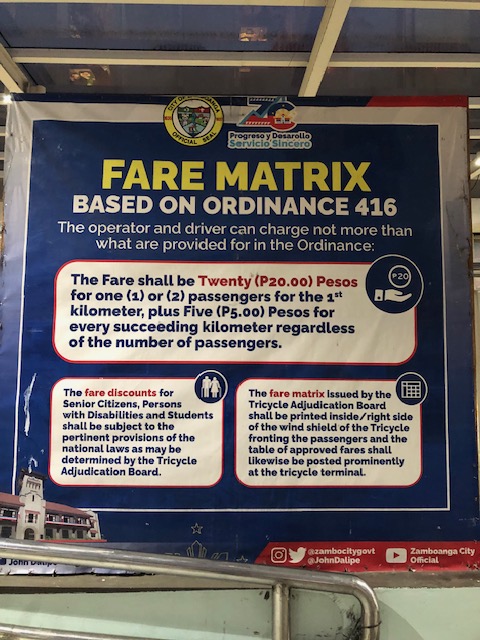 Simple fare calculation stated on the tarp. I assumed there were specific matrices posted in each tricycle but there was none since operations are free-for-all regardless of TODA in the city. That is, trikes in the city practically have no zones of operation where they are restricted or confined similar to what they have in other cities like Olongapo or Quezon City. In the latter, they can issue specific matrices or tables for the passengers’ reference much like what you have in jeepneys that have fixed routes. This can be confusing to passengers and creates situations that may lead to drivers taking advantage and overcharging passengers.
In a city like Zamboanga where there are many one-way streets, tricycle drivers can easily lengthen or appear to lengthen trips leading to overcharging of fares. Where tricycles do not have zones or areas of operations per TODA, this becomes the weakness or flaw even with ordinances in place for erring drivers and a simple fare matrix for passengers’ reference. Of course, regular commuters should be familiar with the usual fares they pay so perhaps that’s among the basis for knowing if you’re being overcharged. Visitors though will likely pay more if the driver consciously takes advantage of the situation. Again, this is a matter for enforcement of the ordinances passed by the city and an example of how such ordinances will be implemented.
–
On sleepy drivers
I am sharing this article on sleep-deprived driving as there appears to be low awareness of the dangers of this behavior as opposed to the typical drunk driving or driving under the influence (DUI) cases that we often hear or read about in the news (mainstream or social media).
Britt, R.B. (April 18, 2023) “Sleep-Deprived Drivers Might as Well be Drunk,” Medium.com, https://robertroybritt.medium.com/sleep-deprived-drivers-might-as-well-be-drunk-887aab48c1c [Last accessed: 4/21/2023]
To quote from the article:
“A 2016 study by AAA linked lack of sleep in the past 24 hours to dramatically higher crash risk, in hour-by-hour increments:
6–7 hours sleep: 1.3 times the risk
5–6 hours: 1.9 times the risk
4–5 hours: 4.3 times the risk
<4 hours: 11.5 times the risk
The risk of a crash drops to zero if you simply stay off the road, of course. Otherwise, the bottom line is pretty clear:
“You cannot miss sleep and still expect to be able to safely function behind the wheel,” said David Yang, executive director for the AAA Foundation for Traffic Safety.”
So make sure you get your sleep because it is really important for you to function not just as a driver or rider. It also applies to other activities or tasks as well whether you’re working, studying or playing.
–
A Serious Critique of Congestion Costs and Induced Vehicle Travel Impacts
Here is a quick share for today. This is an article by Todd Litman critiquing congestion costs and induced vehicle travel impacts:
Quoting from the article:
It is time for planners to rethink the way we evaluate congestion problems and solutions. Vehicle travel is not an end in itself; our ultimate goal is to improve accessibility. Traffic congestion is one constraint on accessibility, but others are more important. For example, the study, “Does Accessibility Require Density or Speed?” found that a given increase in urban density, and therefore proximity, has a far greater impact on overall accessibility than an increase in travel speed, and therefore congestion reductions. This is particularly true of disadvantaged groups who cannot drive or are financially burdened by vehicle expenses.
It is irresponsible for transportation agencies to expand highways in ways that contradict other community goals. If they do nothing, at worst, traffic congestion will maintain equilibrium; people will manage within its constraints. Even better, transportation agencies can invest in resource-efficient alternatives—better walking, bicycling, public transit, and telework opportunities—that improve accessibility, increasing transportation system efficiency.
If we truly want to truly optimize our transportation systems, we need a more comprehensive analysis of impacts and options, including the full costs of urban highway expansions and the full benefits of non-auto mode improvements and TDM incentives. Highway expansion should be a solution of last resort, only implemented when all other solutions have failed and users are willing to pay the full costs through tolls.
It’s time to stop obsessing about congestion and instead strive for efficient accessibility that serves everybody in the community.
Source: A Serious Critique of Congestion Costs and Induced Vehicle Travel Impacts
A brief history of transport strikes – Part 4: impacts and implications
What was supposed to be a week-long transport strike by jeepney drivers and operators was called off yesterday. Frontpage news showed a photo of representatives of protestors with government officials. Government official statements also declare that the government will be talking with the transport sector to sort out issues and to try to address these in relation to the PUV Modernization Program (PUVMP). One day earlier, government was quick to state that the strike had no impact on transport. Were there really no impacts?
I think the fact that schools went back to online mode and offices allowed employees to work from home show the impacts of the transport strike. If you haven’t noticed, the government has been using the tactic of cancellation of classes for quite some time now. To reduce the impacts of transport strikes on commuters, classes on all levels were canceled, thereby reducing transport demand. The only difference now is that there is capacity for online classes due to adjustments made during the height of the pandemic. So instead of cancelling classes altogether, schools reverted to online mode. Meanwhile, for those who needed to go to their workplaces and did not have their own vehicles, there were various free rides (libreng sakay) services provided by national and local government agencies. Cities like Quezon City already operated their own bus services so people could take these instead of their usual PUV modes for commuting.
What are the implications of the shortened strike? The shortened strike has various implications. One is that it showed the protesters did not have enough resources to sustain the strike. It also showed that transport leaders appear to just want some attention from government. A colleague commented about this being something like a show or the strike being part of a game of “bad cop, good cop” among government officials and agencies. If you haven’t noticed, this has been going on for some time now. Government already knows how to reduce the potential impacts of protests like this. Suspending classes in schools significantly reduces the travel demand on a typical weekday. Offices giving their employees the option to work from home during the strike also adds to the reduction in travel demand. And libreng sakay vehicles are easier to deploy as agencies and LGUs have vehicles for this purpose. Meanwhile, the continuing rise in motorcycle ownership also contributed to people being able to still commute (i.e., having the motorcycle taxi option). At least for Metro Manila, once the railway projects are completed, there will be a railway option for commutes. Barring a simultaneous strike with buses and vans, protests from the jeepney sector will surely be diminished.
–
On the need to change mindsets about bike lanes
Public acceptance of bike lanes has grown during the pandemic. Prior to the pandemic, there were few supporters especially among local government units and national agencies that seem to be comfortable with the status quo. Few like Iloilo and Marikina had any bike facilities worth mentioning. The pandemic was supposed to change that and it did for many. However, the acceptance and the gains seem to be eroding as we return to face-to-face activities and the ‘old’ normal situation.
I’m sharing below an article on the need to change mindsets about bike lanes and cycling in general:
Thompson, C. (January 24, 2023) “The Battle Over Bike Lanes Needs a Mindset Shift,” Wired, https://www.wired.com/story/the-battle-over-bike-lanes-needs-a-mindset-shift/ [Last accessed: 1/27/2023]
To quote from the article:
“Maybe bike lanes will always be fraught, until enough of the public is finally in a true lather about climate change—and it seems reckless to not have them.
Crises, after all, have a way of opening people’s eyes to possibilities. During Covid, restaurants and cafés lost so much business that cities nationwide began allowing them to build curbside seating areas where people could sit, safely, in the open air. It greatly reduced parking—but because, well, crisis, shop owners didn’t see any way around it. Patrons loved the outdoor seating so much that cities are making it permanent: A New York City study of several streets closed during Covid found storeowners making more than before, and diners digging the al fresco lifestyle. If data won’t change minds, customers might.”
There are two opposing sides on this matter. On one side are advocates who naturally will push for bike lanes and will promote them as The solution (emphasis mine) rather than one of a cocktail to address the transport mess we are in. On the other side are conservative, status quo types (or car-lovers as bike advocates will call them) who believe cars should have the roads to themselves. Unfortunately, many in government and particularly in transport agencies are with the latter. Perhaps they should be the first ones that need to be converted to favor active transport?
–
On getting started on bike commuting
Here is another article on bike commuting. It really is a challenge to get people into bike commuting even if their workplaces or schools are close to their homes. What more for people who have to travel longer distances between their homes and workplaces or schools?
Bassett, E. (December 1, 2022) “The No B.S. Guide to Getting Started Bike Commuting,” Medium, https://erikbassett.medium.com/the-no-b-s-guide-to-getting-started-bike-commuting-5dd0cbb87e5b [Last accessed:
To quote from the article:
“Assume you’re invisible until proven otherwise.
Like every city I’ve lived or ridden in, yours probably paints pictures on the ground and calls them “bicycle infrastructure.” Road designs encourage excess speed; vehicles aren’t meaningfully separated from cyclists and pedestrians; there are conflicting rights-of-way at intersections, driveways, and so forth.
And that is not right. It’s a sad commentary on urban “planning” in most places that anything but car use requires this degree of paranoia. It points to a profound dysfunction that few (with any serious influence) are willing or even interested to change…yet.
But unless or until it improves, the only viable response is to assume you don’t exist in the eyes of whoever’s driving nearby. “If I weren’t here, would they gun it to make a right turn on red?” Well, assume they will. “If I weren’t here, would they merge up there?” You guessed it: assume they will.
This is unquestionably the worst aspect of bike commuting, and if it’s too stressful in your situation, that’s perfectly fine. But in the spirit of a “no-B.S.” guide, I’d be remiss not to drive home a life-saving lesson that all these years of cycling have so deeply ingrained in me.”
The author also states the difference between bike commuting and sports biking including noting the differences in the objectives or goals for each.
–
Why do we keep widening roads?
I’m just going to share this article here. The article from The NY Times asks a question that has been bugging planners and engineers, particularly those who are in government and perhaps under the agencies like the DPWH, DOTr and NEDA. This also applies to planners, engineers and those from other disciplines involved in transportation infrastructure development and particularly roads or highways.
–
Shared article: Active and Micro Mobility Modes Can Provide Cost-Effective Emission Reductions–If We Let Them
I’m sharing this article on active and micro mobility modes from Todd Litman, published in Planetizen.com:
Source: Active and Micro Mobility Modes Can Provide Cost-Effective Emission Reductions–If We Let Them
From the article:
“Common Active Transportation Leverage Effects:
–Shorter trips. Shorter active trips often substitutes for longer motorized trips, such as when people choose a local store rather than driving to more distant shops.
–Reduced chauffeuring. Better walking and bicycling conditions reduces the need to chauffeur non-drivers (special trips to transport a passenger). These often require empty backhauls (miles driven with no passenger). As a result, each mile of avoided chauffeuring often reduces two vehicle-miles.
-Increased public transit travel. Since most transit trips include walking and bicycling links, improving these modes supports public transit travel and transit-oriented development.
-Vehicle ownership reductions. Active mode improvements allow some households to reduce their vehicle ownership, which reduces vehicle trip generation, and therefore total vehicle-miles.
-Lower traffic speeds. Active travel improvements often involve traffic speed reductions. This makes non-auto travel more time-competitive with driving and reduces total automobile travel.
-More compact development. Walking and bicycling support more compact, multimodal communities by reducing the amount of land devoted to roadways and parking, and creating more attractive streets.
-Social norms. As active travel increases, these modes become more socially acceptable.
The article is a must read if we are to understand how important active transport and micro mobilities are in the context of today’s transport conundrum. Of course, part of the contextualization and perhaps ‘localization’ on these modes will be related to land use or development. The latter is a big challenge especially for the likes of Metro Manila and other rapidly developing cities in the Philippines where housing in the cities (related to compact development) has become quite expensive and has driven more and more people to live in the suburbs. As I’ve mentioned in previous posts, this has resulted in more pressure to develop transportation systems but infrastructure development cannot play the catch up game given the limited resources for their construction. Meanwhile, services are also behind in terms of quality and requires reforms and rationalizations.
–

