
Home » Posts tagged 'public transportation' (Page 10)
Tag Archives: public transportation
Some observations and thoughts about the EDSA carousel
Much has been written or said about the EDSA Carousel. This is the express bus service the government implemented along Metro Manila’s busiest thoroughfare, EDSA or Circumferential Road 4. I feel that it is a decent effort from government to address the lack of supply to address the huge demand for public transport along EDSA considering that it serves to also distribute trips collected from major roads connecting to it. Is it an admission of something wrong in terms of the transport infrastructure along EDSA? Perhaps and from the current administration and DOTr. The admission of flaws certainly did not or will not come from the previous administrations that failed to address problems pertaining to Line 3 including maintenance and operations issues.
 Buses queued before the Trinoma/North Avenue Station of the carousel. Overhead is the junction to the EDSA-MRT depot underneath Trinoma.
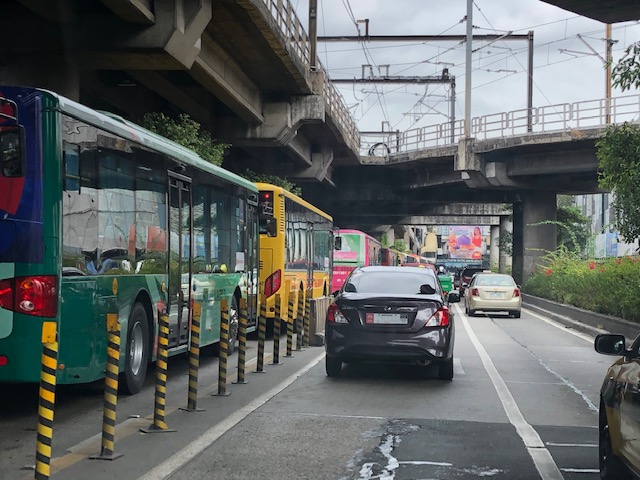 The overhead junction is the MRT’s branch to/from the depot
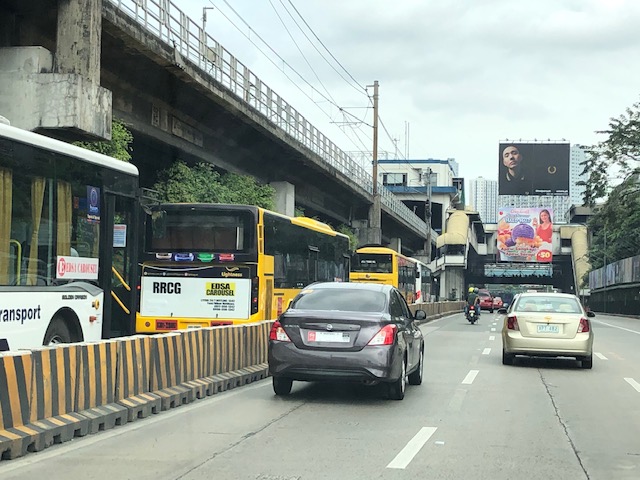 Buses queuing towards the North Avenue Station
 The carousel stations are basically part of the MRT station with the platform located at ground level at the otherwise underutilized space that is the median island of EDSA. Access to the express buses are via the MRT stations as there are no other means for crossing to/from the carousel berths.
The carousel is an attempt to have a Bus Rapid Transit (BRT) along EDSA. It is perhaps the most practical solution to supplementing the already limited capacity of elevated Line 3 despite the continued operations of regular buses. The express bus service is not a new idea along EDSA since Line 3 had to compete with a BRT proposal (though it didn’t use the term BRT then) back in the 1990s. Insiders at NEDA relate that it was then President Fidel V. Ramos himself who allegedly ‘lobbied’ for the MRT instead of an elevated bus transit system. Unfortunately, the MRT proposed, constructed and now in operation is a light rail system like Line 1 and could not easily be upgraded to a heavy rail system like Line 2 or the future Line 7. The line is already problematic due to maintenance issues and the aging rolling stock. And there are questions regarding interoperability with Line 1 (definitely not interoperable with Line 7). So the grand central station currently under construction will really be a terminus for 3 lines as trains will not be able to pass through to other lines like how it is in other countries.
Will the carousel be a permanent fixture along EDSA? Perhaps. But it should be improved further for the convenience of commuters as well as for more efficient operations. The current buses being used are the not the right vehicles if capacity is to be maximized. Articulated buses would be necessary for this purpose. The current barriers should also be replaced with more appropriate and perhaps more clever designs partly for aesthetics but for the system to be safer and more functional in terms of spaces for passengers and vehicles.
–
On a different view of the ’15-minute city’ concept
Here is an article discussing the downside(s) of the 15-minute city; particularly its adoption without understanding first and setting the context for the concept:
O’Sullivan, F. (March 3, 2021) “The Downside of a 15-Minute City,” Bloomber CityLab, https://www.bloomberg.com/news/articles/2021-03-02/the-downsides-of-a-15-minute-city [Last accessed: 3/20/21]
Some people are pushing very much the same concept for quick adoption in the Philippines without again contextualizing it. I feel these people are detached or choose to be so perhaps as they seek shortcuts to achieve what they believe should be the way cities and municipalities are laid out in the country. But wait…don’t we already have 15-minute cities in the Philippines? I will be writing about that soon…
–
Nostalgia: On old photos of transport in the Philippines
I like browsing old photos on the Philippines. Of particular interest are photos showing transportation during the Spanish and American periods. I came upon this photo of a tranvia station at Plaza Goiti in front of Sta. Cruz Church. The church is still there though it looks very different from the structure in the photo below. This is probably due to the reconstruction and renovations done over the years (it was seriously damaged during World War 2).

The source of the photo is a collection I found on the internet. Note that if you clicked the photo, you will be taken to another site where you can view other photos as well. Meanwhile, here is a screen capture of the area from Google Street View:
 Plaza Lacson with Sta. Cruz Church in the background to the left of the statue of former Manila Mayor Arsenio Lacson
Plaza Goiti is now Plaza Lacson with a statue of the former Mayor of Manila standing in the open space. Of course, the tranvia is no longer there but there are buses and jeepneys as well as tricycles providing public transportation in the area. The population is also higher and denser than when the first photo was taken (ca. 1910) but it seems the Sta. Cruz district is still a walkable area. We hope it will remain to be so and more initiatives are taken to have more improvements or enhancements to encourage active transport as well as public transport use over private motor vehicles.
–
On leaders and decision-makers taking public transport or bikes to commute
There has been clamor for our leaders and decision-makers, especially those in the transport and highway agencies, to take public transportation. This is for them to experience how most commuters fare for their daily grinds. And no, having an entourage including bodyguards or reserving your own train car does not count. Dapat pumila o maghintay sa kalye. Makipagsisikan o makipag-habulan sa bus, jeepney o van para makasakay. Many if not most of these officials have their own vehicles or are even driven (may tsuper o driver) to and from work. One even had the gall to transfer his department to where he comfortably resides so he won’t commute but that’s another story.
You see articles and posts about Dutch politicians and even royalty riding the bicycle to work.
 The Dutch Prime Minister bikes to work
Then there are politicians regularly taking public transport while in office. Here is an article about the newly inaugurated POTUS, Joe Biden, who took the train for his regular commutes:
Igoe, K.J. (May 4,2020) “Where Did “Amtrak Joe,” Joe Biden’s Nickname, Come From?”, Marie Claire, https://www.marieclaire.com/politics/a32363173/joe-biden-amtrak-joe-meaning/ [Last accessed 2/14/2021]
Do we have someone close to such an example? Commuting by private plane between your home in the Southern Philippines and your office in Manila surely won’t let one have an appreciation of the commuting experiences of typical Filipinos.
–
Lessons on housing we need to talk about
There’s this recent article on housing that presents and discusses lessons from Singapore housing that
Fischer, R. (February 2, 2021) “Singapore Housing Lessons for the Biden Administration,” Planetizen, https://www.planetizen.com/node/112077?utm_source=newswire&utm_medium=email&utm_campaign=news-02082021&mc_cid=4fac9821d0&mc_eid=9ccfe464b1 [Last accessed: 2/15/2021]
 I’m not an expert on housing but I’ve experienced living in Singapore. Here’s a photo of the wife as she walked ahead of me on our way to the MRT station near our place back in 2012. One of the factors we considered when we chose this place for our residence was its proximity to the orange line station that meant only one ride (no transfers) between our home station and the station closest to the wife’s office. We could also take the train to the nearest mall if we didn’t feel like walking 15 minutes.
To quote from the article:
“…the secret to Singapore’s success is that their housing projects are carefully designed to support mixed-incomes, beautiful green spaces, and access to high-quality public transportation that conveniently links residents to education and community centers. And last but not least, couple all that with the famous Singapore hawker centers (food courts) where all income classes and ethnicities meet, socialize, and dine on Singapore’s famously delicious and affordable cuisine.”
–
On the burdens of car dependence
Here is a quick share today. This is another excellent article from Todd Litman who makes a great argument for why planning should move away from its being car-centric and contribute towards a significant reduction in society’s dependence on cars.
Litman, T. (December 15, 2020) “Automobile Dependency: An Unequal Burden,” Planetizen.com, https://www.planetizen.com/node/111535?utm_source=newswire&utm_medium=email&utm_campaign=news-12212020&mc_cid=e746a044a3&mc_eid=9ccfe464b1 .
Much have been said and written about this topic in many platforms including social media but in many of these, I noticed that the discussion often deteriorated into hating or shaming exercises rather than be convincing, constructive arguments for reforms in planning and behavior and preference changes in transport modes. Litman is always very fair and comprehensive and employs evidence or facts in his articles that should be clear for most people to understand. I say ‘most people’ here because there are still many who are among those considered as “fact-resistant”. Happy reading!
–
New WHO publication on transport in the context of COVID-19
I’m just sharing the new publication from the United Nations (UN) World Health Organization (WHO) – Supporting healthy urban transport and mobility in the context of COVID-19:
https://www.who.int/publications/i/item/9789240012554
The brief document contains recommendations for travelers and transport service providers. It is a compact, concise reference for everyone as we continue to deal with the impacts of COVID-19.
On the safety of transit use during the pandemic
Here is another quick share of an article that reports on a study showing that there is no direct correlation between COVID-19 and public transportation use:
editor@aashto.org (October 2, 2020) Study: No Direct Correlation Between COVID-19, Transit System Use. AASHTO Journal. https://aashtojournal.org/2020/10/02/study-no-direct-correlation-between-covid-19-transit-system-use/
Such articles and the study (there is a link in the article for the report) support the notion that public transportation can be made safe for use by commuters during the pandemic. The report is a compilation of best practices around the world that can be replicated here, for example, in order to assure the riding public that public transport (can be) is safe. Needless to say, car use is still less preferred and other findings have also supported active transport whenever applicable. This reference is both relevant and timely given the new pronouncement (or was it a proposal?) from the Philippines’ Department of Transportation (DOTr) to implement what they termed as “one seat apart” seating in public utility vehicles in order to increase the capacity of public transport in the country. The department has limited the number of road public transport vehicles and the current physical distancing requirements have reduced vehicle capacities to 20-30% of their seating capacities. It is worse for rail transit as designated spaces/seats in trains translated to capacities less than 10% of pre-lockdown numbers.
–
Pasig to Lucena vans
I was surprised to see a sign at the transport terminal of SM East Ortigas announcing van services between the mall and Lucena City (SM City Lucena terminal). This seems to be a very convenient service and it is via a route I consider to be quite scenic. This is the one via the “backdoor” of Rizal through the towns of Teresa, Morong, Tanay, Pililla in Rizal, Laguna province (Famy, Paete, Lumban, Pagsanjan, etc.) and Quezon province (Luisiana, Lucban, Tayabas).
 Modern jitneys (actually more like mini-buses)
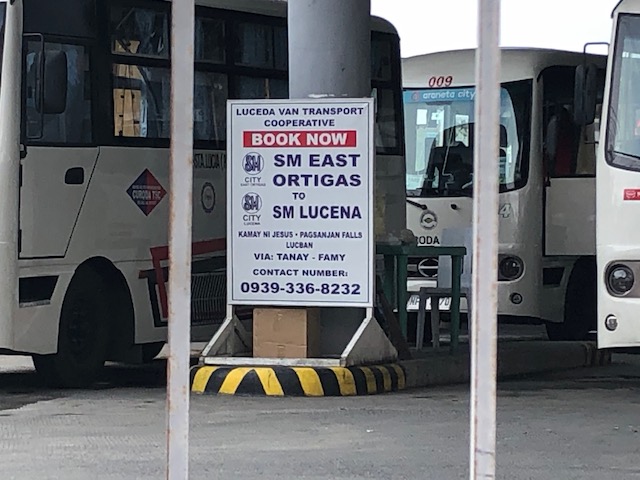 Close-up of sign showing the transport service between SM East Ortigas and SM Lucena in Quezon Province.
–
Public transport along Route 8: Cubao-Montalban
I had to go back to my usual commuting route to my workplace via Tumana as Marcos Highway is usually congested in the mornings. As such, I had the opportunity to take some photos of public transport modes along the way.
 Bus plying Route 8 – Cubao Montalban along the Marikina – San Mateo – Montalban Road (J.P. Rizal Avenue in Marikina City). Montalban is the old name of the Municipality of Rodriguez in Rizal Province.
 A Beep, a modern jitney that is actually a minibus plying to Parang-Stop & Shop route that used to be dominated by conventional jeepneys. That is, of course, a conventional tricycle on the other side of the road. By conventional I mean a motorcycle with a side car, which is the most common type of 3-wheeler in the country.
Recently, I saw G-Liner buses along Route 8. That means the bus company’s fleet is now distributed along 3 routes serving Rizal province and connecting it to Metro Manila. While, capacities are still limited due to physical distancing requirements, these buses should be able to carry a lot more passengers once the situation ‘normalizes’ so PUVs are able to maximize their seating (and standing) capacities.
–
 Caught (up) in traffic