
Home » Posts tagged 'public transportation' (Page 6)
Tag Archives: public transportation
Article share: What Is Bus Rapid Transit?
I found this short article defining and describing Bus Rapid Transit (BRT). I include this as a topic under public transportation in one of the graduate courses that I teach. Fortunately, I have materials for lecture coming from previous engagements concerning BRT including lectures by my former adviser who is an expert on public transportation and has studied the BRT in Curitiba, Brazil. Here is the article appearing in Planetizen:
Source: What Is Bus Rapid Transit?
Quoting from the article:
“Bus rapid transit, known as BRT, is a form of transit widely seen by transportation planning professionals and transit officials as a less costly alternative to light rail that offers a significant improvement over other fixed-route bus services that share lanes with regular traffic and makes bus service faster and more reliable.
BRT generally includes dedicated transit-only lanes or busways for at least part of the route, as well as prioritized traffic signal timing. BRT lanes are often located in the center of the roadway to limit interaction with cars, bikes, and pedestrians. In some cases, busways are elevated or underground.”
Definitions are good in that they provide us with a characterization of the system. There are many good examples of BRT particularly in South America (e.g., Curitiba and Bogota). These should be the models to replicate or adopt in Philippine cities rather than what local officials and their consultants propose and/or implement that are basically aberrations of the BRT concept.
–
On San Francisco’s cable cars
Here a quick share of an article on San Francisco’s iconic cable cars:
Carren, D. (May 11, 2023) “Why SF cable cars are so iconic: a history,” The Bold Italic, https://thebolditalic.com/why-sf-cable-cars-are-so-iconic-a-history-895e30e50784 [Last accessed: 5/14/2023]
From the article:
“Though a scant remnant of what they once were, the three remaining lines are almost always packed with riders, running every 8 minutes for 16 hours a day, clanking along with a lurch’s awkward grace and an artful clattering. The crowd hangs tight to the handholds and the poles and their hats through hairpin turns, and a daring few lean out with one arm, wildly waving to signal all is still quite well.”
I have been to SF a few times and enjoyed using the cable cars among other modes to go around the city. In fact, in one of our stays in SF, we deliberately booked a hotel close to the end point of one of the lines so we can use it more frequently to go to downtown SF.
 San Francisco’s cable cars at the Hyde Street turnabout ca. 2011.
–
Motorela – Paratransit in Cagayan de Oro
Our recent trip to Cagayan de Oro reacquainted us with their paratransit. While they looked like tricycles at first glance, they are actually 4-wheeled. Instead of a motorcycle with side car (with one wheel), this is a motorcycle fitted with a body that has two wheels (total 4). These are called motorela, which look like the Thai tuktuk.
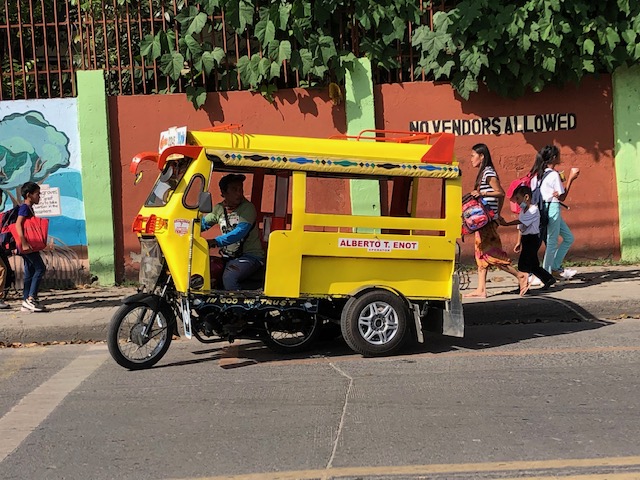

These can seat 9 passengers including the driver. The design though appears to put a lot of stress on the motorcycle due to the weight of the attachment plus the weights of passengers. Typical motorcycles are not built for these loads.
–
Article share: Redesigning Streets for Livability: A Global View
I am sharing this article on redesigning streets. It is actually a promotion for a book: “Streets For All: 50 Strategies for Shaping Resilient Cities”.
To quote from the article:
“Streets For All: 50 Strategies for Shaping Resilient Cities is an expansive 270-page volume that explores the evolving potential of the most ubiquitous public space in our cities. It offers ideas, tactics and strategies from across the world on how our streets are being, and, can be rethought, recast, repurposed and redesigned towards greater resilience and resourcefulness. The globally diverse opinions and case studies in this book remind us why cities with limited means can offer profound lessons to affluent societies that take their prosperity for granted. And in turn, how the virtues of effective urban administration and reinforcement seen in developed societies could reassuringly serve to inspire less economically developed ones.”
On electric vehicles overshadowing public transportation
There seems to be much ado about electric vehicles. Here in the Philippines, there is much hype about hybrid and electric cars as incentives are now in place for people to purchase them at reduced prices and in Metro Manila at least, there is that additional incentive of these vehicles being exempted from the number coding (vehicle restraint) scheme. Here’s an article
Woodhouse, S. and Mohsin, S. (January 26, 2023) “EV Hype Overshadows Public Transit as a Climate Fix,” Bloomberg, https://www.bloomberg.com/news/articles/2023-01-25/public-transit-gets-left-behind-in-us-climate-change-conversation [Last accessed: 1/28/2023]
Some quotes from the article pretty much describes why we must focus on improving public transportation to increase or at least retain riderships:
“If we want to reduce carbon emissions we can’t just have technology-focused answers…
“Buses and trains have a fraction of the greenhouse gas impact of private cars, whether internal combustion or battery-powered, according to the International Transport Forum. A 2021 study from the National Academies of Sciences, Engineering, and Medicine concluded that the energy saved by passengers in the US using public transit rather than personal vehicles saved 63 million metric tons of carbon dioxide in 2018 — roughly the equivalent of taking 16 coal-fired power plants offline for a year…
“In the postwar era, the US prioritized building out its road network, leaving transit behind. For decades, highways and roads have consumed about 80% of federal transportation funding, with transit getting only 20%. In 2019 state and local governments spent $203 billion on highways and roads alone, with a quarter of expenditures coming from federal transfers. At the local level, continued car use is fueled by suburban development patterns and land-use practices like minimum parking requirements, which require developers to set aside space for vehicles. Outside of major cities, transit options are often limited, and historically low level of public support translate into poor convenience and reliability…
“We’re not going to be able to successfully fight climate change — and prevent more damage to the climate — without heavily investing in mass transit and specifically public transit.”
Here is something I shared last year:
https://d0ctrine.com/2022/09/16/on-bicycles-vs-self-driving-cars/
You’ve probably seen the image that evolved from the original comparison of 50 people on cars, bus and motorcycles from Munster, Germany. The variant is 50 people on conventional cars, 50 people on electric cars and 50 people on self-driving cars. That is another perspective (road capacity and congestion-wise) of how electric vehicles will affect traffic.
–
On the need to change mindsets about bike lanes
Public acceptance of bike lanes has grown during the pandemic. Prior to the pandemic, there were few supporters especially among local government units and national agencies that seem to be comfortable with the status quo. Few like Iloilo and Marikina had any bike facilities worth mentioning. The pandemic was supposed to change that and it did for many. However, the acceptance and the gains seem to be eroding as we return to face-to-face activities and the ‘old’ normal situation.
I’m sharing below an article on the need to change mindsets about bike lanes and cycling in general:
Thompson, C. (January 24, 2023) “The Battle Over Bike Lanes Needs a Mindset Shift,” Wired, https://www.wired.com/story/the-battle-over-bike-lanes-needs-a-mindset-shift/ [Last accessed: 1/27/2023]
To quote from the article:
“Maybe bike lanes will always be fraught, until enough of the public is finally in a true lather about climate change—and it seems reckless to not have them.
Crises, after all, have a way of opening people’s eyes to possibilities. During Covid, restaurants and cafés lost so much business that cities nationwide began allowing them to build curbside seating areas where people could sit, safely, in the open air. It greatly reduced parking—but because, well, crisis, shop owners didn’t see any way around it. Patrons loved the outdoor seating so much that cities are making it permanent: A New York City study of several streets closed during Covid found storeowners making more than before, and diners digging the al fresco lifestyle. If data won’t change minds, customers might.”
There are two opposing sides on this matter. On one side are advocates who naturally will push for bike lanes and will promote them as The solution (emphasis mine) rather than one of a cocktail to address the transport mess we are in. On the other side are conservative, status quo types (or car-lovers as bike advocates will call them) who believe cars should have the roads to themselves. Unfortunately, many in government and particularly in transport agencies are with the latter. Perhaps they should be the first ones that need to be converted to favor active transport?
–
Another definition of the 15-minute city
We begin 2023 with an informative article defining the “15-minute city”. This is actually an entry in Planetizen’s Planopedia, which contains definitions of fundamental concepts in urban planning:
Ionescu, D. (December 2022) “What is a 15-minute City?” Planetizen, https://www.planetizen.com/definition/15-minute-city?utm_source=newswire&utm_medium=email&utm_campaign=news-12292022&mc_cid=ee083e2ee7&mc_eid=9ccfe464b1 [Last accessed: 1/1/2023]
I’ve written and shared articles about this concept before. Here are a couple from 2021 where I offered my opinions about the concept as already applied in the Philippines:
https://d0ctrine.com/2021/08/13/on-defining-the-15-minute-city/
https://d0ctrine.com/2021/04/07/didnt-we-already-have-15-minute-cities-and-towns-in-the-philippines/
–
Shared article: Active and Micro Mobility Modes Can Provide Cost-Effective Emission Reductions–If We Let Them
I’m sharing this article on active and micro mobility modes from Todd Litman, published in Planetizen.com:
Source: Active and Micro Mobility Modes Can Provide Cost-Effective Emission Reductions–If We Let Them
From the article:
“Common Active Transportation Leverage Effects:
–Shorter trips. Shorter active trips often substitutes for longer motorized trips, such as when people choose a local store rather than driving to more distant shops.
–Reduced chauffeuring. Better walking and bicycling conditions reduces the need to chauffeur non-drivers (special trips to transport a passenger). These often require empty backhauls (miles driven with no passenger). As a result, each mile of avoided chauffeuring often reduces two vehicle-miles.
-Increased public transit travel. Since most transit trips include walking and bicycling links, improving these modes supports public transit travel and transit-oriented development.
-Vehicle ownership reductions. Active mode improvements allow some households to reduce their vehicle ownership, which reduces vehicle trip generation, and therefore total vehicle-miles.
-Lower traffic speeds. Active travel improvements often involve traffic speed reductions. This makes non-auto travel more time-competitive with driving and reduces total automobile travel.
-More compact development. Walking and bicycling support more compact, multimodal communities by reducing the amount of land devoted to roadways and parking, and creating more attractive streets.
-Social norms. As active travel increases, these modes become more socially acceptable.
The article is a must read if we are to understand how important active transport and micro mobilities are in the context of today’s transport conundrum. Of course, part of the contextualization and perhaps ‘localization’ on these modes will be related to land use or development. The latter is a big challenge especially for the likes of Metro Manila and other rapidly developing cities in the Philippines where housing in the cities (related to compact development) has become quite expensive and has driven more and more people to live in the suburbs. As I’ve mentioned in previous posts, this has resulted in more pressure to develop transportation systems but infrastructure development cannot play the catch up game given the limited resources for their construction. Meanwhile, services are also behind in terms of quality and requires reforms and rationalizations.
–
On Metro Manila having one of the worst transit systems in the world
This is a follow-up to the previous post on the UC-Berkeley Study. Here is an example of how media featured the study outcomes:
https://www.facebook.com/CNNPhilippines/videos/1089453421728393
I didn’t see whether there was a response from government. These studies end up as features and nothing more if these do not prompt or push authorities to act on the problem. Even experts from academe or industry are reduced to being commentators or even pundits providing context, assessments and opinions, even recommendations that are perceived to fall on deaf ears. Perhaps government is already desensitized about these issues and will just trudge along at its own pace? In the end, it is the commuters mostly taking public transportation who continue to suffer and lose productive time to their daily travels.
–
On the best public transit systems in the world
Manila’s poor ranking in recent study conducted by the University of California Berkeley’s Institute of Transportation Studies with think tank Oliver Wynam on public transit systems caught the attention of a lot of people. Media was quick to feature this in the news and I am aware of at least GMA and CNN Philippines doing features of this in their news programs. Here is the article on the same that mentions the UC Berkeley ITS study:
Pollard, A. (November 21, 2022 ) “These Cities Have the Best Public Transit Systems,” Bloomberg CityLab, https://www.bloomberg.com/news/articles/2022-11-21/these-cities-have-the-best-public-transit-systems [Last accessed: 12/11/2022]
Manila, or Metro Manila to be exact, placed only 56th in public transit while ranking 48th in sustainable mobility and 58th in urban mobility readiness. I leave it to the readers to go read the UC Berkeley report rather than depending on media or social med influencers for their takes on the ranking. The report can be downloaded from the link I provided above.
Perhaps there should be an assessment of cities (at least the highly urbanized ones) in the Philippines to see how they are ranked. There should be a criteria (UC Berkeley and Oliver Wynam used distance to public transit, affordability, operating hours, crowding and commute speeds among others in their study) to be agreed upon where experts can score cities using a simple-enough scale, say 1 to 10 with 10 being the highest score. What are your top 5 Philippine cities in terms of public transportation?
–
 Caught (up) in traffic