
Home » Posts tagged 'research' (Page 2)
Tag Archives: research
30th Annual Conference of the Transportation Science Society of the Philippines (TSSP)
I was not able to post on the conference itself but it was definitely a success including the pre conference workshop (Workshop for Young Researchers or WYRe) held for the benefit of young researchers in transportation science.
Here is the link to the TSSP’s official page featuring the program for the Technical Sessions: https://ncts.upd.edu.ph/tssp/archives/2972
There were 6 sessions with papers on public transportation, active transport, traffic engineering and others including port operations and safety. A total of 27 papers were presented and in attendance were more than 150 people, mostly from the academe. The conference was conducted in cooperation with the University of the Philippines Visayas and the City Government of Iloilo. When available, I will also later share information about the very informative and enlightening keynote lecture delivered in the morning of the conference on the topic of Global Health.
–
Technical sessions at the TSSP 2024 Conference
I am sharing here the latest draft of the technical sessions for the 30th Annual Conference of the Transportation Science Society of the Philippines (TSSP). The conference will be held in Iloilo City this coming September 13, 2024.
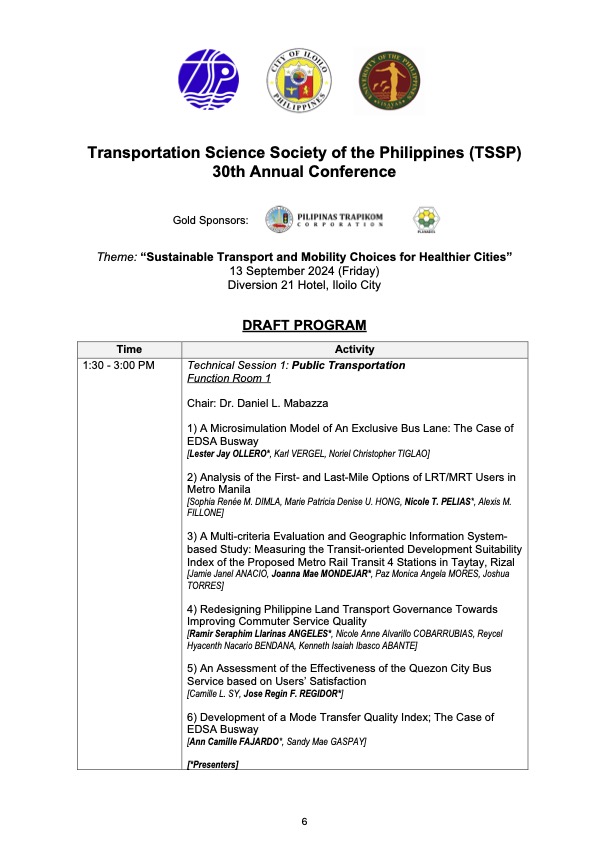
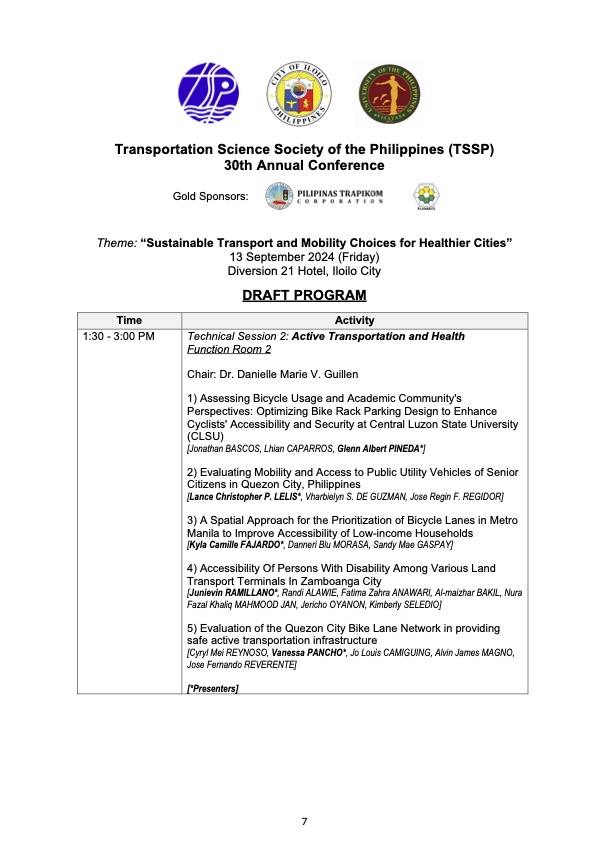
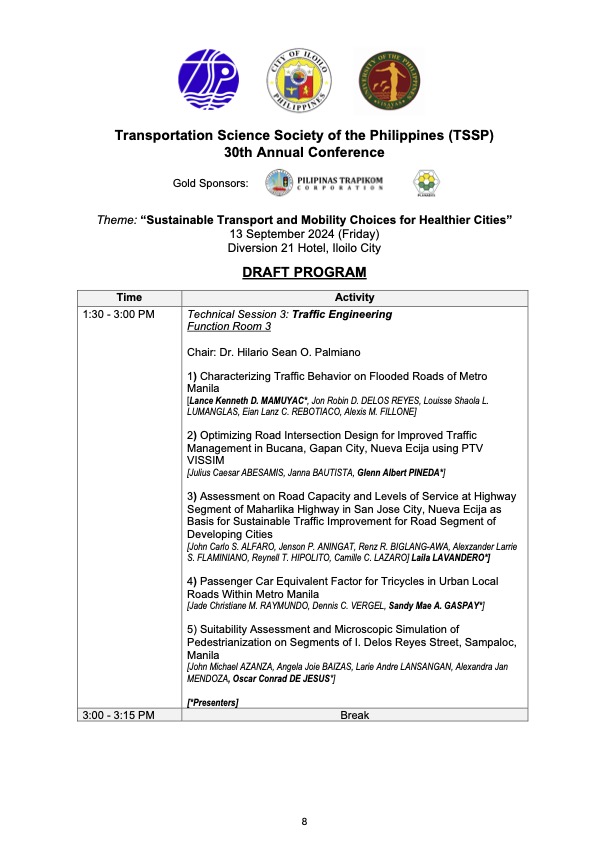
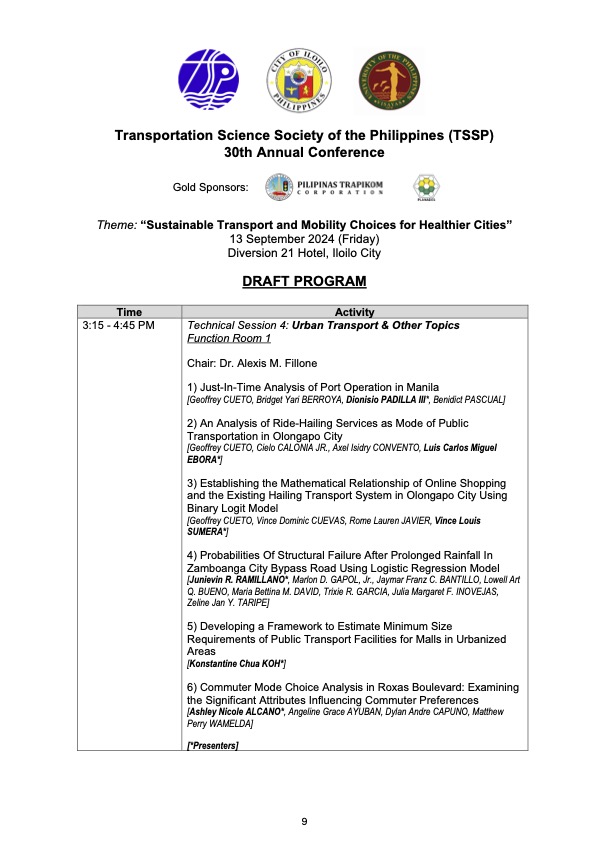
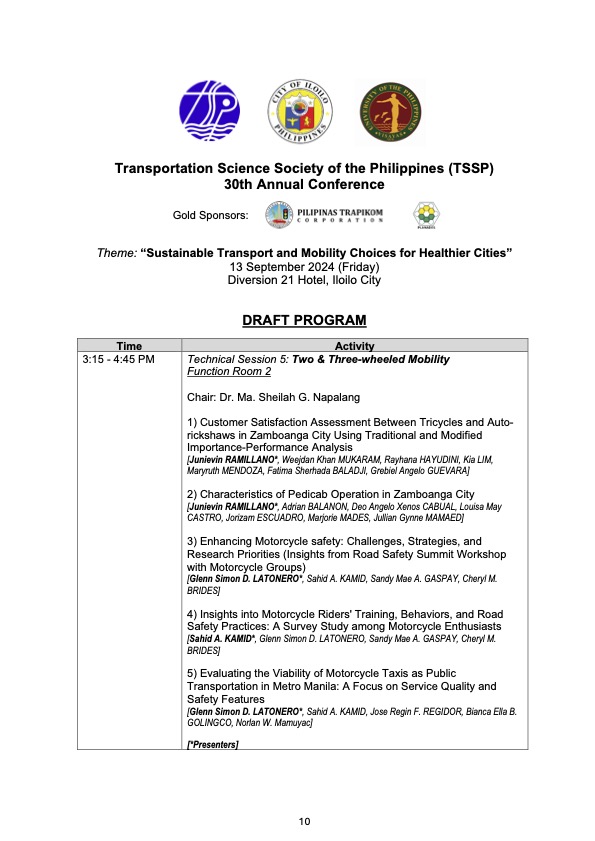
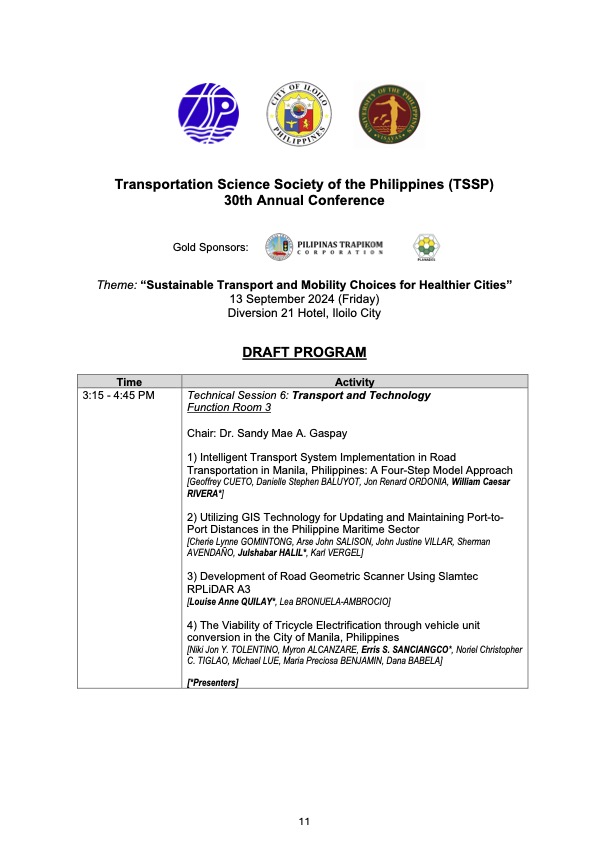
I will share the draft program for the morning plenary session in the next post.
–
On the impact of bike lanes on motor vehicle traffic
With the news that bike lanes will be removed along major roads including, most recently, I share some findings from the US about a decrease in traffic speeds when there are protected bike lanes. The decrease in speeds are associated with a reduction in road crashes, ergo safer streets.
McPherson, K. (June 3, 2024) “Traffic Speeds Decrease When Bike Lane is Present,” Rutgers.edu, https://www.rutgers.edu/news/traffic-speeds-decrease-when-bike-lane-present [Last accessed: 6/8/2024]
To quote from the article:
“They found that the presence of the delineated bike lane made a difference: a 28 percent reduction in average maximum speeds and a 21 percent decrease in average speeds for vehicles turning right. For those heading straight and not turning, a smaller speed reduction of 8 percent was observed. In addition, drivers moving at a perpendicular angle to the bike lane did not slow down.
Marking the bike lanes with cones as a clearly delineated space was more effective at reducing speed than a painted-only bike lane. The painted-only bike lane was associated with a smaller speed reduction of between 11 percent and 15 percent, but only for drivers turning right.
Younes hypothesized that drivers slow down when they see a bike lane marked with the cones because the driving lane is narrower and requires more concentration, and it’s easier to notice cones or planters or some other space delineator than it is to spot painted lines on the road surface.”
Of course, one major element that was probably not considered in their studies is the presence and behavior of motorcycle riders. Motorcycles here frequently enter and use bike lanes whether protected or not. Often they crowd out bicycle users leading to situations where riders of motorized and non-motorized 2-wheelers come into conflict. Still, it would be nice to have a study to determine not just whether there are similar outcomes here but to what extent as well as how motorcycles figure in the study.
–
Article share: Picking it up as we go: how transportation agencies can learn from university research
Here’s a quick share of an article on the JTA Research Lab. This is a good example of how transportation agencies can learn from university research and also how they can collaborate or cooperate with academe to formulate solutions to various transport problems or issues.
JTA Research Lab has been created to identify critical transportation policy questions, and get academics to help solve them. Pencils sharpened? Nathaniel P. Ford explains…
Source: Picking it up as we go: how transportation agencies can learn from university research
30th Conference of the Transportation Science Society of the Philippines
I am sharing here the First Call for Papers for the 30th Annual Conference of the Transportation Science Society of the Philippines (TSSP). The conference will be held in Iloilo City almost to the day of the last time it was held there in Sept. 12, 2014.
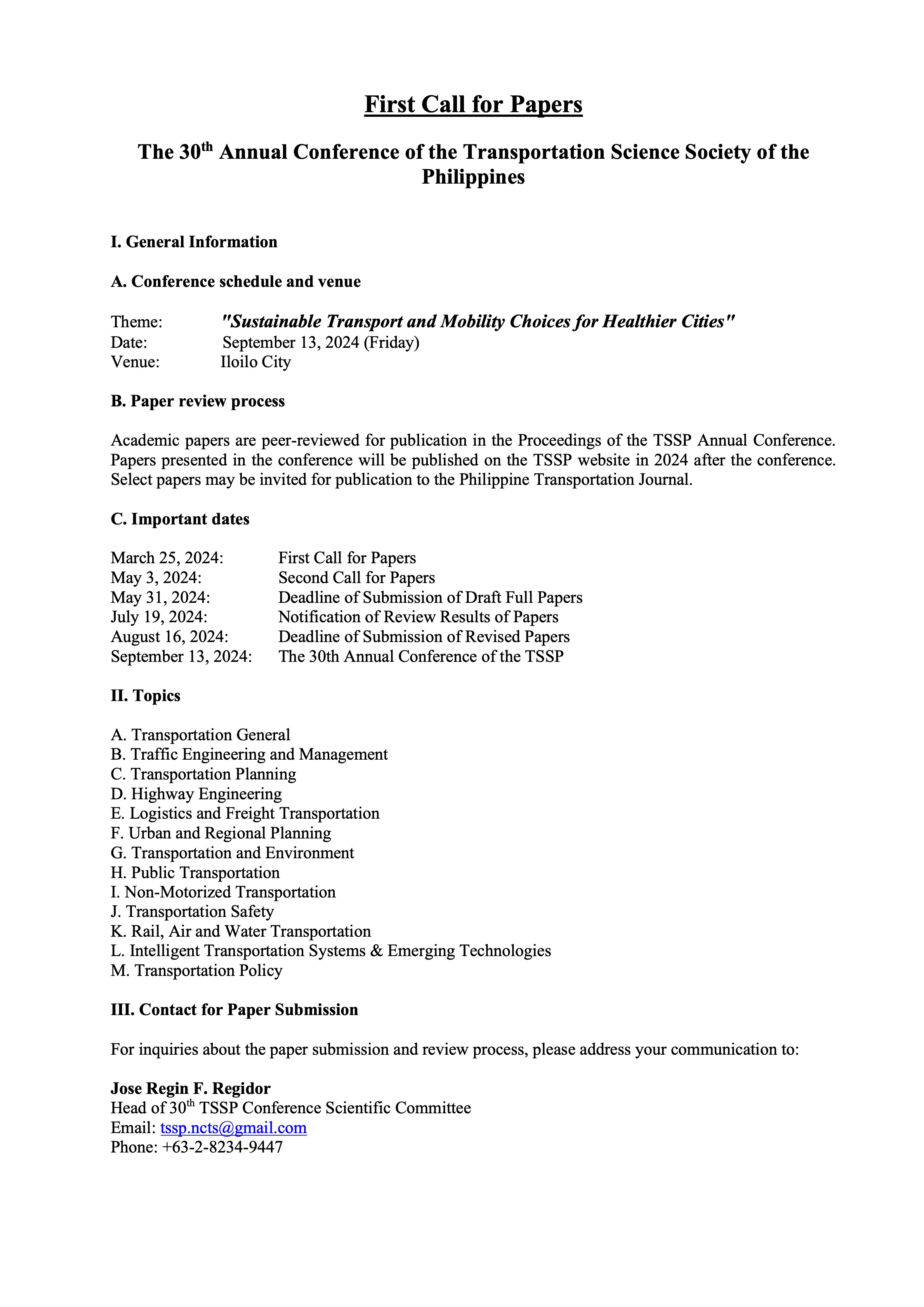
Information on past conferences may be found here: https://ncts.upd.edu.ph/tssp/conferences
–
Another look at home location choices
I recently shared an article showing the results of a survey conducted in the US. That survey appears to show that Americans prefer sprawl. But that may be due to many factors including political leanings that are actually mentioned in the article. I share another article that appears to be a reaction to the first one.
Lewyn, M. (August 14, 2023) “Do Americans Really Prefer Sprawl?” Planetizen, https://www.planetizen.com/blogs/125112-do-americans-really-prefer-sprawl?utm_source=newswire&utm_medium=email&utm_campaign=news-08142023&mc_cid=cd3b2e2ba5&mc_eid=9ccfe464b1 [Last accessed: 8/16/2023]
To quote from the article:
“Why do these surveys yield such drastically different results? The Pew survey notes that 3/4 of rural respondents favor the less walkable alternative; thus, that survey was apparently designed to include a representative sample of Americans, including rural Americans who typically do live in very spread-out environments. It seems to me quite natural that rural Americans would prefer rural lifestyles.
But once rural respondents are excluded, the balance between sprawl and walkable communities in the Pew survey becomes almost a toss-up. 57 percent of urban respondents refer houses with smaller yards and more walkability, and an almost-equal percentage of suburban respondents prefer the opposite.”
Again, I wonder what would be the outcomes if a similar survey were done in the Philippines. Will it reveal preferences for single detached homes rather than condos? Who will prefer the latter or the former? What could be the factors affecting home location choices in the Philippines? Cost is definitely a major factor. Commuting times perhaps and even commuting costs? But how do people weigh these factors? And what other influences are there to the decisions to purchase homes?
–
On university-community collaborations
I’m not a stranger to university-community collaborations. In fact, I even helped draft a proposal for the World Bank to support such collaborations, which I believe would be sustainable and therefore worthwhile to be pursued by potential partner universities and local government units. There are actually many such collaborations but most of these are probably informal with certain faculty members of universities (usually state universities or colleges) being involved in committees or moonlighting in projects implemented or funded by LGUs. I say informal because technically, the school is not involved in the project and it is only incidental that the person or persons involved are affiliated with the university or college.
Here is an article showing an example of university-community collaborations:
National Institute for Transportation and Communities (2022) “Transportation recovery after disasters: A collaborative university/community model,” phys.org, https://phys.org/news/2022-08-recovery-disasters-collaborative-universitycommunity.html [Last accessed: 8/15/2022]
The authors wrote about actions that could be done “to build future economic resilience.” To quote from the article:
-
Increasing pre-disaster investment in resilient transportation infrastructure to reduce the cost of eventual recovery;
-
Improving business resilience practices for high-impact industrial sectors, through education and outreach;
-
Identifying structural barriers to adoption of resilient business practices, and promoting mitigation through recovery.
-
Mainstreaming disaster resilience into economic development by breaking the siloed approach to emergency management and economic development.
While these actions were framed for the community engaged by the University of Utah, they are general enough to be applicable to other communities as well.
I mentioned earlier about the need for formality. The Commission on Higher Education (CHED) encourages and supports what are termed as Extension Works or Extension Projects by higher education institutions. These may be in various forms including committee work, advisory, capacity building/training, or even professional work/services provided to the province, city or municipality (even barangay). But there should be accountability here as well as the proper assignment or allocation of resources.
Just compensation is one of the more sensitive or tricky elements or items here as often, LGUs would like to get something for free or assume that certain services are free. They are not and time and effort should be compensated; just not the international rates you might expect for consulting work from the likes of World Bank or Asian Development Bank.
Here is where contracts (e.g., in the form of Memorandum of Understanding (MOU) or Memorandum of Agreement (MOA)) can be useful to establish the terms of engagement that includes budgets for Personnel Services (PS), Equipment Outlay (EO) and Maintenance and Other Operating Expenses (MOOE). The latter categories should be familiar with LGUs because these are standard items under which details are provided for their programs and projects. State universities and colleges are also familiar with these as standard government terminologies for budgets. Of course, that goes without saying that in certain engagements, there may be third parties such as donor or funding institutions that will should all, most, or part of the costs for collaborative work.
–
On using advanced tools for infrastructure assessments
I came upon this article on how transportation departments in the US are using tools such as drones to assess critical infrastructure including roads and bridges. This is very relevant to us especially as many similar infra are aging and would need to be assessed to determine how to reinforce, retrofit or even rehabilitate certain infrastructure vs. naturally occurring phenomena like earthquakes and typhoons.
Reed, J. (August 2, 2022) “How Transportation Departments Are Using Advanced Drone Technology for Infrastructure Assessments,” Aviation Today, https://www.aviationtoday.com/2022/08/02/transportation-departments-using-advanced-drone-technology-infrastructure-inspections/ [Last accessed: 8/4/2022]
To quote from the article:
“The WVDOT may expand its drone programs to perform road safety assessments and to assist in designing new road routes by providing topographical maps.”
I recall that there have been road-based surveys involving Lidar to map the road and adjacent land surfaces about a decade ago (maybe less). This was a nationwide project funded by the Department of Science and Technology (DOST) and implemented by the University of the Philippines Diliman’s Department of Geodetic Engineering. I’m not sure where that data is stored or hosted but the DGE should have a back-up somewhere that can be used or further processed for road safety assessment applications. This could be an interesting and fruitful research area that can involve people from various disciplines.
–
On how traffic enforcement enhances road safety
It seems to be a no-brainer and has always been an assumption to many traffic engineering studies including those employing simulation to determine the outcomes of various scenarios involving transportation. The element that is traffic enforcement, however, cannot be assumed as something uniform across countries, cities, barangays or even individual road sections and intersections (yet we often do assume uniformity and a certain level of strictness).
Here is an article that reports on new research pertaining to how the enforcement of traffic laws makes roads safer:
Mohn, T. (June 8, 2022) “Enforcing traffic laws makes roads safer, new research shows,” Forbes.com, https://www.forbes.com/sites/tanyamohn/2022/06/08/enforcing-traffic-laws-makes-roads-safer-new-research-shows/?sh=74b03c97591e [Last accessed: 6/10/2022]
To quote from the article:
“High visibility enforcement of traffic safety laws actually works. When carried out, regulations governing driving have a positive and measurable impact on safety by reducing dangerous behaviors behind the wheel that put road users at risk…
““Enforcement alone will not solve the traffic safety crisis,” Adkins added. “We cannot simply enforce, build, design or educate our way out of this problem. The Safe System necessitates a comprehensive approach for achieving our collective goal of zero traffic deaths, including equitable enforcement that focuses on risky driver choices that endanger all road users.”
The article points to new research published by the US National Highway Traffic Safety Administration. The synthesis to that research may be found here while the full report is found here.
Such research and articles are very relevant especially as incidents like the one involving a driver running over an enforcer become viral and bring to the forefront traffic enforcement or the lack of it (some will word it differently – like why many drivers don’t follow traffic rules and regulations). The discussion must continue especially in the context of road safety.
–
On walkability and walkability scores
I’m sharing a couple of articles on walkability and walkability scores. The first one actually points to the second but provides brief insights about the concept of walkability while the second is a more detailed article on the findings of a study on walkability.
Ionesco, D. (May 4, 2022) “Walkability Scores Don’t Tell the Whole Story,” Planetizen, https://www.planetizen.com/news/2022/05/117075-walkability-scores-dont-tell-whole-story?utm_source=newswire&utm_medium=email&utm_campaign=news-05052022&mc_cid=c04e3e4dc0&mc_eid=9ccfe464b1 [Last accessed: 5/7/2022]
To quote from the article:
“if cities truly want to be pedestrian-friendly, they need to think beyond the sidewalk…”
The second article is from late April:
Gwam, P., Noble, E. and Freemark, Y. (April 28, 2022) “Redefining Walkability,” urban.org, https://www.urban.org/features/redefining-walkability [Last accessed: 5/7/2022]
To quote from the article:
“To create a more comfortable walking experience, our research points to a few steps DC planners and policymakers can take to increase racially equitable walkability across the city:
-
expand tree cover in the densest parts of the city,
-
increase nonautomotive modes of transportation in central areas,
-
reduce noise pollution,
-
support more equitable access to key resources, and
-
prioritize road design that limits the need for police traffic enforcement.”
While the article puts emphasis on the topic of racial equity, such concept can easily be adapted and adopted for our purposes. For one, it could be interpreted as being inclusive if one is not comfortable with the term “race”.
Don’t miss downloading the technical appendix of their report. This will be very useful to researchers, practitioners and advocates of active transport.
–

