
Home » Posts tagged 'research' (Page 6)
Tag Archives: research
Local papers presented at the EASTS 2015 conference – University of the Philippines
There were a lot of technical papers from Philippine universities that were presented in the recently concluded 11th International Conference of the Eastern Asia Society for Transportation Studies (EASTS 2015). In the interest of dissemination, I will be featuring a list of papers produced by leading universities in the Philippines that are doing studies on transportation. Following is a list of papers from University of the Philippines Diliman that were presented at the EASTS 2015 held in Cebu City last Sept. 11-13, 2015:
- Innovative Collection of Road and Traffic Data for Road Safety Audit (Aileen Mappala & Ricardo Sigua)
- Study on Safety of Railway/Highway Grade Crossings in the Philippines (Albie Clarito, Beverly May Ramos & Ricardo Sigua)
- Instantaneous Fuel Consumption Models of Light Duty Vehicles and a Case Study on the Fuel Consumption at Different Traffic Conditions in Metro Manila using Shepard’s Interpolation Method (Ernesto Abaya, Karl Vergel, Ricardo Sigua, Edwin Quiros & Jose Bienvenido Biona)
- Development of Drive Cycles and Measurement of Fuel Economies of Light Duty Vehicles in Metro Manila (Ernesto Abaya, Karl Vergel, Ricardo Sigua & Edwin Quiros)
- Selection of Metro Manila BRT Corridors Using Multi- Criteria Assessment (Ricardo Sigua & Cresencio Montalbo, Jr.)
- An Assessment of Walkability in a Medium-Sized Philippine City (Hilario Sean Palmiano, Sheila Flor Javier & Jose Regin Regidor)
- Traffic Noise Measurement, Perception, and Modelling in a University Campus (Hilario Sean Palmiano, John Carlo Villar & Michelle Monelle Quilatan)
- Assessment of Metro Manila Bus Fare Computation (Sylvia Chavez & Hilario Sean Palmiano)
- Estimating Road Roughness Conditions Using Ubiquitous Smartphones and Geographic Information Systems and its Application to Road Network Planning in the Philippines (Joel Cruz & Jun Castro)
- Fuel Economy and Public Utility Jeepneys Using 2% and 5% Coco-Metyl Ester (CME)-Diesel Blends (Edwin Quiros & Karl Vergel)
- Comparison of Fuel Economy of Fuel and Operating Characteristics of Diesel and Auto-LPG Jeepneys through On-Road and Vehicle Tests (Edwin Quiros, Karl Vergel, Ernesto Abaya, Ervin Santos & Jose Gabriel Mercado)
- Challenges of Urban Transport Development in Metro Manila: A look back at the last 40 years (Maria Sheilah Napalang & Jose Regin Regidor)
- An Assessment of the Public Necessity Concept for Estimating the Requirements for Public Transport Vehicle (Arnel Manresa, Karl Vergel & Jose Regin Regidor)
- State of Pavement Engineering in the Philippines and Implications on the Economic Life of National Roads (Maria Sheilah Napalang, Jose Regin Regidor & Nathaniel Diola)
- Planning Metro Manila’s Mass Transit System (Ricardo Jose, Daniel Mabazza, Jose Regin Regidor, Marco Stefan Lagman & Jonathan Villasper)
- Evaluation of Compliance of Dimensions and Selected Systems and Components of Customized Local Road Vehicles (CLRV) with Vehicle Regulations and Standards (Karl Vergel, Rachel Habana, Nonilo Peña, Loreto Carasi, Albert Mariño & Alorna Abao)
- An O-D Approach of Estimating Energy Demand and CO2 Emission for the Luzon Road Transport using Inter- Regional Passenger and Freight Flow Data (Marloe Sundo & Karl Vergel)
- Dignity of Travel: BRT Development in the Philippines (Cresencio Montalbo Jr & Colin Brader)
- Mending a Metropolis – Understanding Passenger Demand Across Metro Manila To Improve Road Transit (Nicholas Greaves & Cresencio Montalbo Jr)
- Accident Hotspot Mapping in Quezon City: The case of Katipunan Avenue (Jerome Ballarta, Nelson Doroy, Ishtar Padao & Cecil Villanueva)
Not included in the list are papers coming out of International Research Groups (IRG) as well as those where involvement by UP faculty were incidental to projects. Many of these papers will soon be posted on the official site of the International Scientific Committee of EASTS as part of either Proceedings or Journal of EASTS. Some may be nominated for the Asian Transport Journal (ATS), which is also published by EASTS.
Transportation research in UP Diliman is the most developed among schools doing research on these topics in the country. Papers came from a variety of disciplines and academic units including Civil Engineering, Mechanical Engineering, Urban Planning, Geography and History. These mostly were and are undertaken through the National Center for Transportation Studies (NCTS), which is with UP Diliman.
Next up: De La Salle University
–
EASTS 2015 – Cebu City, September 11-13, 2015
The 11th International Conference of the Eastern Asia Society for Transportation Studies (EASTS 2015) will be held in Cebu City this September 11-13, 2015. For information on the conference and program, check out their website here:
You can also download a brochure about EASTS here:
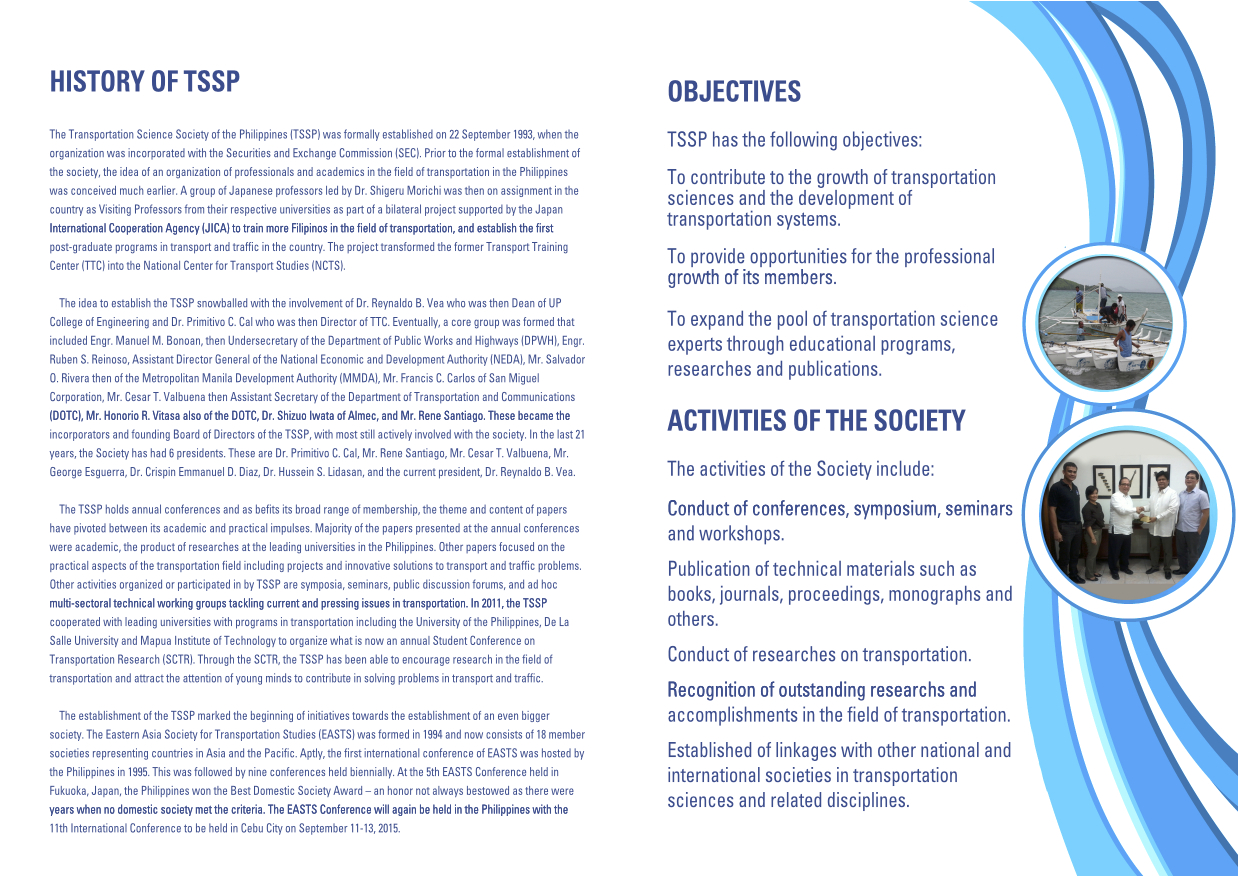
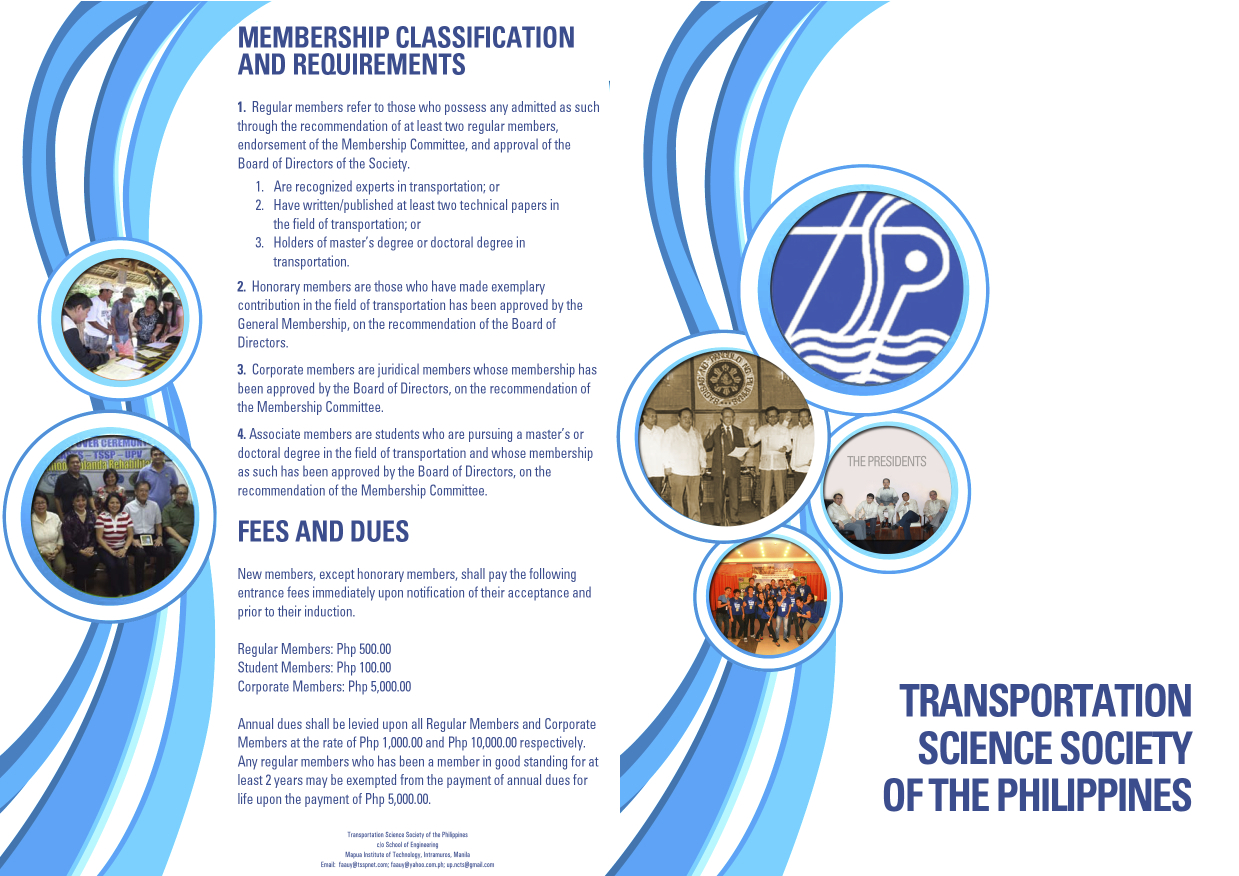
The conference is hosted by the Transportation Science Society of the Philippines (TSSP), which is the local affiliate of the EASTS. More information on the TSSP are found below:
–
2015 National Science and Technology Week and the Hybrid Road Train
The Philippines’ Department of Science and Technology National Science and Technology Week 2015 on July 24-28, 9am-6pm, SMX Convention Center, Mall of Asia, Pasay City. NSTW 2015 has 9,300 square meters showcasing 145 technologies, 51 forum sessions, 11 technology demonstrations, 25 other S&T events, 1 road train. Admission is free. Details at National Science and Technology Week  A special feature this week is the Hybrid Electric Road Train developed by the Metals Industry Research and Development Center (MIRDC) with 5 coaches and capacity of 240 passengers. You can find a description of the road train project in the MIRDC’s site from this link. Here’s a screen grab from the same site/link showing what the road train looks like:

Incidentally, the MIRDC is also the DOST center in-charge of development of Automated Guideway Transit (AGT) vehicles currently being tested in the University of the Philippines Diliman and the MIRDC Compound in Bicutan. Free rides are scheduled on July 24 12nn-4pm; July 25-28, 10am-12nn, 2-4 pm. The road train is envisioned to provide for mass transit needs of cities particularly those with long stretches of major roads like EDSA or C5 in Metro Manila.
–
Transport research agenda
As promised, I am posting our research agenda from the last academic year. This has been revised every year since we established our undergraduate research program more than a decade ago. Back then, the document had been informal in the sense that it was not an official document that was submitted to the university for approval. Over the years, the agenda had been developed alongside that of the National Center for Transportation Studies and has evolved according to the current issues and concerns (including trending topics) in transportation.
A. Traffic Flow Theory and Analysis, and Traffic Engineering
1. Evaluation of Intersection Performance Considering Pedestrian Movement
2. Car-Following and Lane-Changing Models for Local Traffic Micro-simulators
3. Optimization of Traffic Signal Settings
4. Highway and Intersection Capacity and Level of Service
B. Highway Engineering
1. Local Pavement Design Practice
2. Coordination of Horizontal and Vertical Alignments
C. Intelligent Transport Systems (ITS)
1. Advanced Traveller Information and Navigation
2. Advanced Public Transportation and Travel Information
3. Microscopic Traffic Simulation Modelling
4. Advanced Parking Management
5. Integrated Fare Collection for Public Transport
6. Probe Car System for Road Safety and Travel Time Assessment
7. Development of Devices/Sensors for In-Vehicle Air Quality Measurement
8. ITS Support for PWDs, Senior Citizens and Women
9. Smart City and PUV Connectivity for Fully Automated Driving: Internet of Vehicles (IoV)
10. Advanced Traffic Data Collection Tools and Methods
D. Transport Safety
1. Road Safety Audit
2. Road Crash Data Analysis and Management System
3. Road-Based Public Transport Safety
4. Philippine Air Transport Safety
5. Philippine Maritime Safety
6. Safety and Comfort Assessment of Public Utility Vehicles
7. Safety Assessment of Buses Equipped with GPS
E. Public Transport
1. Indigenous Modes of Transport
2. Public Transport Operation and Management
3. Public Transport Station/Stop and Terminals
4. Assessment of Mass Transport Options (e.g. BRT, AGT, AFV)
5. Multi-Modal Transfer Stations in Urban Areas
F. Mobility Management
1. Parking Management Systems
2. Traffic Calming
3. Bikeways Planning and Management
4. Pedestrian Facilities and Walkability
5. Assessment of Freight Vehicle Restraint Schemes
G. Transportation, Environment, Energy and Vehicle Technologies
1. Fuel and Energy Efficiency of Alternative Fuel Vehicles for Public Transport
2. Roadside Air Quality Assessment and Modelling
3. Roadside and Airport Noise Modelling
4. Utilization and Customization of GHG Emissions Estimation Tools for Assessment of Avoid-Shift-Improve Policies and Transport Infrastructure Projects
5. Customized Local Road Vehicles for Public Transport (jeepneys and tricycles)
6. Transport Energy Demand
Note from the above agenda that there are few items that are very specific. The above are not working titles for researches but very general topics that can be the basis for formulating specific topics for each student/group that will be working on that topic. Not indicated in the agenda are information on which faculty members are assigned to each topic. Faculty members have various specializations and have contributed items to the agenda. Students choosing a particular topic will be assigned to the faculty member who will be guiding the students towards proposal formulation and eventually, research implementation.
–
Research topics on transport and traffic in the Philippines?
I noticed that this site has received a lot of hits for inquiries regarding undergraduate research topics. While we at UP have yet to start our first semester of the academic year 2015-2016, other schools have already started their semesters, trimesters or quarterms. I suspect students in their final or graduating year would be looking for topics for their research projects or, what some schools refer to as the undergraduate thesis projects.
I have written about our undergraduate researches at UP Diliman the past few years and listed down the topics our students have implemented for their undergraduate projects. In our case, we have 2 subjects that our students take during their final year – CE 190, a one unit course that focuses on the formulation and approval of the research project and CE 199, a three unit course for the implementation of the approved project. These are taken over 2 semesters, usually the last 2 that the student takes before graduating.
Unfortunately, not all schools would have the capability and capacity to advise students taking on topics on transport and traffic. I noticed that many schools and their advisers just let their students select topics of their own choice. Many provide minimal if any guidance to students. The latter often choose topics on current issues or problems without checking if they have the knowledge and tools to undertake substantive studies. Often too, it seems to us that the advisers are not capable of providing guidance to their own students and as such just let them seek advise elsewhere including people they would identify as resource persons but to whom they would be more dependent on for advice than their schools’ faculty members. Although their enthusiasm and interest in various topics are commendable and there are many out there who would be gracious and generous to share their time, knowledge and experience with these students, they cannot do so as regularly as full-time faculty members. In fact, it is unfair to these people whose times and resources are already constrained by their own responsibilities (e.g., a professor at DLSU also has his own students to guide and classes to teach).
Schools need to develop their own research agendas. That is so that students would be able to choose topics that their faculty can realistically and effectively guide their students instead of sending them out to become the burdens of others. These would include topics concerning local issues. Are there road safety issues at locations such as intersections near the school? Are the streets in the nearby CBD experiencing congestion? Is there an oversupply or lack of public transport services in the city or a nearby town? It seems awkward for a university in Pampanga, for example, to have students taking on a topic concerning EDSA-MRT or students of a university in Metro Manila taking on a topic on Mindanao railways, if their faculty have no relevant experiences or capabilities to properly guide the students.
I would encourage schools to identify topics concerning local issues first. As they say, charity begins at home, and working on solutions for local problems should be top of the agenda of any school. That includes us at UP and there are many topics that focus on issues in and around UP Diliman. If we can’t solve our own problems then how can we be believable in addressing those outside our direct influence area?
In the next post, I will share and example research agenda from the last academic year. This was the basis for our students selecting topics for their undergraduate researches and as starting points for our graduate students in formulating topics for their MS thesis.
–
On doing research for your undergraduate course requirements
It’s that time of year again when we are swamped with requests for interviews from students taking undergraduate courses. These undergraduate courses include those on Science, Technology and Society, English, Communications, Architecture, Geography, Business, and Economics. These requests are not limited to students from our university but also come from students in other schools as well. While we are happy to oblige, granting interviews face-to-face or through correspondence (through email, of course), we are becoming wary about students not doing their part first before requesting an interview. In many cases, they just fire off a list of questions in the first email, probably hoping the addressee would be kind enough to answer all these questions in a comprehensive manner. That way, perhaps the student will be able to save on time and effort in doing his/her report. That’s right, let the expert answer all the questions and tell me what references I should list down in my report. If the student can’t understand what the expert wrote in reply or if the student thinks its not enough, then the latter could just send a follow-up with additional questions or request another interview.
Is this the right way to do research? I do not agree with this and perhaps the faculty handling their respective courses these students are enrolled under should take care in how they frame their requirements. It is as if they are passing on their responsibilities to other faculty members, experts in their particular fields, who would have to contend with requests for interviews or outright questions in their emails. That’s probably understandable for general education courses like English and STS, but not acceptable for undergraduate research projects that are supposed to be “capping” courses in their programs.
How do I address such inquiries in my mailbox? I do respond immediately and in fairness to the students whom I assume are somewhat misguided in his/her research work; particularly on how to conduct research. My usual reply is that I cannot accommodate the request due to my schedule followed by a counter-request for the student to send me his/her questions first (if he/she hasn’t done so in the first email). If I already have an idea of the students’ topics, then I would suggest some reading material or references first, and hopefully that can help the students frame their questions. That way, I can gauge if the students are really serious about their research or are just going through the motions. It’s difficult for me to be serious or passionate with my replies if the person on the other side of the proverbial table is not at all interested in the topic and treats the exercise as just another requirement for him/her to get a good grade.
Doing his/her part before even contacting experts mean the student needs to do some literature review. That can be in the form of research online and not the kind where the student will just mention a few articles (often opinion pieces) that they read on Rappler, Yahoo or other online sources. There’s a wealth of more scholarly and objective information now available on the net and UP students have access to journals, books and other references through the university’s libraries. These are privileges that they have already paid for as part of their tuition so why let these resources go to waste? I believe students can do a good job in their research projects if they are given proper guidance by their advisers or instructors, who should be the “first line of defense” against mediocrity in their studies at this level. Getting rarer these days are students who come in prepared and are really passionate about the topics they are studying.
–
Undergraduate research topics on transportation for AY2014-2015
The Transportation Engineering Group (TEG) of the Institute of Civil Engineering (ICE) recently finalised the researches to be implemented by undergraduate students assigned to the group.
- Calibrating car-following and lane-changing models for local traffic micro-simulators
- Effects of clear yielding rules at weaving sections
- Evaluation of re-opening of traffic signals along Katipunan Avenue
- Shuttle service for University of the Philippines Diliman employees
- Analysing trip-cutting behaviour of jeepneys and UV express with respect tot he LRT Line 2 Santolan and Katipunan Stations
- Assessment of pedestrian facilities along Ortigas Avenue Extension and Marcos Highway
- Study on satellite parking system for UP Diliman
- Road safety audit checklist for expressways
- Study on Philippine National Railways (PNR) station congestion
- Using drones for analysis of weaving sections, and traffic circulation in roundabouts
- Air quality assessment at the Centennial Dormitory along C.P. Garcia Avenue
- Estimating bus passenger demand between UP Diliman and UP Los Banos
- Mode choice modelling of new transport systems
- On-road energy efficiency of alternative fuel vehicles
Note that several topics in the list are focused on issues concerning the UP Diliman campus. These are a continuation of studies geared at providing solutions to transport or traffic problems at UP’s flagship campus sprawled over an area of 493 hectares. The above are working titles at best as students taking up the topics are supposed to develop their research proposals (complete with literature review, methodology and budget) this semester and then implement these in the next semester. Since UP has already adjusted its academic calendar, research implementation will be undertaken from January to May 2015.
–
2014 Professorial Chair lectures on transport topics
The 2014 Professorial Chair Colloquium of UP Diliman’s College of Engineering was held from yesterday until today. Most of the lectures concerning transport were presented today. Here are some of the highlights of the lectures delivered this morning:
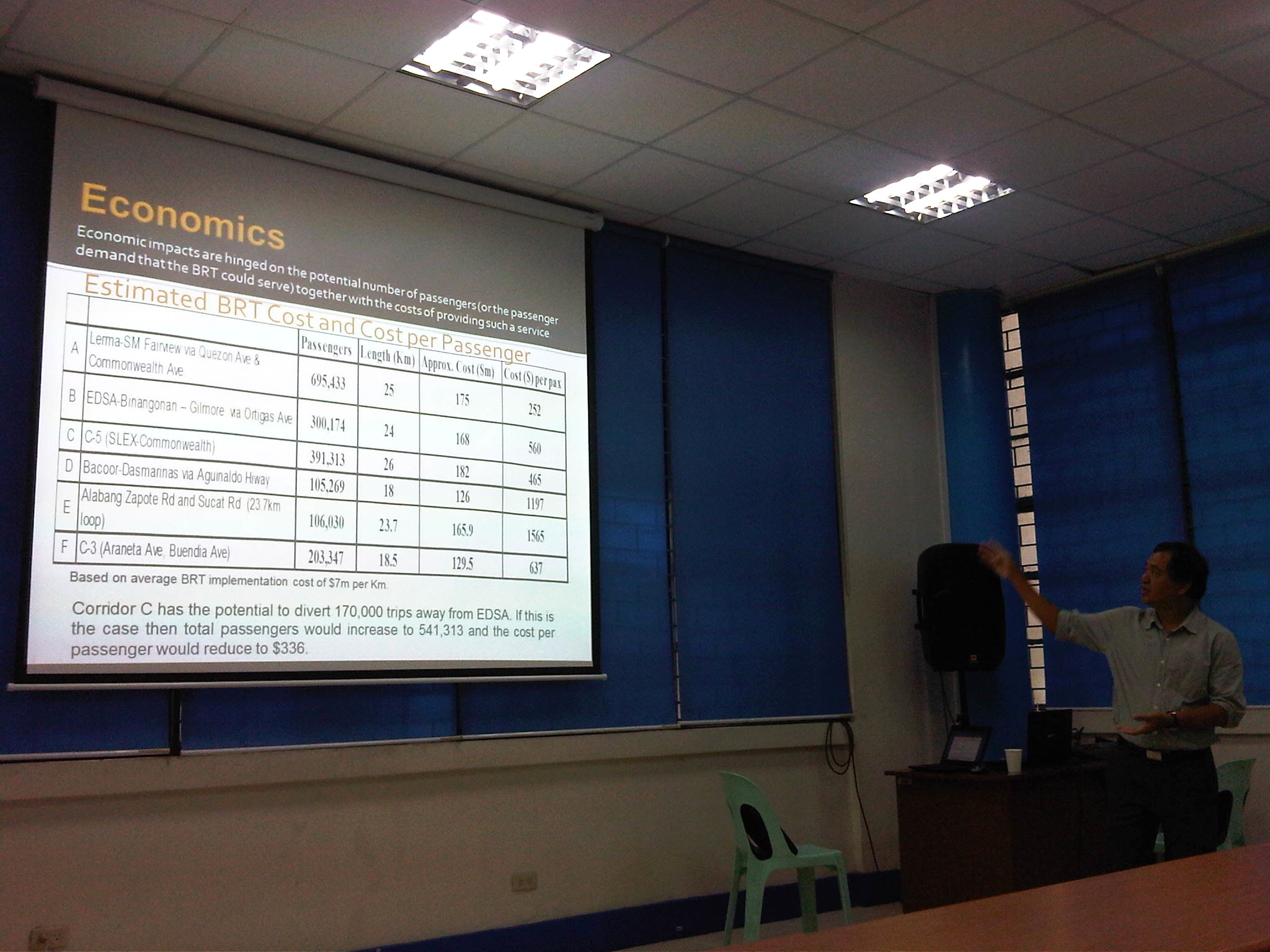 Dr. Ric Sigua, Director of the Institute of Civil Engineering, making a point about the economics of Bus Rapid Transit (BRT).
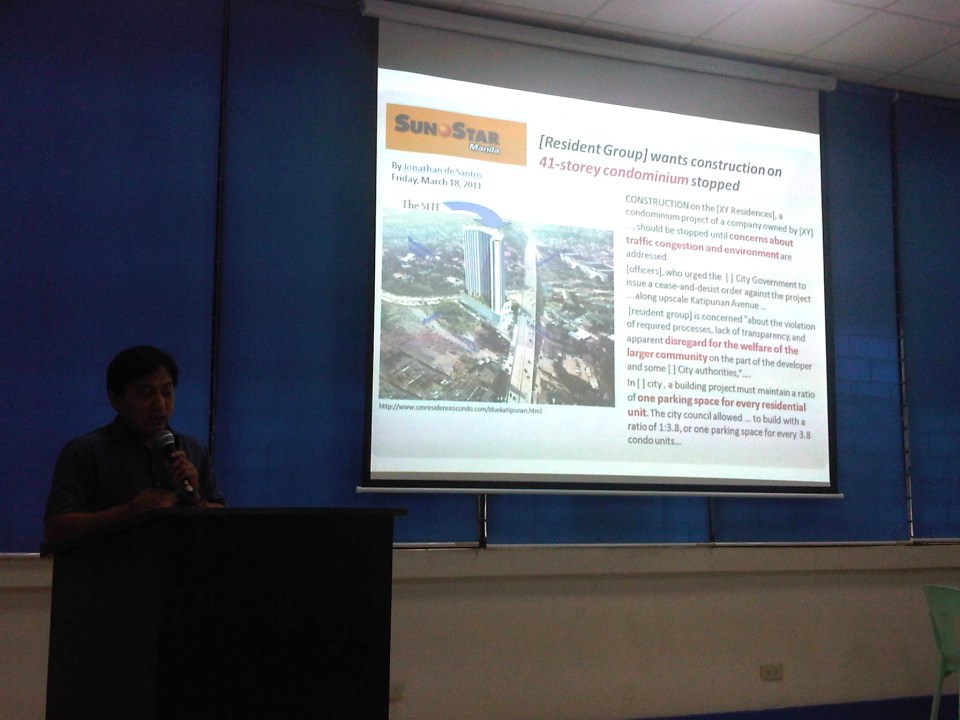 Dr. Sean Palmiano, Director of the National Center for Transportation Studies, explaining the finer points of traffic impact assessment for high density residential developments.
 Prof. Happy Denoga of the Department of Mechanical Engineering explaining on the advantages of hybrid systems for vehicles.
 Dr. Karl Vergel of the Institute of Civil Engineering talking about the on-road tests for jeepneys using B5 or 5% CME-blended fuels in a project commissioned by the Philippine Coconut Authority.
 Comparison of jeepney mileage using 2% and 5% blended fuels.
 Dr. Edwin Quiros of the Department of Mechanical Engineering’s Vehicle Research and Testing Laboratory (VRTL) discussing the dynamometer tests conducted for jeepneys using B5 fuel.
There were other presentations but unfortunately, I wasn’t able to attend these as lectures were spread among various venues at the college. That’s often the hang-up of having parallel sessions during these colloquiums. Nevertheless, it is nice to know that transport remains a popular subject for these lectures.
–
Research topics for undergraduates?
Looking at the recent statistics for this site, I noticed the surge in interest on research topics for undergraduates. What they found were posts I made over the last few years that included lists of titles of researches being undertaken by our undergraduate students at UP Diliman Civil Engineering. In addition, there are also a lot of articles I posted about various topics on transport and traffic that could be used as basis for developing or identifying research topics for their undergraduate research work. There are a lot of problems or issues or challenges that the Philippines needs to solve. Thus, there should be a number of topics that students can choose from depending on their interest as well as perhaps the capacities or capabilities of their respective advisers to guide them in the implementation of their researches. Among the more “in demand” topics are those relating to road safety, public transport, traffic congestion, walking, cycling and even parking. Topics for undergraduate research should be something that could be implemented over a semester or two including the required review of literature, data collection (i.e., field surveys as well as secondary data collection from various sources) and the analysis of such data. Some topics can be more challenging than others and those requiring specific software (e.g., commercial rather than open-source) should not be encouraged if a school doesn’t have the resources. For the “techies,” topics involving development of software tools or apps may be encouraged as long as the objectives and data requirements are well defined and students don’t end up with useless products.
The National Center for Transportation Studies (NCTS) receives a lot of inquiries every year from students of various universities about research topics on transportation. Most of these are emails and letters without the endorsement of their advisers or teachers. And so we advise them to get the necessary endorsements first before they could do their researches at the Center. This gives the request a bit of a formality though we can only usually extend limited assistance as the Center’s resources are also limited. We have to state, however, that we are not in the business of advising or guiding students from other universities or colleges. That is the responsibility of your faculty whose job is to guide your students. The Center can provide whatever it has in terms of data or information but the specific data or information should first be identified by the students and their advisers by doing research on the topics of interest.
I have not yet posted on research topics for Academic Year 2014-2015 as UP has moved its academic calendar from June to August starting this year. At this time of year, we usually already have a list of topics for our students to choose from. These are topics that faculty have provided and which they could confidently guide students who would be under them (i.e., those who selected the topics they listed). It is highly likely that I would be selecting topics from some of the articles I have posted here and my co-faculty would be listing topics that address current issues or challenges in transport. Until perhaps the middle to last part of August when we would already know how many students will be assigned to our Transportation Engineering Group could we come up with a long list. By early September, our students would have selected their topics to embark on their undergraduate research work.
–
A study on a long-term transport action plan for ASEAN
The National Center for Transportation Studies of the University of the Philippines Diliman participated in the project “Study on the Long-Term Action Plan for Low Carbon Transport in ASEAN.” The study was funded by the Nippon Foundation and implemented by the Institution for Transport Policy Studies (ITPS) and Clean Air Asia with experts coming from ASEAN countries including Indonesia, Malaysia, the Philippines, Thailand and Vietnam, and Mizuho of Japan, which led the development of the Backcasting and Visioning Tools employed in the study. Detailed case studies were performed for Indonesia through the Universitas Gadjah Mada and for the Philippines through the University of the Philippines Diliman.
The Final Symposium for the study was held last February 20, 2014 at the Hotel Okura in Tokyo, Japan. A link containing information on the study, the symposium program, information on speakers, and presentation files are hosted by the Japan International Transport Institute, which is affiliated with ITPS.
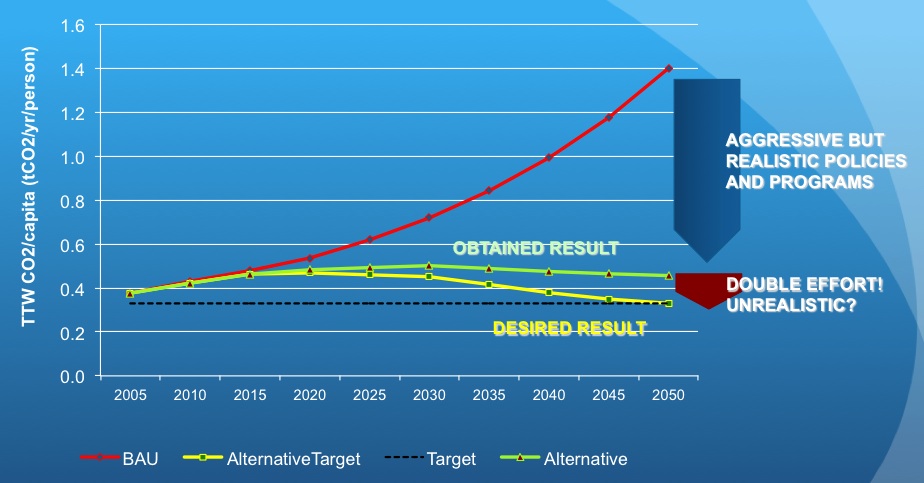 Graph of the result of backcasting for the Philippines using available transport data, policies and other information on various socio-economic and transport factors. (Image capture from the presentation by UP’s Dr. Regin Regidor)
–

