
Home » Posts tagged 'road safety' (Page 15)
Tag Archives: road safety
On slippery roads again
With the onset of the wet season, expect many roads to be slippery during and after rains. As such, extra care should be exercised by travelers especially motorists. It is easy to lose control of vehicles, especially motorcycles, when speeding or undertaking risky maneuvers like overtaking, counter flowing, and tailgating. Traffic enforcement units also need to be active in accosting motorists for risky behavior that may endanger the lives of not only the vehicle occupants but of other people as well like innocent pedestrians and cyclists minding their own business.
Following are a couple of photos of an incident along Sumulong Highway after rains in the area. Apparently, only a motorcycle rider was involved in what seems to be something that would be categorized as a “self accident”. No other motorists may have been involved although I suspect it could also be a case of a “near miss” where the rider lost control after almost hitting or being hit by an errant vehicle.

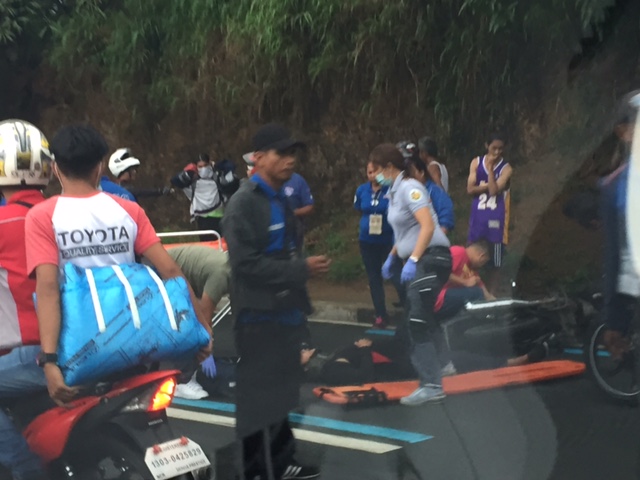
–
Back to school – concerns about congestion and safety
Many roads again are expected to become more congested as school resumes in most parts of the country especially in cities. But while congestion is usually the top issue along roads near many schools, one concern that usually takes a back seat to congestion is safety. Many public schools in the provinces are located along national highways. Many if not most of their students walk to and from school, usually on the carriageway when the shoulders are too rough, dusty or muddy. This situation for students increase the likelihood of their being hit by vehicles using the road. The risk increases because of their exposure to the dangers posed by motor vehicles. Following are a couple of photos showing typical cases at public schools along national roads. Both are in Antipolo City.
 Typical at-grade pedestrian crossing in front of a school. Students in most public schools often commute by walking or taking public transport like jeepneys or tricycles.
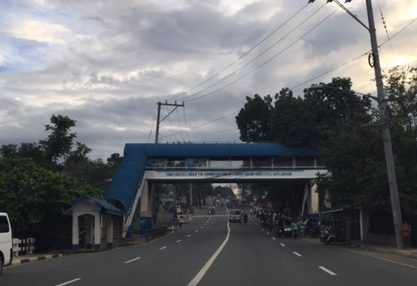 Despite this pedestrian overpass across a public school along Sumulong Highway, most students still prefer to cross on the road rather than go up and down the overpass.
Oftentimes, the seemingly obvious solution of constructing overpasses for safer crossings for students does not pan out as planned or intended. There are many underutilized pedestrian bridges since the natural way is still to cross at-grade. Then there is the issue of providing them safer walking paths or walkways. In both photos above, the sidewalks are only token (“puwede na iyan”) and insufficient for the pedestrian traffic supposed to use them. We need to plan, design and provide such facilities for our pedestrians, especially children, who are marginalized compared to those who have their own vehicles for travel.
–
Road crash at NAIA Terminal 1 parking area
[Warning graphic content]
Last May 30, I was picking up my wife at the airport and heard a loud crash as I was getting my ticket for the NAIA Terminal 1 parking lot. I looked around but could not see anything that could concern me. As I rounded the driveway though, I noticed the vehicles in front of me already slowing down. This was the scene that greeted us:
 Van in an awkward position against the bushes of the parking lot fence and after colliding with a parked SUV. Security staff were already there and one person (the driver of the van?) seemed out of sorts.
As I continued my drive, I saw this gruesome scene of a person who was likely hit by the van when it crashed into the limited access gate of the parking lot:
 The casualty of the incident was lying on the ground with security personnel apparently more concerned about the damaged gate than attending to the person.
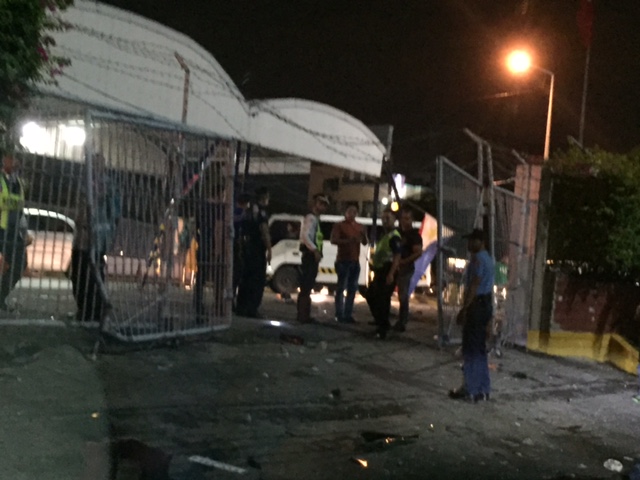 Another look at the damaged gate that the van punched through before finally crashing into the SUV and the bushes as shown in the first photo.
I’m not sure if this incident was featured in the news. It surely is something that would likely be not attract so much attention as it may not be as ‘newsworthy’ as other incidents that have happened recently. That is often the case with road crashes, which seem to be regarded as something typically occurring.
One thing we get and should realize from this is that everyone is indeed vulnerable from road crashes. The casualty in the photo (I assume only one) was likely someone who was there waiting for a relative or a client to arrive. Large groups and even whole families may be found at the airport parking lot as they wait for loved ones to arrive. The victim probably was just wiling his time, even texting people about his status, when tragedy struck that night.
–
Resources on traffic calming and recalling statistics on road safety in the Philippines
As I usually post on some interesting and useful articles on transportation and so I just couldn’t resist sharing this find on resources for traffic calming. This is always a timely source of material on how we can improve road safety particularly in residential areas or where there are more pedestrians exposed to transport and traffic. Such exposure increases the likelihood that they may be involved in a crash.
I recall an article from 2015 that appeared on Rappler:
Francisco, K. (2015) Road deaths in PH: Most are motorcycle riders, pedestrians, Rappler, http://www.rappler.com, October 27, 2015.
The WHO Global Status Report on Road Safety 2015 is a good resource for statistics and the report can be easily downloaded along with other information, and in different languages. Here is the entry for the Philippines appearing in the report:

–
On motorcycle taxis becoming the “new king of the road” (cont.)
This is a continuation of the yesterday’s post on motorcycle taxis. The feature appearing in Sunstar Philippines also focuses on the case of Cebu City where there is a rising demand for motorcycles and issues on public transport have given rise to a motorcycle taxi use despite their being basically illegal under current laws/guidelines. Habal-habal as these motorized 2-wheeler taxis are known have been in service in many cities and municipalities but are mostly tolerated in rural areas where conventional public transport services are scarce.
Part II of the feature by Sunstar:
New King of the Road – Part II
There are three articles in Part II:
Ramirez, J.A.C. (2017) Motorcycles on the rise, Sunstar Philippines, Retrieved from: http://www.sunstar.com.ph, April 4.
Ramirez, J.A.C. (2017) Habal-habal drivers form group to ‘professionalize’ services, Sunstar Philippines, Retrieved from http://www.sunstar.com.ph, April 4.
Ilano, M.V. (2017) Hailing a motorcycle taxi with your smartphone, Sunstar Philippines, Retrieved from http://www.sunstar.com.ph, April 4.
Part III of the feature by Sunstar:
New King of the Road – Part III
Ilano, M.V. (2017) Even with BRT, motorbikes still needed in Cebu City, Sunstar Philippines, Retrieved from www. sunstar.com.ph, April 4.
Ilano, M.V. (2017) Will Cebu City lead the way?, Sunstar Philippines, Retrieved from http://www.sunstar.com.ph, April 4.
I hope these articles on motorcycles and motorcycle taxis will generate meaningful discussions pertaining to their applications and perhaps their regulation. One issue, of course, that should definitely be on the table is safety. That is non-negotiable and assurances by motorcycle taxi transport providers should not be enough to persuade their becoming formalized as a public transport mode. The basis for mainstreaming these should be evidence-based including assessments based on crash (accident) data. Here is something that can be studied by the various schools around the country especially universities that have the capacities and capabilities to conduct such studies in aid of policy formulation at the national and local levels.
–
On motorcycle taxis becoming the new “king of the road”
There is a really nice feature on Sunstar about motorcycle taxis that came out today. This was shared by a good friend on his social media account, which got my attention as we just completed a study on motorcycles last January 2017. Here is the feature:
Part I includes two articles:
Ilano, M.V. (2017) Habal-habal invades cities, Sunstar Philippines, Retrieved from http://www.sunstar.com.ph, April 4.
Anunciado, D.D. (2017) Deadly motorcycle rides, Sunstar Philippines, Retrieved from http://www.sunstar.com.ph, April 4.
Here’s a graphic from the second article that says a lot about motorcycle safety in Metro Manila:

I would just like to comment that the graphic shows MMDA-recorded crashes in Metro Manila. There can be a lot of incidents that went unrecorded or unreported with the MMDA. It would be interesting to check with the local government units about their own statistics and compare these with the MMDA’s. Also, “crashes” is the preferred term over “accidents” as road safety practitioners and advocates argue that these are preventable incidents.
Sadly, such statistics can only be shown by cities doing the diligent work of recording such incidents. The Department of Public Works and Highways (DPWH) has already ceased collecting, processing, analyzing and reporting road crash reports many years ago (which is quite surprising for an agency mandated to plan, design, construct and maintain national roads). There is currently no agency (no, the Department of Transportation (DOTr) has not yet taken over the enormous task) that is collecting, processing, analyzing and reporting on road crashes at a nationwide scale and few LGUs do so at their levels.
I will also post about Part II once its out. There is a preview of what articles will be in the next feature and so that is something to look forward to.
–
Responding to the transport impacts of road crashes
Last March 9, traffic was terrible along Marcos Highway and roads connecting to it including Imelda Avenue and Sumulong Highway due to a truck that slammed into the scaffolding of the Line 2 Extension across the Sta. Lucia Mall, and barely missing the newly constructed column supporting the girders and elevated tracks of Line 2.
 [Photo not mine but sent by an officemate who was glad to have taken his motorcycle that day instead of commuting by car.]
Following are comments I captured from Waze as I tried to get information about the traffic situation:


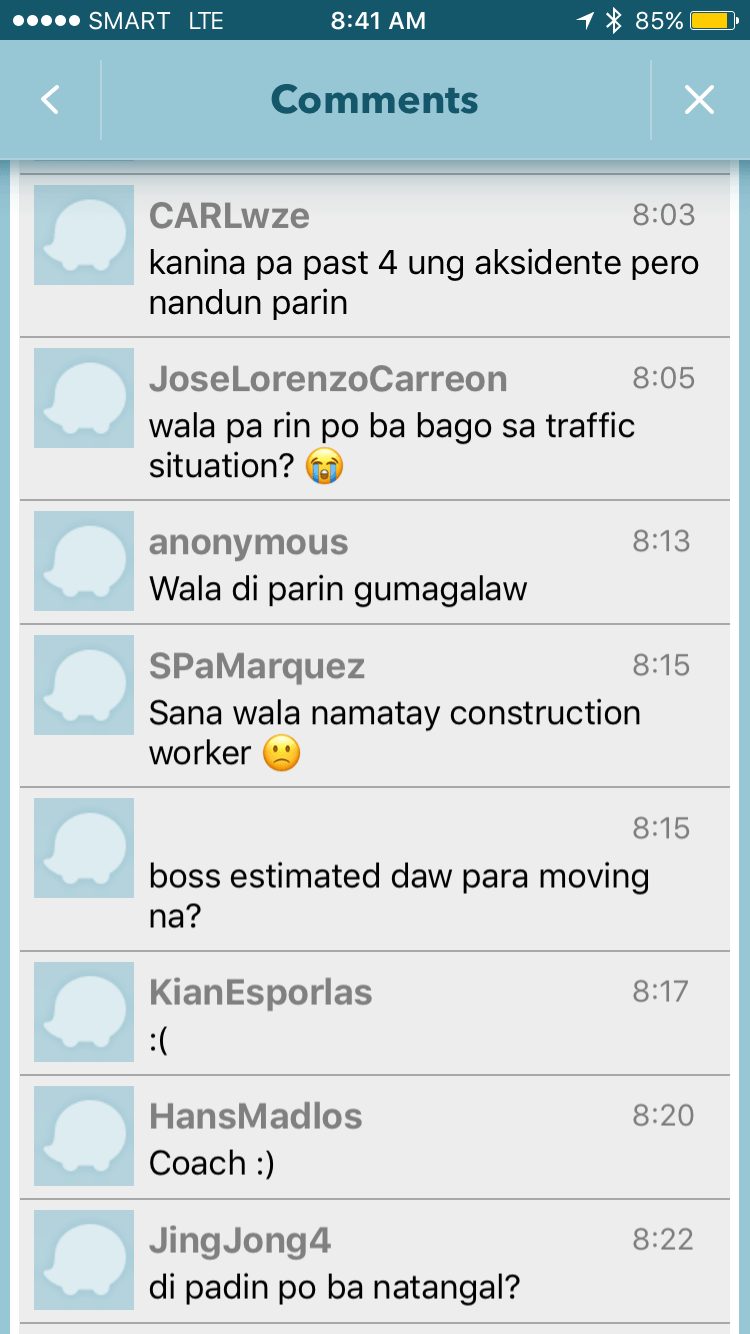
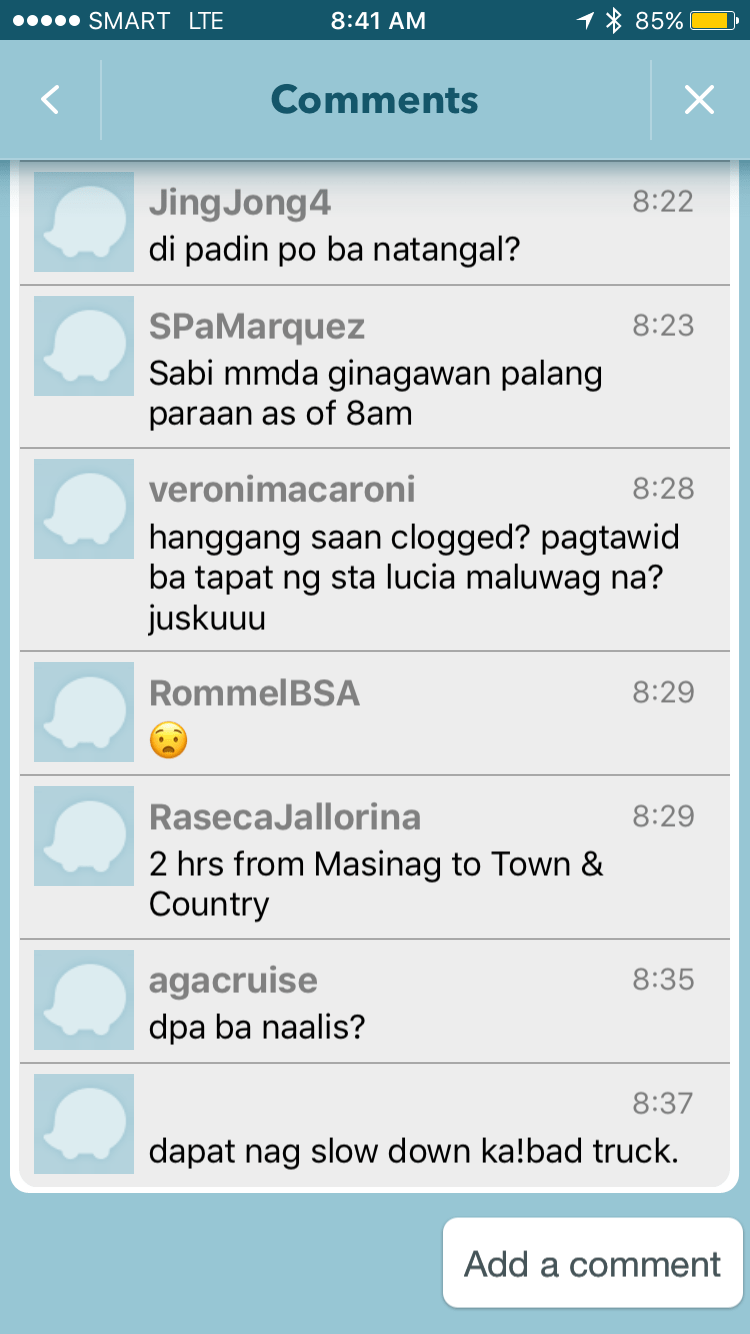
It is very clear from travelers’ comments that most were frustrated and many were angry about what seemed to be a very slow response from authorities in clearing the crash site and getting traffic to move faster. I myself wondered how a crash like this with its impacts manifesting in severe congestion along major roads was not dealt with as urgently as possible by so many entities that were not without capacity to act decisively. The front liner should have been the Metropolitan Manila Development Authority (MMDA) and there were at least four local government units directly affected by the congestion: Pasig, Marikina, Cainta and Antipolo. Surely, these LGUs could have done more if the MMDA couldn’t, in order to resolve the problem? If the availability of heavy equipment was an issue, weren’t there available equipment from Line 2 contractor, DMCI, or perhaps from the construction sites nearby (Ayala is constructing a huge mall near the area.)? Surely, they could lend a payloader or mobile crane that can remove the truck or at least help unblock the area?
I finally decided to turn back and work from home instead that day. Later, I learned that authorities had to stop traffic along Marcos Highway around 11:00 AM in order to tow the truck and clear the area for traffic to normalize. I hope this serves as a lesson in coordination among government entities and that future incidents like this will not results in a “carmaggedon” like Friday’s congestion. One thing that also became obvious is that travelers passing the area are all dependent on road-based transport and the primary reason why a lot of people were affected by the crash. The expanded operations of the Line 2, whenever that will be, will surely change transport in these areas and for the better.
–
On vulnerability to crashes
A beloved aunt was hit by a jeepney as she walked to church yesterday. She was walking on a local road that didn’t have any pedestrian sidewalks because this was in a residential neighborhood with very low vehicular traffic. She sustained serious injuries and was brought to the hospital by the jeepney driver (good thing he did not flee as many likely would have done) and people who witnessed the incident. She is now in critical condition, unconscious and would likely have a very difficult time recovering considering her advanced age if she pulls through. Senior citizens involved in accidents, whether domestic or crashes like this, and who have sustained injuries like hers (i.e., fractured bones and damaged). Her prognosis is not so good and a cousin says it will take a miracle for her to recover from this very traumatic incident.
Many of us do not care about road safety and do not concern ourselves with making an environment that’s safe for all users. That is, until we or someone close to us become victims of crashes. What do we do about this? Do we become instant advocates of road safety? Do we suddenly look for initiatives that we can be a part of? Do we do the talk circuit and find opportunities to share our experiences and give our two centavos worth of advice? Did we really have to wait for these things to happen before we become active in promoting and realizing road safety? Or do we start now and become proactive whether or not we think we ourselves are vulnerable? We are all vulnerable road users. We are all potential victims or participants in crashes. And so we should all be involved in making or enabling a safer environment for everyone.
–
Addressing concerns about hazardous work-sites along Sumulong Highway
The concern about hazardous worksites along Sumulong Highway that I wrote about earlier this week has apparently been addressed. Here are a few photos of those areas and prominent in the photos are the concrete barriers set up by the contractor with “DPWH” painted on each barrier. These are the same barriers that they mass-produced and were just sitting in the project office nearby and not utilized until very, very recently.


While these areas still pose significant risks to road users. These are not a continuous barrier with only yellow tape connecting them, and people and vehicles can still easily get through between the gaps. Yet, these will do (for now) and is better than nothing. Perhaps, though, the DPWH and LGUs like Antipolo City can do a better effort to compel contractors to improve safety in work sites like this in order to minimize the likelihood of crashes or accidents.
–
Hazardous worksites along Sumulong Highway
There are hazardous worksites along Sumulong Highway. These are related to current drainage works and construction of pedestrian facilities (sidewalks) along the highway. Travelers can see the steel reinforcing bars (rebars) sticking out and posing risks to road users. Following are some photos we took as we traversed the stretch near La Montana, Palos Verdes and Cavaliers Village.
 Highway drainage works along Sumulong Highway
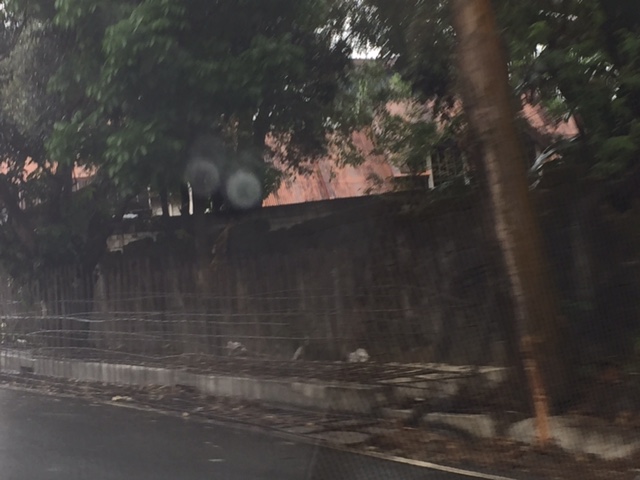 Steel reinforcing bars sticking out of the drainage works along the Masinag-bound side of Sumulong Highway.
 More hazardous worksites
 Unmanned and unfinished worksite along Sumulong Highway. Pedestrians, cyclists and motorcyclists seem unfazed by the hazard posed by the rebars.
These pose dangers to most road users and especially motorcyclists and cyclists who may experience a spill that can lead to riders being impaled by the rebars. The contractor definitely is violating safety codes in as far as construction sites are concerned and these are in plain view of the public. The DPWH as well as the local government of Antipolo City should act immediately and decisively in order to prevent untoward incidents concerning such worksites. There should be measures such as physical barriers that would protect road users against such hazards. There are currently none.
–
 Caught (up) in traffic