
Home » Posts tagged 'road safety' (Page 7)
Tag Archives: road safety
On making streets safer through woonerfs
One of the new things I learned when I was taking up transportation planning as an undergraduate student in the 1990s was about the woonerf. Our teacher then was a Visiting Professor from the Tokyo Institute of Technology. He introduced to us many concepts in that elective course that paved the way to a number of us proceeding to specialize in transportation. What is a woonerf? Well, here’s a nice article defining the woonerf and providing some examples:
Ionescu, D. (October 6, 2022) “What is a Woonerf?” Planetizen, https://www.planetizen.com/definition/woonerf?utm_source=newswire&utm_medium=email&utm_campaign=news-10062022&mc_cid=9d60b3d668&mc_eid=9ccfe464b1 [Last accessed: 10/10/2022]
To quote from the article:
“Translated as “living street,” a woonerf employs strategies like traffic calming devices and low speed limits to force drivers to slow down and safely share street space with pedestrians, cylists, and others, often without raised curbs separating cars and pedestrians. In the Netherlands, where the woonerf originated in the 1960s, motorized traffic within woonerf zones is limited to walking speed…
…A woonerf is not a pedestrianized street, but rather one where multiple users and vehicles co-exist. However, a woonerf can be converted to car-free uses using bollards or other barriers. The woonerf maintains utilitarian uses like loading docks and parking while making the roadway safer and more accessible to non-drivers.”
There should be many applications to the woonerf in the Philippines especially in areas where the dominant land use is residential and through traffic should be discouraged. This is goes well with the complete streets concept that is now being promoted and in fact pre-dates the concept and was well ahead of its time.
–
On animal – vehicle collissions
We feature a different type of road crash today – one involving wildlife and vehicles. This is not something new as I am sure you’ve seen all those road kills (usually cats or dogs) along many of our streets and highways. These don’t even include the frogs, birds and other animals that are killed by motor vehicle traffic. Here is an informative article on such crashes or collisions and what can be done to address them.
Skroch, M. (October 4, 2022) “The dreadful toll of wildlife – vehicle collisions – and what we can do about it,” Governing, https://www.governing.com/now/the-dreadful-toll-of-wildlife-vehicle-collisions-and-what-we-can-do-about-it [Last accessed: 10/10/2020]
To quote from the article:
“Advances in research technology over the past decade have revolutionized experts’ understanding of how wildlife move across landscapes and are now helping to resolve wildlife-vehicle conflicts that are rising due to increased development. One example is GPS collars that are affixed to big game, as well as other mammals and birds, and transmit electronic signals via satellite from some of the most remote regions in the U.S. to researchers throughout the country. This data captures exactly where and when animals move within large landscapes, enabling scientists and engineers to pinpoint where the construction of wildlife crossings — mostly overpasses and underpasses that help animals traverse highways — can most effectively improve motorist safety and facilitate animal migrations. Studies show that a well-placed underpass or overpass can reduce wildlife-vehicle accidents by over 90 percent, providing a high rate of return on federal and state investments in such structures.”
–
Back to the old normal in road safety?
Last week, I almost witnessed a multiple vehicle crash along Katipunan Avenue. Almost because we reached the location minutes after the incident happened and before the traffic build-up. Here are photos as we passed the area. You can see from the photos that there were already a lot of onlookers (i.e., miron and usyoso), most of whom were motorcycle riders taking photos of the vehicles involved. No one seemed to be helping those involved aside from the MMDA personnel who appeared to have just arrived as we passed the area.
 Miron and usyoso in the area near where a large truck plowed to the roadside near a residential area
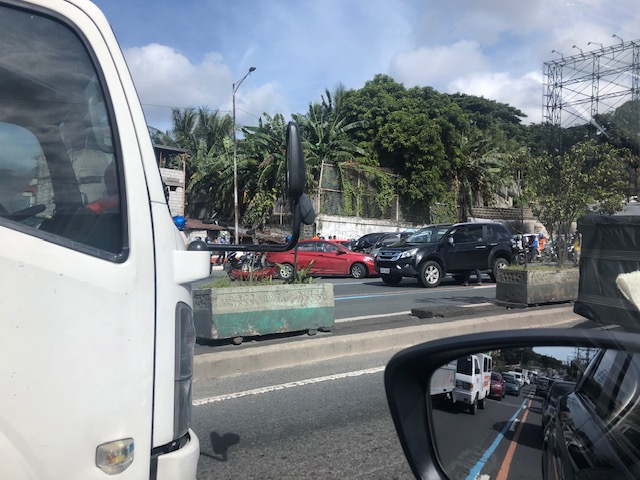 Some of the vehicles involved in the crash were this black SUV and the red car
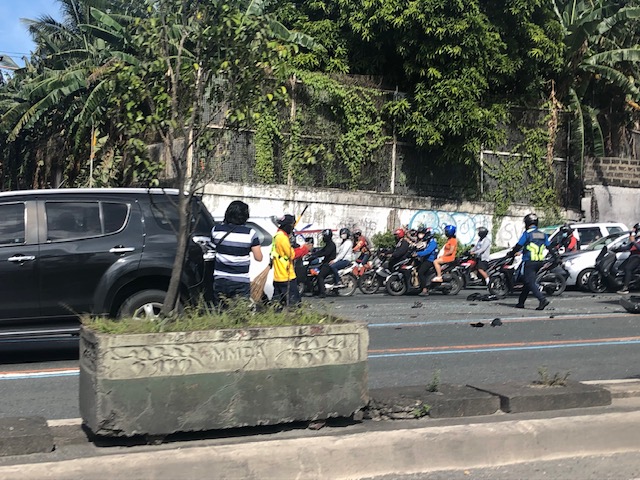 There were scattered debris from the vehicles involved.
 This truck and SUV collided probably as the truck attempted to avoid one of the vehicles
 Traffic jam quickly formed along the southbound side of the Katipunan-Aurora flyover
Traffic along the southbound side of Katipunan is usually heavy that time of day (around 8:00 AM). But there are sections including the flyover where vehicles typically speed up. Still, the likelihood of crashes is perceived to be low given the conditions unless a vehicle such as the truck in the first photo had some trouble with the driver losing control of the vehicle. It takes just one wayward maneuver or movement to initiate a chain reaction among other vehicles that would lead to a multiple vehicle crash.
Traffic has steadily returned to pre-pandemic levels and it seems that road crashes are also back and on the rise. Hopefully, the authorities such as the MMDA and the PNP will be monitoring traffic closely and address the issues contributing to road crash incidence such as reckless driving and defects in road facilities. I believe the data is available but are these being analyzed and evaluated in order to come up with the most suitable or appropriate solutions or countermeasures? Are there timely interventions to improve road safety along our roads?
–
Towards safer streets – on the best street improvements
We conclude the month of September with an article on road safety and particularly on best or good practices towards improving safety:
Brey, J. (September 16, 2022) “What Are the Best Safe-Streets Improvements,” Governing, https://www.governing.com/community/what-are-the-best-safe-streets-improvements [Last accessed: 9/29/2022]
The article points to improvements concerning pedestrians have the best results in terms of reducing the injury rose and death. To quote from the article:
“The data suggested that interventions which give more street space to pedestrians have the best results for lowering the risk of serious injury and death. Somewhat to the department’s surprise, that includes curb extensions, also known as “neckdowns,” which reduce the distance that pedestrians have to cover to cross a street. Those interventions were associated with a 34.1 percent decrease in deaths and serious injuries, according to the report.”
There is an interesting table in the article listing the top safety treatments in terms of injury change and KSI (killed or seriously injured) change. For the latter, the top treatments in order of highest change are:
- Pedestrian island
- Curb & sidewalk extensions
- Road diets
- Leading pedestrian intervals
- Protected bike lanes
- Turn calming
- Conventional bike lanes
With the push for more segregated bike lanes (as opposed to shared lanes), it is interesting to note from the article that:
“Another important takeaway was that conventional bike lanes, which involve little more than paint, did result in significantly fewer deaths and serious injuries. Protected bike lanes, which are separate from traffic by medians, parking space or other infrastructure, were more effective — but painted lanes are also useful…”
This a good reference and taking off point for those who are doing studies on road safety and want to contextualize it from the perspective of the complete streets concept.
–
On gender and transportation safety
There was a nice discussion among colleagues about which among male or female drivers were the safer motorists. My take based mainly on observations is that female drivers were safer or practiced safe driving and riding more than males. Road crash data should be able to validate (and perhaps support) this observation. My colleagues were also in agreement with this view. Here is an article providing some statistics from the US that clearly show female to be safer drivers and riders:
Egan, L. (August 17, 2022) “Road To Zero Fatalities: Male vs. female drivers,” KSLTV.com, https://ksltv.com/503038/road-to-zero-fatalities-male-versus-female-drivers/ [Last accessed: 9/2/2022]
Some quotables from the article/report:
“The girls are more teachable, they want to learn how to be a good driver,” he explained. “The boys really do think they already know how.”
In 2020, males accounted for 72% of all motor vehicle crash deaths and 92% of motorcyclist deaths, according to the institute’s analysis of data from the U.S. Department of Transportation.
In Utah, crash data from 2017 to 2021 showed that 85% of motorcycle crashes involved males, according to the Utah Department of Public Safety.
“Males are more prone to make riskier decisions and tend to be a little more thrill seeking,”
Again, we need to get the data and present these in a meaningful way. You can take the cue from the article above how data can easily be presented to provide insights to driver and rider behavior. More information or details (e.g., age, years of experience in driving/riding, etc.) can lead to even deeper analysis that will allow us to draw or formulate suitable measures to improve safety for everyone.
–
On using advanced tools for infrastructure assessments
I came upon this article on how transportation departments in the US are using tools such as drones to assess critical infrastructure including roads and bridges. This is very relevant to us especially as many similar infra are aging and would need to be assessed to determine how to reinforce, retrofit or even rehabilitate certain infrastructure vs. naturally occurring phenomena like earthquakes and typhoons.
Reed, J. (August 2, 2022) “How Transportation Departments Are Using Advanced Drone Technology for Infrastructure Assessments,” Aviation Today, https://www.aviationtoday.com/2022/08/02/transportation-departments-using-advanced-drone-technology-infrastructure-inspections/ [Last accessed: 8/4/2022]
To quote from the article:
“The WVDOT may expand its drone programs to perform road safety assessments and to assist in designing new road routes by providing topographical maps.”
I recall that there have been road-based surveys involving Lidar to map the road and adjacent land surfaces about a decade ago (maybe less). This was a nationwide project funded by the Department of Science and Technology (DOST) and implemented by the University of the Philippines Diliman’s Department of Geodetic Engineering. I’m not sure where that data is stored or hosted but the DGE should have a back-up somewhere that can be used or further processed for road safety assessment applications. This could be an interesting and fruitful research area that can involve people from various disciplines.
–
Star ratings for bicycles
I just wanted to do a quick share of a new method for evaluating road and bicycling infrastructure – cycleRAP. This was developed by the International Road Assessment Program (iRAP), which has established a star rating system as the international standard for road safety assessments. We currently use their Star Ratings for Schools (SR4S) to evaluate the school environment towards ensuring safe journeys for school children. Here’s the link to their website:
To quote from the site: “CycleRAP is an easy, affordable and fast method of evaluating road and bicycling infrastructure for safety. It aims to reduce crashes and improve safety specifically for bicyclists and other light mobility users by identifying high risk locations without the need for crash data.”
–
On how traffic enforcement enhances road safety
It seems to be a no-brainer and has always been an assumption to many traffic engineering studies including those employing simulation to determine the outcomes of various scenarios involving transportation. The element that is traffic enforcement, however, cannot be assumed as something uniform across countries, cities, barangays or even individual road sections and intersections (yet we often do assume uniformity and a certain level of strictness).
Here is an article that reports on new research pertaining to how the enforcement of traffic laws makes roads safer:
Mohn, T. (June 8, 2022) “Enforcing traffic laws makes roads safer, new research shows,” Forbes.com, https://www.forbes.com/sites/tanyamohn/2022/06/08/enforcing-traffic-laws-makes-roads-safer-new-research-shows/?sh=74b03c97591e [Last accessed: 6/10/2022]
To quote from the article:
“High visibility enforcement of traffic safety laws actually works. When carried out, regulations governing driving have a positive and measurable impact on safety by reducing dangerous behaviors behind the wheel that put road users at risk…
““Enforcement alone will not solve the traffic safety crisis,” Adkins added. “We cannot simply enforce, build, design or educate our way out of this problem. The Safe System necessitates a comprehensive approach for achieving our collective goal of zero traffic deaths, including equitable enforcement that focuses on risky driver choices that endanger all road users.”
The article points to new research published by the US National Highway Traffic Safety Administration. The synthesis to that research may be found here while the full report is found here.
Such research and articles are very relevant especially as incidents like the one involving a driver running over an enforcer become viral and bring to the forefront traffic enforcement or the lack of it (some will word it differently – like why many drivers don’t follow traffic rules and regulations). The discussion must continue especially in the context of road safety.
–
On the right to a walkable life
Here is an article from a perspective that’s very relevant today everywhere. We need to examine our daily routines particularly when it comes to commuting or moving about. Do we live in walkable communities? Is walking to certain places like school, the market, or the office an option to many of us? Or do we automatically choose to ride a car, a tricycle or motorcycle to get to these places?
Malchik, A. (May 13, 2022) “Driving is killing us,” Medium.com, https://antoniamalchik.medium.com/driving-is-killing-us-6a1b35158458 [Last accessed: 5/28/2022]
To quote from the article:
“Ask yourself this question: if you stepped foot outside your door, would you be able to walk anywhere you needed or wanted to go? Can you walk to a store, a library, school, or work? If your answer is “no,” what’s stopping you? Distance, highways, private property, broken or absent or inaccessible sidewalks? …
The loss of walking as an individual and a community act has the potential to destroy our deepest spiritual connections, our democratic societies, our neighborhoods, our freedom, our health, and our lives. But we can reclaim it. We can start to make a world that welcomes the walker, the pedestrian, rather than paving over that incredible human inheritance.”
I myself have enjoyed the benefits of walking when I was a college student in UP, when I was studying abroad in Japan, when we lived in Singapore and now in our community in the midst of the pandemic. I always think about opportunities and even schedule times for walking. Nowadays I am even conscious of my daily step count, which I equate with being active.
–
On phasing out cars in cities
I’m sharing another article on reducing car dependence. The article was referred to by the previous series that I shared recently.
Nicholas, K. (April 14, 2022) “12 best ways to get cars out of cities – ranked by new research,” The Conversation, https://theconversation.com/12-best-ways-to-get-cars-out-of-cities-ranked-by-new-research-180642 [Last accessed: 5/20/2022]
Here are a few excerpts from the article:
“Question: what do the following statistics have in common?
The second-largest (and growing) source of climate pollution in Europe.
The leading killer of children in both the US and Europe.
A principal cause of stress-inducing noise pollution and life-shortening air pollution in European cities.
A leading driver of the widening gap between rich and poor urban residents.Answer: the vehicles on our streets, primarily the not-so-humble passenger car.”
also this:
“The research is clear: to improve health outcomes, meet climate targets and create more liveable cities, reducing car use should be an urgent priority.”
and this:
“To meet the planet’s health and climate goals, city governments need to make the necessary transitions for sustainable mobility by, first, avoiding the need for mobility (see Paris’s 15-minute city); second, shifting remaining mobility needs from cars to active and public transport wherever possible; and finally, improving the cars that remain to be zero-emission.”
You can also listen instead of reading it as it is a narrated article.
–
 Caught (up) in traffic