
Home » Posts tagged 'safety' (Page 2)
Tag Archives: safety
Safety or speed?
We start June by sharing a video on why safety and vehicle speed are incompatible:
I saw this video while browsing an article on “Dangerous by Design”. The article discusses a new publication where road designs are evaluated from the perspective of safety. Most of our roads have been designed with speed in mind. That is, how to facilitate the movement of motor vehicles to ensure they travel faster. Forgotten or, even worse, disregarded is the most important element of safety. Why do we widen roads or insist on higher speeds in populated areas or school zones? Such questions are not addressed directly or not answered at all by agencies in charge of planning, designing, constructing and maintaining roads and bridges. The same is true for agencies or units in charge of traffic regulations or management. The result not surprisingly is an increase in the number of road crashes, fatalities and injuries due to our roads being ‘dangerous by design’.
–
On non-roadway traffic deaths and incidents
I found this interesting article about non-roadway crashes or incidents that may cause deaths. These are often recorded in buildings including parking lots or facilities but are not generally collected and reported by governments as part of road crash data.
Wilson, K. (April 18, 2024) “Why Does the Vision Zero Movement Stop At the Edge of the Road?,” Streetsblog USA, https://usa.streetsblog.org/2024/04/18/why-does-the-vision-zero-movement-stop-at-the-edge-of-the-road [Last accessed: 4/28/2024]
From the article:
“According to the latest report from the National Highway Traffic Safety Administration, a shocking 3,990 people died in car crashes that occurred outside of the traditional transportation space in 2021, the last year for which data is available. One-quarter of those people were outside vehicles, including, pedestrians, cyclists, wheelchair users, and even children simply wishing their parents goodbye before they were accidentally run over by the caregivers who loved them most; all lost their lives after they were struck by drivers on private property, like parking lots, driveways, drive-thrus, and private roads.”
These crashes very likely contribute to under-reporting. One wonders, for example, how many incidents occur in mall parking lots, schools and subdivisions. Recall the incident in Ateneo years ago when a child got ran over and killed as students were being dropped off in the morning. Surely there are other incidents though not involving deaths, and these need to be recorded among traffic incidents. The deaths need to be included in the reports. These are important information to complete the picture of road traffic safety in any country including the Philippines.
–
A risky mode choice – recumbent bike
I spotted this cyclist along Ortigas Avenue Extension. He would be hard to notice considering how low the vehicle is and his position astride the bicycle.
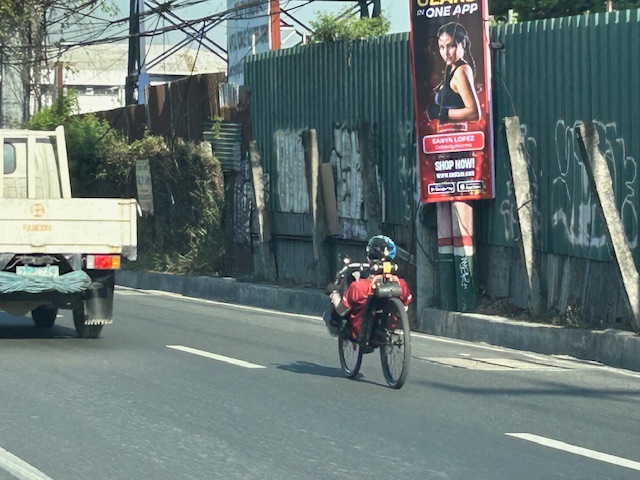 Man on a recumbent bike probably on his daily commute. Note the bike and its rider as compared with the small truck.
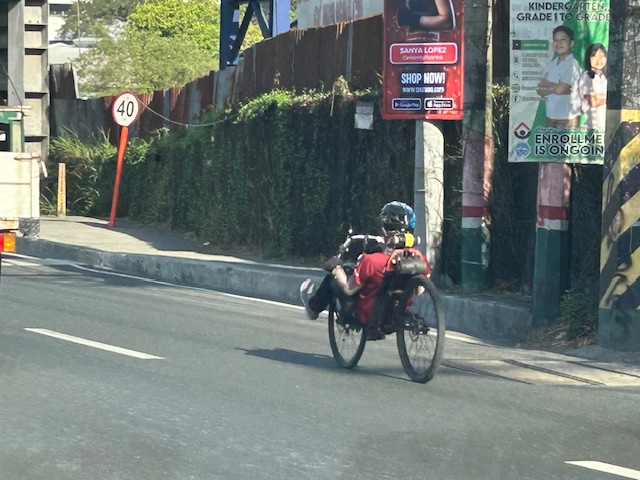
The problem is concerning his visibility to regular or typical road users. He might not be visible for the larger vehicles like trucks and buses, even jeepneys and vans whose drivers may be distracted by other vehicles in the traffic mix.
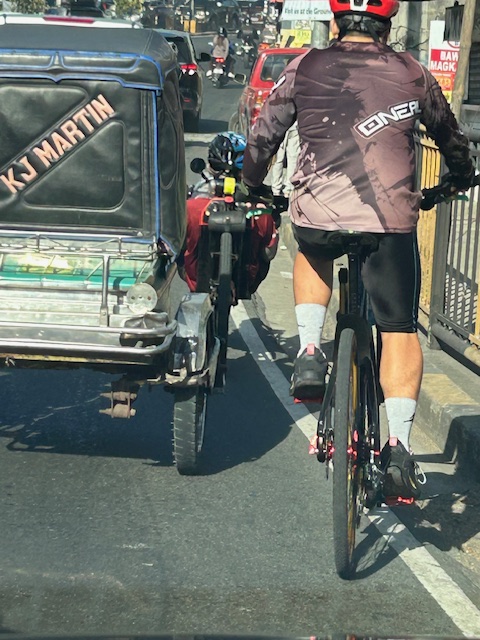 Comparison with a typical cyclist, who is quite visible as shown in the photo
–
Article share: the safest airplane makers
I found this very interesting (to me) article on what are supposed to be the safest airplane makers and the safest airplanes.
Borba, L. (December 16, 2023) “What Are the Safest Airplane Makers in the World?” Medium, https://medium.com/the-expatriate-guide/what-are-the-safest-airplane-makers-in-the-world-8c9a90f48707 [Last accessed: 3/8/2024].
I won’t quote from this article and leave it up to you to read and find out for yourself what the safest maker is and what the safest plane is. There are also information here about the opposite. That is, about the least safe manufacturer and planes.
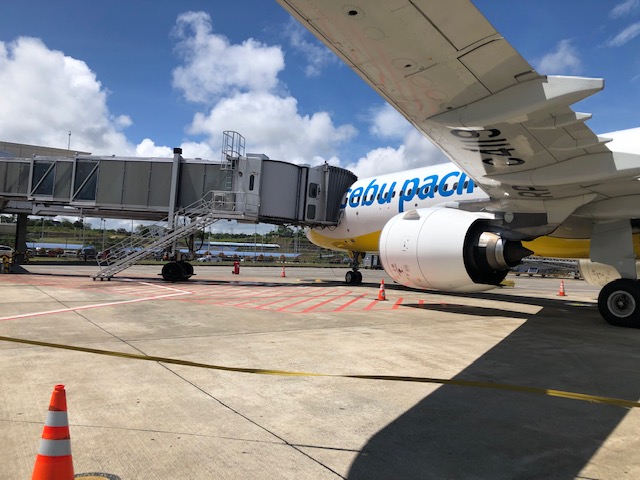 An Airbus A321 plane on the ground at NAIA
–
Article share – on aircraft evacuations and the case of JL516
Here is a very informative article on aircraft emergency evacuations, particularly the case of the recent JAL 516 where all passengers and crew were able to evacuate the burning aircraft.
Tamura, Y. (January 7, 2024) “Why the Evacuation of 379 Passengers from the Burning JAL516 Wasn’t a Miracle,” Medium, https://medium.com/japonica-publication/why-the-evacuation-of-379-passengers-from-the-jal-collision-wasnt-a-miracle-8a03cb02a95c [Last accessed: 3/4/2024]
To quote from the article:
“Japan is said to have become earthquake-resilient over the decades, but it’s less known that the same applies to aircraft accidents.
As the oldest Japanese airline company partially founded by the government in 1951, the history of JAL encapsulates the narrative of Japan’s aviation industry, punctuated by significant accidents.
It is none other than JAL that experienced the worst-ever airplane crash in the world. In 1985, JAL123 crashed into a mountain approximately 100 km from Tokyo.
The crash, believed to have been triggered by improper maintenance of the aft pressure bulkhead, caused 520 fatalities, the largest loss of life in a single aircraft.A former JAL employee comments that those who have survived traumatic incidents often grapple with returning to their duties in the sky. Despite this difficulty, they also carry a deep sense of responsibility to impart their experiences to younger crew members, contributing to the commitment to safety.
I agree that the successful evacuation was not a miracle but a product of the training and dedication of the staff as well as the culture and behavior that was very obviously Japanese. One wonders what could have happened if this were, say, an airliner from a third world country? Or perhaps even one from a country like the US? Would the evacuation have been successful like JL516’s?
–
Solar road studs for Ortigas Avenue Extension bike lanes
The bike lanes along Ortigas Avenue Extension now have solar road studs for these to be more visible at night time or when it is dark. Following are photos of the bike lanes at night.
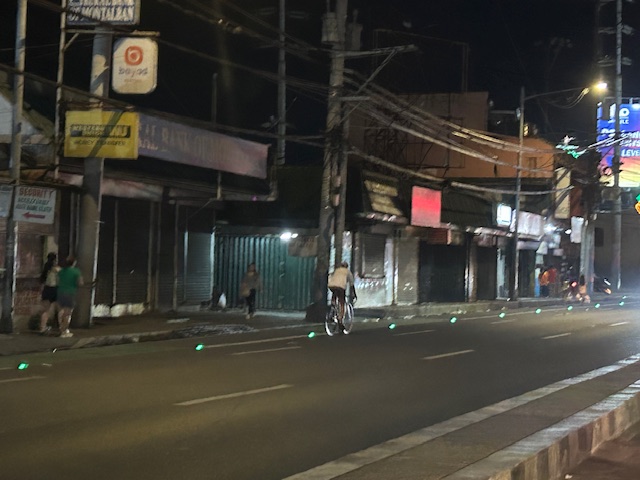
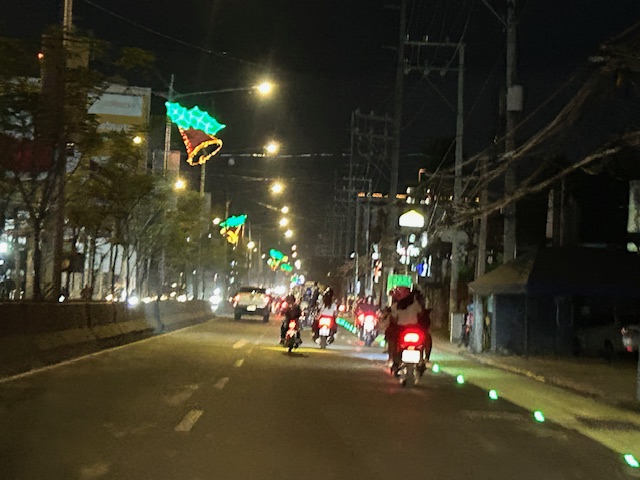
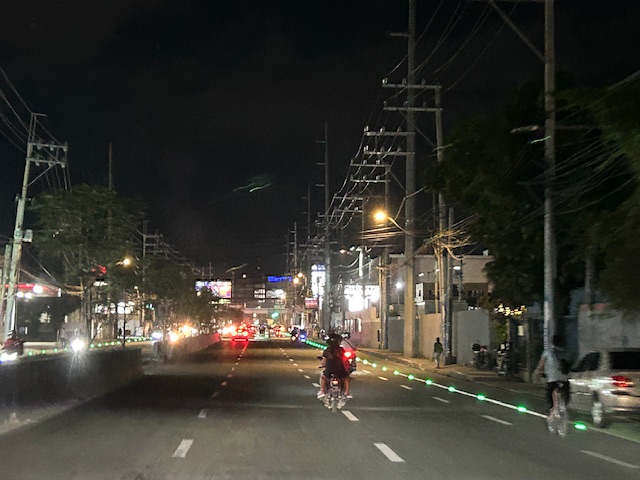
While the studs enhance the visibility of the bike lanes and perhaps also the safety of cyclists, the latter is not assured. The bike lanes are not protected and physical barriers like those installed along Quezon City roads are most effective in ensuring the safety of cyclists against motor vehicles. The solar studs do not deter motor vehicle drivers from encroaching on the bike lanes so they appear to have minimal impacts on safety.
–
On recent airline incidents in Japan and the US
There were two recent incidents involving airlines the past days. One was on a collision as a Japan Airlines Airbus A350-900 jet arrived at Haneda Airport in Tokyo. The other was a midair incident where an Alaskan Airlines Boeing 737 Max 9 plane lost part of its fuselage. While both are troubling, the first incident provided a good example of how emergency evacuations should be. The second incident reminds us of the importance of aircraft maintenance and tests to make sure planes are safe for use by passengers.
To quote from a New York Times article on the Haneda Airport incident:
“In addition to a well-trained crew and an advanced plane, the safe evacuation of 367 passengers came down to a relative absence of panic.”
I think that basically described “how to survive a plane crash” in the context of the collision at the airport, where passengers and crew had to evacuate the plane immediately.
Meanwhile, the B737 Max crash is a cause of concern since the model was already involved in previous crashes that caused the planes to be grounded worldwide. There will be an investigation on this incident and perhaps the outcomes can help address the problems concerning the aircraft. On the business side, such incidents will further convince airliners to reconsider acquisition and operations of these planes. I am sure they are already thinking about replacing the B737’s with the competition’s aircraft (e.g., A319, A320 or A321).
–
Happy New Year and Safer roads for 2024!
We conclude 2023 and begin 2024 with hopeful greetings for everyone especially for the coming year!
Last December 18, 2023, an event was held in Quezon City for the launch of the Global Status Report on Road Safety 2023 by the World Health Organization (WHO) and the signing of a Memorandum of Understanding for Child Road Traffic Injury Prevention (CRTIP) by the UN Children’s Fund (UNICEF). Advocates of road safety were gathered for the launch and the MOU signing including top officials of the Department of Transportation, which is the lead agency for the initiative.

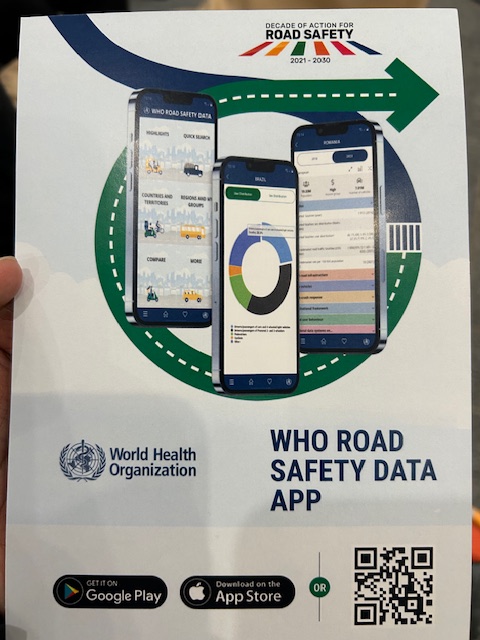 Information and links to the WHO Road Safety Data app. The app is available on Google Play and the Apple App Store. You can also scan the QR code in the photo to get the app and install it on your gadget.
 Representatives of the various agencies, offices and groups who signed the MOU for the National Coalition for Child Road Traffic Injury Prevention (NC-CRTIP).
 Participants to the MOU signing and Philippine launch of the WHO’s Global Status Report on Road Safety 2023
I learned there that the DOTr intends to reconstitute an inter agency committee on road safety. This is a throwback to the Road Safety Steering Committee and Technical Working Group during the time of then President Gloria Macapagal-Arroyo and then DOTC Secretary Leandro Mendoza that was co-chaired by the DOTC and DPWH. People were able to discuss road safety along various contexts and formulate programs and projects involving many if not most of the agencies and organizations at the time. These same agencies and organizations plus many others are still actively campaigning for safer roads or safer streets. Unfortunately, many are not talking with each other and there are those who seem to assume that there were no effort before to make transportation safer (sorry not sorry for pointing that out quite bluntly here). I am hopeful that this committee will be reconstituted this 2024 and that will lead to safer roads for everyone.
–
On making intersections safe by ‘daylighting’
I came across this interesting article that introduced a somewhat new term to me – daylighting.
Abramson, B. (November 24, 2023) “How to Daylight Your City’s Intersections (and Why It Matters),” Strong Towns, https://www.strongtowns.org/journal/2023/11/24/how-to-daylight-your-citys-intersections-and-why-it-matters [Last accessed: 12/3/2023]
From the article:
“Daylighting is the technical term for a common-sense solution to traffic safety: By removing visual obstructions in approaching intersections, users can better see and more safely cross each other’s paths. “
There are certainly many intersections and even mid-block crossings in our cities and municipalities that could use ‘daylighting’ to improve safety. Many of these intersections and crossings are used by the most vulnerable road users like children, senior citizens and persons with disabilities. Interventions need not be expensive and may also involve the community. Examples are shown in the article, and these can easily be implemented formally or informally with the cooperation of stakeholders including the local government units and national agencies (i.e., DPWH) under whose jurisdiction many roads are.
–
Article share: on aviation security
I found this article on Israel’s national airline, El Al, being the “most secure airline” in the world. That is, the airline has the capability to evade threats like missiles launched against it (i.e., to shoot a plane down). Here is the link to the article on Medium:
I am not aware of other airlines having similar capabilities. Two examples that I know involved passenger airliners being shot down by missile include the ill-fated Korean Airlines Flight KAL 007 during the height of the Cold War 1983 and the Malaysian Airlines MH17 shot down over Ukraine in 2014. Both could have benefitted from the retrofits/upgrades El Al installed on their planes.
–
 Caught (up) in traffic