
Home » Posts tagged 'safety' (Page 7)
Tag Archives: safety
On distracted driving vs. other, more urgent, traffic issues
Much has been written and said about the new law against distracted driving. The people who crafted the law, Senators and Congressmen, are in agreement that their intention was mainly to address the rampant use of gadgets including cell phones by motorists. Yet, when the agencies in-charge of implementation drew up the implementing rules and regulations (IRR), their interpretation was the subject of a lot of complaints. Many opined that the IRR didn’t take into consideration actual vehicle dashboard designs or that the definition of the term “line of sight” was open to interpretation. This necessitated another round of consultations with stakeholders leading to the infographic below:
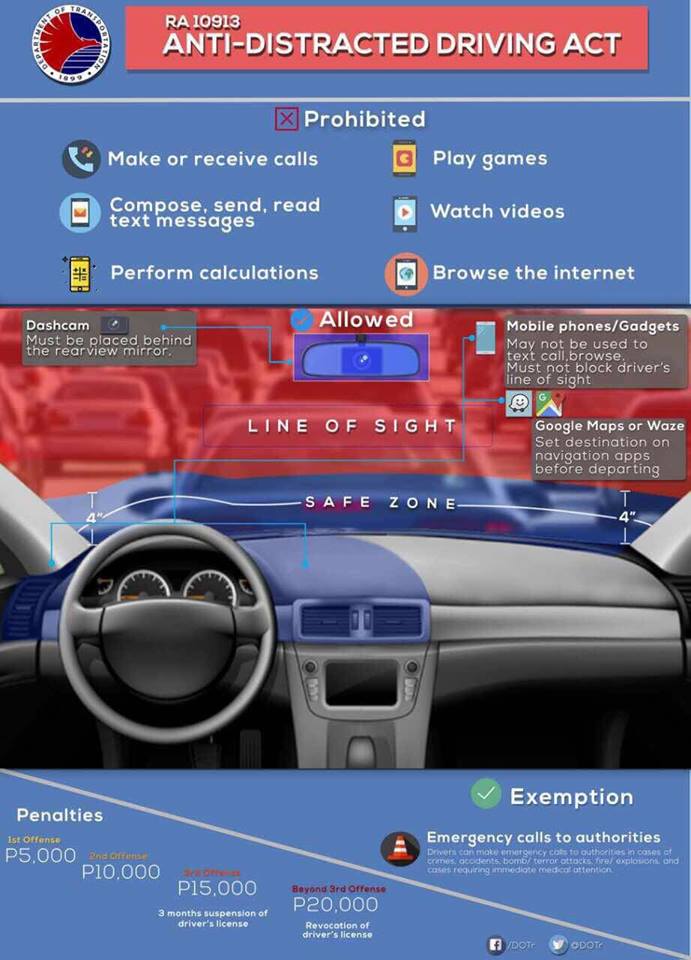
Frankly, I am more concerned about speeding, counter flowing and reckless weaving in traffic. These are equally if not more dangerous than many aspects of the distracted driving law. Quite serious would be the combination of distractions with any of the three behaviors mentioned. More disturbing would be the deliberate (definitely not distracted) or conscious acts of speeding, counter flowing and reckless weaving that are often the cases if one observes the incidence of these three driving behavior. We can only wonder about the likelihood of crashes due to these behaviors.
–
On vulnerability to crashes
A beloved aunt was hit by a jeepney as she walked to church yesterday. She was walking on a local road that didn’t have any pedestrian sidewalks because this was in a residential neighborhood with very low vehicular traffic. She sustained serious injuries and was brought to the hospital by the jeepney driver (good thing he did not flee as many likely would have done) and people who witnessed the incident. She is now in critical condition, unconscious and would likely have a very difficult time recovering considering her advanced age if she pulls through. Senior citizens involved in accidents, whether domestic or crashes like this, and who have sustained injuries like hers (i.e., fractured bones and damaged). Her prognosis is not so good and a cousin says it will take a miracle for her to recover from this very traumatic incident.
Many of us do not care about road safety and do not concern ourselves with making an environment that’s safe for all users. That is, until we or someone close to us become victims of crashes. What do we do about this? Do we become instant advocates of road safety? Do we suddenly look for initiatives that we can be a part of? Do we do the talk circuit and find opportunities to share our experiences and give our two centavos worth of advice? Did we really have to wait for these things to happen before we become active in promoting and realizing road safety? Or do we start now and become proactive whether or not we think we ourselves are vulnerable? We are all vulnerable road users. We are all potential victims or participants in crashes. And so we should all be involved in making or enabling a safer environment for everyone.
–
Addressing concerns about hazardous work-sites along Sumulong Highway
The concern about hazardous worksites along Sumulong Highway that I wrote about earlier this week has apparently been addressed. Here are a few photos of those areas and prominent in the photos are the concrete barriers set up by the contractor with “DPWH” painted on each barrier. These are the same barriers that they mass-produced and were just sitting in the project office nearby and not utilized until very, very recently.


While these areas still pose significant risks to road users. These are not a continuous barrier with only yellow tape connecting them, and people and vehicles can still easily get through between the gaps. Yet, these will do (for now) and is better than nothing. Perhaps, though, the DPWH and LGUs like Antipolo City can do a better effort to compel contractors to improve safety in work sites like this in order to minimize the likelihood of crashes or accidents.
–
On the worsening state of road safety in Metro Manila and adjoining areas
Recent days have seen some serious road crashes occurring along major roads to the east of Metro Manila. A friend posted about a crash along Marcos Highway last June 10 at the still incompletely paved Marcos Bridge. No one was killed in the crash though the driver and passengers sustained serious injuries. However, there was a high potential for this to have been a fatal crash.
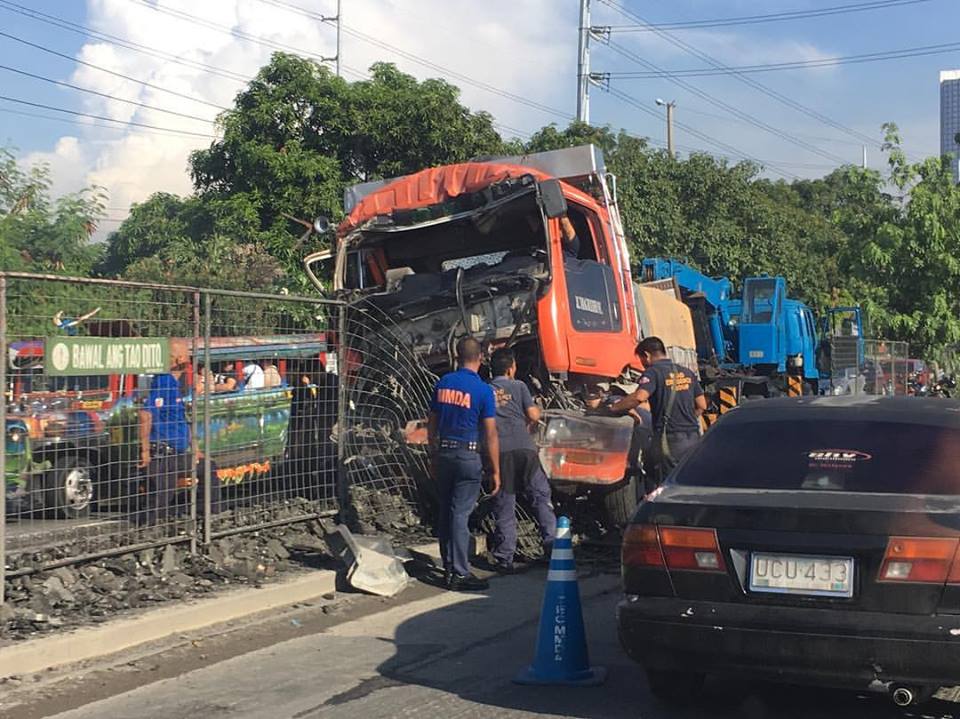 Crash involving a truck plowing into the steel fence and median of Marcos Highway near the Marcos Bridge along the eastbound direction of the highway. Both directions of the bridge’s carriageway’s asphalt overlay had been scraped off and remained neglected for several months until this morning when I observed workers laying out asphalt concrete along the eastbound lanes of the bridge.
An even more ugly crash occurred yesterday in Taytay, Rizal when a truck plowed into the tiangge are of Tatay’s public market killing scores of people and injuring more. Here is a link to some photos and videos about the Taytay crash. These two are but examples of what is happening along national and local roads all over the country with many not even being reported on mainstream or social media.
As I have mentioned in previous posts these crashes were all preventable. Truck operators and drivers need to regularly perform maintenance checks on their vehicles. Brakes are among the critical or essential parts that need to be checked especially with safety in mind. How many fatal road crashes have been reported involving brake failure? In the Marcos Bridge crash, there is also the need to make sure roads are well-maintained and projects not left out for months. In fact, poor road pavement conditions also contribute to traffic congestion as vehicles tend to slow down because of the roughness of the road (e.g., too many potholes). How can the next administration reinforce the enforcement of traffic rules and regulations as well as testing of private and public utility vehicles for these to be certified safe for driving along our roads? Will the Department of Transportation (DOT), the Department of Public Works and Highways (DPWH) and other allied agencies (e.g., LTO and LTFRB), local government units and private entities come up with a more aggressive effort to curb what seems to an increasing trend in road crashes? We hope so and look forward to positive change coming to our roads.
–
Is a truck ban the solution to truck-related crashes in Antipolo?
The crash near Masinag Junction in Antipolo City that led fatalities, injuries, damage to property and terrific costs due to the congestion was caused by a truck that apparently had defective brakes. I’ve read some posts on social media calling for a truck ban in Antipolo City. Some comments go as far as specifying major roads like Sumulong Highway and Marcos Highway where a truck ban can be ‘most effective’.
Is a truck ban in Antipolo City and particularly along major roads like Marcos Highway and Sumulong Highway going to solve truck-related road safety issues? It should have some success but it does not address the root causes of the problem. Among these root causes are related to driver behaviour and the maintenance or condition of trucks. Issues pertaining to driver behaviour can be seen in the form of aggressive or reckless driving (e.g., speeding trucks, trucks weaving in traffic, overtaking at critical sections, etc.). Meanwhile, issues pertaining to vehicle maintenance/condition can be seen in instances where trucks climbing Sumulong Highway, Marcos Highway or Ortigas Ave. Extension tend to slow down traffic (overloaded and/or underpowered?) as well as in crashes involving the malfunctioning braking systems. These cannot be addressed through truck bans, which are likely to be more effective for cases of severe congestion that can be directly attributed to trucks.
A truck ban will only punish the good (read: disciplined and competent) drivers and responsible truckers/truck operators. Good drivers know their traffic rules and regulations and how to position themselves on the roads as well as the speeds they need to travel by together with mixed traffic. They exercise caution especially along areas where there are a lot of pedestrian activity (e.g., Masinag area, Mambugan, Cogeo, Tikling, Cainta Junction, etc.). Meanwhile, responsible trucking company operators would likely have more structured or organised maintenance regimes for their trucks and likely would have newer and standard (read: non-modified) vehicles in their fleets. These would be able to carry load according to their specifications and maneuver safely in varying traffic and road conditions. On a larger scale, truck bans will definitely have a detrimental impact on logistics that will carry over to the local economy as well as Antipolo is the origin of many goods/freight and much also pass through the city.
–
Fatal road crash at Masinag, Antipolo City
I learned this evening about a major road crash that occurred at the Masinag Junction in Antipolo City in the late afternoon. This was probably why there was a tremendous buildup of vehicles along Aurora Boulevard near Katipunan. Marcos Highway’s capacity is already reduced due to the ongoing construction of the LRT Line 2 Extension from Santolan, Pasig City to Masinag. A major traffic incident like the one this afternoon surely affects traffic along this very busy corridor connecting the already densely populated eastern cities and towns (i.e., Marikina, Antipolo, Cainta) with Metropolitan Manila. This was actually along one of my usual routes between my workplace and my home in Antipolo. Today, however, I decided to take Ortigas Ave. Extension as advised by Waze.
I had written about Marcos Highway already being a killer highway (Another killer: highway…, August 6, 2014) though I think it is not at the level of Commonwealth Avenue in Quezon City. Still, the potential is high for road crashes occurring along Marcos Highway and this potential has increased due to the hazards posed by the construction works between Santolan and Masinag. As they say, such crashes are disasters waiting to happen and such a disaster in terms of both lives lost and traffic congestion costs happened this afternoon when a truck plowed into a building at Masinag.
Hopefully, this crash will be an eye opener and would lead to immediate actions from the LGUs and agencies responsible for ensuring safe roads and safe travels to commuters passing through Masinag Junction and the two major highways converging there, Marcos Highway and Sumulong Highway.
–
Safe steps – Road Safety
I would like to share on an initiative that’s close to my heart – road safety. I had been part of several road safety initiatives before and continue to be part of several today. I have also been doing research on pedestrian and cycling safety together with my students as part of our institute’s research agenda. Here is an example of very good promotional material on road safety including videos highlighting relevant statistics on safety that we should be aware of as well as encourage us to act and contribute towards safer roads for everyone.
Featured in the videos is Road Safety Ambassador Michelle Yeoh, whom people might remember for the movie “Crouching Tiger, Hidden Dragon” that now has sequel at Netflix. I had the honor and pleasure of meeting her many years ago when she was in Manila to speak on road safety at the Asian Development Bank’s Transport Forum. In fact, she visited the University of the Philippines Diliman to inaugurate the road safety and traffic discipline zone that is the campus core and along the Academic Oval. I had the privilege of driving her around the oval on an electric jeepney.
–
Counterflow culture: pang-iisa
There are several videos currently circulating in social media showing counter-flowing motorists. In one, a driver with a camera on his dashboard proactively positions his vehicle along the middle lane of the correct side of the road and engages a counterflowing motorist who initially appeared as if he were going to insist on his wrong behavior (feeling entitled perhaps?). The driver with the dash cam didn’t budge or give way and the errant driver had to go back to his correct lane.
In another, more serious video, another dash cam records a scene along a curved 2-lane section of Marcos Highway where an oncoming motorcycle slammed into a counterflowing vehicle coming from the left side of the vehicle with the dashcam. It was clear that the counterflowing motorist violated the double yellow line rule, which led to the dreadful crash.
These are examples of what seems to be a counterflow epidemic among many motorists. Counterflowing is not only prevalent among motorcycles and public utility vehicles but among private vehicles as well. There are even those who follow emergency vehicles that legitimately and urgently use the opposing traffic lane. This behavior seems to be associated with these motorists wanting to get ahead of others. In Filipino or Tagalog, the term is translated to pang-iisa or gustong maka-isa (wanting to get one up on other people). This behavior can be attributed to a person being impatient, undisciplined, reckless, feeling entitled, or – all of the above.
Such issues could have been preempted by a stricter licensing system that can be administered by the Land Transportation Office (LTO). However, since many already have their licenses then the burden for correcting such behavior falls upon traffic enforcement agencies and their personnel including the Highway Patrol Group (HPG) and the MMDA. Hopefully, such errant behavior can be corrected and our roads can be safer for all users.
–
Sudden intended acceleration? Intended ones are more dangerous!
The motoring community in the Philippines has been in rather heated discussions regarding the Mitsubishi Montero’s alleged defect that causes what has been termed as ‘sudden unintended acceleration’ or SUA. This term refers to the vehicle suddenly, and without the driver doing anything, rapidly accelerating, forward or backward, and hitting anything in its path. The proofs to these alleged incidences are supposed to have been documented by many including videos that have been uploaded to YouTube and even shared or used by mainstream media. The vehicle’s manufacturer itself denies that there is a defect in the model(s) being cited for SUA. They have also released a new model of the vehicle in the market and most people not paranoid about SUA seem not to mind the buzz about the alleged defect. The new model, after all, is supposed to be free of that particular defect considering the manufacturer, despite its denials, should have been aware of the complaints and concerns.
Defect or none, I think what’s more dangerous is not the ‘sudden unintended acceleration’ of vehicles. In fact, I am not aware of any fatalities attributed to this and all the videos I’ve seen alleging the defect happened in parking lots and driveways. These have caused only minor injuries and, surely, damage to properties. What is more dangerous and should be the concern by all is the intended acceleration leading to speeding (or over-speeding) that is so common in our roads regardless of whether these are expressways or city streets. Such behaviour are almost always intended and therefore the drivers are very much aware of their actions and in control of their vehicles. In control, that is, until they hit something or, worse, someone. Such irresponsible and often reckless behavior plague our roads and one person’s folly can be the doom of others as is usually the case in road crashes involving (over)speeding.
–
On road crashes (again)
I was driving to work early this morning and despite today being the first day of school for public schools, I was surprised to encounter heavy traffic so early as I approached the Santolan Station of LRT Line 2. Most commuters using the station were university/college students and workers but most of the latter won’t have school until next week and it was too early (around 5:50 AM) for most workers to be at the station given that offices open either 8:00 AM (government) or 9:00 AM (private). It turned out that there was a road crash involving a large truck and a motorcycle. The motorcycle rider survived and was texting on the median island. A close look revealed that he was bloodied by the close encounter with the truck and that despite stopping, no one from the truck got down to check on the motorcycle rider. This has become a typical scene and fortunately (especially for the rider) it was not a fatal crash.
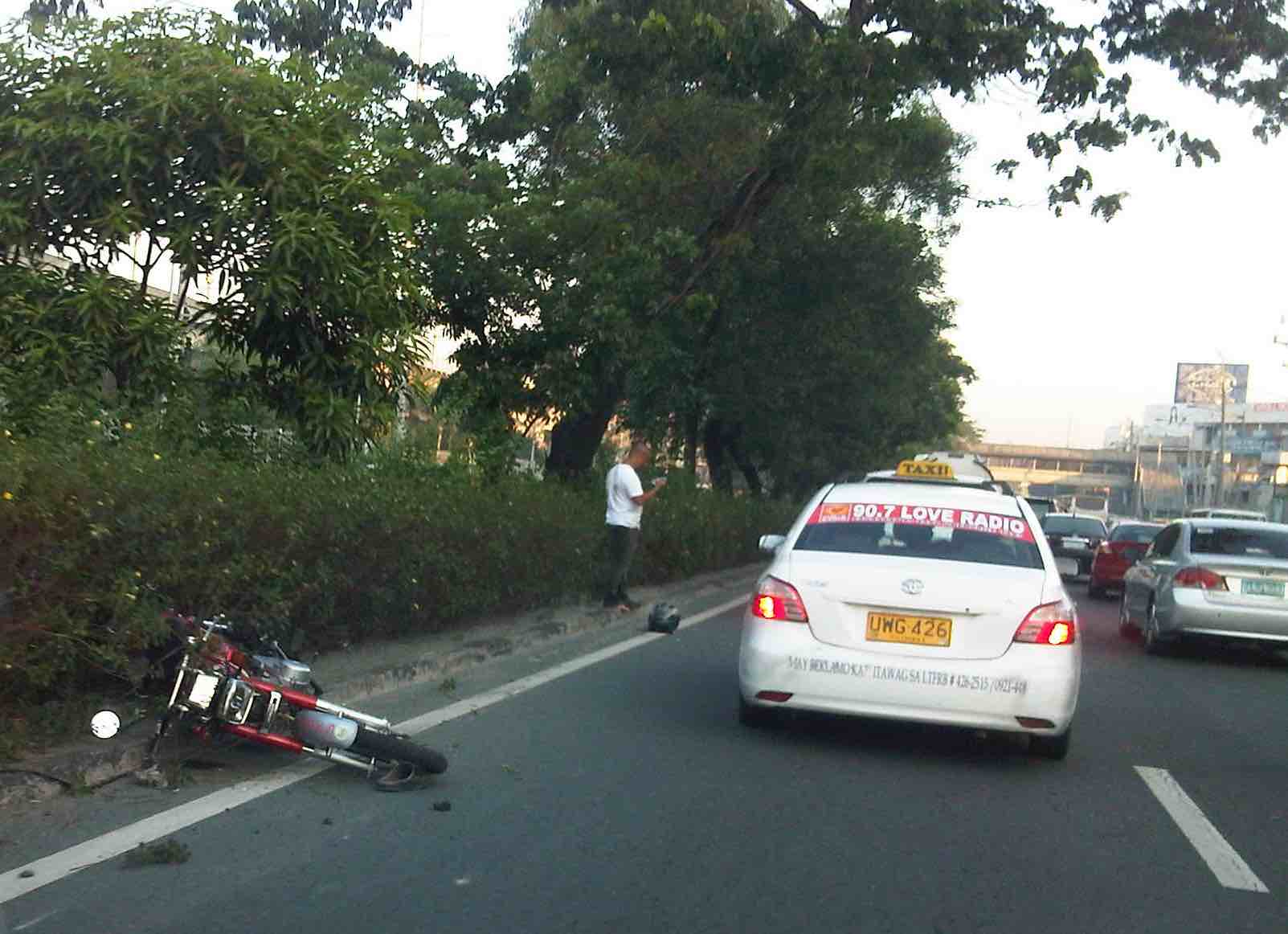 Motorcycle involved in crash with a large truck (covered by taxi in the photo).
Some quick recommendations are provided for different road users in order to avoid such situations leading to crashes:
a. For people driving large vehicles like trucks and buses: Always keep in mind that you are driving a large (and likely long) vehicle that has limitations in terms of manoeuvrability. Don’t drive as if your vehicle is a car and keep in mind that a slight mistake can lead to a fatal crash.
b. For people on motorcycles: Always ride along lanes assigned to motorcycles or refrain from aggressive weaving or lane-splitting. 2-wheelers require balance and so anything to distract the rider (e.g., using cellphones while riding) or aggressive behaviour (e.g., speeding, frequent lane changing, etc. and their combinations) lead to the high likelihood of being involved in a crash. No matter how minor these may be (e.g., dents on vehicles) the cumulative impacts are still significant in terms of costs.
c. For people driving jeepneys, UV Express and taxis: Always keep in mind that you are supposed to be driving safely as you are driving public utility vehicles carrying passengers whom you must convey safely to their destinations. This means you should exercise utmost care in driving and not doing because you simply want to earn money means you have no business providing public transport service.
d. For people driving private cars: Follow traffic rules and regulations. Common causes of traffic congestion and road crashes can be the simplest violations. The more dangerous behaviour include counter flowing, speeding and cutting (or aggressive lane changing).
e. For pedestrians: Cross at designated areas. If there are none or you choose to cross anywhere (i.e., jaywalk) make sure that you are alert and that there are clear gaps allowing for “safe” crossings.
f. For cyclists: People using bicycles should use assigned lanes whenever available. Admittedly, there is a lack or absence of bike lanes in most Philippine cities and the reality is that these will not be provided in an instant. And so cyclists should also be responsible and exercise care as they pedal along. “Sharing the road” also means cyclists need to follow road traffic rules and regulations. They are not excused, for example, from stopping at intersections when the red light is on disregarding one way streets.
With the onset of the wet season, roads will be slippery from rains and therefore add to the challenges of ensuring safe roads. We should not forget that every road user is a vulnerable person. Vulnerability is not limited to the pedestrian or cyclist though they may be the most vulnerable, often with little protection that will allow them to survive collisions with motor vehicles. Though valuable time can be lost by exercising extra care and discipline on the roads, the time cannot substitute or compensate the possible loss of life and limbs due to crashes.
–
 Caught (up) in traffic