
Home » Posts tagged 'safety' (Page 8)
Tag Archives: safety
Some thoughts on transport safety and security
There is an Office of Transport Security (OTS) under the Department of Transportation and Communications (DOTC). Under its mandate is coming up with plans and programs in order to ensure safe and secure travel for all. Security here is most often associated with the prevention of crime and the control of criminal elements in how they could affect transport (i.e., terrorists, robbers, etc.). I believe that this interpretation extends to safe driving as well since reckless driving is practically a criminal act especially when we realize the potential for fatal crashes due to these behaviors by drivers and riders. Unfortunately, the OTS like many agencies under the DOTC have a lack of personnel to be truly effective in carrying out their mandate.
I think passengers should be more proactive in ensuring their rides will be safe and secure. They should be in a position to pressure the driver to be more careful and responsible with the operation of the vehicle. However, there will always be apprehensions on the part of any passenger who might be thinking about the backlash or negative reactions they would get from the driver, conductor or even fellow passengers. Ironically, its the reactions from the latter that could turn something proactive to an embarrassing or humiliating experience. I recall one time a friend was conducting a survey on bus operations and one driver commented that passengers get angry with them when they slow down, saying the reason they rode buses of this particular company was because they drove very fast. Such thinking betrays their ignorance and disregard for safety – until, of course, they happen to be involved in a crash!
And so perhaps the OTS and other responsible agencies could enlist the help of other government personnel who would have the training required for authority figures on security and safety. For example, there are many of our servicemen in the armed forces and the police who take public transportation or who provide transport services by being operators or drivers (to augment their incomes with the AFP or PNP). Those who are passengers should assert themselves in the service of other passengers by accosting reckless drivers and reminding the latter of their responsibilities as service providers and the penalties for irresponsible driving. Servicemen can be formally (and legally) granted this authority by the LTO and/or LTFRB, which do not have the personnel to police the thousands of public utility vehicles around the country.
–
Rail incidents
The big news in Japan today seems to be the rail incident where a woman saved the life of a man who attempted suicide or fell unto the rail tracks of the JR Yokohama Line. Unfortunately, the woman died as she was ran over by the train as she apparently positioned the man in between the tracks. As far as I could understand, it seemed that the barriers for a crossing were already down and the alarms announcing the arriving train were also engaged when a man entered the danger zone and fell (or laid) at the tracks. People including pedestrians and those in their cars were shocked by the situation but only the woman who was with a companion in a car decided to act to save the man from the oncoming train. Following are photos I took from a TV news report on the incident.
 Simulation of train operations using JR East’s simulator to review what could have happened
 Demonstration of train approach to station
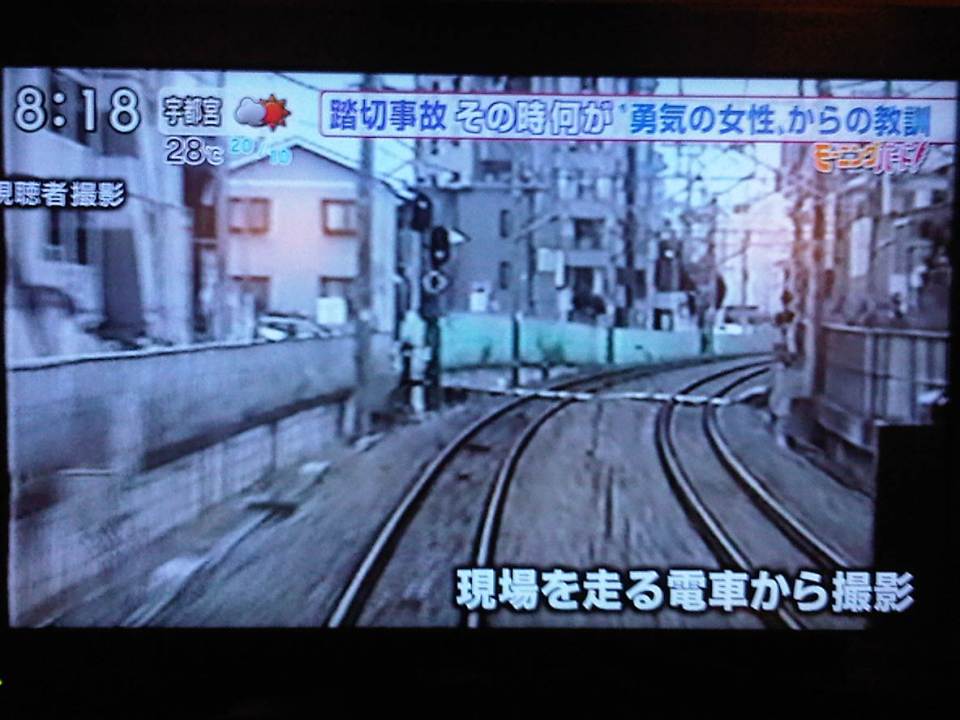 Footage of the crossing where the woman perished.
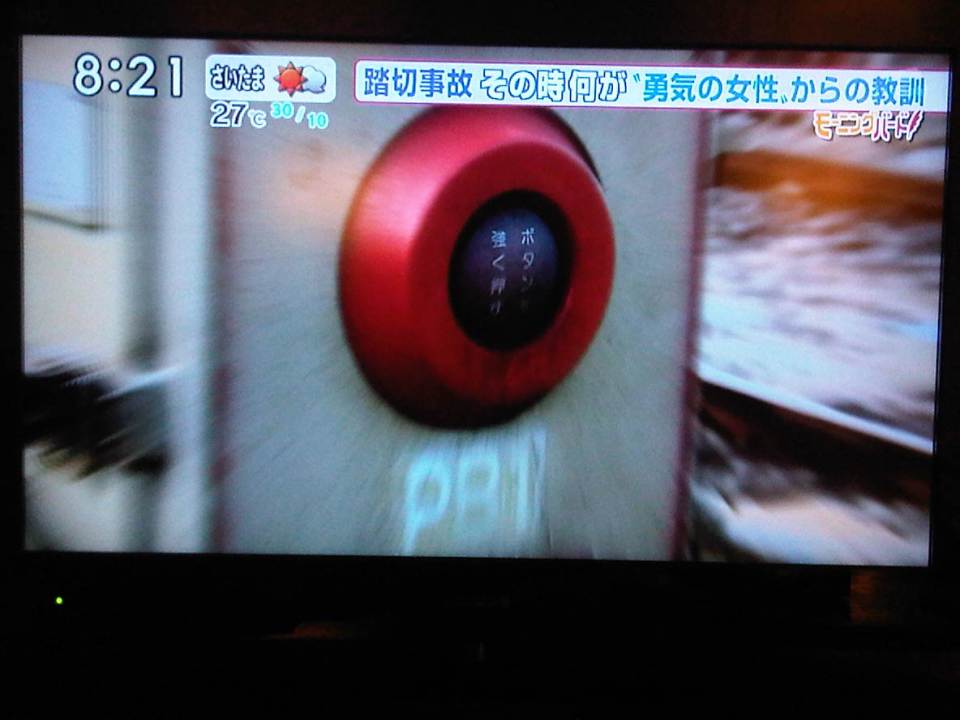 Emergency button that was supposed to be used by people in exactly such cases but people were apparently too shocked or unfamiliar with this safety device at railway crossings.
 Demonstration of the ill-fated rescue
 Photo of the heroine who, if I understood from the report, will be awarded posthumously for her effort to save another person.
 Another photo of the 40-year old woman, Murata-san.
Japan takes pride in their work towards making their transport systems safe. Rail incidents have been minimized by using modern, high technology tools including sensors and monitoring systems. However, it seems that there are cases such as these where the intervention of people (including those who might be spectators of an incident) are still necessary as these are likely beyond the capabilities of even high tech countermeasures installed at rail crossings. We salute and honor this woman who was willing to help another person at the cost of her own life. She deserves the honor and recognition for this great humanitarian act.
–
Who’s to blame?
I first saw this report about one motorist driving his car straight into a flooded section of a street in Quezon City on GMA 7’s prime time news program 24 Oras last night. I also saw it again on New TV 11’s State of the Nation with Jessica Soho. Friends and former students have posted the video from GMA 7 as well as from YouTube. The guy blamed everyone including the MMDA, the media and the tambays in the area for not warning him about the flood. He never even thought twice about getting angry and virtually berating everyone else. Perhaps it would have served him better if he had an ounce of common sense in him that could have spared him (and his car) from the incident. Now, he is all over the net thanks to the viral video of him spreading around and showing everyone else what many of us have become. He’s practically a poster boy for citizens who do nothing except blame everyone else.
The GMA7 news report may be found here.
All roads lead to Antipolo
The title of this post is based on a saying referring to the Shrine of Our Lady of Peace and Good Voyage that is located in what is now the City of Antipolo in the Province of Rizal, to the east of Metro Manila. The saying is based on observations during May when the feast of Our Lady is celebrated the entire month. While people flock to the shrine throughout the year often to pray for safe travel, many devotees go up the city in the Sierra Madre range during Lent to pray the novena to Our Lady, hear Mass, or simply to partake of the other attractions of this city.
Antipolo has been a popular pilgrimage site since the Spanish Period ever since the reports of miracles performed through the image of Our Lady of Peace and Good Voyage. These include her image being reportedly found among the Antipolo tree that is the basis for the name of the town that now is a highly urbanized city and capital to the Province of Rizal. Rizal, of course, is the name of the province that once was generally called Morong. One town of the province still bears that name and it, too, has a beautiful, picturesque church. The Shrine is often visited by those seeking safe travel, perhaps these days it has even become more popular due to the tremendous numbers of overseas foreign workers (OFWs) employed abroad. Antipolo is also allegedly the richest among the most popular shrines or churches in the Philippines, supposedly ahead of Quiapo (Black Nazarene), Cebu (Sto. Nino), Baclaran (Our Lady of Perpetual Help), Naga (Penafrancia) and Manaoag (Our Lady of Manaoag), though not necessarily in that order. I think I read about this in one of Ambeth Ocampos’ columns from the Inquirer.
The popularity of the Shrine is so much so that a road was built to directly connect it with Manila, particularly to Intramuros where the seat of government was at the time. This road is most probably along the corridor that is now Ortigas Avenue. Of course, in the Spanish Period, this would be a more general route that would have likely included many rough trails considering that the Ortigas we know now was only developed in the 1970’s. I witnessed this when we moved from Mandaluyong to Cainta in 1976, often seeing huge machines work their way along what is now Valle Verde to carve out a wider right of way for Ortigas Avenue.
During the American Period, the trams operated by the Manila Electric Rail and Light Company (MERaLCo) included a line that went up to Antipolo. Those trams were the state of the art and representative of high technology in public transportation in those years after the turn of the century and a line to Antipolo reinforced the shrine’s importance to many people and the government’s recognition of this. The tram network, which was probably the most developed in Southeast Asia if not in Asia at the time, was destroyed during World War 2 and was never rebuilt for some reason. It is something that Metro Manila now continues to regret if only to postulate what might have beens and what could have beens if the network was revived after the war. Of course, this bit of history is related to the eventual rise of the jeepneys but that is another story for another post. Nevertheless, there still exists in Antipolo some remnants of the tram’s glory days and it is remembered as a road which is still called “daang bakal,” as the railways were fondly called then and now.
There are now many ways from Metro Manila and its neighboring provinces to Antipolo, although several of these eventually merge into three main roads en route to the Shrine. One is via the old route along Ortigas Avenue, a second is the route via Sumulong Highway, and the third is through a “back door” via the Antipolo-Teresa Road. Routes from the general areas of Manila, Makati, Pasig, Mandaluyong, Taguig and the southern cities of Metro Manila and towns from Laguna, Batangas and Cavite will most likely merge to Ortigas Avenue. Meanwhile, people coming from Quezon City, Caloocan, Marikina, Bulacan, Pampanga and the northern Rizal towns of San Mateo and Rodriguez (Montalban) will likely converge along Sumulong Highway. Meanwhile, those coming from the east including the Rizal towns like Tanay, Teresa, Morong, and Jala-jala, the Laguna towns like Paete, Pakil, Pangil, the Quezon towns of Luisiana, Lucban, Infanta and General Nakar, and others will most likely take the Antipolo-Teresa Road that climbs from the east of Antipolo. People from Marikina, Cainta and Pasig generally may take either the Ortigas or the Marcos Highway/Sumulong Highway route.
Public transport to Antipolo these days include mostly jeepneys as the city is the end point of many routes – a testament to its importance even as a reference point for public transportation. One can easily spot the Antipolo-Cubao jeepneys in the Araneta Center in the Cubao business district in Quezon City. There are two lines, one via Cainta Junction (where jeepneys eventually turn to Ortigas Avenue) and another via Marcos Highway, turning at the Masinag Junction towards Sumulong Highway). Another terminal is at the EDSA Central near the Ortigas Center in Mandaluyong where Antipolo-Crossing jeepneys are queued. And still there is another, albeit somewhat informal terminal near Jose Rizal University (JRU, which was formerly a college and hence the old JRC endpoint), which passes through Shaw Boulevard, Meralco Avenue and eventually turns towards Ortigas Avenue. Other jeepneys from the Rizal towns all have routes ending in Antipolo simbahan, referring to the shrine.
There are now also Filcabs or AUV Express, shuttles offering express trips between Antipolo and the same end points of Cubao or Crossing. Others go all the way to Makati in the Ayala financial district. These evolved out of the Tamaraw FX taxis that started charging fixed fares during the 1990’s and competed directly with the jeepneys. These are popular, however, with office employees and students during weekdays and the nature of their ownerships and operations do not make them serious competitors to the jeepneys during the merry month of May and the Lenten Holy Week.
There was an Antpolo Bus Line before. These were the red buses that plied routes between Antipolo and Divisoria in Manila. These died out sometime between the late 80’s and the early 90’s probably due to decreasing profitability and likely because of its competition with the jeepneys. That bus company, along with the green-colored G-Liners, the red EMBCs (Eastern Metropolitan Bus Co.) and CERTs, and the blue Metro Manila Transit Corp. buses used to form a formidable mass transport system for Rizal and the eastern towns of Metro Manila. There were even mini-buses (one I recall were the Antipolo “baby” buses and those that plied routes betwen Binangonan and Recto). Most of these, except the G-Liners eventually succumbed to the jeepneys.
In the future, perhaps the jeepneys should give way to buses as the latter will provide a higher level and quality of service along Ortigas Avenue and Marcos and Sumulong Highways. Already in the drawing boards is a plan to ultimately extend LRT Line 2, which currently terminates at Santolan, Pasig, to Masinag Junction and then have a branch climb along Sumulong Highway and terminate near the shrine. This will bring back the trains to Antipolo and would surely make the church and the city very accessible to people. I look forward to these developments both in my capacity as a transportation researcher-engineer and a Catholic who also visits the Shrine to pray for safe travel for loved ones and myself.
Gearing-up for a Decade of Action for Road Safety: 2011-2020
Today we are holding a Road Safety Conference with the theme “Gearing-up for a Decade of Action for Road Safety: 2011-2020.” The theme is consistent with a worldwide campaign led by the Global Road Safety Partnership (GRSP) and its partners that aims to curb the sharp increase in the incidence of road crashes. The program was actually launched last year at the Road Safety Forum held in October in Singapore and formalized with the first Transport Ministers’ conference on road safety held in Moscow the following month of November.
The Road Safety Conference in the Philippines is organized by the Automobile Association Philippines and the National Center for Transportation Studies of UP, and is mainly sponsored by Toyota Motor Philippines as a major part of the latter’s advocacy for road safety. Partners include SafeKids Philippines, Pilipinas Shell and 3M Philippines. This year, we are happy to have on board the fledgling GRSP Philippines (PGRSP) that is comprised of major companies dedicated in promoting road safety in the country.
The program includes 3 panel discussions with the first one tackling road safety legislation including the status of the Road Safety Bill filed in the last congress. The second panel discussion will feature the International Road Assessment Program (i-RAP) that will be implemented in the Philippines through the Department of Public Works and Highways (DPWH). The assessment will involve an automated audit of more than 4,000 kilometers of roads throughout the country. These include roads classified under the Asian Highway (AH) network as well as the tollways of Luzon island. The third panel discussion will be on eco-safe driving. which is a practice that aims to promote both safety and energy efficiency by encouraging more relaxed driving while putting emphasis on regulating the driver’s use of the gas pedal. The latter, in effect, allows the driver to manage the engine revolution so that upon acceleration and during cruising, the engine will only reach around 2,000 r/min maximum.
These are but among the many topics that are part of the bigger picture that is road safety. They are surely among the most interesting ones that are oriented toward actions necessary if we are to succeed in cutting down the steady rise in road crashes and save lives. The topics are also a welcome departure from past conferences where many presentations showed statistics and sought to establish context for road safety initiatives. That context is already well established and if one is not aware or has a clear understanding of the state of road safety, then perhaps that person is disconnected with what is happening around him.
This year’s Road Safety Conference will be held at the GT Toyota Asian Center Auditorium at the University of the Philippines Diliman. It is a whole day event that starts at 9:00 AM and concludes at 5:00 PM.
Road Traffic Safety
I reproduce below an article I wrote about road traffic safety, which came out on October 19, 2009 in Business World:
Safety First
Road traffic accidents are now mentioned in the same breath as killer diseases. The World Health Organization ranks it among the top ten (9th as of 2004) causes of death together with strokes, heart disease, HIV/AIDS and influenza. The WHO’s Global Status Report predicts that road traffic injuries will rise to become the 5th leading cause of deaths worldwide by 2030 while already being the top cause of death for 15 to 29 year olds. However, like many diseases, traffic accidents can be prevented or if “diagnosed,” can be “treated.” Moreover, we already have a wealth of resources including tools to enable us to address the problem. A major roadblock seems to be that we have not yet been able to bring all these resources together as government agencies and private sector entities struggle to cooperate to stem the rapid increase in the number of traffic accidents.
There are no quick solutions or cures to this disease. We can, however, treat symptoms to alleviate its impacts – among which are economic losses that are estimated to be in excess of US$ 2 billion a year for the entire country. Diagnosis of the symptoms is the collective responsibility of the DPWH, local government units, and the Highway Patrol Group with the enabling of the DOTC through the LTO. Road safety audits should be undertaken for major roads and this know-how needs to be transferred to local governments for them to make similar assessments for local roads. It is necessary for the HPG to intensify its campaign in monitoring roads as well as the apprehension of errant motorists even for minor offenses. But they should not do this “to instill fear in the heart of motorists and pedestrians”, as some officials have often declared, but rather to firmly establish a culture of responsible motoring and discipline for road users through informed, fair and consistent enforcement.
In Metro Manila, a significant number of accidents occurs everyday but not of these accidents are reported and recorded. Instead they are relegated to the profusion of anecdotal information going around about how frequent and serious accidents have become in the metropolis. However, the installation of video cameras at critical locations around the metro provides an opportunity not just for monitoring and recording but for studying the behavior of drivers, riders and pedestrians. Footage from the cameras, if clear enough, may also be used to go after traffic violators.
Local government units including the MMDA would do well in refraining from overdoing efforts that employ unconventional or unorthodox methods for traffic engineering and management. While “out of the box” solutions have been successful to a certain extent, caution must be exercised when applying these schemes elsewhere. The prevailing practice is to over-generalize the application of traffic schemes, resulting in continuing experimentations which in turn create situations that lead to accidents and traffic congestion.
I’ve always taught my students that it is important to go back to the basics when dealing with the safety aspect of roads. In highway design we have to keep in mind that there are many elements that come into play including those concerning the vehicles, the drivers, and the environment. Key to the design is to have an understanding of the interactions that take place among the elements for one to be able to come up with a suitable design. Such are the basis for design speeds and curvatures as well as determining the appropriate traffic control or management schemes for the road. One has to ensure the natural movement of vehicles as well as enable conditions where motorists are able to assess the situation on the road with minimal complications that may bring about driver error. Failure to account for the design elements or to understand the interactions among the elements will lead to higher risk of accidents. Thus, a person can have all the skills and experience of a good driver and still be involved in an accident due to a poorly designed (or located) island or barrier. Also, a person could be the best defensive driver and yet be hit by a drunken driver or a motorcycle weaving in and out of traffic.
Highways need not be declared as traffic discipline zones if efforts are firm, consistent and sustained for all roads. It is understandable though if authorities would want to focus on particular corridors or areas in order to gain quick wins and confidence in the campaign for safe roads. However, such campaigns must be fought simultaneously along several fronts. It is here that the DOTC through the LTO and the LTFRB should play a lead and active role especially since they have the mandate in as far as licensing and franchising are concerned. In addressing the accidents involving public transportation, for example, it is recommended that stricter policies be formulated and implemented with respect to licensing and employing public transport drivers. Operators must be held accountable for accidents. There should also be initiatives towards emphasizing transport as a service rather than a business and a source of livelihood or employment.
Road traffic accidents have become an occurrence that is too common. Television and radio news programs report incidents round the clock; often putting the spotlight on those involving public transport and particularly ones that have resulted in fatalities. All these scream the obvious: our roads are unsafe. We are all vulnerable whether we are behind the wheel, a passenger of a public utility vehicle, or maybe a pedestrian just standing at roadside.
For now, it is important to sustain the sense of urgency generated by the recent spate of accidents and take advantage of this increased awareness and clamor for safe roads. The opportunity for genuine reforms that would lead to safer roads is here and it is imperative that we act decisively. Needless to say, this will require strong commitment and cooperation among various stakeholders to ensure success in reducing the rate of traffic accidents and making our roads safe for the present and future generations.
 Caught (up) in traffic