
Home » Posts tagged 'taxis'
Tag Archives: taxis
Green GSM spinoff?
Yesterday, we saw what looked like a Green GSM taxi in Antipolo. The color scheme was certainly the same and the vehicle was of the same Vietnam-made model (Vinfast).
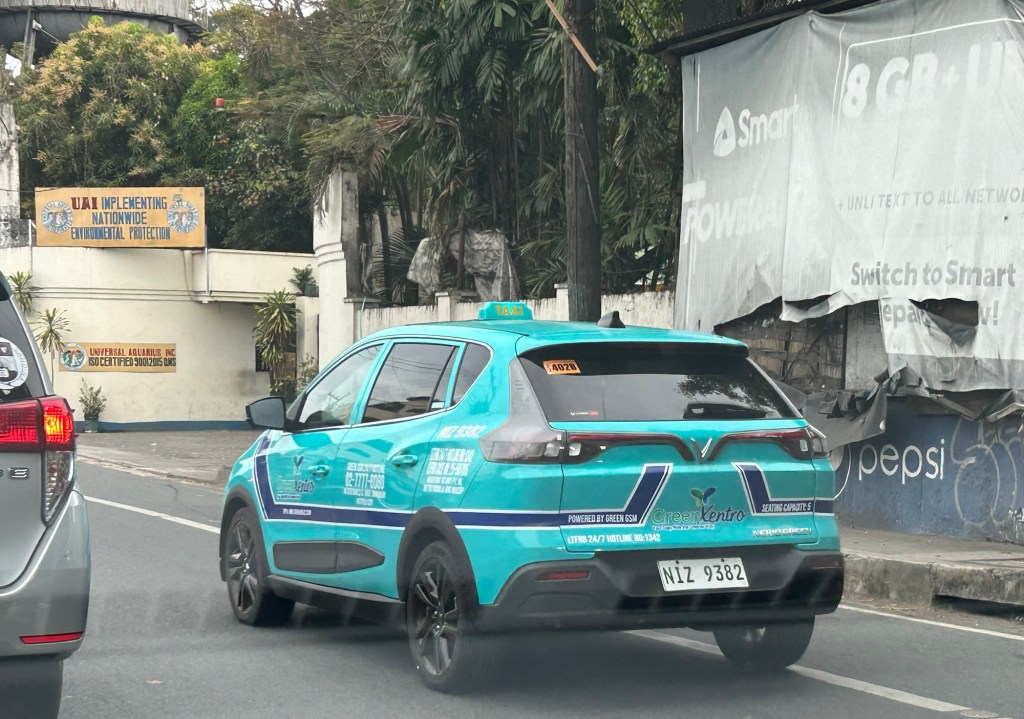
The operator is Green Xentro. Xentro refers to the company operating a few small malls in Rizal and Marikina.
It’s probably related to Green GSM, which might be the mother company. This brings the taxi service closer to Rizal towns. I also have seen a few maintenance shops in Antipolo having a sign indicating they can service Vinfast vehicles. This is welcome if it means we ‘ll see more of these taxis around Rizal towns.
–
Green GSM taxi first impressions
These past months, I have been alternately using Grab and In Drive vehicles for my commutes. If I had another choice, it would have been Green GSM taxi. I have used their taxis traveling between Quezon City Pasig City and within Quezon City. So far, it’s been a good experience including in terms of the fares I’ve paid. Green GSM boasts of an all electric vehicle fleet. They are also a big company compared to the current taxi operators in Metro Manila. I think what may be comparable in terms of fleet size would be the taxi companies in Cebu, Iloilo and Davao. The difference, however, is in terms of their business models. The usual taxis are still basically rental vehicles for the drivers. The latter pay the owners/operators a fee (i.e., boundary) and usually the drivers have to cover fuel and other operating and maintenance costs.
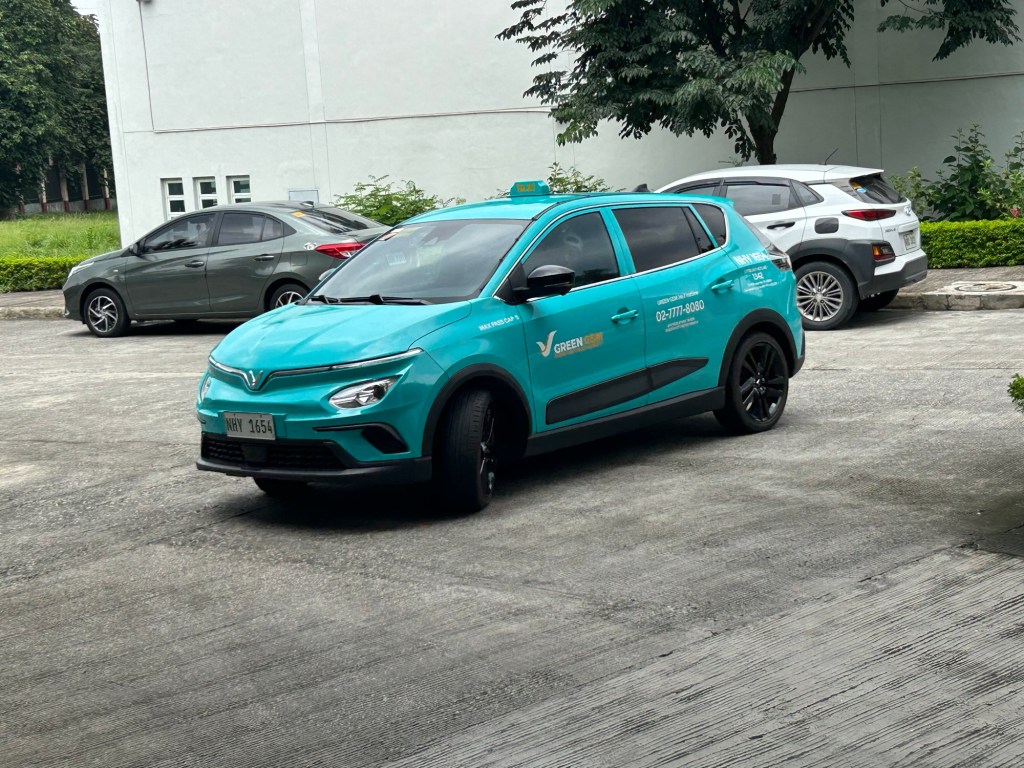
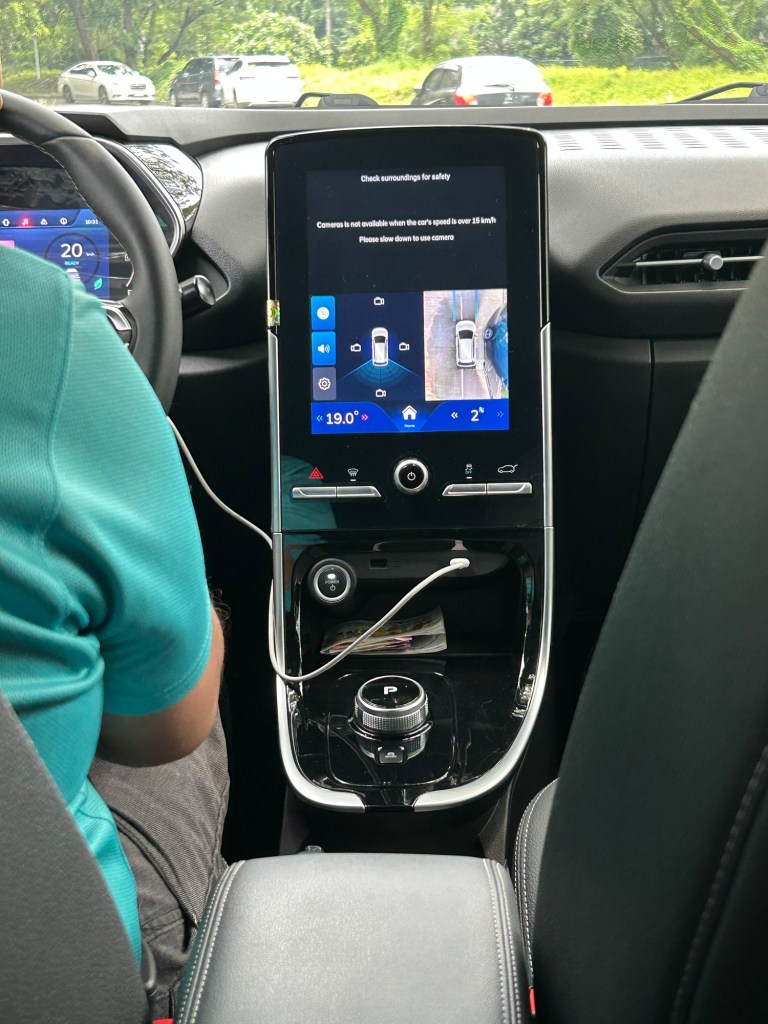
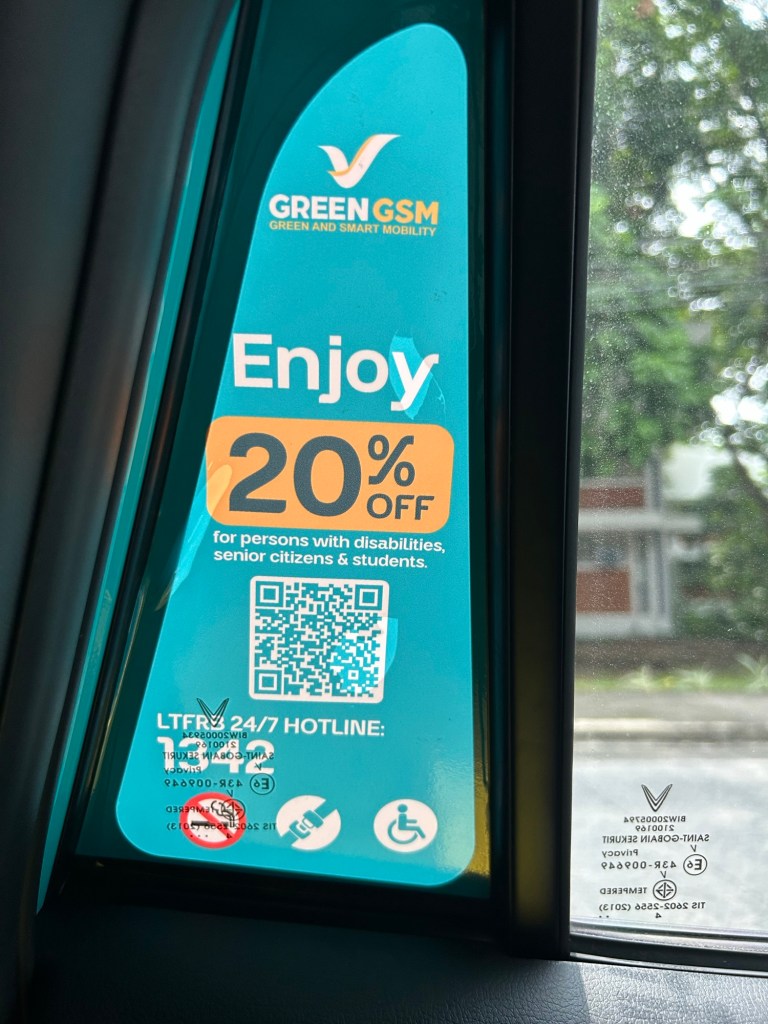
The Green GSM taxi drivers I’ve talked to say they receive a regular salary and have benefits very much like regular employees. They also had accredited stations where they can charge their vehicles or conduct maintenance such as change tires. You can also hail them on the street much like the conventional taxis. You don’t need an app to book a ride but it is more convenient to use their app. The limitation though is that currently you can only book a ride using their app for trips within Metro Manila. If you’re heading out like to Antipolo City, the app will display an error in terms of coverage area. If you happen to hail one of their taxis though, you can use them to go outside Metro Manila. I’ve seen them in Antipolo, Cainta and Taytay so I guess you can also hail them instead of being dependent on the app.
I have a couple of students whose research topic is on Green GSM Taxis characteristics. We’ll soon find out more of their operating characteristics and how their attributes compare with those of TNVS or ride-hailing services like Grab and In Drive.
–
More electric vehicle taxis
I wrote about the new player in town, Green GSM Taxi, which has an all EV fleet. But while this is a relatively big company, there are smaller players who are also operating EV taxis. Here are a couple of them.
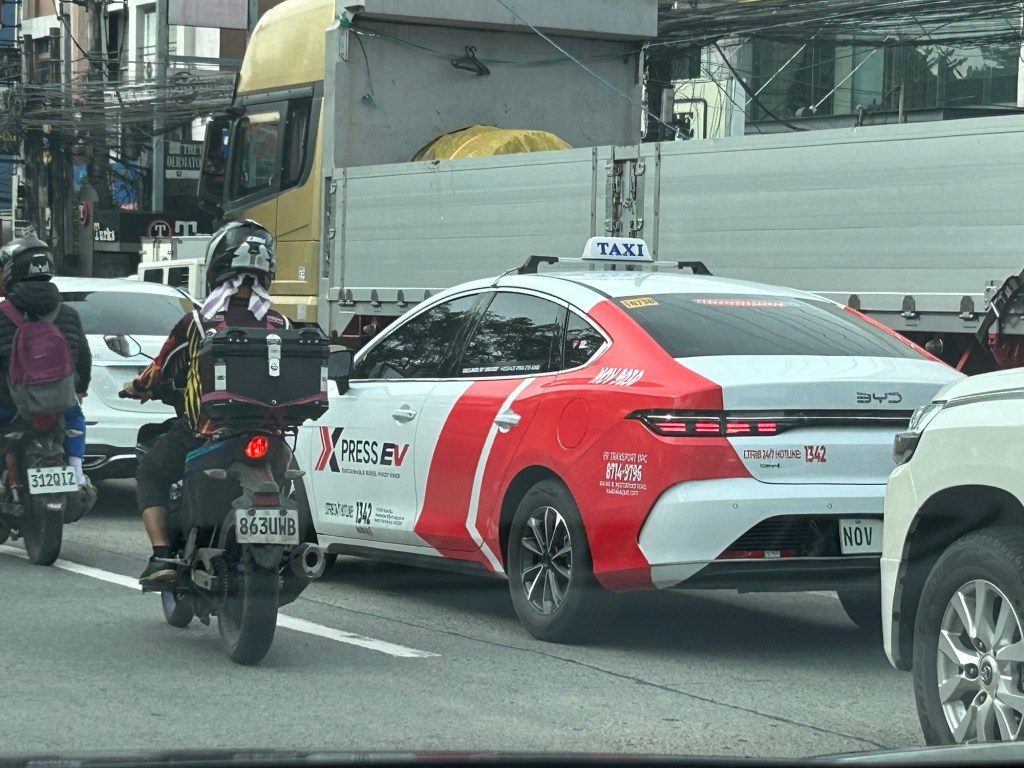
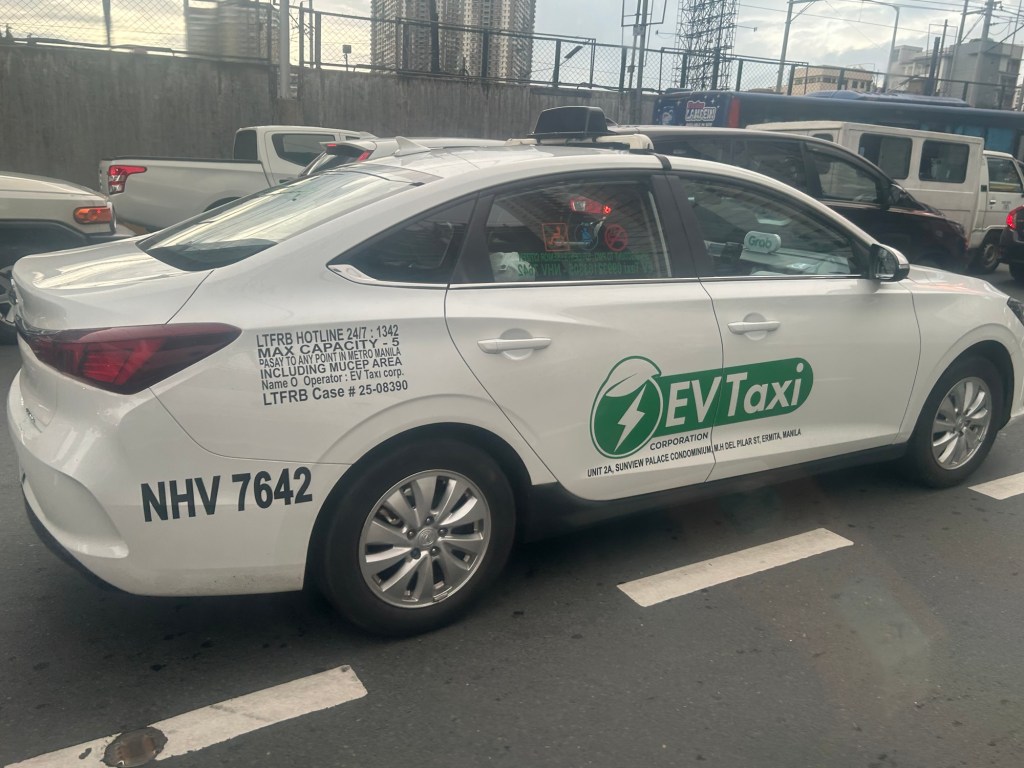
The last one, EV Taxi, is affiliated with Grab. The former doesn’t have sticker or anything identifying it with any of the app-based services. I haven’t seen many of both Xpress EV and EV Taxi so I assume there are fewer vehicles under the operator. This is much the same as previous conventional taxi operators and a consolidation of sorts is via one of the app-based companies like Grab. Is this (small operator) a sustainable venture? Is there anything new about these taxis aside from the vehicles being electric? Maybe the drivers are the same as before (for better or worse)?
–
First impressions of In Drive
There’s another TNVS service operating and competing with Grab. I heard about In-Drive from friends who regularly take Grab when they are in a hurry and opt out of their usual public transport options. They relate that In-Drive was cheaper than Grab based on their most recent bookings. They also said it was easy to book a ride with In-Drive.
And so I downloaded the app and finally had an opportunity to try them as I traveled between UP Diliman and Ortigas Center. I was able to book a ride immediately and it was less expensive compared to Grab. But that was just one booking so I had to try it another time. On my return trip, the same happened and I was able to get the same result with a cheaper booking than Grab.
One time I had to travel home from my office in UP after my evening class, I decided to try this again. Here are the screenshots for my evening ride. The first image is for Grab and the second for In Drive. The routes indicated in the maps are the same. Noticeably different are the estimated travel times (73 minutes for Grab vs. 64 minutes for In Drive) and fares (at least 556 pesos for Grab vs. 472 pesos for In Drive). The choice here was easy – In Drive.
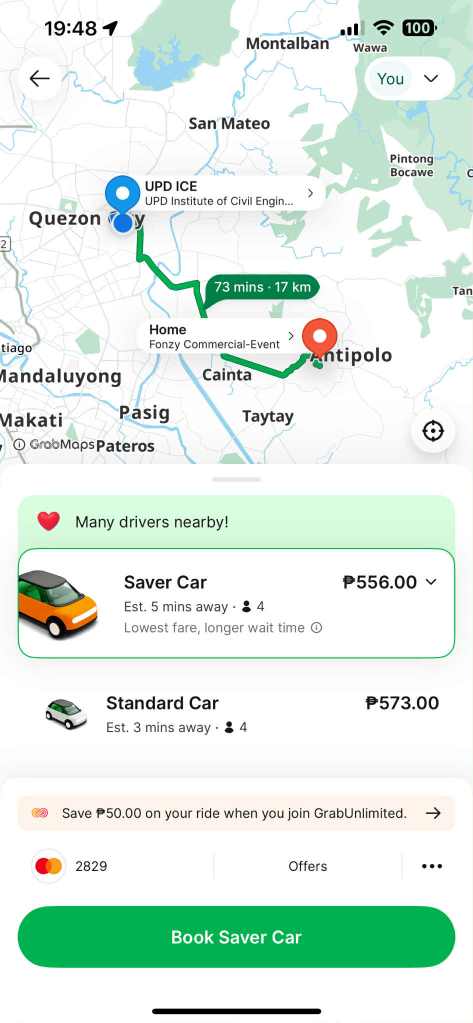
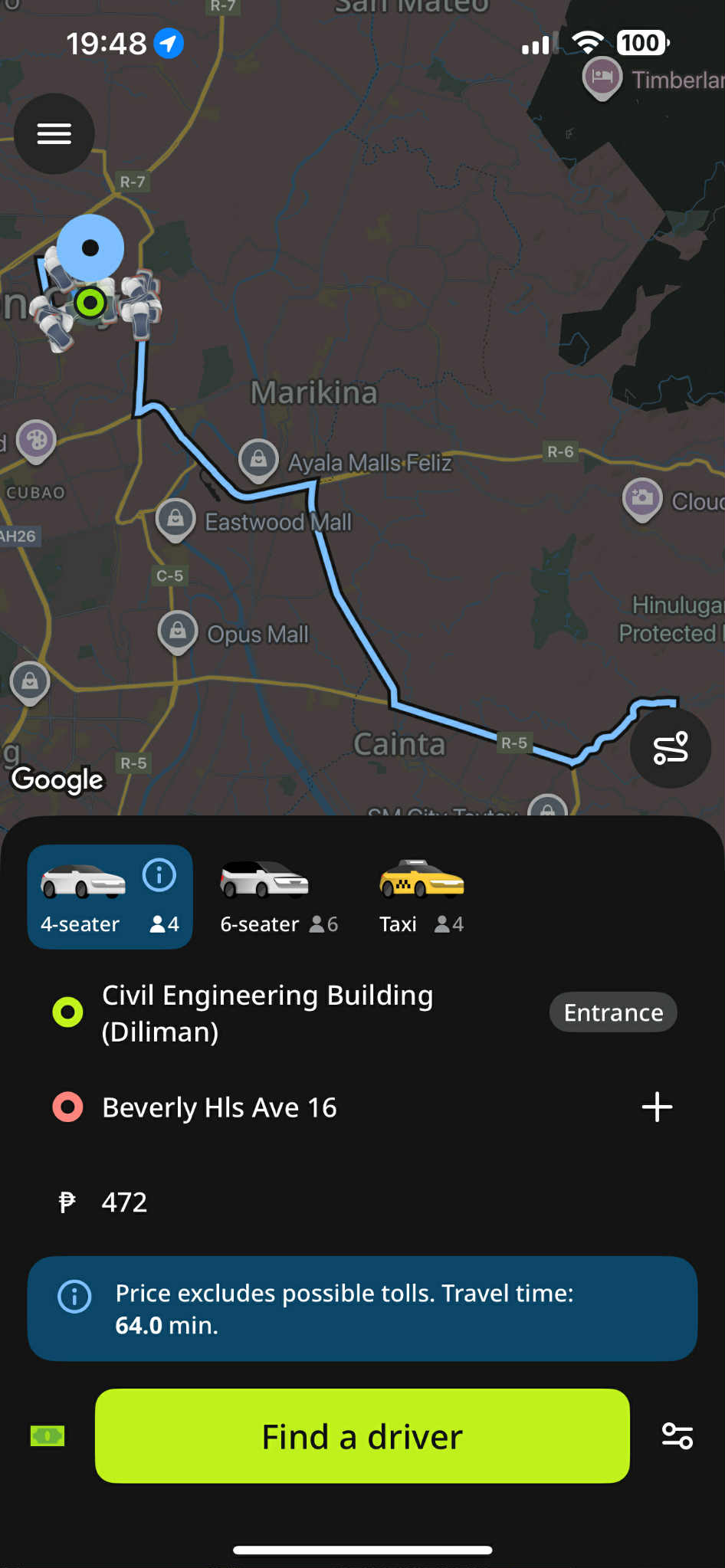
My experiences so far indicate that In Drive was indeed cheaper than Grab. For the last example, it also indicated a shorter travel time. But that’s just me and a few bookings. It is worth studying or exploring further if indeed In Drive, in general, provides for less expensive travel. Other circumstances or conditions can be considered including the origins and destinations for the bookings, the time of day or day of the week, and so on. These are necessary to really have an objective and conclusive comparison of the two.
There’s another option that’s been getting some buzz recently among my friends and students. A taxi company with a full electric car fleet is also now available and competing with the TNVS companies. I will write about Green GSM very soon!
–
Competition for Grab?
Friends have been talking about the two new options that they say should rival and compete with Grab. These are another ride hail company and, interestingly, a taxi company. That ride hail company is In Drive and the taxi company is Green GSM.
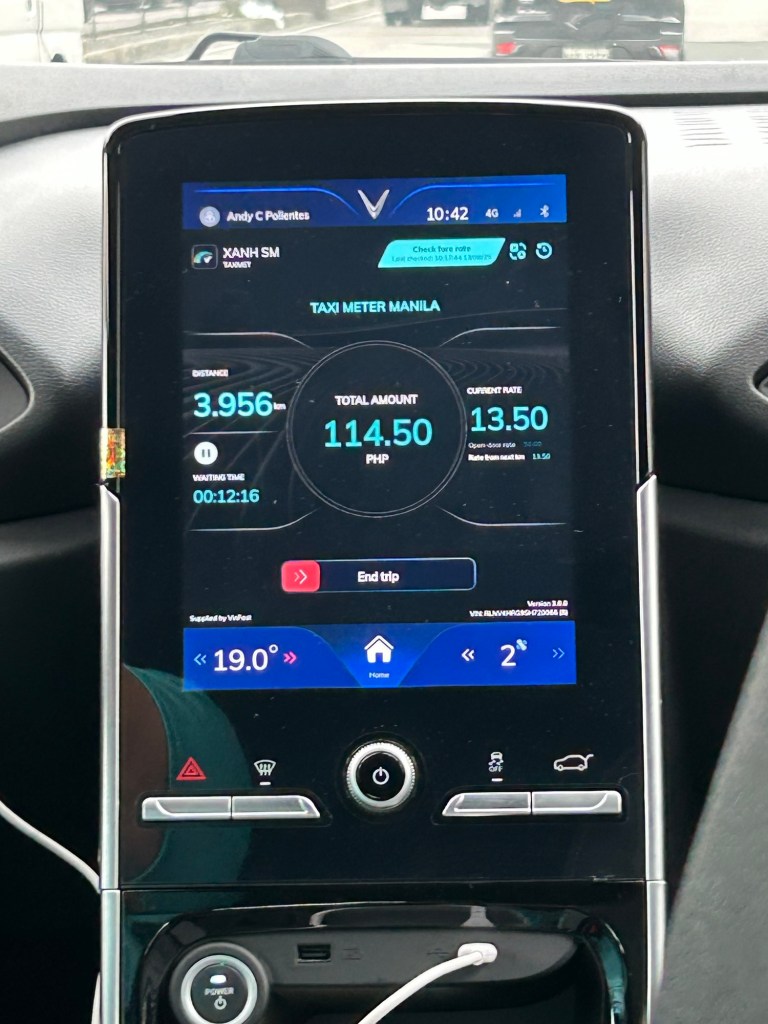
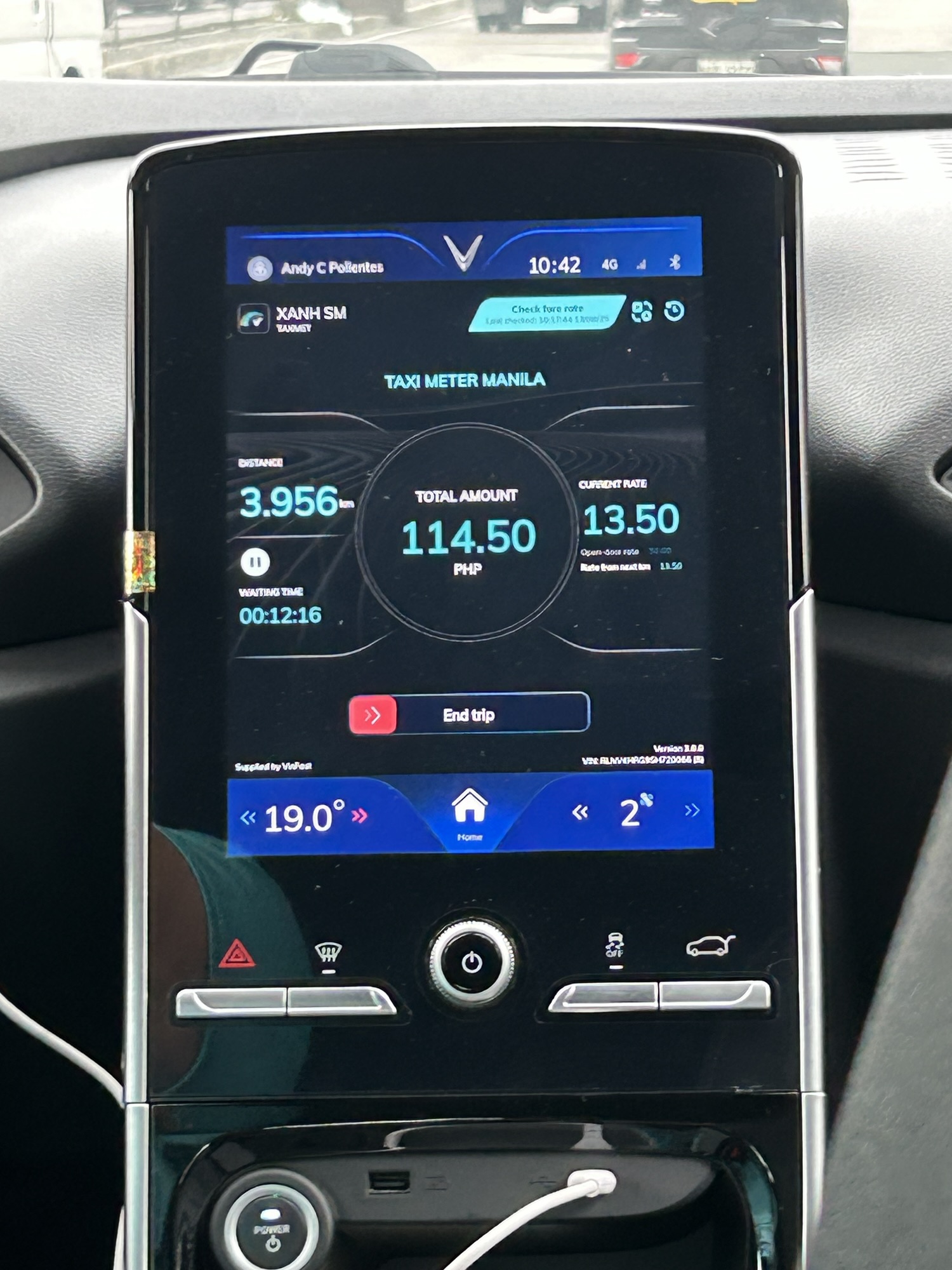 Green GSM vehicle dashboard showing the taxi meter details
The observation and consensus are that either is cheaper than Grab. My personal experience is that they are cheaper than Grab and substantially so. What does this mean? Probably that more people will eventually discover and experience the same and Grab’s ridership will decline. By how much? We don’t know that yet. What we know is that Grab’s most significant competition now are the motorcycle taxis like Angkas and Joyride. Move It is Grab’s response to the other two after it was prevented by government to compete directly with the two. More details in future posts this September.
–
Electric taxis anyone?
Finally saw one of the taxis operated by Green GSM, which is a Vietnamese company. This is supposed to be the first all-electric taxi service in the Philippines.
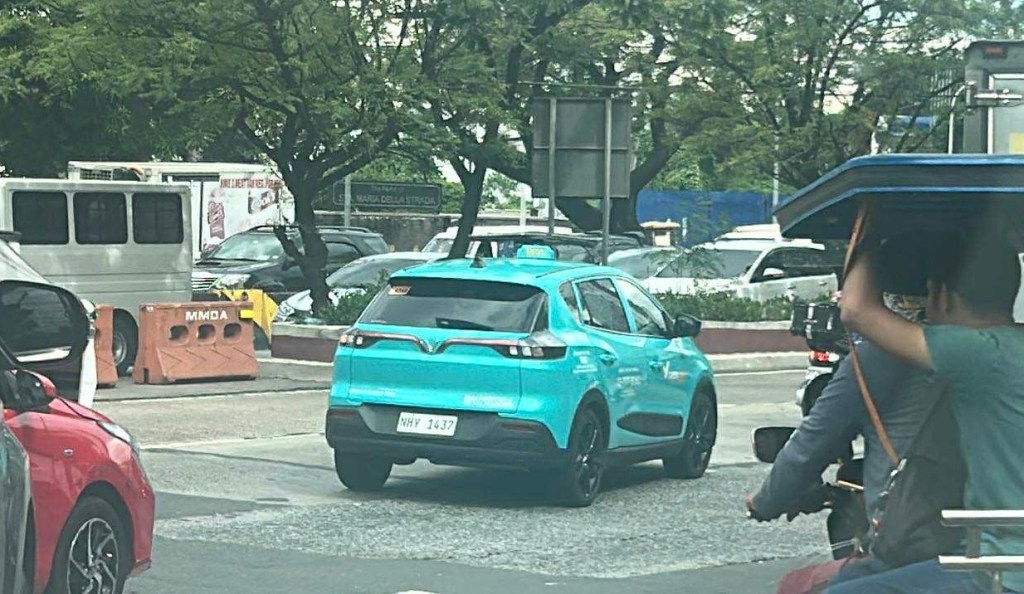
My colleagues and I were talking about this. Among other topics is whether these taxis will not encounter problems once the rains pour and many streets are flooded. We also wondered whether these vehicles will add to the congestion; slugging it out with the established competitors.
Another, more deeper and serious topic is whether these are really clean. While these are emission free as far as the proverbial tailpipe is concerned, the sources of power are not necessarily so.
While we do have renewables in the mix including hydro, geothermal, solar and wind, much of our power used to produce electricity uses fossil fuels.
–
Initial thoughts on driverless cars
The wife is currently in San Francisco in the US. She sent me some photos and videos of the driverless car ahead of booked to get to their office there.
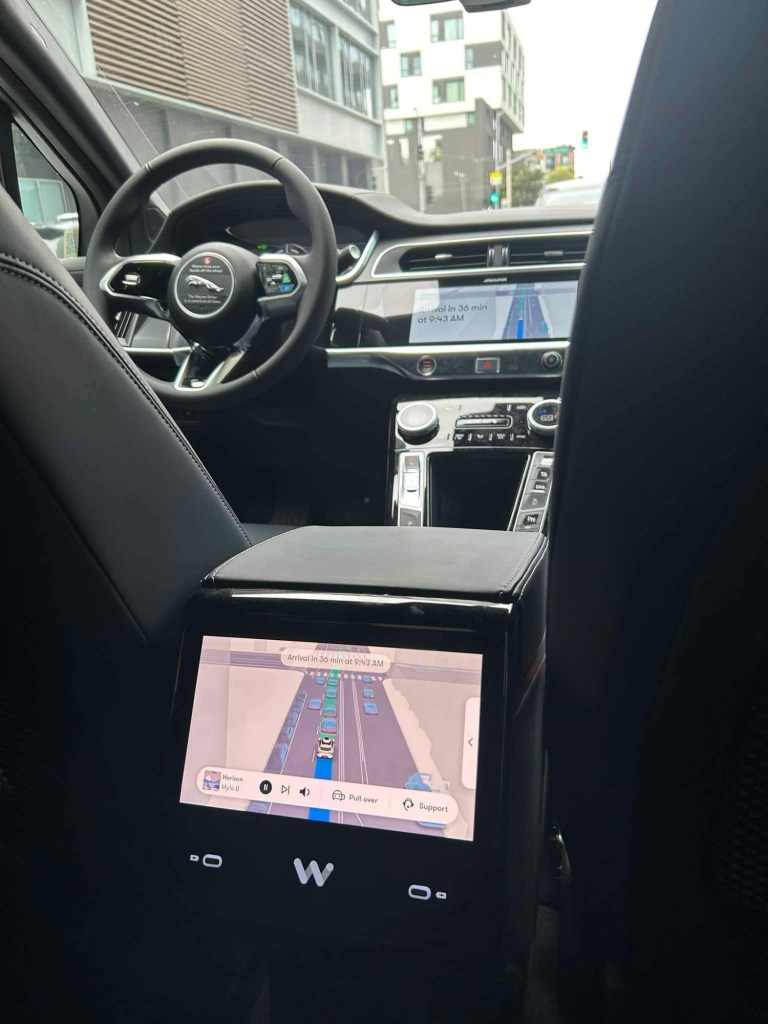
The first thing that came to mind seeing the photos and videos is “It’s cool!” Their creation and operation are indeed wonders from an engineering and technology standpoint. Unfortunately, these are not the solution to our transport problems. These will just replace the cars we already have and causing congestion and other concerns.
–
Shared rides, anyone?
Would you share your ride with other people? This is not the conventional ride-sharing where you drive for someone else (i.e., Grab, Uber, etc.) but refers to a passenger sharing the vehicle he/she booked with another passenger or passengers. This is supposed to reduce the cost of the ride but can lead to more distance traveled as the matching of passengers has not been perfected. That is, it is likely to share a ride with a person heading to a destination that is out of the way of the passenger (in as far as typical routes are concerned).
Walker, J. (May 26, 2023) “Lyft: The End of Shared Rides,” Human Transit, https://humantransit.org/2023/05/lyft-the-end-of-shared-rides.html [Last accessed: 6/12/2023]
To quote from the article:
“I used this service once. On a departure from the airport, it paired my trip with one in a substantially different direction. The other trip was to a point further from the airport than my destination, and yet it served that trip first. I ended up with a travel time about twice what my direct travel time would have been, and much more than the app had estimated. I never used this option again. My impression was that they were overselling the product in contexts where it wasn’t appropriate, and they were offering the same discount to the person dropped off first — whose trip is exactly what it would have been if traveling alone — as to the person whose trip was being made much longer.”
We actually already have shared rides in the Philippines. This is in the form of UV Express (formerly and popularly referred to as FX after the Toyota vehicle model that became popular from the 1990s), which continue to be a popular mode of public transport. Shared rides evolved from a group of people negotiating with FX taxi drivers to take them to a common point or destination (not to their final destinations). At the common destination, the passengers will eventually part ways for their last mile trips. Here is the article on a taxi service that eventually became a shared service I wrote a while back:
That was before there were apps to facilitate the sharing. I think this also showed how people will find ways to overcome problems like a lack of public transportation for their commutes.
–
On the future of Uber and other ridesharing/ridehailing companies
A few years ago, Uber was the darling of transportation. It and others like it were considered disruptors. They were but then eventually unraveled as their business model and practices were challenged and exposed. Here’s an article that does not mince words in describing what and how Uber is:
Doctorow, C. (August 11, 2021) “End of the line for Uber,” Medium, https://marker.medium.com/end-of-the-line-for-uber-901e3077bbbc [Last accessed: 8/21/2021]
There’s a wealth of references (links provided) in the article provided to support the arguments of the author. It is not anecdotal but an accumulation of facts from various experiences as well as a documentation of the company’s efforts to hide its flaws.
I co-authored several papers analyzing what was seen as a phenomenon. It was clear that people preferred Uber or Grab over regular taxis because of the higher quality of service they got. Similar results were obtained elsewhere and spelled the doom of many taxi drivers. Those that survived were the better serving ones like taxis in Japan and Singapore. However, the more recent of those papers have shown that what are called TNVS or transport network vehicle service have basically been deceiving and took advantage of their drivers (whom they do not want to refer to as employees). Did they help reduce congestion? They did not, and even added more cars to traffic.
–
On the DOTr Guidelines for Public Transport – Layouts for Distancing
Here again, for reference, are the guidelines issued by the DOTr in relation to the transition from ECQ to GCQ and beyond (immediate rather than far future). The following images show the physical distancing prescribed for road transport.
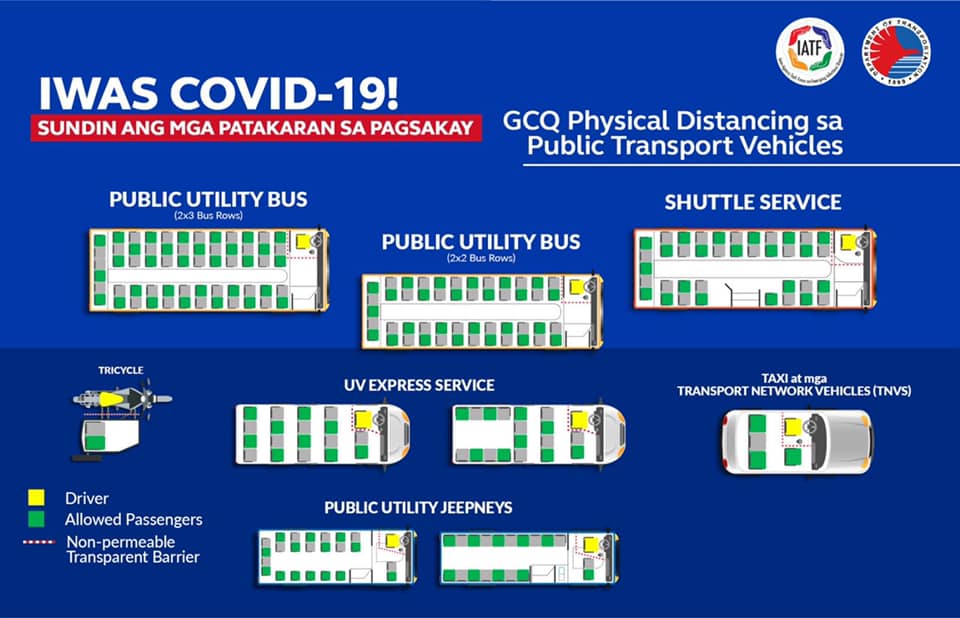


The last image for the tricycle is something that should have been allowed at least for a limited number of tricycles during the ECQ period. That could have eased transport woes for many people especially those who had to walk long distances in order to get their supplies. Some LGUs like Davao were able to issue Executive Orders to that effect that the IATF did not contend (or is Davao a special case?). Now, we see a lot of LGUs issuing EO’s and ordinances allowing public utility tricycles to operate again but limiting their numbers through odd-even schemes. Perhaps the same should be applied to pedicabs or padyak (non-motorized 3-wheelers), too.
–
 Caught (up) in traffic