
Home » Posts tagged 'taxis' (Page 3)
Tag Archives: taxis
On the Uber and Grab predicament
A lot has been said and written for or against Uber and Grab. Social media made sure the more popular but not necessarily the truthful ones are spread. One popular personality associated with motoring has even led an online petition against the rulings by the Land Transportation Franchising and Regulatory Board (LTFRB). An objective check of the facts reveal that LTFRB is not solely at fault here. Uber and Grab should not have promoted themselves and took in additional drivers (nagpaasa ng mga drivers) after the agency issued a moratorium last year. Estimates vary but it seems they have taken in tens of thousands of drivers (20.000? 30,000? 40,000?) and earned revenues along the way to what is now an historic penalty levied upon Uber and Grab by the LTFRB.
Perhaps the most level-headed article I’ve seen online is the following:
The thing about Grab, Uber and the LTFRB [by Vince Pornelos, July 18, 2017, https://www.autoindustriya.com/editors-note/the-thing-about-grab-uber-and-the-ltfrb.html]
It seems all is well, for now, as meetings were held between the DOTr, LTFRB and the concerned parties (Uber and Grab). In one of the meetings, a couple of Senators seem to have brokered a deal to resolve what appeared to be an impasse that a lot of people on social media reacted to. There are definitely a lot of vested (and veiled) interests involved here including those by various “operators” in the transport sector on both the sides of government and private sector. One takeaway though that I observed is that many appear to be against LTFRB even though the agency was truthful about their statements regarding the illegally operating transport vehicles. They seem to have made up their minds about the LTFRB and this is not surprising as transport problems have been festering for decades with little progress in terms of improving transport, conventional or innovative. Most people seem to have lost their patience about transport services and regulation, and perhaps this is a good thing if it translated to demanding for mass transit, too.
–
Grab at NAIA Terminal 2
Here is another useful post for travelers especially during this Holy Week and the summer holiday season in the Philippines. Many people usually look for a ride heading out from the airport. Not everyone would have someone to fetch them. There are several options now for those wanting to take public transport. Aside from the conventional taxis, there are also airport taxis, vans and the more recent airport bus service provided by UBE Express. Ridesharing or car sharing services are also available and the most visible will be Grab with options for either car or taxi available via you own app or through their booths located at the NAIA airport terminals. There should be a Grab booth located at the arrival areas of NAIA’s terminals. They also have a booth at the Mactan Cebu International Airport terminal.
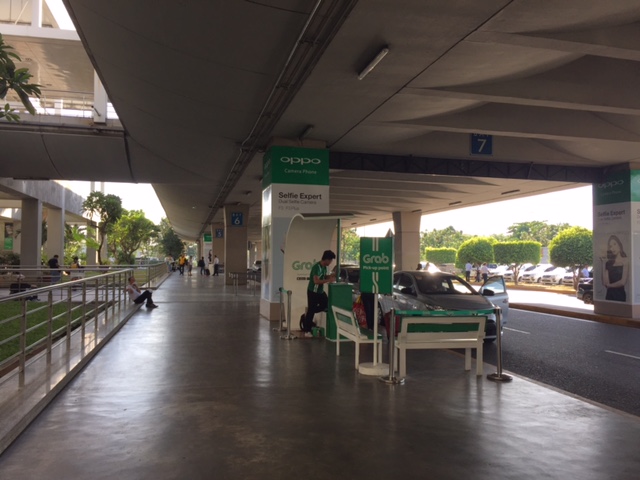 You can easily spot the Grab booth and pick-up area as you exit the terminal’s arrival lounge.
 You can book a ride with the grab staff at the booth if you don’t have a smart phone and the Grab app. You can also just call for a car or taxi using the app. This is the pick-up point for Grab Cars. Grab Taxis would have to use the driveways for taxis parallel and just to the left of this driveway.
Grab has become a game changer for taxis out of the airport. In fact, my own father found them to be a convenient and safe option for a recent trip from Terminal 2 to our home in Cainta. He didn’t have to negotiate fares and he paid a very reasonable fare while enjoying his ride on a recent model car.
–
Some views on Uber and Grab
I took screenshots of a DOTr social media post on Transport Network Companies (TNCs) and the comments made on the post. If the post is an accurate quote of the current LTFRB Chair, then it reveals how a top official of the LTFRB (and at the same time DOTr) thinks about such services and perhaps shows a lack of understanding for what these “innovative” companies are all about. I purposely put the word innovative in quotation marks because there are also challenges that Uber is currently facing.
But then can we blame the official and others of how they understand the business models of TNCs like Uber and Grab? Can we blame them when these companies’ models’ seem to be quite different from their original set-up that made them the popular modes that they are now in many countries? At the same time that they have become the bane of conventional taxis, it seems they are also killing off the good ones, too. In my opinion, Uber and Grab are treading a fine line between ridesharing/carsharing (their original model) and taxi services.
Here are some social media posts not too long ago regarding fare regulation being applied to TNCs:
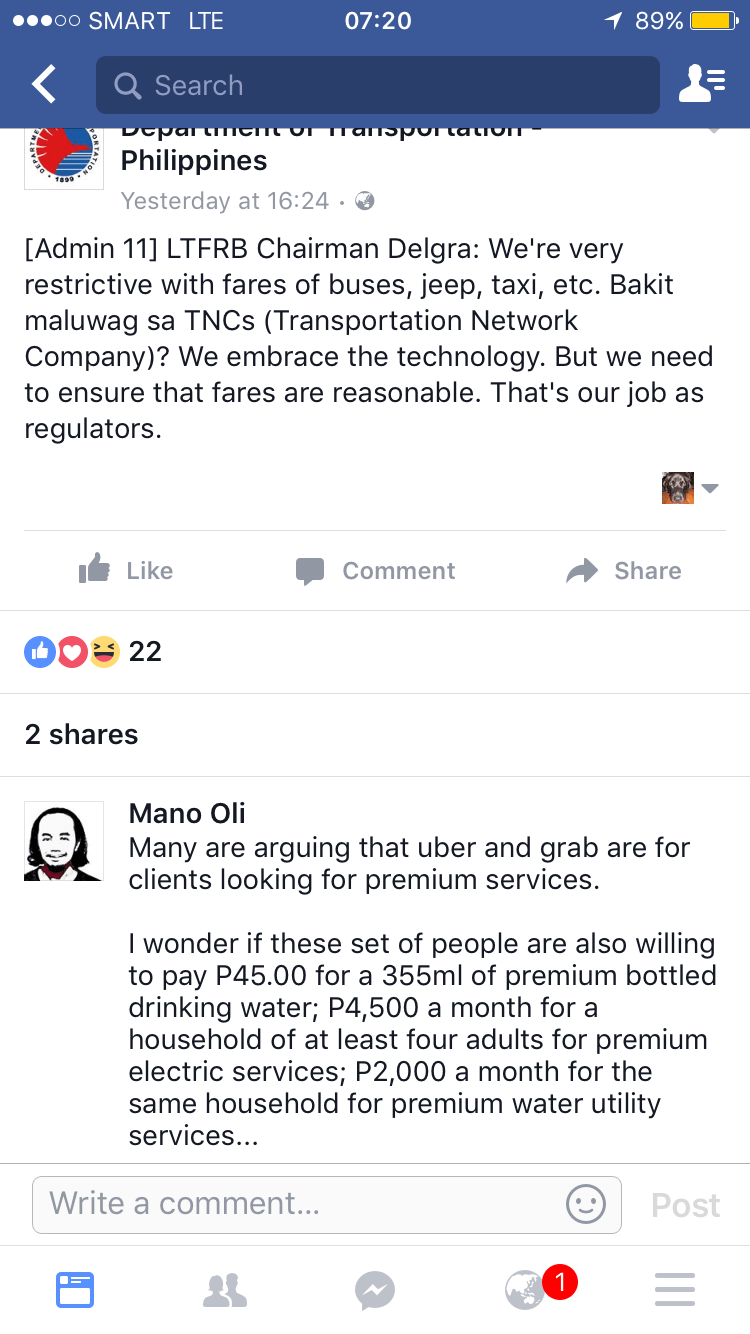

There are healthy (as well as inane) discussions online about TNCs. More recently, there were reactions when Uber appeared to take advantage of a nationwide jeepney strike. I guess people should take in different perspectives about TNCs and in the end, it is the commuters’ welfare that is important regardless of what modes of transport are available them. That welfare should be the priority of government and we should not blame the latter when they are actually doing their jobs.
–
Uber as a Ponzi scheme?
I came upon this article posted by an acquaintance on his social media account. The article appears to be click-bait given its title but reading through it, the author leads you to other articles of what seems to be a series about Uber’s operations. I won’t give any assessment here as we are also doing research on ridesharing (although for now its mostly about the passengers perspective and characteristics). I will let my readers digest the content and context of the following article:
Excellent, deep series on Uber’s Ponzi-scheme economics
–
Oversupply of vehicles for ridesharing/carsharing – Part 2
This is a follow-up on the recent post on ridesharing/car sharing where I talked about my observation that there seems to be an oversupply of vehicles being used for what is claimed as ride-sharing or car-sharing. In that post, I mentioned an observation by me and my colleagues that popular ride-sharing/car-sharing companies like Uber and Grab have led to more vehicles on the roads. I add to that the findings of our students that:
- Those shifting to Grab and Uber are mostly those already using taxis (regular users) and those using UV Express, which is a higher capacity vehicle using either vans or AUVs (average passenger capacities between 10 and 18 passengers).
- GrabCar and Uber function more as premium taxis rather than ride-share or car-share modes.
A friend who’s among the first Uber drivers in the country (He was already an Uber driver before the explosion in the service’s popularity.) shared that Uber earlier had been a real car-share/ride-share. My friend’s full time job was as a musician and he thought of becoming an Uber driver only to have some additional income for when he wasn’t busy with his work or didn’t have gigs. He was not roving around Metro Manila to get fares much like what is now being done by many Uber and GrabCar units.
Later, when Uber and Grab began more aggressive marketing; promoting their services as potentially generating much more income than conventional taxis and perhaps even a person’s full-time job, people started purchasing cars not for their use but to use in business in the form of Uber and Grab cars. I can probably understand those who bought cars and drove the cars themselves. To me, these would still qualify as ride-sharing/car-sharing but on the upper limit of what we can really consider “sharing” since they are supposed to be driving during their free times. Arguably, unemployed people have the entire day as free time compared with employed people or those who run businesses other than being Grab or Uber drivers. These include housewives and even “househusbands” who may have a vehicle at home that they can use for Uber or Grab. Employed people can only share their rides during the time they go to their offices or when they travel home later in the day. Others may have more free time as business people would likely have more flexible schedules.
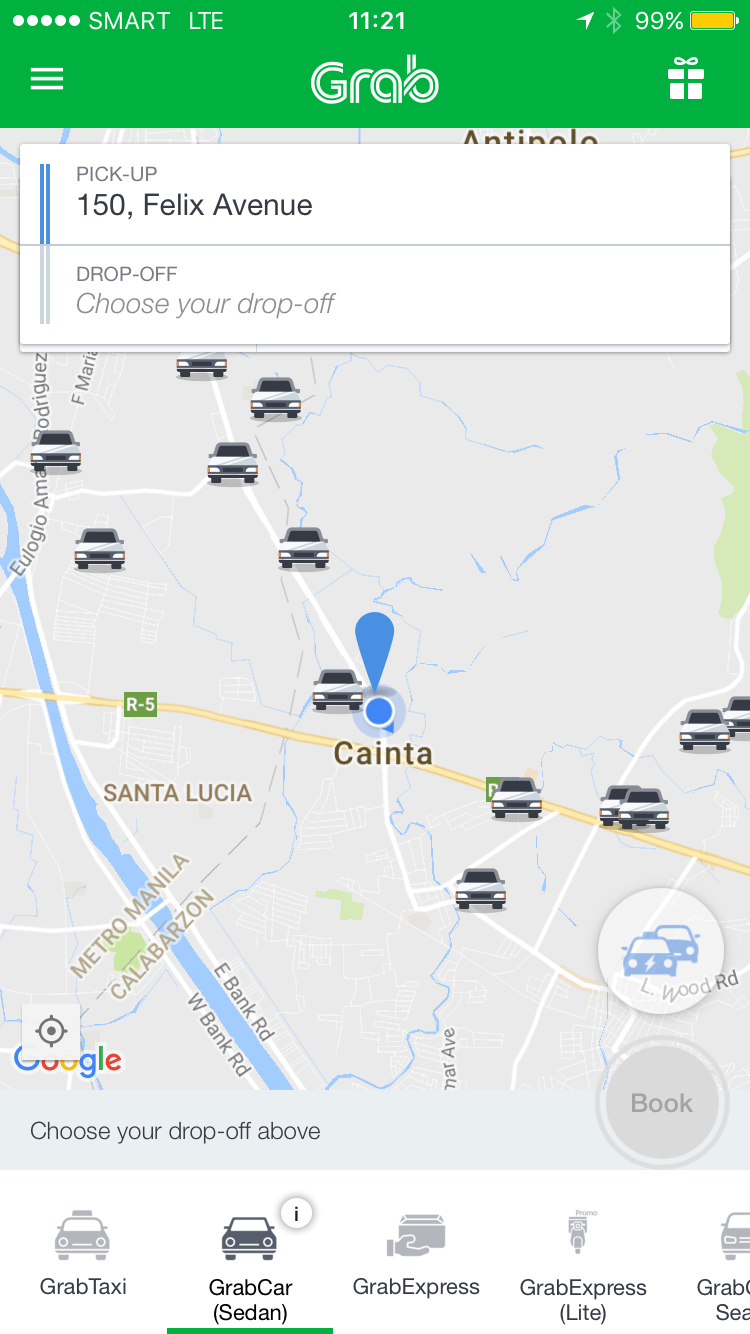
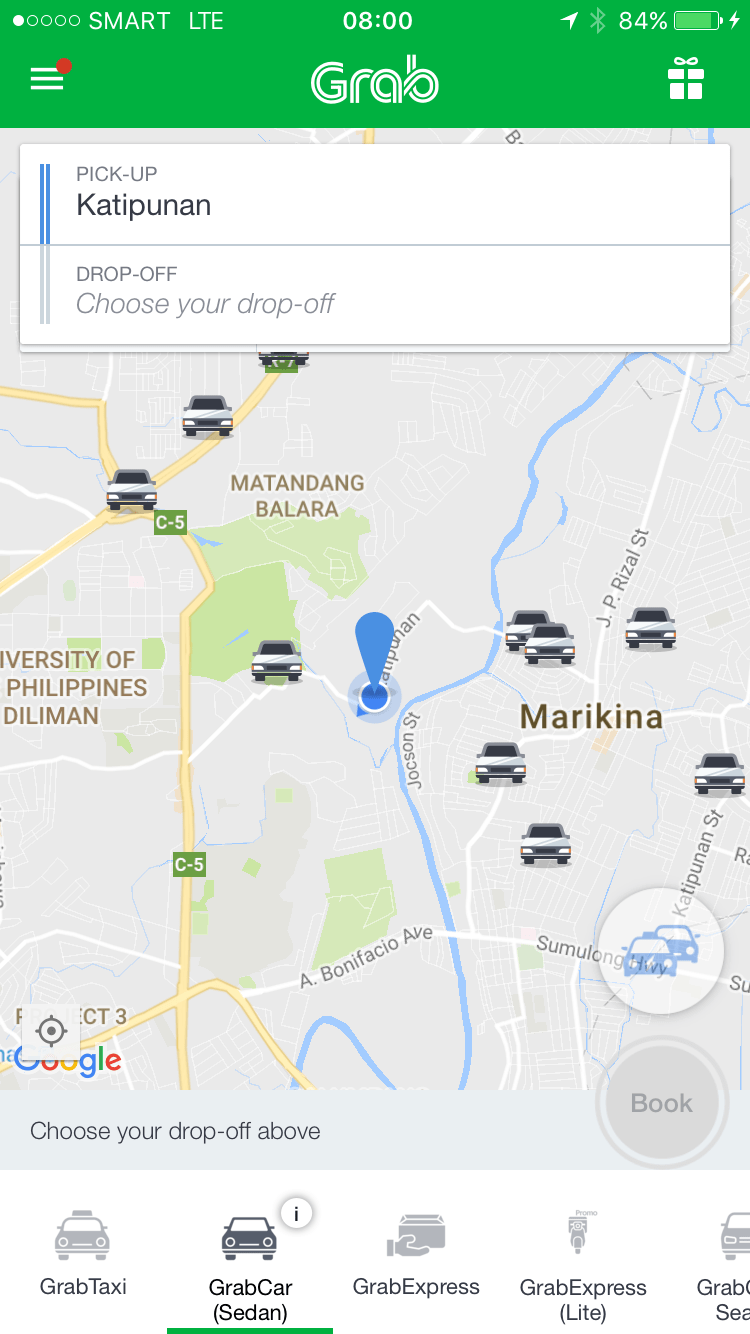
Following is a series of screenshots I took en route to a meeting. It is, I believe, more systematic in terms of trying to determine the availability of vehicles – in this case GrabCars. Again, correct me if I’m wrong about my assumption that the vehicles displayed represent available cars. If they do not then it means the app is misleading people into thinking there are available cars for them to hire.

Grab Cars in the vicinity of UP Diliman
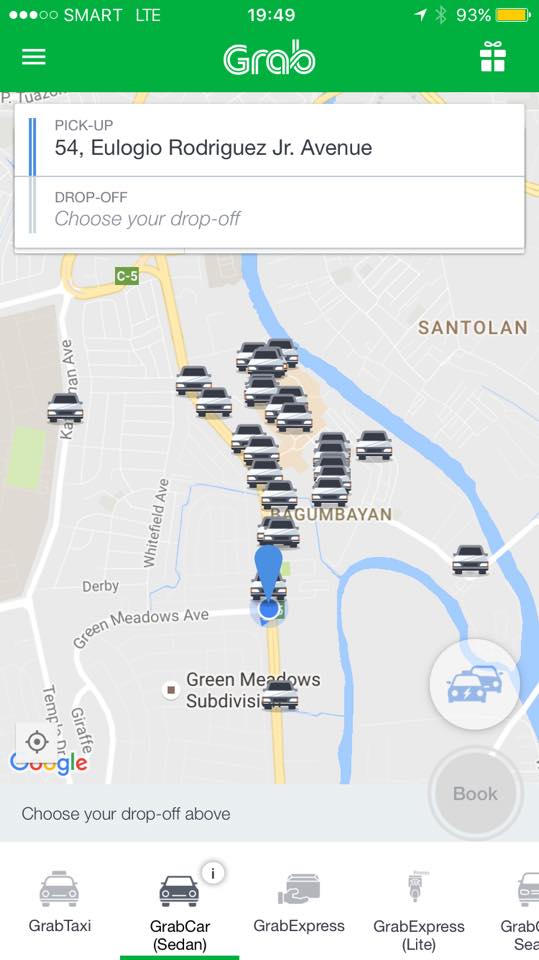 Grab Cars in the vicinity of Eastwood
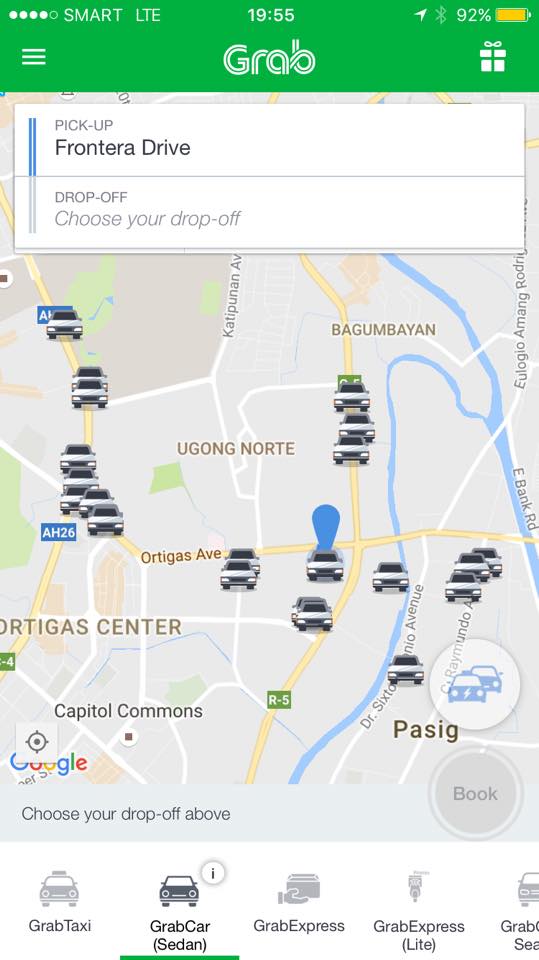 Grab Cars in the vicinity of Tiendesitas
 Grab Cars in the vicinity of Cainta Junction
–
Oversupply of vehicles for ride-sharing/car-sharing – Part 1
My students recently concluded studies on popular ridesharing/carsharing services Uber and Grab. The studies details how, for example, people have come to prefer Grab Taxi, Grab Car and Uber over regular taxis. One important finding and conclusion in one study is that Uber and Grab in the Philippines cannot be considered as contributing to sustainable transport. Note that this conclusion is just for the Philippine case and perhaps can be further constrained to Metro Manila since all data collected was with the geographical bounds of the metropolis.
There is already a perception that there is an oversupply of vehicles being used for what is being claimed as ride-sharing or car-sharing. This is due to the surge in new vehicle purchases as people joined the Grab/Uber bandwagon. Who can resist the opportunity to earn good money from being a Grab or Uber driver? That is basically the question answered by a lot of people who decided to purchase cars and register these and themselves for Grab or Uber.
To see if there is some truth to this perception of oversupply, we use one ride-sharing app for the information it provides users. One can make a quick check of how many Grab vehicles are moving about and ‘looking’ or waiting for riders/passengers. Following are what’s displayed on my phone in three random instances last Tuesday for GrabCar. I leave it up to the reader to draw conclusions from these screenshots.

More in Part 2…
–
Curiosities of transport services in Metro Manila
There are a few interesting observations we can make out of transport services in Metro Manila and chief among them is the poor quality of service that we can generalize among most if not all modes of public transport available to commuters. This poor quality of service of public transport is what drives many people to aspire to own and drive or ride their own vehicle. Already there has been a surge in motorcycle ownership in Metro Manila and its neighboring towns and cities (collectively Mega Manila) and car ownership is also on the rise. These trends have led to increased congestion along many roads. And we will probably not see a significant improvement until the mass transit projects have all been completed. These include the Line 2 Extension to Masinag, the MRT 7 along Commonwealth, the Line 1 Extension to Cavite, and yes, the capacity improvement of MRT 3. Hopefully, there will also be BRT lines along C-5 and Quezon Avenue to complement the rail transport projects.
The UV Express is actually a response to poor public transport services as it evolved out of the FX taxi services of the 1990s that later mixed with informal van and AUV services. These are actually a precursor of today’s ride sharing modes. Only, in those days when the FX service was born, you didn’t have tools like apps to facilitate your ride. People had to agree about the fares and the destinations from terminals like those in Cubao (Quezon City) and Crossing (Pasig/Mandaluyong).
But let us focus on three services that would not have been attractive if only services by their conventional counterparts were (very) satisfactory and if there was a comprehensive and efficient mass transit network in the metropolis. These are Uber, P2P buses and airport express buses.
Uber offers services much like that of the conventional taxi. Its advantages are mainly having recent model vehicles (not dilapidated ones), a better driver (this attribute is quite subjective), and an app-based system for availing services. Fares are generally more expensive than those for regular taxis. And there is a surge pricing for when congestion is really bad. It has a very good feedback mechanism that allows passengers to evaluate their drivers. However, this wouldn’t have been necessary if taxi drivers in general were more disciplined and courteous to their passengers.
P2P buses operated by Froehlich Tours offers services much like that of conventional buses. Its current advantages over conventional buses are that it operates express services, buses are new, well-maintained, and with drivers that appear to be more disciplined than the typical public utility bus driver. A friend’s take is that P2P’s are the bus equivalent of UV Express. It is not at all necessary if the quality of service of regular buses were much better than it is right now. And I am referring to the practically stop anywhere, recklessly driven and poorly maintained regular buses.
Premium airport buses have recently been introduced and these are operated by Air21, which is a freight forwarding company. It is a service that’s long overdue given the many difficult experiences of people to and from NAIA’s passenger terminals. While an airport limousine bus service should have been provided many, many years ago it also is a reflection of the poor quality of airport taxi services. Airport taxis are expensive and according to many stories circulating can be predatory.
What I am driving at, if it is not yet so obvious, is that many ‘new’ services are actually borne out of crappy services of conventional modes. There are many lessons to be learned here in and lest I be accused of neglecting other Philippine cities, I should mention that Metro Manila presents so many lessons to be learned by other rapidly growing and urbanizing areas in the country. At this time we can mention Cebu, Davao, Iloilo, Cagayan de Oro and perhaps Clark/Angeles as metropolitan areas to watch in terms of transport system development. Hopefully, there’s a kind of reverse psychology in their approaches to address their transport needs in that they avoid what has been done in Metro Manila. Surely, transport services in these other cities can do better than Metro Manila’s.
–
When conventional taxis were a little better
There was a time when conventional taxis were at least a bit better than what they are perceived to be now. I say “a bit” because then as now, unruly taxi drivers were quite rampant and many drivers were into negotiating fares or choosing passengers. But to those who remember the taxis from the 80s and the 90s, there was one R&E taxi company that was supposed to be more reliable than others. There was even one movie starring the father of a current presidential candidate where the recognized king of Philippine cinema played a taxi driver along with a host of popular basketball players. That was a time when people preferred R&E over other taxis and it was easy to spot their yellow and green cabs.
Then there was also Basic taxi company, which featured a phone-a-taxi (on demand) service. The wife used to call for a taxi to her home or office so she didn’t need to stand out to wait and hail a taxi when she had some heavy stuff with her. I was reminded of this feature of their service when I spotted a Basic taxi in front of our vehicle earlier today. Pick-up call services are still available and I guess there are other taxi companies with similar services for the convenience of passengers. However, with the eventual deregulation of taxis and the proliferation of individually owned cabs, services continued to deteriorate in Metro Manila and other cities.

These convenience features are not new ones as what it seems to younger people these days who have their Uber and Grab apps on their smart phones. I guess if there were smartphones in the 1980s and 1990s, then similar apps could have been developed for taxi services. I had written about one taxi company in Iloilo City that has these pick-up call services and an app for people who prefer to use these with their gadgets. One just wonders if conventional taxi companies could have been preferred by more people over Uber and Grab if their drivers were more professional (i.e., stuck to their meters and weren’t choosy of passengers).
–
Honest Iloilo taxi driver
As if on cue, I just read a news article reporting on a taxi driver who returned a big amount of money left by one of his passengers. The driver is of a Light of Glory taxi. Call it coincidence but then the article mentions that the driver also was in the news before for returning a notebook computer another passenger has left in his cab.
Taxi driver returns P300,000 left by passenger
So it’s the driver and not necessarily the company? Likely, and we do need more trustworthy drivers like him behind the wheel of our taxis.
–
Good intentions and knee jerk reactions
Social media is again abuzz with stories about Uber and how Philippine government agencies like the Department of Transportation and Communications (DOTC) and the Land Transportation Franchising and Regulatory Board (LTFRB) are hassling Uber, Grab and similar companies into complying with government regulations covering their services. Is it really a hassle and are these “Transport Network Companies” or TNCs the real deal in terms of solving part of Metro Manila’s transport woes?
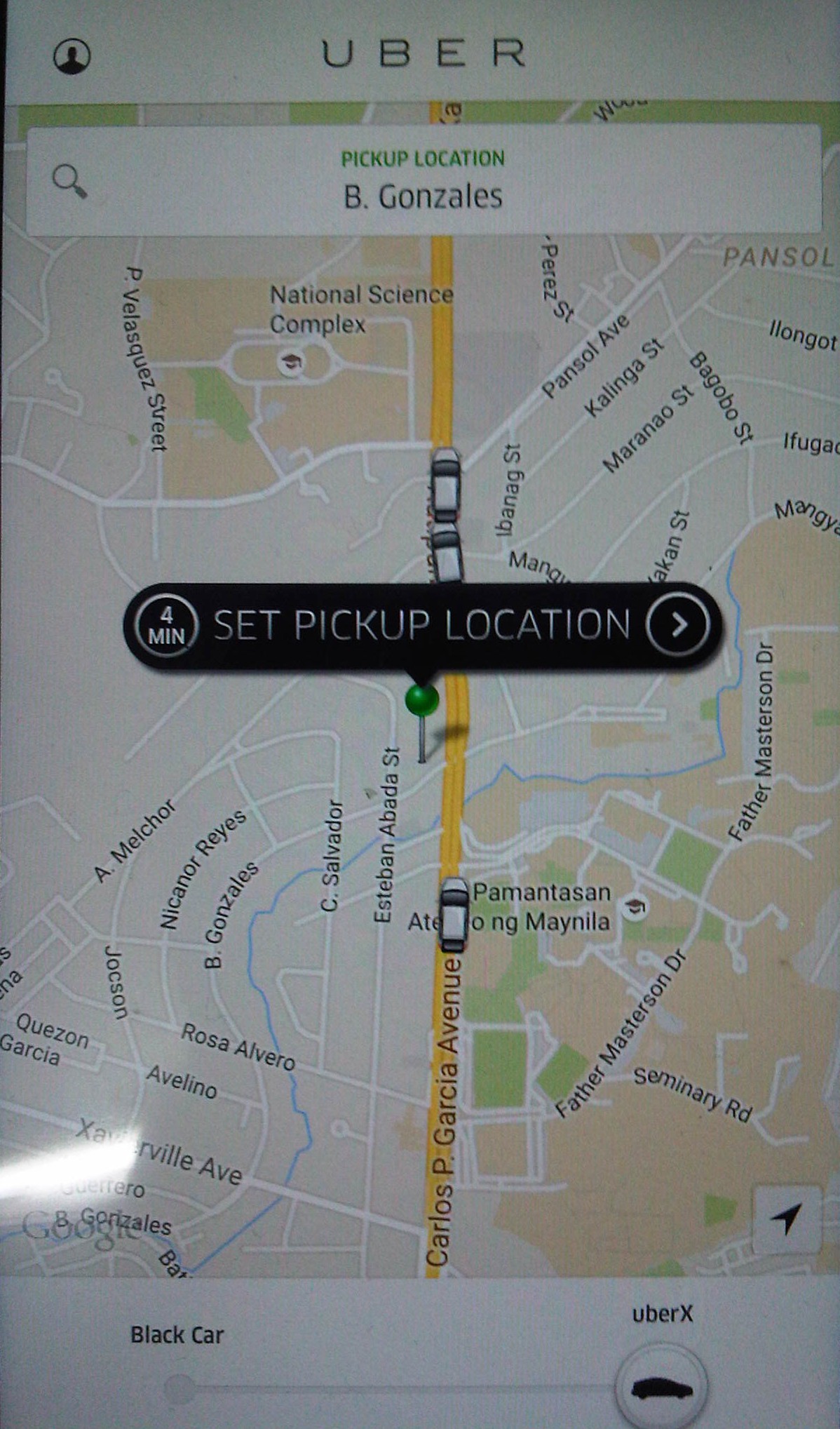
I believe Uber and other services like it have good intentions towards providing high quality, on-demand transport services. However, based on what I’ve read about the service in other countries (particularly in the US and Europe), the intention (original?) was to take advantage of surplus or excess capacity of vehicles being driven by “owner-drivers” between origins and destinations such as their homes and offices. That means an improvement of sorts for traffic as, instead of having one vehicle per person, two or more can share a single car. The main differences with conventional carpools is that the driver and his passengers practically do not know each other, and the passengers pay the driver a fee that is agreed upon at the start of the transaction. This works well in car-oriented cities as well as those with less than satisfactory public transport services especially when it comes to taxis.
The last sentence seems to be the right description for Metro Manila and other rapidly growing Philippine cities. And so, Uber, Grab Car and other shared service attracted many users who can afford them and providers willing to share their rides with total strangers. I stated “owner-drivers” in the previous paragraph as this was supposed to be an essential part of the set-up where Uber and others didn’t add to the cars already on the roads. Problem is, apparently and allegedly, some enterprising people who had the resources thought it would be a good idea to deploy all their vehicles (and even purchase additional ones) by hiring drivers they could register with Uber or Grab Car. That way, they thought they could bypass the typically bureaucratic process of getting a franchise for taxi or rental car franchises that also include all those business permits and, of course, taxes. The result of this would not be the utilization of excess capacity but the addition of more cars on the roads and therefore contribute to worsening congestion.
As far as the LTFRB is concerned, like it or not, they are just doing what they are mandated to do and are supposed to do with any transport service provider that is not purely private (i.e., services with a fee). It just so happens that the DOTC and LTFRB have been on the receiving end of a lot of flak from the public and especially in social media for what is perceived as the agencies’ ineptitude in dealing with major issues in public transportation. These include the continuing saga that is EDSA-MRT 3 and the perceived low quality services provided by buses and jeepneys in general that leave people at the mercy of taxis and UV express if they opt not or cannot afford to purchase their own vehicles.
The main issue is not whether DOTC and LTFRB should pay attention to Uber and others like it. The agencies should as per their mandates. However, there are a lot of other more serious and more urgent issues/problems including the much delayed mass transit projects and the low quality of service being provided by buses, jeepneys, UV express and conventional taxis that the DOTC and its attached agencies need to act on and now. I know it is a generalization (There are many good bus, jeepney, UV express and taxi drivers and operators out there who are also working their butts off to earn a living.) but then when you combine unsafe driving, with high fuel consumption and a lot of harmful emissions then you get a cocktail that’s definitely bad for all travelers.
How many people use Uber or Grab Car or taxis? Do they outnumber those taking the LRT/MRTs, buses, jeepneys and UV express? They don’t and therefore only represent a small percentage of the trips being taken everyday in Metro Manila and adjacent areas. And so the more pressing issues are really those pertaining to mass transit and the dire need to construct these systems once and for all in order to achieve a more sustainable and inclusive transport system for this still growing megalopolis.
–
 Caught (up) in traffic