
Home » Posts tagged 'TNVS'
Tag Archives: TNVS
First impressions of In Drive
There’s another TNVS service operating and competing with Grab. I heard about In-Drive from friends who regularly take Grab when they are in a hurry and opt out of their usual public transport options. They relate that In-Drive was cheaper than Grab based on their most recent bookings. They also said it was easy to book a ride with In-Drive.
And so I downloaded the app and finally had an opportunity to try them as I traveled between UP Diliman and Ortigas Center. I was able to book a ride immediately and it was less expensive compared to Grab. But that was just one booking so I had to try it another time. On my return trip, the same happened and I was able to get the same result with a cheaper booking than Grab.
One time I had to travel home from my office in UP after my evening class, I decided to try this again. Here are the screenshots for my evening ride. The first image is for Grab and the second for In Drive. The routes indicated in the maps are the same. Noticeably different are the estimated travel times (73 minutes for Grab vs. 64 minutes for In Drive) and fares (at least 556 pesos for Grab vs. 472 pesos for In Drive). The choice here was easy – In Drive.
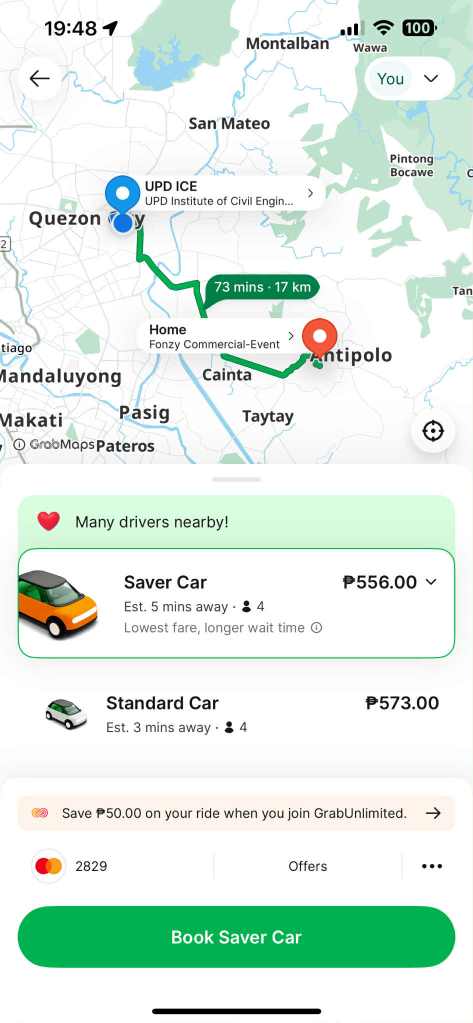
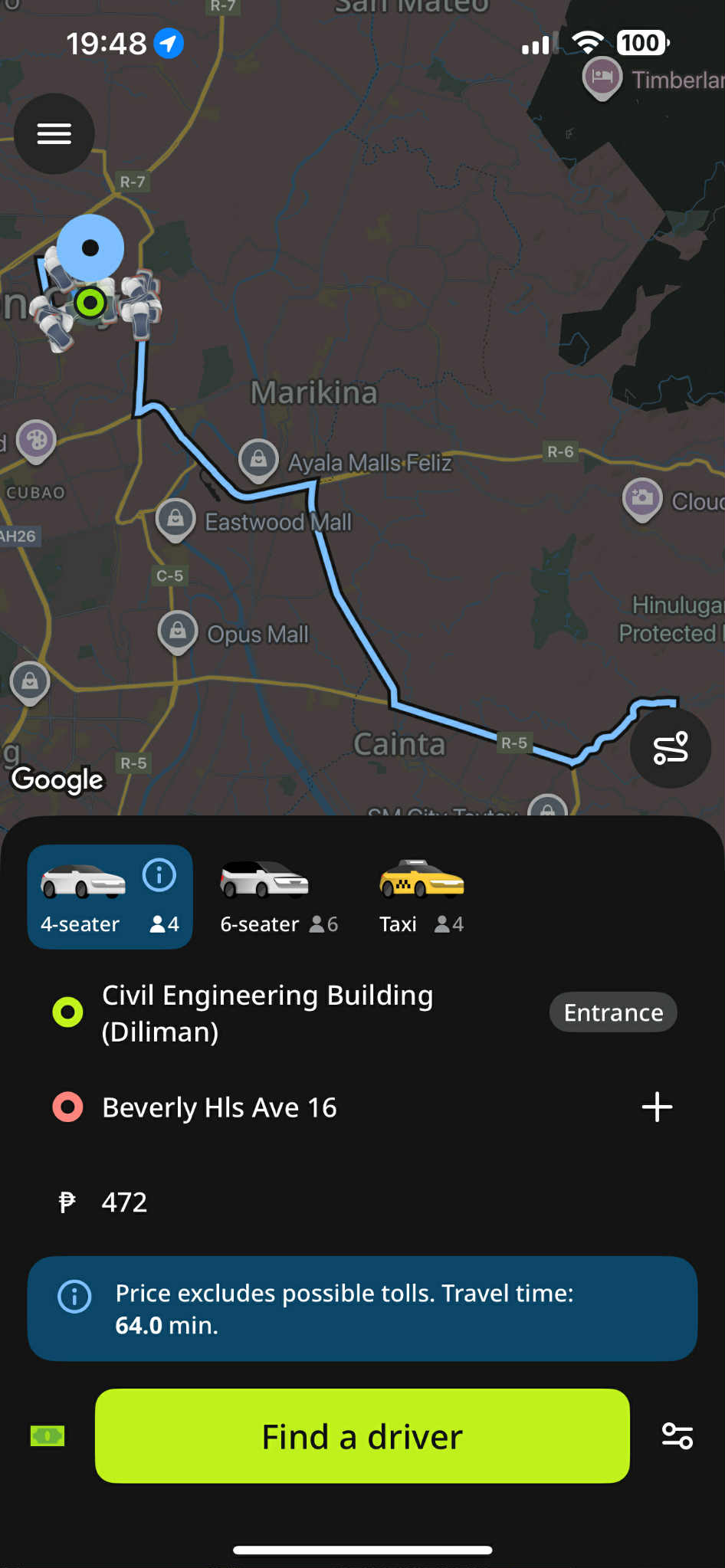
My experiences so far indicate that In Drive was indeed cheaper than Grab. For the last example, it also indicated a shorter travel time. But that’s just me and a few bookings. It is worth studying or exploring further if indeed In Drive, in general, provides for less expensive travel. Other circumstances or conditions can be considered including the origins and destinations for the bookings, the time of day or day of the week, and so on. These are necessary to really have an objective and conclusive comparison of the two.
There’s another option that’s been getting some buzz recently among my friends and students. A taxi company with a full electric car fleet is also now available and competing with the TNVS companies. I will write about Green GSM very soon!
–
inDrive- A cheaper alternative to Grab?
Friends have been sharing that a new player in the TNVS business is less expensive than Grab. And yet they have comparable vehicles and drivers. They are also supposed to be easier to book. I’ve tried them a few times so far but forget to get screencaps to show the difference between the new players and Grab.
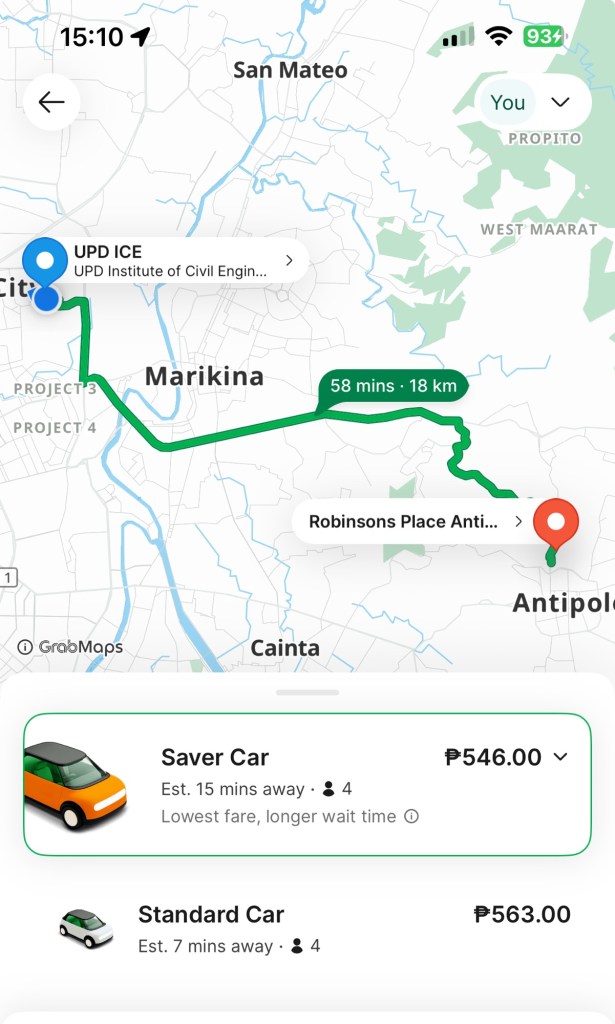
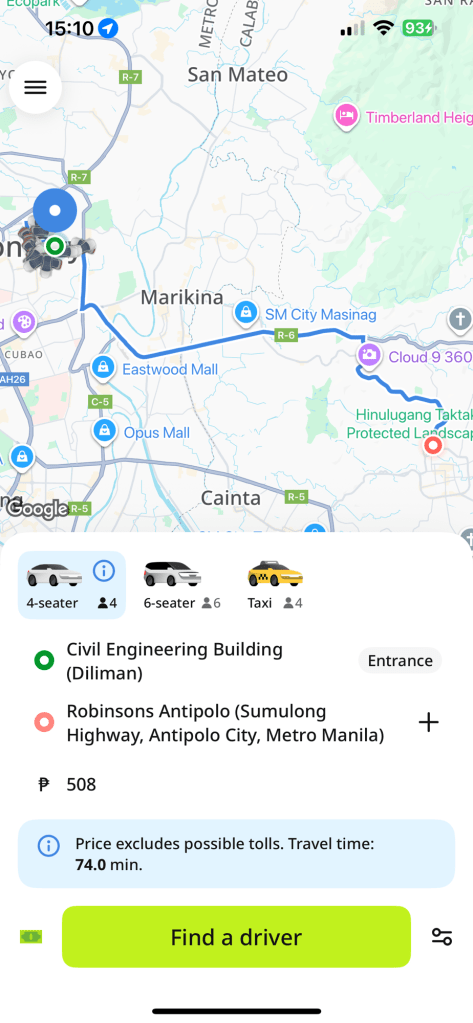
Of course, I ended up booking inDrive as it was cheaper by about 60 pesos for a standard car. I will continue taking screen caps for succeeding rides I will be taking in the future.
–
On the DOTr Guidelines for Public Transport – Layouts for Distancing
Here again, for reference, are the guidelines issued by the DOTr in relation to the transition from ECQ to GCQ and beyond (immediate rather than far future). The following images show the physical distancing prescribed for road transport.
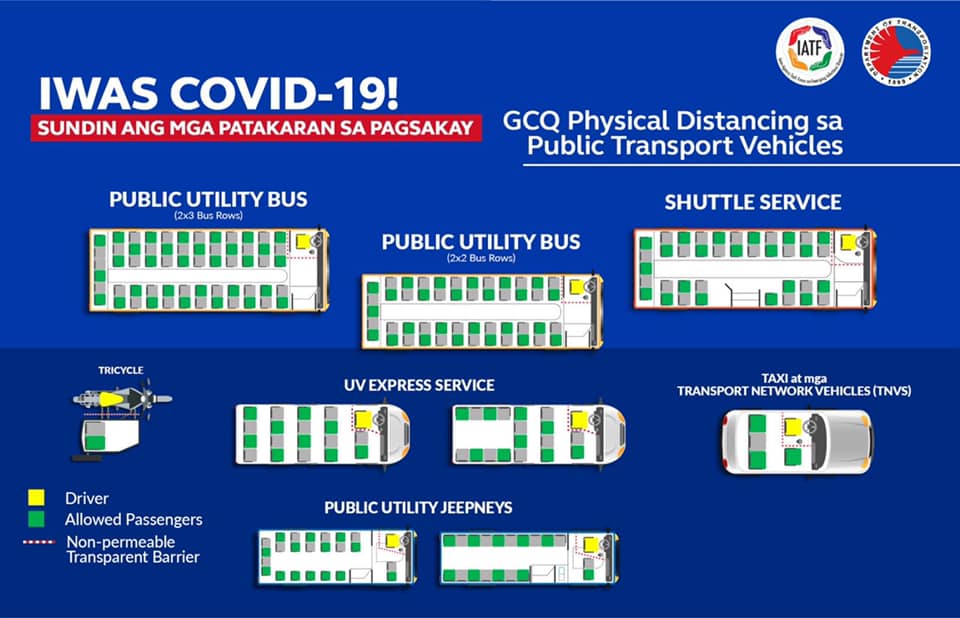


The last image for the tricycle is something that should have been allowed at least for a limited number of tricycles during the ECQ period. That could have eased transport woes for many people especially those who had to walk long distances in order to get their supplies. Some LGUs like Davao were able to issue Executive Orders to that effect that the IATF did not contend (or is Davao a special case?). Now, we see a lot of LGUs issuing EO’s and ordinances allowing public utility tricycles to operate again but limiting their numbers through odd-even schemes. Perhaps the same should be applied to pedicabs or padyak (non-motorized 3-wheelers), too.
–
How many TNVS vehicles are enough?
There’s this old article I chanced upon on social media:
Badger, E. (2018) “What’s the right number of taxis (or Uber or Lyft cars) in a city?”, The Upshot, The New York Times, https://www.nytimes.com/2018/08/10/upshot/uber-lyft-taxi-ideal-number-per-city.html [Last access: 3/26/2019]
This article is still very much relevant since the government is still apparently unable to determine the number of TNVS vehicles needed to serve the demand in cities. The latter refers to those cities that TNCs have identified for operations and where they are already operating. Obviously, the question applies to taxis as well. But then taxis and TNVS have practically the same operational characteristics. I am not referring to business models but to the way these modes operate as parts of a cities transport system. What is really the demand for driven for-hire vehicles? Will this demand be significantly reduced once mass transit lines like MRT-7 and the MM subway are operational?
This also extends to motorcycle taxis as well. While there is already a proliferation of informal motorcycles taxis around the country including major cities and the capital, the formal services represented by Angkas shows just how many riders want in on this service. And it’s basically attractive due to the potential income they can derive from this. And so this begs the question: How many habal-habal units are enough?
–
Increasing the number of TNVS units? Not so fast!
The Land Transportation Franchising and Regulatory Board (LTFRB) is planning to increase the number of TNVS units (i.e., rideshare vehicles) in Metro Manila to meet what is perceived as the demand for them based on the numbers provided by TNCs like Grab. The problem with this number they want to eventually achieve, 65,000 units supposedly, is that this is based on current transport conditions in the metropolis. Also, this is based on data that is biased for the interests of TNCs, which obviously want to increase their driver and vehicle base in order to maximise profits. Here is a nice article that should provide some context from abroad where rideshare vehicles are actually generating more car traffic and taking people away from public transport.
Fried, B. (2018) “Uber and Lyft Are Overwhelming Urban Streets, and Cities Need to Act Fast,” Streetsblog, https://nyc.streetsblog.org/2018/07/25/uber-and-lyft-are-overwhelming-urban-streets-and-cities-need-to-act-fast/ [Last accessed: 7/26/2018]
Currently under construction are the Line 7 and Line 2 Extension projects and soon there will also be the Line 1 Extension. Also, in the pipeline are the proposed subway and rehabilitation of PNR that is supposed to revitalise its commuter line. These are examples of projects that will likely be game changers in terms of commuting with the objective of drawing people away from car use. In the bigger scheme of things, perhaps there is a need to rethink numbers for TNVS and instead focus on improving taxi services in Metro Manila. The same can be said for other cities as well where there is already a need for better public transport services to avert a transport future similar to what Metro Manila is already experiencing now.
–
 Caught (up) in traffic