
Home » Posts tagged 'traffic enforcement' (Page 2)
Tag Archives: traffic enforcement
The need for speed (limits)?
My social media newsfeed regularly contains updates being posted by various entities about transport and traffic in Metro Manila and across the Philippines. Among those I regularly see are posts on road safety and interesting to me are the frequent posts on legislating speed limits at the local level. These are in the form of city or municipal ordinances that are supposed to strengthen, supplement and/or clarify speed limits that are actually already stated in the road design guidelines of the Department of Public Works and Highways (DPWH). These limits apply not only to national roads but to local ones as well. However, their effectiveness may be limited or reduced by the absence or lack of signs, markings and, most importantly, traffic law enforcers who are supposed to monitor traffic and apprehend those violating rules and regulations.
While there is a need for defining and clarifying speed limits perhaps in the form of local legislation, I believe the more urgent matter is the implementation and enforcement of laws. It has often been mentioned that we already have so many laws, rules, regulations and the truth is we do, and may not need more. One really has to go back to the basics in terms of enforcing these laws and that means enforcers need the knowledge and tools to be effective in their work. There is an opinion that many enforcers are not knowledgeable about many rules and regulations and therefore are prone to just focus on a few including violations of the number coding scheme, truck bans and the much maligned “swerving”. You do not often seen apprehensions for beating the red light, beating the green light (yes, there is such a violation), speeding, or “counter-flowing” (or using the opposing lane to get ahead of traffic in the correct lanes). There are also turning violations as well as those involving vehicle (busted tail lights, busted headlights, busted signal lights, obscured license plates, etc.). More recently, there are anti-drunk-driving laws that also urgently need proper implementation.
I think the current work that includes sidewalk clearing operations and anti-illegal on street parking of the Metropolitan Manila Development Authority (MMDA) is one good example of going back to the basics. These address the necessity of clearing space for both pedestrians and vehicles; space that have been constrained by obstacles that should not be there in the first place but so often have gotten the blind eye treatment. Going to the “next level” though requires tools such as speed guns, high speed cameras at intersections, and instruments for measuring blood alcohol levels in the field (breath analyzers). And these require resources for acquisitions as well as capability building in the form of training personnel to handle equipment. No, I don’t think we need more laws, rules and regulations. What we urgently if not direly need is their proper implementation to effect behavior change that will improve both safety and the flow of traffic.
–
Some thoughts on Metro Manila traffic
I was going to defer posting another article this September as I reached my usual quota of at least 10 posts. Particularly, I wanted to have a series about my recent trip to Vietnam. But then the traffic congestion the past week was just so severe that I felt I just had to write another piece.
To be fair, there are so many reasons why transport and traffic are bad in Metro Manila. Among these is the lack of mass transit infrastructure, particularly a more comprehensive rail-based system. Metro Manila, with its population of over 12 million requires something like 8 to 10 mass transit lines that are interconnected and allows for seamless transfers with road transport modes. Singapore, with less people, has more efficient options for public transport. Then, there is the lack of facilities for walking and cycling that could tremendously reduce the number of trips using motor vehicles particularly for short trips (perhaps within 2 to 3 kilometers travel distance?). I won’t even go to the deficiencies of road public transport and the proliferation of private cars operating as full time taxis (ridesharing anyone?). And urban planning? Well, that deserves its own article…
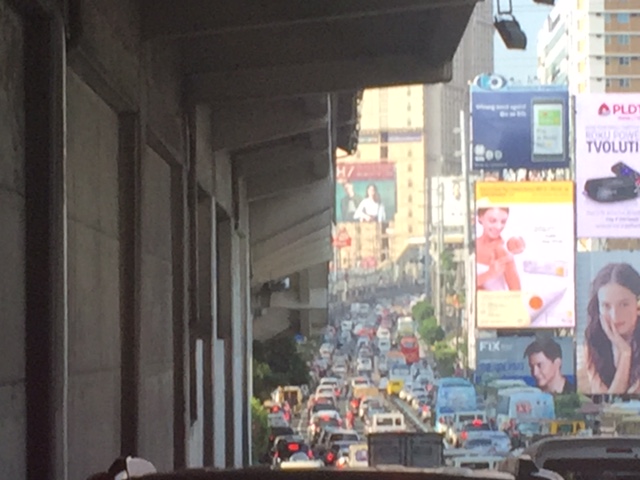 This is EDSA in the mid-afternoon. I took this photo while we were heading back to Quezon City from Makati around 3:30PM. It was not supposed to be this heavy considering people were still at their workplaces, schools or even the shopping center/malls.
There is no quick fix to Metro Manila’s problems. Obviously, the infrastructure that should have been in place decades ago need to be built albeit at a high cost. Our children and grandchildren will likely end up paying for these but there is also the reality that such infrastructure won’t get cheaper in the future. There should also be stricter policies and enforcement to improve the quality of services of public transport. As it is, private transport modes including taxis, the popularity of ridesharing/ridehailing services and the unregulated motorcycle taxis are steadily taking people away from public transport. This is perhaps among the most significant causes of more congestion for the metropolis that needs to be quantified and validated for us to understand and determine what measures need to be taken.
I conclude this post and September with a nice article on walkability:
Steuteville, R. (2017) Why walkability is not a luxury, Public Square, https://www.cnu.org/publicsquare/2017/09/28/why-walkability-not-luxury, last accessed September 29, 2017.
–
Wheel “chaining” in Taytay, Rizal
Another municipality that has become somewhat aggressive in its campaign against illegally parked vehicles is Taytay also in Rizal province. In the case of Taytay, instead of wheel clamps, authorities have opted to employ what appears as more cost efficient (read: less expensive) tools in their campaign – chains and locks. Instead of the more sophisticated (and likely more expensive) wheel clamps in neighboring Antipolo, chains are wrapped around one of the front wheels of a vehicle and then secured by a lock. Examples are shown in the following photo:
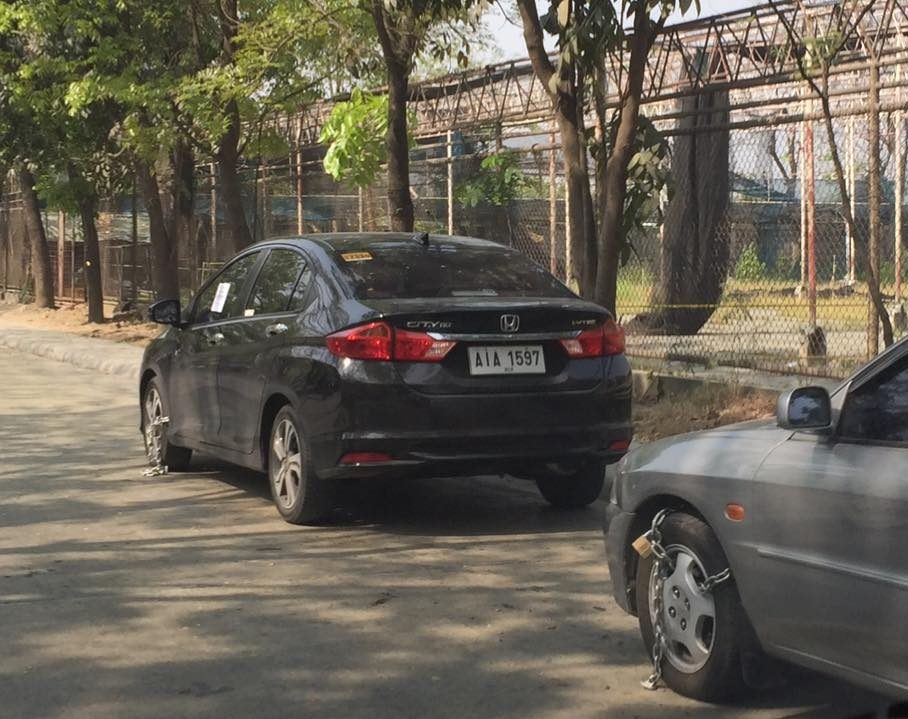 Car wheels chained and padlocked along Don Hilario Cruz in the Taytay Public Market area. The road connects the Manila East Road with the new Taytay municipal hall complex.
Anti-illegal parking enforcers also post a sheet of paper on the window of the vehicle to notify the driver about the violation. The enforcers are posted nearby; waiting for drivers to approach them. There’s supposed to be a fine similar to when a vehicle is towed and reclaimed by the driver or owner. This, campaign, however, seems to have been relaxed in the same area where I took the photo as there are again a lot of vehicles parked on either side of the street on the Saturdays that I pass by the area. I’m not yet sure if this is a case of ningas cogon on the part of the municipality or perhaps they are just exercising some flexibility considering the parking demand for the market and the numerous clothes shops there where wholesalers flock to for merchandise. I haven’t seen similar “chaining” activities in other parts of Taytay unlike Antipolo, which has been continuously and consistently conducting campaigns throughout the city.
–
Traffic management in Tagaytay?
My recent trip to Tagaytay made me recall why I no longer like the city as much as before when we were frequent visitors for rest and recreation. Two things come to mind whenever we plan a trip to Tagaytay, one is where to stay and the other is when to go. The latter question is usually a no-brainer as we opted to go to Tagaytay on weekdays rather than the weekends. There are much less people during the weekdays and you can still enjoy the city even with one having to deal with the worsening traffic conditions brought about by the intense development along the national highways. The former question is easily answered, too, since there are many good hotels (including bed & breakfast places) in the city.
Traffic though has worsened in this city that probably has tourism as its top industry. It has attracted a lot of developers who seem to have gobbled up a lot of land for what has become intense development. Surely they were targeting a market comprised of people wanting to own property in Tagaytay. The high rise condominiums address the demand for a view of Taal Lake and Volcano. The commercial developments are supposed to cater to the needs (shopping?) of tourists. The city seems to have neglected the fact that its transportation system’s carrying capacity (never mind for this article the capacities for other critical resources like water) cannot handle the trip generation attributed to these developments. And so its transport problems, again basically rooted on trip generation, are exacerbated by limited capabilities for traffic management. [The capacity seems to be there given all the staff manning the Tagaytay rotunda.]
A colleague opined that perhaps traffic management here is limited, too, by the options Tagaytay has in terms of management measures. You basically have a major intersection, a rotunda, where practically much of traffic converges. These include traffic along the Tagaytay-Nasugbu Road, which includes a lot of vehicles coming from or going to the Sta. Rosa-Tagaytay Road. And there are vehicles taking the Aguinaldo Highway. Traffic personnel seem helpless as they attempt to manage traffic movements. Their approach though is haphazard and only results in very long queues extending outward along all the intersection legs.
 Traffic jam against the backdrop of a gigantic tarp with greetings from the ruling political dynasty in the city
 The Tagaytay – Nasugbu Highway is terribly congested due primarily to the Ayala mall. Not seen in the photo is the barrier that stretches from the rotonda to beyond Lourdes Church that forces all traffic from the west head to the rotonda to make a turn.
 Vehicles coming in from Aguinaldo Highway are backed up. There is also a new mall under construction and opening soon that is too close to this major junction in Tagaytay.
I wonder if the major trip generators (i.e., malls and high density residential developments) were required to do impact studies before the projects were approved for implementation. There’s really not so much in terms of traffic circulation or transportation improvements that can be undertaken given the linear form of the city and the limited road network available for planners. I am curious too see for myself what recommendations were made by these studies in order to alleviate the detrimental impacts they now have on transportation in Tagaytay.
–
Motorcycle lanes along Sumulong Highway?
I noticed something along my commute and that is the newly marked pavement along Sumulong Highway at the section in Barangay Mambugan until Barangay Mayamot at Masinag Junction. I guess this is more likely part of Antipolo City’s initiative in managing motorcycle and tricycle traffic. In a meeting with the City Administrator, Robert Nacianceno, last year, he said that the city was moving towards improving road safety. That included addressing concerns about tricycle and motorcycle operations that has led to crashes and congestion. Motorcycle lanes designated by blue pavement markings are not new and likely was inspired by the MMDA’s initiatives along major roads in Metro Manila.
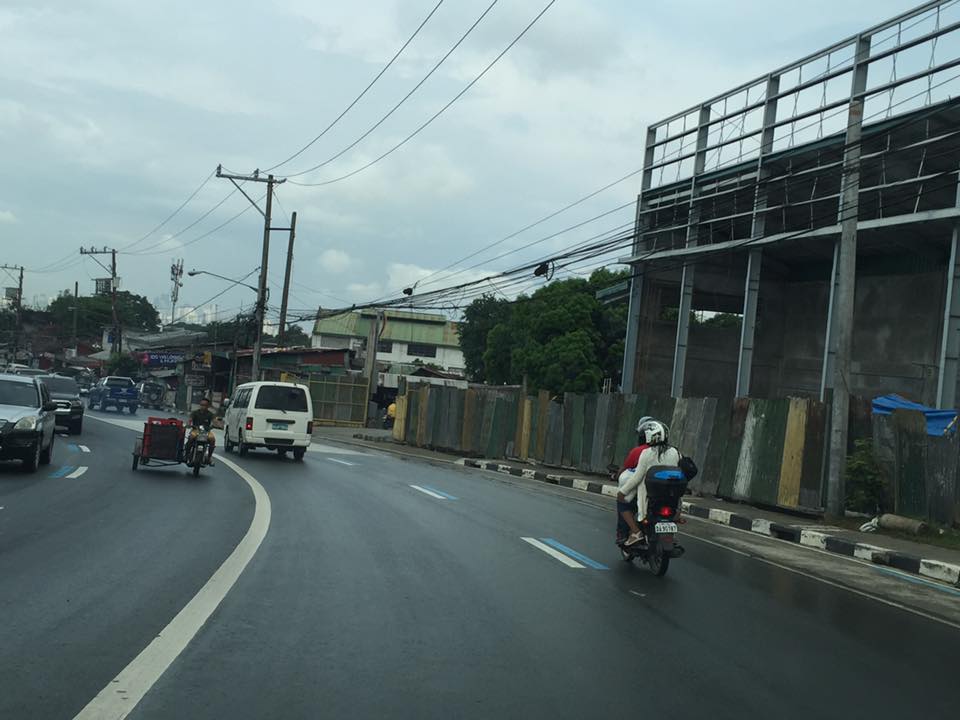 Motorcycle running along the designated lane
 The blue markings are present along both sides of Sumulong Highway
The real challenge with these motorcycle lanes would be on the enforcement. That is, how would the city be ‘encouraging’ motorcyclists and tricycle drivers to stick to the outer lanes of the highway. Such would require a tremendous effort for the city as they will definitely have to apprehend erring motorists and also clear the designated lanes of obstructions. Should this program be successful along Sumulong Highway, perhaps they should consider the same for Marcos Highway.
–
Statement on the proposed emergency powers to solve transport and traffic problems
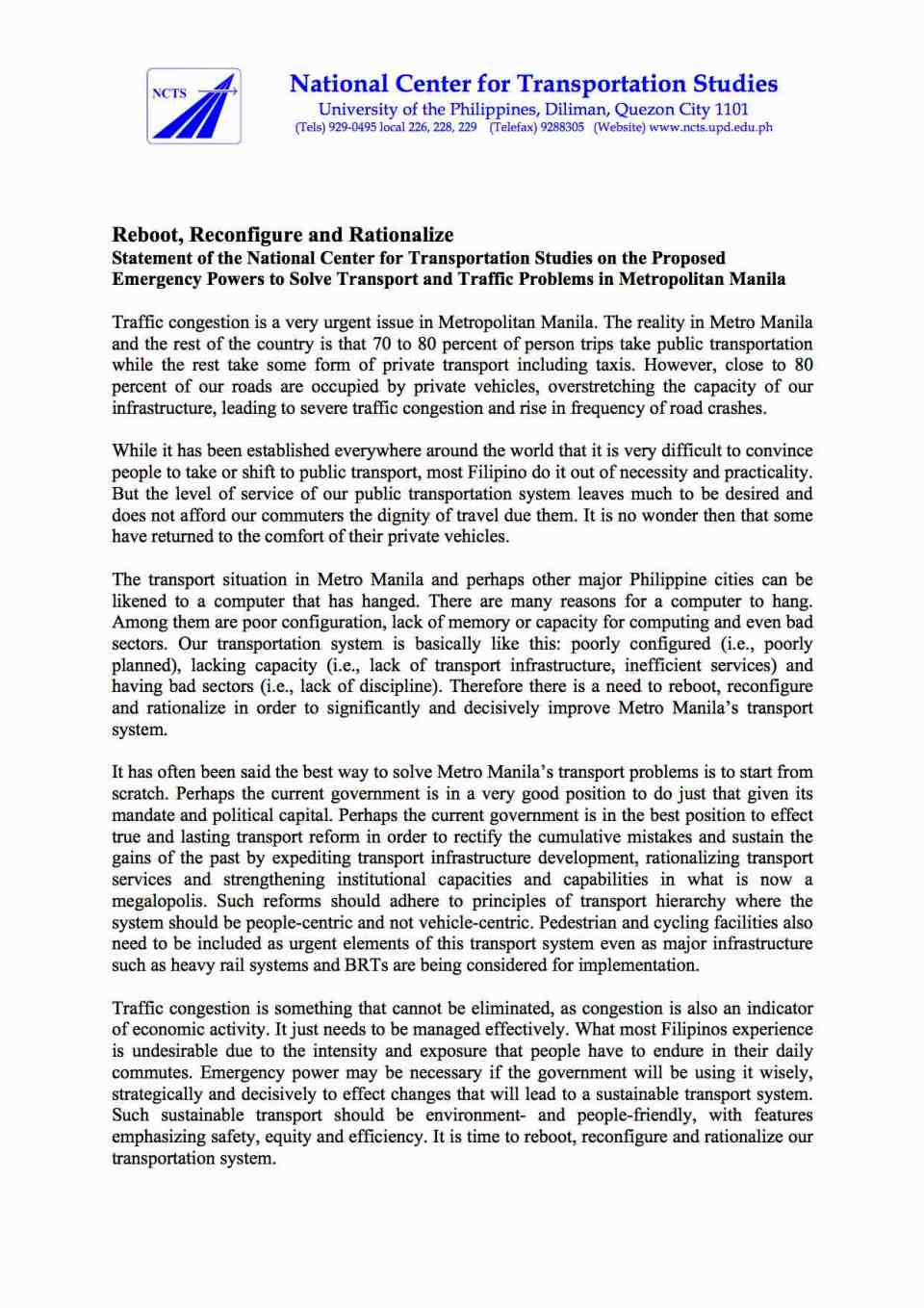
The National Center for Transportation Studies (NCTS) of UP Diliman submitted a statement to the joint Senate committees evaluating the proposal to grant emergency powers to the Philippines President in order to solve the transport and traffic problems in the country and especially in Metro Manila. Following is a copy of the one-page statement:
–
Seemingly minor violations that affect traffic and safety
The following photo shows one of the many minor violations that happen everyday along many roads and particularly at intersections. Motorcyclists and drivers frequently occupy spaces that are supposed to be clear of vehicles. The motorcycles and AUV below occupy the pedestrian crossing that is typically space for pedestrians and cyclists crossing the intersection. Both vehicles also are encroaching upon the intersection’s yellow box, which can be risky given that the intersection is signalised and other vehicles are given the right of movement according to the cycle settings of the intersection.
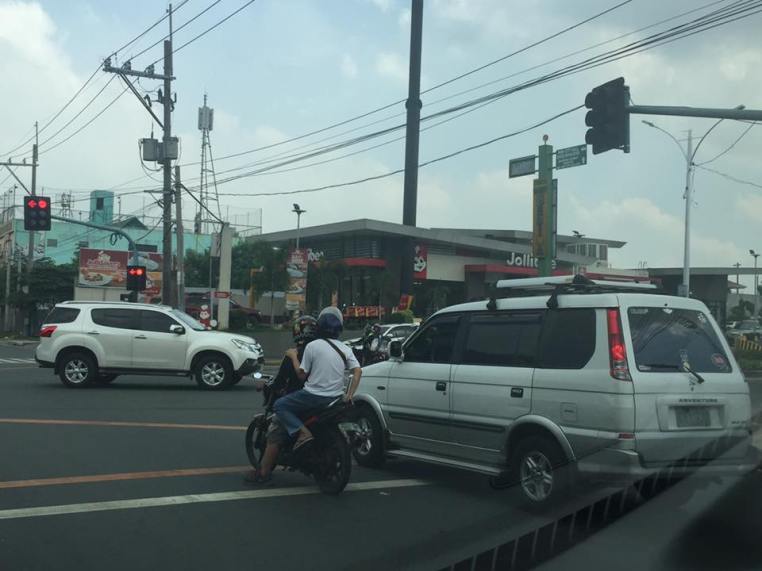
This and others like it are what seems to be minor incidents but in truth have a combining or cumulative effect on traffic streams that contribute to congestion as well as having implications on road safety. Pedestrians and cyclists are forced to go around the vehicles blocking their paths, likely putting them in harm’s way. Other motorists try to avoid these errant vehicles, which, like in the photo, may be blocking the path of vehicles proceeding towards the intersection leg to the right that is hidden in the picture. Motorists doing this must be apprehended by traffic officers/enforcers as these are clear violations of traffic rules. If one is to promote discipline among road users, then it should start with minor violations that tend to be disregarded by traffic enforcers.
–
Addressing congestion due to school traffic congestion
There are two important traffic news stories yesterday:
- MMDA successfully clears parked vehicles outside La Salle Greenhills
- MMDA sets drop off, pick-up points for Ateneo students
For some reason that’s a bit surprising for many, the MMDA seems to have solved two of the most enduring issues on traffic congestion along two major thoroughfares. LSGH is along Ortigas Avenue while Ateneo is along Katipunan Avenue (C-5). Both have high trip generation rates and a significant percentage of their trip gen is comprised of private vehicles. While, Ateneo’s trip generation has led to traffic congestion due to the sheer number of trips the university attracts, the congestion due to La Salle is due to the poor traffic management and lack of parking spaces for vehicles attracted by the school.
I only wonder why it took so much time to address these problems considering the solutions mentioned in the articles are basically ones that could have been implemented years ago. In the case of La Salle, good old fashioned traffic enforcement apparently did the trick. But then, the MMDA even with the LGU constraint could have been stricter before whether when they were under Bayani Fernando (BF) or any of his successors as MMDA Chair. With Ateneo, the scheme is very similar if not the same as what BF proposed over a decade ago when he was MMDA Chair. At that time though a touchy issue was the U-turn scheme he installed along Katipunan that cost trees and the former service road on the west side of the avenue. We can only hope that these claimed ‘successes’ will be sustained and ensure smoother flow of traffic along the major roads they directly affect.
–
On the uncommon sense on license plates
The issuance of new license plates has been a very “painful” process and experience to a lot of people and it is not without serious issues. For one, there is still a backlog in license plates as evident from Strictly speaking, these vehicles shouldn’t be operating or not allowed to be driven even considering they are technically registered with the Land Transportation Office (LTO). The proliferation of vehicles without license plates allows for the abuse of such by owners of relatively new vehicles who can remove their plates in order to be able to take their cars on their coding days. It is also possible to be involved in a road crash or incident where the driver of a vehicle without a license plate can make an escape (the details on the conduction sticker are not easy to spot and memorize) or evade apprehension.
Among the most problematic is the issuance of plates of the same design as that used by private vehicles to public utility vehicles like UV Express and taxis. This creates a lot of opportunities for abuse especially private vehicles masquerading as PUVs. These are without the proper franchises and are illegal (i.e., colorum). What the LTO claims as security features on the plate are meaningless as the uniform color of the plates defy the simple logic behind the old policy of having a specific color to quickly distinguish among vehicles bearing different color plates. This makes it easier for traffic officers including the Philippine National Police (PNP) to spot vehicles with mismatched or inappropriate license plates.
 Taxi cab bearing plate with the same design as that used by private vehicles.
 UV Express van bearing license plate for private vehicles
The purpose of having plates with different colors is for quick identification and distinction of vehicles. A plate with yellow background has always been associated with public utility vehicles. Those with blue lettering or background are those for diplomatic plates. Those with red lettering or background are for government plates. Fortunately, the LTO has reverted to the original policy pertaining to the license plate colors and new plates to be issued to PUVs will once again be a distinctive yellow. Perhaps corrections are due for those legitimate PUVs that were issued inappropriate design (i.e., color) plates.
–
“Gatong” comments by traffic enforcers
Friends who have been involved in a road crash have noted that traffic enforcers seem to have the propensity for making unnecessary remarks while attending to a crash scene. I have experienced this first hand. Some of the more common comments that enforcers make include:
– How crash or accident-prone an area is (citing issues in the area);
– How certain motorists are more likely to be involved in crashes (often referring to one of the parties involved); and
– How one party’s behavior leads or led to a crash (essentially blaming one party for the incident).
[You’re free to add a comment you heard yourself or someone else got from a crash scene.]
Traffic enforcers or police should not make such comments at the scene of a crash especially in front of the parties involved. It is not about whether they have the right to do so but whether it is appropriate coming from a person of authority who should first and foremost be neutral in such circumstances. For one, such unnecessary comments could affect how people involved in a crash could behave. Generalized statements could wrongly favor one party over the other simply because a person of authority made a comment to the contrary of how things really happened. Enforcers should be neutral and go about their business in getting the facts about an incident and proceed in making the formal report for the crash. Even the investigator assigned to the scene should be as objective as possible in order to have a fair assessment of the incident.
–
 Caught (up) in traffic