
Home » Posts tagged 'traffic enforcement' (Page 3)
Tag Archives: traffic enforcement
The Philippines Anti-Drunk Driving Law
It’s a Friday and another weekend is here. It’s also payday weekend and so it’s expected that restaurants, cafes and bars will be full tonight and the weekends with people dining, lunching, having coffee, and likely for many – drinking. For many years, the latter has resulted in too many road crashes, a significant number of which have had fatal outcomes – usually cars or motorcycles crashing into one another or by themselves. It’s even more dangerous (and highly likely to be fatal) for motorcycle riders who need to balance themselves on two wheels after getting inebriated. Meanwhile, a lot of driving under the influence (DUI) that in many other countries including the US and Japan don’t get apprehended primarily due to the absence of laws and guidelines for their capture and evaluation. There was no way to test their blood alcohol content (BAC) in the field and traffic personnel couldn’t force people to go to hospitals to be tested.
There’s good new, however, especially for road safety advocates. The Philippines is finally implementing Republic Act No. 10586 – An Act Penalizing Persons Driving Under the Influence of Alcohol, Dangerous Drugs, and Similar Substances, and for other Purposes, which was signed into law in May 27, 2013. Under the law, private vehicle drivers can be arrested and penalized for BAC of more than 0.05% while truck and public transport drivers and motorcycle riders can be apprehended for a BAC of more than 0.0%. For comparison, Japan requires a BAC of 0.0% for ALL motorists.
The Implementing Rules and Regulations for the law may be found here: PH Anti Drunk Driving Law2013 Rules. The Land Transportation Office (LTO) and the Metro Manila Development Authority (MMDA) have already acquired equipment to help them evaluate apprehended persons. These include breath analyzers and staffs of both agencies have already undergone training to be able to implement the law. Unfortunately, traffic enforcers cannot randomly test people on the road but would have to apprehend them first for violating other traffic rules and regulations. But I am sure our traffic law enforcers can be quite creative in how to catch these people who pose dangers to all other road users by their being irresponsible for driving or riding under the influence of alcohol or dangerous drugs. And with the national elections coming up next year, there will be a lot of checkpoints sprouting up along major roads that will also open opportunities for testing and apprehensions.
–
On jaywalking, overpasses and informal terminals
I had some errands last December and decided to take public transport instead of taking our car and wasting time parking the vehicle. There was significantly less traffic at that time of the year because schools already on Christmas break and everyone else seemed to be on the slow side of the holiday mode (read: not in shopping mode). I needed to cross the wide road that is Quezon Avenue and there was a sign where I usually crossed that it was now prohibited to cross there. I had to take the overpass to get to the other side and to the jeepney stop to board one to get back to the university.
The overpass at the Quezon Ave.-Araneta Ave. intersection is under-utilized. I base this on the several times I’ve used the overpass. Most people prefer to cross at road level, taking advantage of the traffic signal cycle that allows for gaps in the traffic for pedestrians to cross safely. Of course, there are those who cross any time and seem to tempt fate by their behaviour. They seem to tempt also the MMDA traffic enforcers assigned in the area but from what I have observed, enforcement of the “no jaywalking” policy is usually lax or non-existent. People regularly cross at ground level in plain view of traffic enforcers.
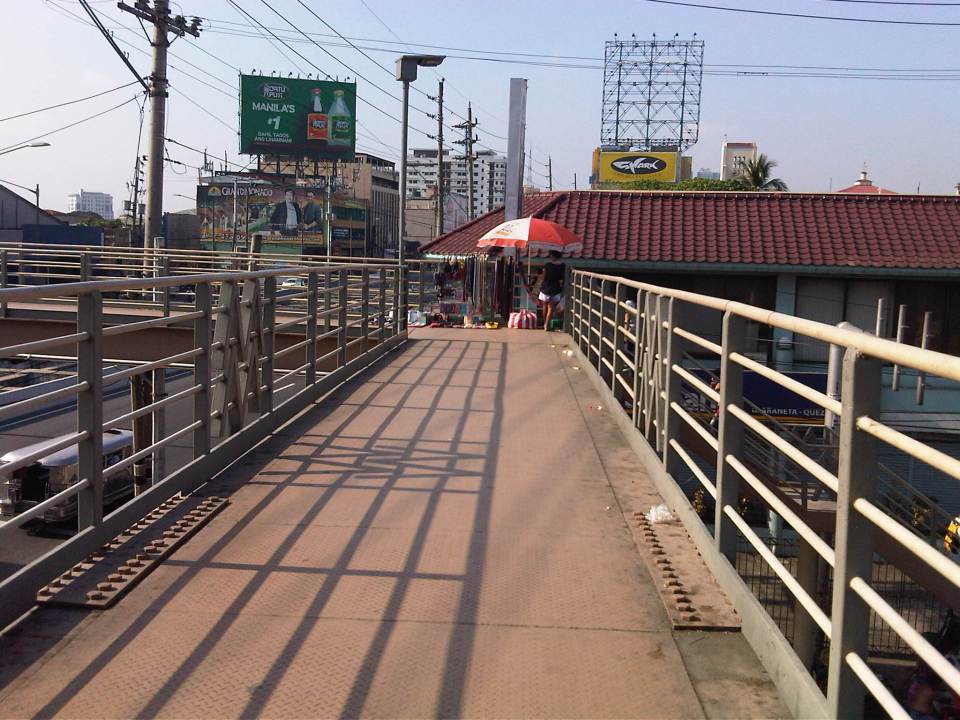 A vendor set-up at the corner of the pedestrian overpass at the Quezon Ave.-Araneta Ave. intersection. Obviously, there are few pedestrians using this overpass as most prefer to cross at ground level.
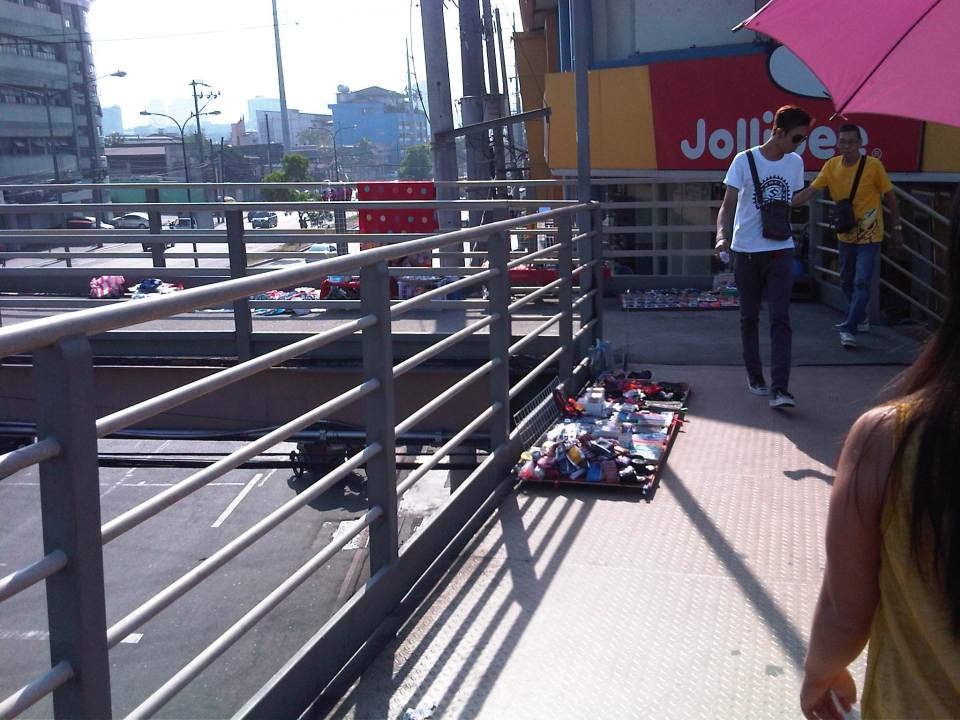 More vendors on the overpass – fortunately, there were few pedestrians using the overpass at the time. Its not the same for other overpasses that are crowded due in part to vendors occupying much of the facility.
 The stairs for many overpasses around Metro Manila are a bit on the steep side. That’s generally not okay with senior citizens, children or persons with disabilities.
There is an informal, on-street jeepney terminal right at the foot of the overpass. If you are in a hurry, its best to try to board a jeepney on the second lane as they are more likely to proceed when the approach is given a green light. From my experience, it takes about 2-3 cycles before the “queued” jeepneys finally cross the intersection. It takes that time to at least have several passengers for the jeepneys before it proceeds to cross the intersection. Most passengers here are transferring from jeepneys plying routes along Araneta Ave. There shouldn’t be an informal terminal here and jeepneys occupy 1-2 lanes of the road at a critical point – the intersection approach. This means intersection capacity is significantly affected and many vehicles could not proceed as they are blocked by the jeepneys. Special mention is made of vehicles wanting to make a right turn but have to go through this “gauntlet” of public utility vehicles. Again, there are MMDA enforcers in the area but it seems the jeepneys and the barkers hold sway and likely with the blessing of enforcers. Such situations are commonplace in Metro Manila and many other cities, and contribute to traffic congestion and other problems commuters regularly encounter.
–
On the new vehicle plates in the Philippines
A lot has been written about the new license plates being issued by the Land Transportation Office (LTO) for vehicles. I have read and heard many opinions or explanations from officials, experts and pundits about how the current license plates were better than the old ones due to its security features. As well, I have heard the opposite – criticisms by similar officials, experts and pundits usually focusing on the flaws of the new plates compared to the previous ones. They do agree on one thing, that the 4 numbers now appearing on the new vehicle plates issued to vehicles registered from January 2014 (5 numbers for the new motorcycles) are a necessity due in part to the rapidly increasing number of registered vehicles in the Philippines. Of course, the delays in the actual issuance of the plates themselves for new vehicles is another story.
Green plates are for private vehicles (not for hire). Red plates are for government vehicles. Blue plates (with only numbers and no letters) are diplomatic plates. Orange plates are the newest type of plates and were issued to electric vehicles. These solid orange plates and not of similar design to those bearing the Rizal Monument. Yellow plates are for “for hire” vehicles including public utility vehicles like buses, jeepneys, taxis and vans-for-hire. Recently, there were actually two types of yellow plates. One type used the design with the Rizal monument in the middle and these were issued to limousines such as those operated by hotels and tour companies. The other is the solid yellow plates (no Rizal Monument) that were issued to PUVs.
 UV Express vehicle with the solid yellow plate.
The new plates issued by the LTO are black and white – basically black lettering on white plates. Recently, friends have been telling me about their seeing the new black and white plates on taxis. I had thought that this shouldn’t be the case since PUVs like taxis are supposed to have distinctive color (yellow) plates in order for illegally (so-called colorum) operating vehicles to be spotted easily by authorities. It turned out that the LTO under the previous head of the agency did away with the yellow plates in favor of what they claimed to be more sophisticated new plates. My reaction was that this was absurd and visual identification (i.e., seeing the color of the vehicle’s plate) is still the easiest was to spot colorum vehicles. I had wondered, too, how the LTO came up with that obviously flawed decision and if they consulted among law enforcement agencies like the PNP who would be tasked to apprehend illegally operating road transport.
 Such incidence of green plates on public utility vehicles were a no-no (illegal) in previous administrations. I assume that this one is “temporary” in the absence of what were phased out yellow plates.
Fortunately, the LTO led by its current chief has decided to bring back the yellow plates. These will probably follow the new plate design but with yellow instead of a white background. Hopefully, all legitimate PUVs will have these yellow plates instead of the “temporary” private plates many have been issued. These will aid in the enforcement of regulations pertaining to PUVs and will help weed out colorum vehicles.
–
Bottlenecks and other traffic issues in Antipolo
Commuting between our home in Antipolo and my work place in Quezon City, I have noted a lot of issues on transport and traffic that needs to be attended to by the local government in coordination with other entities like the DPWH and Meralco. Here are some photos with my notes and comments.
 Much of Sumulong Highway have been widened to 4 lanes but many electric posts remain in the middle of the additional lanes and pose hazards to motorists and cyclists. These posts seem to have been here for quite some time now and the paint on them gives the message that they will be here for the foreseeable future. Paint or no paint, they are road hazards and have the potential to kill people on vehicles crashing into the poles. I think this is supposed to be the responsibility of the power company (Meralco) but there needs to be a firm request and coordination coming from Antipolo City Government to finally relocate these poles.
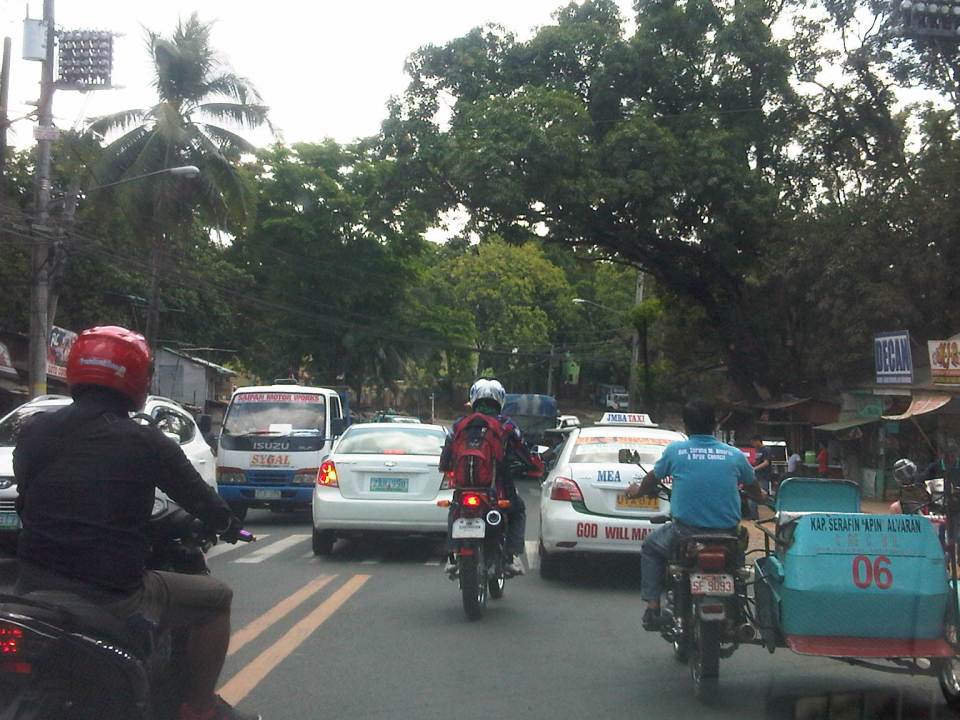 Congestion is often caused by counter-flowing vehicles forcing their way back into the right lane (like the car in the middle of the photo) upon encountering opposing traffic. It doesn’t help that there are motorcycles splitting the lanes to make for a very crowded road.
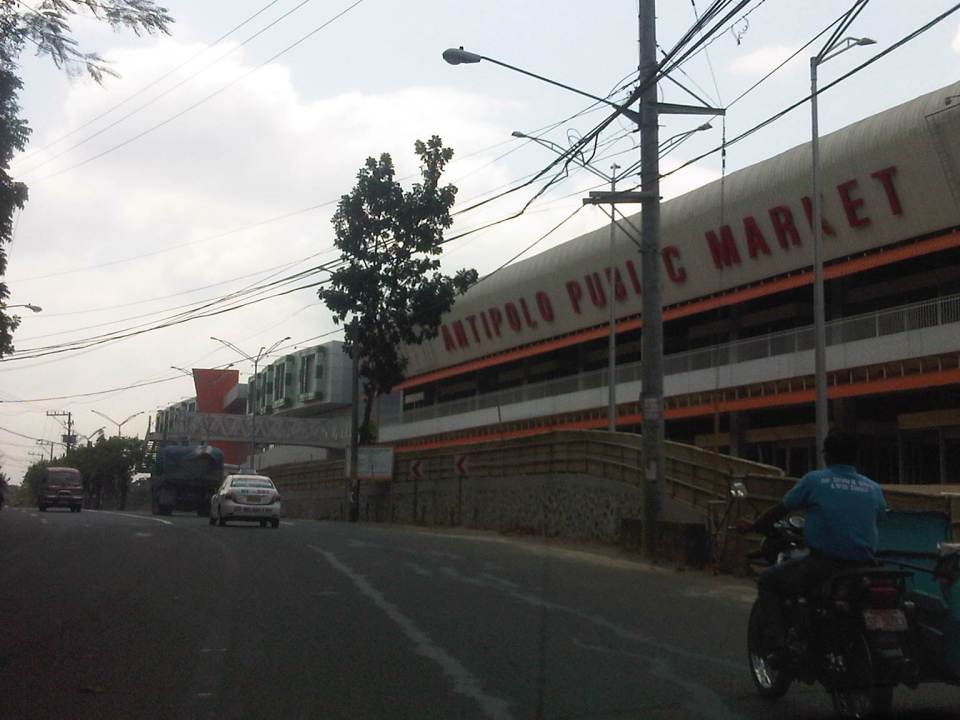 The new but still closed Antipolo Public Market along Sumulong Highway and near the intersection with Daang Bakal (the old railroad line that’s now a road). I wonder about the trip generation potential of this complex as it is not yet operational. Meanwhile, a huge Robinsons mall (looks larger than their Magnolia property) is currently under construction just across from it and will definitely be a major traffic generator in that area. The combined traffic to be attributed to these commercial complexes will surely have a tremendous impact on Sumulong Highway and other roads in the vicinity.
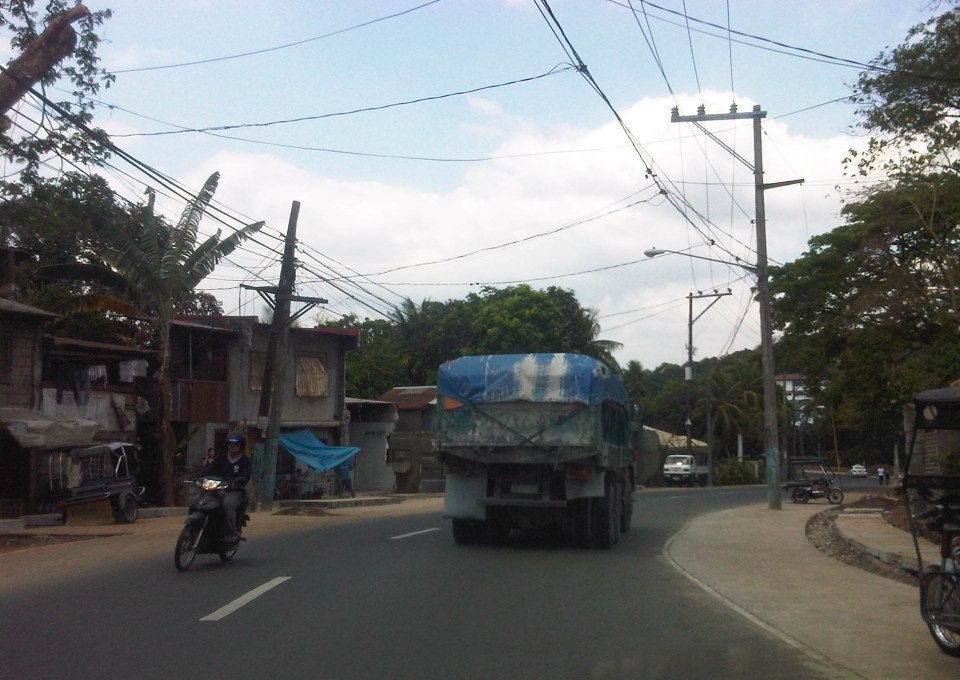 Both Sumulong Highway and Ortigas Avenue Extension carry significant truck traffic. These often cause congestion as they are slow going up to Antipolo and can block the entire road as Sumulong Highway and Ortigas Extension have some narrow sections where the shoulders could not provide enough space for other vehicles to pass the slower moving ones. In certain cases like the one in the photo above, there are electric posts in the middle of the shoulder lane.
 Tricycles occupy the outer lane of Ortigas Ave. Ext./Olivares Street. Such informal and on-street terminals are illegal along national roads and yet the city tolerates them. One explanation for this is that there are informal communities along the highway on shanties built along what is supposed to be a ledge along the mountainside (shown at right in the photo). These are where tricycle drivers and their families reside.
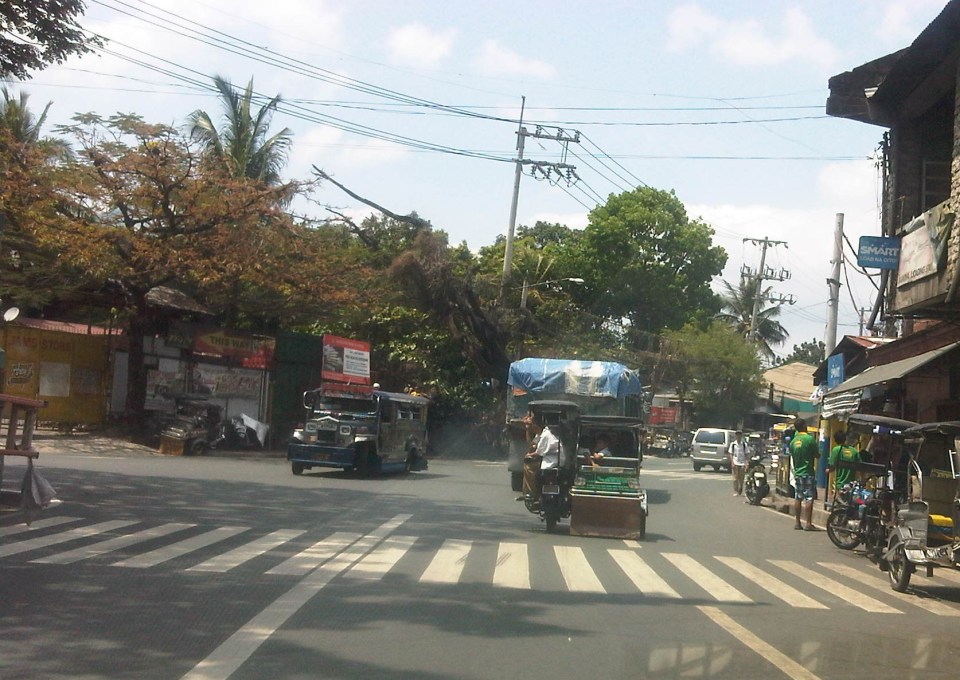 Tricycles from different tricycle operators and drivers associations (TODAs) seem to roam the entire city. This is contrary to the common practice in other cities and municipalities where tricycles are limited within a certain area or district that in many cases just overlap with others (e.g., UP Teachers Village-Philcoa-Krus na Ligas).
 Many tricycles serve as school service. However, the observation is that most tricycles tend to be overloaded with passengers. These are usually small children so the driver probably figured that they could cram more passengers than what is legally allowed.
 Sharing the road? Antipolo is very popular with cyclists and weekends bring a lot of them to the city as they come from all over via the main routes along Sumulong Highway and Ortigas Avenue (there should also be those coming from the east via the Antipolo-Teresa Road and Antipolo-Tanay Road). Most motorists are aware of these cyclists and give way to them. Most experienced cyclists are also aware of the ROW of other vehicles and so keep to the inner lanes. This mutual awareness and respect are vital to make roads safe for all. I think the only thing needed is to provide space for pedestrians as there are significant numbers of people walking, hiking or jogging along these roads.
–
Hang time
Traveling to the office one morning, I spotted a jeepney overloaded with passengers. Many were already hanging on to the jeepney at the rear and I could count eight people including 6 who were practically dangling from the jeepney. Such behaviour is common among males who do this just so they could get a ride to their workplaces. But this is also common among students who, with their bags (usually backpacks) face even greater risks when they hang on at the rear of jeepneys. This is actually illegal but poor traffic enforcement combined with the inadequacies of public transport force a lot of people to make sabit (hang-on) to the jeepney. Granted that some of these people have no intention of paying their fares but there is a real danger of lost lives if not serious injuries if one falls off the vehicles.
 Eight passengers hanging on to a jeepney as it is stopped at an intersection. Note the ones with backpacks that add to the degree of difficulty for this practice just to get a ride to work or school.
 The same jeepney with all 8 passengers dangling as the vehicle speeds up along Marcos Highway in Antipolo. These sabit passengers are actually lucky that their driver is not so reckless (e.g., changing lanes so often, making abrupt movements).
This practice is among a host of seemingly small but important items that can easily be addressed with strict enforcement of traffic rules and regulations. Prompt and timely apprehension and penalties will go a long way into influencing behaviour change among both drivers and passengers. I think the basic idea going on in the minds of both parties is that despite the practice, there’s seldom an incident when a passenger falls off from the jeepney. Such should not be the case and an acceptable reason if we are to prevent untoward incidents from happening, and it starts with sending a strong message through proper enforcement. Are the authorities up to the challenge though? Or is the ningas cogon attitude going to prevail all the time for such situations?
–
Traffic consultants for Philippine cities?
I was driving to the office one morning, and as I was slowing down to stop at the Masinag junction I spotted a familiar face giving instructions to Antipolo traffic personnel. Robert Nacianceno was formerly the General Manager (Undersecretary level position) with the Metropolitan Manila Development Authority (MMDA) when it was chaired by Bayani Fernando, the first MMDA Chair to gain a cabinet level post (previously the MMDA Chair was not a Secretary level position). He was in an office barong while leading Antipolo staff in positioning orange traffic cones to mark the lanes for turning traffic along the Sumulong Highway approach from Antipolo.
Nacianceno is a cyclist so I would like to think that he can take that perspective in transport planning and traffic management for Antipolo. Unfortunately, his track record at the MMDA does not provide strong evidence as to his competence in transport planning or traffic management. Insiders say most policies and schemes during BF’s time was the latter’s ideas (e.g., U-turns, bike lanes, etc.) and he had his own consultant (and reportedly an inner circle) for various matters including traffic. In fairness to the man, Nacianceno probably has tremendous experience on the job but one has to note that there were other people with the MMDA who also dabbled in transport and traffic. Also, as GM he had other things to attend to during his stint including waste management and flood control.
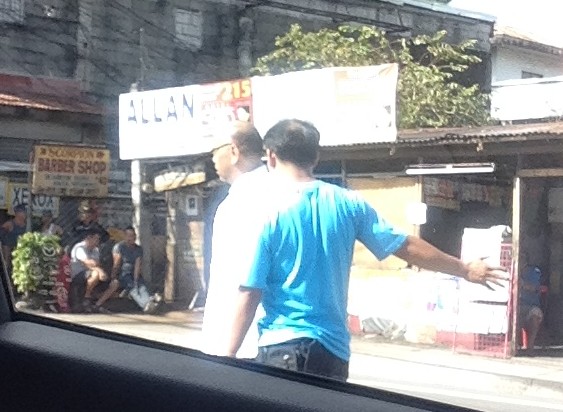 Remember this guy? He used to be the MMDA GM during BF’s stint at the agency.
I recall that the previous traffic consultant of Antipolo City was also a former MMDA official, Ernesto Camarillo. Unfortunately, I couldn’t say that Antipolo traffic improved during the last few years. Based on what I have seen in my daily commute, transport and traffic conditions have degenerated. Antipolo is overrun by tricycles and people generally do not follow rules and regulations. Informal terminals dot the city and you don’t have to go far to find inappropriate terminals as these are in plain view and across from the Rizal Provincial Capitol. Antipolo has a new mayor in the former Rizal Governor and his mother now sits as governor of the province. I’m crossing my fingers as to how they will improve transport and traffic in Antipolo if there is really a desire to do so. For starters, is there a transport and traffic plan for this Highly Urbanized City (HUC)? There should be one as the city needs it badly together with a land use plan to bring some order in development.
Antipolo is rapidly developing but at the same time conditions (including traffic) are also rapidly deteriorating. Hopefully, the LGU will address these issues and eventually make this city a modern one and fit for its being an HUC as well as a popular pilgrimage site for decades if not centuries due to the Shrine of Our Lady of Peace and Good Voyage (Is there some irony here?). Nacianceno’s work has just started and I hope he is up to the challenge of bringing order to Antipolo’s chaotic transport and traffic situation. I hope, too, that he will take note of good practices in other cities (Philippine or foreign) and won’t be relying purely on his experiences in Metro Manila. And hopefully, whatever improvements from the traffic schemes he will be introducing and implementing will be felt immediately by travellers. Good luck!
–
On high definition cameras to improve traffic enforcement and management
Watching the news one evening, I saw a report that featured traffic enforcers being caught on camera extorting money from drivers caught violating traffic rules and regulations. Extortion, “kotong” or “pangongotong” is not a new thing. It is actually a given to many motorist, particularly those who spend a lot of time on the road like drivers of public utility vehicles and trucks. In many cases, the enforcer or police officer is already or automatically assumed to be an extortionist even without the subtle suggestions via talk or body language. Motorists simply slip a bill with their license or in the form of a handshake to the apprehending officer. This, of course, translates into bribery, which is also a crime for both parties involved.
Traffic violations carry penalties in the form of fines that vary in amount depending on the violation. Usually, the amount is commensurate to the bribe or the “suggested” amount being extorted by the apprehending enforcer(s). In other cases, a larger amount is “suggested,” often to remind the erring motorist Of course, this assumes that the motorist is indeed guilty or in any case (guilty or not) didn’t want to waste time and opts for the perceived easy way out. However, there have also been cases when corrupt enforcers/officers meet their match in motorists who are aware of their rights and are knowledgable of traffic laws (e.g., lawyers, etc.) or are well-connected and simply show business cards of influential people (e.g., politicians, high government officials, police or military officers, etc.) to get out of a traffic bind. These instances actually reveal that many enforcers/officers are not so familiar with traffic rules and regulations so are unable to justify their apprehensions beyond their very basic knowledge.
The MMDA has made a lot of effort in trying to simplify the process of paying the penalties with the guilty party now being allowed to take the ticket and pay the fine through accredited banks within a certain grace period. Traffic enforcers can no longer take your driver’s license (Note: Only Land Transportation Office officers and deputized personnel may confiscate licenses.) and this eliminated the long lines of drivers at the MMDA offices to get back their confiscated licenses. This has also reduced the incidence of extortion as many private motorists can just opt to have tickets issued to by the apprehending officer. The latter is basically no longer allowed to collect money and contact time is also reduced. There is a grace period for the erring driver so he/she has to pay the fine within this period or else risk being flagged by the LTO itself.
The new camera system that the MMDA has in place is part of Phase 1 of its traffic signalization project. With this project, the MMDA hopes to upgrade the network of traffic signals in Metro Manila and have in place a dynamic, adaptive system to better address traffic circulation in the metropolis. This is actually a departure from a past program that was premised on the continuous traffic flow that was supposedly derived from U-turns masquerading as rotundas or roundabouts. Though the sensors and software for the traffic signal system are not yet in place, the MMDA already has a new traffic control center just across its building at the corner of EDSA and Orense Street in Makati City, from where they can now monitor traffic conditions using high definition cameras installed across the metro.
Davao has been in the forefront of using such high definition cameras for traffic management as well as for monitoring the behavior of traffic enforcers and motorists. Their traffic management center has been operational for the past few years and I’ve had the chance to have a look at how the city is able to monitor traffic conditions in that city. With this tool, they are able to address issues by deploying personnel on sight or by changing the setting of traffic signals. In certain cases, they can watch out for incidents like road crashes or monitor apprehensions to make sure both apprehending personnel and erring motorists are honest and no anomalies are encountered.
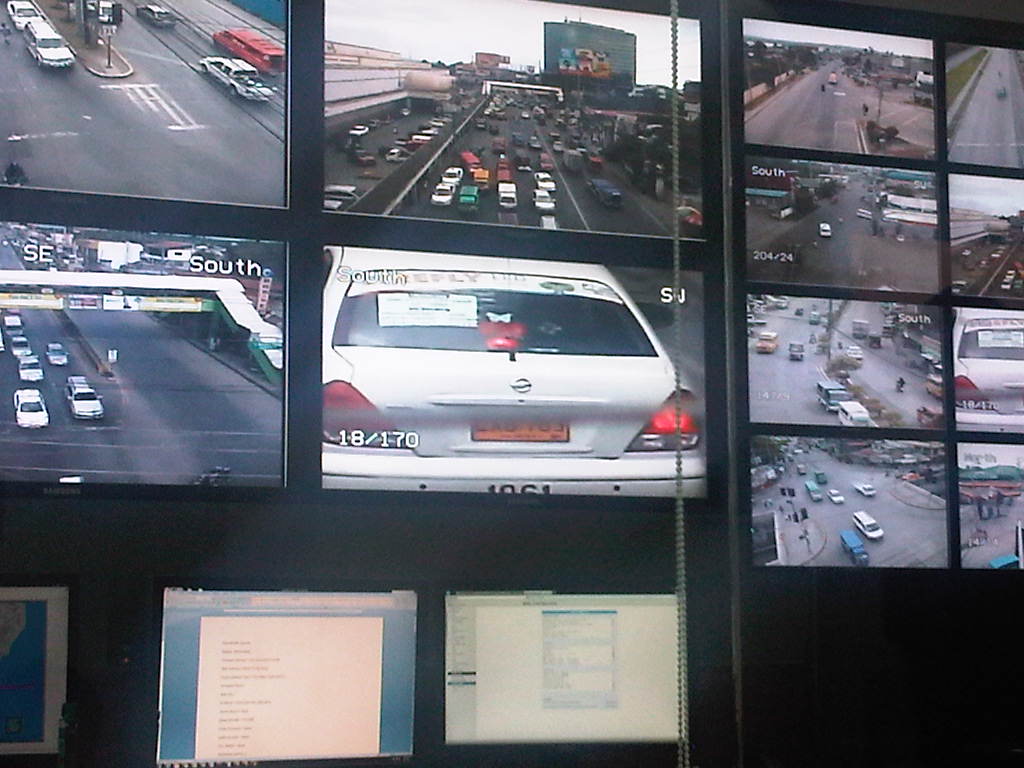 Davao’s cameras have been used to monitor not just erring motorists and pedestrians but also erring traffic enforcers and policemen who might be preying on road users. The city has also been able to use their system to record and evaluate incidences of road crashes.
Perhaps in the near future, many other cities would be able to acquire and apply such tools in traffic management. I think the larger and highly urbanized cities in the country already require sophisticated systems for traffic. Unfortunately, there is always the issue of having limited resources, which usually discourages a city from investing in expensive systems, often opting for basic signals for their intersections. Such basic systems, however, can be optimized if city personnel in-charge of these have the knowledge or capability for setting signals to be synchronized with each other. These are fundamentals necessary for whoever will be dealing with traffic engineering and management in these cities. Also, there are now ongoing researches at universities with some now sponsored by the Department of Science and Technology (DOST) through its Philippine Council for Industry, Energy and Emerging technology Research and Development (PCIEERD) seeking to produce traffic systems at lower costs. These should eventually be deployed in our cities to help alleviate traffic problems.
–
Old style intersection traffic management
Heading to the DOST complex for a meeting, I took a few photos of the enforcers managing the traffic at the intersections at the Bicutan interchange from on top a traffic box. The intersections are formed by the on and off ramps of the South Luzon Expressway, the service roads and Gen. Santos Ave./Dona Soledad Ave. It was a welcome scene considering the enforcers seemed to be doing very well (i.e., traffic was flowing quite smoothly at the intersections) while also evoking times when traffic signals weren’t the norm in major intersections. Of course, it helped that pedestrian movements on the ground were eliminated by the pedestrian overpass set-up at the interchange, a legacy of the BF era at the MMDA.
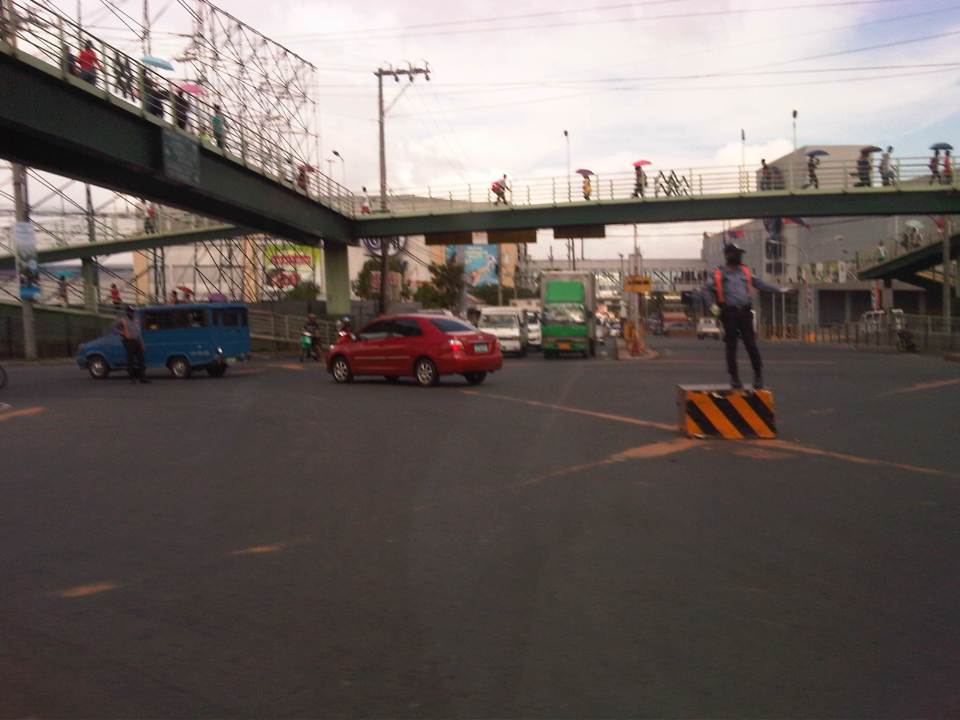 Traffic enforcer on a box directing traffic at the intersection of the SLEX soutbound ramps, the West Service Road and Dona Soledad Ave. That’s SM Bicutan in the background with its two buildings on either side of Dona Soledad and connected by an elevate walkway. Pedestrians have been eliminated from the equation thanks to the elevated walkway at the SLEX Bicutan interchange.
 Traffic enforcer at the intersection of the the SLEX northbound ramps, the East Service Road and Gen. Santos Ave. The PNR tracks run along just after the intersection.
–
Traffic Congestion in Metro Manila: Is the UVVRP Still Effective? -Conclusion
The MMDA always reports what it claims as improvements of travel speeds along EDSA that past years. They have pointed to this as evidence that traffic congestion is being addressed and that programs like the UVVRP are effective in curbing congestion. However, many traffic experts have cautioned against making sweeping generalizations pertaining to the effectiveness of schemes especially if the evidence put forward is limited and where data seems to have been collected under undesirable (read: unscientific) circumstances.
The MMDA also has been using and to some extent overextending its use of a micro-simulation software that is employs to demonstrate the potential effectiveness of its proposed traffic schemes. The software has an excellent animation feature that can make the untrained eye believe in what is being shown as The problem here is when one realizes that computer software will only show what the programmer/operator wants, and is perhaps an example where the term “garbage in, garbage out” is very much applicable. And this is especially true should the computer model be uncalibrated and unvalidated according to guidelines that are well established, and extensively discussed and deliberated in a wealth of academic references. The fallacy of employing advanced tools to demonstrate how one’s proposal is better than another was highlighted when the DPWH acquired the same tool and came up with an entirely different result for an analysis being made for the same project by that agency and the MMDA. Surely this resulted in confusion as the outcomes of the simulation efforts of both agencies practically negated each other.
It should be pointed out that such micro-simulation software is unsuitable for the task of determining whether metro-wide schemes such as the UVVRP is still effective given the actions of those affected by the scheme. What is required is a macroscopic model that would take into account the travel characteristics of populations in Metro Manila and its surrounding areas (cities and towns in the provinces of Rizal, Bulacan, Cavite, Laguna). There are quite a few of these models available but most if not all were derived from the one developed under the Metro Manila Urban Transport Integration Study (MMUTIS) that was completed in 1999. The main beneficiary from the outcomes of MMUTIS happens to be the MMDA but for some reason, that agency failed to build capacity for maintaining and updating/upgrading the model. As such, the agency missed a great opportunity to invest in something that they could have used to develop and evaluate traffic schemes to address congestion and other traffic issues in Metro Manila, as well as to assess the impacts of new developments.
Metro Manila has come to a point where its options for alleviating congestion are becoming more and more limited. The combination of a still increasing rate of motorization and private vehicle use have definitely contributed to congestion while there are also perceptions of a decline in public transport use in the metropolis. The share of public transport users in most Philippine cities and municipalities range from 80 – 90 %, while in many highly urbanized cities the tendency seems to be a decline for this share as more people are choosing to purchase motorcycles to enhance their mobility and as a substitute to cars. This trend towards motorcycle use cannot be denied based on the steep increase in ownership and the sheer number of motorcycles we observe in traffic everyday.
Metro Manila needs to retain the substantial public transport share while accepting that motorcycle ownership will continue to chip off commuters. The latter phenomenon can be slowed down should authorities strictly enforce traffic rules and regulations on motorcyclists, effectively erasing the notion that the latter group is “exempted” from such. The bigger and more urgent issue is how to put up long overdue mass transport infrastructure that is direly needed in order to create another opportunity for rationalization transport services. We seem to like that word “rationalization” without really understanding and acting on what is required to once and for all address transport problems in the metropolis. We are not lacking for examples of good practices that are both effective and sustainable including those in the capital cities of our ASEAN neighbors. However, we seem to be unable to deliver on the infrastructure part that we have tended to over-rely on a TDM scheme that has long lost much of its effectiveness. The evidence is quite strong for this conclusion and perhaps we should stop being in denial in as far as the UVVRP’s effectiveness is concerned. Efforts should be turned towards building the necessary infrastructure and making public transport attractive so that private car and motorcycle users will be left with no excuse to shift to public transport use. It is inevitable that at some time they will understand the cost of congestion and that they will have to pay for their part in congestion like what is being done along tollways or, in the more sophisticated and mature example, Singapore. But this cannot be realized if we continue to fail in putting up the infrastructure Metro Manila so direly requires.
Microcosm of society
As me and my colleagues crossed the street at the corner of the College of Engineering towards the Main Library grounds, we heard the distant sound of whistles of security guards posted along the Academic Oval. At first, we didn’t pay much attention even stating among ourselves that the guards may be trying to catch the attention of certain people. There are still many litterbugs on campus and there are street children often going around and trying to collect material they could sell at some junk shop. In some cases, they take whatever they find even those that are not supposed to be taken by them like scrap materials from buildings that are being constructed or renovated. These, after all, are not fair game in as far as the contractors and the university are concerned.
After we had crossed, however, the guards continued to whistle and the frequency and manner seemed to indicate urgency and not just as if they were not just trying to accost someone but were also in pursuit of someone or something. Another guard posted near the library stood up from where he was taking his lunch on a bench under the trees near the road and also started whistling. We soon saw the cause for the alarm – a black BMW 5 series was speeding counterflow along the bicycle lane.
We stopped near the Main Library kiosks to see where the BMW was heading and made our bets that it would be turning left towards the Asian Center and probably towards the exit along Magsaysay Avenue. We were not surprised when the car indeed took a left (and without signals) but towards the driveway in front of Malcolm Hall – the College of Law. I say we were not surprised because there have been many instances before this one when similar vehicles and even those with SUV escorts who have blatantly violated traffic rules and regulations inside the campus. Often, the excuse mentioned is that they were in a hurry. But then aren’t we all?
We did not see who alighted from the car (it was too far to see) but it was parked in front of Malcolm Hall so I assumed it must be a faculty member, a lecturer or a guest of that College who drove or owned the vehicle. It would also be likely that the occupant was a lawyer. This begs the question of what kinds of lawyers are teaching at the College of Law. I know this is quite a generalization and perhaps unfair to many whom I know from that college. But this simple act of violating the one-way scheme along the oval and using a lane dedicated to pedestrians and cyclists despite all the signs and the guards shouting at you, which some people (like lawyers for example) would dismiss as petty are manifestations of more serious things. And I will restrain myself from alleging what those serious things are.
If he or she was a student, then the obvious question is what kind of students do the college have these days? What kinds of lawyers are being bred by the college? And may I dare ask what kind of lawyers have been produced in the past as there are evidences (from the UP Police, the MMDA and other traffic enforcers) that the same professionals are the one most likely to argue with enforcers even when they are guilty of violating traffic rules and regulations.
It is the arrogance of such motorists that is among the common causes of road crashes and the major cause for anarchy and chaos in our roads. The example in UP only shows how far we are from the objective of instilling discipline among our motorists. That same arrogance shows, too, how we regard everyone else including the joggers, walkers, and cyclists who had to give way to a motor vehicle that intruded into their right of way and practically bulldozed its way towards its destination. For these people, it is no matter that they put the lives of people in danger by their actions. After all, they were in a hurry. I believe the pedestrians and cyclists were in no hurry. they were in no hurry to get injured or, God forbid, to die because a motorist in a luxury car had to run against the one-way flow and use road space that is dedicated for pedestrians and cyclists – most of whom happen to be students who have yet to fulfill their potentials, and hopefully for the good of this country.
 Caught (up) in traffic