
Home » Posts tagged 'traffic signs'
Tag Archives: traffic signs
Shared lanes in Baguio City – Loakan Road
I have several drafts of articles about our recent travel to Baguio City. Those include write-ups about roads to/from and in Baguio City. Before I post about Kennon Road and Marcos Highway, I want to share some examples of shared lanes I was able to take photos of while going around the city. The following photos were taken along Loakan Road near Camp John Hay. It is the same road that takes you Baguio’s airport.
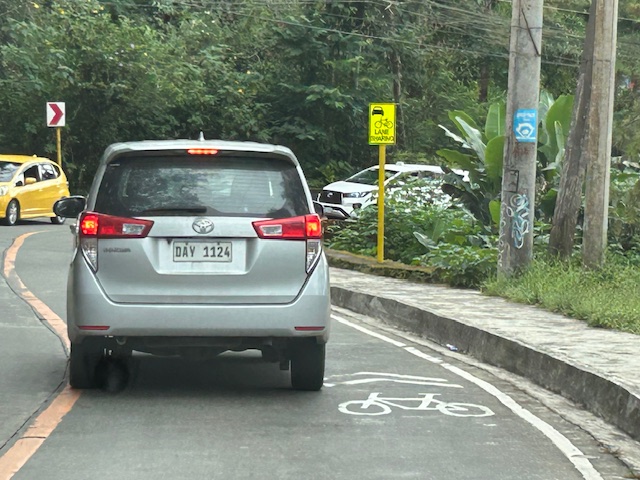 Note the use of the international standard for bicycle pavement marking. This is different from the rather odd bicycle marking in the DPWH guidelines that looks like a person on a treadmill (among other interpretations).
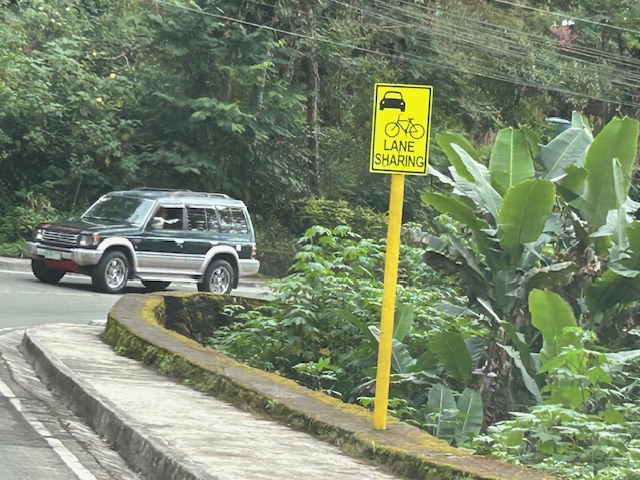 The signs are also not standard and somewhat small as you can probably see in the photos.
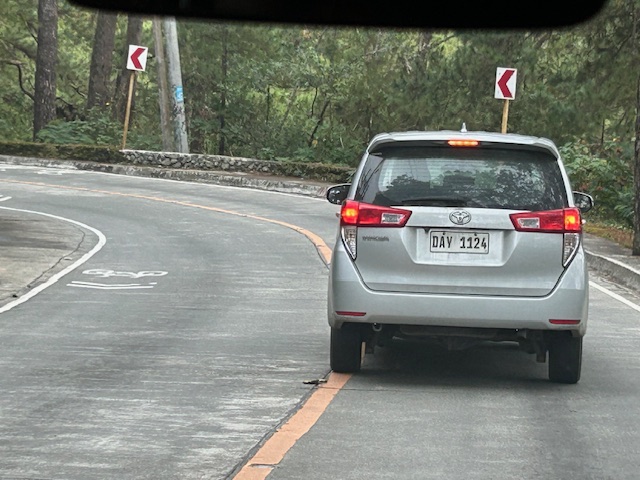 Chevron signs for the curve
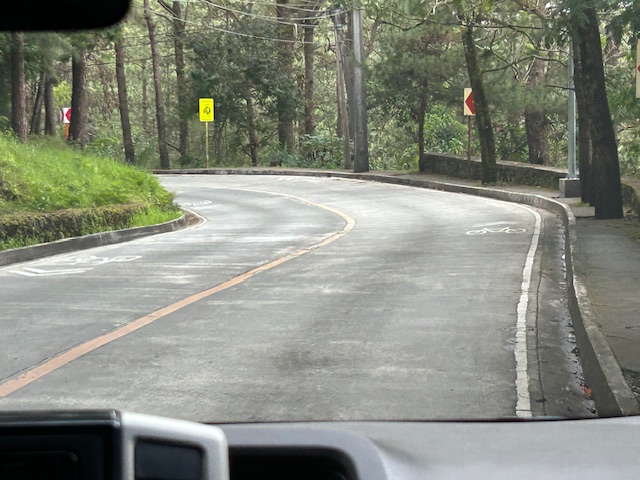 Another example of a curve section
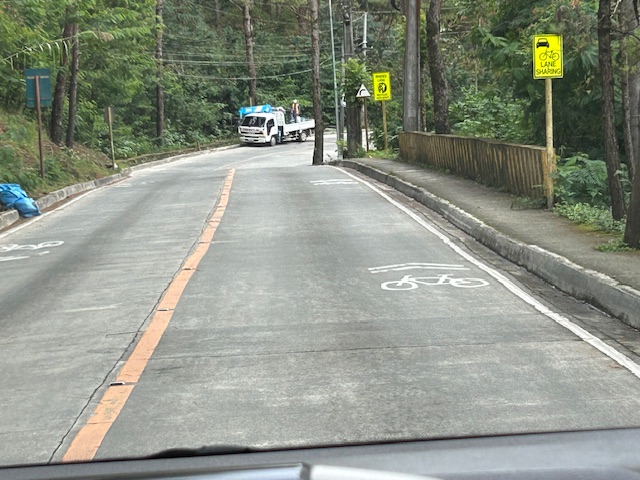 There are actually two types of signs installed along the road – both state lane sharing but with the other directing bicycles to keep right.
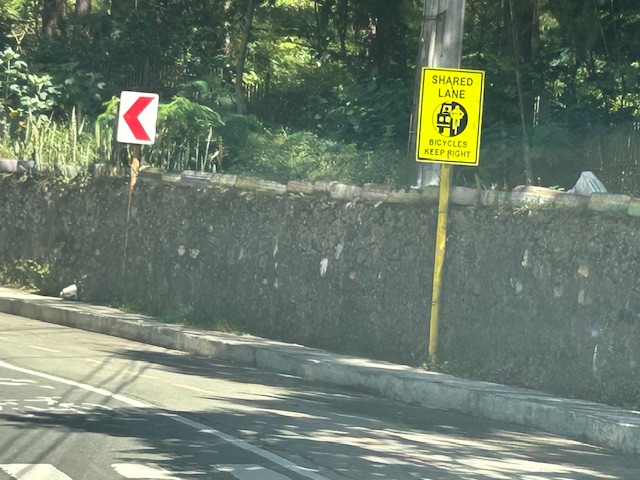 Two signs alternated along Loakan road. This one directs bicycles to keep right.
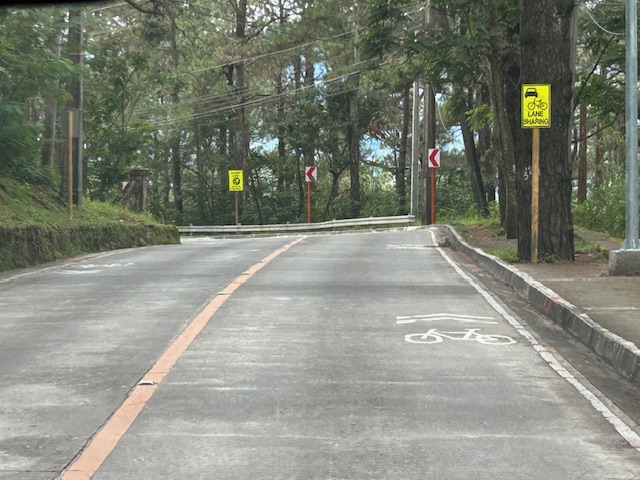 Signs and pavement markings are closely spaced. Perhaps the intervals are less than 5 meters for the pavement markings?
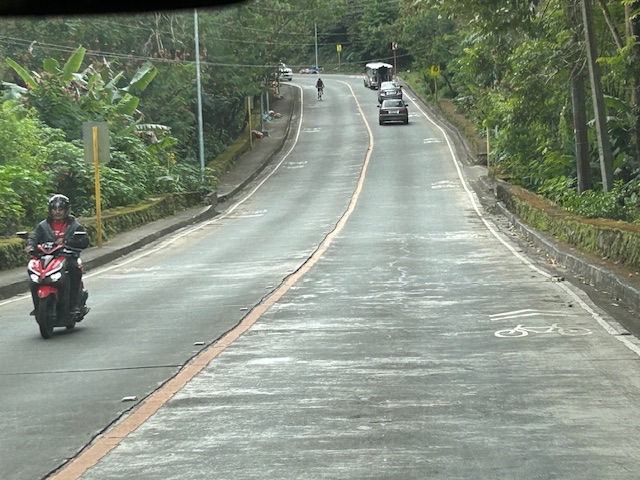 Section showing pavement markings for shared lanes
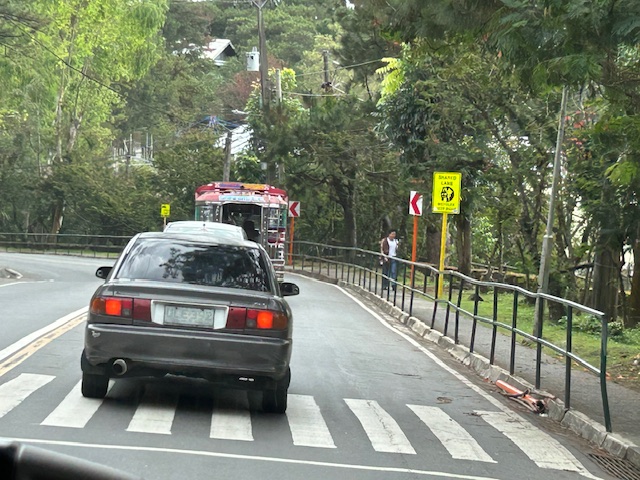 Pedestrian crossing and fenced sidewalks
While shared rights of way (sharrows) or shared lanes is not preferred where there is space for bikes, these can be implemented for 2-lane roads with adequate lane widths such as Loakan Road. It is clear from the photos that there is ample if not generous space for cyclists and motorists to share a single lane. The premise for safety here is that motorists will not be hogging the road space, being mindful of cyclists, and will move at safe speeds.
–
Back in Tagaytay
It’s been a while since I’ve been to Tagaytay. I think the last time was before the pandemic and with family. There used to be a time when we went there at least every month not counting the seminars and workshops we attended there. It was an easy drive from our home in Antipolo to Tagaytay via C6, SLEX and the Sta. Rosa-Tagaytay Road. We had our favorite stopovers with breakfasts usually at the Paseo de Sta. Rosa. Later, as Tagaytay became more crowded and congested, the trips became fewer. Of course, our schedules also became busier but then it wasn’t like we looked forward to the traffic and the crowded attractions there. I’m doing a project there now with my team at the office and that means I get to go there for work. Since we’ll be there anyway, we could have some side trips to eat some good meals (bulalo!) and maybe take some photos of Taal volcano.
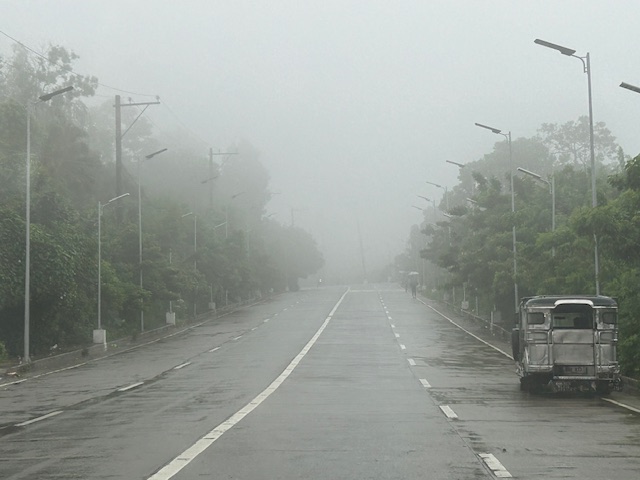
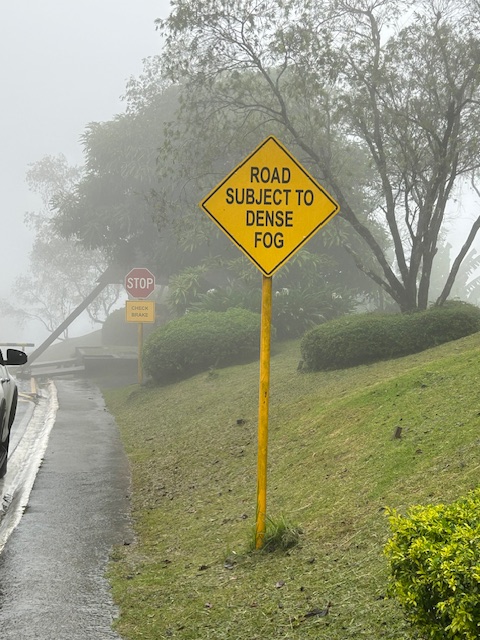
The fog was a quick reminder of the Tagaytay of old that we frequented before. But what we noticed was that it wasn’t cool. It was still somewhat warm if there was no breeze or wind blowing. This was certainly not smog as you can smell the pollution if it was. We even joked that it probably wasn’t because of the volcano as the smell of sulphur would probably be strong. We were in Tagaytay during the weekdays so there were fewer people and traffic. We were told that it was worse on weekends. That was to be expected. And with CALAX, Tagaytay became more accessible to visitors. I will write about the developments there in the next post. I feel there’s just too many buildings and the intense development has made Tagaytay less attractive. I have similar memories and feelings about Baguio but that’s another story to tell or write about.
–
Revising the DPWH Design Manuals
A friend posted about the current initiatives in the US as they embark on revising their Manual on Uniform Traffic Control Devices (MUTCD). This manual along with AASHTO’s Geometric Design of Highways and Streets and their Highway Capacity Manual are something like the holy trinity for Highway and Traffic Engineers. These are also the main references for our DPWH for the manuals and guidelines we use in traffic and highways.
Here are a couple of articles calling for the revisions to reflect recent designs mainly from NACTO, which itself publishes guidelines for roads to be more inclusive rather than car-centric:
NACTO (May 2021) Modernizing Federal Standards: Making the MUTCD Work for Cities, https://nacto.org/program/modernizing-federal-standards/
NACTO (May 11, 2021) A Blueprint to Update America’s Street Manual, https://nacto.org/2021/05/11/a-blueprint-to-update-americas-street-manual/
We don’t have to pattern revisions after the MUTCD but then that requires that the DPWH through its Bureau of Research and Standards (DPWH-BRS) do its part in compiling, reviewing, studying and adopting materials from various countries, and developing suitable standards and guidelines for roads in the Philippines. Do they have to reinvent the wheel? Not so and they can still refer to the US manuals as long as again these are localised for our conditions and situations.
–
Vienna Conventions on Traffic and Road Signs
There are two important international conventions or agreements that the Philippines is a signatory to. These are the
Vienna Convention on Road Traffic (November 8, 1968):
and the Vienna Convention on Road Signs and Signals (November 8, 1968):
These are important as signatories are bound but the agreements on road traffic rules and regulations and standard signs and signal. I included the links to each agreement as they also include the exceptions taken by different countries such as Thailand and Vietnam declaring they will not be bound by Article 44, choosing to classify mopeds as motorcycles. Apparently, the Philippines did not declare exceptions or objections to any of the articles.
–
Are the traffic signs in the Philippines the same as those in the US?
This seems to be a simple question with a simple answer. And the answer is no. While the Philippines is signatory and has ratified the Vienna Convention on Road Traffic and the Vienna Convention on Road Signs, the United States hasn’t. The US also depends on their Manual of Unified Traffic Control Devices (MUTCD) that is by their Federal Highway Administration (FHWA).
Here is a nice article on Wikipedia for a comparison of signs in different countries:
https://en.wikipedia.org/wiki/Comparison_of_traffic_signs_in_English-speaking_countries
I recall an interesting project I was involved in where we audited signs along what was a new Subic Clark Tarlac Expressway (SCTEX). The signs from Clark to Subic followed international convention while the ones from Clark to Tarlac followed the MUTCD. We recommended that the latter signs be changed to international convention. I am not sure if the tollway operator changed the signs as I recall there were still US standard signs there particularly for speed limits.
–
Whatever happened to those ‘enhanced’ pedestrian crossings?
Before the lockdowns, a lot of people seem to have become excited with what a private company did as part of their PR campaign (I’m certain about this because their ads feature these.). That is, they painted on the existing pedestrian crossings in Antipolo City along major roads such as Sumulong Highway and the Sumulong Memorial Circle. While coordination with the LGU was done, there seems to be none with the DPWH considering these are national roads and any matter concerning them are under the agency’s jurisdiction through their District Engineering Office. The following photos were taken prior to the lockdown and as you can see (if you were objective) there’s nothing really notable about them though they appear to enhance the existing crosswalks.
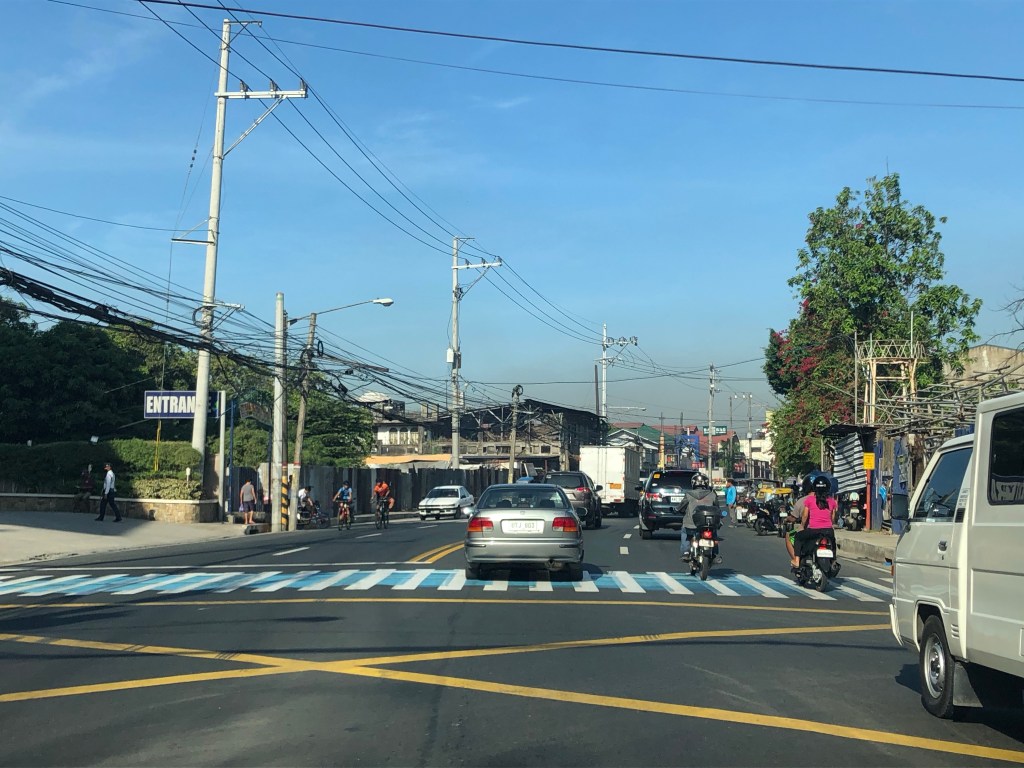
The artwork is practically invisible to motorists especially those on cars whose drivers’ eyes are lower than those driving SUVs, jeepneys, buses or trucks (i.e., larger and taller vehicles).
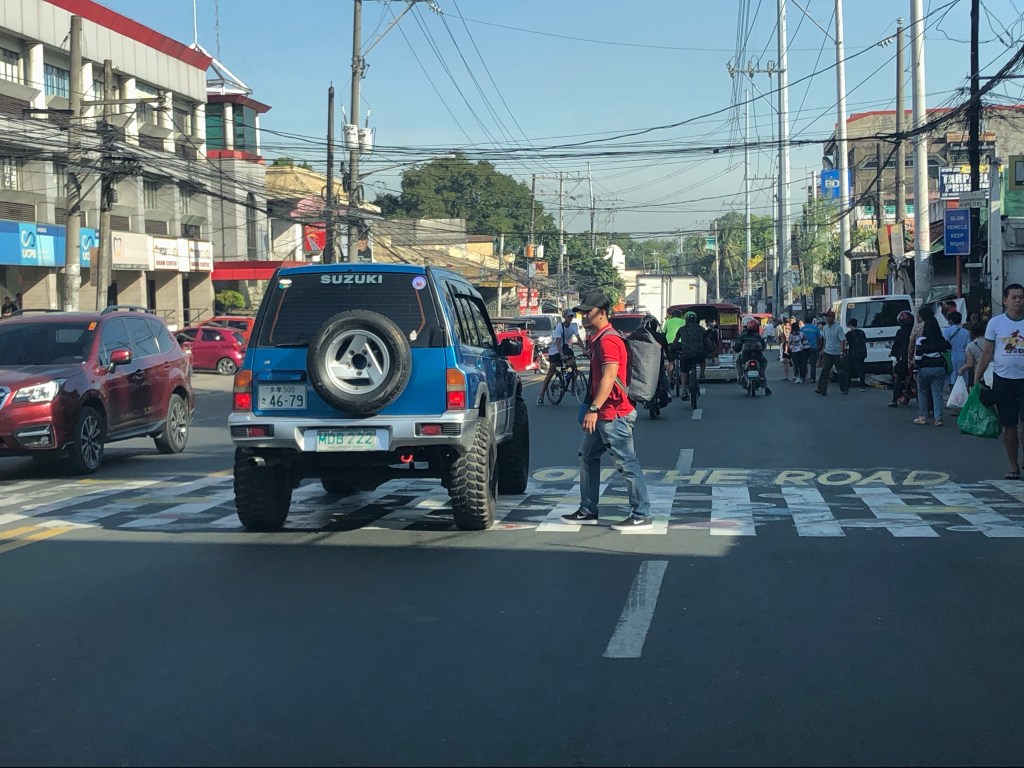
There is no strong evidence that such works enhance road safety.
There is no strong evidence that such works enhance road safety and you can check on this by doing either a quick or even an extensive search for literature proving significant impact. I guess the key here is to also install other devices such as a speed table or rumble strips for motorists to feel that they are approaching a pedestrian crossing. Also, perhaps instead of just painting on the crosswalks, they could have painted so as to widen the crosswalk. Then they could have increased the visibility for pedestrian crossings. That said, they should also have used the standard paints for these facilities that make them visible at night and could have been more resistant to weathering.
–
Signs of the times – road signs or ads?
A friend recently posted an episode on his vlog that featured the excessive signage we now find along many roads. I thought this was a relevant topic as, for one, there are many signs that are basically contributing to the “visual pollution” that tend to either distract travellers or make them numb about these signs. Hindi pa kasali dito ang mga LED/video ads that are now installed around the metropolis. Being a distraction means they may lead to road crashes. But then there is also the issue of clutter and obstruction. I noticed that many signs have been installed without consideration of the spaces required by pedestrians and cyclists. Many seem to have been forcibly installed at locations blocking the path of pedestrians.
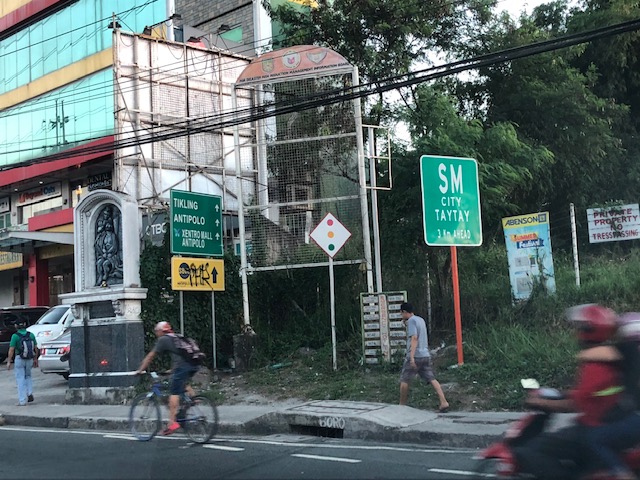 So which among these signs is the only one that should be there? Only one and that is the one in the middle informing travellers of the signalised intersection ahead. The others are basically ads masquerading as signs (directional signs to be more specific).
I avoid describing inappropriate signs as ‘illegal’ simply because the proponents were given permission for installation by local government units including the MMDA. LGUs seem to benefit from these as I also see inappropriate signs bearing the logos or slogans of LGUs. Meanwhile, the DPWH seems to be mum about this concern, which appears to be a non-issue among the government entities involved. What do you think about such ads pretending to be road signs?
–
 Caught (up) in traffic