
Home » Posts tagged 'Uber' (Page 3)
Tag Archives: Uber
Good intentions and knee jerk reactions
Social media is again abuzz with stories about Uber and how Philippine government agencies like the Department of Transportation and Communications (DOTC) and the Land Transportation Franchising and Regulatory Board (LTFRB) are hassling Uber, Grab and similar companies into complying with government regulations covering their services. Is it really a hassle and are these “Transport Network Companies” or TNCs the real deal in terms of solving part of Metro Manila’s transport woes?
I believe Uber and other services like it have good intentions towards providing high quality, on-demand transport services. However, based on what I’ve read about the service in other countries (particularly in the US and Europe), the intention (original?) was to take advantage of surplus or excess capacity of vehicles being driven by “owner-drivers” between origins and destinations such as their homes and offices. That means an improvement of sorts for traffic as, instead of having one vehicle per person, two or more can share a single car. The main differences with conventional carpools is that the driver and his passengers practically do not know each other, and the passengers pay the driver a fee that is agreed upon at the start of the transaction. This works well in car-oriented cities as well as those with less than satisfactory public transport services especially when it comes to taxis.
The last sentence seems to be the right description for Metro Manila and other rapidly growing Philippine cities. And so, Uber, Grab Car and other shared service attracted many users who can afford them and providers willing to share their rides with total strangers. I stated “owner-drivers” in the previous paragraph as this was supposed to be an essential part of the set-up where Uber and others didn’t add to the cars already on the roads. Problem is, apparently and allegedly, some enterprising people who had the resources thought it would be a good idea to deploy all their vehicles (and even purchase additional ones) by hiring drivers they could register with Uber or Grab Car. That way, they thought they could bypass the typically bureaucratic process of getting a franchise for taxi or rental car franchises that also include all those business permits and, of course, taxes. The result of this would not be the utilization of excess capacity but the addition of more cars on the roads and therefore contribute to worsening congestion.
As far as the LTFRB is concerned, like it or not, they are just doing what they are mandated to do and are supposed to do with any transport service provider that is not purely private (i.e., services with a fee). It just so happens that the DOTC and LTFRB have been on the receiving end of a lot of flak from the public and especially in social media for what is perceived as the agencies’ ineptitude in dealing with major issues in public transportation. These include the continuing saga that is EDSA-MRT 3 and the perceived low quality services provided by buses and jeepneys in general that leave people at the mercy of taxis and UV express if they opt not or cannot afford to purchase their own vehicles.
The main issue is not whether DOTC and LTFRB should pay attention to Uber and others like it. The agencies should as per their mandates. However, there are a lot of other more serious and more urgent issues/problems including the much delayed mass transit projects and the low quality of service being provided by buses, jeepneys, UV express and conventional taxis that the DOTC and its attached agencies need to act on and now. I know it is a generalization (There are many good bus, jeepney, UV express and taxi drivers and operators out there who are also working their butts off to earn a living.) but then when you combine unsafe driving, with high fuel consumption and a lot of harmful emissions then you get a cocktail that’s definitely bad for all travelers.
How many people use Uber or Grab Car or taxis? Do they outnumber those taking the LRT/MRTs, buses, jeepneys and UV express? They don’t and therefore only represent a small percentage of the trips being taken everyday in Metro Manila and adjacent areas. And so the more pressing issues are really those pertaining to mass transit and the dire need to construct these systems once and for all in order to achieve a more sustainable and inclusive transport system for this still growing megalopolis.
–
Grab a taxi
When we were residing in Singapore, it was so easy to book a taxi wherever we might be. Comfort Taxi’s booking system allowed us to get a taxi from our home to the airport or to avoid long queues at the mall by booking a taxi by phone and waiting for it at a designated stop nearby. With the arrival of GrabTaxi and EasyTaxi in the Philippines, getting a cab became a little easier and convenient though one friend opined that the app basically mainstreams the current practice of negotiating with the cab driver for the fees (usually higher than the meter fare for metered taxis) to be paid for a ride. Hindi pa kasama ang tip dito! This ‘negotiating’ is a ‘trial and error’ thing and in certain cases, there might not even be a negotiation for the fares as Metro Manila cab drivers are notorious for being choosy about their passengers and their destinations.
Here are a few screen grabs from a booking we made last month after having some difficulty getting a ride out of UP Diliman in Quezon City.
 Information about the booking fees in various Philippine cities. The booking fee in Manila is conspicuously and significantly higher than those in other major cities.
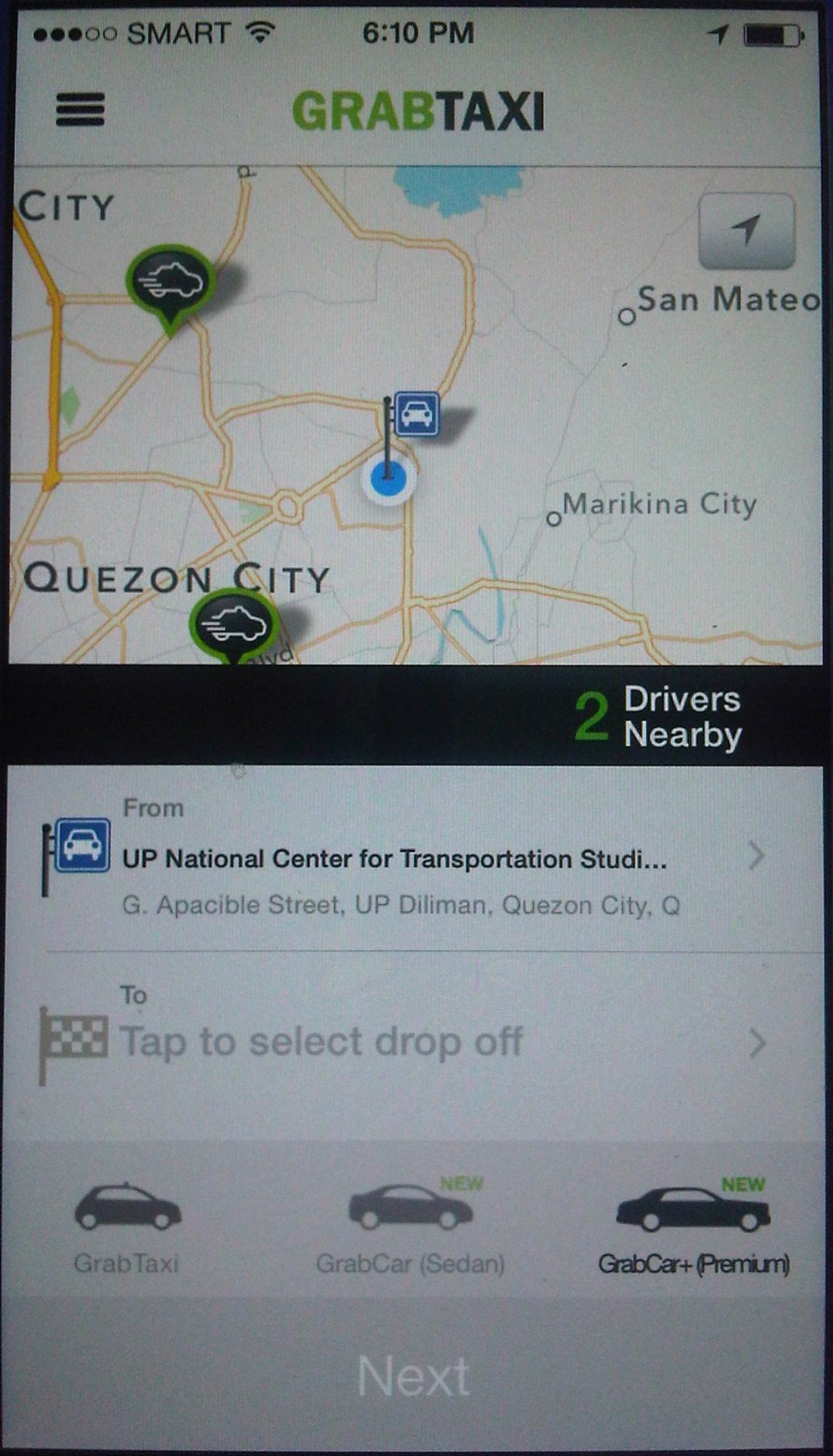
 Grab Taxi’s interface shows the number of taxis nearby, which is apparently the number within something like a 4 or 5-kilometer radius of our location (204 is a big number!). We were at Melchor Hall at the time and the most convenient pick-up location was at the National Center for Transportation Studies, which was behind Melchor Hall.
 You can also check out the availability of more exclusive (and expensive) Grab services such as GrabCar and GrabCar Premium. When you slide to GrabCar, the status bar will also show how many drivers of that service option are nearby (i.e., 20 drivers nearby for GrabCar). GrabCar would be similar to the basic service (and vehicle) provided by the more popular Uber.
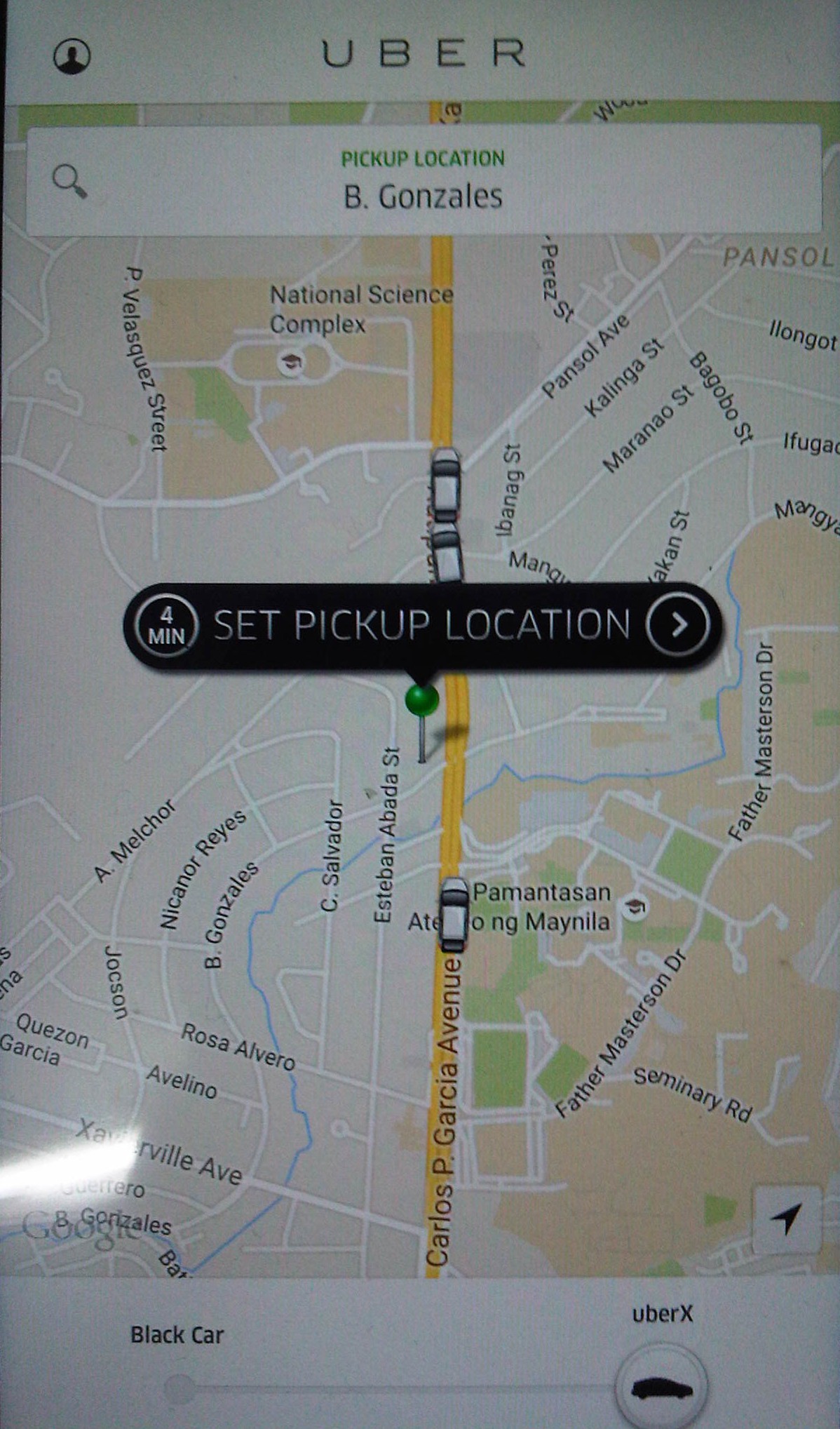
 GrabCar Premium is probably the equivalent of the Uber Black Car service we have in Manila.
 Another view of the user interface showing some (or many) of the 204 taxis nearby.
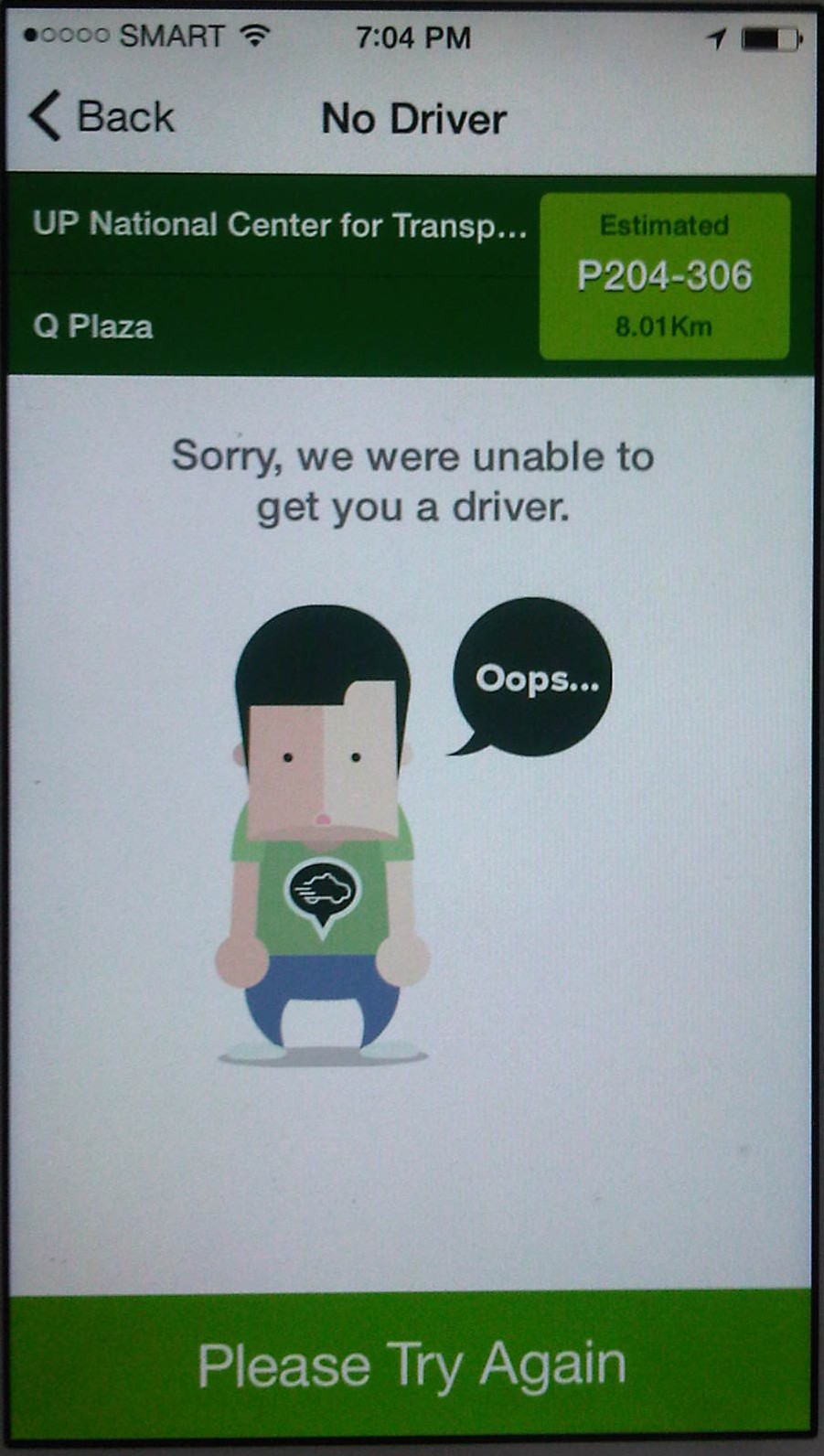 Here is an example of a message from GrabTaxi after it was unable to get a cab for us.
We were fortunate that the failed attempt at getting a cab was once only as we got a cab in our next try. This is despite all the cabs supposedly nearby. In reality only those who are willing to go to my destination from Quezon City will initially be interested in taking my request via the app. There is also a gratuity feature of GrabTaxi that allows the user to indicate how much he/she would be tipping the driver on top of the fare and booking fee. In the end, I guess my stating a very generous tip ensured my successfully getting a cab. For this, my friend’s opinion seems to be true that apps such as GrabTaxi mainstreams or makes the negotiations formal and a given when using the app. It, however, already eliminates the part where the prospective passenger gets turned down by the cab he/she hailed. When a cab responds to a request via GrabTaxi, EasyTaxi or even Uber, the driver already agrees to the terms of the deal regarding the ride. And it is a good thing that these apps now feature feedback mechanisms (e.g., rating the drivers) in order to weed out those that are still uncooperative, greedy or want to take advantage of the need for taxi service.
GrabTaxi now has a new service, Grab Express, which is an on-demand pick-up and delivery service. This is a service already provided by other companies in the US that are now giving traditional or conventional courier/logistic companies a lot of competition. I would think there is a demand for such services especially in cities where documents and other stuff still need to be submitted to offices like reports, manuscripts, letters and others that need to be delivered in “hard copy” format.
–
On the new transport categories by the DOTC
An article came out recently about the four new transport categories introduced by the Department of Transportation and Communications (DOTC).
These are:
- Transportation Network Vehicle Service (TNVS),
- Premium Taxi,
- Airport Bus, and
- Bus Rapid Transit
To quote from the article from Rappler, TNVS are:
“Vehicles of application-based, ride-sharing service providers, like Uber, GrabTaxi, Tripda, and EasyTaxi, will now fall under the category TNVS.
TNVS will cover vehicles that provide pre-arranged transportation services for compensation, using an online-enabled application or platform technology to connect passengers with drivers using their personal vehicles, Abaya said.
These new rules will also allow ride-sharing service providers to accept regular passengers heading to any point of destination in the country, Abaya added.
Operators of TNVS, called Transportation Network Companies, are also required to screen and accredit drivers and register them with the Land Transportation Franchising and Regulatory Board (LTFRB).
All TNVS vehicles will also be required to install and use global positioning system (GPS) tracking and navigation devices. Only sedans, Asian Utility Vehicles, Sports Utility Vehicles, vans, or similar vehicles will be allowed, and these should not be older than 7 years.
The new framework makes the Philippines the first country to have nationwide rules on ride-sharing, according to both the Philippine transport department and Uber. Previously, only local and city governments have regulated the services…”
Premium Taxis are described as:
“…vehicles with a 7-year age limit under this new category will be equipped with GPS, online and smartphone booking capability, and cashless transactions through credit or debit card payments.
Like TNVS, premium taxis will be allowed to accept regular passengers heading to any point of destination in the country…”
And Airport Buses are:
“…should have fixed schedules and off-street stops, low-floor height and adequate luggage space, CCTV cameras, GPS device, free WiFi, and must run on Euro V or clean alternative fuel.”
Abaya pointed out that Green Frog has expressed interest in the airport bus service that would ply three areas including Makati City, Mall of Asia (MOA) as well as Bonifacio Global City (BGC) or Ortigas business centre…”
I won’t mention the BRT anymore. It deserves its own feature (as if the previous ones on it are not enough to describe the system), and is the only mass transit among the 4 categories “introduced” by the DOTC.
These new transport categories are obviously a step in the right direction. These are not new ideas and the institution of these categories by the DOTC is long overdue considering that the agency had to go through this process in order to address legal issues pertaining to such services. In the case of TNVS and Uber, for example, much has been mentioned about franchise issues and how Uber was illegal under the prevailing set-up. It is good to have another option to the regular taxis but then weren’t GrabTaxi and EasyTaxi were supposed to have enhanced services?
As for airport buses, such limousine services have been in operation in many other countries. Unfortunately, in Metro Manila’s case, these buses would have to contend with worsening traffic conditions along most major roads connecting the airport terminals to the various points of interest mentioned in the article (e.g., Makati CBD, BGC, Ortigas CBD, etc.). It is good though that Green Frog was mentioned in the article as the new category provides an opportunity for cleaner and more efficient technologies to be applied to transport services. Still, if these services will be operated by reckless drivers then they won’t be much better than what we already have at present.
–
 Caught (up) in traffic