
Home » 2011 (Page 8)
Yearly Archives: 2011
Is there a need for a transport infra master plan? – responses to comments and questions
Is there a need for a transport infra master plan?
The NCTS crafted an issue paper for Bantay Lansangan entitled “Is there a need for a transport master plan?” partly as an exploratory initiative to widen the perspective of the organization from its current focus on roads.
Master plans are supposed to be guides for both government and other interested parties such as the private sector for determining what projects are to be prioritized. They also should be able to provide the basic cost estimates and other requirements that should pave the way for more detailed planning and design for specific or particular projects. As such, the absence of master plans or perhaps outdated ones is considered as handicaps in the prioritization and implementation of projects.
However, despite the availability of master plans, there is the question of the acceptance of their recommendations. There are also questions pertaining to how comprehensive these plans are and how would be able to address social, economic, environmental and even political issues should certain projects be implemented and the plan realized. On the last concern on the political aspect there are also those projects that are altered, apparently according to the whims of national or local leaders. Such deviations can be unnecessary and may lead to increased costs for project implementation. As it there have been many master planning studies conducted for the Philippines, the main issue tackled by the paper is the lack of an integrative document, a master plan for all master plans so to speak, that will clearly show how each and every major project is linked with the others.
The paper aimed to:
- Situate what has been initiated in the past vis-à-vis infrastructure master plan;
- Discuss the present framework (if any) that guides government’s long-term investments, policies and projects in infrastructure;
- Highlight the key concepts and processes involved in the formulation of an infrastructure master plan;
- Identify gray and problematic areas; and
- Identify recommendations and ways forward.
I reproduce below the concluding section of the paper:
“Master planning studies are generally directed to the government and provide frameworks for where investments should go. These include recommendations concerning prioritization that is reflected in the implementation periods or targets mentioned in the plan. Projects where the private sector may invest in should seldom deviate from those included and proposed in a master plan. This ideal situation would presume that unsolicited proposals are generally classified among non-priorities. Otherwise, it would seem that the master plan is flawed and failed to identify projects that are attractive for investments. More often than not, private sector entities will also have their own views on which projects will be most profitable and therefore most attractive for them to venture into. It is the government’s responsibility to ensure that plans are implemented according to their importance or urgency.
There is a need for long-term infrastructure master plans. However, these should be updated on a regular basis and not premised on the availability of foreign funding support as the long-term eventually becomes part of the medium-term and ultimately the short-term. Infrastructure master plans should also be flexible as it serves as a guide not only for potential loan packages but the participation of the private sector in putting up the infrastructure essential for the sustainable progress of the country. Lastly, it is important that coordination be clear in the master plans should these be formulated according to the different transport sub-sectors. Elements must be integrated to ensure that the different transport infrastructure projects complement each other rather than appear as isolated or disconnected.”
The paper was presented last August 1, 2011 at the DPWH-BL Fair held at the DPWH headquarters at the Port Area in Manila. It was generally enthusiastically received based on the feedback I got from our technical staff who presented the paper before a predominantly DPWH audience. I will address questions and comments forwarded to me in the next posting.
Pedestrian overpasses along Commonwealth Avenue
Commonwealth Avenue is still regarded as a “killer” highway despite the efforts to reduce road crash incidence along this thoroughfare. Many of these crashes involve pedestrians who continue to cross the highway on at-grade or on ground level at many points of the highway despite this being prohibited or discouraged. To cross the avenue, pedestrian overpasses have been constructed at strategic locations along the highway including those at Fairview Market, at Ever/Shopwise and at Tandang Sora, at U.P. (2 overpasses – one at AIT/CHK and another at Technohub), and at Philcoa. Despite these facilities being constructed and possibly with a few more to be constructed in the future, many people still choose to jaywalk. Among the reasons cited are stairs being too steep and the long distances they have to walk to and from the overpasses.
Following are photos taken on a Sunday drive from Novaliches to UP showing the conditions on and around overpasses along Commonwealth Avenue. Noticeable are overpasses across Fairview Market and Ever/Don Antonio where vendors have set up shop and impede the flow of pedestrian traffic.
 Pedestrian overpass across Commonwealth at Litex and before Fairview Market (section is at Commonwealth southbound) – the overpass is surprisingly free of vendors despite its being well within the influence area of the market.
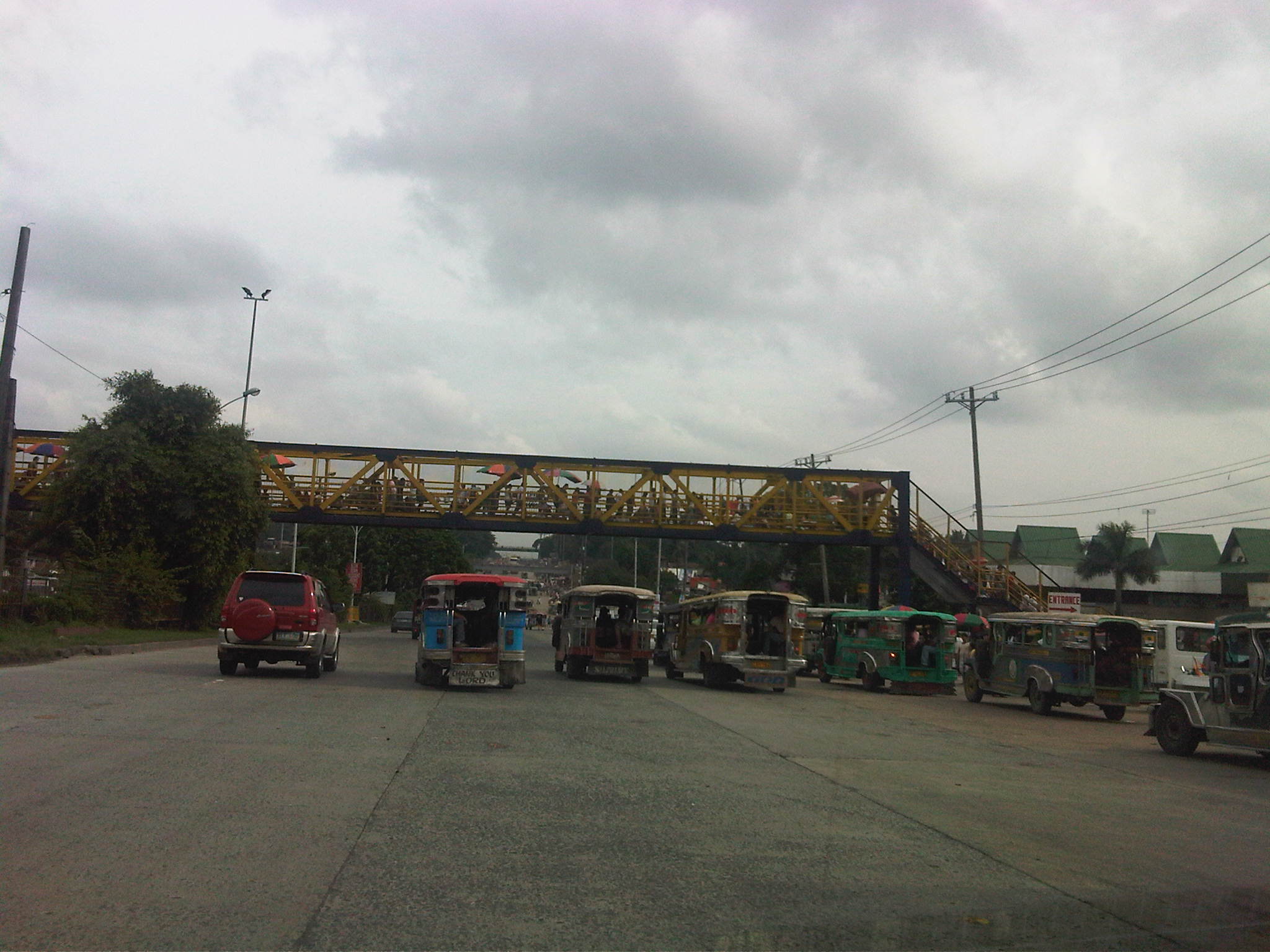 Overpass across Fairview Market (section is across Commonwealth southbound) where vendors have set up to sell various merchandise. Notice the umbrellas to shield vendors from the elements. Note, too, the jeepneys congregating under the overpass and taking up 2, 3 or even 4 lanes of road space and thereby causing congestion along the wide avenue.
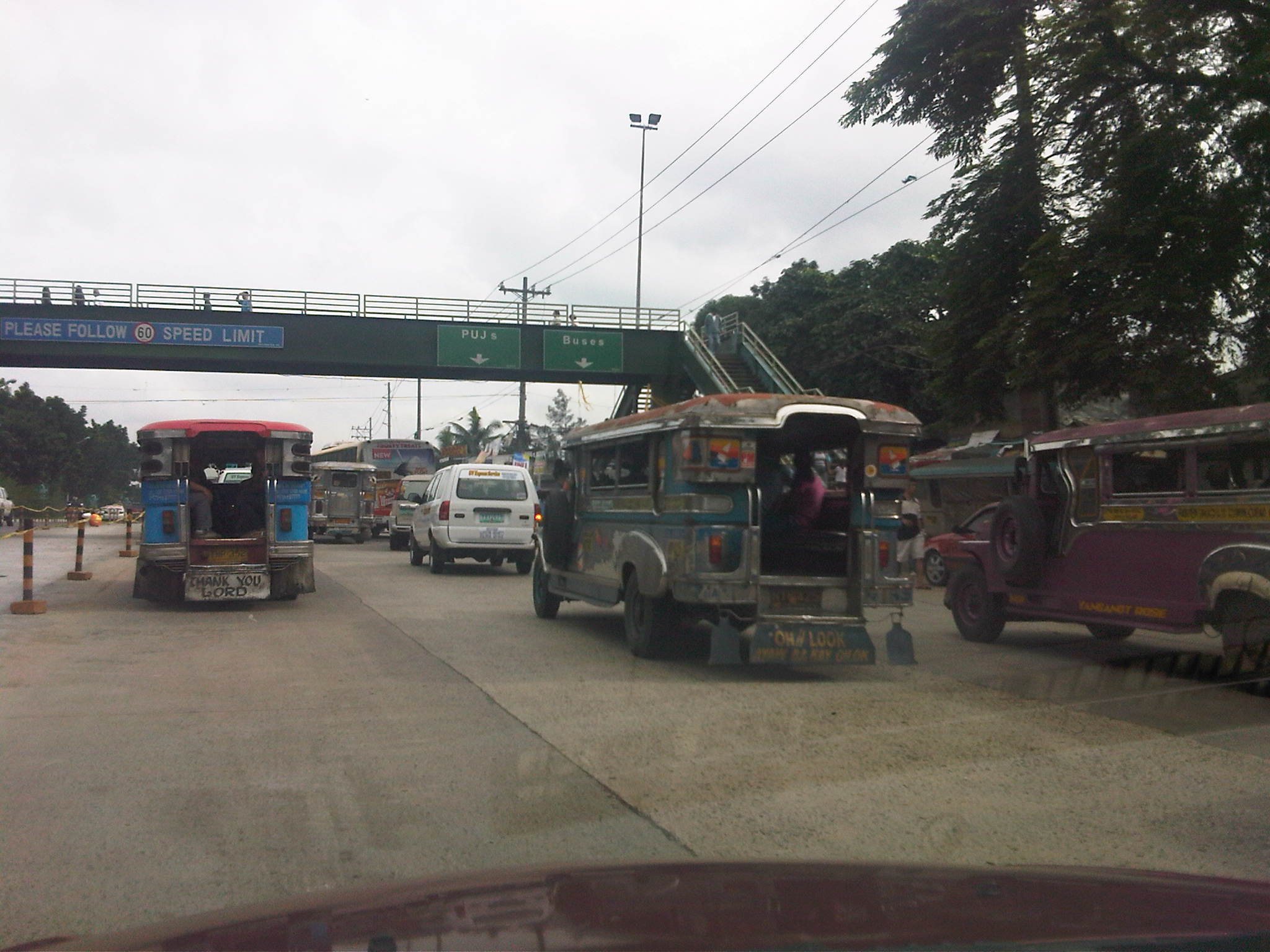 Overpass after Fairview Market and across densely populated areas that are mostly informal settlements. Jeepneys and buses usually congregate under this overpass and another downstream which is across from the Sandiganbayan. The bollards to the left are to segregate a lane with recently laid concrete (re-blocking of certain lanes along Commonwealth).
 Overpass across Ever Commonwealth where vendors have also set up to sell merchandise. The design evokes those of old steel truss bridges in Manila across the Pasig River like the Quezon and Ayala Bridges. Notice the congestion at the overpass at the left portion of the photo.
 Overpass across Tandang Sora where the middle portion descends under the T. Sora flyover in an unusual design that calls to mind the adjustments made for pedestrian facilities constructed across EDSA, and above or below the MRT3 alignment. Notice the countdown timer for the signals at this major intersection.
 Overpass across AIT and CHK of UP Diliman. The canopy is one of two set up atop the overpass for MMDA personnel taking random speed samples to enforce the 60 kph speed limits along Commonwealth. On most days I travel along Commonwealth, there is usually no one taking measuring speed along the NB direction of the highway.
The overpass across the UP Technohub is relatively new but it is free from vendors. In fact, the two overpasses across UP are free from vendors and are regarded as safe and secure because of guards (and even MMDA enforcers) posted at the overpasses to ensure the safety of users of the facilities, especially students and employees of UP and of the Technohub. However, the Philcoa overpass continues to be occupied by vendors despite its roof being removed by the MMDA a few years ago with reasoning that this would deter vendors from setting up atop the overpass.
The problem of vendors on the overpasses is an enduring issue and one that is quite easy to solve if authorities are serious about addressing it. In fact, it is so easy for enforcers or police to prevent or even apprehend/accost vendors as frequent as the latter attempt to set up on the overpass. The continued presence of vendors suggest that there is no sustained effort against these vendors. There are those who even suspect (and are perhaps correct in certain cases) that enforcers or police are being paid to turn a blind eye to these vendors. This is a story that is replicated in many parts of Metro Manila as well as in other cities across the country where overpasses become small time malls or shopping streets, thereby defeating the purpose of having these facilities in the first place. The challenge is for local government units to do what is right in such cases if only to ensure that facilities for pedestrians are safe, secure and unimpeded for efficient flow.
Countdown
Among the things you get to observe at signalized intersections are the behavior of drivers given the setting of the traffic lights. While the cyclic transition from red to green to amber and then to red again seems routine and possibly trivial to many, it is an opportunity for traffic engineers to examine how drivers react to the lights. Among the most notable behavior are common violations like beating the red light and occupying the area within the yellow box despite full awareness that the exit is already full.
Then there are the not so obvious but risky habit of some drivers to beat the green light. That’s when a driver anticipates the green light and proceeds to move prior to the signal and before the intersection is clear of any vehicles or pedestrians that may have been caught in the change in signals. It is a practice that increases the probability of a road crash occurring as the clearance interval for vehicles whose paths may be in conflict is drastically reduced. This is a habit of many drivers who are familiar with the sequence of signals at an intersection and who know when its their turn for the green light.
In most cases, drivers and pedestrians are unaware of the length of time available for them to cross the street or intersection. There are no indications for when the lights will change and only familiarity would allow for drivers or pedestrians to estimate when it would be their turn to proceed. In Japan, many intersections play music during that tends to speed up when the signal will be changing. This audible indicator allows for both the blind and the busy to know whether it is safe to cross the street and if there is enough time to do so. It is also something that is probably taught to children for them to more easily know when it is safe for them to cross the street.
There is another innovation to traffic signals that is surely welcome to pedestrians and motorists alike but which may also have its disadvantages. I am referring to the countdown timer, which provides road users the information about the lengths of green and red signals (Note: Amber or yellow is usually fixed at 3 seconds.). From the perspective of energy efficiency, such information may allow motorists to turn off their engines, usually done when one practices eco-driving, resulting in fuel savings. Meanwhile, drivers of vehicles approaching an intersection may be able to tell if there is enough time for them to do so, and if there isn’t enough time they may be able to slow down their vehicles to stop at the next red light. Countdown timers may also be a helpful tool for enforcement as the timers establish that a driver should be aware of the time. Thus, a driver can no longer reason with the apprehending officer that he/she was not aware of the remaining time for movement.
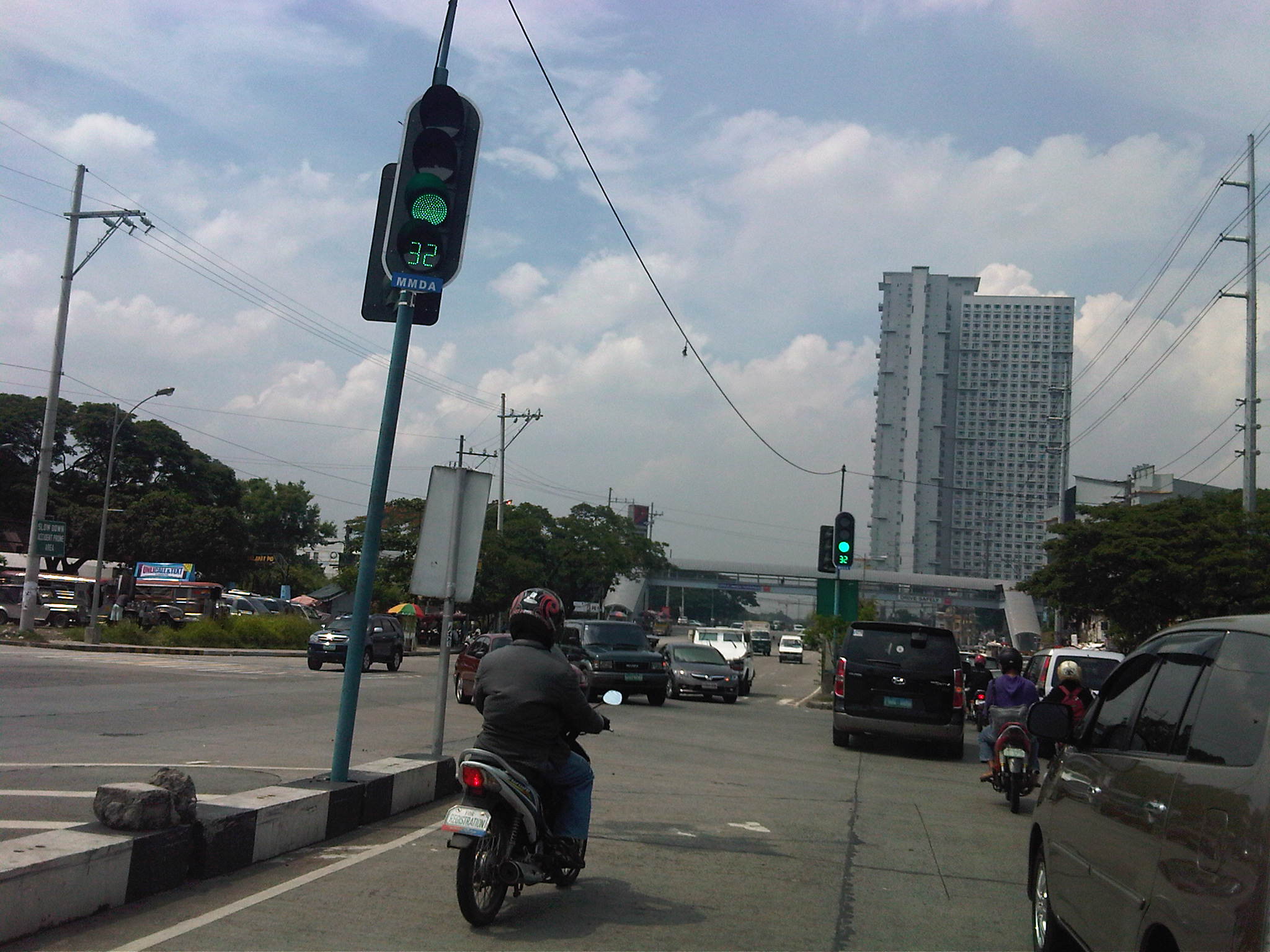
Pedestrians may also benefit from the knowledge of available time to make a safe crossing. This information should ultimately reduce the need for running in order to completely cross the street. The photo below shows the new countdown timer installed for the southbound through movement at the Katipunan Avenue (C5) – C.P. Garcia Avenue intersection.
One possible disadvantage would be that aggressive drivers may still try to beat the red light by speeding up upon knowing what amount of time is available for them. Another disadvantage relates to beating the green light as even those unfamiliar with the signal sequence will have the information of how much time remains before they can proceed. Thus, many driver and riders start revving up their engines and push on their gears to anticipate the green signal. You can even imagine the countdown timer being used as if it were ticking towards to start of a race.
Despite the disadvantages mentioned, countdown timers should prove to be more beneficial than detrimental in most situations. In fact, countdown timers like the ones already installed at intersections in Bonifacio Global City should enhance traffic safety provided that these devices are fully complemented by enforcers who would flag down motorists and pedestrians who would attempt risky actions in relation to the timing device. Of course, from the research perspective there needs to be a scientific assessment of the actual impacts of countdown timers much like the studies already conducted elsewhere to determine and even measure the effects of these devices on both motorists and pedestrians. Only then can we truly say if they do enhance safety and promote more efficient operations at a signalized intersection.
Who’s to blame?
I first saw this report about one motorist driving his car straight into a flooded section of a street in Quezon City on GMA 7’s prime time news program 24 Oras last night. I also saw it again on New TV 11’s State of the Nation with Jessica Soho. Friends and former students have posted the video from GMA 7 as well as from YouTube. The guy blamed everyone including the MMDA, the media and the tambays in the area for not warning him about the flood. He never even thought twice about getting angry and virtually berating everyone else. Perhaps it would have served him better if he had an ounce of common sense in him that could have spared him (and his car) from the incident. Now, he is all over the net thanks to the viral video of him spreading around and showing everyone else what many of us have become. He’s practically a poster boy for citizens who do nothing except blame everyone else.
The GMA7 news report may be found here.
Traffic and flooding
Metro Manila and other cities around the country are again in the headlines because of flooding brought about by strong rains. Rains are not new to the Philippines and there are many articles (and blogs) that have been written about the history of flooding in the Philippines. Some even feature old photos or caricatures showing how life was during the Spanish and American periods when floods also occurred, probably due to similar strong rains brought about by the monsoons or by the typical typhoons that regularly visit the country during the wet season.
In those times many years ago, the subject of drainage has already been mentioned and there is evidence that certain infrastructure were constructed to address the problems of flooding. In fact, the esteros that we presently associate with informal settlers and garbage were man-made waterways that functioned as open channels that could alleviate flooding in times of heavy rains. These waterways also functioned as transport facilities as they were constructed wide enough for boats to travel along the network of esteros that also connected with the Pasig River. These were not so different as the waterways that are now being used in Bangkok that have significant commuter and even goods traffic. There are many photos of these esteros as they were back in the Spanish and American periods. There are even more recent postwar photos that allow for comparison with photos at present. Unfortunately, I cannot post these here as there may be IP issues involved. Nevertheless, one can use your preferred search engines to find and view these photos.
Through the years, however, these esteros have been neglected and, as more and more squatters came to construct their shanties above the channels and tons of garbage disposed of, they became clogged and thus resulting to flooding in many parts of Manila. The esteros, however, are not wholly to blame when the subject of floods come up every now and again. It is a fact that the drainage systems of Metro Manila and other Philippine cities are already quite antiquated and their designs cannot accommodate the amounts of rainfall experienced these days. This is the result perhaps of poor planning and even more due to the neglect of national and local governments. And so we now experience floods almost each time we have significant rainfall. In some areas, the floods do not recede until after the wet season is over. Such is the sad plight of many Filipinos who are reduced to prayers and tests of faith if only to assure themselves that things will improve – some day.
Meanwhile, other cities have engaged similar flooding problems head-on and have invested on solutions that have saved their cities from much of the costs due to damages brought about by floods. Among those cities is Kuala Lumpur in Malaysia where they constructed a tunnel that is usable as part of their drainage system as well as a highway. Kuala Lumpur’s SMART Motorway Tunnel is an example of an engineering solution that could help alleviate flooding in Metro Manila. It is quite costly, with construction amounting to about USD 514.6 million at the time of its completion in the first quarter of 2007 with construction starting about 4 years earlier in 2003. Much has been written about this infrastructure and its benefits. It has saved KL and Malaysia from potentially disastrous flooding so many times now since its opening. Was it worth it? No doubt our Malaysian friends with tell us it is and will continue to save them from more floods years from now. Thus, the cost of such projects can easily be justified and the return in investment will be quite quick given the costs of flooding that have been compiling these past years including 2009’s Ondoy (Ketsana). In fact, KL’s SMART Motorway Tunnel is part of its tollway system and was built using a public-private partnership (PPP) arrangement that is much like what the current administration is preaching.
Perhaps its not yet too late for Metro Manila and other Philippine cities? Maybe we should get our acts together in finding and contributing to solutions that also address multiple problems facing our cities in this era of climate change and extreme weather conditions.
Slippery when wet
The MMDA reported a high of 30 road crashes occurring in Metro Manila. These happened during a very wet day with heavy rains brought about by a typhoon approaching Luzon. Among the high profile crashes yesterday were one involving a bus that fell from the Skyway that cost the lives of 3 people including the driver of the bus. The other involved multiple vehicles including buses (again) and several private vehicles along the underpass section of EDSA near Ayala Avenue in Makati City.
In both cases, those involved and those investigating the incidents all cited the wet and slippery road as the probably cause of the crashes. The statements were all too familiar with drivers stating that they didn’t have enough time and space to stop because of the slippery road. Such reasoning only indicates that there is the likelihood that these drivers did not apply safe driving practices to keep their distance from vehicles ahead of them and to regulate their speeds given that wet roads offer less friction or resistance that would allow for shorter braking distances.
Despite denials, it is likely that the bus that plunged from the Skyway was speeding and that the driver lost control of the vehicle. I would like to believe that the barriers of the elevated highway were designed according to standards set by the DPWH, which are based on international standards that are incorporated in their safe design manual. Despite the standard design for the barriers, the bus still managed to penetrate it, apparently elevating once it hit the barrier.
Barriers are designed according to certain test levels that are deemed suitable for the specific facility. Such test levels that need to be satisfied incorporate elements like vehicle mass, speed, angle of impact and height of center of gravity of the vehicle (Reference: DPWH Highway Safety Design Standards, Part 1: Road Safety Design Manual, 2004). Since traffic along the Skyway consists of a significant number of heavy vehicles including trucks and buses, then the barriers should satisfy the test levels appropriate for these type of vehicles. Thus, it would be easy to check if the Skyway barrier design satisfies standards by checking the as-built specifications of the facility with the DPWH manual.
Nevertheless, speeding and not keeping a safe distance between vehicles are typically causes that may be attributed to the driver. These lead to such road crashes being categorized under driver error as their cause, which is quite justified given that perhaps there are no problems pertaining to the infrastructure/road or the vehicles involved. The weather is not really to blame since it is beyond control but road conditions may deteriorate due to rains if, for example, road drainage is not properly designed or provided. In fact, hydroplaning may occur should there be significant amounts of water on a road and becomes a hazard when vehicles travel at speeds that effectively allow water to come between the tires and the pavement. In such cases, it is also necessary to check whether the tires are able to pump out water as the vehicle runs along the road. In fact, the ridges in tires are supposed to be designed to be able to pump out water, which is the basis for tires to be also checked to make sure that they are suitable for wet roads.
Basically, all drivers should heed the message from a road sign that is provided along roads that are treacherous when the pavement is wet. “Slippery when wet” actually applies to all roads whether it be of Portland cement concrete or asphalt concrete surface, whether of good or bad condition. The mere presence of water on the road pavement presents hazards that can only be addressed if drivers practice safe driving. That is, to regulate their speeds, keep safe distances and lessen maneuvers regarded as risky even when roads are dry.
Too late?
A friend posted her disappointment over what she regularly observed through her condominium window overlooking EDSA Guadalupe. The traffic jams along EDSA seemed to be a 24-hour thing and she lamented about whether Metro Manila could solve this problem on congestion. She continues to be an active advocate for the environment and we have worked together on the electric jeepney that is now operating a 3rd route in the City of Makati and is also found operating elsewhere in other cities where its applications, to be fair, is still quite limited.
My response to her is something I have also mentioned in other venues including previous posts on this blog and interviews granted to major media networks that have asked me what’s wrong about transport and traffic in our country. It’s really simple – we have failed to build the necessary infrastructure when they needed to be constructed. And we continue to NOT build the infrastructure that could have saved us much in terms of fuel costs alone and perhaps contributed much more to our economy, and definitely outweighing the costs that have often been cited as if it were a deterrent to the realization of a mass transit network for Metro Manila.
Being one who has lived in both Tokyo and Singapore where they have good public transportation systems, I could not help but become excited when, returning from Japan before the turn of the century I came upon plans for Metro Manila’s rail network. I was excited because the decade before I was first exposed to similar plans for MM at a time when other capital cities in Southeast Asia like Bangkok, Jakarta and Kuala Lumpur where also planning for their own mass transit systems. In fact, they were also planning expressways in their respective metropolitan areas (i.e., Bangkok Metropolitan Area or BMA and Jakarta-Bogor-Depok-Tangerang-Bekasi or Jabodetabek/Greater Jakarta). Flash forward to the present, it is frustrating, if not depressing, to see that Bangkok and Jakarta were able to implement many of their plans that were critical for the growth of these metropolitan areas and definitely contributed to the overall sustainable development in those countries. Granted, Bangkok and Jakarta still experiences congestion like the legendary jams along urban highways in Bangkok. But which city around the world does not experience congestion? The key is to provide a viable and more efficient (also convenient and comfortable) alternative to taking one’s car. That should be in the form of a mass transport system that is comprehensive enough that it will allow for both mobility and accessibility to the traveler/commuter. The following figure from the 2005 World Transit Maps envisioned a network that is still now unrealized and, for the existing lines, have become the subject of controversy and other issues that include the absence of a single ticketing system similar to the smart and octopus cards found in other countries.

Can we imagine what could have been the experience of commuting in a Metro Manila where such a rail system would have been in place? My former students have related to me about how it was so convenient to move about in Singapore, Tokyo and Hongkong where the mass transit systems where comprehensive and integrated such that rail and bus systems could provide for the transport needs of commuters. I would like to believe that we have all the plans with us by this time and that the construction of transport infrastructure has long been delayed for our cities (not just Metro Manila but also other metros such as Cebu and Davao) so much so that we continue to suffer from the lack of critical systems that could definitely alleviate congestion and improve the plight of the general public. Perhaps people taking their cars and motorcycles will be convinced to shift to public transport if they see the benefits of doing so. For others who are still captives of our inefficient public transport systems, I am sure that the experience of having improved systems (and an expanded network) will be liberating considering their daily sacrifices just to make ends meet while losing much quality time, productive time stranded in traffic.
Locally made AGT
I got my first look at the vehicle currently being developed by the DOST-MIRDC at the DOST complex in Bicutan. This was the same vehicle that was shown on some news programs a couple of days ago when there was some buzz about a MOA being signed between UP and DOST for the development of an automated guideway transit (AGT) prototype and test track at UP Diliman. The DOST Secretary was supposed to have said that it would cost somewhere between a fourth or a fifth of those developed elsewhere (read: other cities abroad) and that it would have a capacity of 60 passengers. The Secretary also was reported to have said that the AGT would eventually be travelling at 100 – 120 kilometers per hour! That’s quite fast for something that’s being packaged as an urban mass transit system.
Together with the reports, both on TV and print (I haven’t heard anything from radio.), were images of a transit vehicle used by DOST in publicizing the project. What appeared was an artist’s impression (or so it seems) of what looked more like a monorail than an AGT. But coming to Taguig for a meeting, I made it a point to ask our friends at DOST to give us a brief tour of the test track they constructed at the complex where the MIRDC with a little help from another agency involved in rail transit was testing a prototype vehicle that was shown on TV. I wasn’t able to catch those news reports so I was a little excited to see the vehicle being developed and by local engineers and scientists. Below are a few of photos of the vehicle together with the test track.
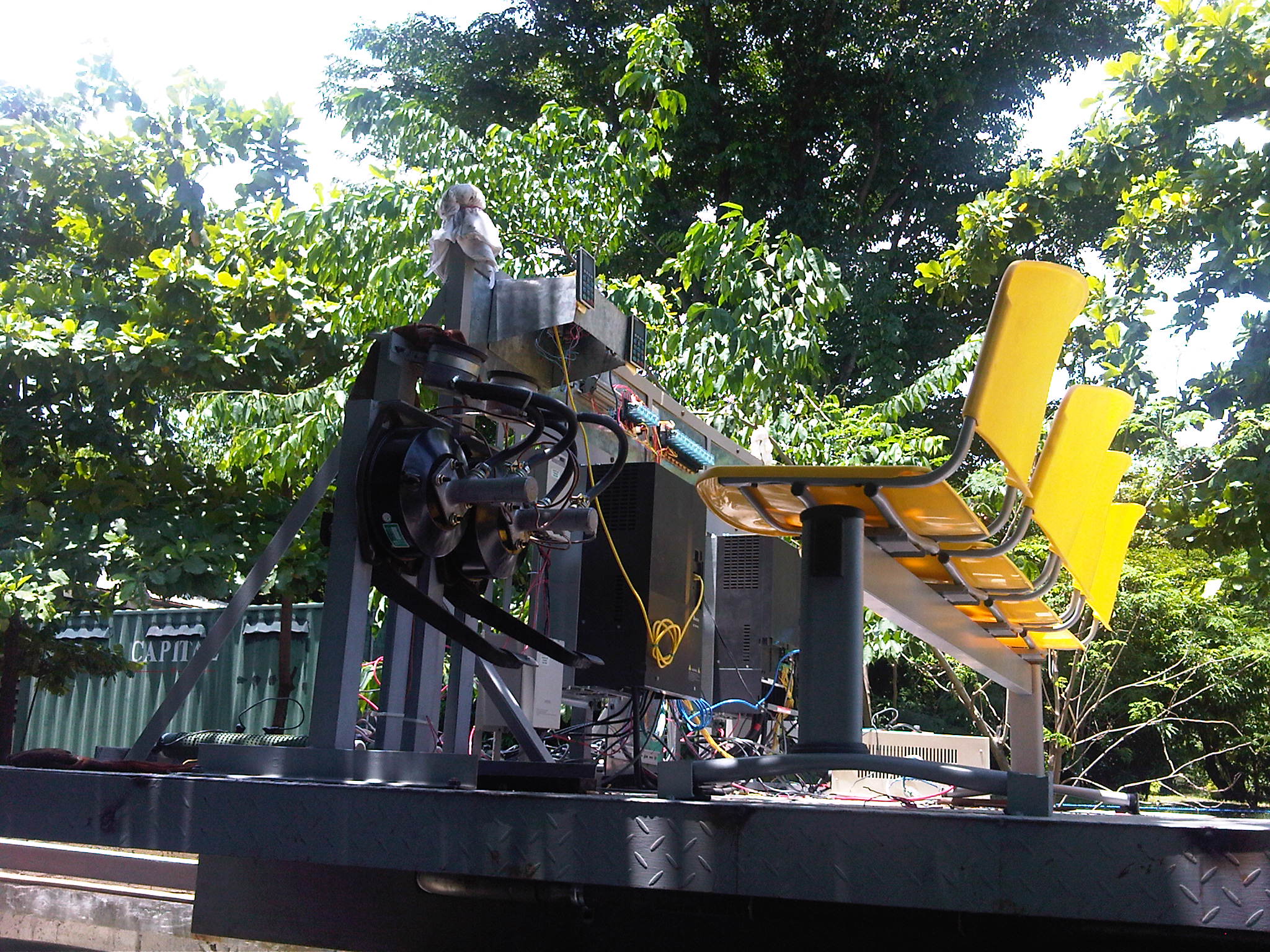
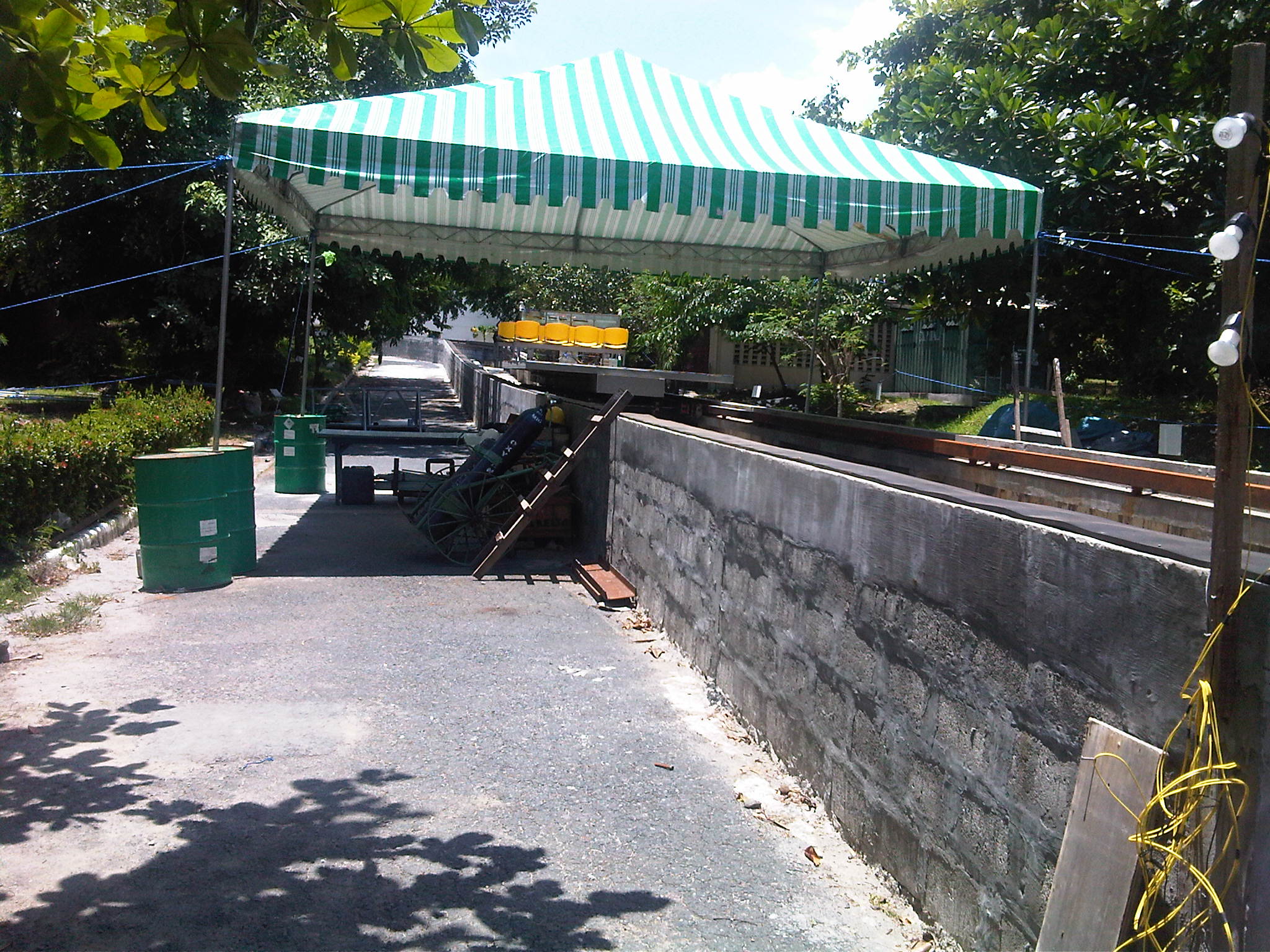
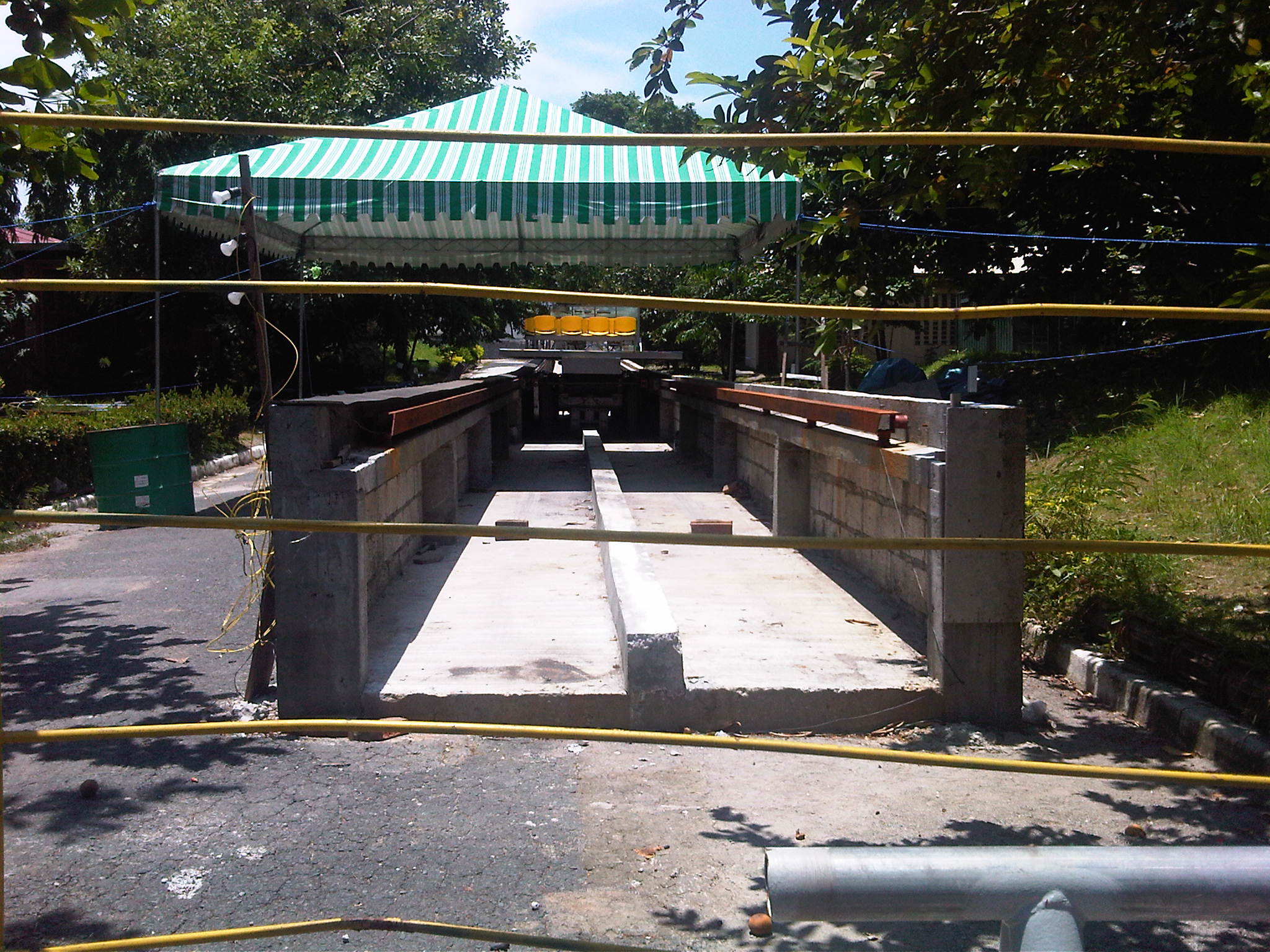
I’m sure a lot of pundits out there were disappointed with what they saw after getting all the hype about the UP AGT. However, it turns out that this won’t even be what will run along the test track to be constructed at UP Diliman. Our friends at the DOST say that this was just a practice vehicle of sorts that DOST staff experimented on just to prove that we (Filipinos) are capable of developing a transit vehicle and the track that will carry it. Of course, the future track and the proposed loop in UP Diliman will be overhead. Also, there will be other challenges pertaining to the superstructure (foundations, columns, girders, stations, etc.). Then there is the vehicle itself that should be safe and comfortable with designs adhering to ergonomic standards, an efficient motor and controller (it will be electric), and a suspension system that should give a smooth ride. Needless to say, the vehicle should also look good to be able to attract people and for it to be marketable. These are tremendous expectations indeed and it could really use all-out support from the government and maybe the private sector. I would not be talking about the funds and other resources required for this undertaking. Info on these are already available from the DOST and UP, and there are already initiatives to attract the private sector into having a look at the project and perhaps provide support in whatever way they can.
I can’t help but be proud of what has been accomplished and what is still to come in as far as the project is concerned. I believe we should be eager to pitch in what we can in order to ensure the success of this collaboration between UP and DOST. Who would not want to be involved in a project where Filipino engineers and scientists will come together to come up with a product we can not only showcase as home-grown but something that would have a significant impact on public transportation in this country.
Meanwhile, it would be better for DOST and UP to temper expectations so as not to put undue pressure on those who will be involved in the project. Pronouncements claiming that the system will replace the IKOT jeepneys are at this stage premature and only raises flags that would not be in the interest of the project. Claims, too, that the vehicle will run at 100 kph is unfounded and unnecessary considering, for one, that the average running speeds of such systems would be between 30 and 40 kph and probably top at 60 kph if there were sufficient distance between stations. I understand that the statements made were probably words of encouragement but I guess we have our work cut out before us and the challenges have been revealed on the way to the development of a home-grown AGT.
Technology-driven transit system development
The proposed UP transit system, whether it will be an AGT or a monorail, is a technology-driven project. As such, it can be argued that it does not need hard studies to establish the need for the system. Indeed, it is packaged as a prototype and one which, if implemented properly, will hopefully be a good example that can be deployed elsewhere where such a system is necessary. Such places may include CBDs like the rapidly emerging one in Bonifacio Global City or in small cities where there is a need for a more efficient form of mass transportation but could not afford the conventional MRTs or LRTs that have been constructed in Metro Manila. Also, a significant part of the initiative is the development of the vehicle, which is being undertaken by the DOST’s MIRDC. Their design and their production process should be replicable and they should have been able to bring down the costs according to the marching orders of their Secretary. After all, this system is being touted as something that would cost a fifth of a conventional system.
The conventional way of planning, designing and building transit systems require a lot of studies including the so-called ridership studies that would establish the demand for the system. Of course, there are also considerations pertaining to the stations and analysis of the superstructure that will also cost something. It is no joke that the best examples of AGTs or monorails in other countries are priced so because of all the effort and expertise that went into their developments. We should not kid ourselves by claiming this will cost much less because we did not take into consideration just compensation to people who will be devoting their time and expertise to develop a “home-grown” version of what has been built in other cities. We shouldn’t also sacrifice the quality of the superstructure that includes the stations just because we want to reduce costs. We have to keep in mind that the infrastructure should be able to resist typhoons and the possibility of earthquakes. The foundations for the columns, in fact, should be designed well considering UP’s soil characteristics.
On Wednesday I might just get my first look at the prototype vehicle when I visit the DOST for a meeting not quite related to the proposed transit system although it would be about customized vehicles. The vehicle that is the rolling stock for the proposed system is supposed to have already been built and being tested on a very limited basis at the DOST compound. Perhaps I can see for myself if it is something that will eventually be an impressive piece or something that will need much work once it is brought to UP.
 Caught (up) in traffic