
Home » 2012 (Page 10)
Yearly Archives: 2012
Overnight parking at NAIA
The main terminals of Manila’s Ninoy Aquino International Airport (NAIA) each have overnight parking facilities. These are all open lots located near the terminals and have roving personnel on motorcycles for security. The overnight parking spaces for Terminals 1 and 2 are located a bit of a walk away from the terminal buildings but are generally spacious and do not reach their full capacities.
Terminal 1’s overnight parking is located on the lot to the right as travelers drive through the security check for vehicles. Terminal 2’s overnight facility is near the old Nayong Pilipino gate and appears to be the combined parking lots of the now-closed theme park and the also closed Philippine Village Hotel. Terminal 3’s overnight parking spaces are generally spread out with most along the service road or driveway that leads to its still closed multi-level parking facility. Other spaces made available for overnight parking are those near the entrance to Terminal 3.
I haven’t tried overnight parking at T1 and T2 but I recently availed of overnight parking at T3. Following are a couple of photos to describe overnight parking at T3, followed by a few tips on how to get a slot in what is always a full area.
 Overnight parking spaces are along the service road on the right that ultimately leads to a ramp access to the still closed multi-level parking facility at Terminal 3. There is a sign that states overnight parking is full. Ask for assistance from the security staff to find a slot.
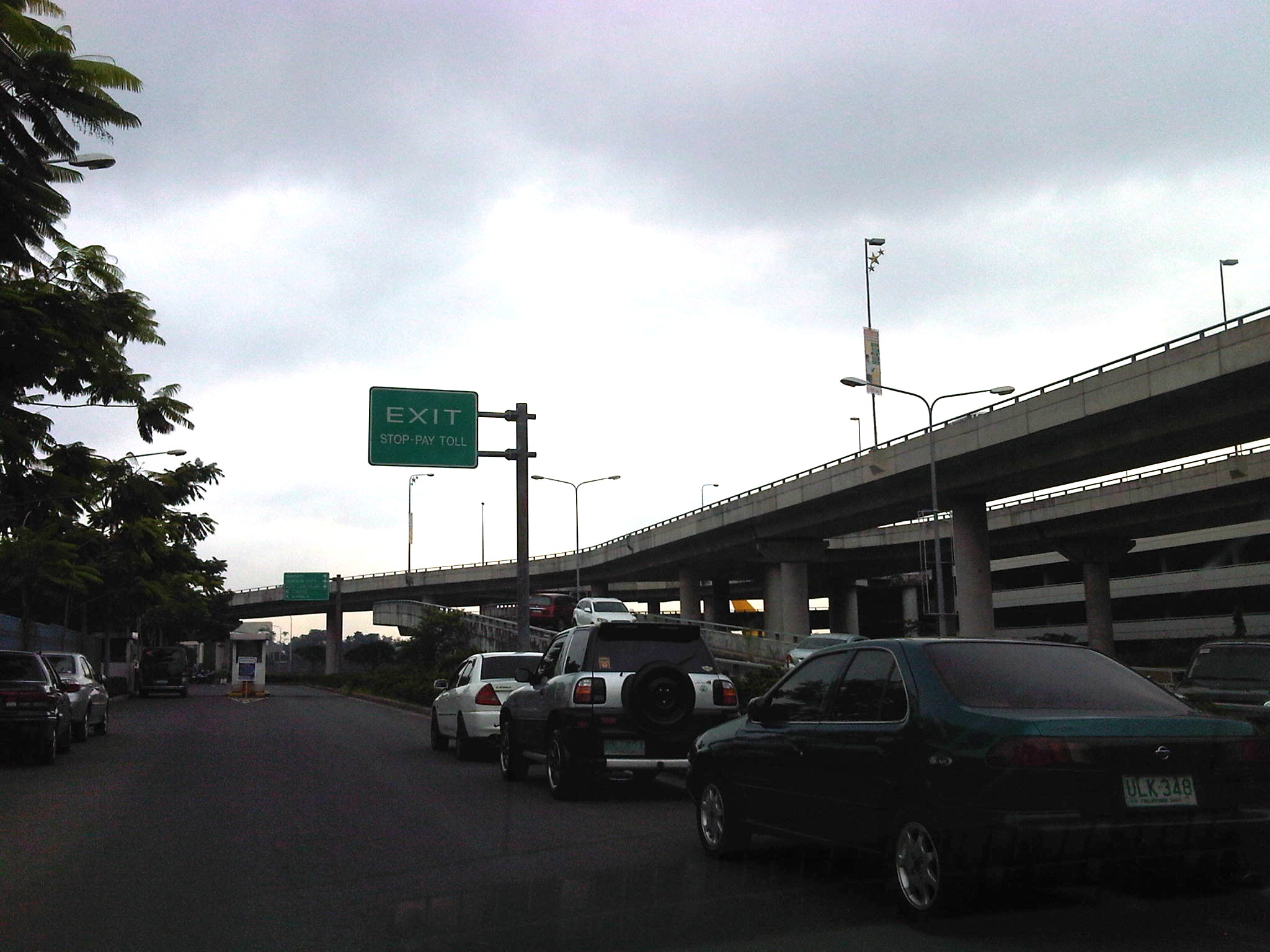 The service road leads to a ramp (visible at the center of the photo) to the closed multi-level parking (also visible on the right of the photo) of Terminal 3.
A tip for those wanting to park their cars for a night or more at Terminal 3: ask nicely for assistance from the security guard at the entrance to the parking lot. They will help you find an open space somewhere (trust me, it’s quite a challenge) in what is always a full overnight parking area. Show your gratitude by tipping. It’s definitely worth it and they’ll probably even check your car to return the favor. And yes… overnight parking fees are quite cheap at 50 pesos (about 1.15 USD) per night.
–
Persistence of stubornness? Taking photos on the tarmac
I took this photo while waiting for our plane to complete boarding procedures at Changi’s budget terminal. Two passengers (not sure if they are OFWs or tourists) stopped on the tarmac and took photos of the plane before each posed to have their photo taken by the other. They were so obvious and took quite some time on the tarmac that I was already anticipating Changi security personnel to approach them and instruct them to go and board the aircraft. For some reason, the ground staff did not seem to notice them or perhaps just decided to just let it go as a harmless act. Harmlessness notwithstanding, such incidents are actually considered security issues, which are among those ticked off by people evaluating airports. And this is why for most cases at the Budget Terminal ground staff are strict about passengers loitering on the tarmac including taking photos like what is shown below. I can understand the value, possibly sentimental, of such souvenir photos especially if one is heading home after a long stay abroad as a worker. Still, the time spent should not be as if people were already holding photo-shoots on the tarmac.
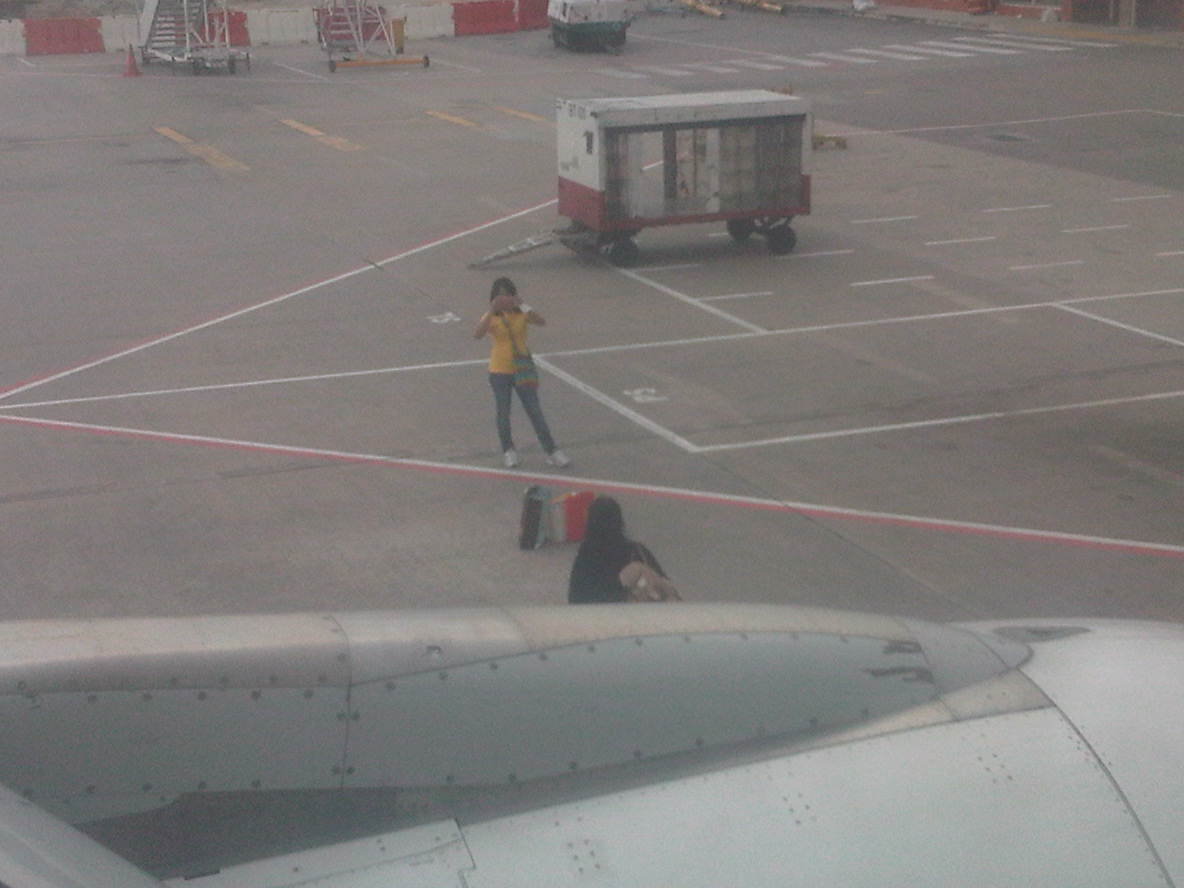 Passengers taking photos on the tarmac and near the restricted area with respect to the aircraft
Close-up of the same photo
–
Another look at Tagbilaran Airport
Tagbilaran Airport is the gateway to the province of Bohol and the resort paradise that is Panglao Island. I wrote about the airport earlier but the photos were quite limited as they were somewhat taken more as a matter of coincidence and for souvenirs than for a blog feature on airports. Following are a few photos I consciously took specifically for this post.
 Tagbilaran Airport as seen from our plane that had just arrived.
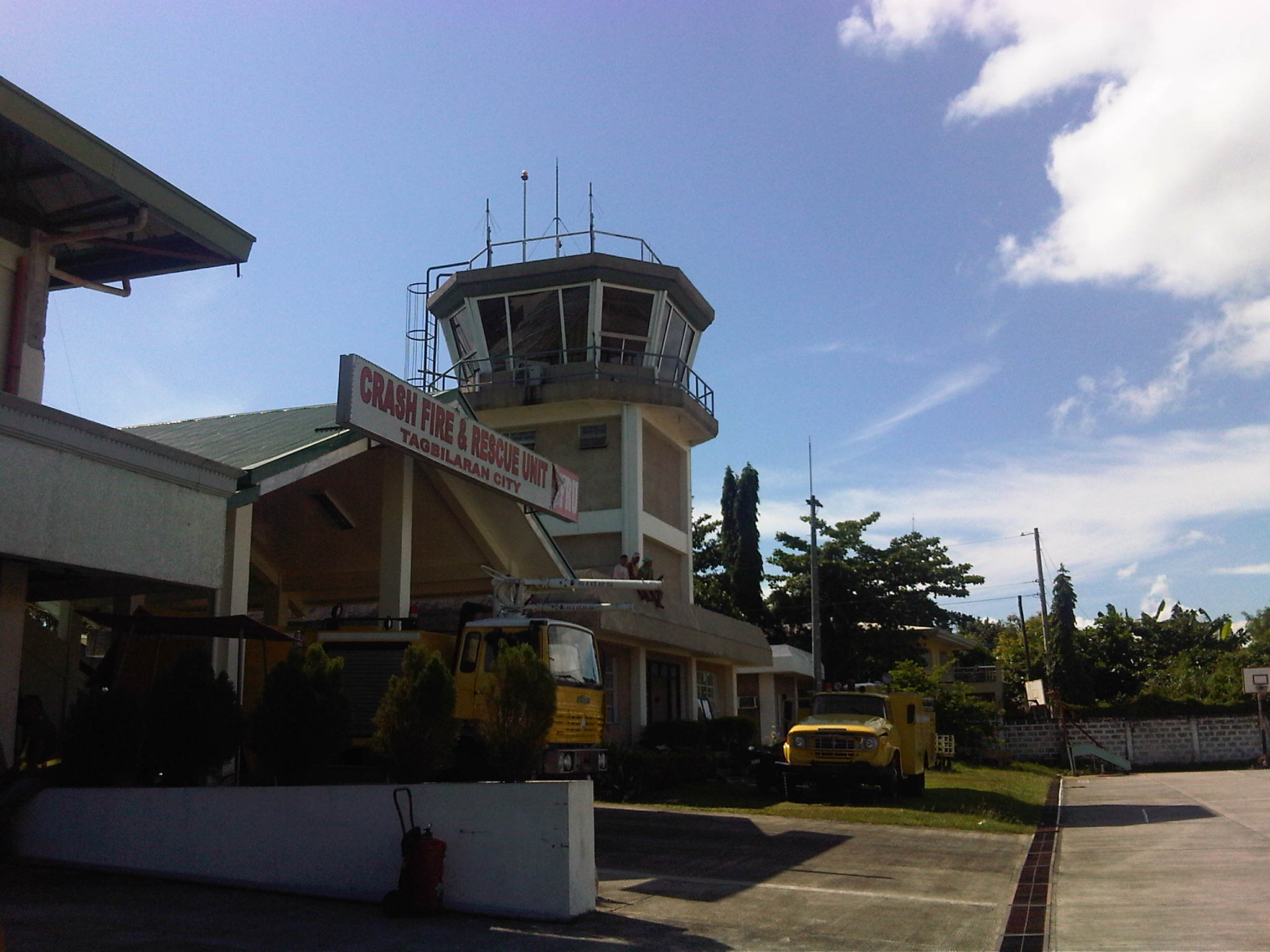 Air traffic control tower and emergency services at the airport.
 The airport is under renovation with the terminal being expanded to be able to accommodate the increasing number of passengers being handled by the airport.
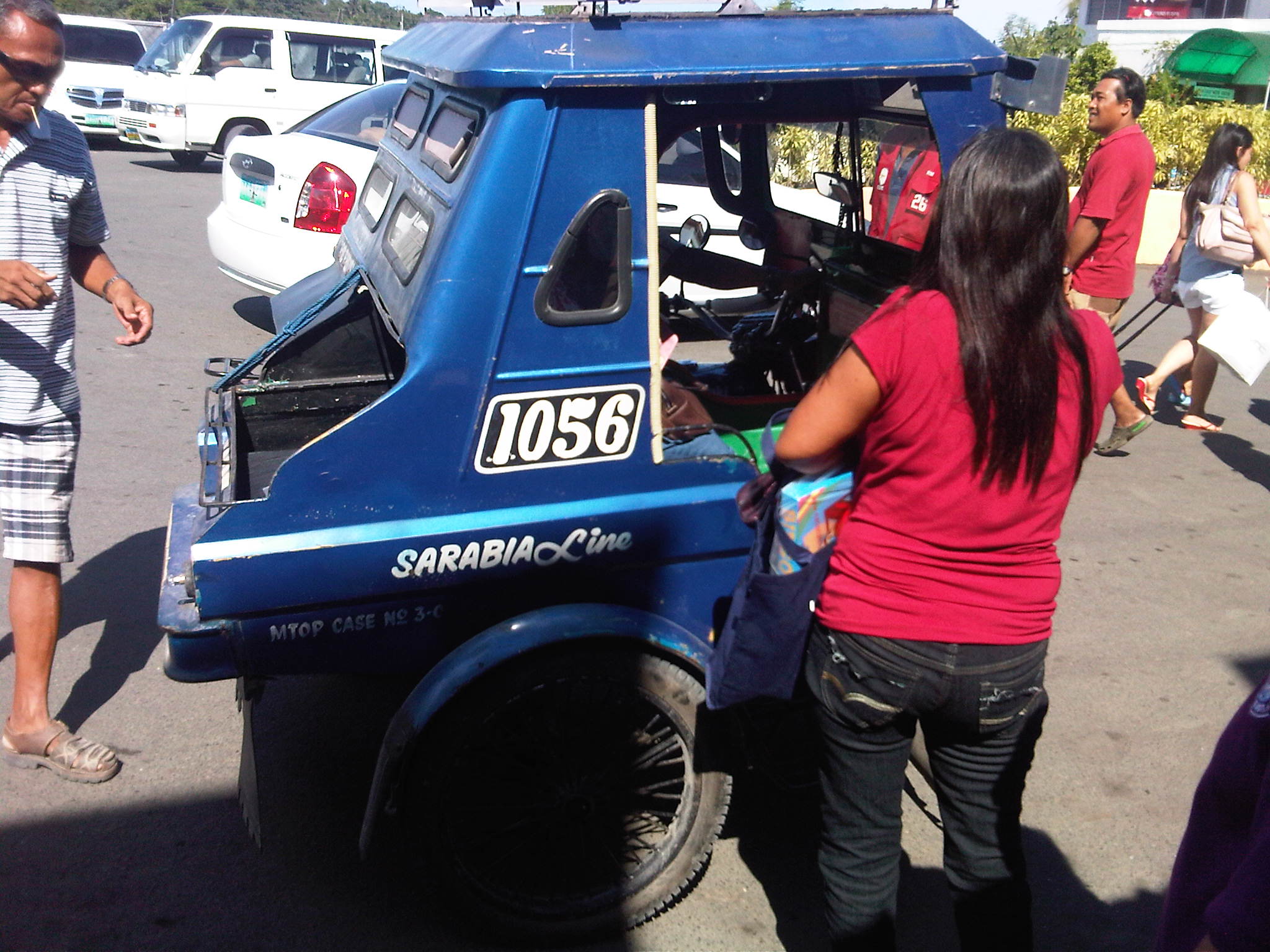 Tricycles are the dominant mode of public transport in Tagbilaran’s roads and others throughout Bohol. Their version of the tricycle comfortably seats 3 passengers including 2 in the cab and 1 behind the driver. The sidecar also features a baggage compartment or trunk in the back.
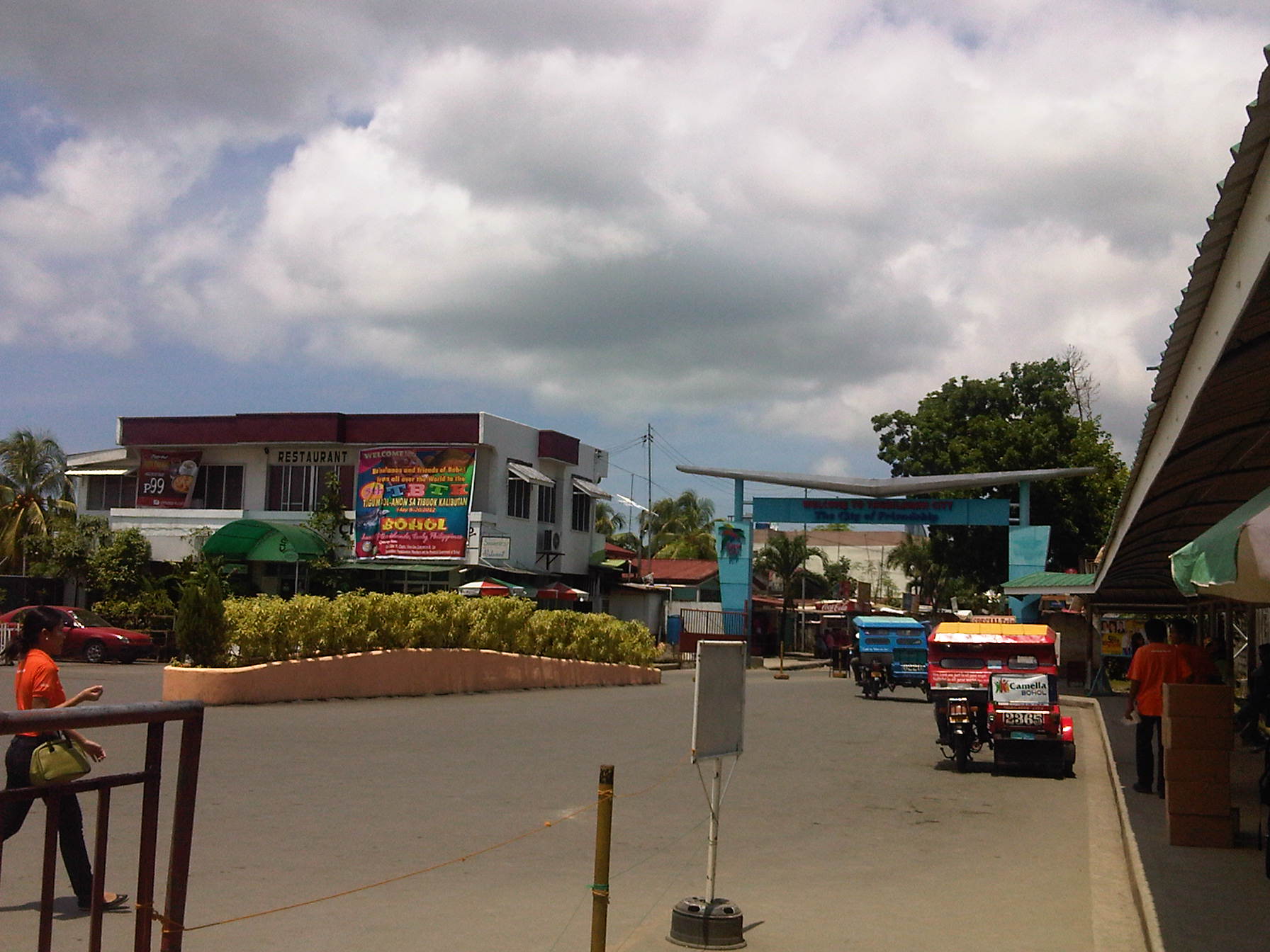 Entrance to the airport terminal – there’s precious little space at the airport for passengers and well-wishers. In fact, parking is very limited and there is usually not enough space for the mix of people and vehicles when a plane arrives at the airport.
 Pre-departure – seats at the ground floor pre-departure area at the airport. There are two concessions from where passengers may purchase refreshments or last minute souvenirs.
 Extension – the second floor is also used as waiting area for passengers. There’s one concessionaire on the second floor and a massage service with blind men as masseurs.
 Baggage handling – on the way to board our plane, I took a quick photo of the baggage being loaded unto the plane.
A new airport is being proposed for Bohol as the current one in Tagbilaran can no longer be expanded with the area required for a longer runway and a larger terminal restricted by the surrounding built up area. A new airport is planned to be constructed instead in Panglao Island where it will be closer to the resorts and other attractions that regularly bring in thousands of tourists and perhaps many more should there be a better airport for Bohol. Already, there are many issues being raised against a new airport but then if the project is implemented according to international standards, including those pertaining to the mitigation of negative environmental impacts, then we should expect the airport to be more beneficial to all involved.
–
PNR Naga City Station
The wife recently went on a trip with her father to attend a family affair in Naga City in Camarines Sur. Arriving by plane in the morning, they went to the PNR station in the afternoon to purchase a ticket for my father-in-law who wanted to try the train for the trip back to Manila. He got word of the resumption of Bicol Express services from me as well as from the news. The PNR had been featured on TV and he had been curious about taking the train. He used to take the train for trips between Naga and Manila before and told us stories of how nice traveling by train was back in the day. Following are a few photos around the Naga Station of the PNR.
 Aren’t we glad? – The PNR Naga Station has been renovated and now features updated office buildings and ticket counters
 Contrast the new and the old – PNR’s old coaches at the newly renovated platform
 Room for improvement – passengers waiting along the platform with some seated on the few benches available
 Simplicity – don’t expect turnstiles yet and it’s still somewhat a crude entrance to the platform but these should improve soon as passenger demand steadily increases.
 5
5
 Looking forward – the train at the platform was bound for Legazpi City, Albay and I like to think the photo The photo actually shows the back end of the train as the front end is pulled by the locomotive shown in a previous photo.
 Old workhorse – this diesel electric locomotive pulling the passenger coaches and a few others like it have been
 View from the top – there are pedestrian overpasses crossing the tracks for access to platforms and other parts of the station. Visible in the photo are discarded bogeys and the blue car that is an executive class coach with reclining seats.
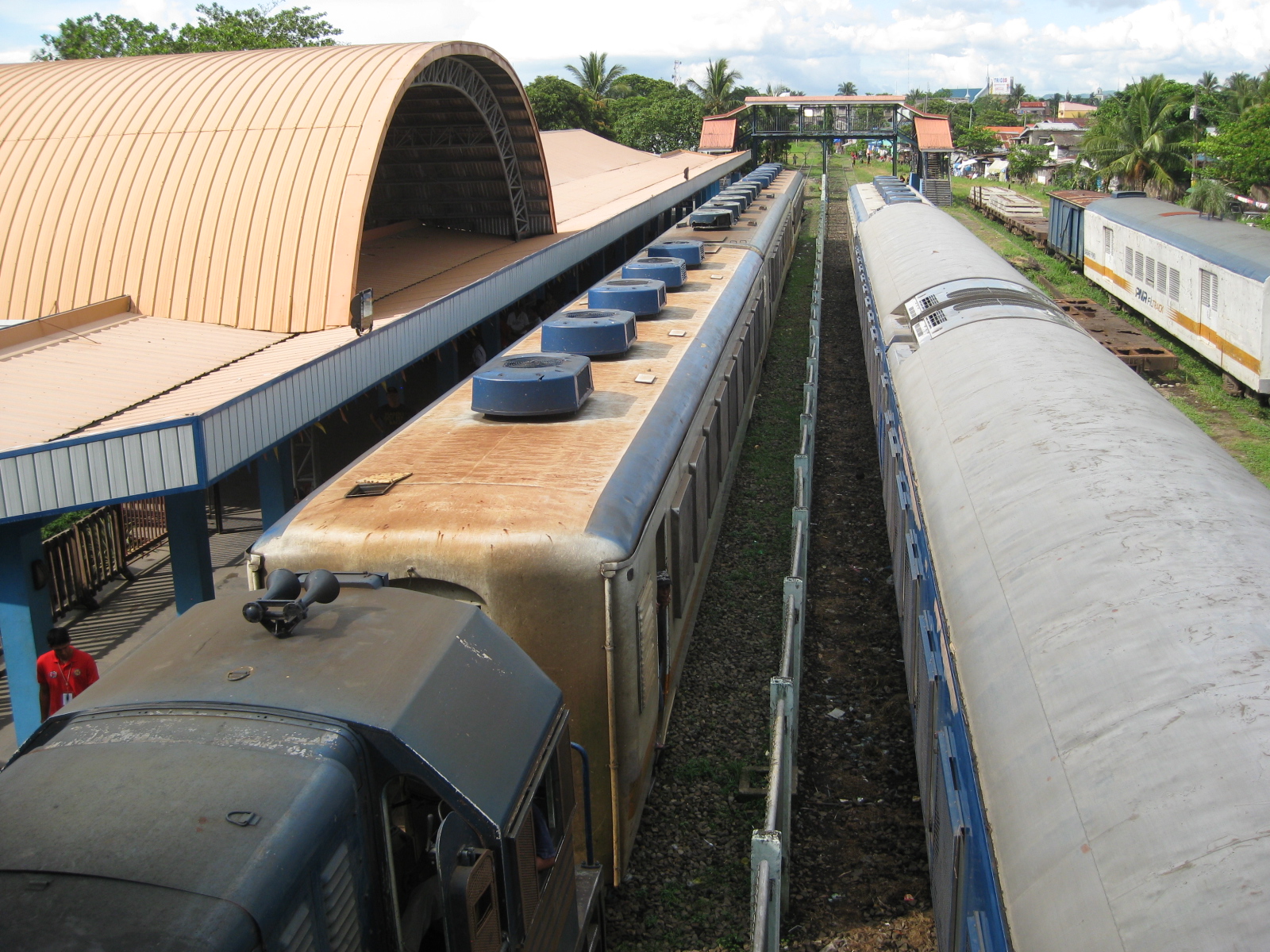 Regular and Special – the train on the left and parked alongside the platform has regular coaches with fixed seats much like the Tokaido Line long distance commuter trains. The train on the right has executive class coaches with reclining seats and more space for passengers that translate to a more comfortable ride. Unfortunately, there were no sleeper cars with either trains at the time.
–
School traffic generation – Part 3: LSGH and Ortigas
Was at the DOTC for a meeting and couldn’t help but look out the window from the conference room while waiting for the meeting to start. Our meeting was being held at the 16th floor of the building housing the Department and so it gave an excellent vista of the surrounding area. I was particularly interested in a view of Ortigas Avenue know there was no congestion that time of the day mainly because school was still off. The latter observation is important here because La Salle Greenhills, which is just a stone’s throw away from the building, is a major traffic generator with cars and school service vehicles clogging up the stretch of Ortigas Ave. from Galleria to the Greenhills Shopping Center. In fact, one can find vehicles parked or waiting along the road and even on the sidewalks, depraving pedestrians the proper and safe space to walk.
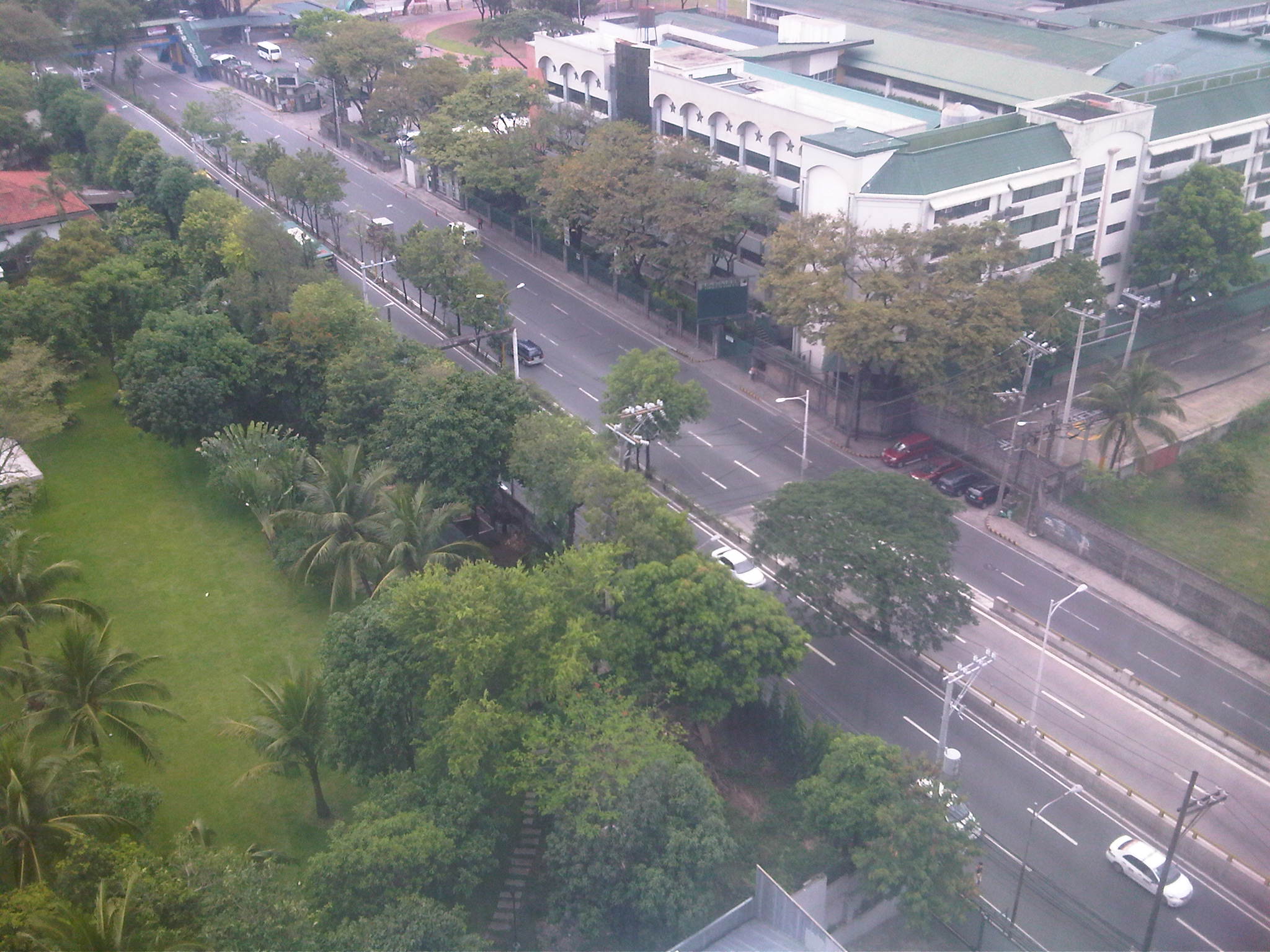 Free-flowing traffic along Ortigas Ave. in front of LSGH on a Friday mid-afternoon.
 Main gate and pedestrian overpass at LSGH – there seems enough space for a multi-level parking lot inside the school but perhaps there are other options other than low capacity transport for the students.
 Impact area – photo showing LSGH in the foreground and the Greenhills area in the background, including Virra Mall on the upper left and the condominiums around the Greenhills Shopping Center and behind Camp Crame.
 Exclusive roads – the photo above seems the same as the previous one. A distinction though is that it shows Holy Cross Street (at right in the photo), which is inside Greenhills East Subdivision, an exclusive residential subdivision. The road and other streets in the subdivision are not open to general traffic and so cannot ease traffic along Ortigas Ave during congested periods.
 Greenery – across LSGH is Wack wack, one of the first golf courses in the country and a welcome patch of green in the middle of the metropolis. Trees also line up along Ortigas Ave. but their capacities to absorb the CO2 produced by motor traffic are not enough considering the volume and frequent congestion along the road.
–
Bali-Denpasar International Airport
One of the more interesting airports I have used in my travels is the Bali-Denpasar International Airport. I was not able to take photos when we arrived at the airport as it was already late and our group was already feeling tired from the long flight from Manila via Singapore. We also didn’t expect the long walk from the terminal to the parking lot where the guide who fetched us left his vehicle. Thus, the following photos were taken on our departure when we had some time to explore the nice airport.
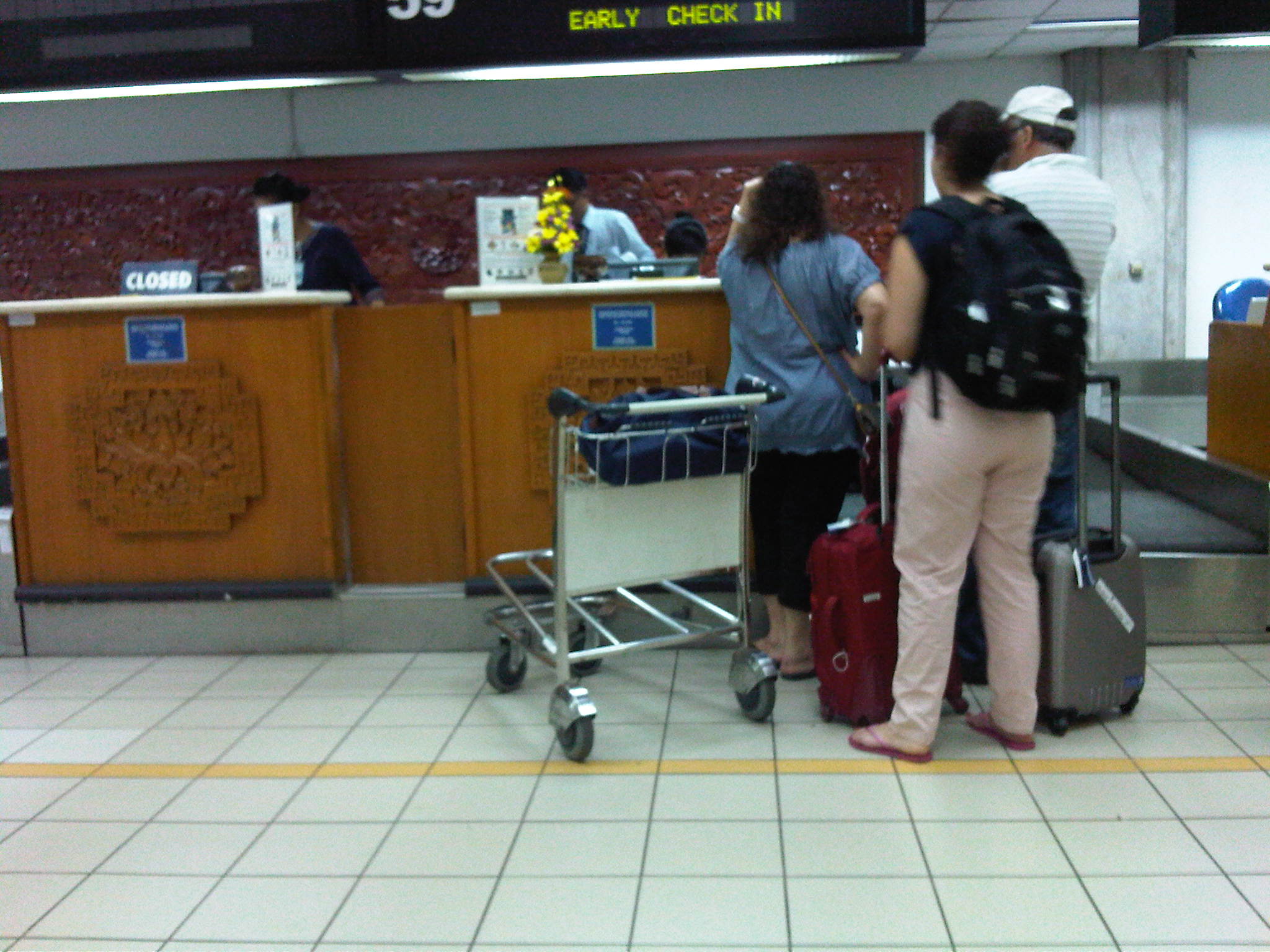 Check-in – we were quite early at the airport and were directed to the early check-in counters. I wanted to take more photos but was aware of the tight security at the airport check-in area, and didn’t want to risk being accosted by airport security.
 Where to? – Directional signs at one of the junctions inside the airport
 Time out – the spot in front of a world map with international times on display seems to be a favorite resting place for airport maintenance staff though I am not really sure about the intended use of the steel poles.
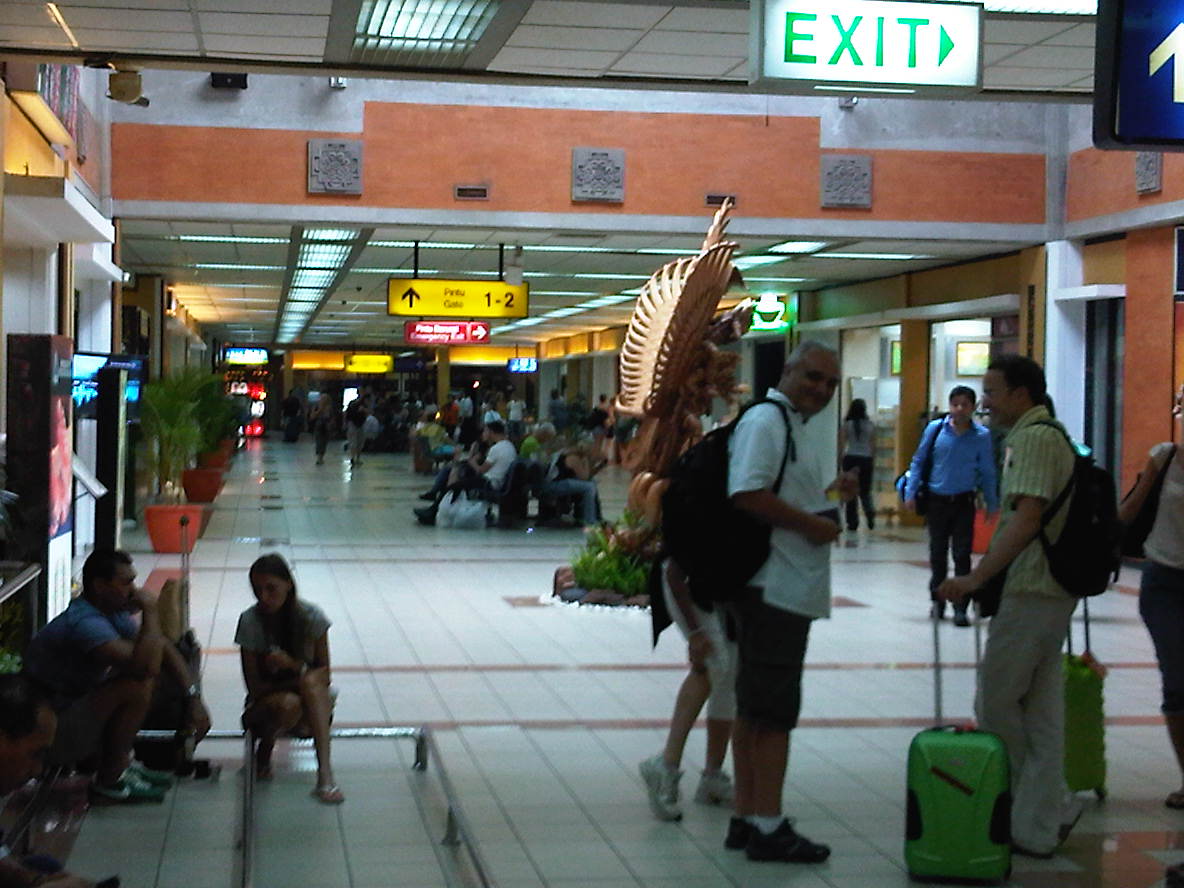 Burning time – travelers exchanging stories near a junction where stands a statue of the mythical figure Garuda, the King of Avians who is the inspiration for the name of Indonesia’s national airline
 Shopping mall – inside the airport, the layout reminded me of shopping malls as corridors were lined with shops and restaurants.
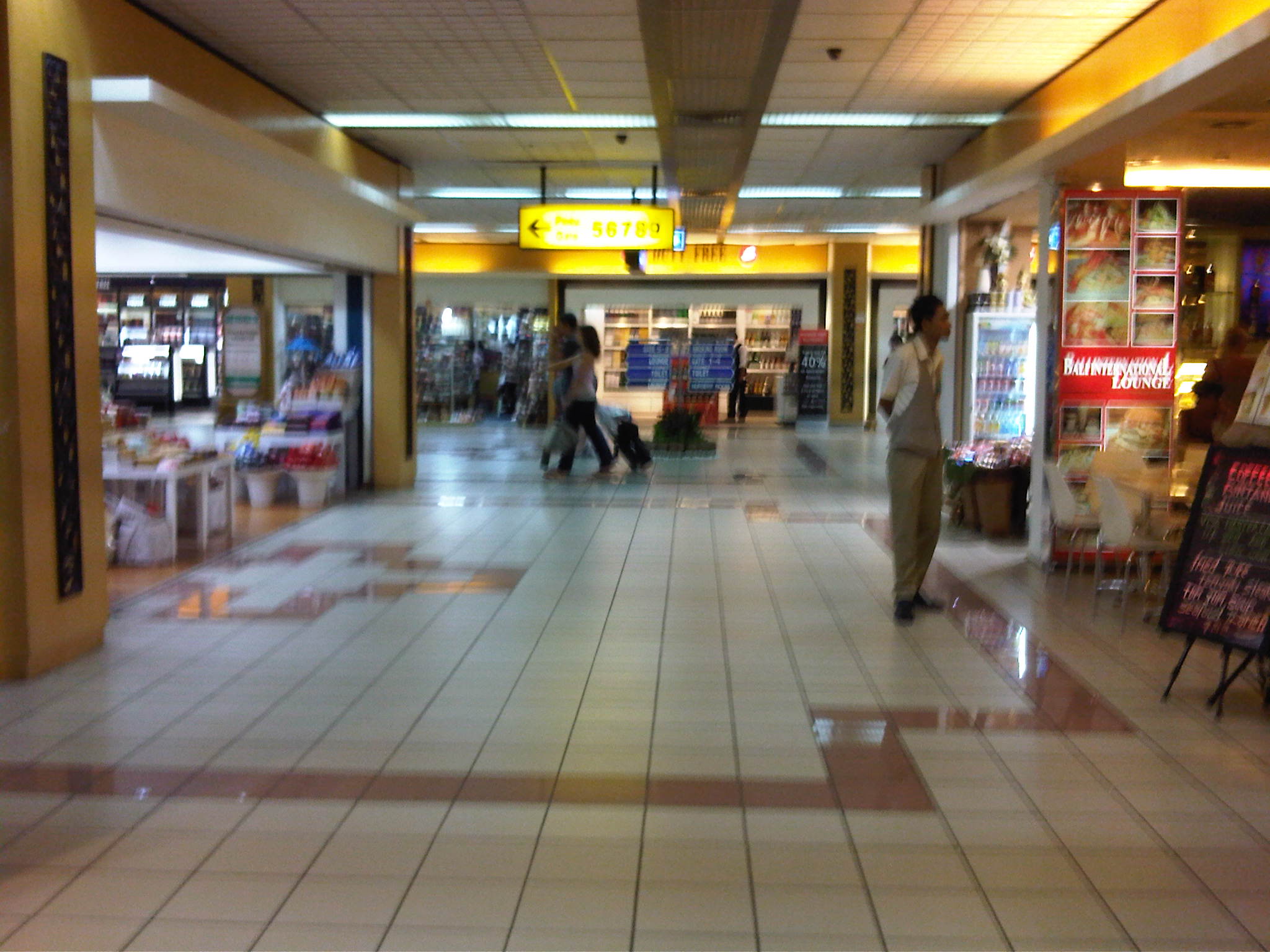 Shop and eat – while the prices indicated in the menus of restaurants were reasonable (read: they compare favorably to prices at restaurants outside the airport), the goods in the shops were priced for tourists (read: a bit expensive even considering duty free privileges). You can try haggling with some shops especially for local products like batik or souvenirs but you won’t be able to get prices close to shops elsewhere like, say, Bali Collection.
 Must try and must buy – Indonesia chocolates are available at the airport. The Monggo brand has many variants and the prices seem reasonable though I assume they are even cheaper if bought outside the airport. We didn’t have time to go to a regular supermarket and so had to do some quick shopping at the airport.
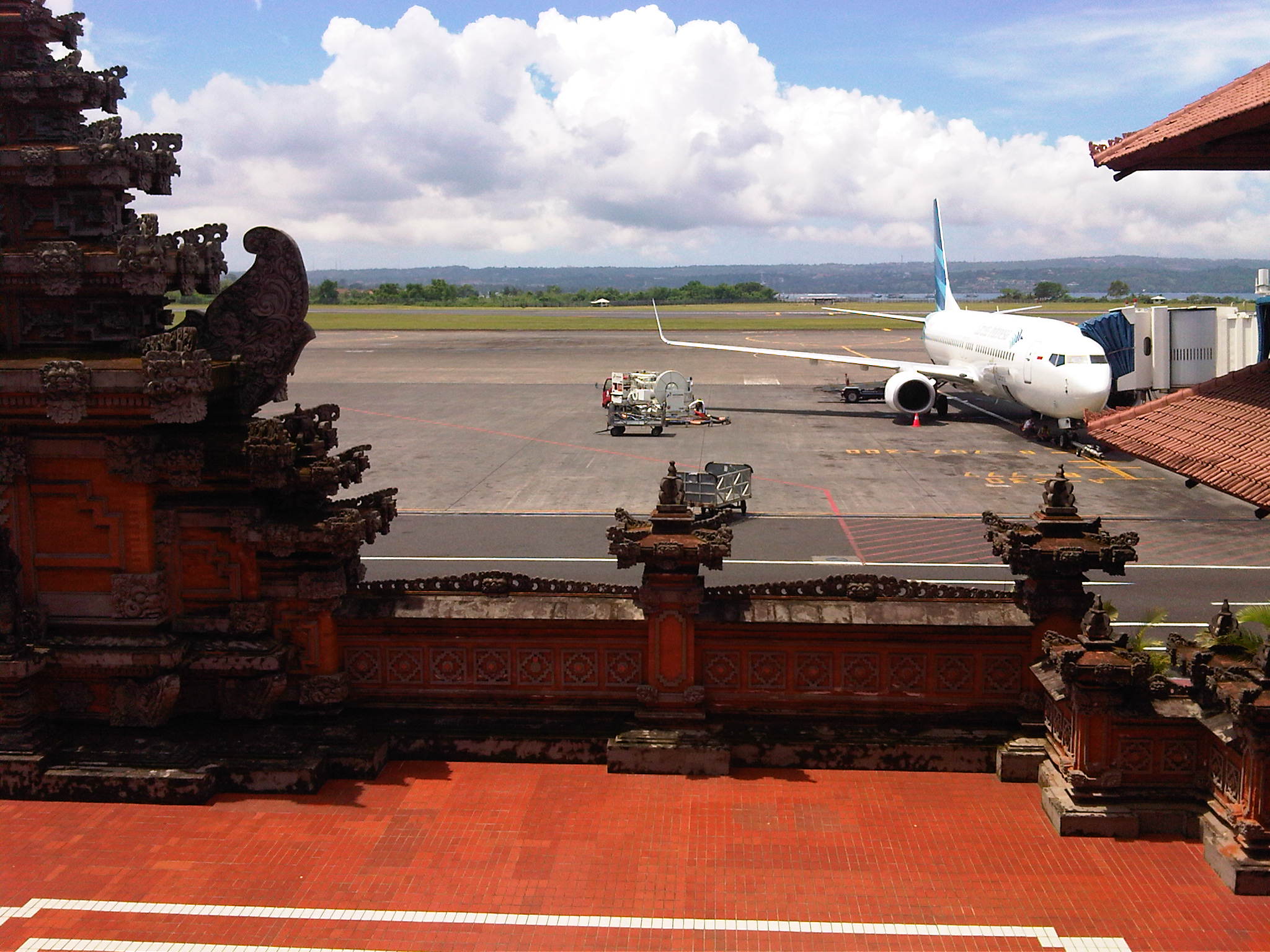 Ancient and modern – Indonesian national carrier Garuda B737 docked at the airport. Garuda, of course, also refers to the mythical God-king of the birds.
 Ancient gateway? – I am reminded of the Sci Fi series Stargate everytime I look at this photo. Such architecture gives the airport a lot of character as it banks on the cultural heritage of the region.
 The older wing of the airport with its clay-tiled roofs is shown on the right.
 Another look at the Balinese structure with a modern air bridge and the newer wing of the terminal in the background on the left.
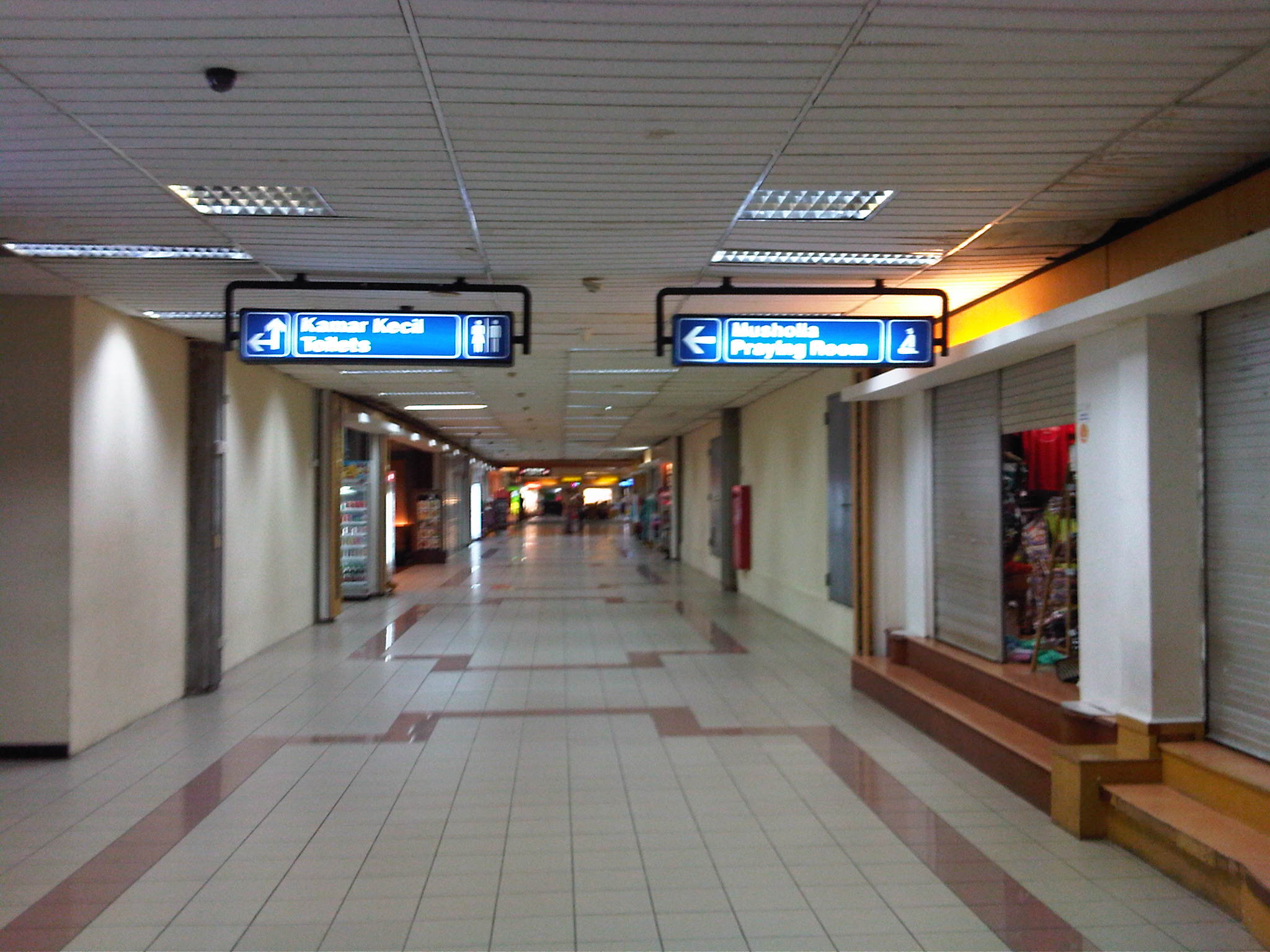 Corridor and more shops along the way towards our boarding gate.
 Benches – there were few seats near the entrance to the departure lounge. There were only two 4-seaters that were spaced a bit far from the next set of seats.
 Airport fee – Bali-Denpasar charges a 150,000 Rp (about 16.20 USD) fee for international passengers that is paid prior to the immigration counters.
 No seats? – passengers starting to crowd around benches just across from the door and the final security check to the pre-departure area. Airport staff would not allow passengers early for their flights to enter the area. It seemed to some of us that this was also a ploy for people to patronize the restaurants and shops outside the pre-departure area. There were no concessions inside.
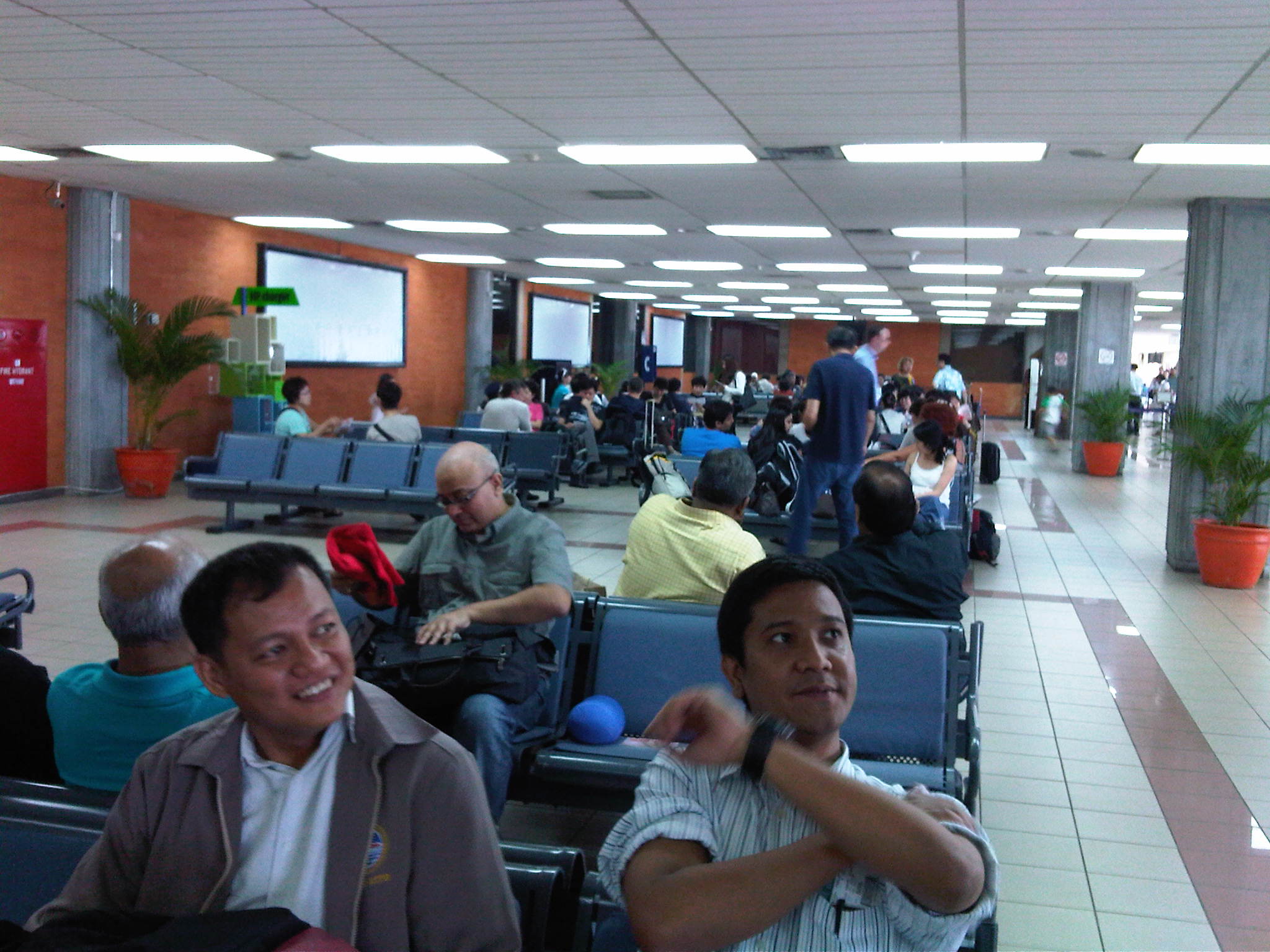 Waiting for the call – fellow passengers waiting for our respective boarding calls
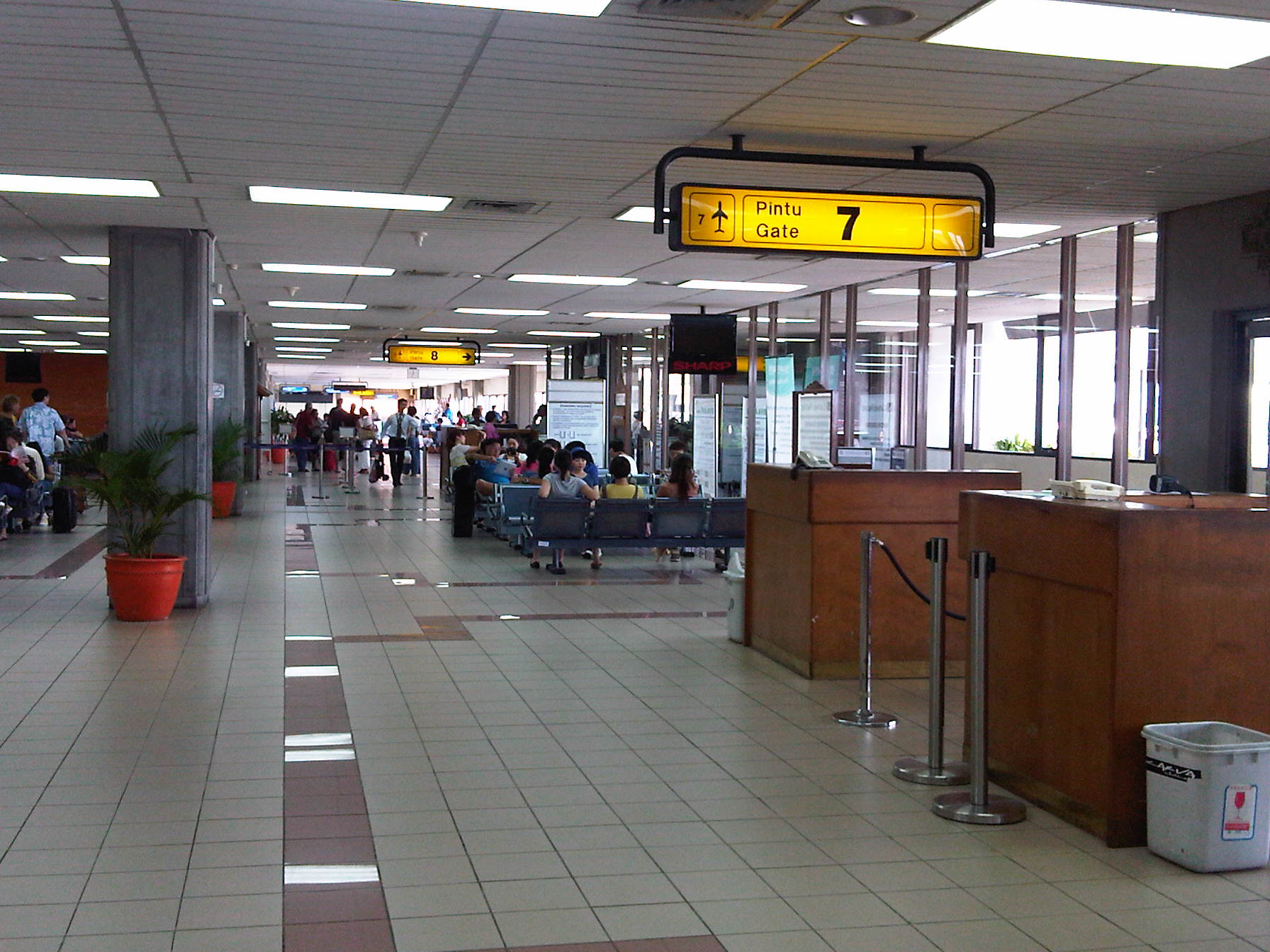 Familiar layout – the layout of the departure lounge including the boarding gates at Bali-Denpasar reminded me of the layout of the old domestic airport in Manila.
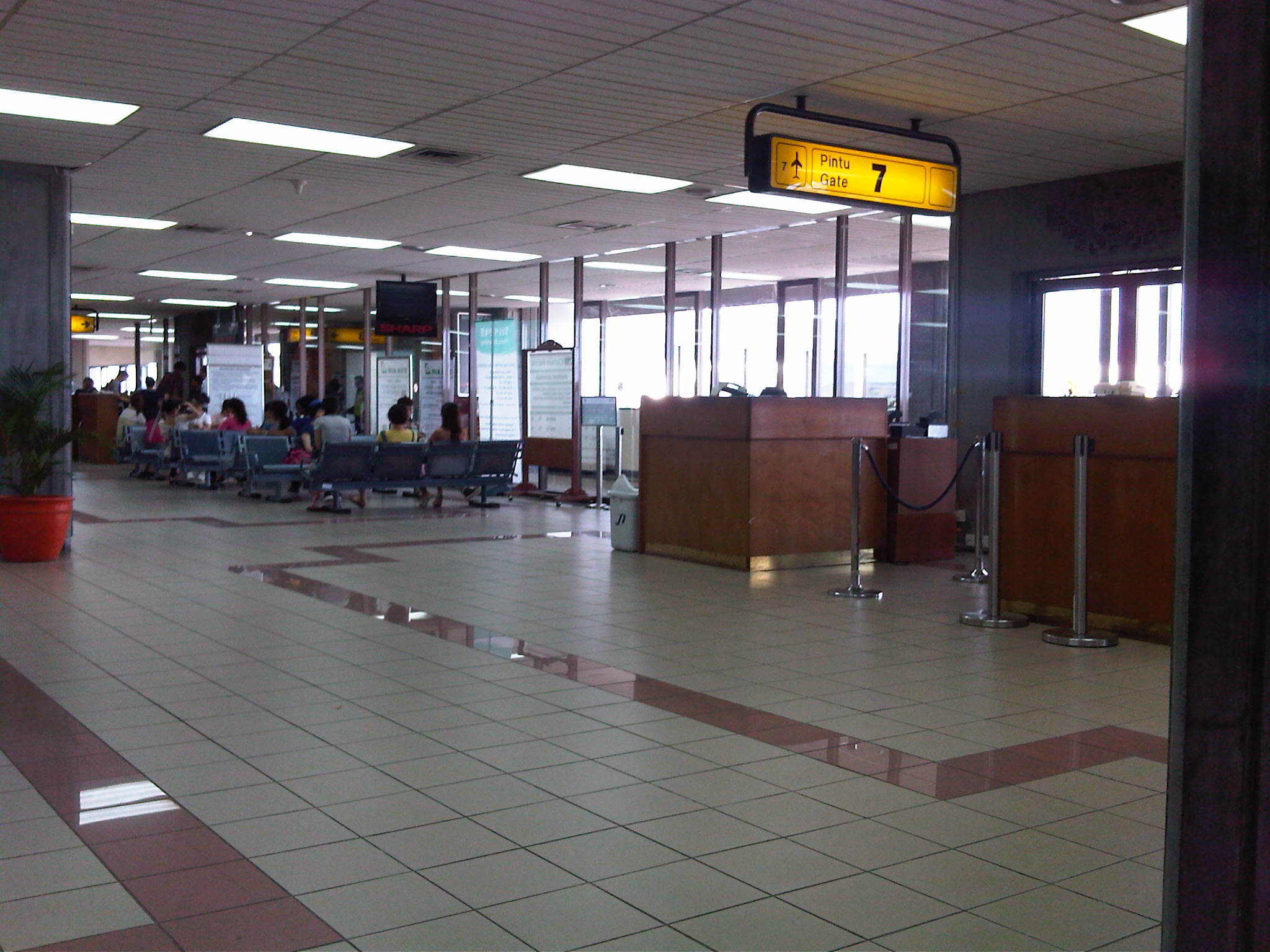 Counters – airline ground staff will eventually arrive to process passengers for boarding
Bali-Denpasar is actually constructing an even larger airport. This is necessary given what seems to be hundreds of thousands of visitors flocking to Bali mostly for recreation. The current terminal is already congested and the wise investment is for a huge modern terminal for this gateway to Indonesia. The determined push for a new terminal is admirable and seems to be what the Philippines lacks for in terms of critical aviation infrastructure that would be able to handle the projected passenger demand should the country want to attract more tourists.
–
Electric vehicle revolution in the Philippines
It started with the deployment of the first electric jeepneys and tricycles about 5 years ago. Today, electric vehicles are the rage in the Philippines with public transport being the main application of the e-vehicles. Makati already has 3 operational e-jeepney routes including the first e-vehicles to be registered and the first franchise for public transport. E-trikes have been operating in Bonifacio Global City in Taguig as well as in limited numbers in Puerto Princesa, Surigao and Boracay. During the 2nd Electric Vehicle Summit held last May 24-25, 2012 at the Meralco grounds, models of various electric vehicles for private and public transport use were on display for people to inspect and appreciate. These included cars, motorcycles, tricycles, jeepneys and a bus. Special mention goes to the Segway booth and its clone, which featured more personalized modes that are not really in the same category as most of the e-vehicles on display.
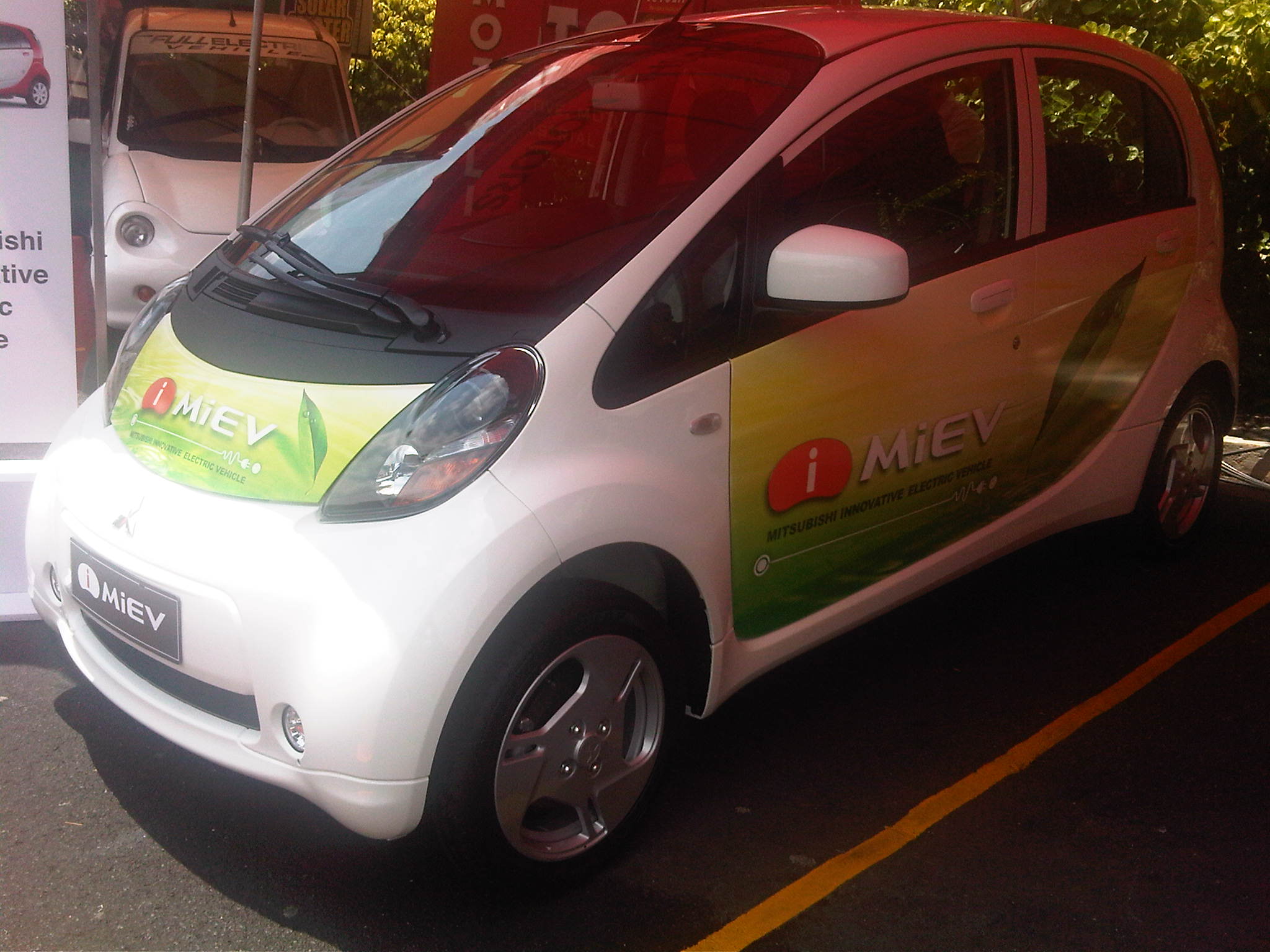 Mitsubishi’s entry in the local market is via the MiEV, a unit of which was donated to the Department of Energy (DOE)
 The REVAi is a small car produced by an Indian company. The logo on the car is of the leading battery company in the country.
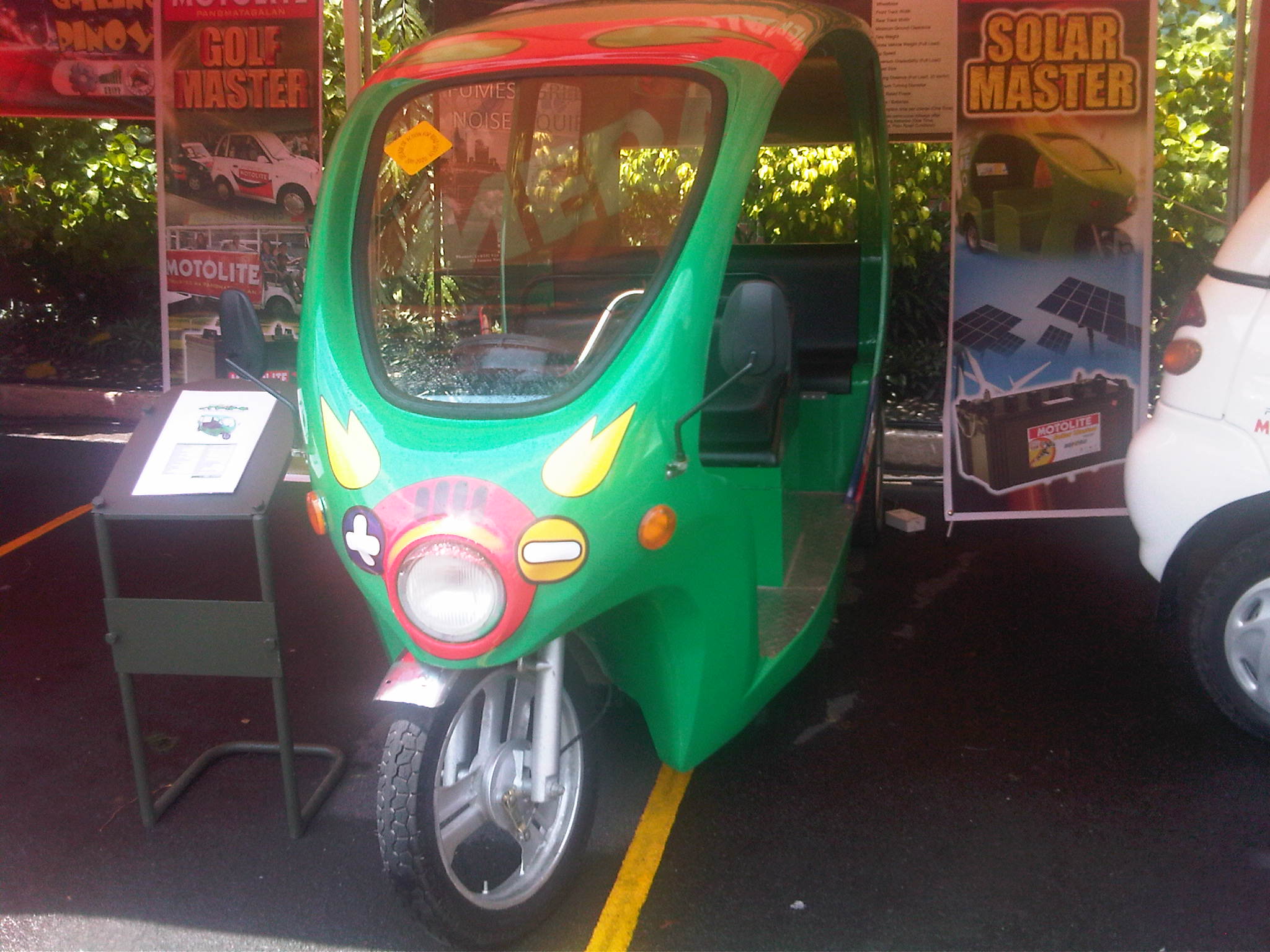 A locally assembled electric tricycle that is now popular in tourist areas like resorts.
 The 4-wheeled e-vehicle dubbed as the E-quad that is locally assembled.
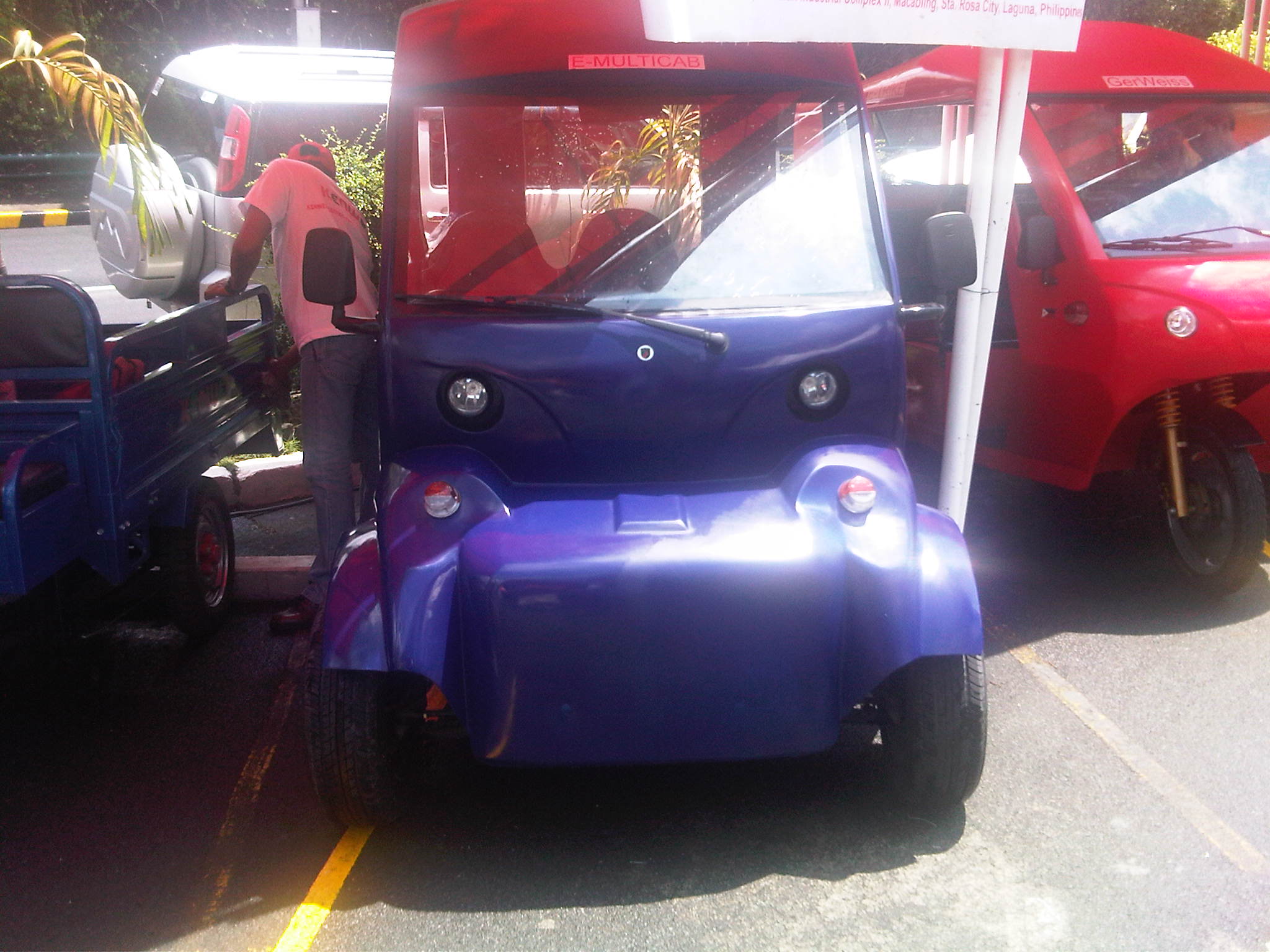 Variants of 3- and 4-wheeled e-vehicles including one (visible on the left) that is designed as a pick-up or delivery vehicle. All are made by local companies.
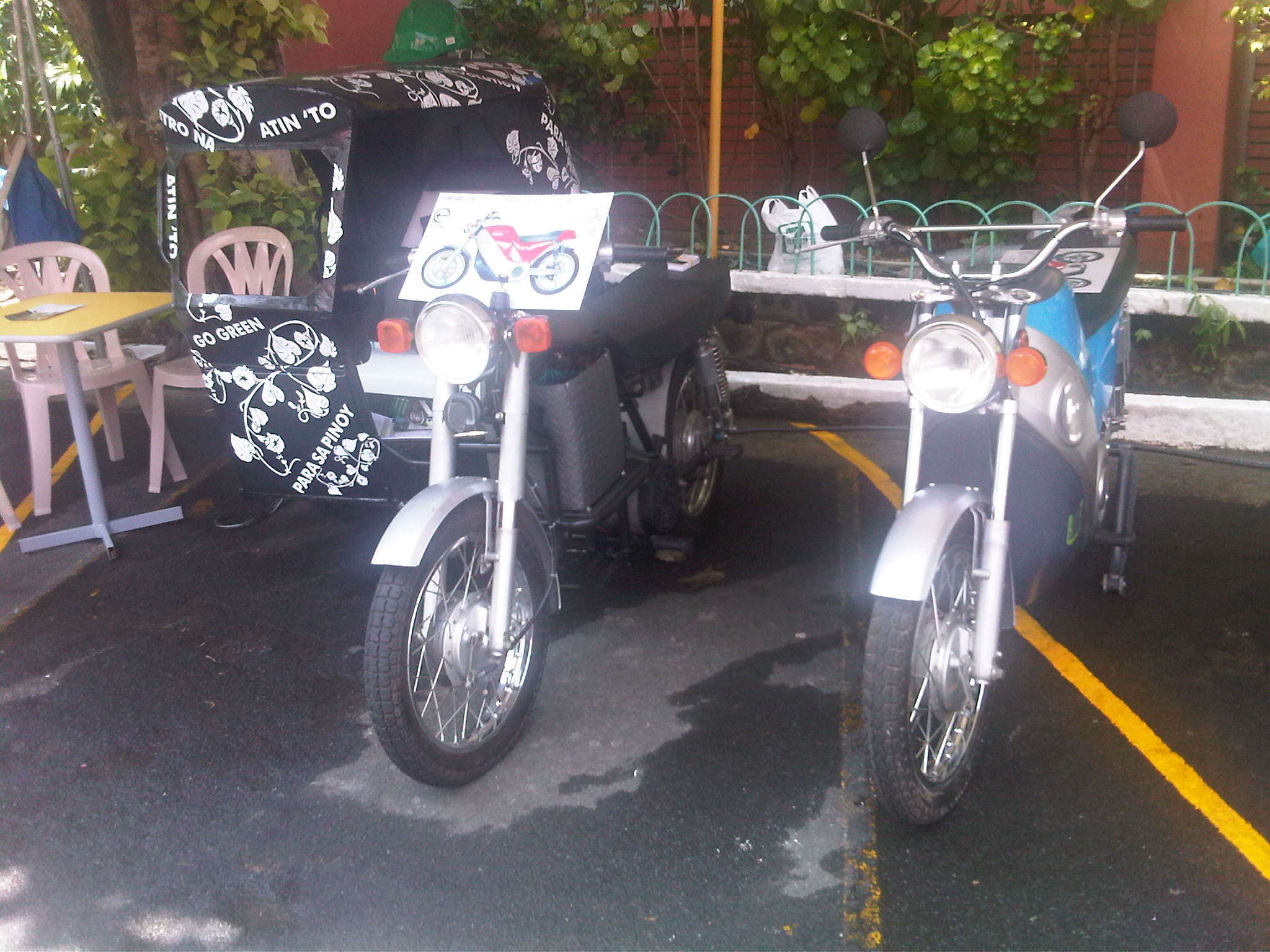 Electric motorcycles with one having a sidecar, which is the same form of the traditional tricycles that are the dominant public transport mode in local roads, many small cities and rural areas in the country.
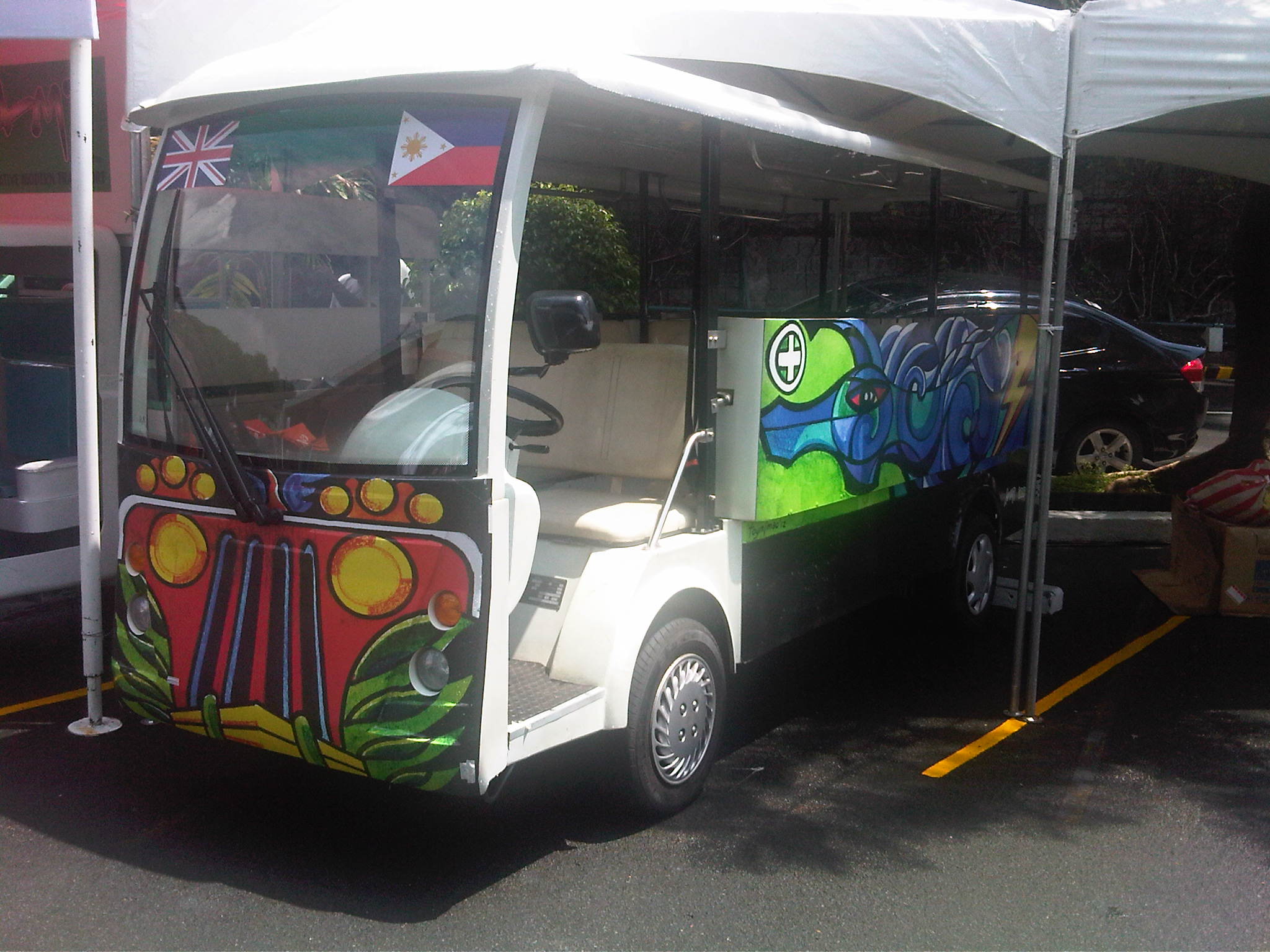 The electric jeepney that is also locally assembled with the motor and controller the only major components that are imported. I think this model is the latest one and has a more powerful motor that allows the vehicle to negotiate steeper slopes. Other models are currently operating in Makati City (CBD) and as shuttles in shopping mall complexes and industrial areas.
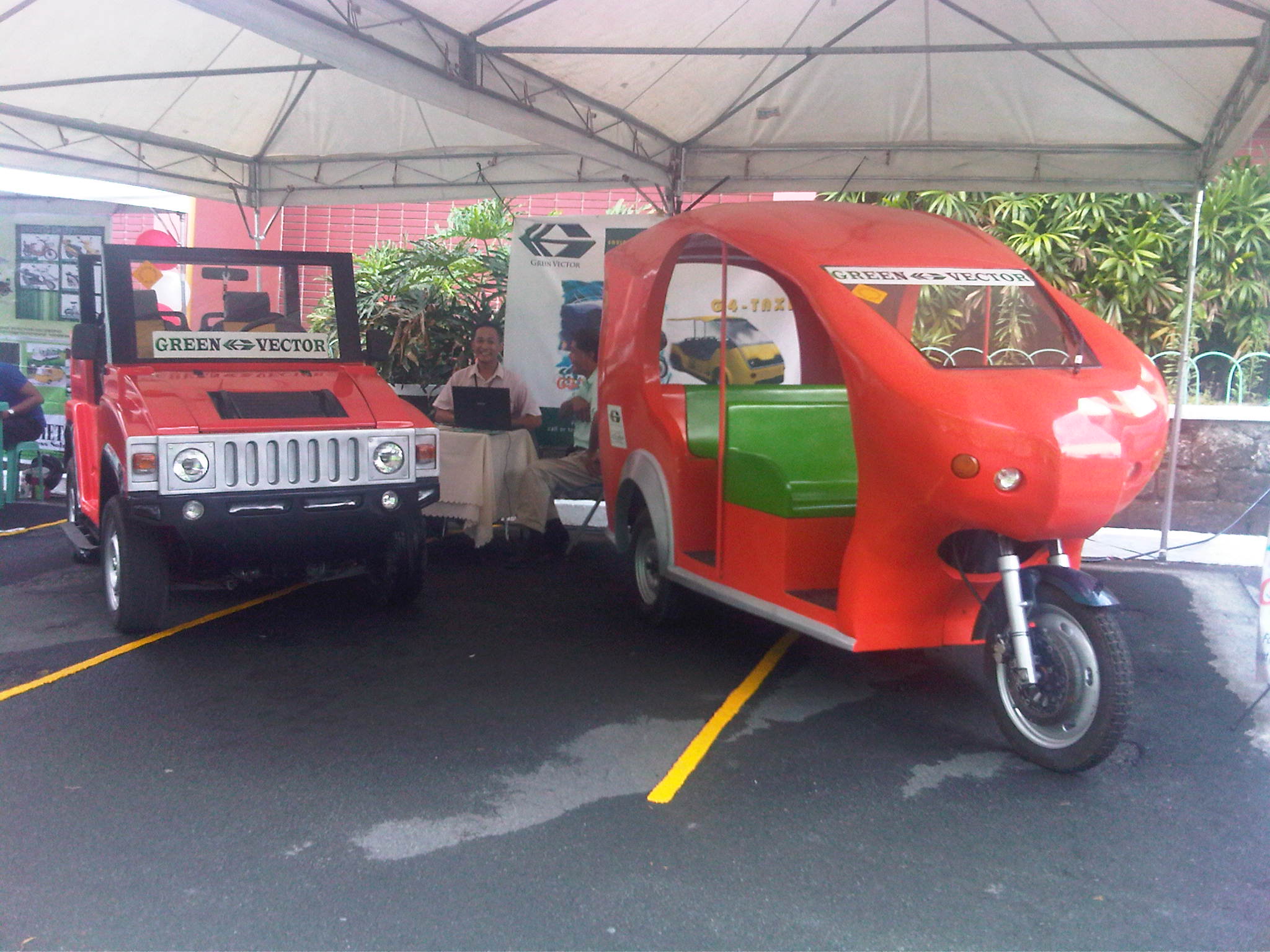 Another e-trike with form similar to the Thai tuktuks and another, a 4-wheeler, made to look like the popular Hummer vehicles.
 Electric scooters on display outside the summit venue
 The electric bus imported by a company affiliated with Victory Liner, one of the largest provincial bus companies in the Philippines was a popular attraction during the summit.
There are still many issues pertaining to the deployment or operations of e-vehicles in the Philippines. Among the more important ones involve costs and the need for infrastructure such as charging stations to support e-vehicles. Unlike the experiences in other countries, especially in Europe, the e-vehicle initiatives in the Philippines are mainly for public transport rather than for private use. In fact, the DOE’s E-trike project together with the ADB looks to the deployment of 100,000 e-trikes to replace traditional tricycles around the country. This seems to be a small initiative considering Metro Manila alone has about 250,000 legally operating tricycles (there are quite many illegally operating units) and an estimated more than 1.5 million legal units around the country. But such initiatives if carried out and evaluated scientifically, systematically and objectively will surely go a long way to addressing transport problems in this country. The Makati e-jeepneys already provide a good model for replication elsewhere and soon, more studies will be underway to evaluate such vehicles in comparison with the traditional jeepneys and the emerging Auto-LPG variant. With an impending law that will provide incentives for electric, hybrid and other alternative-powered vehicles, e-vehicles will be here to stay and perhaps effect a transformation of Philippine transport.
–
Romulo Highway: San Clemente – Lingayen
Romulo Highway originates from Tarlac City and passes through the towns of Sta. Ignacia, Camiling and San Clemente in Tarlac, and then the towns of Mangatarem, Aguilar, Bugallon and in Pangasinan. It ends at Lingayen, Pangasinan, in essence connecting the capitols of two major provinces in Central Luzon (Region 3/Tarlac) and the Ilocos (Region 1/Pangasinan).
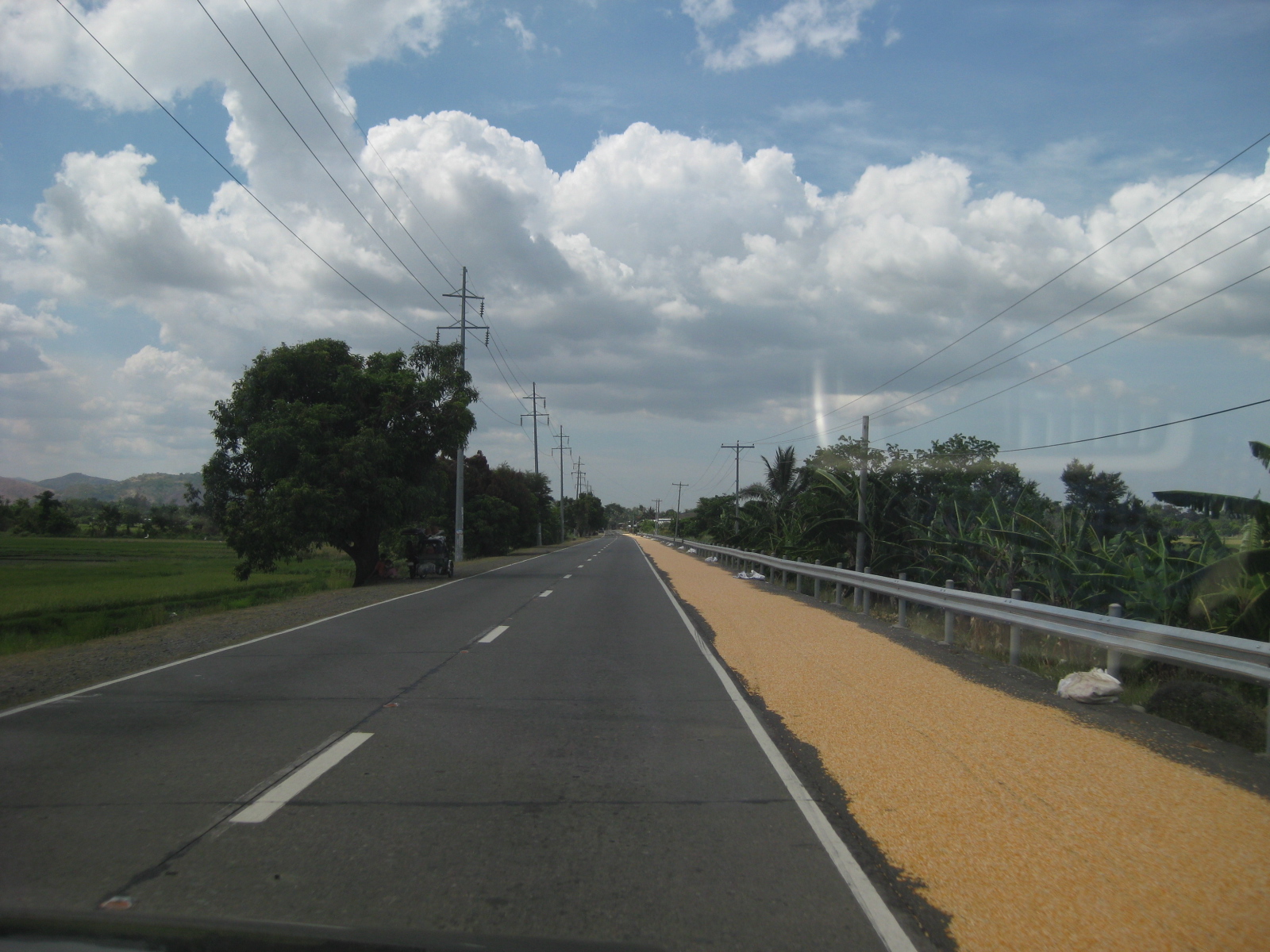 Solar dryers – a common sight along Philippine highways is palay spread out along the shoulders to dry naturally under the sun
 Good condition – pavements along sections of the Romulo Highway between San Clemente and Lingayen are generally well-maintained
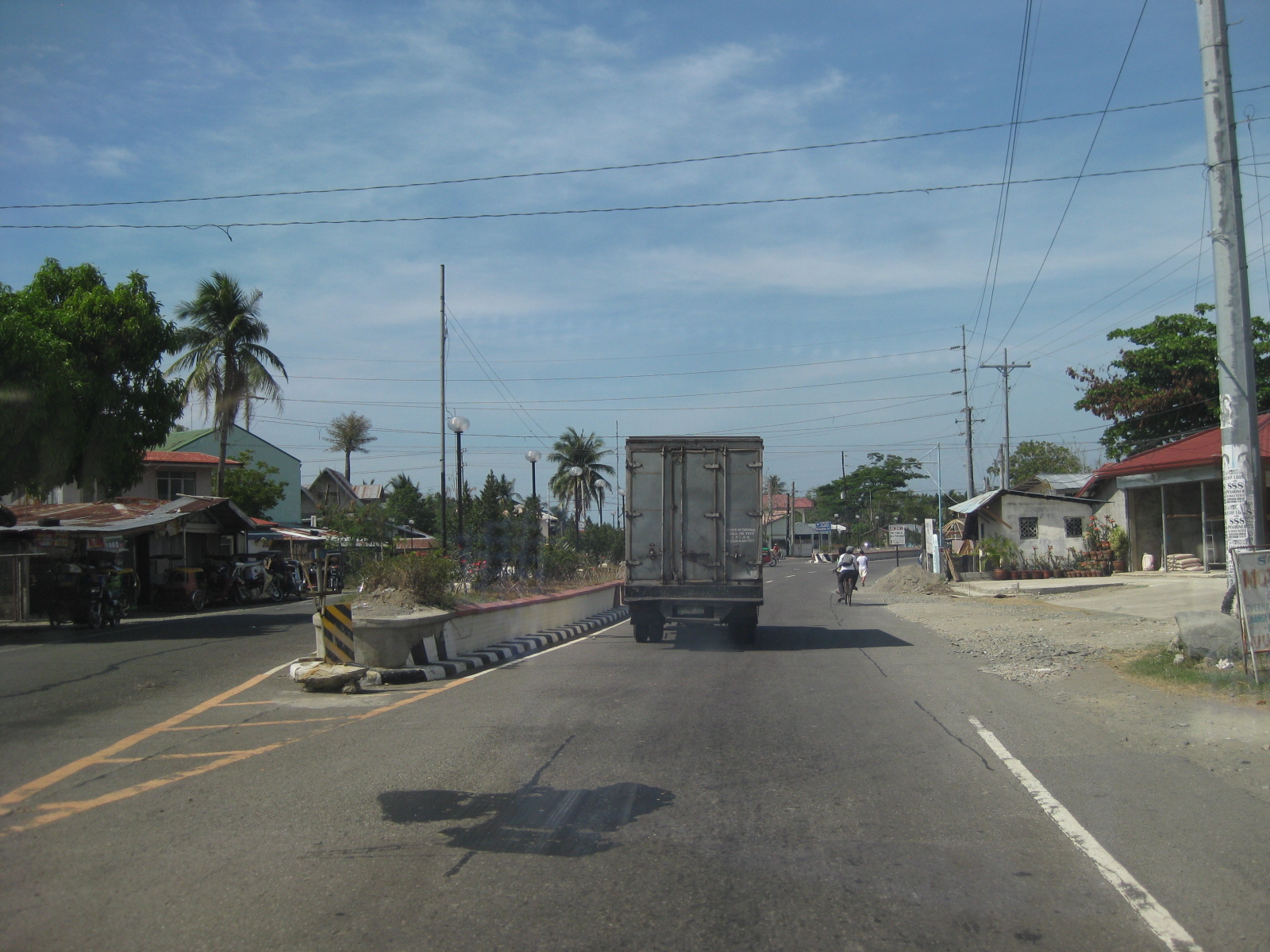 Approach to intersection – the island is part of the channelization at the junction to physically separate vehicles approaching the junction.
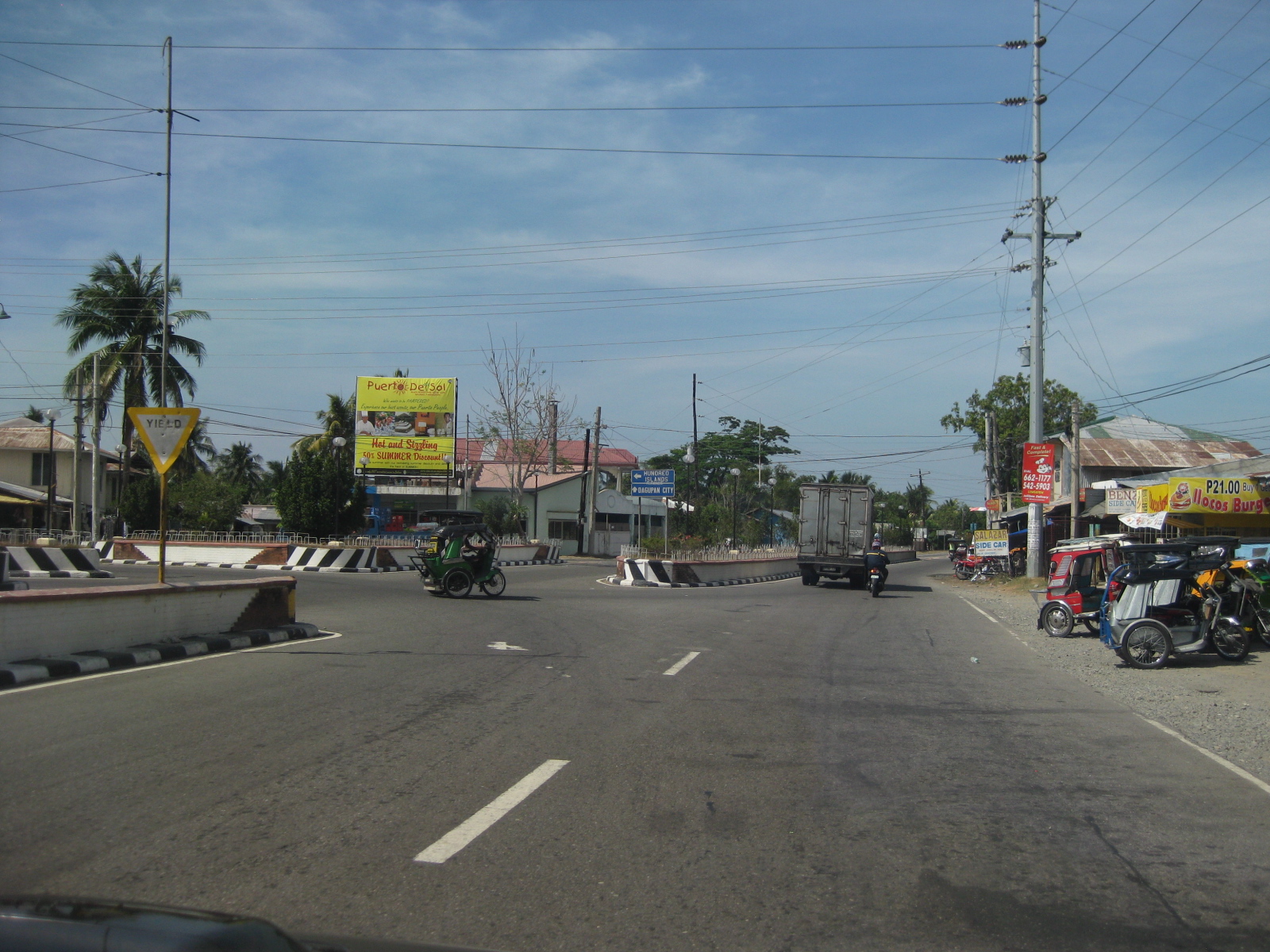 Channelization – the islands along with directional signs help guide motorists at the junction.
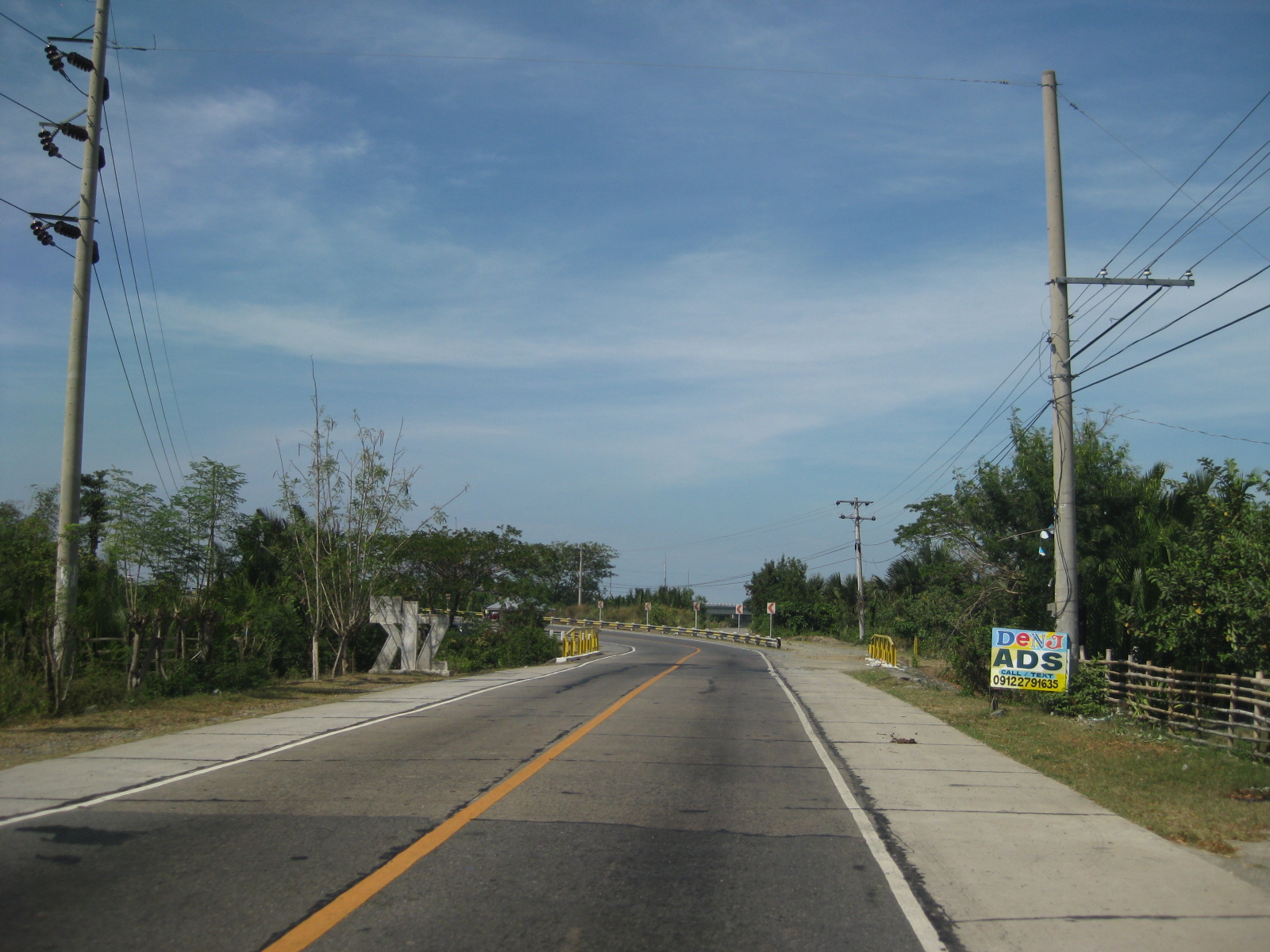 Approaching a curve – this section can be a little tricky with a climb towards a horizontal curve.
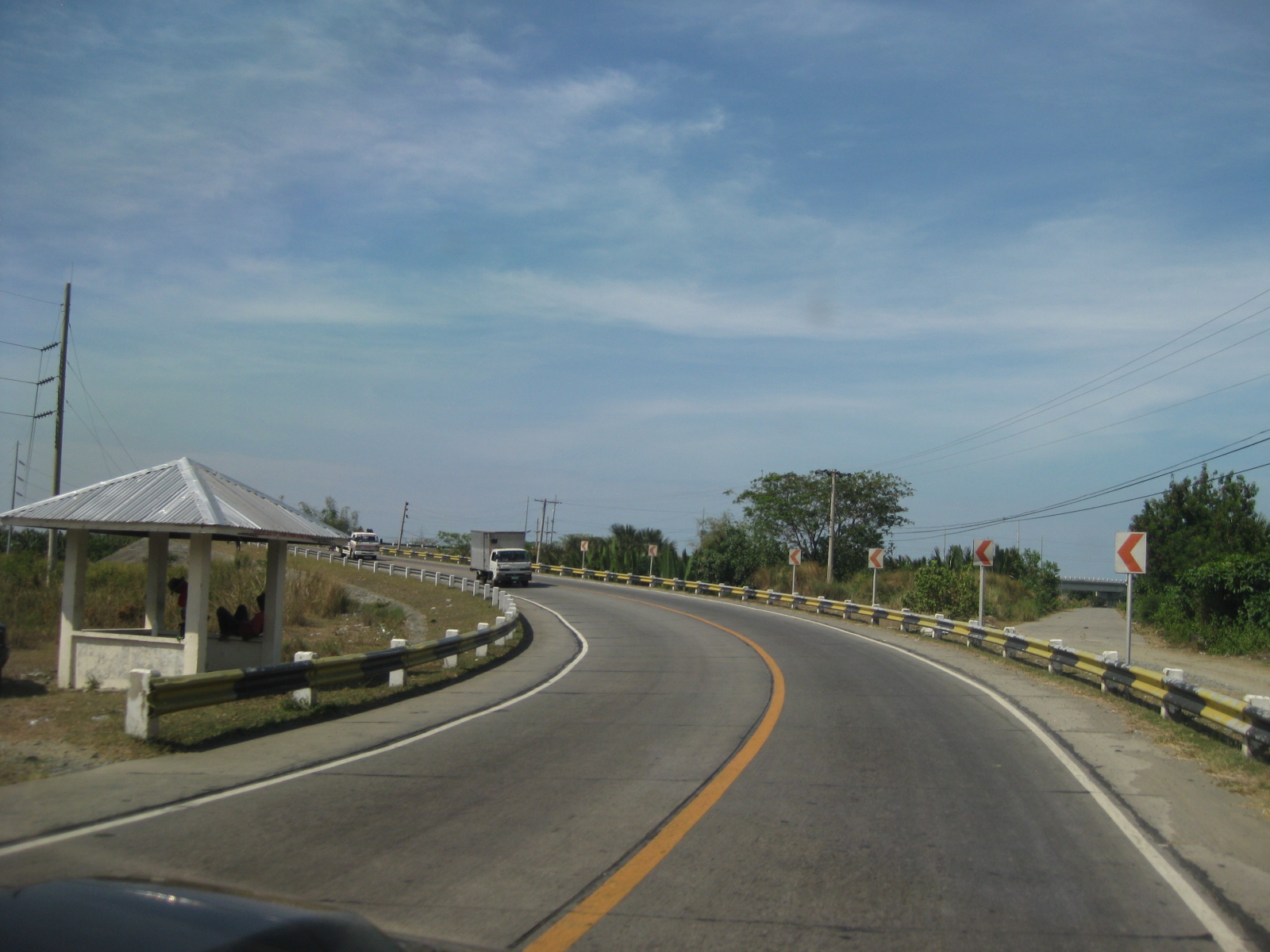 Sharp curve – the curve is sharp enough to necessitate the installation of chevrons. This is combined with a climb or descent.
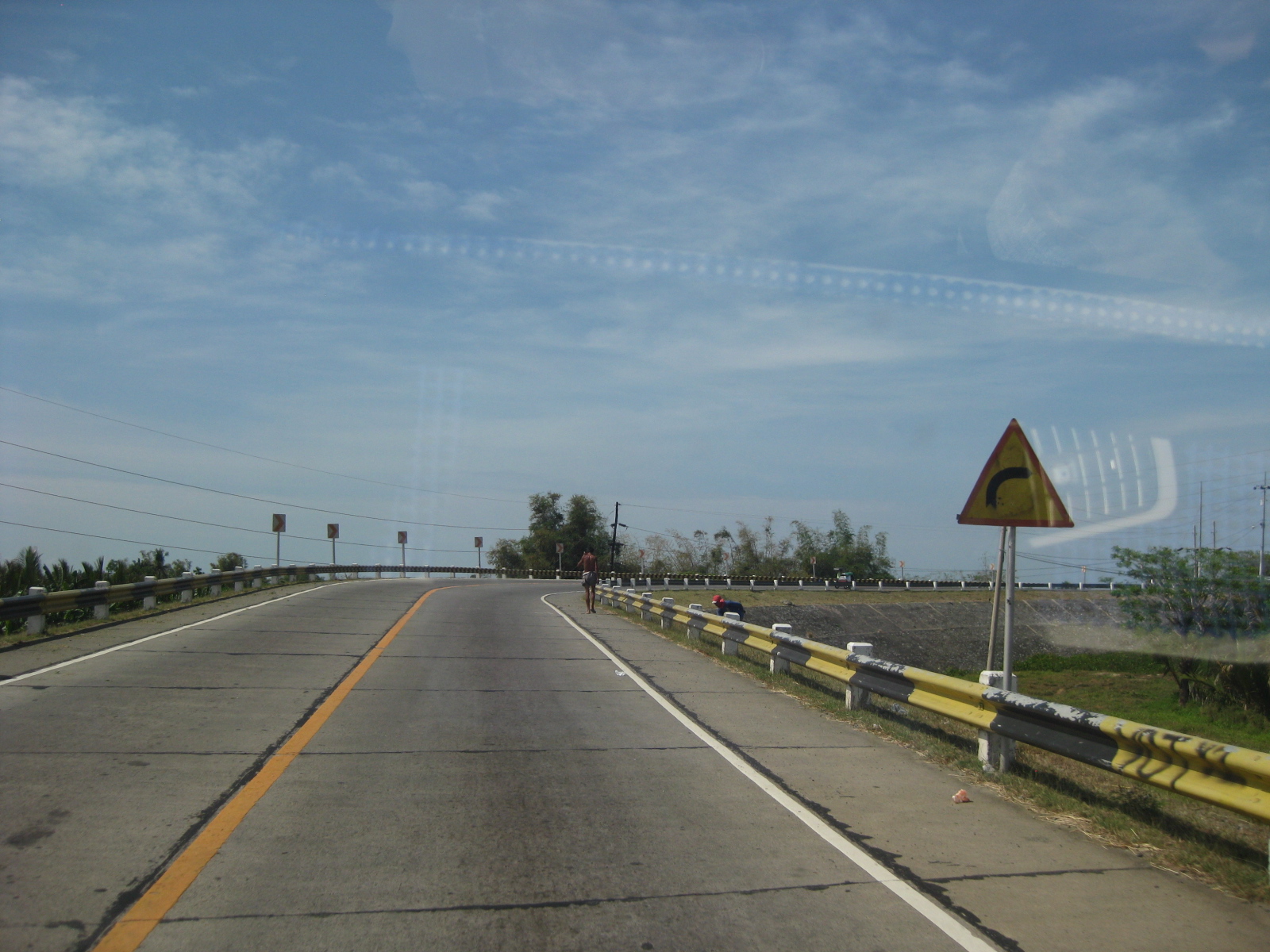 Reverse – it turns out that this section is actually a reverse curve, which increases the complexity of the section for drivers and riders.
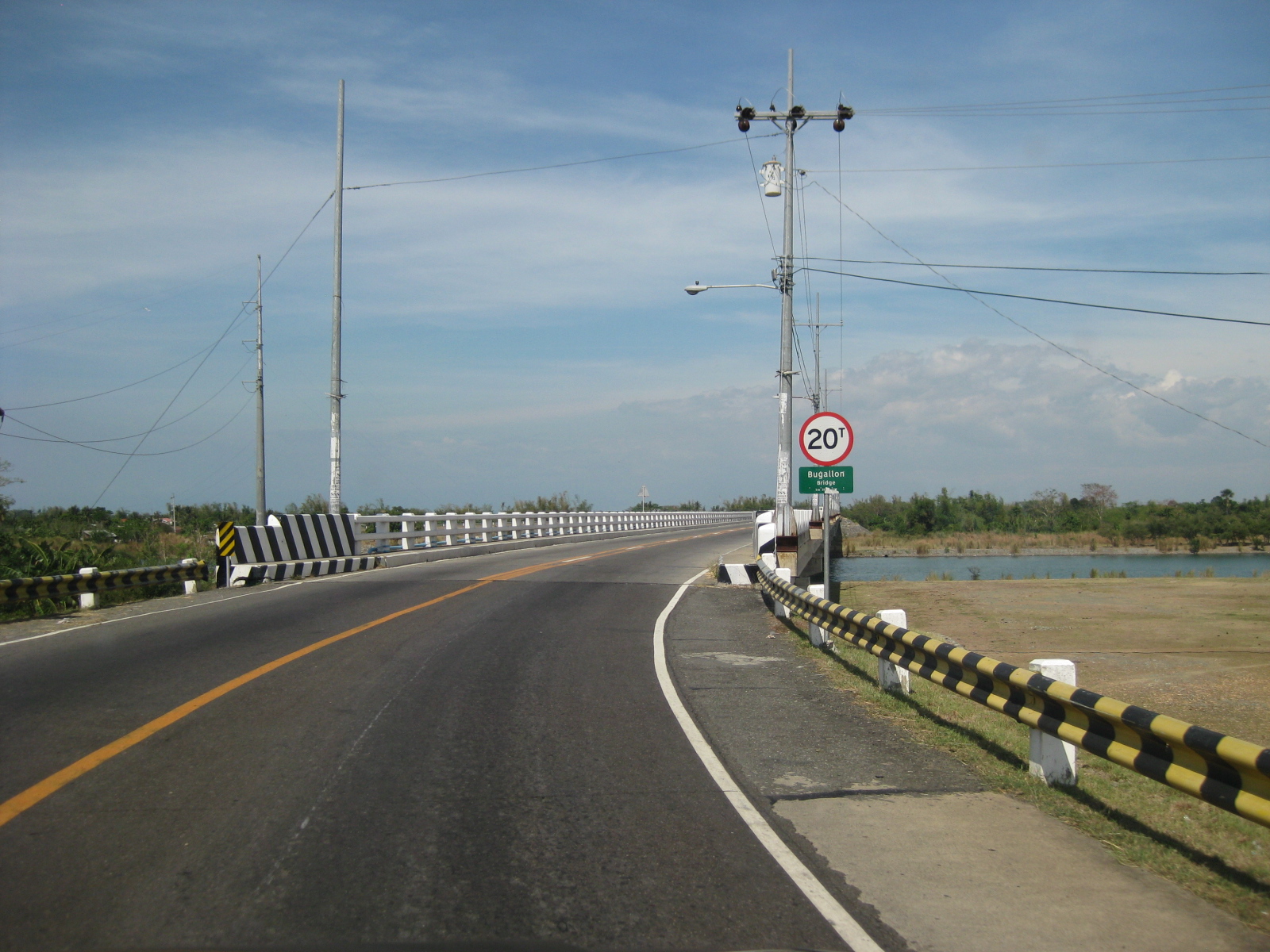 Transition to a bridge – the reverse curve leads travelers to the Bugallon Bridge across the Agno River (direction towards Lingayen). Note the 20-ton limit of the bridge indicating that it is a relatively new bridge applying the DPWH standards for load limits.
 Bugallon Bridge – is typical concrete bridge structure without an arch. Barriers are concrete and should be able to withstand collisions with most type of vehicles.
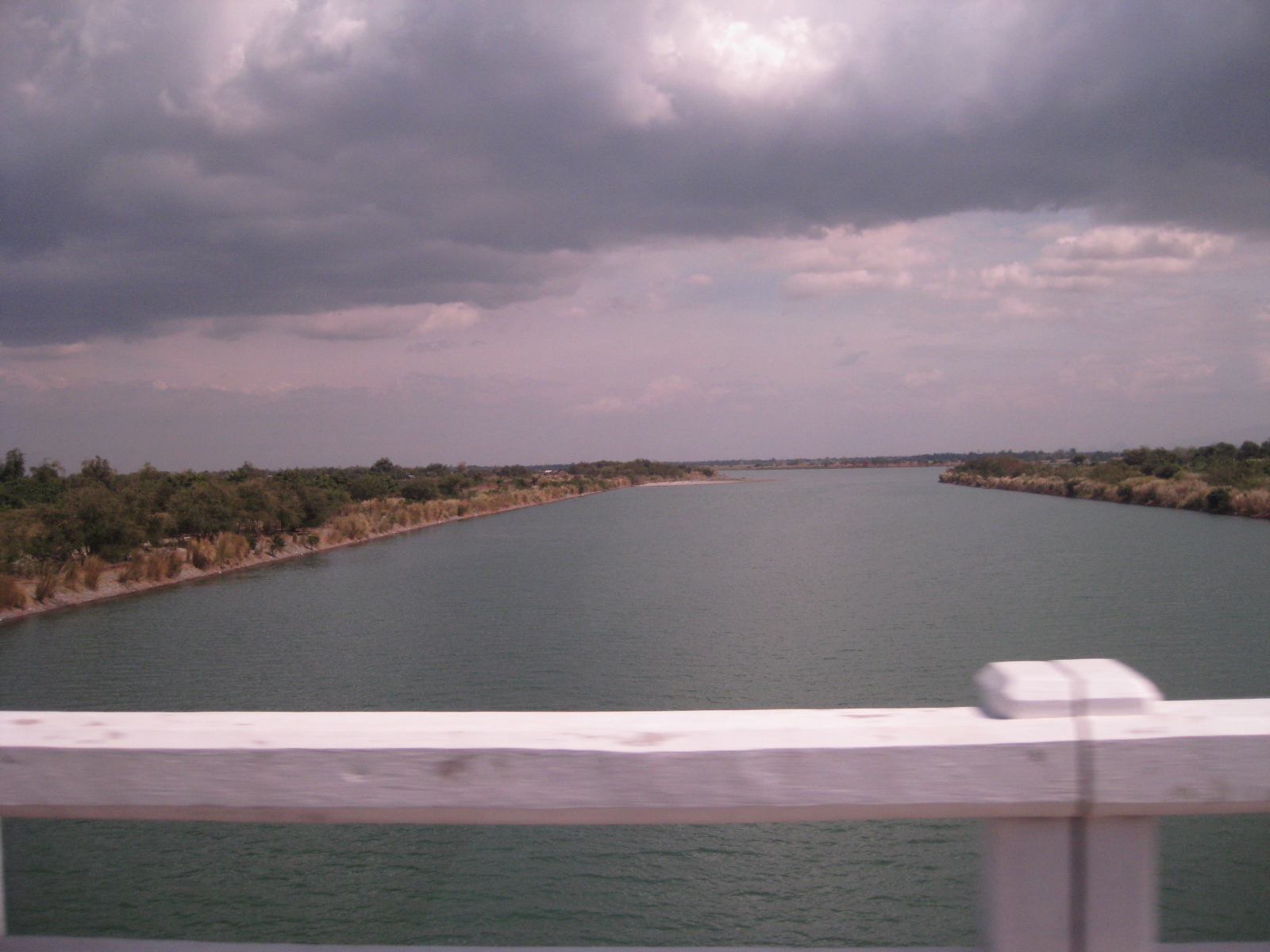 Agno River – is part of one of the larger river systems in Luzon Island and the country. The river becomes the Tarlac River when it branches out to Tarlac Province.
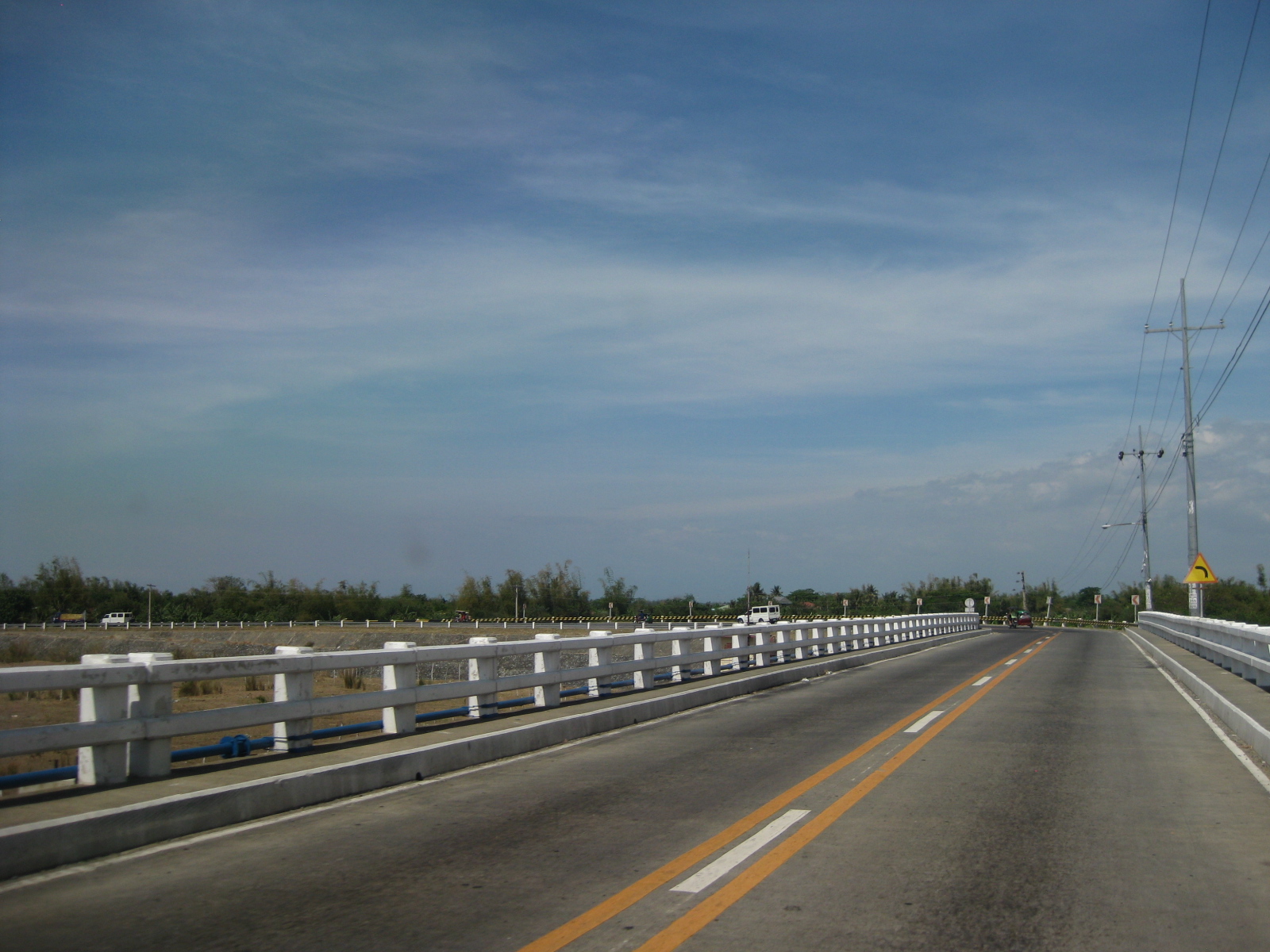 Bugallon Bridge – continuation of the long bridge terminating at an embankment that leads to another bridge towards Lingayen.
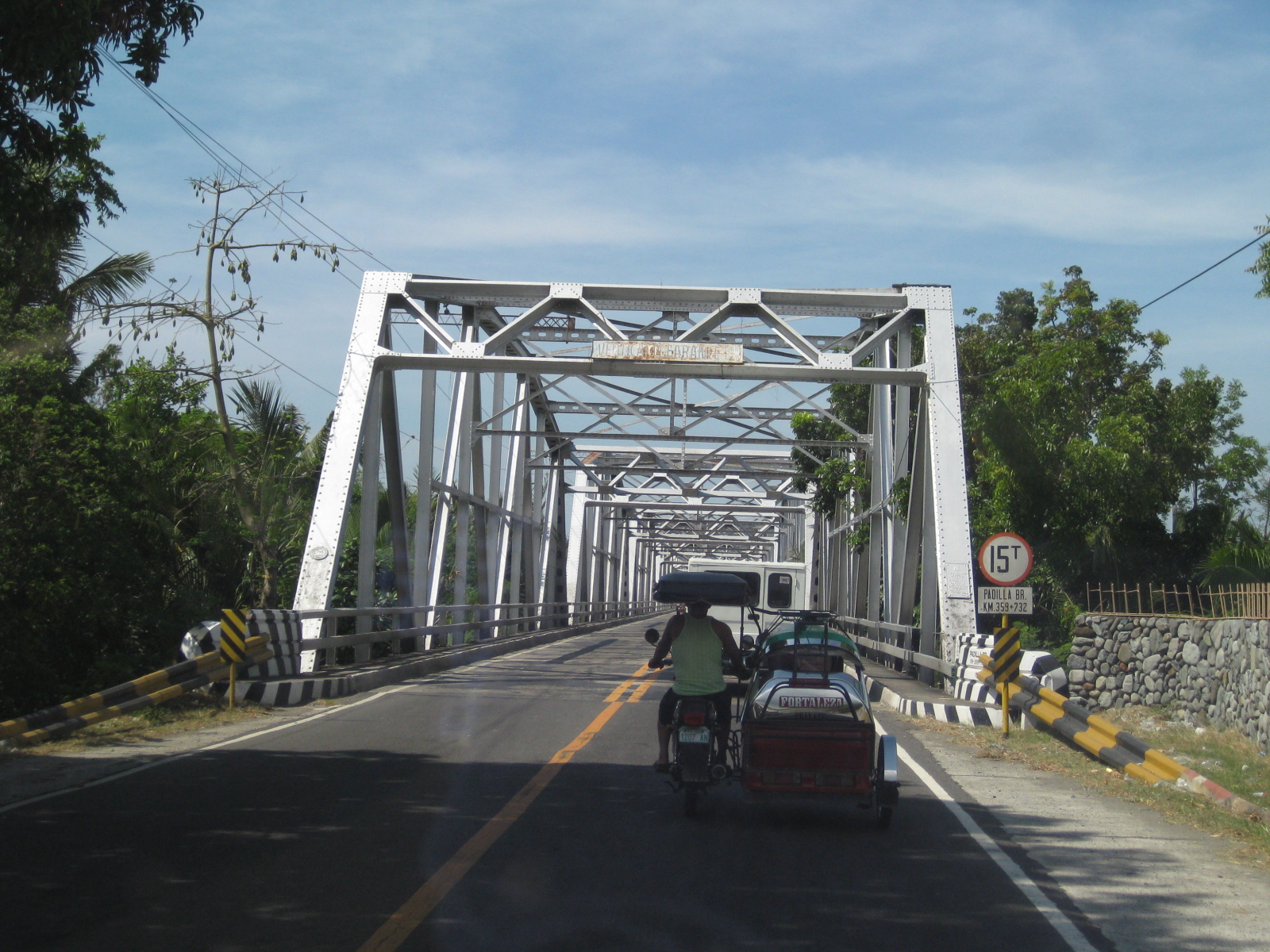 Padilla Bridge – is a steel truss bridge that is older than the Bugallon Bridge not only based on the form (many old bridges along national highways are steel truss bridges) but also on the load limit of 15 tons. The lane widths are also narrower than that of the Bugallon Bridge.
 Padilla Bridge – is longer than the Bugallon Bridge as it crosses a wider branch of the Agno River system.
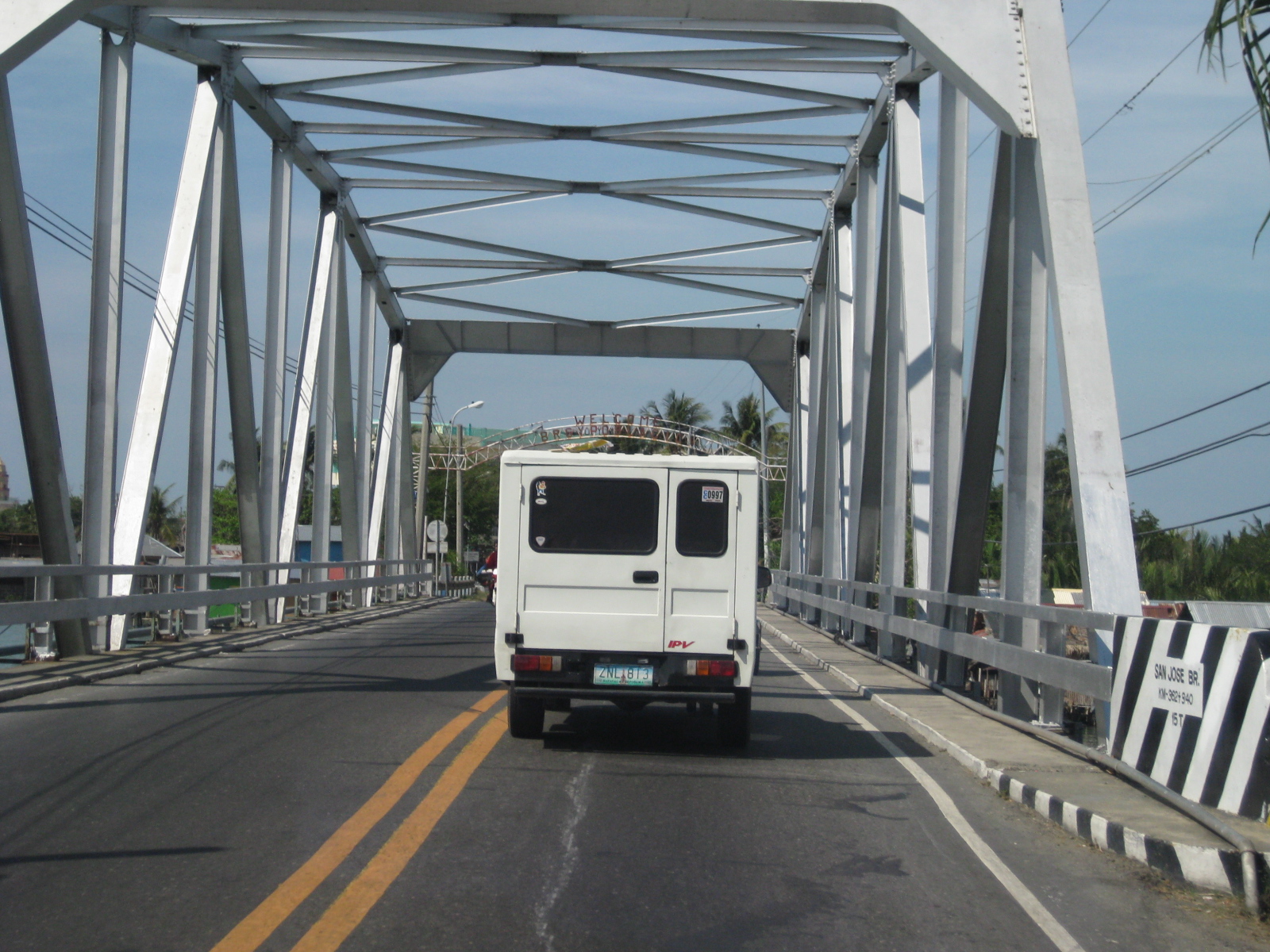 San Jose Bridge – viewed towards Lingayen from Bugallon is a relatively short steel truss bridge.
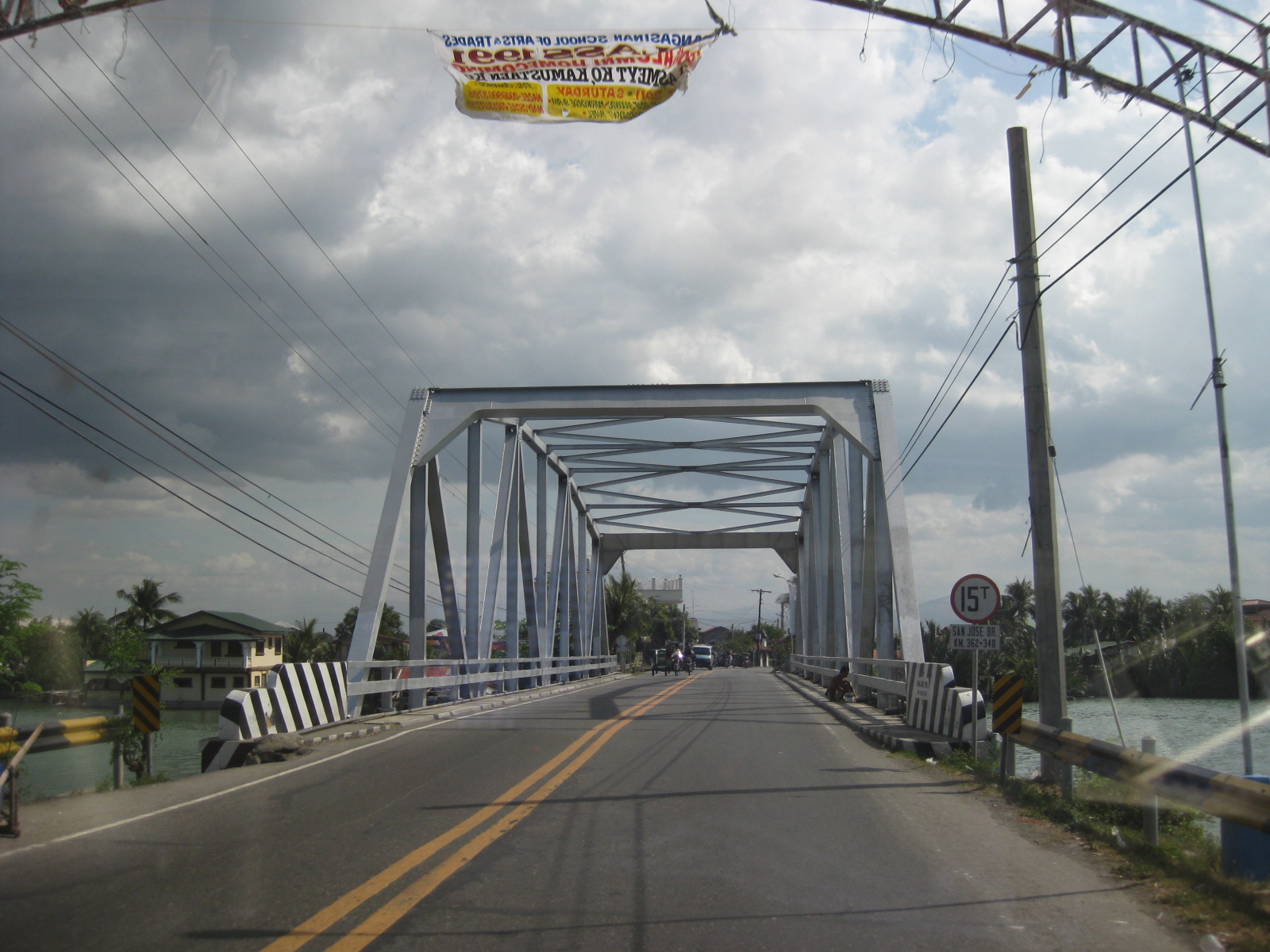 San Jose Bridge – view towards Bugallon from Lingayen is probably the same age as the Padilla Bridge. This bridge also has a 15-ton load limit.
 Crossroads – vehicles turning to the left will be headed back towards Tarlac through Bugallon and Mangatarem. Going straight will take the traveler to the towns of Labrador, Sual and the general direction of Alaminos and Bolinao. The SUV on the left is headed for Lingayen and Dagupan.
 Provincial boundary – a simple arch marks the boundary between Pangasinan and Tarlac. A little further downstream is another arch formalizing the boundary for the Municipality of San Clemente in Tarlac.
 First town after the border – San Clemente is the first Tarlac town along the Romulo Highway upon crossing from Mangatarem, Pangasinan.
–
Olongapo-Castillejos Road: Castillejos
The name of the town Castillejos translates to “little castle.” Such names are part of our Spanish or Castillan legacy, being under Spain for more than 300 years until 1898. Following are photos showing segments of the Olongapo-Castillejos Road within the Municipality of Castillejos.
 Double yellow – the twin solid lines emphasize the “no overtaking” rule for both directions of flow. Often disregarded in the Philippines, crossing over a double yellow will result in an apprehension and a ticket when driving in the US or Canada.
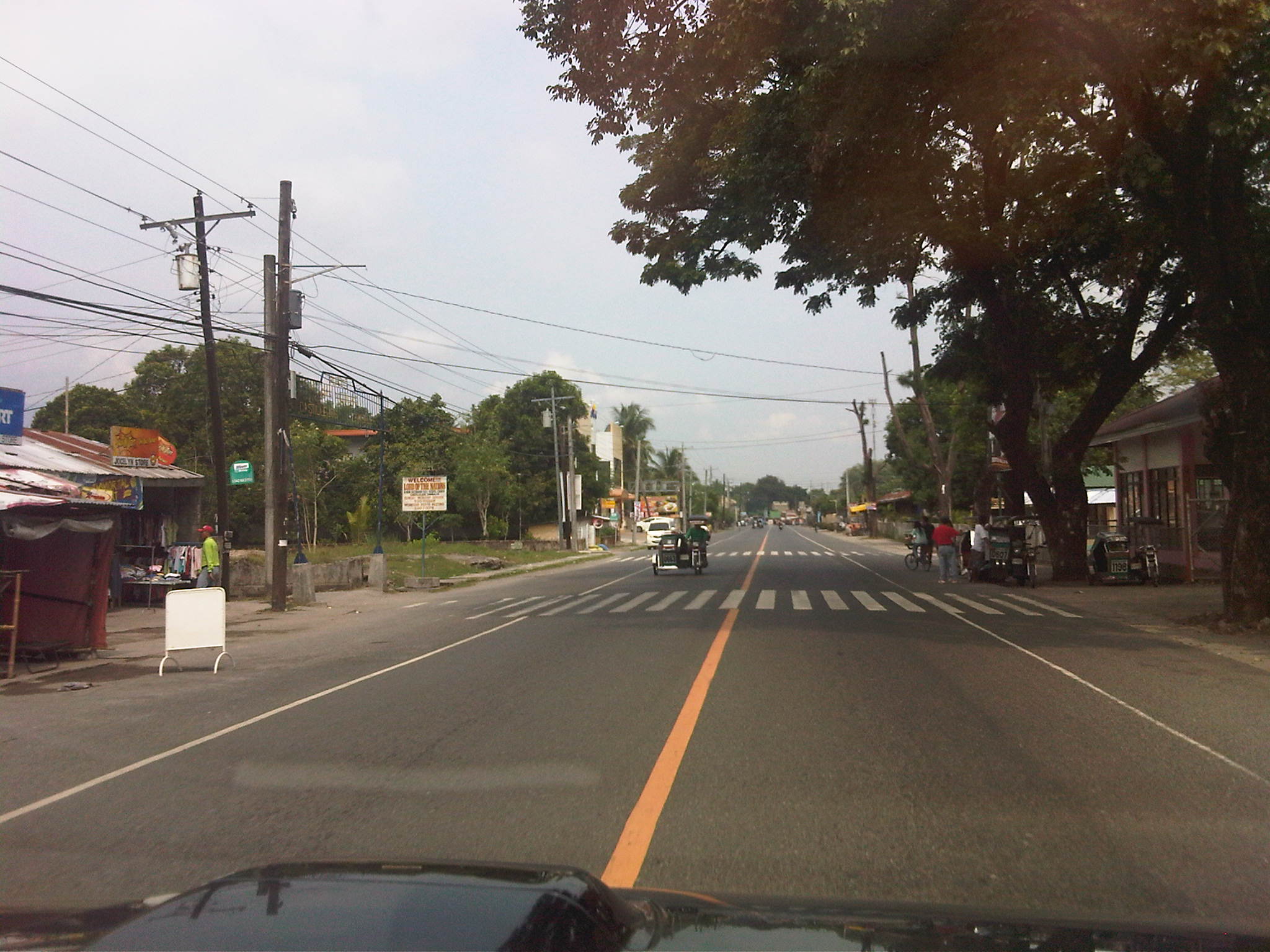 Single yellow on a straight section? – the single yellow line also means “no overtaking”
 Obstacle course – among the things people should expect or anticipate when traveling along Philippine roads are various checkpoints that tend to slow down traffic. Some are operated by the PNP or the Army as part of their security measures. There are also those by the DENR to check the transport of restricted items such as logs, corals, exotic animals, etc. Also, there are those set-up to slow down traffic due to the presence of schools or pedestrian crossings like the one shown in the photo.
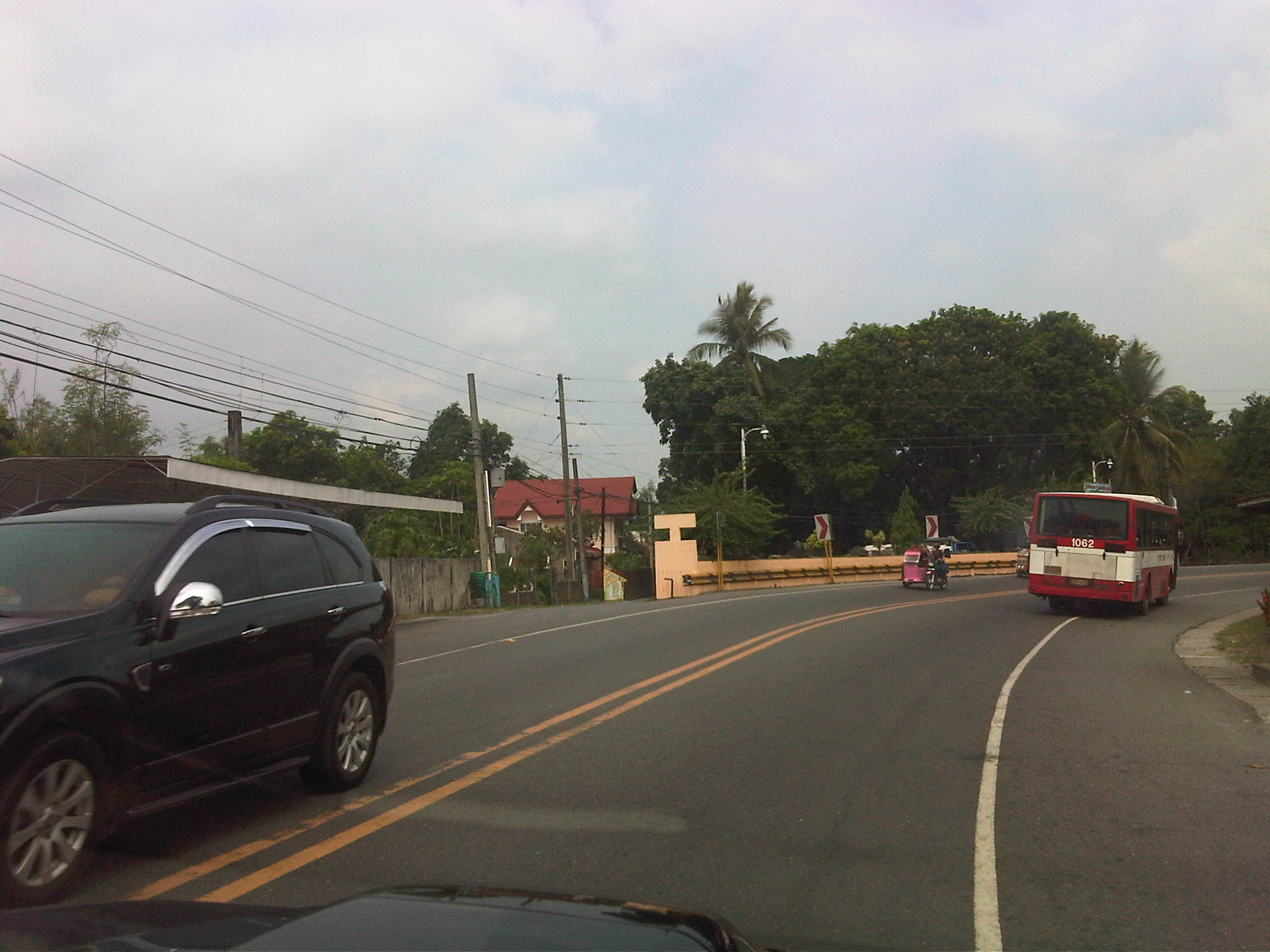 Turning – typical curve along the highway with the paved shoulders allowing for more maneuver space and improving sight distance
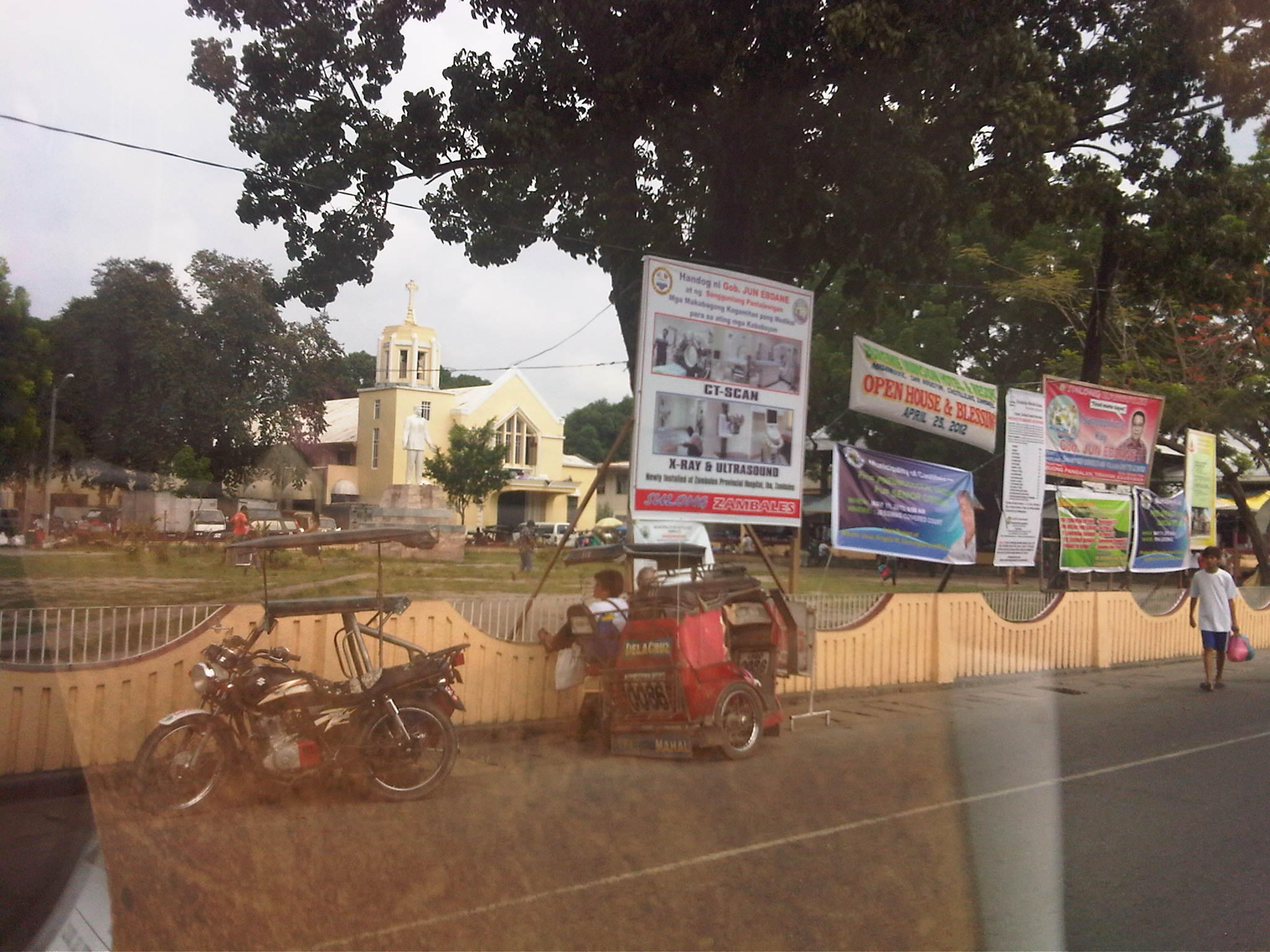 Town center – the poblacion or center of Castillejos is typical of most if not all old towns in the country with the Municipal Hall, Parish Church, local school and market are located together, and usually around or near a plaza.
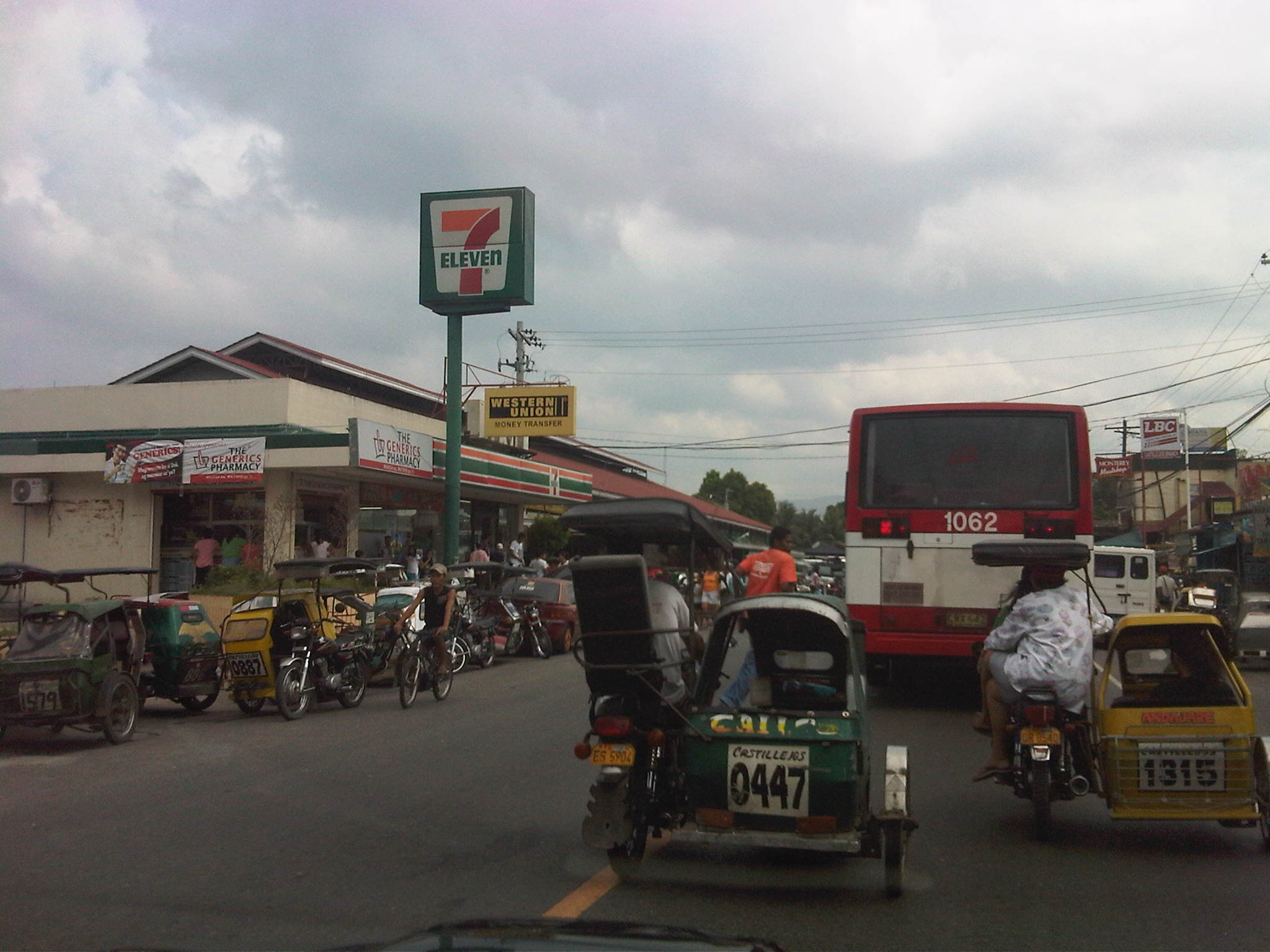 Tricycles galore – three-wheeled taxis everywhere around the market area. The location of the market along the national highway means local traffic during market days will surely impeded traffic flow.
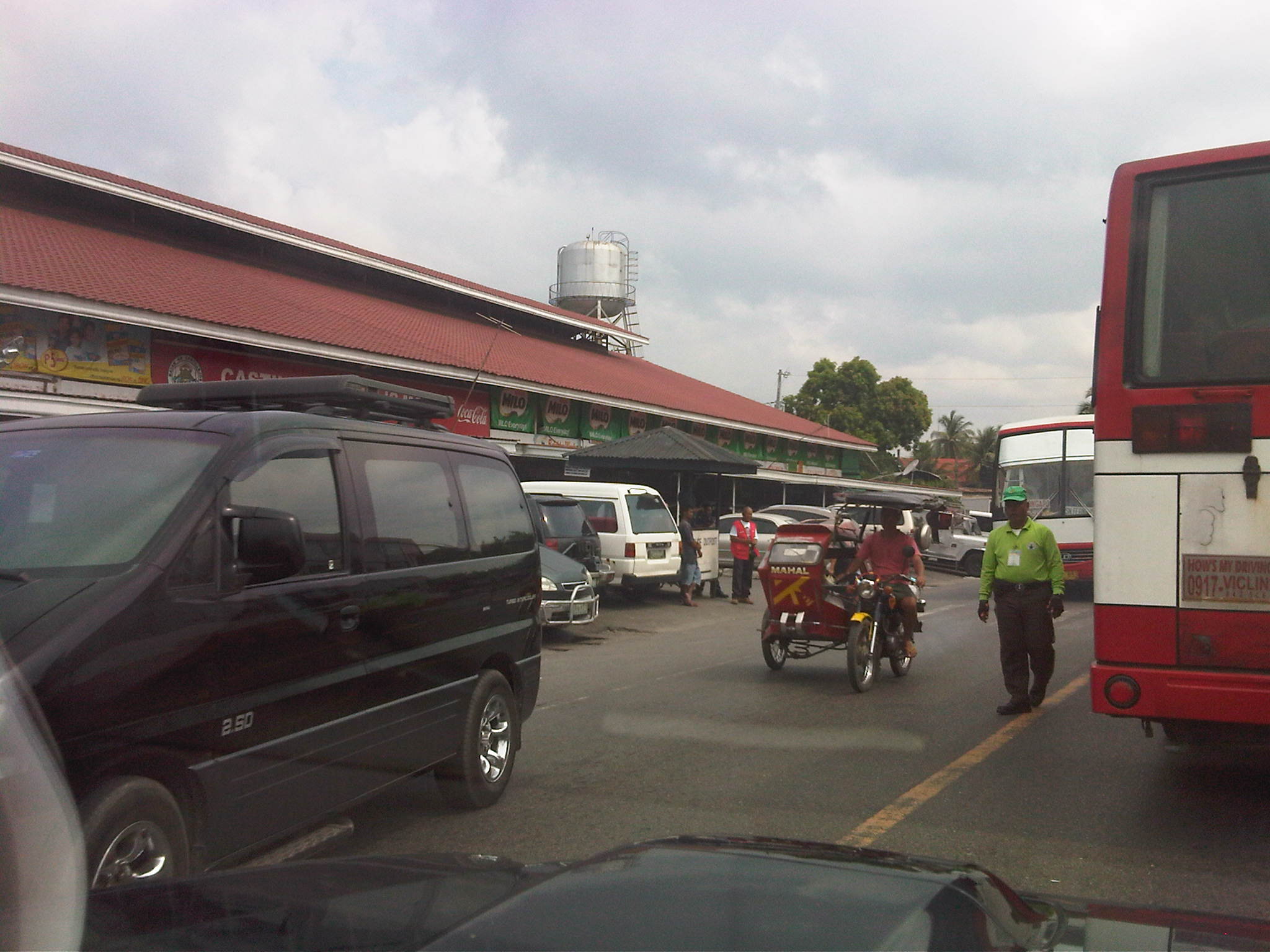 Marketplace traffic – it is common for travelers to encounter congestion due to the presence of a town’s market along national roads. There are enforcers like the one in green in the photo but they are usually helpless and reduced to managing for the maneuvers of parked vehicles or helping people to cross the road.
 Opposite congestion – after passing the market area, we were relieved that we could proceed with much less congestion. Traffic along the other direction would have to contend with the congestion.
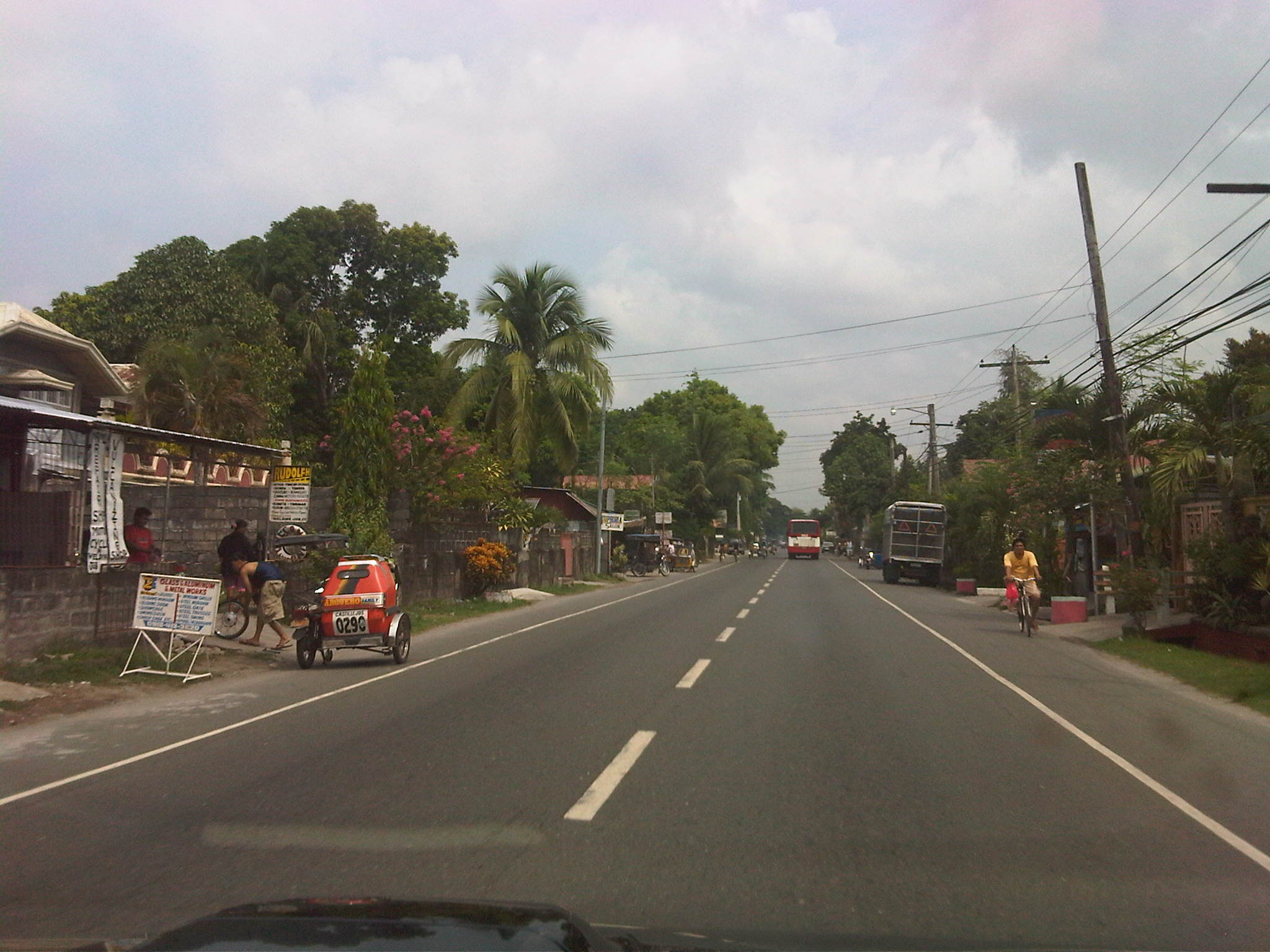 Usable shoulders – we were pleased to see that the shoulders were paved and in excellent condition. Such cases allow for walking and cycling off the carriageway such as the example shown by the cyclist on the right. Tricycles would also be able to pull to the side to avoid impeding general traffic. A concern though would always be parked vehicles on the shoulders.
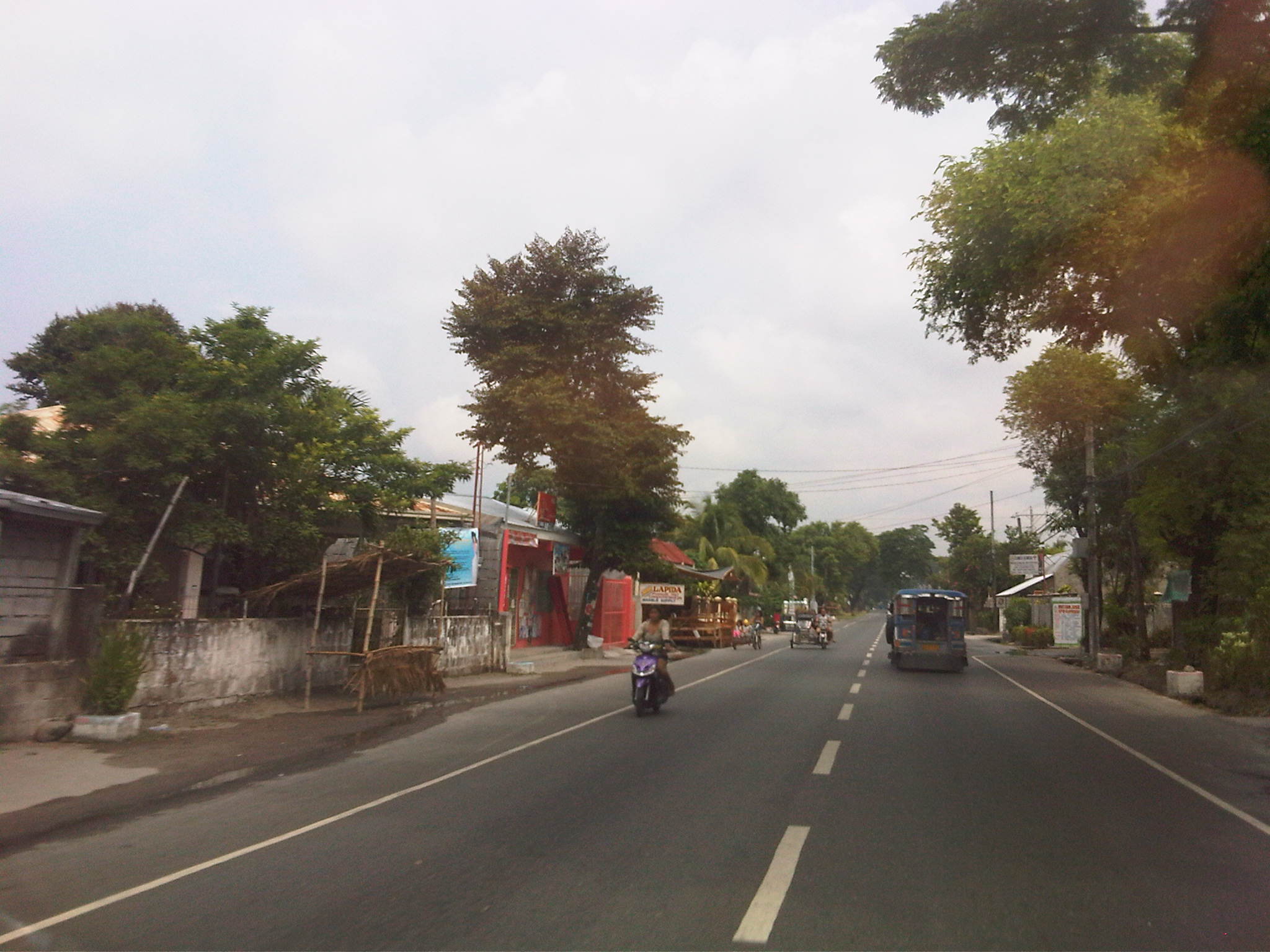 Minimal encroachments – we were also pleased to observe that there were few properties encroaching upon the RROW along the highway, especially in populated or built-up areas like the one shown in the photo above. Such is not the case with many other towns where stores, shops and houses practically dominate shoulder space and even take up parts of the carriageway.
 Free flow – these tricycles seem to be racing and could actually pick up speed even with passengers in the cab, probably due to the straight level road and the excellent pavement as shown in the photo. The shoulders are paved and should be sufficient for tricycles to use in order to not impede the flow of other vehicles.
 Unimpeded flow – the photo above shows further proof of minimal encroachments on the RROW and especially along the shoulders, which are paved and usable.
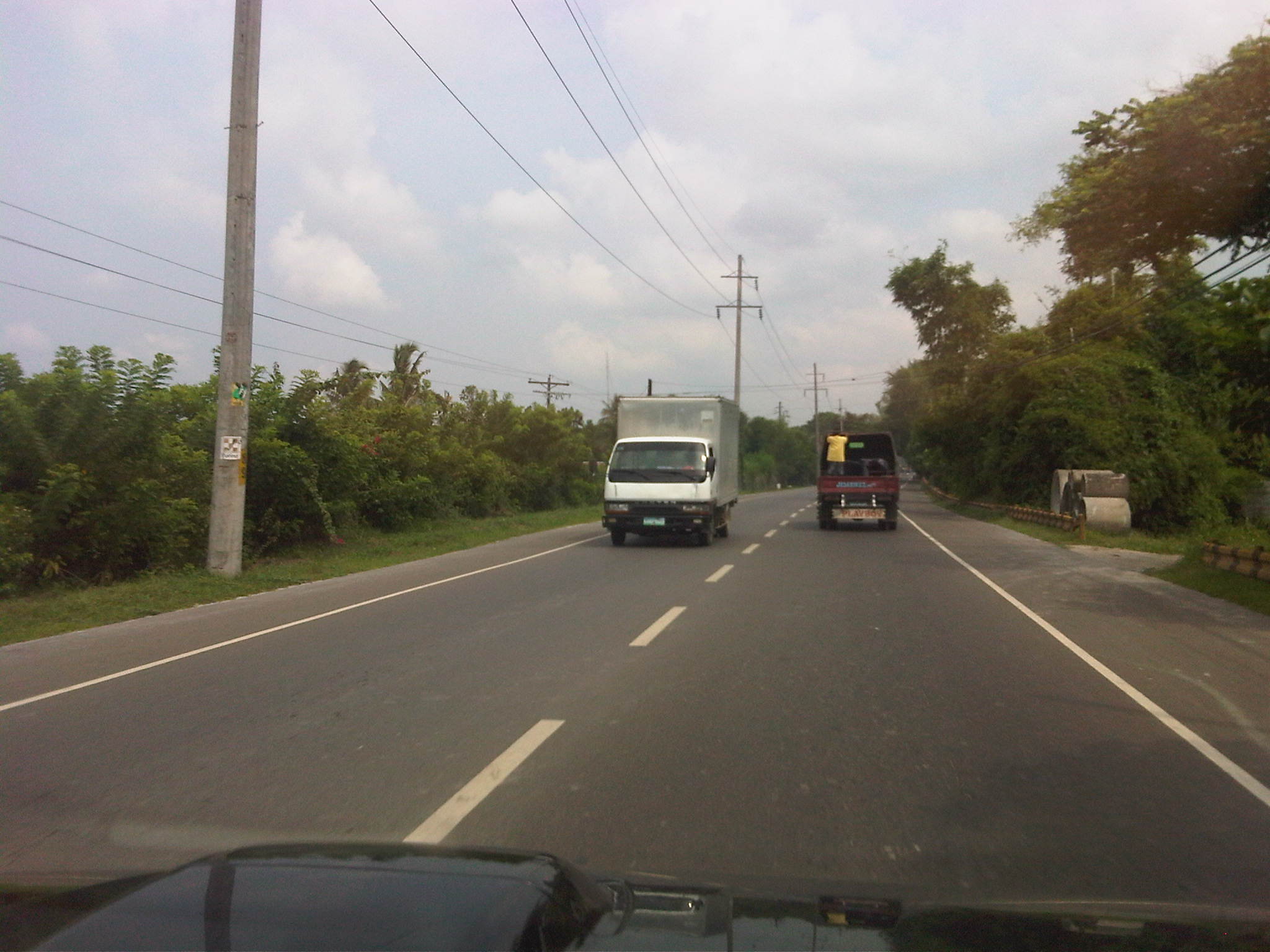 Light traffic – traffic was quite light along the highway the time that we traveled.
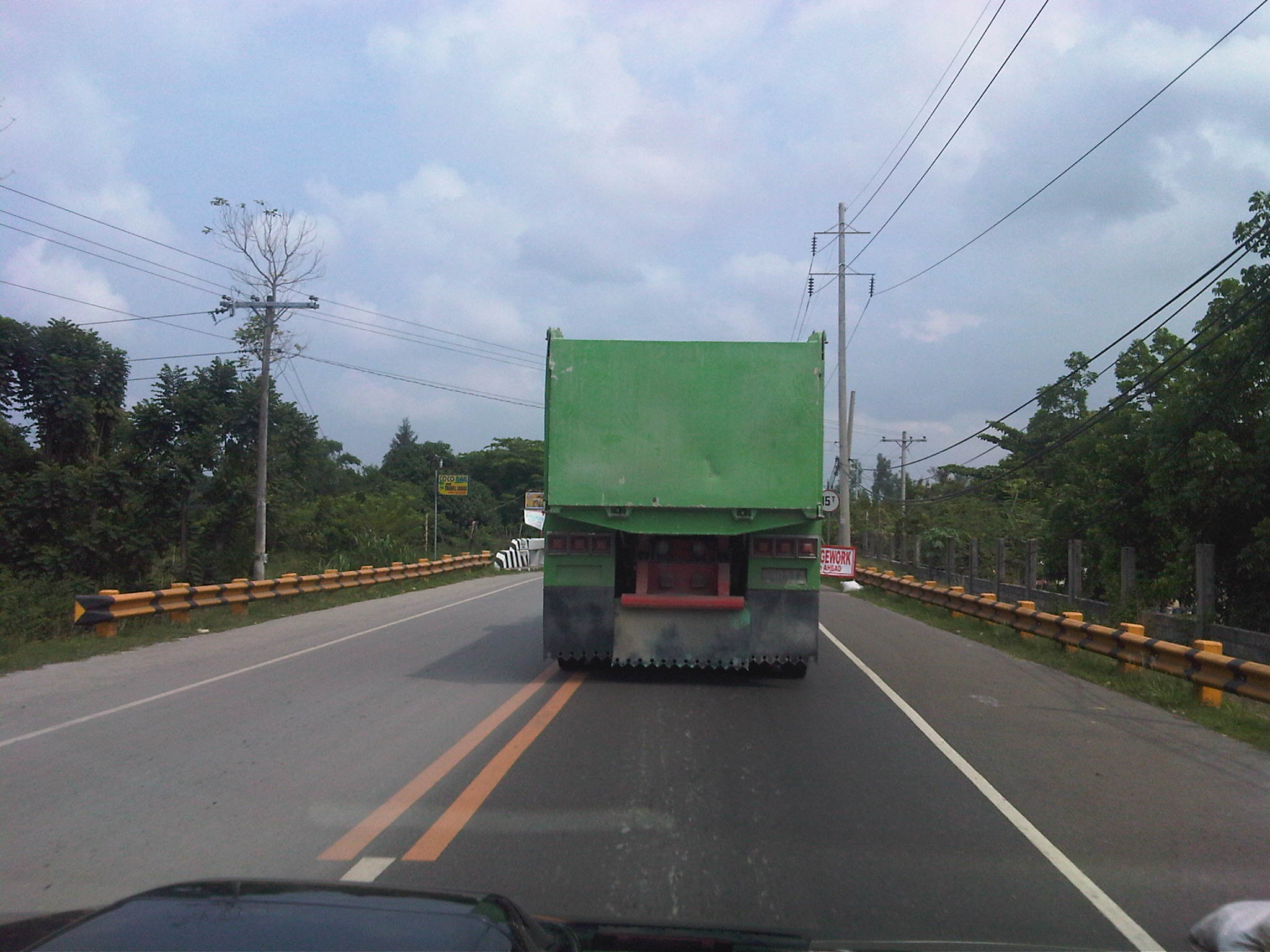 Bridge ahead – the roadside barriers and the signs already visible from a distance inform motorists of the bridge ahead. We didn’t see any advance temporary signage for the construction site that would have been ideal to advise motorists about the work site.
 Detour – the sign speaks for itself but seems to have been placed quite late into the approach to the bridge construction site.
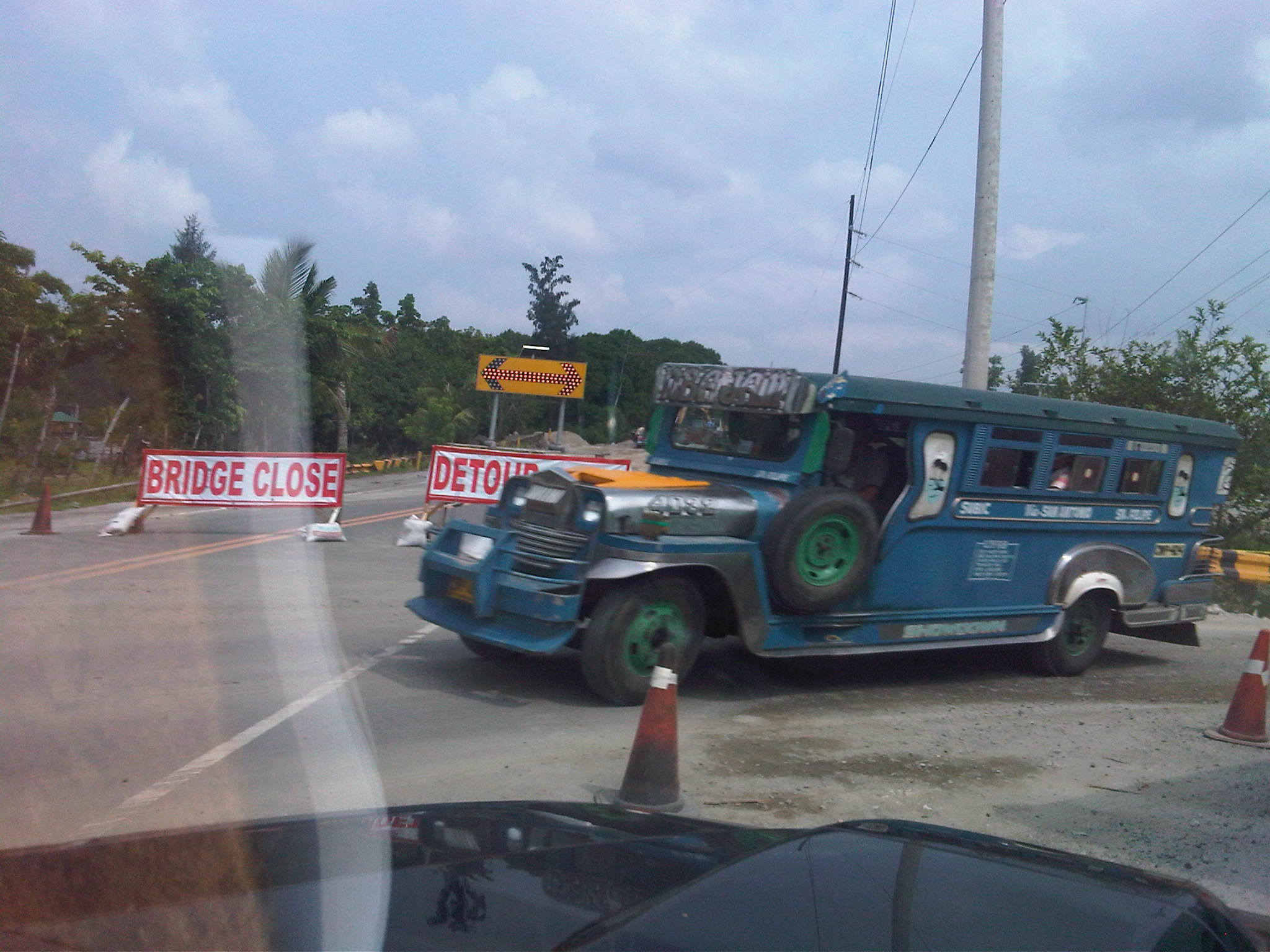 Blocks – signs block the way towards the bridge under construction along the highway while a jeepney emerges from the temporary diversion road.
 Sight distance? – while there is sufficient sight distance along the diversion road, there are cones along the middle of the road to discourage overtaking.
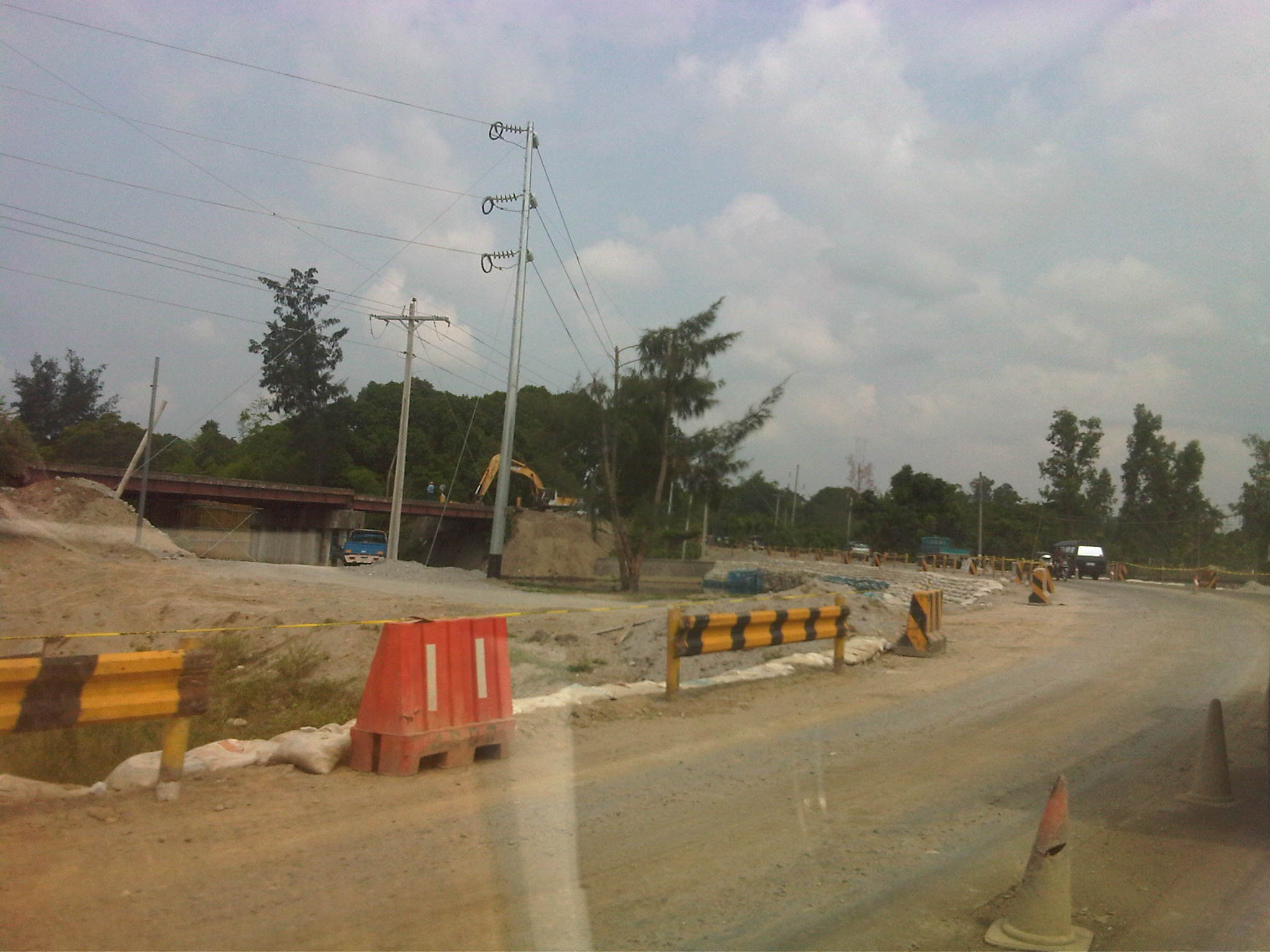 Gravel surface – the temporary diversion road was well-graded and wasn’t that rough unlike many other roads built for such purpose.
 Steel structure – steel girders laid across the river and on top of the columns in the middle.
 End support – a backhoe was working on material to reinforce the embankment at the northern approach to the bridge.
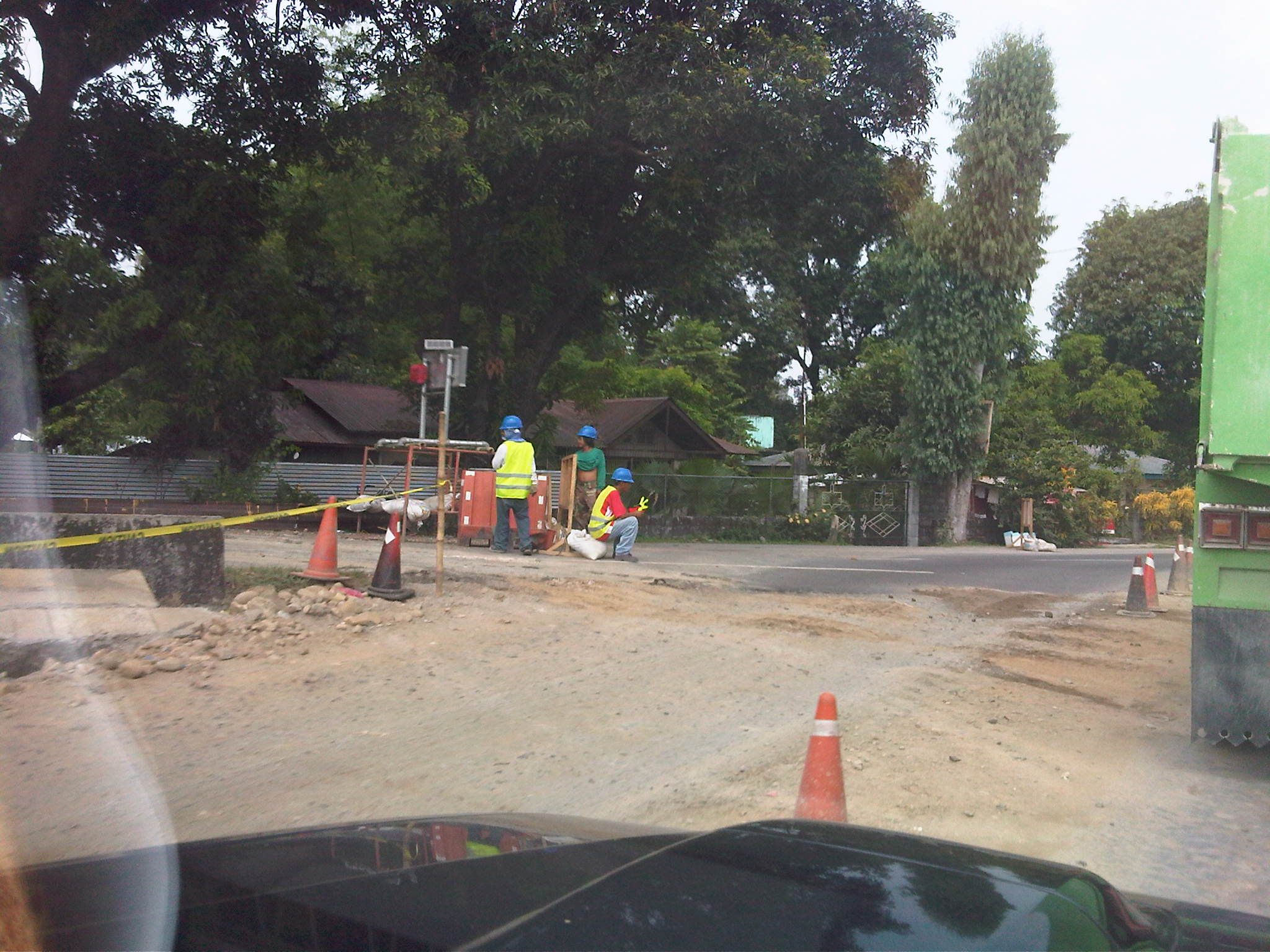 End of the road – the diversion road, that is, at the other end of the bridge.
 Boundary – arch symbolizing the gateway to the next town of San Marcelino.
–
Road and drainage works along A. Tuazon Ave., Marikina
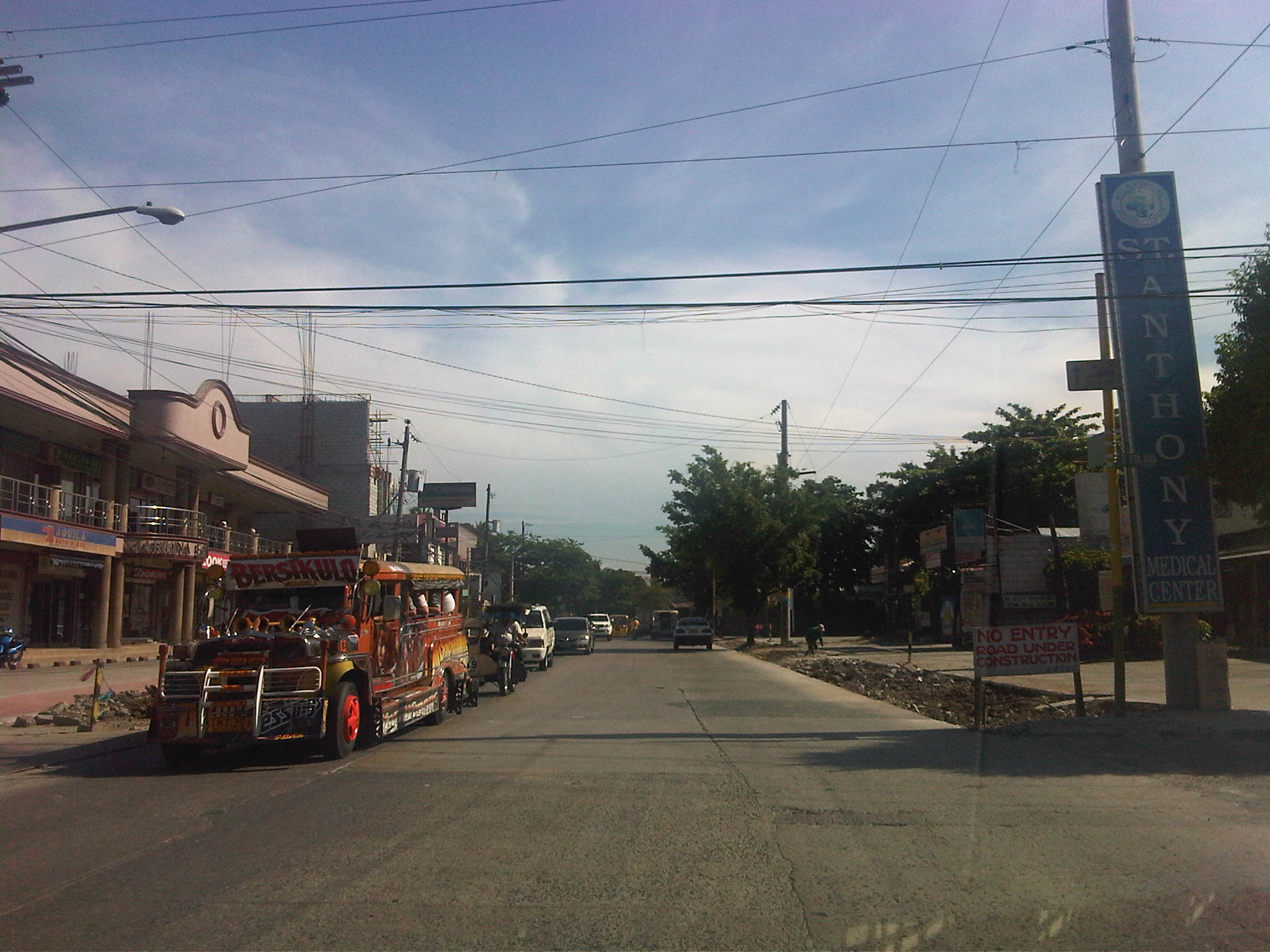
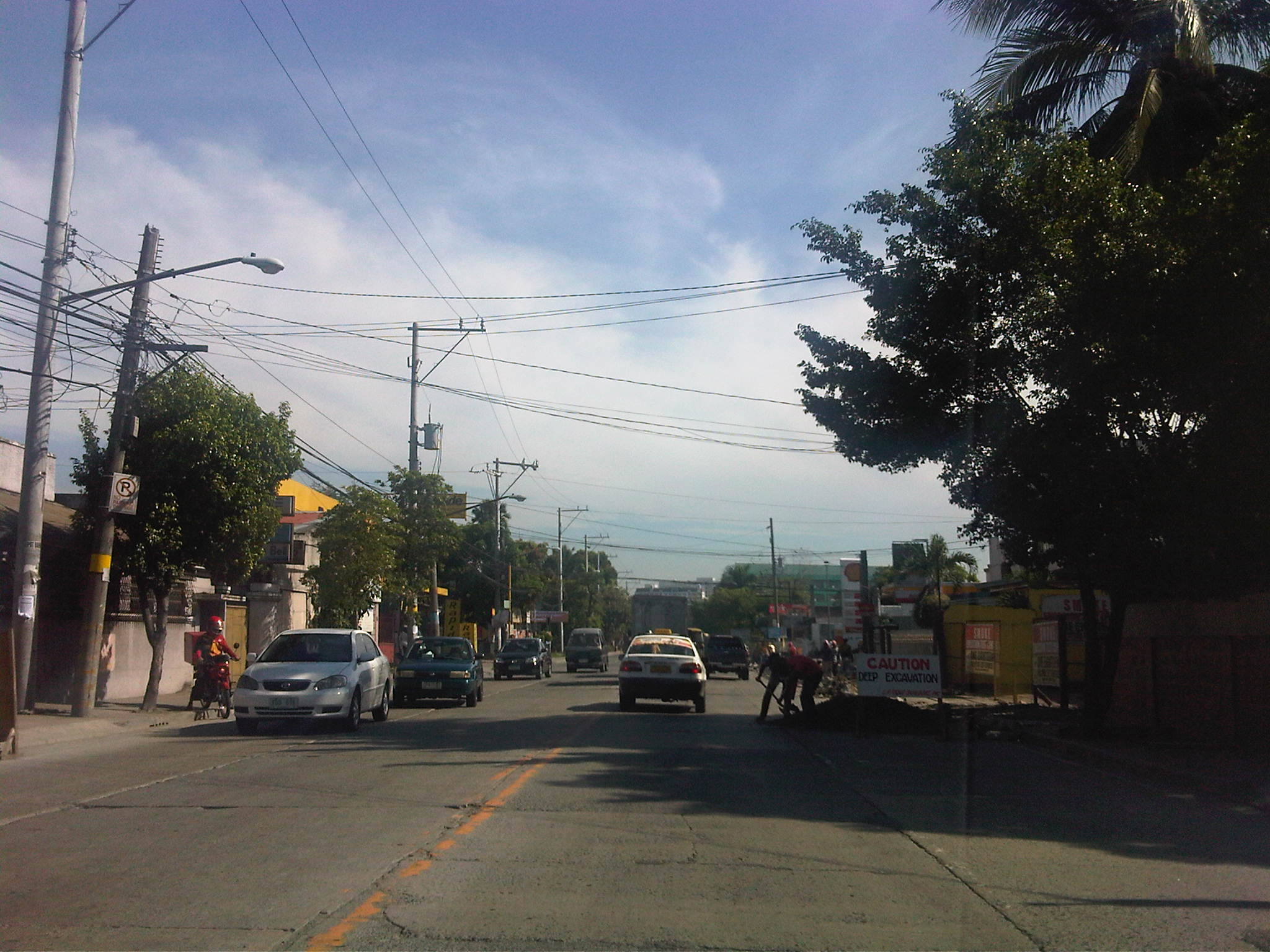
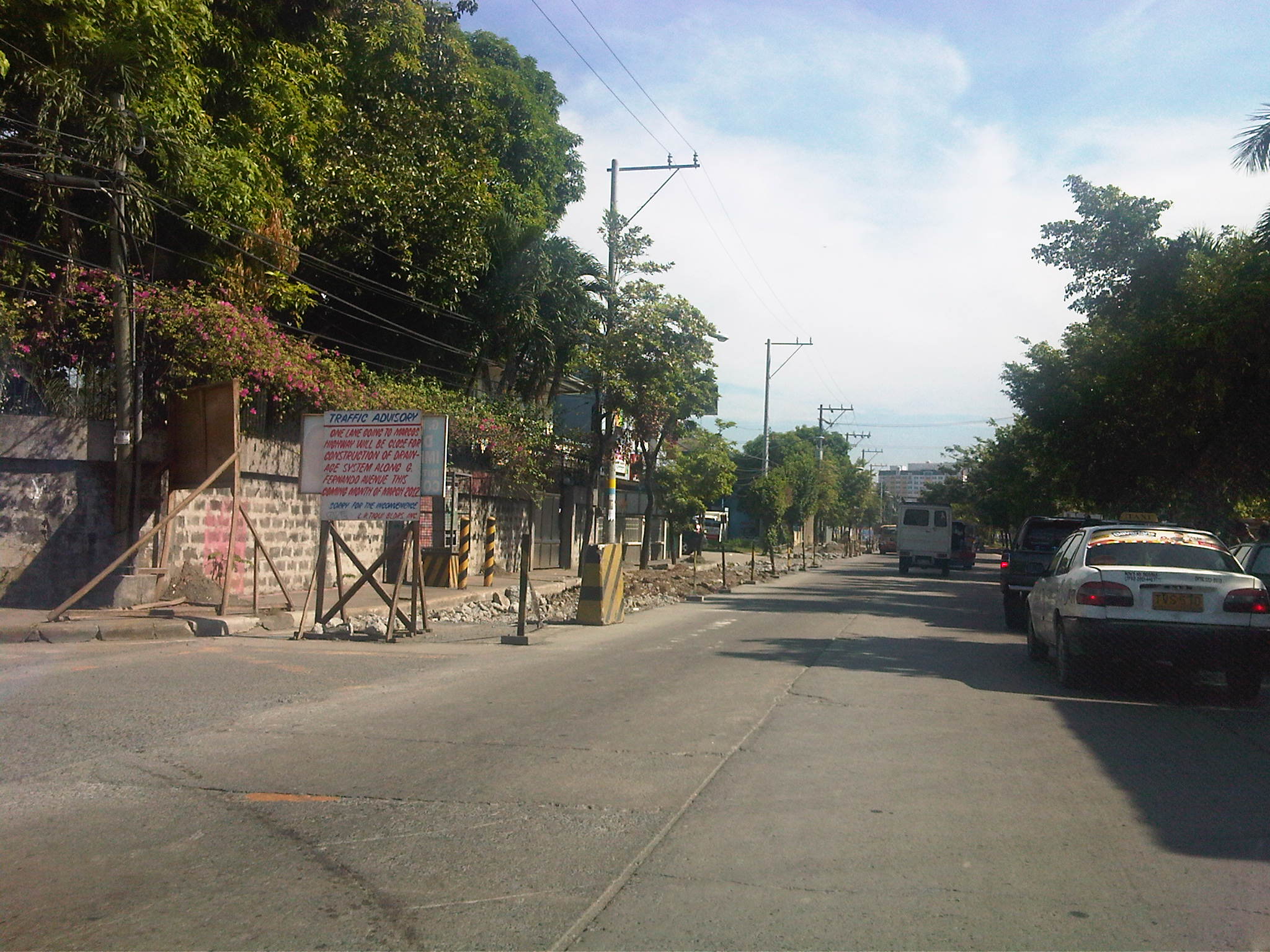
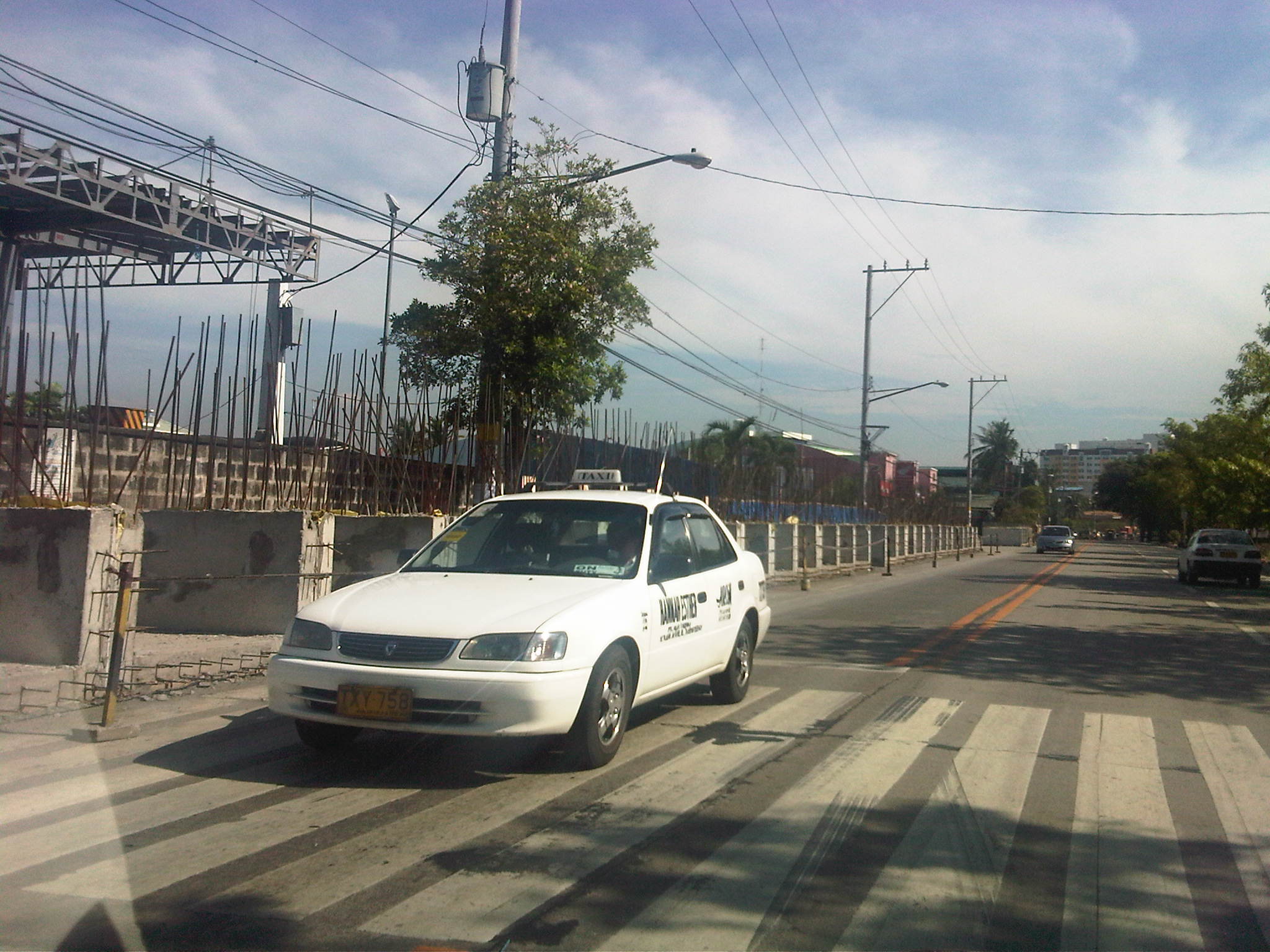
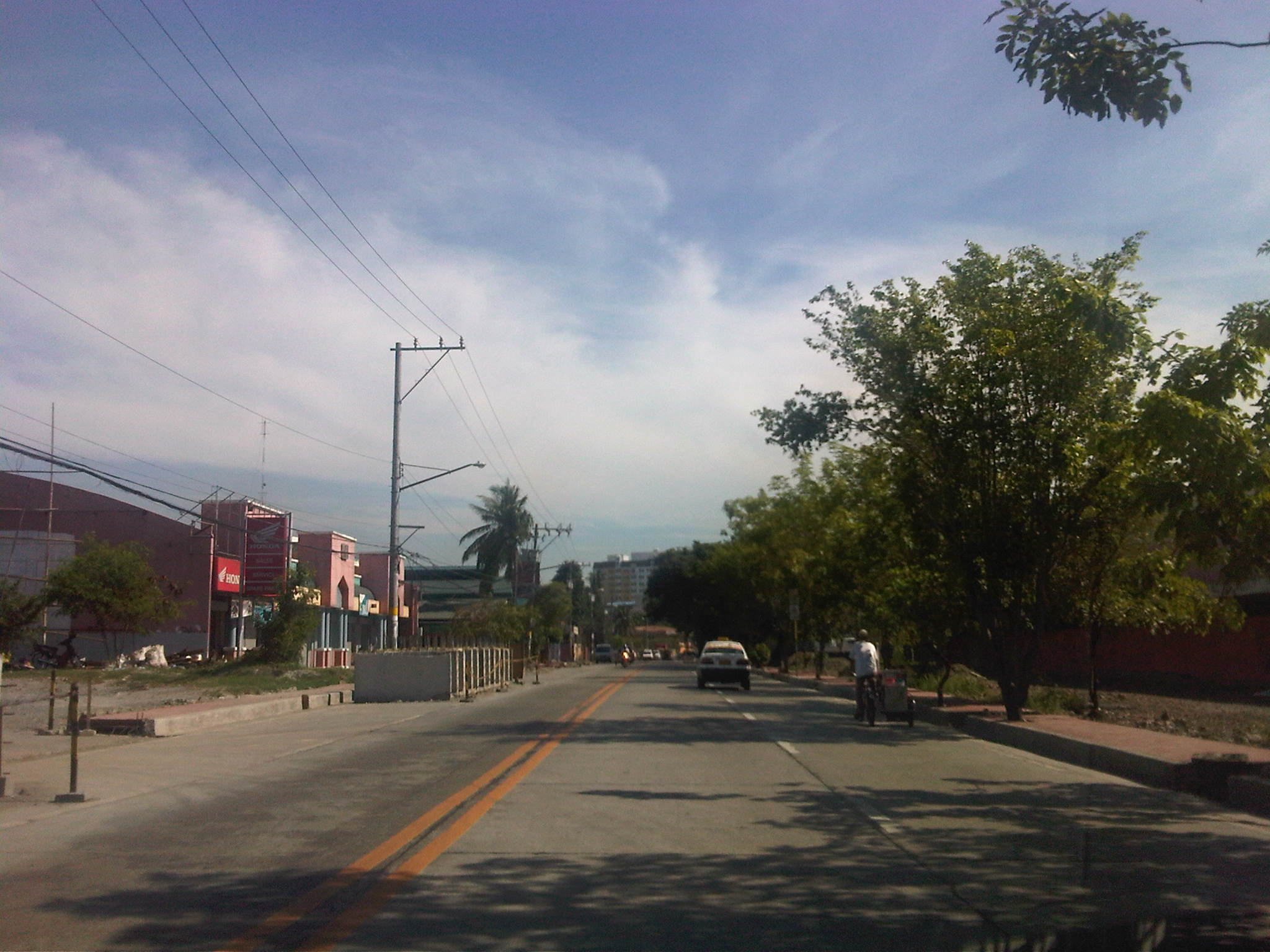
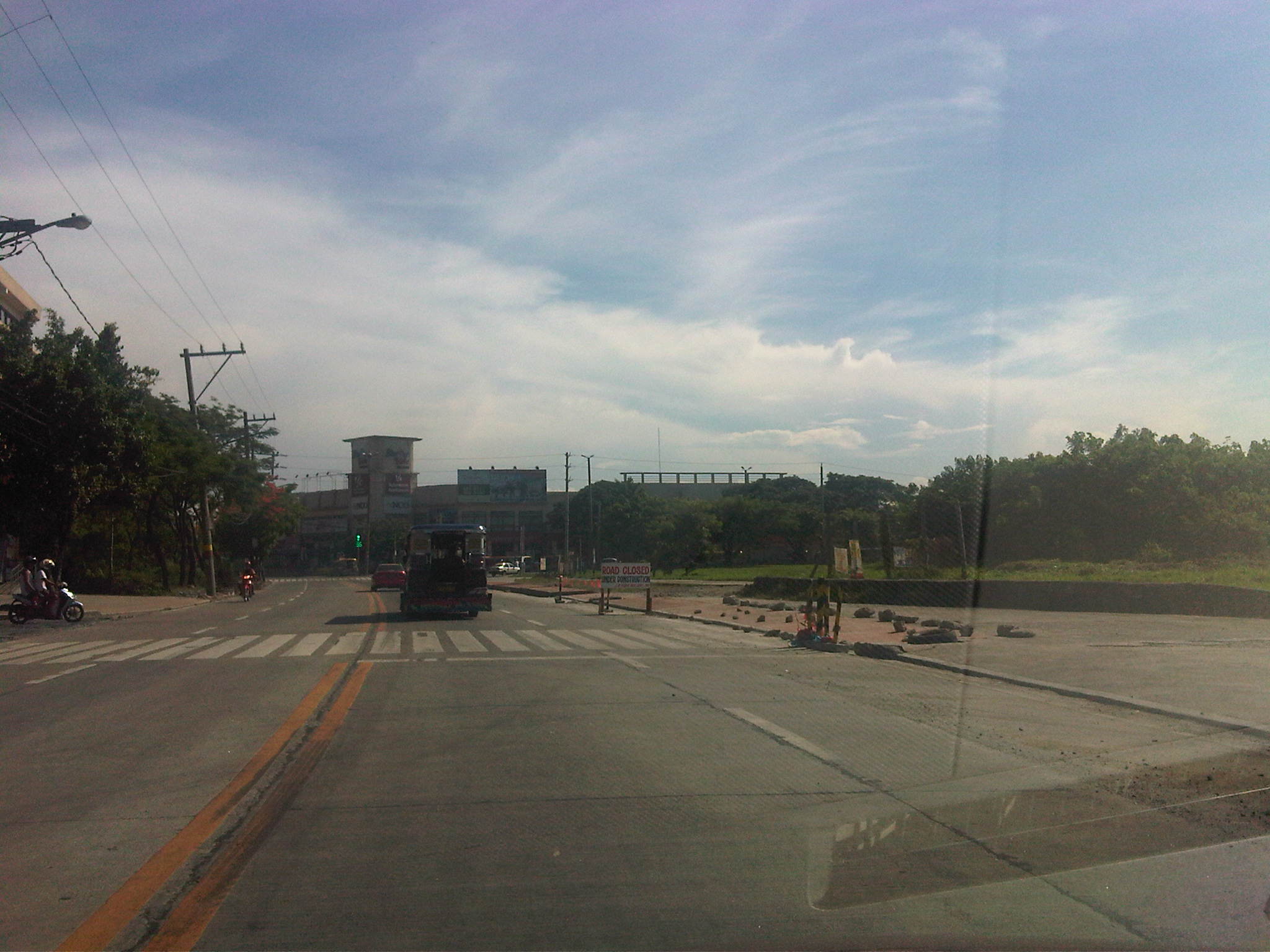
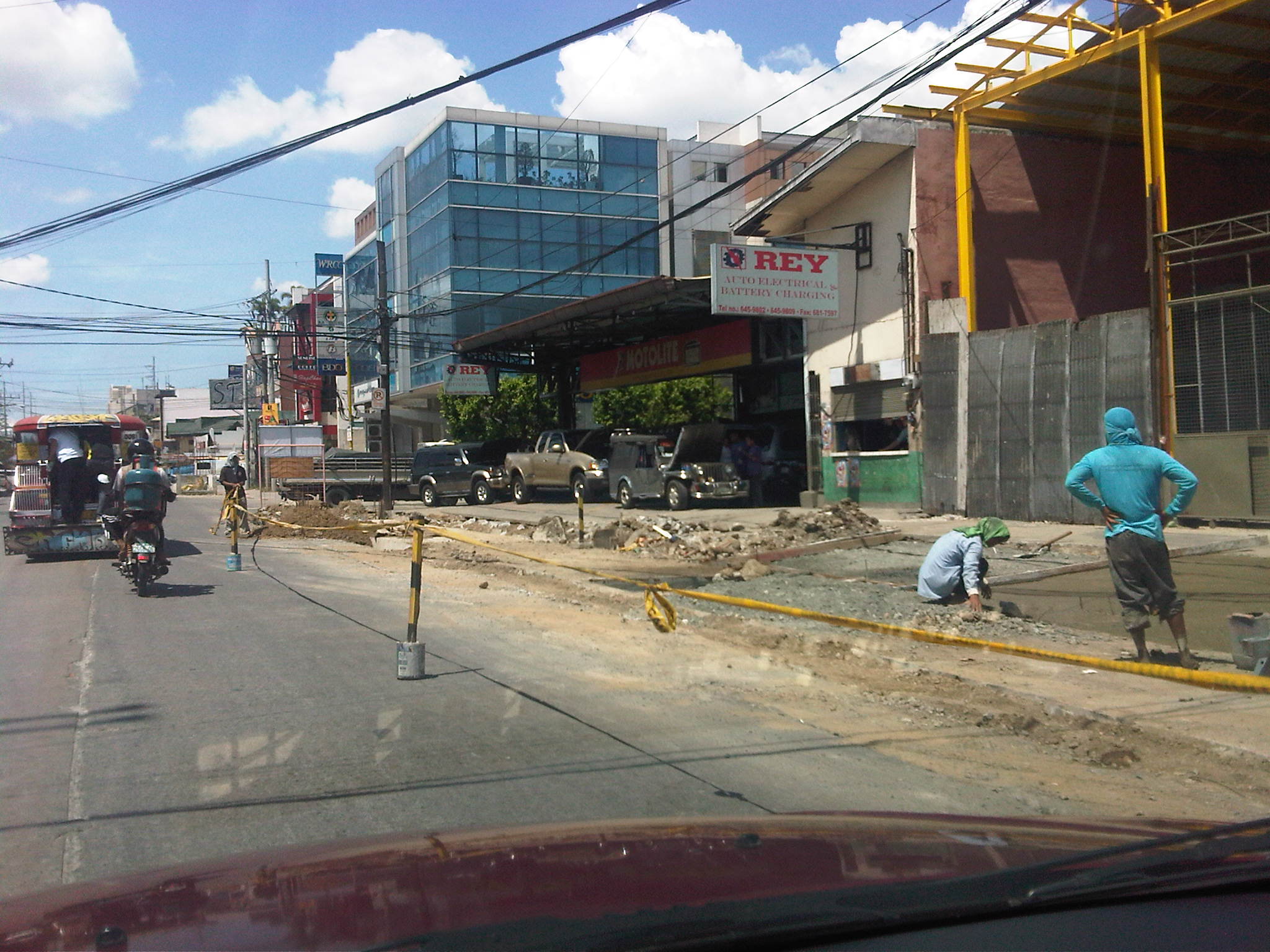
Driving to the dentist on a Saturday morning, I came across roadworks along Angel Tuazon Ave. in Marikina City. The road connects the Marikina portion of Sumulong Highway with Marcos Highway in the Pasig/Cainta area and was also known as Fernando Sr. Ave. at one time. With the completion of works along Marcos Highway and Imelda Avenue, I was happy to see another road near my residence getting some much needed attention.
I thought that the works were just for the rehabilitation/concreting of damaged or weather pavements but it turned out to be something of a larger scope that includes drainage/flood control. The following photos were taken along the stretch of A. Tuazon last Saturday. Shown in the photos are road repairs, re-blocking/re-paving, drainage works and sidewalk construction in various stages of implementation. By the looks of it (there were a lot of people working along different sections of the avenue) the project will finish in time for the opening of school in June. Kudos to Marikina leaders for doing their jobs in this road and area that are usually subject to flooding during times of severe rain.
 1
1
 2
2
 3
3
 4
4
 5
5
 6
6
 7
7
 8
8
 9
9
 10
10
 11
11
 12
12
 13
13
 14
14
 15
15
I didn’t bother to put captions on the photos as they pretty much speak for themselves.
–
 Caught (up) in traffic