
Home » 2017 (Page 9)
Yearly Archives: 2017
On walking and the old pedestrian overpass at UPIS
I decided to go for a long walk one day last April. I walked from our office to the UP Town Center, which was just under 2 kilometers away, to purchase something. I could have taken my car or perhaps rode a jeepney but I wanted to see for myself how easy or difficult it was to walk that distance. It turned out that it wasn’t a difficult walk at all. From Melchor Hall, I crossed the street so that I could walk along the inner part of the Academic Oval. I then took a short cut through the trail in front of Malcolm Hall at the edges of the Sunken Garden, emerging just near the grandstand. From there, I crossed towards Vinzons Hall and then walked towards and along Shuster Street near UP Integrated School. I exited the campus at the portal at the end of Shuster and crossed Katipunan using the old pedestrian overpass that connected the main campus with what used to be UPIS on the other side of C-5.
 The pedestrian overpass is an old structure compared to many of its kind around Metro Manila. The design is quite massive considering it is a concrete structure. The photo above was taken towards the direction of UP Town Center.
 The steps are quite steep on either side of the overpass
 Here’s a photo of a person carefully walking down the steps of the overpass.
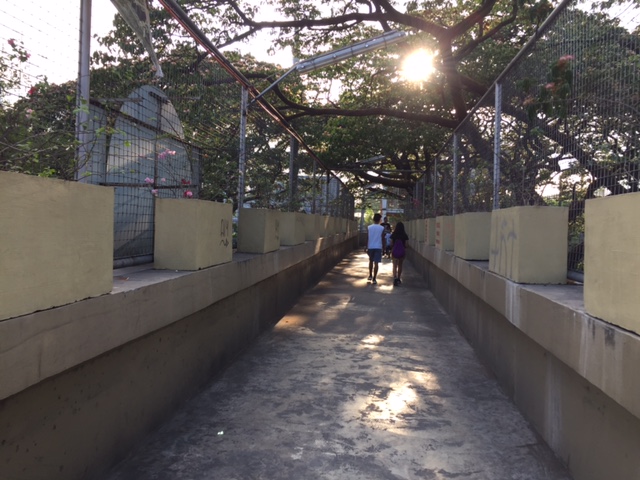 The photo above was taken towards the direction of the UP campus.
The overpass used to be dirty, unkempt, and to many was revolting enough that it was rare to find people using it to cross Katipunan. Most people crossed the busy thoroughfare on the ground, often braving the traffic and taking on the risk of getting hit by a vehicle. Since the overpass was integrated with the UP Town Center (i.e., it is physically connected to the mall and there security personnel posted there), more people now use it. MMDA also fenced much of the median of Katipunan in the area and so the only way to cross the stretch of UP Town Center from Shuster to C.P. Garcia is via either of the two pedestrian overpasses (there’s a second, newer steel structure near C.P. Garcia).
As for the walk to Town Center and back, I thought it was safe, convenient and invigorating (nothing like some walking to help in blood circulation). I took a leisurely pace (not brisk) for my walk so I could enjoy the environment. You tend to see a lot of things when you take such walks and the campus is full of activities, sights and sounds, to help make the walk enjoyable such that you won’t even notice the time and perhaps, won’t even mind the exercise.
–
Pavement distress along C-5 due to the truck lane policy
I frequently use Circumferential Road 5 (C-5), which is known by many names according to the MMDA, the DPWH and the LGUs it passes through. One thing I always notice is the deteriorating or deteriorated pavement, particularly along the lane designated for use by trucks. The MMDA had instituted and implements a policy requiring large trucks to use one lane of C-5 during times when the truck ban is lifted (10:00 AM to 4:00 PM). Smaller trucks are allowed to use other lanes.
The result has been a long platoon of large trucks along the designated lane of C-5 and this concentration of load on the highway has caused faster pavement deterioration for that lane. This is especially evident when the pavement surface is of asphalt concrete. Flexible as it is, the concentration of load has led to obvious pavement deformation as shown in the following photo.

For Portland cement Concrete pavement (PCCP) cases, I would presume that there is also significant damage and the distresses (e.g., cracks) can be linked to this concentration of load. This situation and the conditions for loading likely have detrimental implications on maintenance costs for C-5 and is probably an unintended consequence of the MMDA’s policy. It would be interesting to quantify the impacts of this truck lane policy, whether it has contributed to improve traffic flow along the major thoroughfare, and whether the maintenance costs have risen (and by how much) from the time the policy was implemented.
–
New publication on urban transport by ITDP and UC-Davis
There is a new publication on urban transportation from Institute for Transportation and Development Policy (ITDP) and the University of California-Davis. The link may be found here:
Three Revolutions in Urban Transportation

The content reminded me of similar exercise we did back in 2013-2014 for ASEAN where we did visioning and simulations for low carbon transport in the region by 2050. Electrification was a major assumption for the Philippine case as electric vehicles were gaining ground (they seem to be in a limbo now) back then and on the verge of a breakthrough. Not yet evident for the Philippines was the eventual rise of sharing, and though the idea is out there, automation seems to be too high tech for the country (even Metro Manila) for now.
–
Wheel “chaining” in Taytay, Rizal
Another municipality that has become somewhat aggressive in its campaign against illegally parked vehicles is Taytay also in Rizal province. In the case of Taytay, instead of wheel clamps, authorities have opted to employ what appears as more cost efficient (read: less expensive) tools in their campaign – chains and locks. Instead of the more sophisticated (and likely more expensive) wheel clamps in neighboring Antipolo, chains are wrapped around one of the front wheels of a vehicle and then secured by a lock. Examples are shown in the following photo:
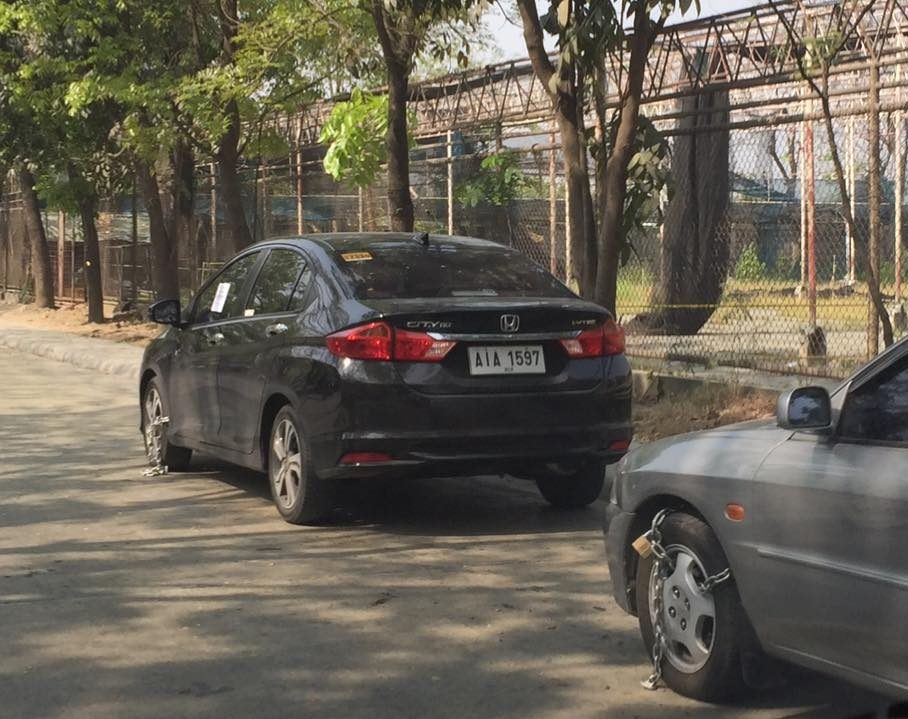 Car wheels chained and padlocked along Don Hilario Cruz in the Taytay Public Market area. The road connects the Manila East Road with the new Taytay municipal hall complex.
Anti-illegal parking enforcers also post a sheet of paper on the window of the vehicle to notify the driver about the violation. The enforcers are posted nearby; waiting for drivers to approach them. There’s supposed to be a fine similar to when a vehicle is towed and reclaimed by the driver or owner. This, campaign, however, seems to have been relaxed in the same area where I took the photo as there are again a lot of vehicles parked on either side of the street on the Saturdays that I pass by the area. I’m not yet sure if this is a case of ningas cogon on the part of the municipality or perhaps they are just exercising some flexibility considering the parking demand for the market and the numerous clothes shops there where wholesalers flock to for merchandise. I haven’t seen similar “chaining” activities in other parts of Taytay unlike Antipolo, which has been continuously and consistently conducting campaigns throughout the city.
–
Wheel clamping in Antipolo
Earlier this year, Antipolo City implemented an aggressive campaign against illegal on-street parking. This policy was borne out of a new ordinance penalizing on-street parking that has been perceived as the cause of traffic congestion along many of the city’s roads. A more detailed description of the conditions or situations warranting wheel clamping may be found in the Antipolo City website.
The following photos were taken from the Antipolo City Government Facebook page:


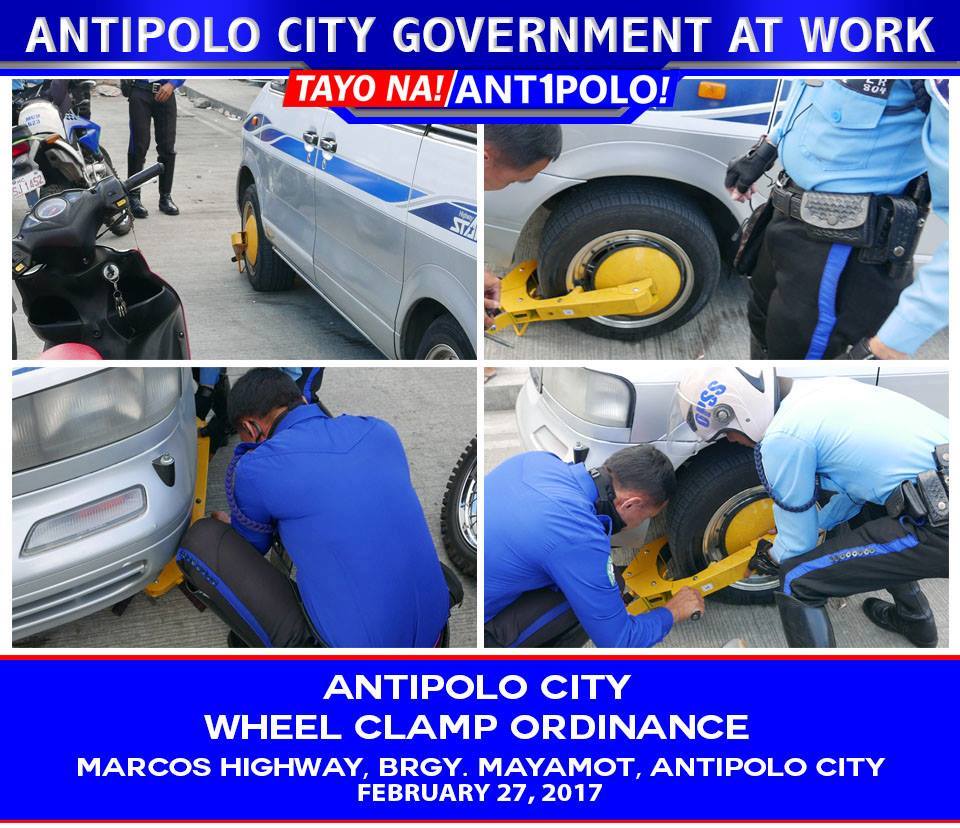
The ordinance and its implementation by the city is very timely (some may say overdue) considering that many streets particularly in the city center is already clogged with vehicles parked on-street. In certain cases, there’s double parking; severely constricting traffic flow even along one-way streets. There are (as always) evidence of resistance but hopefully, the city’s resolve will overcome and improve the situation.
I think another thing that should be in Antipolo’s agenda that’s very much related to the problem of on-street parking is the requirement for off-street parking spaces as stipulated in the National Building Code. The Code actually prescribes for the minimum number of slots per building or development but it is the local government that is tasked to implement or enforce the provisions in the NBC. Going around Antipolo, one can observe that there are many establishments clearly in violation of the Building Code provisions. One major university, for example, along Sumulong Highway does not have enough spaces considering the vehicle trips it generates. This situation is compounded by the expansion of the school to include a hospital and the adjacent commercial development that conspicuously also appears to not have enough parking spaces. An LGU can actually have a policy for stricter minimum parking slots. Quezon City and Makati City have ordinances stating so but have had mixed results compared to the outcomes they probably thought about as desirable.
Of course the topic of minimum parking spaces is currently the subject of discussions in other, more progressive cities and countries, and particularly those with better developed public transport and more disciplined land development. While relevant to us here in the Philippines, it is a topic that is not yet ripe for serious discussions given the many concerns (i.e., violations, non-compliance issues) that still need to be addressed by LGUs like Antipolo City at present.
–
Newly opened sections of C-6
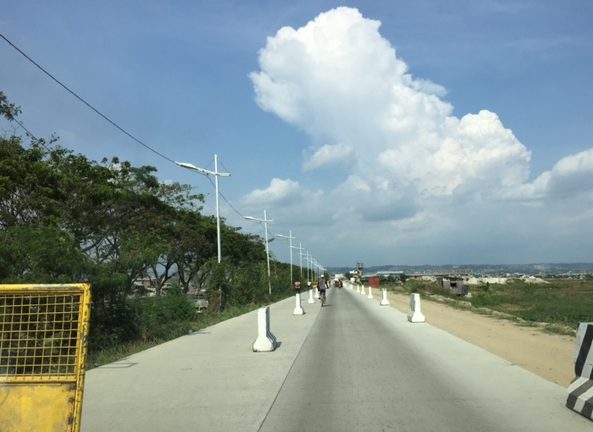
I have been wanting to post these photos of the newer sections of Circumferential Road 6. The section was constructed months ago and is part of a project that seeks to widen the current stretch of C-6 from Taguig (Lower Bicutan) to Pasig (Napindan) from the old 2-lane, 2-way road into a 4-lane, divided road. The new section opened to general traffic along the southbound side (to Taytay) and has improved traffic along the section that’s provided people from Rizal an alternative route to Makati and BGC through Taguig. Only, light vehicles are allowed along the new section and trucks and other heavy vehicles take the old road, which is quite battered by the traffic. Only one lane is currently available as there are barriers along the section as shown in the following photos. Traveling along the section also afford people a nice view of the Laguna de Bay to the right.




–
Some issues abroad on car sharing/ride sharing companies
There are two articles recently that are worth reading for those who are into ride-sharing/car-sharing. And I am not necessarily referring to those who regularly take Uber or Grab, or those who opt to use these whenever they need a taxi ride. There are many who are already studying these services being provided not by your traditional or conventional taxi companies or rental vehicle companies but by supposedly private individuals who supposedly have the spare time and spare vehicle that they can use to provide transport for other people. I use the word “supposedly” here because this is a big assumption and the premise by which transport network companies like Uber, Grab and Lyft have been able to go around the bureaucratic processes that taxi and other companies have to go through as formal public transport (i.e., public utility vehicles). These articles are along the lines of the discussions in previous articles I have posted here about ride-sharing/car-sharing, and are mostly based on the experiences in countries who have more developed and presumably better transport than us in the Philippines.
Denton, J. (2017) Two Federal Lawsuits Could Spell Big Trouble for Uber, Pacific Standard, http://www.psmag.com, April 10, 2017.
McGraw, D.J. (2016) How Lyft and Uber are Ignoring the Poor, Pacific Standard, http://www.psmag.com, May 12, 2016.
I leave it up to my readers (any researchers out there?) to pick-up the main points and perhaps look at the issues from different perspectives. I have pointed out before that the situation in Metro Manila could be very different from the situations in other major cities like Cebu, Davao and Iloilo. And so transport network companies may not necessarily succeed in cities where taxi services, for example, are significantly better than what we have in Metro Manila.
–
List of infrastructure projects for the Philippines’ BuildBuildBuild initiative
I was looking for a list of projects said to be prioritized by the current administration in the Philippines and mentioned in the presentation made by government yesterday. Here’s one I found from GMA News:
Infrastructure projects lined up by the Duterte administration
Noticeable for me are the following:
1. No mention of major bridge projects that were heavily hyped both on mainstream and social media – these bridges include those that were proposed to connect the islands of Panay and Negros, Negros and Cebu, and Cebu and Bohol. It doesn’t mean, of course, that these have been abandoned but likely only sidelined for the moment.
2. Break-up of Clark Green City into several components – this seems to be a more realistic approach especially considering how big and complex this project is, and how many agencies or entities are and will be involved
3. Mass transit projects in Metro Manila – these include big ticket projects such as the proposed subway, BRT and the rehabilitation of PNR lines. These are all projects that should have been done a long time ago but for various reasons have been delayed. Say what you will about so much resources being poured into Metro (Mega?) Manila but it is the economic center of the country and efficient transport will go a long way in generating resources that can eventually be used in other parts of the country.
4. Emphasis on Clark Airport – it seems to me that the current administration is focused on developing Clark as the alternative (if not the main) gateway to the greater capital region. This is a departure from the hype we have received about a replacement for NAIA including one that was proposed at Sangley Point in Cavite.
5. Scaling down of Mindanao Railways – instead of pushing for a much grander (and unrealistic I think) railway project for the entire island, they identified a more realistic and perhaps practical line connecting Tagum, Davao and Digos. One colleague noted, however, that this corridor is already heavily serviced by buses and vans so rail ridership is at best threatened from the start.
What’s your take on the proposed projects and the list in general?
–
Resources on traffic calming and recalling statistics on road safety in the Philippines
As I usually post on some interesting and useful articles on transportation and so I just couldn’t resist sharing this find on resources for traffic calming. This is always a timely source of material on how we can improve road safety particularly in residential areas or where there are more pedestrians exposed to transport and traffic. Such exposure increases the likelihood that they may be involved in a crash.
I recall an article from 2015 that appeared on Rappler:
Francisco, K. (2015) Road deaths in PH: Most are motorcycle riders, pedestrians, Rappler, http://www.rappler.com, October 27, 2015.
The WHO Global Status Report on Road Safety 2015 is a good resource for statistics and the report can be easily downloaded along with other information, and in different languages. Here is the entry for the Philippines appearing in the report:

–
On the planning and design dilemmas for traffic and highway engineers
It’s the Holy Week so I had some time for some musings. Quite some time ago, I commented on a post a prominent architect made on his social media page that practically blamed traffic and highway engineers for problems for what he considers as flawed designs. He even singled out the Department of Public Works and Highways (DPWH) for being responsible. The reality though is that not all architects are a progressive, innovative and responsible as him. In many if not most projects that civil engineers have engaged in, they are usually provided with what are supposed to be preliminary plans drawn up mainly by architects. Many of these plans though are not really preliminary but in an advanced stage in the design process that often do not involve civil engineers much less transportation engineers or planners.
Granted, the traffic and highway engineers involved in many projects seem to proceed with their work blindly and mechanically, they should also be responsible for being aware of the interdisciplinary nature of these projects. These are civil engineers by profession and many seem to have been indoctrinated with the notion that local guidelines such as those issued by the DPWH are basically the only authoritative references for design. For many, there is no need to be proactive and look for more progressive references such as those on complete streets or people-friendly infrastructure, many of which are now more easily available online than before. There is a National Building Code (NBC) but the provisions, often referred to as minimum standards, are often not followed as one can plainly see in many developments in cities and towns around the country. Parking and driveway provisions, for example, are among those that many buildings do not comply with. Then, of course, there is the case of pedestrian sidewalks; particularly their absence along many streets.
Perhaps there is a need to revisit the education of civil engineers? There have been observations (criticisms?) that most undergraduate programs in the Philippines are “board-oriented”, meaning that the end result for programs are for graduates to pass the CE licensure exam. Memorization of formulas is encouraged. At UP though, early on in civil engineering courses, we already make it clear to our students that infrastructure engineering and planning involves a host of a lot of disciplines including architecture, economics, social and behavioral sciences, and, of course, other engineering fields as well. Maybe CE’s would have benefited from a stronger liberal arts program as what critics of UP’s proposed reduction of GE courses claim? But then you already have a lot of general education subjects in most BSCE curricula especially those offered in sectarian schools. Perhaps the lack of connection with the humanities is not a concern that is entirely to be attributed to one’s education in college but instead is one traceable to more fundamental issues that can be traced to one’s formation from as early as grade school if not high school? But then that’s another topic that deserves its own article…
–
 Caught (up) in traffic