
Article on building support for walking and cycling infrastructure
There is another recent article on non-motorized transport (NMT). This is a good read and something that I think should be required for those who are little too serious or staunch about their advocacies.
Doyon, S. (2017) “Building support for walking and bicycling infrastructure” Public Square, A CNU Journal, https://www.cnu.org/publicsquare/2017/11/11/building-support-walking-and-bicycling-infrastructure (Last accessed 11/11/2017)
I believe that if you want to convince people to appreciate and support your cause, you should not take the hardline. Instead, there should be a more persuasive process for wooing people. This is especially true in transportation and the advocacies for walking and cycling. You will not get a lot of support, for example, by condemning car users and telling everyone they should bike instead.
–
How about simulating the BRT along EDSA?
History seems to be repeating itself as the situation along EDSA for the upcoming ASEAN meetings is practically the same with that about 2 years ago when the APEC meetings were held in Metro Manila. We have a different administration now with a lot of new people at the Department of Transportation. You would think that they see an opportunity here, to have another chance to simulate Bus Rapid Transit (BRT) along EDSA. They did recently deploy P2P bus services to augment the failing MRT Line 3 but perhaps it is more likely for that purpose and nothing else. There is no indication that the now exclusive lanes along either side of EDSA will be used for a mass transportation experiment during or after the ASEAN meetings. I guess this will be another missed opportunity for a proof of concept?
–
Origins of ridesharing/ride-hailing?
Here is a very interesting article on the beginning of Uber:
Campbell, G. (2017) “The Beginning of Uber,” Medium, August 23, 2017, https://medium.com/@gc/the-beginning-of-uber-7fb17e544851 (Last accessed 11/10/2017).
The article contains the company’s first pitch and should be of interest to researchers (that includes my students) who may want to know about and from the Uber’s origins. It might be useful to taxi operators and drivers as well since the slides show their characterization and what (good) features distinguished Uber from the conventional taxis at the time.
–
Eastern Metro Manila transport depot?
The eastern transport terminal that had been under development along the Marikina riverbanks and across from SM City Marikina does not seem to be progressing in terms of the public utility vehicles it is supposed to be attracting and dispatching. Not even the heavy promotion of a tiangge or goods market in the area could attract people.
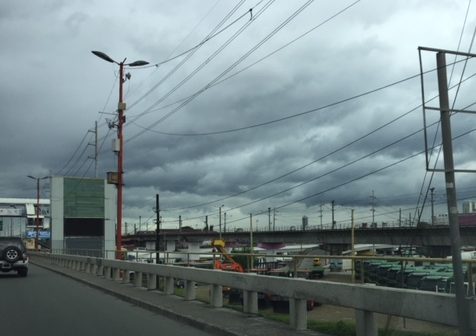
Passing the area, one can see trucks and other heavy equipment parked and occupying much of the terminal’s space. It seems to have become more of a depot than a working public transport terminal. I think this is to be expected as the designation and development of this area as a terminal for the east seems to have been undertaken haphazardly. For one, the connection to the Line 2 Station at Santolan is not that good and requires a lot of walking in a not so comfortable or convenient environment. Meanwhile provincial buses terminating at the terminal would have to be routed via C-5 with those from the north passing through the very congested Katipunan and those from the south also deliberately modifying their routes for this terminal. Connections with other modes is also quite problematic. The location just isn’t as strategic as Cubao or Crossing for this terminal to succeed in the natural sense. While I am still hoping I am wrong here, the gut feel and the observations every time I pass by the area says otherwise.
–
Vested interests, Part 1
An old friend and I met up some time ago and he casually mentioned the ongoing transit projects, particularly one that has affected him along his commute via Commonwealth Avenue. He said he can’t wait until Line 7 was completed and running. Perhaps then, there will be less vehicles along Commonwealth and he can have a shorter (travel time) drive from his home to his office in Ortigas. This type of comment did not surprise me as it is a reality that many would still likely prefer to take their cars or perhaps opt for car-share services rather than take public transportation, even with a new and note efficient option like the Line 7 available.
I have read or browsed articles, both technical and anecdotal, about many drivers wanting (and even encouraging) others to shift to public transport in order to lessen the cars on the road. This is so they can benefit from the reduction in vehicular traffic (i.e., less congestion equals faster travel by car). One article in the US even went as far as saying that if you didn’t drive 60,000 miles per year then you probably didn’t need a car. This is understandable for those who probably are, by default, dependent on their cars. It is frustrating, if not ironic, for those who don’t have to drive or take their cars but opt to do so. The latter includes people who have shorter commuting distances and with less transfers (less inconvenience) in case they do take public transport.
Next: Ridesharing as sustainable transport?
–
Tacloban’s one-way traffic scheme
I was in Tacloban City last month and got to meet former participants to our training program who are working for their Traffic Operation Management Enforcement and Control Office (TOMECO). Among the topics of discussion was the traffic scheme for the central business district (CBD). Last year, the city had implemented a one-way traffic circulation scheme for the CBD as shown in the following map in the traffic advisory released by the city:
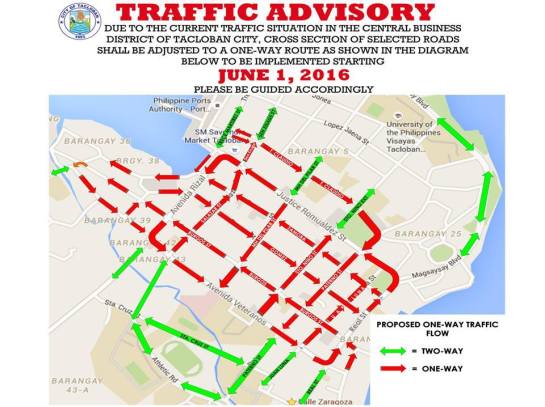
The city had to ease up on the one-way scheme, retaining it for the northwest-southeast directions and reverting to 2-way flow for the northeast-southwest directions. This decision was apparently due to the feedback the city got from various stakeholders about travel times and distances becoming longer due to the one-way scheme. This needs to be verified by collecting data pertaining to typical routes taken by vehicles, private and public utility, in order to get from an origin to a destination (e.g., from home to school). This can be simulated or estimated using field data (travel time surveys). We intend to use both as we make an assessment of the scheme and formulate recommendations for the city.
–
Everyone’s an expert?
I wrote before about some frustrations among transport professionals who are getting smart-shamed on social media. Everybody seems to be an expert these days. And who can blame people who are quite familiar, aware or knowledgeable about transport and traffic issues, particularly along their commuting routes or where they reside or work. But then what distinguishes an enthusiast from a trained professional? What distinguishes a well-read, observant person from another who has formal training (i.e., one with a professional degree or advanced degree) and work experience? In some cases, it can simply be in terms of how articulate people are. Many engineers and planners are not so articulate (or telegenic) as certain personalities like one so-called road safety enthusiast/motoring journalist or as good a writer as one prominent and progressive landscape architect. Many probably are more into technical writing and that doesn’t translate all too well into something easily understandable or “publishable”. They may also get “lost in translation”, so to speak, should they be interviewed, preferring to sound technical rather than attempt to simplify their explanations a the “pedestrian” level.
A couple of senior transport professionals, one who was in academe but served as a government official before, and another who is a sought after consultant here and abroad, however, are pretty cool about this and just brush off the comments they get from articles where they are cited. They are established and secure about themselves and their current roles as ‘elders’ in the transportation field. They are often invited to congressional or senate hearings about transport and traffic for them to share their wisdom about current issues and proposed solutions. Others are simply not into social media and so are quite insulated from the seeming brouhaha of every other person suddenly becoming transport or traffic experts if not pundits. We all continue with our work, knowing we have a lot to do and hopefully leading to improving transport and traffic in the country.
–
In memoriam of road crash victims
I wrote earlier this year about a beloved aunt who was involved in a road crash. She was hit by a jeepney driven recklessly as she was walking; on her way to church one early morning. She was in the hospital for weeks before she finally passed away. It was painful to see her in her hospital bed, unconscious but fighting for her life.
No, I don’t feel anger anymore whenever I recall the incident and note that if the driver were just careful then she would still have been alive today. I feel sad. I feel sad and frustrated that despite all the efforts a lot of people have put into road safety programs and projects, there seems to be little in terms of the reduction of recklessness on the roads. The recent weeks, for example, are full of reports of crashes that claimed the lives of many and injured more. These often involved trucks that mowed down everyone in their paths. Then, you see a lot of motorcycles weaving in and out of traffic, many ride like stuntmen and without regard for life, limb or property as long as they can get away with it.
Additional laws in the form of local ordinances or Republic Acts will not be effective in reducing road crashes and the death toll it has brought upon us. It is the enforcement, the implementation of these rules and regulations. Rules and regulations are just words that, if not acted upon, do not have any effectiveness. And so we get to the root of the problem and that is enforcement; the lacking if not missing ingredient in the road safety broth that is necessary to save lives and create a safer environment for all. Does it deserve more attention and resources from our national government and local authorities who are in-charge of most of the enforce aspects of road safety? I do think so. Statistics on traffic-related deaths, injuries and damage to property compare strongly with if not exceed those attributed to drug abuse. When you purposely drive recklessly and crash into another vehicle or person, one is practically murderous. You also destroy the lives of people related to the person you kill or injure (e.g., that person could be the sole breadwinner of a family). The comparisons and examples are plenty and I am sure a lot of people have their own personal experiences about this as well as their opinions. For now though, let us reflect on those who perished from road crashes and perhaps think not about “what could have been” but instead of “what can be done.”
–
Some recommended references for sustainable transportation design
We conclude the month of October with the following recommended readings:
- Designing Walkable Urban Thoroughfares: A Context Sensitive Approach, An ITE Recommended Practice, 2010
- Model Design Manual for Living Streets, 2011
- Smart Transportation Guidebook, Planning and Designing Highways and Streets that Support Sustainable and Livable Communities, 2008
While these are guidelines and manuals developed and published in the United States, the principles and much of the content and context are very much applicable here.
As an additional reference, here is the latest version of functional classifications for streets that is supposed to be context-sensitive:
- Stamatiadis, N., A. Kirk, D. Hartman, J. Jasper, S. Wright, M. King, and R. Chellman. 2017. An Expanded Functional Classification System for Highways and Streets. Pre- publication draft of NCHRP Research Report 855. Transportation Research Board, Washington, D.C.
–
Differences in opinions about safer roads?
I posted on a road safety-related page and suddenly there’s this guy who pounces on the post and delivers what he probably thought was an amusing commentary. From his posts, it was clear that he was one of those hard-core cyclists. I don’t want to use the word ‘fanatic’ but that is how many people would probably see him given his posts, comments and stand regarding cycling and safety. He also seems to revel in his claim to be a victim but the way he states this won’t really give him as much sympathy as he probably hopes to get. You have be more engaging and diplomatic if you want to be taken seriously whether as a stakeholder, a government official or an expert.
Everybody is certainly entitled to their own opinion (but not their own facts and that’s another story for another article that’s transport-related) about how roads can become safer for all. I say all because it is not only a concern of cyclists and motorists but pedestrians as well. Everyone, regardless of age, gender, economic status, etc. is vulnerable. And the only way we can succeed is if there is a collective effort that is fact/evidence-based and structured or organized. Cooperation is vital among various sectors and we must accept that there are many approaches, ways by which we can achieve the objective of safer roads and transport. Going hardline on one’s stand and trying to impose this on others will not get us anywhere.
–

