
On experiments and crowd-sourcing for solutions
If you didn’t notice, the government (national agencies and local government units) has implemented and successfully employed experimentation and crowd-sourcing to find solutions for transport and traffic problems. In the case of experimentation with traffic, this has been going for a while now but not at the level of those conducted during Bayani Fernando’s stint at the MMDA. At the time, full scale experiments were undertaken as the agency dabbled with the U-turn scheme. The ultimate product of that time are the twin U-turn flyovers at C5-Kalayaan. I say ultimate because it involved both experimentations and traffic simulation, where the latter was used to justify the U-turn flyovers over what was originally proposed as an underpass along C-5. As I recall, the model was not calibrated or validate contrary to the agency’s claims. I say so because I personally saw how the model ran and the presentations were more like demonstration of the software used. Meanwhile, the DPWH at the time made their own simulation models and did the necessary calibration and validation to come up with sound models for other projects including the Quezon Avenue-Araneta Avenue underpass.
Crowd-sourcing, mainly through social media is a more recent approach. It is not an entirely new animal because prior to social media, there were a lot of inter-agency committees that included people from various stakeholders (some invited, some not) who were the primary “sources”. The crown now is larger and perhaps more diverse. Whether this is a conscious or unconscious effort is uncertain. And this can easily be denied or shrugged-off. But in this age of social media, there are just so many enablers or influencers for crowd-sourcing each of whom have their own agenda. Some mainly to promote or prop up the current administration. Some to mainly criticize without offering solutions. And others to invite constructive scrutiny or assessment while also providing options to address problems and issues. It is the latter group whose opinions and recommendations should carry more weight if indeed the administration is fishing for solutions from the so-called crowd.
Consider the following recent examples (not in any order):
a) Closing U-turn slots along EDSA
b) Requiring face masks for all who are outdoors including cyclists
c) EDSA carousel
d) Resumption of public transport with mostly air-conditioned vehicles
e) Bike lanes along major roads
f) Public transport reform (in general)
There are others but the six listed above have been discussed a lot on social media after government picked up an idea or two about them, and implemented each seemingly without conducting due diligence or paying attention to the details including potential glitches. They ended up with mixed results, many very costly (I wouldn’t say disastrous at this point). However, in all cases, they seem to welcome (though at times begrudgingly or feigning resistance) crowd-sourced solutions particularly those from organized groups who are only too happy for themselves to be in the limelight.*
One thing is for sure and that is that there is still a lack of capabilities among government agencies and LGUs when it comes to transportation. Don’t get me wrong. National government and many LGUs have the resources and capacity to address transport problems. However, their capabilities are in question here because they seem to be unable to harness their capacities and resources to come up with sound and suitable solutions. In the end, they appear to buckle under the pressure of their own crowd-sourced schemes only to emerge as manipulators after they are able get what they want with the willing assistance of the naive.
–
*Some of these are true advocates who have worked hard to make transport better for all while others are the bandwagon types (nakikisakay lang) who are content dropping key words that now sound cliche at every opportunity. I leave it up to my readers to determine which are which. 🙂
On travel restraint and transport options in the time of COVID-19
Previous to the lockdowns associated with the COVID-19 pandemic, there were typically a lot of trips being made that many can regard as unnecessary. These are not the typical “to work” or “to school” trips that are being made on a regular basis (e.g., every week day). With the easing of the quarantine everywhere around the country, it seems a lot of people who felt they’ve been cooped indoors or have been limited in their activities have gone out. Many seem to have thrown caution to the wind, too, as evidenced from the many photos being shared showing people doing mass (bike or motorcycle) rides, shopping in crowded streets, etc. It becomes even more worrying now that Christmas is fast approaching when more people are going out to shop or visit relatives and friends. The following are quite basic while we are still experiencing the pandemic:
a. Required/imposed travel restraint – reimposition of the number coding scheme implemented by the MMDA with variations in certain LGUs such as Makati City (no mid-day coding windows) and those in the periphery (longer coding windows during mid-day), and limited implementation of the truck ban for certain roads (these of course will have certain exemptions for vital goods);
b. Increased number of public utility vehicles – the DOTr and LTFRB have been proceeding so slowly (but surely?) in re-establishing or resuming public transport services as they realized there will be no other opportunities like this to implement their rationalization and modernization plans simultaneously. However, the pandemic necessitates physical distancing and other measures to reduce if not eliminate the risks of infection
c. Making all modes available and viable as an option for commuters – Needless to say but all options must be provided for safe travel (esp. commuting). By ‘all’ I mean both motorized and non-motorized modes must be given as options to commuters, whichever they choose must be a safe option for them. That means providing the necessary facilities for walking and cycling, and, as mentioned, adding or augmenting public transport supply where necessary. By ‘commuters’ I mean those who really require traveling. These include our front liners and essential workers. Despite the push for local tourism, I personally believe this should be limited and LGUs need to discourage excursions that have the potential for spreading the virus.
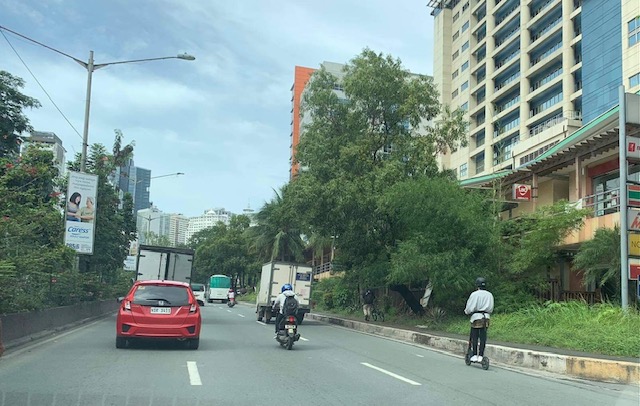
d. Voluntary travel restraint – this is for everyone to consider rather than set aside. I guess given the easing of quarantine restrictions, many people have already had their fare share of going out including children and senior citizens who can now go out for some fresh air. Those opportunities should have already contributed to easing mental health issues, too. However, with the impending (if not yet here) increase in the infections once again, perhaps we should exercise self restraint during these holidays. This self-restraint can also be considered as sacrifices not just for one’s sake but for others especially loved ones we don’t want to get sick with COVID-19.
We still do not know who among us are or can be carriers and who can pick-up the virus and become very ill. As such, we should still be very careful, and adopt and practice measures to reduce infection risks. This goes very well with the spirit of the season. Let’s make the necessary sacrifices to beat this pandemic. Do not ‘gift’ your loved ones with Covid-19!
–
Post-typhoon BFCT and SM Marikina area
Still on the aftermath of Typhoon Ulysses (Vamco) though this is already a late post about it, here are some photos at the river banks level on the side of SM Marikina and the vicinity of the transport terminal constructed and operated by the former MMDA Chair and Marikina Mayor’s company. The area is basically a flood plain and in other countries would not have been suitable for building. Rather, these are often used as open spaces like parks, football fields or baseball diamonds, among other possible uses.
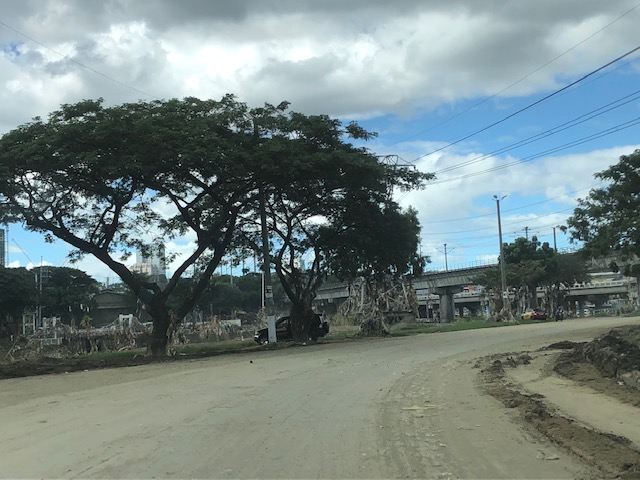 There were garbage and mud everywhere. By the time I passed by, the mud had dried up and turned into fine dust that blanketed the area.
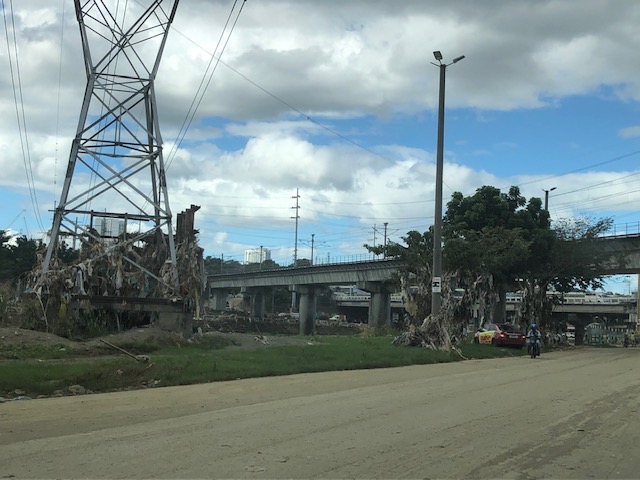 Trash were everywhere and you can see how deep the water was by the garbage still on the power line towers and the trees.
 Underpass leading to SM Marikina – bulldozers and payloaders were busy moving mud and garbage to clear the roads. There were no signs of the work in progress so I ended up making a U-turn seeing the way to SM’s parking was blocked by mud and debris.
 On the way back to Marcos Highway, you can see the large trees that were transferred to this area from Katipunan Avenue (when it was widened by way of removing the service road to give way to the MMDA’s U-turn scheme). It is heartening to know these survived the river’s onslaught.
–
On maximizing seating capacities of public transport
The restrictions for physical distancing for public transport seems to be easing. The reason for this statement is the observation that passengers of public utility vehicles are no longer one seat apart (less than the ideal 2m distance between people but deemed sufficient with physical barriers installed in the vehicles). If allowed to be seated next to each other (of course with some sort of physical barrier between them), the set-up will increase the allowed passenger capacities of PUVs to at least their seating capacities. Conventional jeepneys will be able to seat the 16 to 20 passengers their benches are designed for and buses, depending on their sizes and seating configurations may seat perhaps 40 to 60 passengers. That doubles or even triples the number of passengers that can be carried by each vehicle from the time these were allowed to resume operations after the lockdowns.
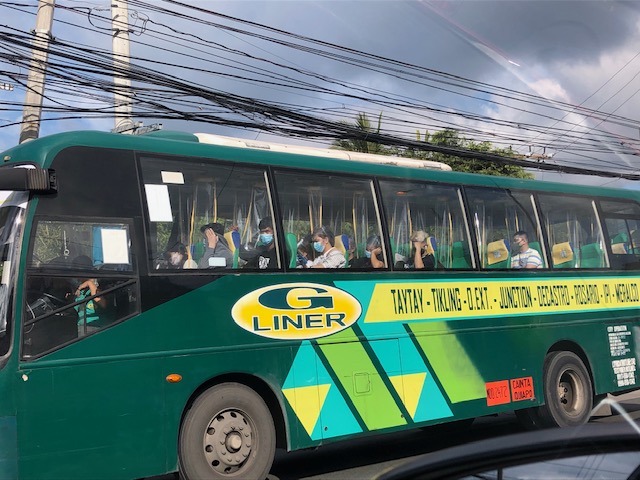
Plastic barriers separate passengers seated beside each other
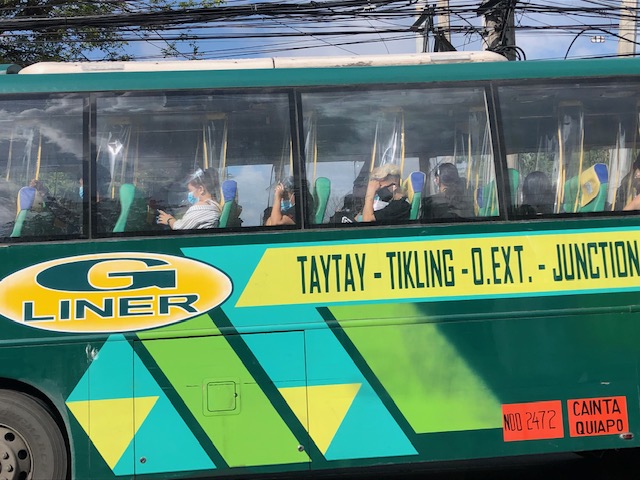
Not all physical barriers are designed and installed to provide whatever protection passengers can get from them. The photos above for a G-Liner bus seems to be the more desirable design as the barriers are practically like curtains. I have seen token plastic barriers installed in jeepneys. I wonder if these even went through some approval process of the DOTr, LTFRB or local government unit. Such inferior designs do not help the cause of promoting public transport use over private vehicles.
–
On the continued lack of public utility vehicle services – some observations
Traveling along Marikina roads en route to my office, I spotted not a few of the minibuses that are being promoted as modernized or modern jeepneys. These are definitely not jeepneys or jitneys but small (or mini) buses. They are airconditioned with seating capacities about the same as the typical conventional jeepneys but with space for standing passengers once these are allowed given the pandemic. There’s a lot near the end of the Gil Fernando Avenue Extension that serves as a depot or parking lot for vehicles that have not been deployed (or sold?). And here are a couple of photos showing these.
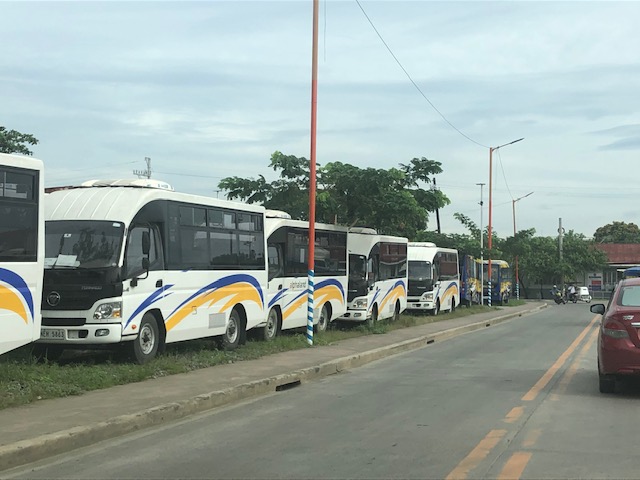
New mini-buses being touted as “modern or modernized jeepneys” parked along the Gil Fernando Avenue Extension connector road.
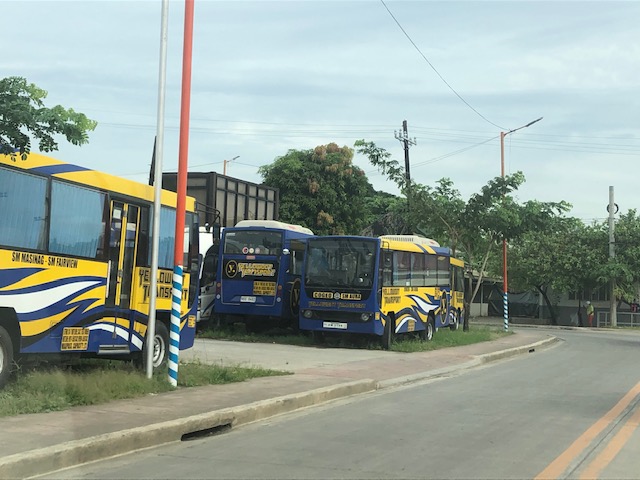
These mini-buses used to ply the SM Masinag – SM Fairview (via Marikina and Batasan) and Cogeo – SM Aura (via Marcos Highway and C-5) routes.
There is a perceived continued lack of public transport supply in Metropolitan Manila and its adjacent cities and municipalities. This is evidenced from the long lines at terminals and stations and the many people waiting for a ride along streets. With the DOTr and LTFRB slowly but surely adding buses, “modern jeepneys” and conventional jeepneys along many old routes and new ones, it may seem that there are enough vehicles. The situation may be summarized as follows:
- The DOTr and LTFRB are taking advantage of the situation to try to rationalize public transport routes under their rationalization program. Certain routes, for example, that were served by conventional jeepneys are now assigned to buses and ‘modern jeepneys’. You can’t exactly blame them for this as the lockdown presented the opportunity to sort of start from scratch in as far as rationalization is concerned. They won’t get another chance at this without stiff resistance from various stakeholder groups.
- PUVs are still limited in terms of allowed/permitted passenger loads due to physical distancing requirements. These are already being eased for both buses and jeepneys but standees are not yet allowed for buses.
- The observed lack of supply is not as widespread as perceived. Commuters along some routes are better off than others. Traffic congestion due to the preference and use of private vehicles by many who used to travel by public transport exacerbates the situation as PUVs are unable to make quick turnarounds thereby making it appear that there is not enough of them operating. Approving and deploying more public transport without exerting efforts to improve confidence in using them will only lead to more congestion and inefficiencies to their operations.
–
Micromobility policy atlas from the Shared-Use Mobility Center
Here’s a quick post sharing a policy atlas on micromobility from the Shared-Use Mobility Center. It looks like this will be something like a work in progress since there surely would be more policies and infrastructure in more cities and countries as micro mobility catches on with people. Already having many users prior to the pandemic, micro mobility, especially cycling, has gained even more during the lockdowns and afterwards when people opted for this mode over public transport (usually because of a lack of it), private cars (expensive), motorcycles (not their thing), and walking (too slow for their taste?).
Here is the link to the atlas: https://learn.sharedusemobilitycenter.org/atlas/?
–
Non-motorized logistics
The pandemic and the resulting lockdowns led to people rediscovering what is now termed as active transport modes – walking and cycling. Not that these modes were not being used for travel as usually they, especially walking, represent the last mile/kilometer mode for most people. With the absence or lack of public transportation or service vehicles (e.g., free shuttles for frontliners, office service vehicles, etc.), many people turned to cycling. Perhaps one area outside of commuting where bicycles have plenty of potential (and I use the word ‘potential’ here because it is not yet as widespread as motorcycle use) is for delivery services. It is the general perception that there has been a surge in deliveries for various items especially food from restaurants. Why not employ bicycles either to supplement or augment the usual motorcycles used for such purposes? I took the following photos showing an example of deliveries using bicycles.
 Jollibee delivery rider on a fat bike
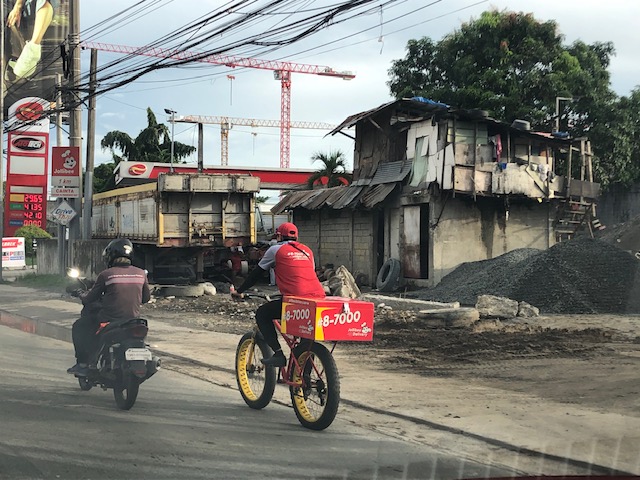 The bicycle rider compared to a motorcycle rider – the bike is just about the same size as the motorcycle, only higher/taller due to the large wheels on the bicycle. The carrier or box is also larger than the typical carrier as it is for transporting food that can be of a large quantity or even multiple orders if these are in close proximity to one another.
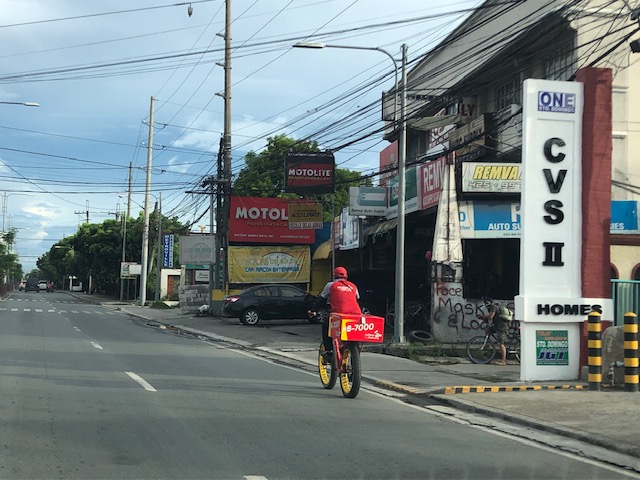 Fast-food delivery via bicycle along Felix Avenue in Cainta, Rizal
–
The FVR Road and Bridge after Typhoon Ulysses
This is a continuation of the feature on the aftermath of Typhoon Ulysses (Vamco). I am posting this here as part of my archives on the floods in the Marikina Valley.
There’s a road branching off from Marcos Highway that links to a bridge crossing the Marikina River and connects with the FVR Road along the Marikina Riverbanks. The following photos speak for themselves in as far as the mud and garbage that was left after the floods subsided.
 Descending from Marcos Highway, only one of two lanes are passable after heavy equipment moved tons of mud and garbage to the roadsides. The fences trapped a lot of garbage, too, as seen in the photo.
 Piles of mud and garbage at the service road leading to the east bank of the Marikina River and the SM Marikina access road.
 Under the Marcos Highway Bridge, garbage, mostly plastics, remain on the wire fences. This area was totally submerged during the height of the floods with water reaching the underside of the bridge. Fortunately, the bridge seems undamaged.
 Even lamp posts and electric poles caught a lot of garbage.
 The Olandes housing development was surely affected by the swelling of the river.
 The FVR Road leading to C-5 is already clear for 2-lane traffic but you can see the mud and garbage all around. The dried mud has turned into dust (alikabok) that blows away as vehicles pass through the road. There is also mud on the plants in the median planters as this area was also submerged during the height of the typhoon.
–
On transportation equity
Here’s another quick share of an article on transport equity:
McQuaid, H. (November 23, 2020) “Equitable Transportation Starts At Community Level,” CT News Junkie, https://www.ctnewsjunkie.com/archives/entry/20201123_equitable_transportation_starts_at_community_level/
How many times have I heard and read about people talking about the concept of “dignity of travel” or “dignity of transportation” referring to the quality of our commutes in terms of the quality of transport services available to us. The article also talks about societal exclusions and biases that sometimes we only attribute to America but in reality are also applicable here based on how we regard people from the rural areas or our being regionalistic.
–
More parks and trees = longer lives
Here is an article about a topic that seems unrelated to transportation but is actually strongly related to it. We already know about the benefits of tree-lined boulevards and parks as lungs of a town or city. The following article discusses the benefits and advantages of having more parks and trees.
Yanez, E. (November 19, 2020) “More Parks, Longer Lives,” Parks and Recreation, https://www.nrpa.org/parks-recreation-magazine/2020/december/more-parks-longer-lives/
I suddenly recall what were tree-lined national highways across the country. Many of these trees were cut down to give way to road-widening projects of the national government through the Department of Public Works and Highways (DPWH)., Nevermind that the widening was not really required in many if not most cases, and that the trees were never replaced or was there ever an effort to do so. The results have been disastrous in terms of the environments along these roads. Transport systems can also be developed with parks and trees in mind; especially if active transport were the focus of the development. Surely parks and trees will enhance the environment and encourage more people to walk or cycle. This should translate into better overall health and wellness for people.
–
 Caught (up) in traffic