
Antipolo’s bus port
I like taking photos of aircraft of various airlines in airports. Among the photos I like taking are of their tails aligned to show the different airlines docked at the terminals. As we were stopped at an intersection just across from the Robinsons Antipolo public transport terminal, the wife took this photo of buses at the terminal. To me, the terminal has become somewhat like a bus port; with buses serving the long distance routes between Cubao in Quezon City and Antipolo in Rizal province. That’s about 20+ kilometers via Marcos and Sumulong Highways.
What used to be a small amusement part has been cleared prior to the lockdown in March and the area now functions as a parking lot for buses serving the Antipolo-Cubao via Masinag Junction and Antipolo-Ortigas Center routes. The latter was already operational prior to the lockdown with P2P buses leaving every 30 minutes.
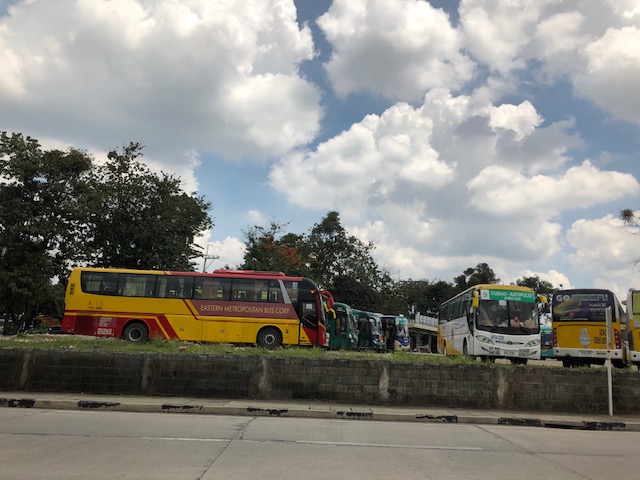
When the Antipolo-Cubao bus route first started operation when Rizal and Metro Manila first transitioned to GCQ, there were three (3) companies operating along the route – G-Liner, RRCG and EMBC. All used air-conditioned buses. Before MECQ in early August, there were additional companies including those that deployed regular or non-aircon buses. I will try to take more photos of the terminal, the buses and the paratransit providing local transport (i.e., within Antipolo). These are tricycles of different models including the conventional motorcycles with sidecar, the tuktuks, and the e-trikes.
–
Of inequitable allocations and accessibility
In the news recently were figures released supposedly by Philhealth showing the top hospitals receiving reimbursements from the agency for claims relating to COVID-19. Southern Philippines Medical Center, a hospital in Davao City received 326M pesos while UP-PGH got 263.3M pesos. I was not surprised that my social media newsfeed included posts from both sides of the fence (The fence sitters among my friends on social media were not commenting about these anymore and seem content in just posting on food or whatever activity they were in.). Each were posting information divulged by the whistleblowers in the ongoing hearings on the issues pertaining to PhilHealth funds.
I will not go into the political aspect of this controversy but will just focus on the transportation aspects of the issue. I will just compare the top two hospitals in the list to simplify the assessment while mentioning others in general.
The claim that the hospital in Davao was the equivalent of PGH in Mindanao doesn’t hold water as the hospital does not treat even 10% of the cases that PGH is handling and for a much smaller geographical area. While UP-PGH is accessible to a larger population and for less travel times, SPMC is not as accessible to say people coming from other major cities like Cagayan De Oro or Zamboanga City. Yes, there are other major cities on the same island that have sizable populations with ‘catchment’ or influence areas comparable to Davao City. They, too, probably need funds to be able to treat COVID-19 patients. It is true that there are many other hospitals in the National Capital Region (NCR) that have the facilities to treat COVID-19 patients. However, many of these are private hospitals that tend to incur more costs for the patient and are not generally accessible (read: affordable) to most people who are of middle and low incomes. Thus, UP-PGH can be regarded as the frontliner among frontline hospitals.
What? There are other public or government hospitals in Metro Manila and surrounding provinces? True, but many of those have very limited capacities in terms of facilities and Human Resources. The same applies to Davao’s case as well because there are also medical centers and hospitals in surrounding provinces. And to round-out the resources available to these hospitals, local government units have also (over) extended their resources to hospitals. Perhaps the allocations and proportions can be explained in another way that is not the “apologist” but based on actual numbers pertaining to cases handled by the hospitals?
–
Painted lines are not enough for bike lanes
From the experiences of many biking or trying to bike in the Philippines, painted lines are not enough for bike lanes. Only recently, cyclists using bike lanes that did not have any physical barriers to deter motorists from encroaching have been involved in crashes, with at least a couple being reported as fatal for the cyclists. Here is an article on what cyclists need in order to ensure or at least improve the safety of their commutes.
UTC (2020) “White lines? Cyclists need more,” ITS International, https://www.itsinternational.com/its8/feature/white-lines-cyclists-need-more [Last accessed: 8/6/2020]
 Commuters on bicycles along the Marcos Highway bridge bike lane
Are there differences regarding cycling in different countries? From a somewhat cultural-behavioral perspective, perhaps there are studies (though I am not aware of them yet) about how peoples from different countries or cities behave with respect to cyclists whether or not there are bike lanes designated for the latter’s use. I recall my experiences cycling in Japan and drivers are generally respectful of cyclists on the roads. Pedestrians, too, are very tolerant of cyclists on the sidewalks or designated areas for walking. Of course, the cyclist would have to do their share of respecting others’ spaces, too, and should behave and position themselves accordingly while traveling.
–
On bicycles slowing down cars
There is a perception that cyclists tend to slow down other vehicles, mainly motorized, along roads. Again, such can be the experience of some that have been generalized and accepted as fact in most cases. However, if we look closely at the evidence, the perception may not be true for most cases after all. This article comes out of Portland State University:
Schaefer, J., Figliozzi, M. and Unnikrishnan, A. (2020) “Do bicycles slow down cars on low speed, low traffic roads? Latest research says ‘no’,” EurekAlert!, https://eurekalert.org/pub_releases/2020-07/psu-dbs072320.php [Last accessed: 8/1/2020]
Check out the wealth of information through the links found throughout the article that includes references to published material in reputable journals. EurekAlert! is from the American Association for the Advancement of Science (AAAS).
–
On the benefits of shared roads during the pandemic
There is evidence, and they are increasing, for the benefits of shared roads. Here is another quick share of an article supporting that:
Brown, M (2020) “Shared-use roads improve physical distancing, research shows,” Medical Xpress, https://medicalxpress.com/news/2020-07-shared-use-roads-physical-distancing.html%5BLast accessed: 7/30/2020]
With the situation in the Philippines and particularly in Metro Manila appearing to be worsening rather than improving, national and local governments should take heed of the evidence for shared-use roads and the importance of active transport to ensure people’s mobility will not be hampered. This is particularly important for our frontliners and other essential workers if we are to survive this pandemic.
–
On making roads safer for students
Here is a nice article from the National Academies of Science, Engineering and Medicine about how transportation research makes roads safer for students as they go back to school:
Transportation research makes the road safer for students to get back to school
There is a wealth of information there, and one should browse and perhaps download resources shared that can be useful references not just for those in North America but elsewhere towards making journeys between homes and schools.
 Scene near a public school in Zamboanga City [photo taken in June 2019]
We, too, have several initiatives towards making the journeys of children safer between their homes and schools. It is something that all of us find essential and worthwhile. Children, after all, represent our future and making their journeys safer gives them better chances to succeed in life. It also shows them examples that they can replicate for their own future children. I will write more about these as we obtain the data and perform our assessment.
–
The plight of commuters during GCQ
I write this on the eve of the imposition of Modified Enhanced Community Quarantine (MECQ). It is another unfinished article that was intended to be a quick post showing the typical conditions for commuters during the GCQ. Public transport supply was slow to return to adequate levels as the government took advantage of restrictions to impose route rationalization and modernization programs. The following scenes were common along my commuting routes:
 Commuters waiting for a ride near the provincial capitol
 The rains of the wet season added to the misery of the wait.
 Long queue at the public transport terminal at Robinsons Antipolo, which is the terminus for buses connecting Antipolo with Cubao and Ortigas Center.
 The queue reaches beyond the shaded areas of the terminal.
I think national government should be the one to provide for the public transport needs of frontliners (i.e., health care workers including doctor, nurses, medical technologists, pharmacists, etc.) and other essential workers. My definition of the latter are those required for logistics to function as well as those to ensure the required production or manufacturing for the rest of us who need to stay at home. Not everyone has the same, fair circumstances as there are those who can afford to stay at home and those who need to work for them to live, often on a day-to-day basis.
The pandemic has taken a toll not only on the physical but the mental health of many of us. Government rants and retorts are unnecessary and uncalled for given its dismal performance. I dare say dismal as the evidence shows certain local government units and the Office of the Vice President doing much, much more despite their limited resources. We are not in this quandary because government performed well and to the best of their people’s abilities. If that was their best then they have no business staying in their positions. If our health care system fails, then there is nothing to stop this pandemic from claiming much more than lives.
–
On bike shares and the pandemic
We begin August 2020 with another article I want to share. Here is another article on cycling, this time on bike share:
Kanik, A. (2020) “The decisions cities made about coronavirus had a big impact on bikeshare ridership,” citymetric.com, https://www.citymetric.com/transport/decisions-cities-made-about-coronavirus-had-big-impact-bike-share-ridership-5218[Last accessed: 7/29/2020]
Our university’s bike share program currently dedicated their bikes for the use of frontliners. Outside UP Diliman, only the City of Pasig has a bike share program. Is it somewhat surprising that these are the only bike shares we know in the country? It should be, considering the potential of bike shares and cycling as a mode of transport for mobility. In fact, two cities, Marikina and Iloilo, which pride themselves having formal bikeways (Marikina even has an extensive bikeway network that began 20 years ago.) have no bike share programs. Is the concept or perhaps the lack of facilities to encourage people to bike safely that is absent and therefore need to be provided? With the surge of bike users post-lockdown, there should be evidence that bike shares can work but only if cities work on it, too.
 File photo of Iloilo City’s bikeway along the Benigno Aquino Jr. Ave. (formerly Diversion Road) taken in 2015.
–
On designing street for bicycles
There have been a lot of discussion both online and offline about coming up with bike lanes for Metro Manila. Already, there are examples of pop-up bike lanes in some cities while others have had bike lanes and bikeways constructed years ago (e.g., Marikina and Iloilo). While agencies like the DPWH and MMDA have formed technical working groups (TWG) for bike facilities, the perception is that these are moving too slowly (dragging?) and have not produced any gains in so far as design recommendations or guidelines are concerned. Just how important are such guidelines and perhaps at the beginning, context setting, to come up with suitable designs incorporating cycling (and walking) rather than the usual car-centric set-ups? Here’s another article I am sharing that argues for these street designs:
Jaffe, E. (2020) “The most important bike technology is…street design”, medium.com, https://medium.com/sidewalk-talk/the-most-important-bike-technology-is-street-design-401c94065b5c [Last accessed: 7/26/2020]
People biking to work along the Marcos Highway bridge’s painted bike lane
–
Route 9: Antipolo-Cubao
I keep forgetting posting something about the buses that now operate along the Antipolo-Cubao route. Route 9, as the DOTr and LTFRB have designated this route covers one of 2 routes connecting Antipolo and Quezon City’s older CBD. Route 9 is via Sumulong Highway and Masinag Junction. The older route via Felix Avenue and Cainta Junction has not been revived. Both routes used to be served by jeepneys; many of them the “patok” kind that were known for speeding and risky maneuvers. It seems, at this time, that these will not be allowed to operate again along these routes with the rationalization efforts of the government. Following are photos taken at the Robinsons Antipolo transport terminal, which is where one of the end points of Route 9 is located.
 Buses maneuver at the spacious terminal grounds at Robinsons Antipolo.
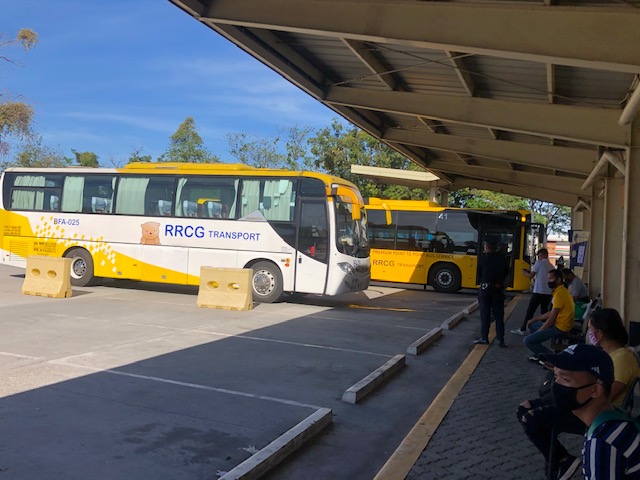 There are two bus services currently terminating here. One is the P2P bus service between Robinsons Antipolo and Robinsons Galleria, and the other is Route 9 between Antipolo and Cubao, Quezon City.
 Many of the buses were “pulled out” from their former routes. The term pulled out is actually inaccurate since public transport operations were suspended during the lockdown.
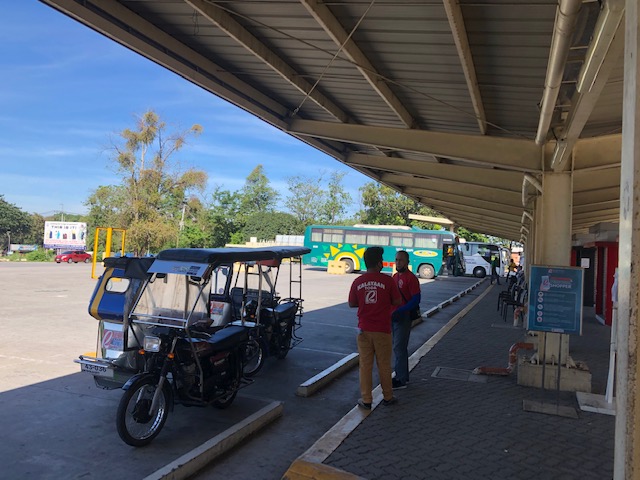 The transport terminal is an intermodal one that’s supposed to cater to buses, jeepneys, vans and tricycles. There are currently no UV Express vans operating here and traditional or conventional jeepneys have yet to return to Antipolo.
 A big part of the terminal is an area reclaimed from a failed amusement park that occupied the corner of this lot. The rides and other equipment were removed prior to the lockdowns.
 There are minimal restrictions to the vehicles accessing the terminal grounds. Here you see a taxi and tricycle moving about. Cars may be parked nearby and these (parked cars) were not uncommon before the lockdown as some people practiced “park and ride” with the P2P buses.
 EMBC buses such as this one used to ply the Tanay – Divisoria and Tanay – Quiapo routes
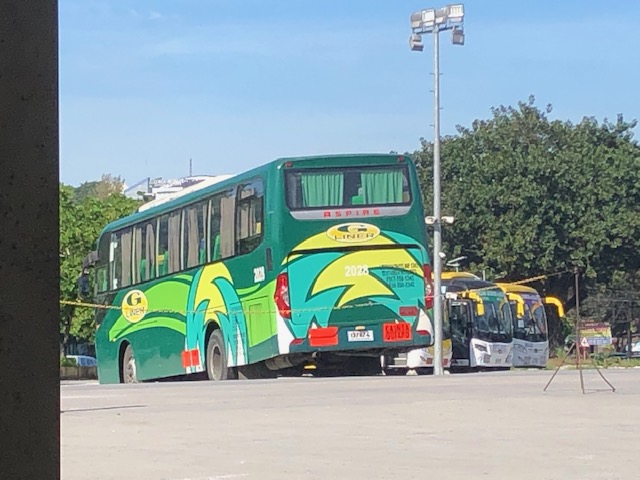 G-Liner buses are a familiar sight in Rizal where they are probably the oldest company continuing service since the 1980s. Correct me if I’m wrong but I only remember them being in operation in the 1980s. Before them were Metro Manila Transit Corp. buses and the baby buses that plied the Binangonan-Recto route.
 G-Liners now operate two routes from the rationalization program: Antipolo-Cubao and Taytay-Gilmore.
The passenger capacities of the buses and the service between Antipolo & Cubao have been significantly reduced due to health protocols. Thus, buses can only carry perhaps up to 40 or 50% of their seating capacity. I mentioned seating capacity here because of physical distancing requirements and the ban on standees. Previously, a bus left every 5 minutes and their frequency could not cover the demand along the route. Recently, I observed more buses in operation and the addition buses from two more bus companies that used to ply the Fairview-Baclaran and Fairview-Alabang routes. These could probably help ease the supply issues.
More on the Antipol-Cubao service soon!
–

