
UN General Assembly resolution on road safety
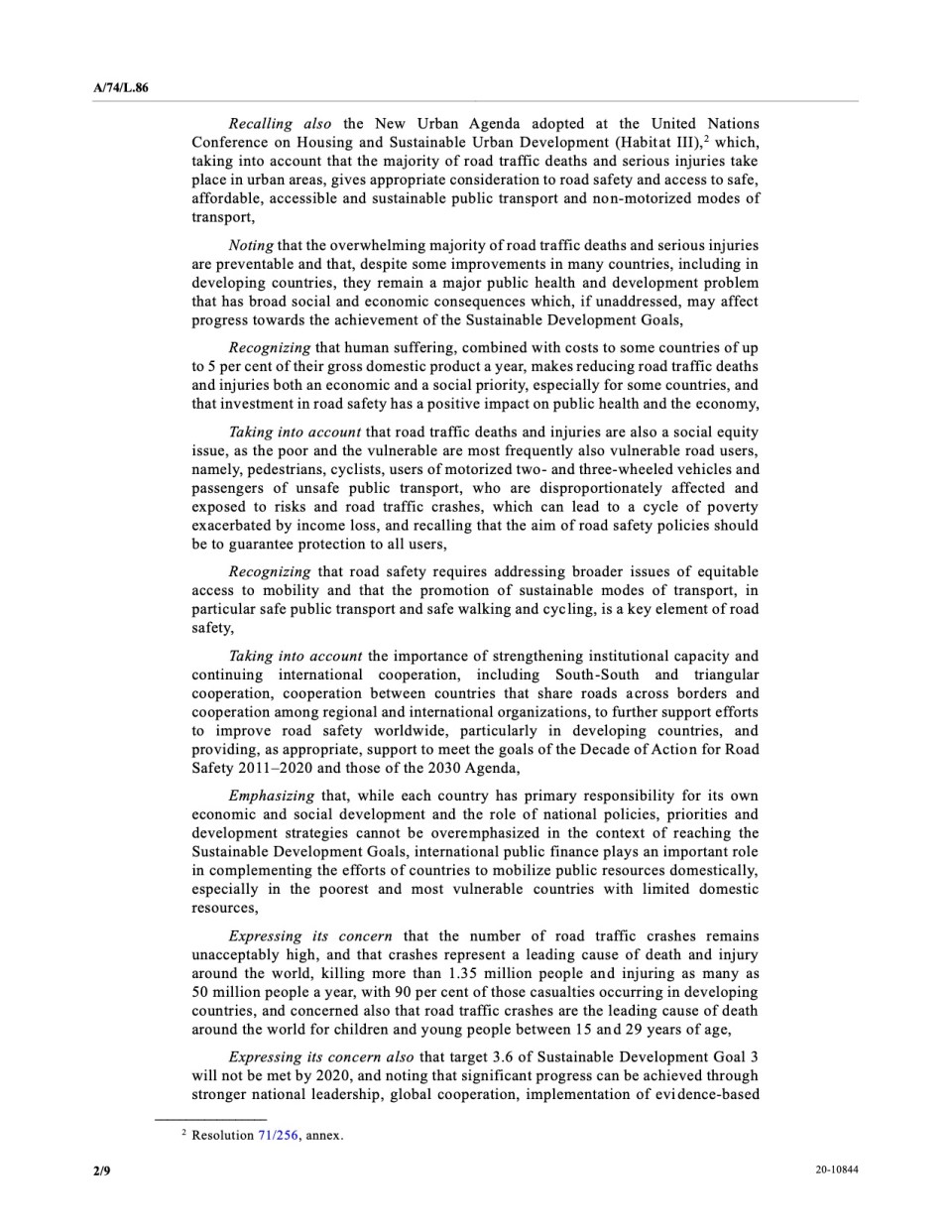
I’m posting here the 9-page resolution on road safety of the United Nations General Assembly that was recently (August 2020) passed by the body. This is the key resolution that launched a second Decade of Action for Road Safety, 2021-2030. The document may also be downloaded from the net. Here is a link to the document via the Asia Pacific Road Safety Observatory site:



–
Social distancing on trikes
We came alongside this tuktuk-type tricycle. The model produced by Piaggio is not the motorcycle & sidecar combination that is the most common type of motorized 3-wheeler in the country. The latter currently has a one passenger limit due to the health protocols instituted in light of the pandemic. The layout of the former, however, allowed for a physical barrier in the middle of the back seat that allowed for 2 passengers for the trike.
 A peak inside a Piaggio shows the plastic barrier between passengers seated at the back of the vehicle. There is also a plastic barrier between the driver and his passengers.
Being able to carry two passengers at a time contributes to reducing the number of these vehicles required to transport people. However, most passenger tricycles function as taxis and are not in the same category as buses or jeepneys in terms of the number of people they could carry. Some cities have also taken advantage of the pandemic to reduce the number of trikes going around. In the case of Antipolo, the LGU has a program encouraging trikes to take on deliveries instead of passengers. The current passenger limit should not be used to justify more of these trikes in any city or municipality.
–
On solving the inequality problem in cities
Here is another quick share of an article that is timely and relevant not just now but for years (maybe decades?) to come:
Grossman, D. (2020) “New Study Proposes a Mathematical Solution to Big Cities’ Inequality Problem,” Inverse, https://www.inverse.com/science/a-new-study-shows-why-building-more-equal-cities-could-save-lives?link_uid=15&utm_campaign=inverse-daily-2020-09-14&utm_medium=inverse&utm_source=newsletter [Last accessed: 9/15/2020]
I will just leave it here for future reference but to summarize, the article explains how cities should be planned or replanned based on the distribution or redistribution of certain facilities like hospitals, banks, schools, supermarkets, and parks. It argues that there is an optimum location for these in relation to where people live and work. If properly planned, travel distances and times can be significantly reduced.
–
Do we still have to practice self restraint in travel?
I took this photo this morning as I was coming home from the market. Ever since Metro Manila, Antipolo and other areas around the NCR transitioned into General Community Quarantine (GCQ) and Modified General Community Quarantine (MGCQ), a lot of people have been going out and taking group rides on motorcycles and bicycles as if there was no pandemic hanging around. I understand that a lot of people have been holed in their homes for quite some time now but these trips seem excessive considering many are cross-town or even inter-provincial trips that are long in terms of distance and times traveled.
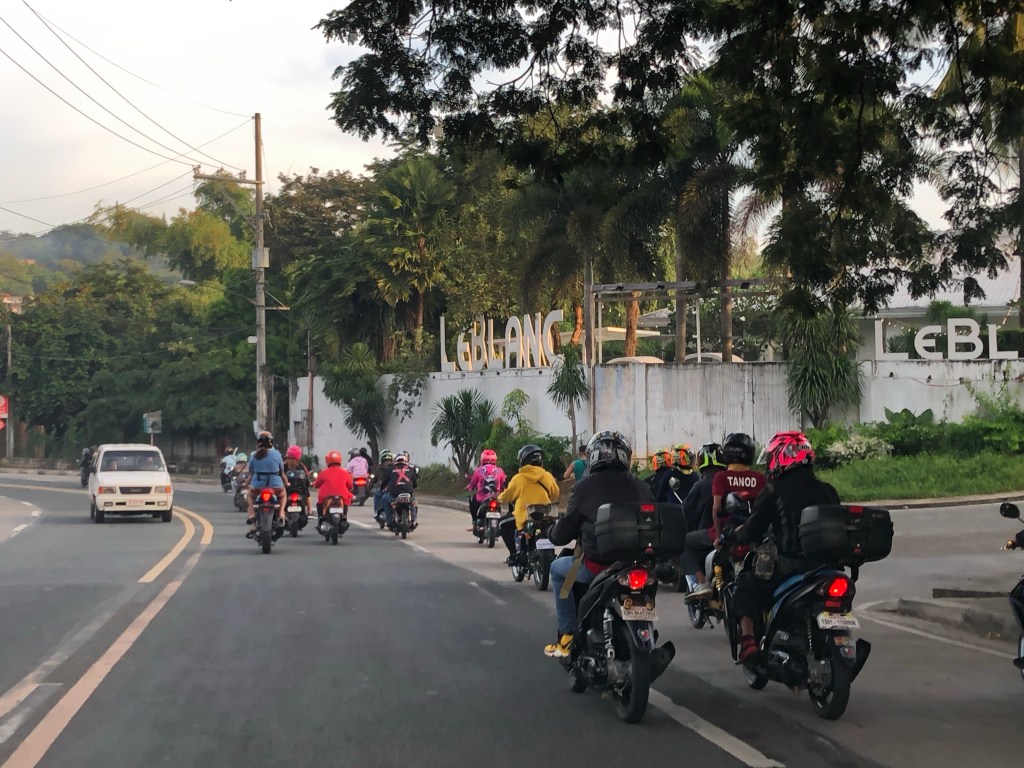
Motorcycle group traveling along Daang Bakal in Antipolo City
I posted the same photo on social media to solicit reactions or comments. I asked the question of whether these trips are necessary. So far, I only got a couple of sad face reactions and a couple of comments. The sad face reactions included one from a cycling advocate. I know the person to be very passionate about bicycle commuting but also advised vs. group rides during MECQ and GCQ. I guess the point here is that we seem to be lowering our guard against Covid-19 and to me these trips (i.e., long rides, group rides) are unnecessary trips. While there seems to be no spikes in infections due to these rides, we don’t know really as data is poorly collected and analyzed. For those who don’t give a damn, I give the analogy of road safety, many situations of reckless driving or riding do not necessarily lead to a crash but the high potential for one means it is something waiting to happen. The same applies to these rides where there might be one, just one, asymptomatic rider who can potentially spread Covid-19. Maybe those infected will be asymptomatic, too. However, others they are in contact with may not be and become seriously ill. So until we do have a vaccine vs. Covid-19 and many are vaccinated already, I would advise against these unnecessary trips.
–
Some takeaways from a UNICEF webinar
The UN together with its partners recently launch a Second Decade of Action for Road Safety (2021-2030). I will share the statement in a subsequent post. For now, I will share some slides from the recent webinar organized by UNICEF that focuses on safe and healthy journeys for children. Those of us who are working directly with UN agencies have been working on safe journeys for children particularly as they travel between their homes and schools. The recent launch and pledges or commitments of support from partner organizations will surely reinforce efforts to ensure the safety of children whether or not they return to school.

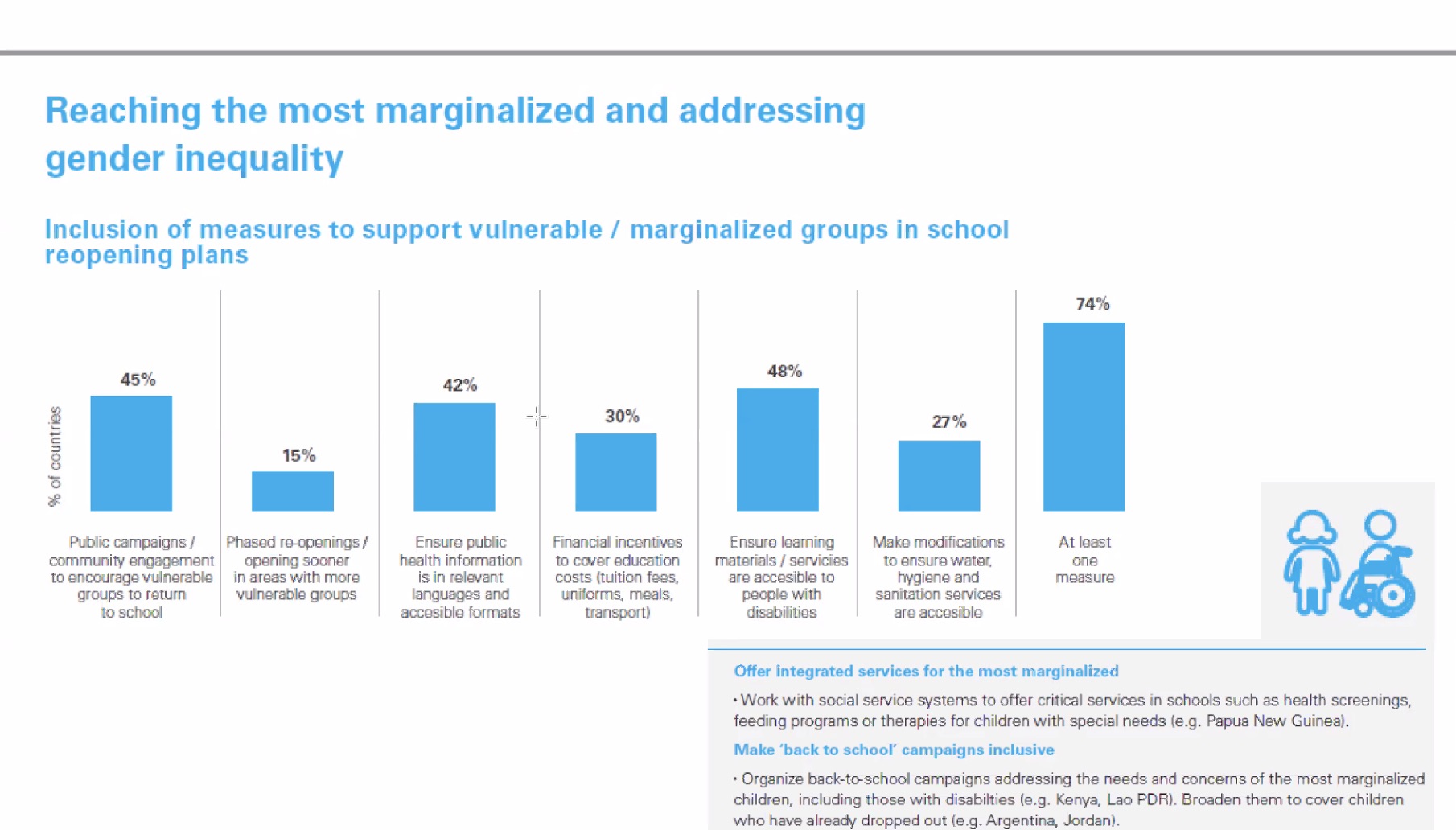 Context setting or rationale for UNICEF’s initiatives
 Key resources or references shared by the webinar host
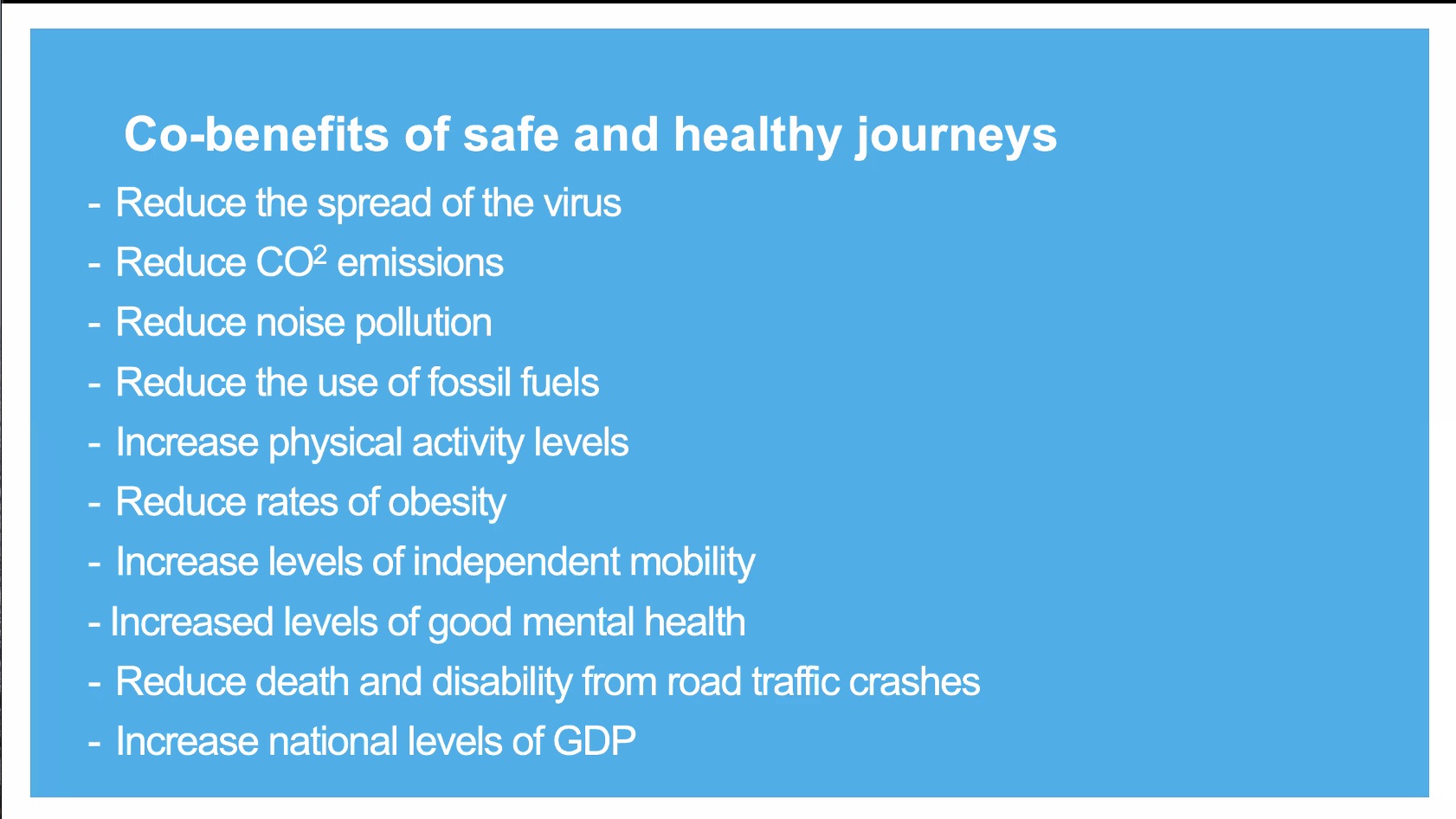 The term ‘co-benefits’ reminded me of a past project I worked on that was about low carbon transport. We also did assessment using co-benefits of low carbon transport. Among these were road safety.
 The slide and the table speaks for itself – examples of effective strategies
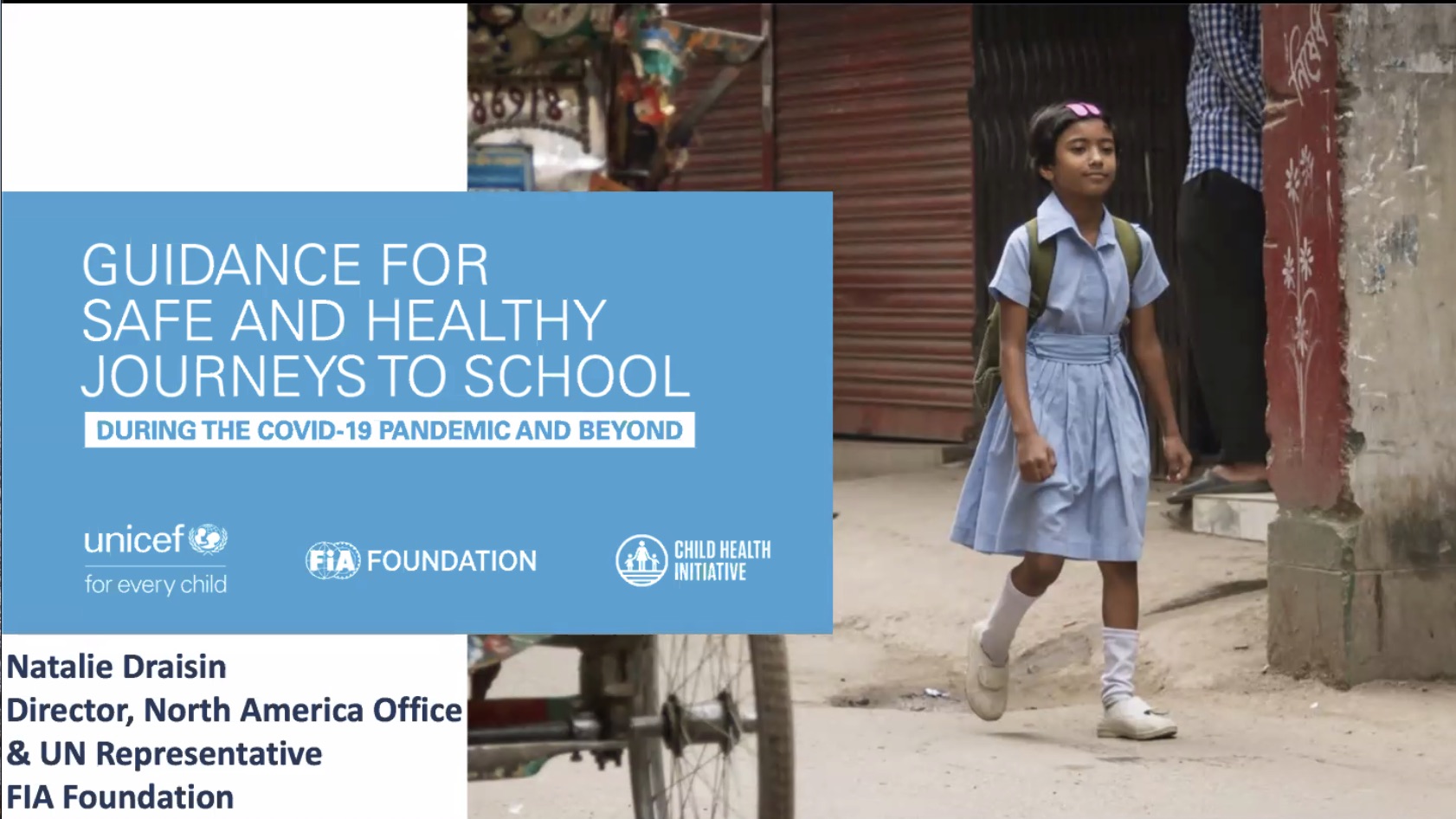 There were several presentations during the webinar. However, the most interesting and informative for me was this one about the guidance for safe and healthy journeys to school.
 Ten (10) points to consider as guidance for safe and healthy journeys to school
 Database initiative in support of the guidance (I will get the link to this and share it in a future post.)
 An example from London’s experience
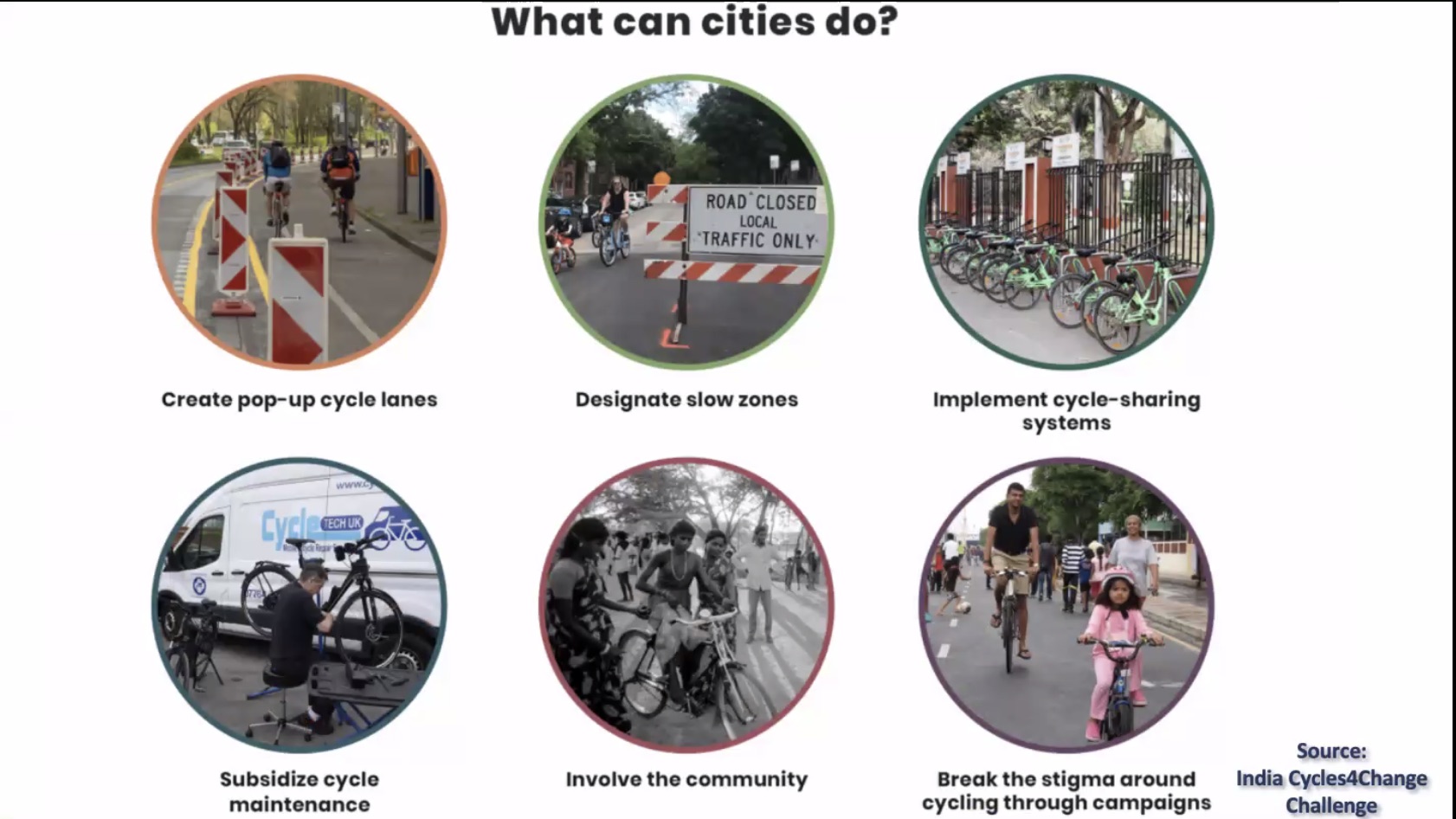 This is a slide on what cities can do to promote active transport among children.
 The photo shows what is termed as a “bicycle school bus”. This and “walking school bus” are real options for children and their guardians when traveling between their homes and schools. Such underlines the option of not using motor vehicles (i.e., reduction in motor vehicle trips).
I will try to elaborate on these in future posts, particularly on the 10-point guidance.
–
Paved paradise? On pollution due to asphalt roads and parking lots
Here’s another quick share of an article mainly about asphalt as a material used for roads, parking lots and roofs:
Pullano, N. (2020) “Sun-heated streets can lead to air pollution strikes – study”, Inverse, https://www.inverse.com/science/summer-streets-beat-the-heat?link_uid=15&utm_campaign=inverse-daily-2020-09-03&utm_medium=inverse&utm_source=newsletter [Last accessed: 9/6/2020]
While we have a significant number of roads with asphalt paving or surfacing, the majority of roads are of Portland cement concrete (PCC). Most lots are also PCC or gravel. And unlike in the US, most roofs here are made of galvanized iron (GI) sheets or even clay tiles.
–
On bicycles and transit
Here is another quick share of an article on bicycles and transit (i.e., public transport):
Cox, W. (2020) “Bicycles: A Refuge for Transit Commuters?”, New Geography, https://www.newgeography.com/content/006753-bicycles-a-refuge-transit-commuters [Last accessed: 9/4/2020]
What do you think? Are we getting there in terms of the bicycle-transit relationship? MRT and LRT lines have allowed foldable bikes to be carried in their trains but buses and other road-based public transport may not allow you to bring your bike inside the vehicle. For the latter vehicles, there are usually racks installed in front of the vehicles that can accommodate 2-3 bikes. Train stations now should have bicycle parking facilities for the last mile trips of their passengers.
–
The return of the conventional jeepneys during GCQ and MGCQ
I spotted more jeepneys along my commuting route yesterday and took photos while we were stopped in traffic (yes, roads are again congested as they were before the lockdowns). Here are the photos showing the barriers required for the vehicles to be allowed to operate. Most jeepneys also have signs at the doorway vs. passengers not wearing face masks and shields. These are required for public transport users, and drivers have to reject people not wearing masks and shields.
 Plastic sheets dividing the seating spaces and serving as physical barriers between passengers
 Plastic sheets attached to wood frames on this jeepney
 Another example of plastic sheets defining the passenger spaces.
Some jeepney seat barrier configurations seem more sturdy or offer more physical separation or protection from others. I have seen versions with metal (wire) and wood frames. And then there are the customized “trapal” types similar to the window covers that are folded for air to flow in the jeepneys and unfolded when it is raining. Instead of passengers being one seat apart though, they are practically beside each other with only sheets of plastic dividing them. For precautions sake, this does not seem to be the recommendation of the medical community. While the open windows allow for better ventilation and air flow compared to the closed, aircon vehicles, the physical distancing is not practiced as it should be, with or without the face masks and shields required when riding public transport. This may pose a problem considering we are not over the hump, so to speak, in as far as COVID-19 infections are concerned.
–
Requiem for the Antipolo-Cubao jeepneys?
From the time Metro Manila and Rizal transitioned to General Community Quarantine (GCQ), there have been limited public transport services connecting the two considering most Rizal towns are like bed towns to Metro Manila. The term “bed town” refers to towns, or municipalities, even cities, that are basically the place of residence of persons who during the day time usually travel out to workplaces or schools outside their areas of residence. Many who reside in Rizal province actually work or study in Metro Manila. Similar cases may also be found in the other provinces surrounding Metro Manila like Bulacan, Laguna and Cavite. These connections are made mainly by public transport, which for the National Capital Region (NCR) and adjoining areas currently comprise about 70% of total trips. The rest is by private transport. [Note: Not counted are trips mainly by walking and cycling. While everyone walks, walking is usually at the ends of the commutes.]
Current public transport services now comprise of buses plying the Antipolo-Cubao and Taytay-Gilmore routes that were among the first operationalized under the rationalization program of the Department of Transportation (DOTr). For the Antipolo-Cubao route, several companies have shared the load with mostly aircon buses running between Quezon City and Antipolo City. I wrote recently that there are now non-aircon (referred to as ordinary) buses serving this route and that in addition to the main line (Aurora Blvd.-Marcos Highway-Masinag Junction-Sumulong Highway via) there was now a branch going through Cogeo and via Olalia Road.
 Aircon bus approaching the Robinsons Antipolo terminal
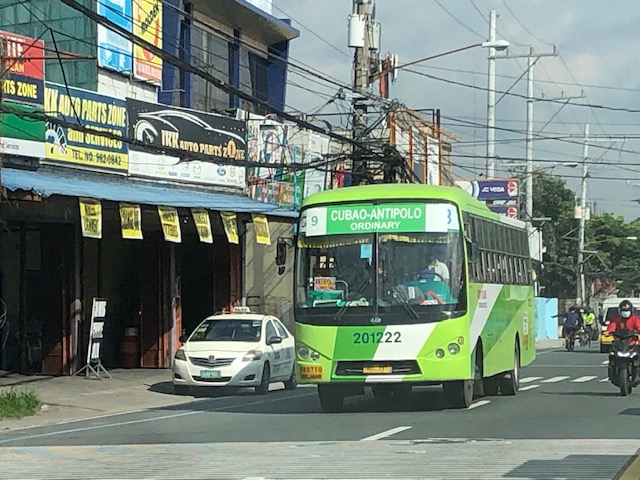 Non-aircon (ordinary) bus plying the Antipolo-Cubao route along Sumulong Highway past the Masinag Junction
We got a comment about how perhaps DOTr and LTFRB plans to introduce variations to main routes including adding to the route number to distinguish one variation from another. While the original route signs look like the one on top of the windshield in the Aircon bus in the first photo with the white box on the left displaying the route number, the bus in the second photo shows two boxes. The second box to the right of the route name is blank. So perhaps there can be an ‘A’ to refer to the original Route 9 and ‘B’ can refer to the one via Cogeo. Does this mean there can also be a ‘C’ and that can be via the even older route via Felix Avenue, Cainta Junction and Ortigas Avenue. If this becomes a reality, then that probably puts the proverbial last nail on the coffin of the Antipolo-Cubao jeepneys. Jeepneys would have been phased out for the route in favor of the higher capacity buses.
–
Other buses operating the Antipolo-Cubao route
I had mentioned in previous posts that more buses have been deployed to serve the Antipolo-Cubao route. The route had already evolved to have two alternatives: the original route via Aurora Boulevard, Marcos Highway and Sumulong Highway, and the variant that goes through Cogeo and passes through Olalia Road to/from Sumulong Highway. Here are a couple of photos showing a couple more bus companies that used to ply other routes via EDSA.
 Jayross Lucky Seven Tours bus – these used to ply the Fairview-Baclaran route via Commonwealth Avenue and EDSA with all aircon buses.
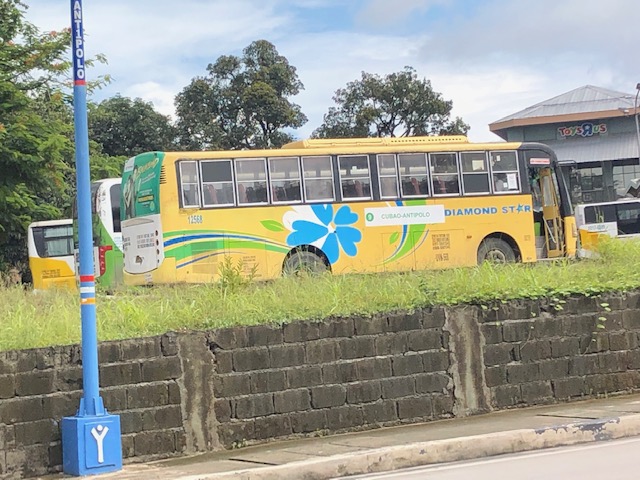 Diamond Star bus – these used to ply the Malanday-NAIA route via EDSA with both ordinary and aircon buses
More photos of other buses now serving the Antipolo-Cubao route.
–

