
Shoes made in Marikina
This seems to be an odd topic for this blog at first but then shoes are very much related to transportation. You have to have a good pair of shoes on you for walking, jogging or running. There are even driving shoes and boat shoes (i.e., those docksides and topsiders were originally made for boating or walking along the seaside). And so I write this short article about shoes; particularly those made in Marikina.
Marikina is well-known for its shoemaking industry. It used to be a major industry that manufactured shoes that were popular throughout the country as well as being exported for sale abroad. These were mainly handmade using techniques and skills passed on from one generation to the next. It was not uncommon for families to be involved in shoemaking and the brands of many shoes carry the names (or combinations) of families involved in the business. There was even a Marikina Shoe Expo in Cubao where I recall we had bought many pairs of shoes for school and casual days. Among the brands I remember were Chancellor, Valentino and Cardams. There is also a Shoe Avenue in the city along which many shops are located. In many cases, these are also the factories themselves.
The industry suffered due to a combination of automation (i.e., mass production) and the influx of cheap shoes from China. Without government support for the industry, many, regardless of whether they were small or big, eventually seized shoemaking. Those who survived and those who were revived are the ones you still see. And then there are upstarts who have been encouraged by the support now being provided by the city government. One venue for this support is through a “Sapatos Festival” that the city organises to promote shoes and other footwear made in Marikina.
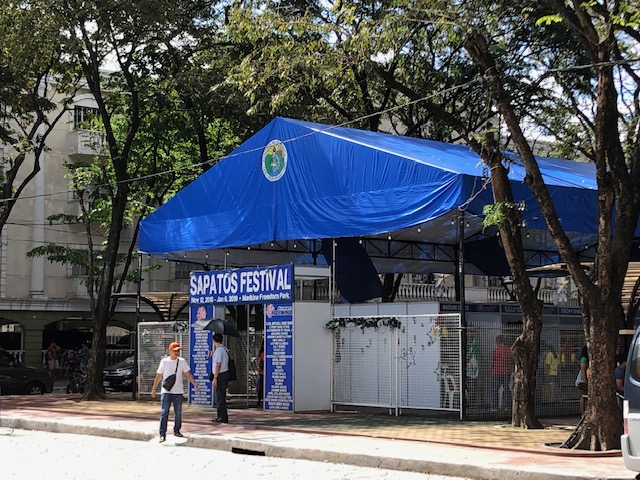 The Sapatos Festival was held right across from the Marikina City Hall.
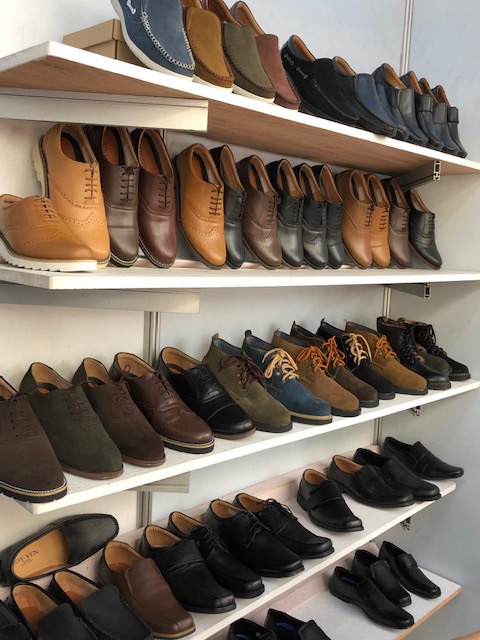 One could find a variety of footwear using various materials including genuine leather, rubber, faux leather, etc. This photo shows men’s shoes being sold at one of the shops there.
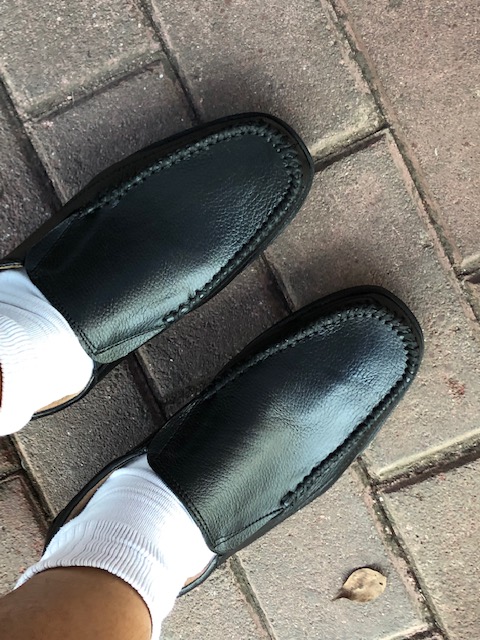 I tried on a pair I fancied and after the typical examination of workmanship and quality, I decided to buy this pair for 900 pesos (about 9 US dollars!).
Marikina-made footwear and bags are also sold at the Riverbanks mall that used to be a textile factory complex. These are inexpensive yet very good quality products that I think we should re-discover and support. Perhaps we should also provide constructive comments or suggestions on how the makers can further improve their products in order for them to be able to compete with the mass-produced variety. There is definitely a market for well-made footwear whether you walk, take public transport or drive.
–
Aerial photo: Diliman, Quezon City
The aircraft we were flying on in a recent trip circled on the approach to NAIA and we were afforded some terrific opportunities to take aerial shots of Quezon City. This was before the rains of the Christmas holidays so the skies were clear of clouds. Here is one of the photos I took showing the University of the Philippines Diliman campus.
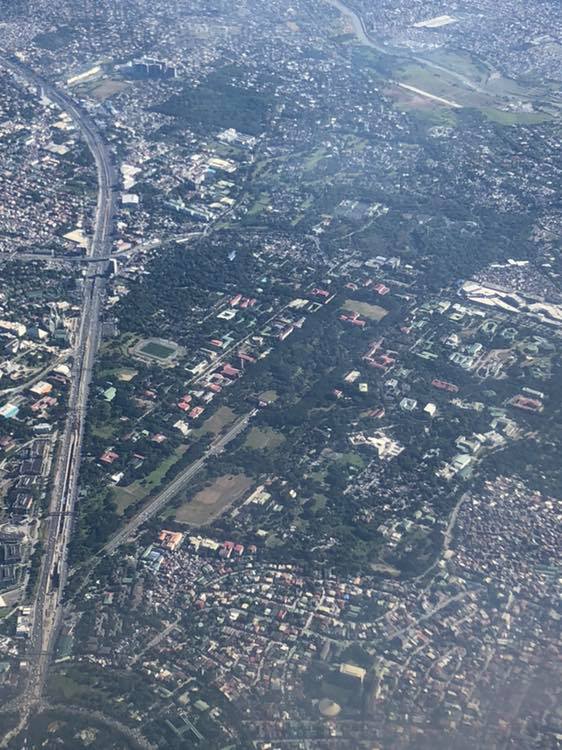
That wide road on the left is Commonwealth Avenue and you can see part of the Elliptical Road at the bottom left. There are few large patches of green in Metro Manila and many are in the largest city – Quezon City. You can see that these include the campus and Balara.
Aerial photos are no longer that rare these days as there are many who take shots from drones. Then, of course, there are shots like these you can take from the plane you’re riding. Have a nice Sunday!
–
Smoggy Metro Manila and a look forward to improving transport and air quality in 2019
I took the photo as we were driving up to Antipolo one morning this month when the opportunity presented itself for a quick photo of Metro Manila:

This serves as a reminder for those working to improving air quality in Metro Manila and elsewhere. It has already been established that much of the air pollution in Metro Manila and its adjacent areas can be attributed to mobile sources (i.e., motorised transport). A reduction of motor vehicle use, particularly cars, combined with more efficient engines and cleaner fuels should be lead to significant air quality improvements and, ultimately, an improvement in the quality of life. Of course, there should be parallel efforts to improve facilities for walking and cycling, and implementing the mass transit projects that will carry most people between the origins and destinations regardless of the distances.
Here’s to the approaching 2019 and the optimism that comes with the New Year!
Manigong Bagong Taon sa lahat!
–
The Julia Vargas Avenue protected bike lane
I thought I already posted an update on the Julia Vargas Avenue in Pasig City. It turned out I was only able to upload photos on my folder but wasn’t able to get to writing about the bike lane. And so we conclude the year 2018 with a positive post of something we would like to see more in 2019 and beyond. We are hopeful that the protected bike lanes along Julia Vargas Avenue, connecting C-5 with the Ortigas Center, will expand and that this example along those of its predecessor bikeways in Marikina and Iloilo would be replicated across the country particularly in highly urbanised cities.
 A view of the westbound bike lane along Julia Vargas at the Ortigas Center. Note that the eastbound bike lane (visible in this photo) is not similarly protected vs. motor vehicle encroachments. It would be preferable for that lane to be protected, too. Parang bitin pa tuloy ang effort nila.
 Another view of the protected bike lane along the westbound side of Julia Vargas Avenue in contrast with the obviously congested lanes available for motor vehicles.
The middle lanes of the carriageway are wide and can accommodate motorcycles though the latter always seem to prefer filtering or splitting the lanes. The median lanes are generally for low occupancy vehicles (less than 3 passengers) while the middle ones are for high occupancy vehicles (3 or more passengers) including UV Express vans and buses.
Happy New Year to all!
–
Some suggestions for the bike lane along C-5/Katipunan Avenue
In the spirit of the season, here are some recommendations or suggestions (if this term is preferred) for the bike lanes drawn along Circumferential Road 5. First, rather than a token lane that will fit exactly the width of a pedicab, I suggest that an entire lane be allocated for either side of C5/Katipunan Ave. But at the very least perhaps it should be half a lane rather than a third. Second, instead of a green line that can be invisible to many during the night time and on days like this rainy Saturday, have a double yellow as a delineator. This definitely has more clout than the solid green line, which is unfamiliar to most road users. Third, the bicycle lane must be painted for it to be clearly marked for bicycles. And last, the lanes must be protected, physically, from likely encroachments of motor vehicles. Perhaps bollards can be installed similar to what Pasig has done along Julia Vargas. Here are a couple of illustrations I quickly made using PowerPoint as I updated my lecture material for complete streets.
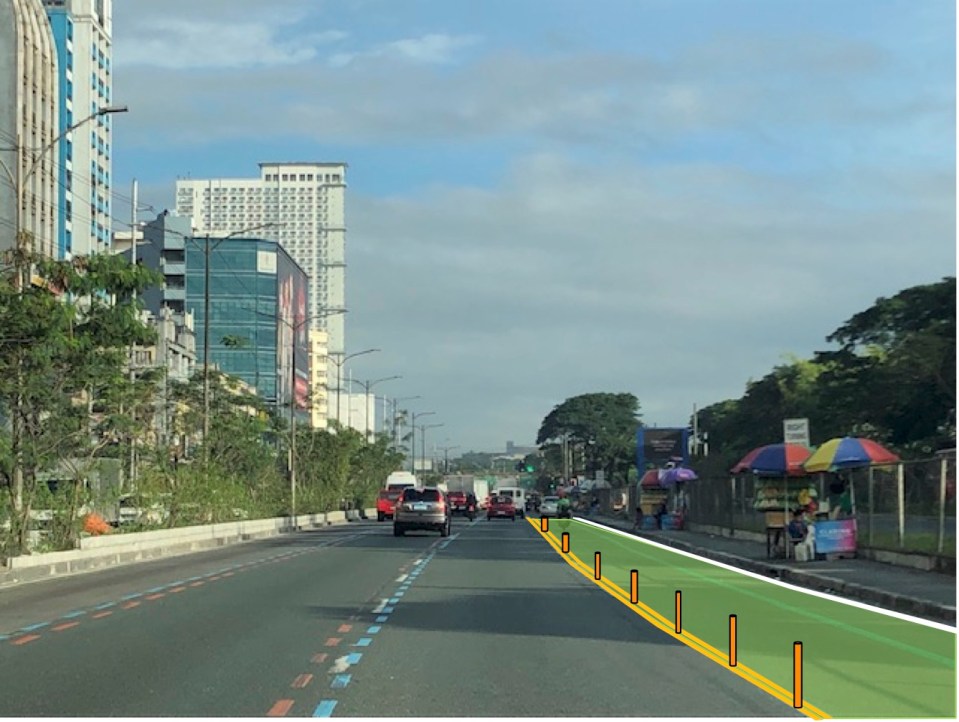 Suggestions for the bike lane along the NB side of Katipunan Ave. (C-5)
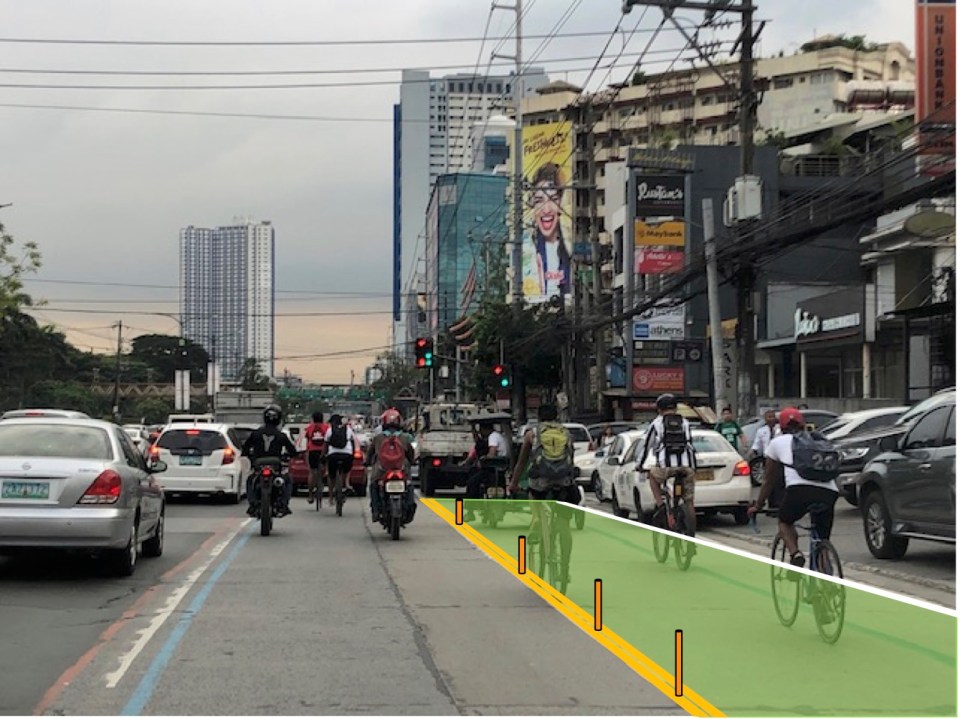 Suggestions for the bike lane along the SB side of Katipunan Ave. (C-5).
The NB side of Katipunan is less challenging with respect to the design details required for driveways and public transport stops. That is mainly because this is where the two schools, Ateneo and Miriam, are located. The SB side is more complicated due to the way the establishments there were developed. Note the roadside parking on the photo and there are numerous driveways from the condos, shops and restaurants on this side of Katipunan. Recall that this side used to have a service road where the two outermost lanes are, and a tree lined island separate this two-way road from the main carriageway of C-5. Perhaps it would be nice to re-imagine Katipunan with this service road again. I will leave the intersection and driveway details as a challenge to my readers and students. The same for a more complete re-imagining of Katipunan Ave.
Katipunan bike lanes?
Here are photos of the bike lanes along Katipunan Avenue (Circumferential Road 5). The lanes are basically just marked with a solid green line but without any signs or pavement markings reinforcing this designation. The lanes are not protected ones like the example along the eastbound bike lane along Julia Vargas Avenue in Pasig City. And so, as expected, there are many motor vehicles encroaching upon the Katipunan bike lane including parked or standing vehicles as shown in one of the photos below.
 The bike lane is derived from the outermost lane of Katipunan
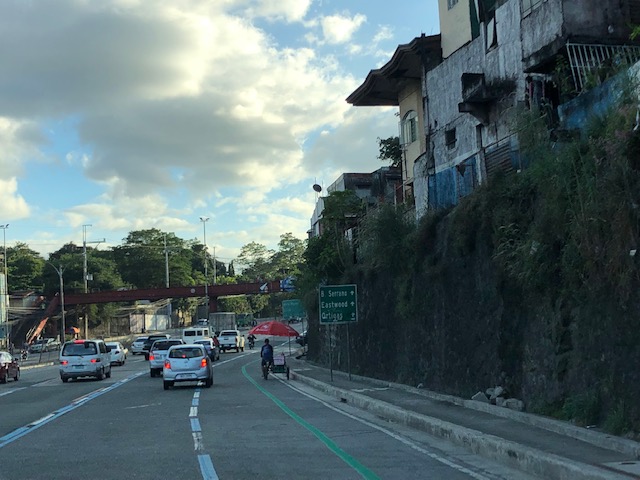 Here is the bike lane along the southbound side of Katipunan at the approach to Tuazon Avenue. That’s a pedicab on the bike lane so one can easily appreciate the dimensions particularly the width of the lane.
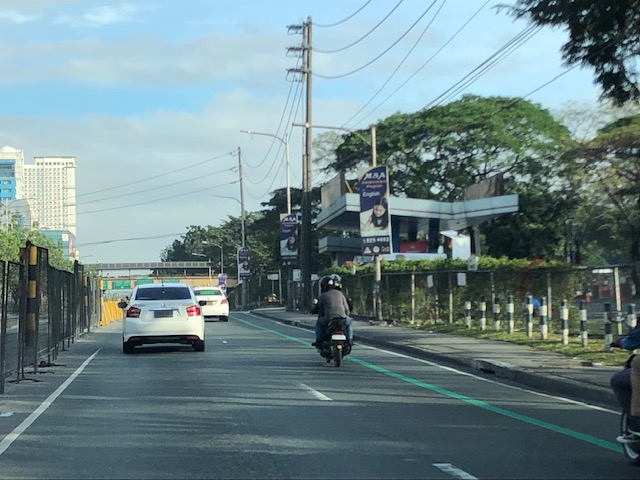 Bike lane along the northbound side of Katipunan approaching Ateneo’s Gate 2
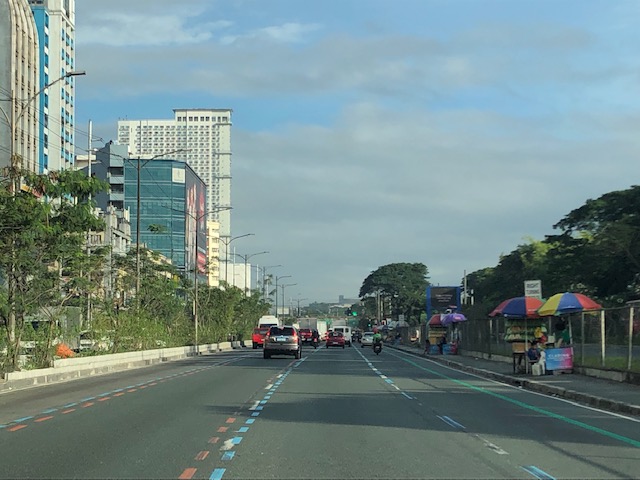 The bike lane along with the designated truck lane and motorcycle lane.
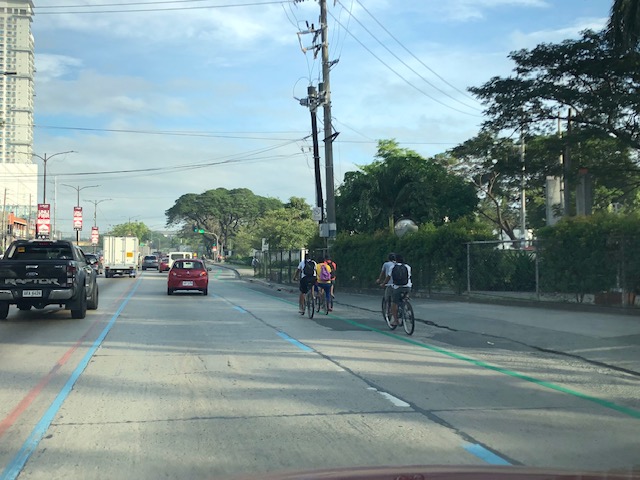 Here are cyclists using the lane past Ateneo’s Gate 3 and approaching the main gate of Miriam College
I’ll try to sketch a few recommendations into the photos as I have done in a past article:
On the Pasig HOV lane experiment
This can also be used for exercises I assign to my graduate and undergraduate classes when we’re on the topic of complete streets.
–
Persons-with-disabilities- and senior citizen-friendly ramps for aircraft
The trip to Cagayan De Oro via Laguindingan Airport allowed me to take photos of the new ramps being used in our airports. These ramps are suitable for persons with disabilities and senior citizens who may have difficulties ascending or descending the usually steep stairs of aircraft from or to the ground. Not all airports have the tube or bridges connecting the terminal to the plane. Here are some of the photos I took at Laguindingan Airport prior to boarding our plane to Manila.
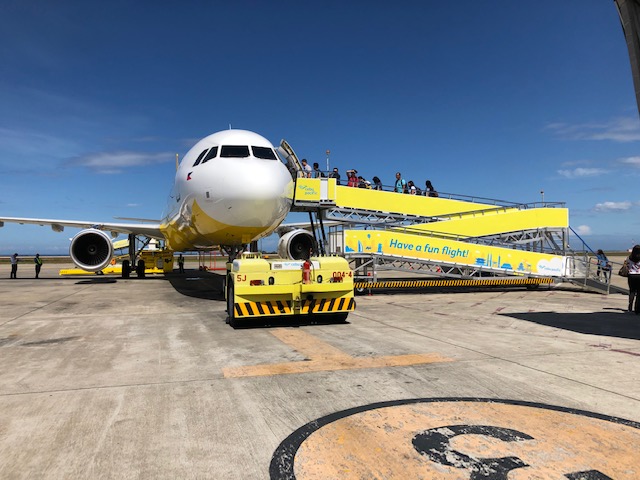

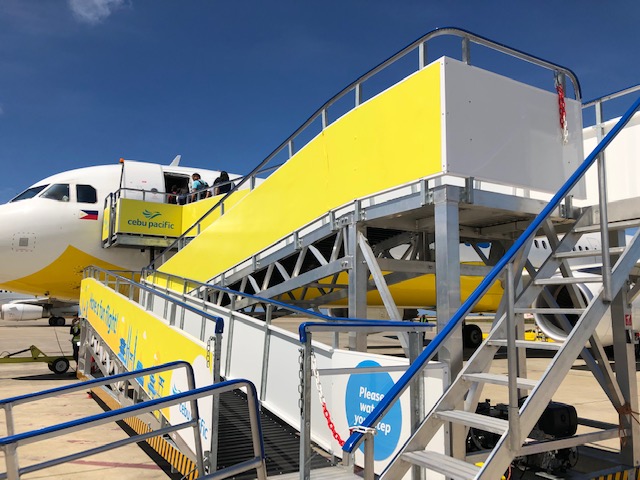
Compare the ramps to the conventional stairs for the rear door of the aircraft.

Meanwhile, smaller aircraft such as the turboprop plane below have built-in stairs. But these planes are lower compared to the larger Airbus 321’s we flew on our way back home.
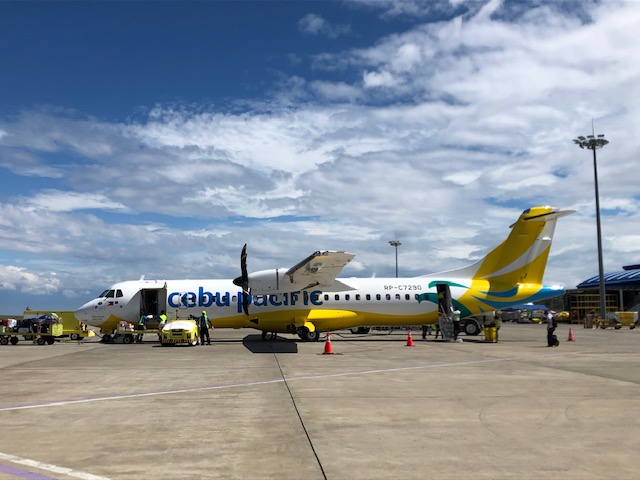
I also saw the same ramps at NAIA when we deplaned near Terminal 3. But it seems Cebu Pacific is the only local airline who are using these? We hope there would be more of these in every airport in the country. That will definitely be for the benefit of all and not just those with physical disabilities or physically-challenged.
–
About the habal-habal again
There’s a nice article written by the current City Administrator of Cebu City, Nigel Paul Villarete. Paul has a regular column in a major daily and one that is always a good read. The article is a consolidation of previous articles he has written about the habal-habal or motorcycle taxi.
Villarete, N.P. (2018) “Habal-habal: the Two-Wheeler “Public” Transport in the Philippines,” http://www.streetlife.com, http://streetlife.villarete.com/habal-habal-the-two-wheeler-public-transport-in-the-philippines/?fbclid=IwAR06y9lrH-j6YtXRLf6rDL_JssnewNhR0b49dJ4Muc2PKyCzxeK50X6Ul6Y [Last accessed: 12/21/2018].
The article is relevant and current in its take on the motorcycle taxi and why it is important to consider this mode of transport as a form of public transportation. For one, it obviously gives people another choice for travel that is supposed to be able to cut down travel times compared to when they use conventional public transport or private vehicles. The question and perhaps the challenge to those operating such services is to prove that they are a safe mode of transport. Also, not to forget, is the question of fares and how to set the proper structure in order to protect people against abusive or excessive fares charged by the service providers.
There is news recently that the DOTr is convening a technical working group (TWG) to look into what they perceive as an issue on habal-habal. I wish the TWG well and hope that this will lead to something constructive including regulations that everyone can agree to. That said, I also believe that service providers, especially transport network company (TNC) Angkas, should exert more effort to prove they are a safe mode of transport rather than resorting to what appears to be more a fallacy of appealing to the emotions of people while trying to evade the legal constraints imposed on them. There is definitely a difference in motorcycle taxi operations in rural areas compared to those in the urban setting including the fact that they would have to deal with more vehicular traffic along urban roads. This means more interactions with other vehicles that may lead to an increased likelihood of road crashes involving motorcycle taxis if the latter don’t exercise safe driving practices.
–
On payment schemes for public transport services
Here is a nice article about paying for your fares:
Weinstein, Z. (2018) “Why do so many public transit agencies make it so difficult to… pay for public transit,” http://www.medium.com, https://medium.com/@z_75510/why-do-so-many-public-transit-agencies-make-it-so-difficult-to-pay-for-public-transit-c5ae98ae2571 [Last accessed: 11/28/2018].
This is interesting for us as we are just starting to come up with more efficient and innovative ways for paying for public transport services. This is in the form of the Beep card that is now being used for rail transit services as well as for some buses and jeepneys (electric?). Still, we have a lot of catching up to do in the Philippines compared to, for example, Japan and Singapore where it’s possible to go cashless in paying for public transport. We don’t even have a pass (e.g., there’s a monthly, quarterly and even annual pass that Japanese railway companies sell to students and employees that gives them a substantial discount for travels between their home station and work or school station) for regular transit users. Hopefully, the use of Beep will expand and perhaps other modes of payment may be introduced for the convenience of public transport users.
–
On motorcycle taxis again – in support of the habal-habal
I was writing this article when I read the news about the Supreme Court upholding the LTFRB’s decision against motorcycle taxis, particularly that vs. Angkas. Prior to that, I’ve been spotting more of the “formal” motorcycle taxis around Metro Manila. And more recently, there have been news reports about some of them, particularly Angkas, being involved in road crashes. While I support having motorcycle taxis in part to address transport and traffic issues, I still have reservations concerning the safety of these services. The recent crashes and how they were or are handled will provide us with better insights on what regulations should apply to them. I know people tend to be allergic about ‘regulations’ especially when associated with the LTFRB or DOTr. But we have to understand that regulations are important to ensure safety of users of the service. That is, of course, if we assume the regulations are properly implemented or enforced. This is still a big question mark with a host of other regulations that are already in place and spelled out and yet are not enforced.
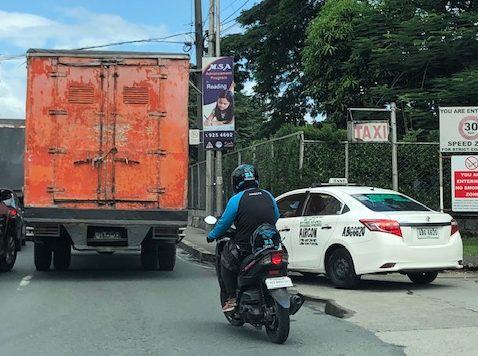 Angkas rider along Katipunan Avenue
More recently, I’ve spotted Angkas riders in Antipolo and Cainta along my usual commuting routes. And then I noticed quite a few of them in Cagayan De Oro, which means a more formalised “habal-habal” given the identification of Angkas riders with their helmets and shirts. Other “habal-habal” do not have anything to distinguish them from general motorcycle traffic. Former students with the DPWH who have access to data on road crashes state that there is still an increasing occurrence of motorcycle-related crashes and many involve those with passengers. However, it is unclear whether these are the typical free “riding in tandem” cases, which are likely the most common, or the “for hire” case as with motorcycle taxis like Angkas. I guess the key here is to keep the discussions ongoing and come up with solutions to address issues rather than simply ban the habal-habal.
A friend tagged me in a social media post where he explained his position on the motorcycle as a mode of public transport. He also shared some articles he wrote for his newspaper column. I replied that I also support inclusion of this mode of transport and think that authorities should engage positively and progressively. Again, there are opportunities here to help alleviate transport problems. Government should busy themselves in ensuring safety and security rather than just go for a ban. That’s a lazy approach to this matter.
–
 Caught (up) in traffic