
On inflight meals again: Emirates
I decided to take Emirates for my recent trip to The Netherlands as I opted to have a stopover in Dubai to have some recovery time. Travel time between Manila and Dubai took about 8 hours and between Dubai and Amsterdam about 7 hours. I thought (and friends have also told me) that this was better than having a very long flight where you’re practically confined to the aircraft. I have also been informed that the inflight meals on Emirates were better than most airlines even on economy. I must agree with that observation and I’m now posting some of the “stolen” shots I took of the inflight meals.
 Breakfast served on the Manila-Dubai leg of my trip
 Breakfast on the Dubai-Amsterdam leg of my trip
 Menu on the Dubai-Amsterdam leg of my trip
 The lunch selection was okay and I always thought that one doesn’t have to gobble up everything served to you inflight. Eat and drink just enough so you won’t feel hungry or thirsty on a long flight. Check out the food if the taste suits you. If you don’t feel eating or it doesn’t taste right to you then perhaps you should pass or opt for some light snacks.
I refrained from taking photos of my meals back to Manila but they were again alright compared to most inflight meals I’ve had. I guess the better ones I’ve had would be on my long haul flights to the US with Japan Airlines (JAL). Of course, I am sure other people would have other opinions about inflight meals including those who categorically state these are unhealthy. You are certainly entitled to your opinion but keep it to yourself and don’t even try posting it here. 🙂
–
On the negative social impacts of ridesharing/ridesourcing
I have shared a few articles before about the impacts of ridesharing/ridesourcing to taxi drivers. In the Philippines, taxis where ridesharing/ridesourcing services are available are plenty are supposed to have experienced a significant drop in their business. Yet, there has been little improvement in taxi services in Metro Manila. The Department of Transportation (DOTr) and the Land Transportation Franchising and Regulatory Board (LTFRB) have not put pressure on taxis to improve so operators and drivers are pretty much the same in terms of practices and service quality. Here is a recent article that appeared on Wired about New York taxi drivers:
Katz, M. (2018) “Why are New York taxi drivers killing themselves?”, wired.com, https://www.wired.com/story/why-are-new-york-taxi-drivers-committing-suicide/?CNDID=37243643&mbid=nl_032918_daily_list1_p4 (Last accessed 3/30/2018).
Admittedly, the set-up for New York taxis is quite different from those in the Philippines. The medallions referred to in the article are limited and carries with it prestige and perhaps honour, considering the commitment and pride attached to them. Franchises in the Philippines are quite different and drivers will usually work for multiple operators/employers. Those who own their taxis are not so many and can be flexible in the way they conduct their business. Perhaps a significant number of drivers have even left the taxi business and now drive for TNCs like Grab and Uber.
With Uber’s sale of their business in Southeast Asia to main rival Grab, it seems now that there is suddenly and practically a monopoly of the ridesharing/ridesourcing business. Upstarts have not had a significant share of the market and by all indications will not get a bigger share in the near future. I still think that there should be pressure for taxi services to be improved and a good chance for people to shift back to taxis. But this requires effort on both sides (regulator and operator). I still mention examples of taxi operators in Cebu and Iloilo who appear to be unscathed by the entry of ridesharing/ridesourcing in those cities. Good quality taxi services will promote itself and will be patronised by commuters.
–
A bridge too far
I’m currently in the Netherlands and after fulfilling my responsibilities here, I decided to go on a trip to Arnhem. Arnhem was the site of one of the more memorable events during World War 2 when the British 1st Airborne attempted to take the Arnhem Bridge as part of Operation Market Garden. The drama that unfolded is told in the movie “A Bridge Too Far” where Arnhem was the titular bridge that was to be taken and held by the British. However, only Lt. Col. John Frost’s 2nd Parachute Battalion made it to the bridge and had to defend it against a superior German force.
 My first look at the historic bridge over a river branch of the Rhine
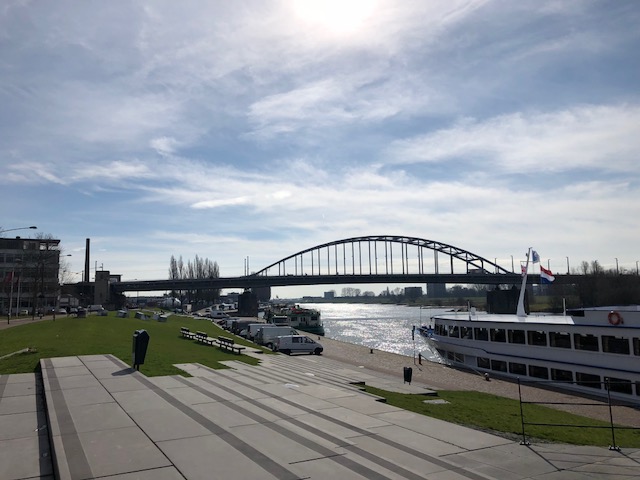 A view of the bridge from the platform in front of “Airborne at the Bridge”
 Airborne at the Bridge is kind of a museum with video retellings of the events pertaining to the bridge. It includes material of Operation Market Garden, which was a massive land and air operation that was supposed to lead to an end of the war in Europe before Christmas 1944. They also have a shop selling literature about Market Garden and the events of the bridge as well as souvenirs.
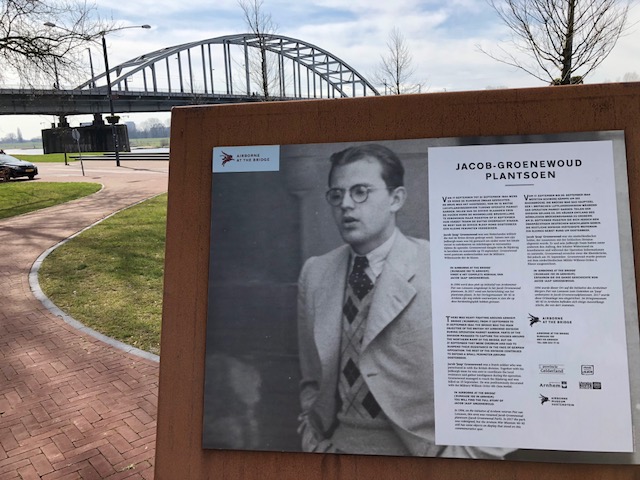 A memorial to Jacob Groenewoud who helped gather intelligence for the allies during the operations to take the bridge. He gave his life to this cause, falling after being shot by a German sniper.
 Airborne Memorial – an old artillery piece is set-up as if targeting the bridge. This was the side the British held until defeated by the Germans after what was a costly battle. The British lacked supplies as ground forces that were to relieve them were delayed at other bridges before Arnhem.
 A view from under the bridge
 A view of the bridge from the end that was held by the British. There are now bicycle and pedestrian lanes on either side of the bridge, which is now called the John Frost Bridge.
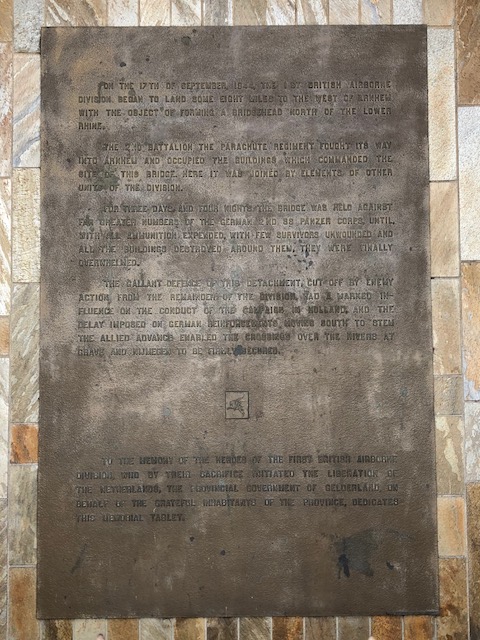 There is a plaque and memorial on the bridge retelling what transpired there in September 1944.
 Liberation route marker near the bridge
I had thought about going to Arnhem during this trip in The Netherlands. I am a military history buff and would have regretted it much if I wasn’t able to go to this site of one of the more dramatic events during World War 2. I picked up a few souvenirs at the memorial shop and will remember this experience quite fondly.
–
On Visita Iglesia and Quiapo transport and traffic
As it is already the Holy Week, I thought it would be good to write about transport and traffic around one of the busiest churches in the Philippines – Quiapo Church. This is surely a popular stop for the Visita Iglesia, which is a tradition for many during the Holy Week. People visit as many churches (usually the target is seven) as they can where they are supposed to pray the novena appropriate for the season.
 A side view of the church from Quezon Boulevard, which is the main access road for the church. Most public transport pass along this boulevard that connects to other major roads. It’s a good thing that the City of Manila has been stricter in enforcing against on-street parking here.
 In front of the church is Plaza Miranda, where many political rallies are held including one fateful rally in the early 1970s that eventually led to the declaration of martial law, is a bustling area with many vendors selling all kinds of items, religious and otherwise, including those that are claimed to be medicinal. Note though that vehicles are allowed to park on-street and this means people would have to hail jeepneys in the middle of the street.
 This is traffic along Quezon Boulevard as seen from the descent from the Quezon Bridge (Quiapo church is seen at the left). I took this around 4PM on a Wednesday so it was not surprising to have heavy traffic on both sides of the boulevard. I’ve been told, however, that for most of the day during weekdays, traffic is as heavy as this.
Traffic in Quiapo is not as heavy on Sundays (It’s also quite as bad on Saturdays.) and holidays. During the Visita Iglesia period of Holy Thursday and Good Friday, however, there will likely be heavy traffic in the area as a lot of people bring their own vehicles for the Visita Iglesia as well as for their “church tours”. I used the term “church tours” because I’ve observed that many don’t really come to pray (e.g., Stations of the Cross or novenas) but to take photos (i.e., selfies or ‘groupfies’) and eat & drink about. In Metro Manila, there are several churches popular for this tradition. These include Our Lady of Perpetual Help in Baclaran, Christ the King, Sto. Domingo and Our Lady of Lourdes in Quezon City, and the Manila Cathedral, San Sebastian, St. Jude, Malate and Binondo Churches in Manila. That is not an exhaustive list as there are many churches (old and new) spread around Metro Manila including those in other cities like Malabon, Marikina and Las Pinas. And then there are also the churches in the provinces surrounding Metro Manila, which I will try to write about soon…
–
Tacloban City’s New Transport Terminal
Tacloban City has what is called a new transport terminal located to the northwest of downtown and across from the new Robinsons mall in the area. Here are a few photos of the terminal taken earlier this year.
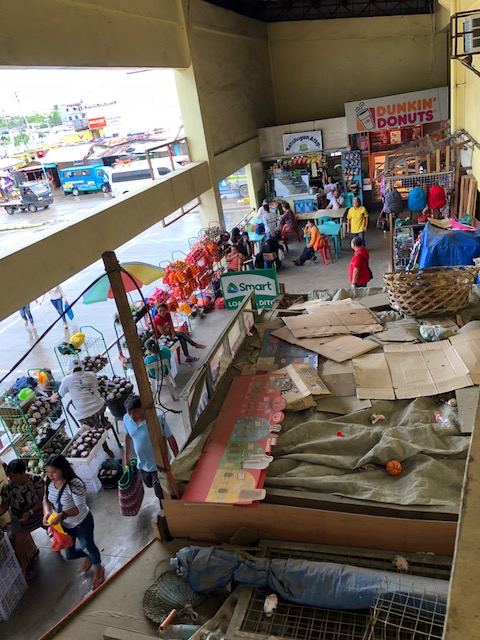 Vendors selling mostly food items including local delicacies
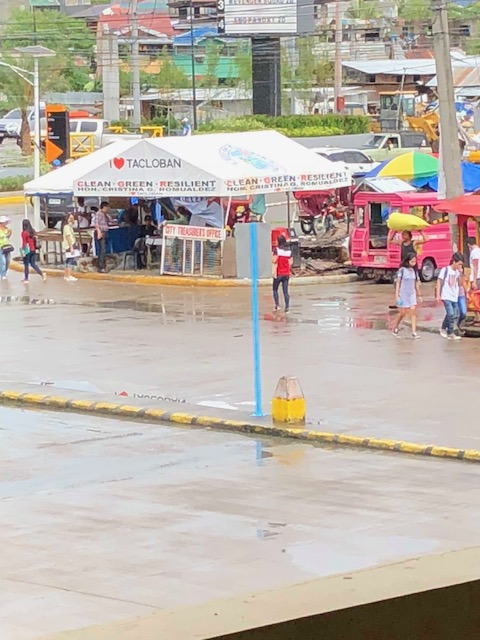 The City Treasurer’s Office has a makeshift post at the terminal to collect fees from transport operators including buses and vans using the terminal.
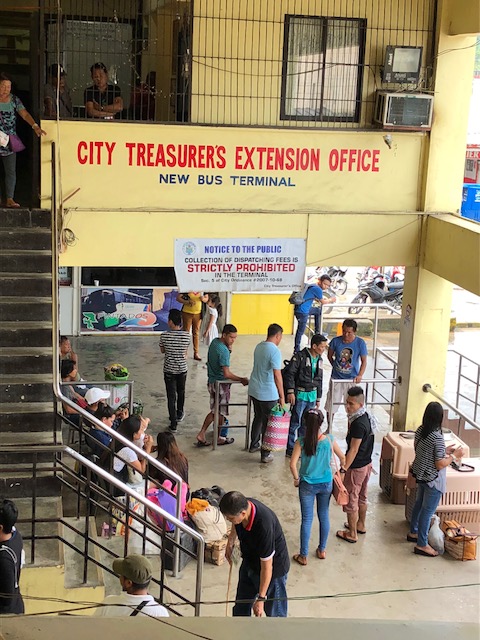 The terminal hosts an Extension Office of the City Treasurer and also has a K-9 unit to help keep the terminal safe and secure. The dogs work regularly to sniff out illegal substances that may be carried by people using the terminal.
 Passengers wait for their buses or vans at the terminal.
 The waiting area is not air-conditioned but is relatively cool and is clean.
 Another view of the passengers’ waiting lounge
 Passengers may purchase bus tickets at the terminal prior to boarding a bus.
 The same goes with vans including those called mega taxis
 View of the front of the terminal
 A view of the terminal from the transport parking lot
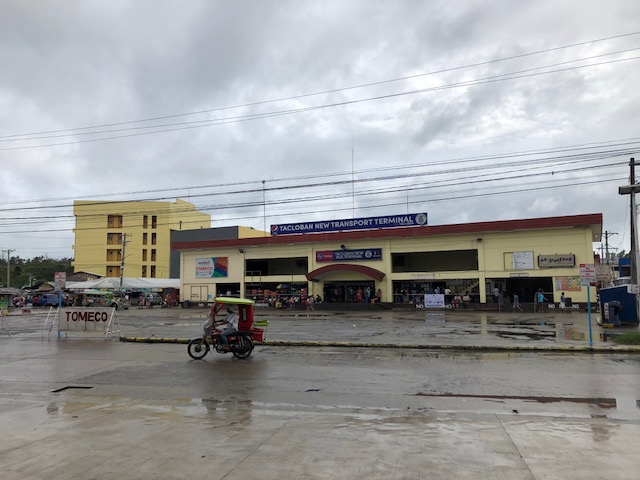 A view of the terminal from mall across from it. Note the sign at the left side of the photo? The office of the city’s traffic management and enforcement unit (TOMECO) is located at the second floor of the terminal.
Tacloban hopes to continue development of the terminal area that will eventually be expanded to have an even larger lounge for passengers, a hotel and more commercial spaces aside from berths for public transportation.
–
On P2P bus services
We decided to take a Point-to-point (P2P) bus from Quezon City to the Ortigas Center to attend a meeting there. The venue was close to SM Megamall so we thought it best to just take the bus service from SM North EDSA. It was my first time to take a P2P bus but was familiar enough with the service from the research our students have been doing on public transport. Here are some photos from the experience.
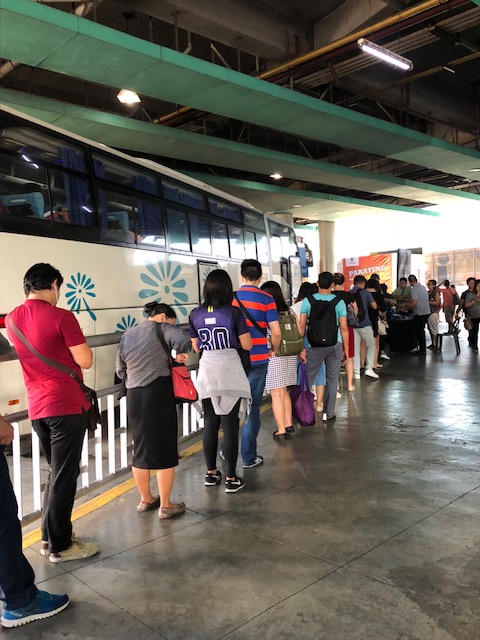 There’s a line for passengers riding the P2P bus from SM North to SM Megamall. It appears to be long but it moves pretty quickly because of the frequent bus arrivals that time in the morning (around 9:00 AM).
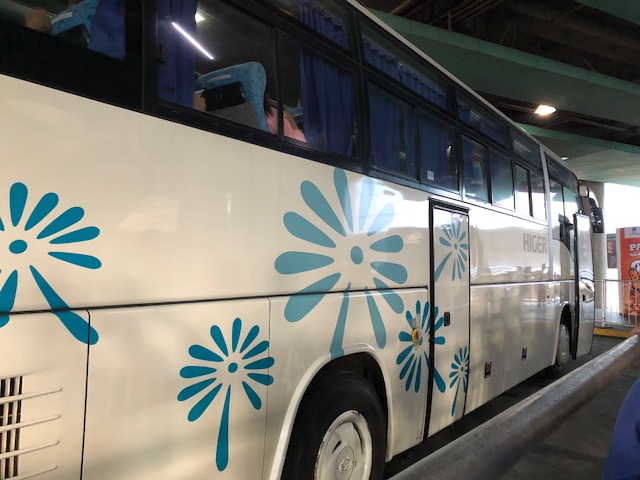 The bus before ours was quickly filled with passengers. There is a “no standing” policy for this service so when all seats are taken, people in queue would have to wait for the next bus.
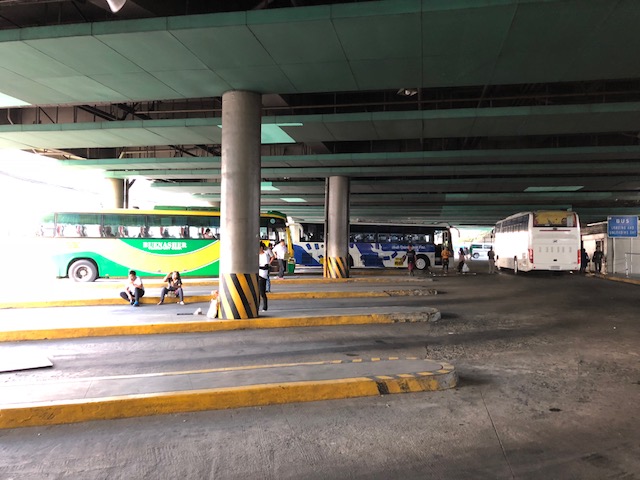 Here’s a view of the bus bays at SM North EDSA. The white bus at the right is the P2P bus that just departed.
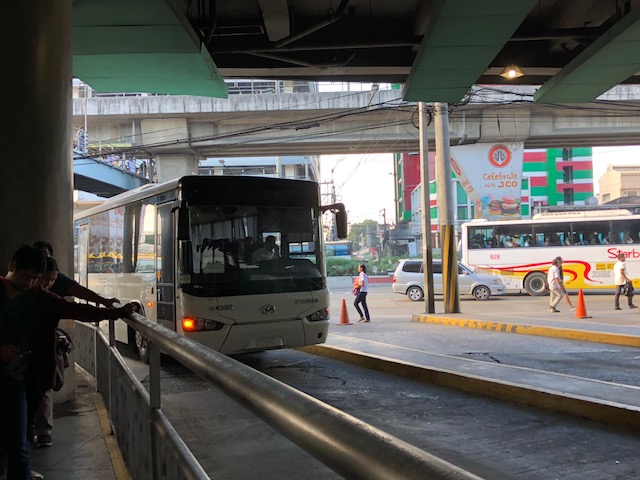 Our bus arrives at the terminal.
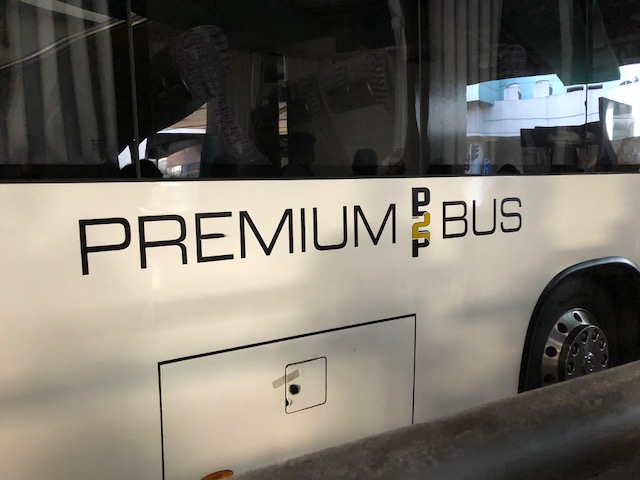 Unlike the first bus that had generic signs/markings on it and only had a signboard on the windshield identifying it as a P2P bus, this one had the service on its livery. The rapid increase in the number of P2P bus routes and buses serving those routes meant that bus companies had little time to properly change the livery of their buses to clearly show these were for P2P services.
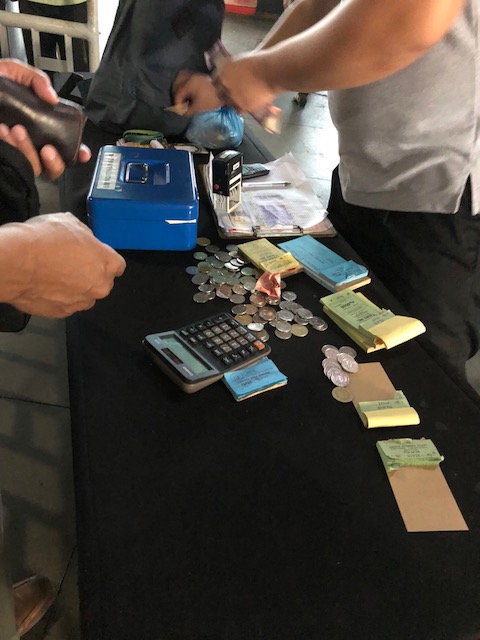 Passengers pay at the head of the line and just before boarding the bus.
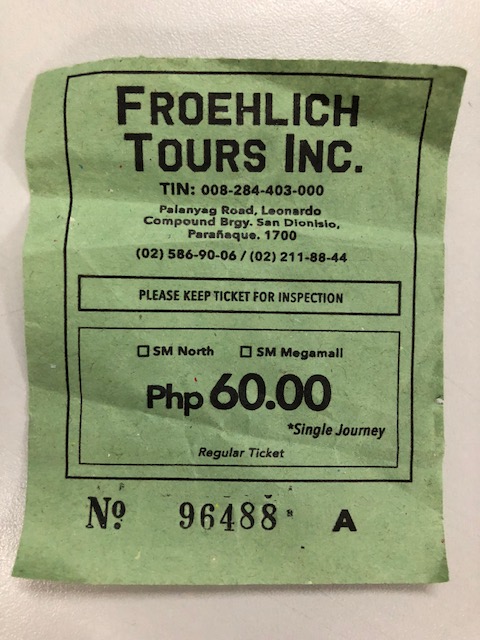 Our ticket showing the fare paid and the name and contact details of the operator of this service between SM North and SM Megamall. Froehlich is one of the first companies granted a permit to provide P2P services by the government. They actually started the service during the previous administration when DOTr was still DOTC.
The P2P bus services present an attractive option for commuters who are not satisfied with their usual public transport options (e.g., bus, jeepney or UV express) and cannot afford to frequently take taxis or ridesharing (Uber, Grab). They may or may not be car-owners but have longed for better public transport services especially in terms of comfort and convenience. Many are likely able to afford higher fares and will pay such if the services are worth it.
In Antipolo, for example, I have noticed that the parking lot near the P2P bus terminal at Robinsons already have many cars parked (parking is free so far), which I assumed are owned by people opting to take the bus instead to go to Ortigas Center. They have the jeepney and regular bus options (G-Liner and RRCG) but are turned off by the frequent stops and the cramped conditions during the rush hours.
My only other critique of the P2P buses aside from their drivers apparently being just the same as other buses in the way they drive (i.e., I’ve observed many of them are as aggressive if not as reckless as regular bus drivers.) is that these services are actually the higher capacity versions of UV Express. Note that UV Express (previously called Garage to Terminal Express or GT Express and generically the FX taxis of the 1990s) basically operated under the same conditions before with fixed routes and with supposedly only 2 stops (i.e., “point to point”). Hopefully, they won’t be but I also wonder how these services will continue once the new rail transit lines come into operation.
–
Updates on the MRT Line 7 construction
I recently posted some photos showing the progress of work on the Line 2 Extension. This time, I wanted to show photos on the progress of the Line 7 construction along Commonwealth Avenue. Following are some photos my companion took this morning as we headed for Novaliches. Work continues along this major corridor even on Sundays. While it has caused much congestions and therefore inconvenience, the continuous work offers hope to those who will benefit from this mass transit line once it becomes operational.
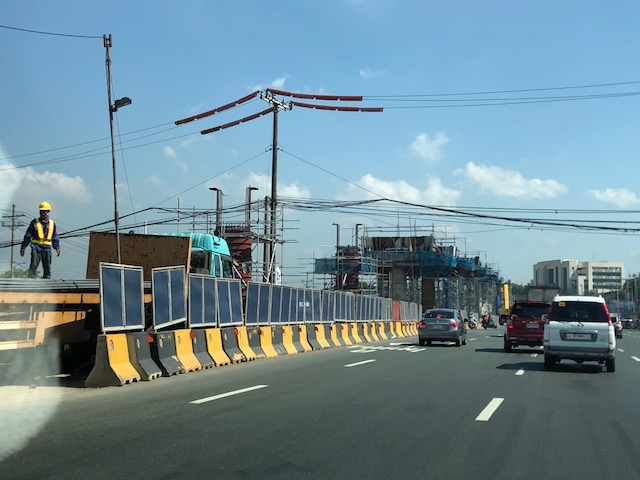 Columns rise along Commonwealth Avenue just across from the Ever mall and St. Peter’s church.
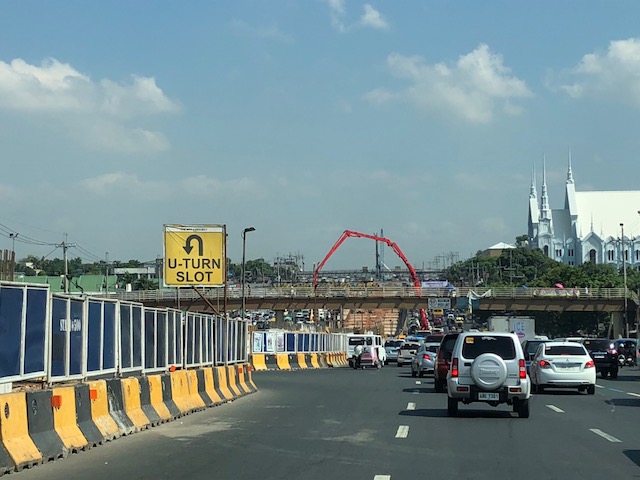 Here’s a traveler’s view of the ongoing construction along Commonwealth Avenue.
 Concreting even on Sundays – it was quite congested today near the Fairview Market due to lanes occupied by heavy equipment including several concrete mixers lined up along one lane to supply the mix.
I have several former students who are now working on the Line 7 construction in various capacities. I usually get my updates from them. I am happy for them to be involved in such a major infrastructure undertaking. Hopefully, their experiences will be useful for other future railway lines in the country.
–
In support of bike lanes
Here is another interesting article about bike lanes but from the perspective of a non-cyclist. I believe this (support for bike lanes) is a view shared by many but not much articulated. The assumption is usually that car-owners would like to have less of other’s cars on the road so they could benefit from the presumed reduction in congestion should more people take up cycling. But then the same can be said for public transportation and its users as well. That is, car-users would want others to take public transport so as to also reduce road congestion; allowing them faster trips/drives.
Lewyn, M. (2018) “A Non-Cyclist’s Case for Bike Lanes,” planetizen.com, https://www.planetizen.com/node/97632?utm_source=newswire&utm_medium=email&utm_campaign=news-03152018&mc_cid=0e22636014&mc_eid=9ccfe464b1 [Last accessed: 3/17/2018]
–
Some updates on the Line 2 Extension
I just wanted to post a couple of photos showing the progress of the Line 2 Extension construction work. There are two stations along the extension including the future end station before the Masinag Junction (intersection of Marcos Highway and Sumulong Highway).
 Ongoing construction of the Line 2 Masinag Station just across from SM City Masinag in Antipolo City, Rizal – there are actually 3 usable lanes with only the middle being a full lane, the other two have concrete barriers encroaching along the site as shown in the photo.
 Ongoing construction of the Emerald Station across from both the Sta. Lucia and Robinsons Metro East malls at the boundaries of Pasig City, Marikina City and Cainta – the construction site here is longer than the one for Masinag but has wider spaces for traffic. Volumes, however, are significantly heavier than at Masinag so this area can easily become congested with traffic often stretching past the PLDT office along the westbound side and Ligaya along the eastbound side.
I will post more about the progress of construction for these stations in the future especially as it would be interesting to see the actual forms of the stations.
–
Lazarus franchises?
I was recently asked about my views on Lazarus franchises. At first the term didn’t catch on to me but “Lazarus” is a name that’s associated with coming back from the dead. “Lazarus”, after all, is the Biblical person Brought back to life by Jesus after the latter arrived to find his dear friend had passed away due to illness. It is now being used to refer to a dead public transport franchise that is to be resurrected but under new ownership. I recall I have written about the topic some time ago (many years ago) when I spotted what I thought was a BLTB Co. bus that turned out to be a DLTB Co. Bus. The logo and livery for their buses were the same as are the destinations in Southern Luzon. Then there were the EMBC buses I spotted along my commute that turned out to be operated by RRCG. These obviously are revived franchises and in both cases take advantage of what name recall the brands still have.
 DLTB Co. used to be BLTB Co., which stood for Batangas, Laguna, Tayabas Bus Co. Tayabas is the old name of Quezon Province. This is the current company’s terminal along EDSA in Cubao. The old terminal is also along EDSA near Tramo in Pasay City.
I opined “that brands associated with these franchises can be revived but there are prerequisites. These include an inventory of units currently operating in relation to the demand. The rule is to determine first if existing operators/companies can cover the increasing demand. If not, then the LTFRB may decide to open routes for new players including issuance of new franchises. “New” here probably includes “resurrected” franchises that have name recall among people.” To be clear, there is a process by which franchises are granted by the government and this should be followed in order to be fair with current, active franchise holders.
I wonder if the Antipolo Bus franchise can be revived to serve the old Antipolo – Divisoria route?
–
 Caught (up) in traffic