
Home » Academe (Page 2)
Category Archives: Academe
Lower speed limits may not slow drivers, a before-and-after study shows
I am sharing this article on drivers not reducing their speeds after speed limits have been lowered along certain roads. My first reaction after reading the article is that it is that perhaps in the US case, the after study was conducted quite early and before people have become aware, understood and adjusted to the lower speed limits. The responses or reactions to lower speed limits (particularly those posted or on signs) may vary among cities and countries. In the Philippines, where drivers and riders appear to be oblivious to speed limits, other interventions may be required including some types of traffic calming devices. This is very much a concern particularly in school zones where children are exposed to the risks of being run over by motor vehicles speeding along the roads and not minding the speed limits in the area.
Here is the Research report:
Source: Lower speed limits may not slow drivers, a before-and-after study shows
29th Annual Conference of the TSSP
The Transportation Science Society of the Philippines (TSSP) held its 29th Annual Conference today, December 7, 2023. Following is the program for the conference, which featured a panel discussion in the morning and technical sessions in the afternoon.
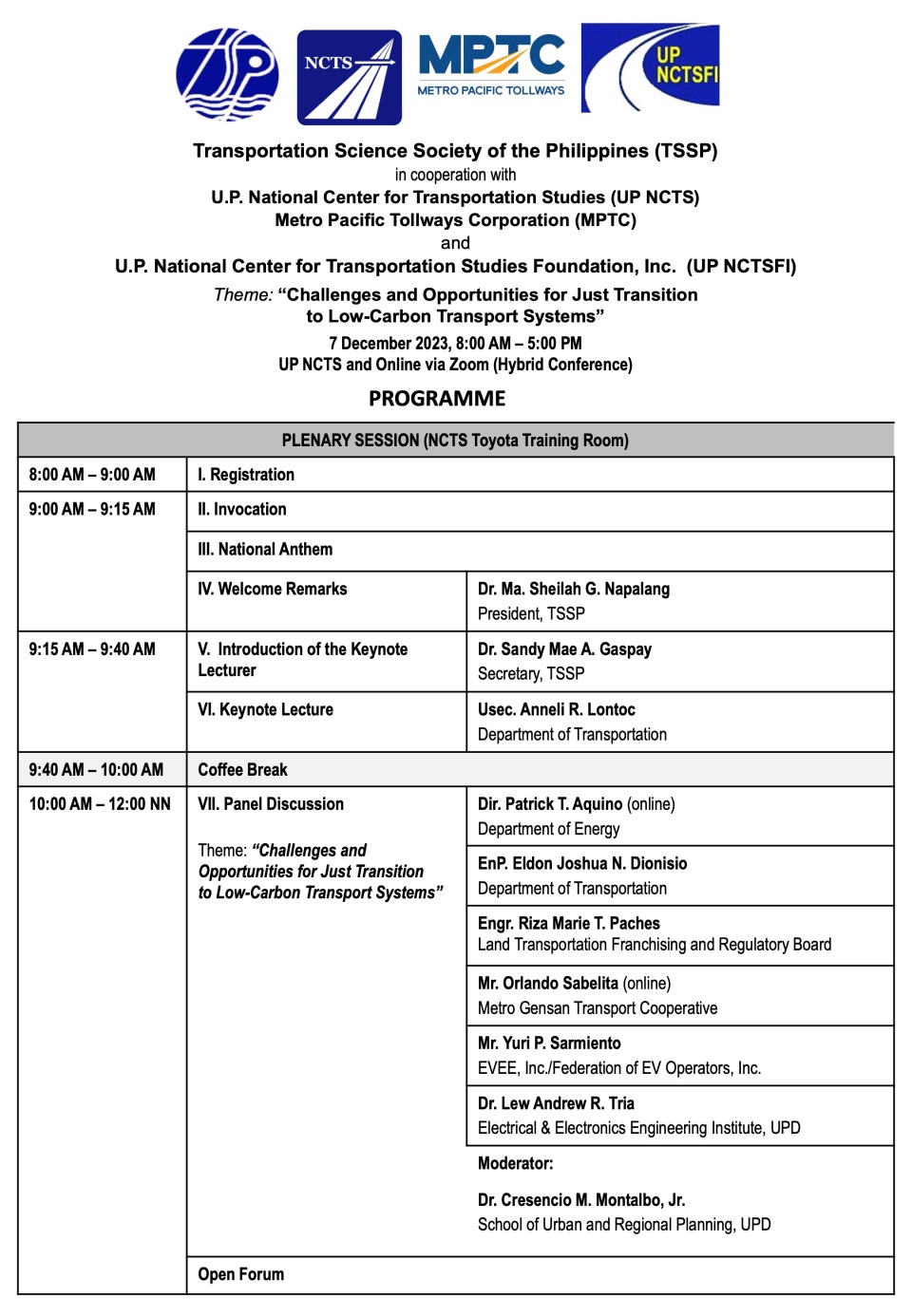
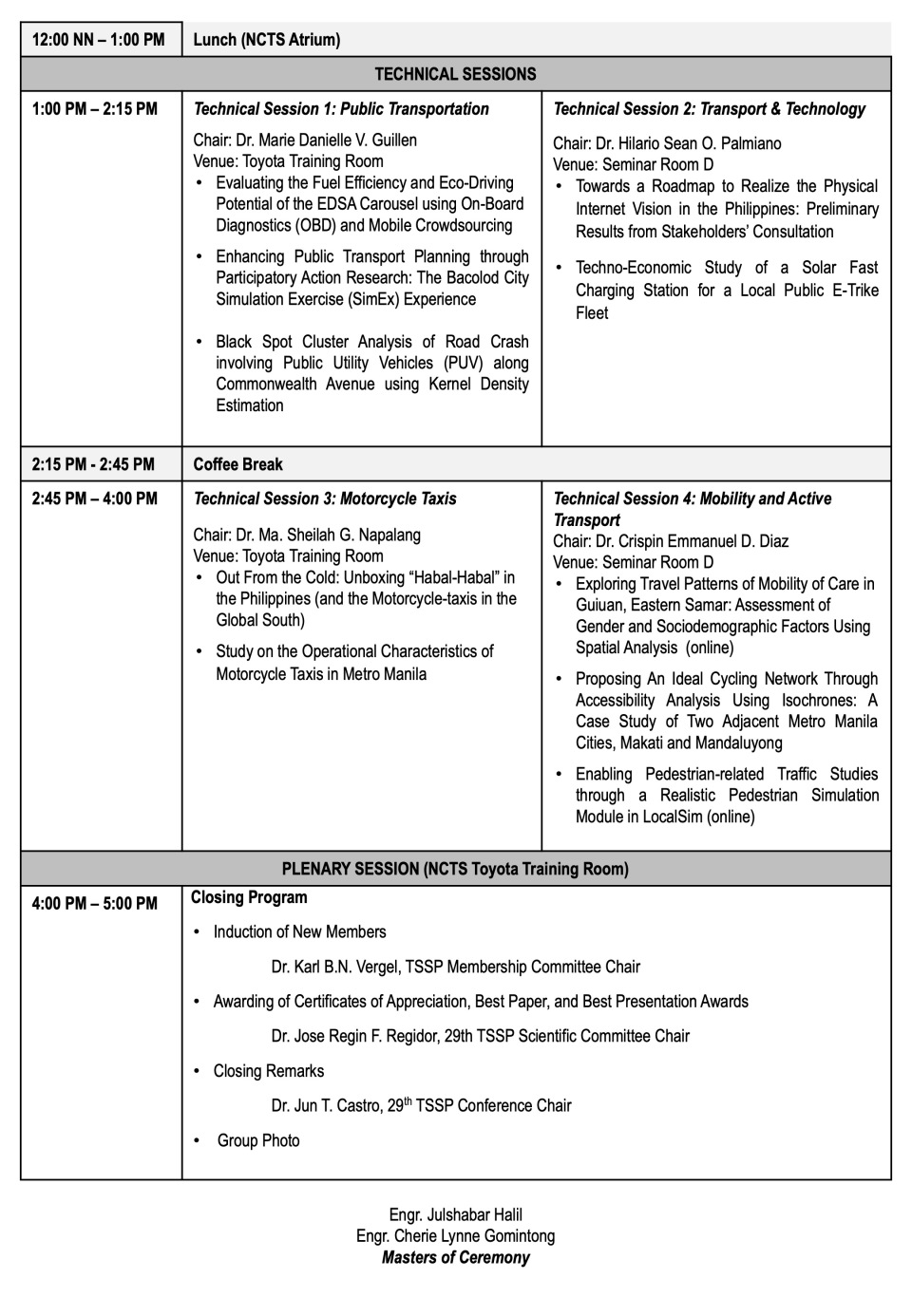
This was the first mainly face-to-face or in-person conference for the society since 2019. Previously, the conferences were online. As reported in the concluding part of the program, there were 84 participants who showed up at the venue while there were 30+ participants who were online via Zoom.
There were a couple of awards at the conference. These were the Best Paper Award and the Best Presentation Award. The Best Paper Award, based on the scores garnered from the blind review of the papers went to:
Maria Belen Vasquez and Jun T. Castro of UP Diliman for their paper entitled “Exploring Travel Patterns of Mobility of Care in Guiuan, Eastern Samar: Assessment of Gender and Sociodemographic Factors Using Spatial Analysis”
There was a tie for the Best Presentation Award. The two were Ms. Vasquez for the presentation of the paper on the Mobility of Care in Eastern Samar, and Mr. Erris Sancianco for the presentation of a paper he co-authored with Noriel Christopher Tiglao, Niki Jon Tolentino, Gillian Kate Hidalgo, Mary Joy Leanda, and Lester Jay Ollero entitled “Evaluating the Fuel Efficiency and Eco-Driving Potential of the EDSA Carousel using On-Board Diagnostics (OBD) and Mobile Crowdsourcing“. These papers will likely find their way to the Philippine Transportation Journal’s next issue.
Though it was not announced, a likely venue for the next conference will be Vigan, Ilocos Sur in the Northern Philippines. The likely host will be the University of Northern Philippines, the premier state university in that province. Previously and most recently, the conference was held in Cebu City (hosted by the University of San Jose-Recoletos) in 2019 and before that in Cagayan De Oro City (hosted by Xavier University) in 2018. TSSP was already organizing the 2020 conference when the pandemic struck and the country went on a lockdown. That conference was supposed to have been held in Baguio City in Benguet, and to be hosted by St. Louis University.
More information on the conference may soon be found at the TSSP’s official website: https://ncts.upd.edu.ph/tssp/
–
Why College Campuses Make Ideal Models for Cities
I recently read this article on college campuses being models for cities. Of course, this refers to campuses or perhaps university towns that have developed in the US. These appear to be microcosms of cities or what cities should be. I can imagine this for the UP Diliman and UP Los Banos campuses. There are others that are similarly structured but most universities and colleges in the Philippines may not even have full campuses like UP including those in the University Belt in Manila. Many are practically just buildings. Others that have land like UST and Ateneo do not have the residential areas like UP’s that would make the campus a town in itself.
To quote from the article:
“Universities and other educational institutions make the lives of their students easier by placing amenities close to student housing so they can travel on foot or by bicycle to reach their destinations. This design encourages human interaction and improves quality of life.
The same can be done for cities and towns. Urban planners can look to college campuses for inspiration, borrow the features that enable this lifestyle, and incorporate them into city design. Such a holistic approach will make it preferable to travel on foot, make sustainable transport more accessible, and create thriving local economies.”
A real battle of Katipunan – the search for a transportation solution
Is it obvious that I was alluding to the classic match-ups of the two major universities – Ateneo De Manila University and the University of the Philippines Diliman – that are located along Katipunan Avenue for the title of this article? That is deliberate on my part as there is a ‘real’ battle along Katipunan Avenue, and it does not involve sports.
Following is a recent article from the Philippine Collegian that reports on the current state of traffic along the corridor:
https://phkule.org/article/971/private-cars-mainly-to-blame-for-katipunan-traffic-transport-experts
I have written before and many times about transport and traffic along Katipunan Avenue. This road has been part of my daily commute since 1988 when I was admitted to UP Diliman as a B.S. Civil Engineering major. Back then Katipunan was not as wide as it is now, especially along the section between UP Diliman and the MWSS complex. That section only had 2 lanes then. What is not a wide center island with large, old acacia trees used to be the frontage of MWSS. So now you can probably imagine how much land was ceded by MWSS for road widening.
I also wanted to write about Katipunan in part as a sort of farewell to the former MMDA Chair and Marikina Mayor Bayani Fernando (BF), who recently passed away. Much of how Katipunan looks like and the traffic situation today can be traced to what transpired during his time at MMDA. I will refrain from writing about this and him for now. I am actually thinking of writing a series about BF and his time as Mayor in Marikina, as MMDA Chair, and his brief stint as DPWH Secretary. This short article will do for now.
A vintage US Army Jeep – the ancestor of the jeepney
We were visiting the studio of a friend last weekend and learned that he was a history buff. He did historical reenactments as well as researched on militaria including the uniforms worn by combatants in World War II. The latter was part of his work towards more accurate uniforms being used for period films. A surprise for us was that he also collected vintage cars that included two US Army Jeeps and a truck that were parked in their garage.
 A US Army Jeep greeted us as we entered their studio premises
 The 4-cylinder engine of the Jeep
 Another view of the engine. Notice, too, the front grill of the vehicle.
 A second jeepney is parked behind the first. This second one had a canvass top on and a radio antenna that’s supposed to be original.
 There’s the steering wheel and the machine gun mount.
 The wipers whose design was retained by the jeepneys
I had always wanted to see an intact specimen of this jeep. The surplus units eventually were modified or customized to become the first jeepneys that seated 4 to 6 passengers at the back (they were shorter back then. The designs were based on the auto calesa, which were cars that were modified to become public transport vehicles with bench seats at the back. The rest, as they say, is history and we now still have what are termed as conventional jeepneys that now seat 16 to 24 passengers at the back of the driver.
–
Top urban problems in Metro Manila
I was looking for material to include in my introductory lecture for a graduate class. I came upon this slide from the study “Roadmap for Transport Infrastructure Development for Metro Manila and Its Surrounding Areas (Region III and Region IV-A)” that was conducted by JICA through a consulting firm and completed in 2014. The slide shows the top three urban problems identified in Metro Manila (or perhaps what we now refer to as Mega Manila or, as what was tagged as NCR plus during this pandemic).
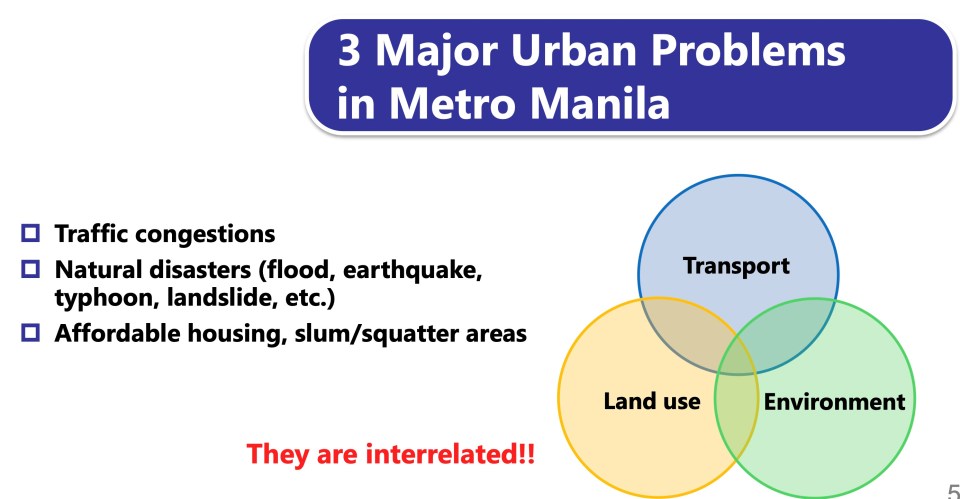
Traffic congestion was identified as one of the top problems if not the top problem itself. This is not independent of the other two (or other problems identified in the survey). All of them are intertwined somehow as illustrated in the simple Venn diagram in the slide. Affordable housing, for example, affects our transportation system and puts much pressure to transportation infrastructure development as well as to the provision of transport services. People continue to choose living in the periphery of Metro Manila or outside NCR because of the expensive residential choices particularly in the CBDs where most people have their workplaces and where many of the elite schools are also located. These people would have to commute long distances and experience longer travel times than what seems to be the reasonable. The result is loss in productivity and transport related costs that include fuel and maintenance costs.
What do you think about these urban problems? How can be address them in a comprehensive manner?
–
Some takeaways from a lecture
I lecture from time to time at the Philippine Public Safety College. This is the counterpart of the National Defense College. In the latter graduates are conferred a Masters in National Security Administration (MNSA) while in the former, graduates are conferred a Masters in Public Safety Administration (MPSA). It is no wonder that many who take these courses are military or police officers seeking graduate degrees that may later be useful for them after their typically early retirement (military and police officers retire at 56 years old instead of the typical 65 years mandatory retirement for other government employees). There are many civilians who take these programs, too. The MNSA degree actually promotes a person to a high rank as a military reservist. I am not sure about the MPSA degree but graduate degrees like these are useful for promotions in their respective offices.
I lectured recently to a class consisting of two batches of their MPSA program. Each batch consists of uniformed (mostly senior police officers with a rank equivalent to at least a Lt. Col.) and non-uniformed personnel (from various offices and professions including public and private universities, private companies, etc.). I get a lot of questions and comments regarding transport and traffic during my lectures. Some can be out of context or perhaps posed in a smart-aleck fashion but most are well-intentioned. After all, who doesn’t want to “solve” traffic? Among the more notable comments during my recent lecture are as follows (not in any order):
- There is a need to have better urban planning for our cities;
- Investments for transportation infrastructure need to be shared by government and the private sector;
- A holistic approach is required and we cannot isolate transportation or traffic;
- There is a need to have a law restricting vehicle ownership (mostly related to parking);
- There is a need to invest or allocate more resources to develop other cities to help decongest the larger cities.
Based on my experience having lectured at the PPSC over 5 years, these two batches had more listeners and were more sensible when they posted their comments and opinions on the chatbox (the lecture was via Zoom). There were only a couple of comments with ideas I did not agree with:
- Transferring the capital to another location – this seems to be a trendy (read: “nakikiuso”) topic and a very tempting one for discussion but it is not a simple task and has had mixed results in other countries that tried it (e.g., Brazil, Pakistan and Malaysia). Is it worth exploring? Probably.
- Cable cars for Metro Manila – I explained that this is still band-aid solution that does not address the roots of the transport problems experienced by Metro Manila. It is not suitable as for one, it will not have the capacity required for regular commutes and, to me at least, it is more a novelty than a solution. Resources would be better allocated elsewhere such as active transport.
Overall, I thought that this most recent lecture generated the best feedback so far from my students. I look forward to more lectures and interactions like this. And perhaps the next one will be face to face.
–
Who can design bikeways?
I have read many comments about how bike lanes and other bike facilities are sub-standard or unacceptable because they were designed by non-cyclists. From an academic perspective and perhaps also from a point of view of someone who values empathy, the planning and design of bicycle facilities should not be so limited. The objective of education, and particularly for schools whose graduates become professionals like engineers, architects and planners, should be to have the latter be able to plan and design the most suitable infrastructure and facilities for all users. Suitability here should include equity considering the many elements involved for people of different gender, physical ability or disability, age, health conditions, etc. That said, it is the responsibility of agencies such as the Department of Public Works and Highways (DPWH) to revise and update their design manuals and guidelines to ensure that these are according to International standards and mindful of the best practices in various cities and countries that are now very well documented.
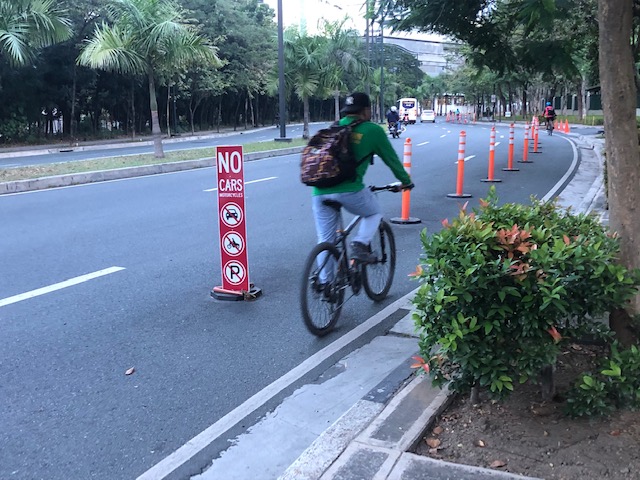 Bike lane in BGC,Taguig City
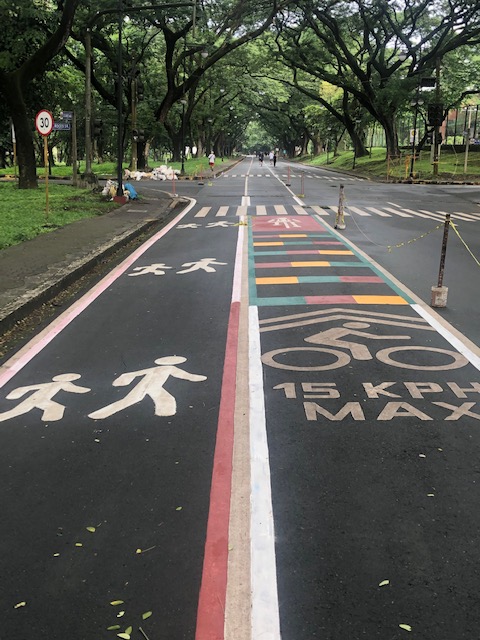 Bike lane and jogging/walking lane in UP Diliman
–
How my students see transport and traffic
With social media and the ascendance or popularity of influencers and the like, we have often encountered assessments or opinions about transportation and traffic. While there are those that make sense, there are more that are of the rant variety. The latter include the self-righteous who seem to relish bashing professionals and government officials while not being able to present much in terms of their own accomplishments. I am aware of my students (including research advisees) being aware of these people and I often see them posting their comments on topics, articles and opinions being shared on social media. For most, their comments and posts on social media show they’re being more informed than most, especially about the state of transportation in the country.
Here are some observations and comments from my students:
- One of my students asked me about my take on the public transport situation. I replied that it is unfortunate that public transportation has deteriorated the way it has for the past decades. The current state is not due to recent policies or regulations but a product of various policies, regulations and even trends over so many years. My student countered that perhaps the current officials must not make an excuse of the past in failing to act in the present.
- I always read about posts that anchor their arguments on the supposed low car ownership in Metro Manila. These are usually followed by calls for taking lanes away from car use for public transport and cycling. While I agree with the latter, I don’t with the former arguments. A student was curious about my statement in one lecture that we need to validate the numbers because what we see on the streets appears to be inconsistent with the notion of low car ownership. There are other ways, she said, to determine vehicle ownership other than the conventional HIS data. We could probably use the Family Income and Expenditure Survey (FIES) that is regularly conducted by the Philippines Statistics Authority (PSA). This will show if people own motor vehicles as well as how much they spend for transportation.
- I asked my students to critique the plans and implementation of airports in the Greater Capital Region (GCR) also known as Mega Manila, and which is larger than the NCR Plus used to refer to Metro Manila plus Bulacan, Rizal, Laguna and Cavite. I was not surprised about their assessments as all of them did their homework in the sense that they researched on information and data they could use for their critiques. Most were in favor of developing a new capital airport in Bulacan rather than in Cavite. And many favored the continued operation of NAIA but with reduced air traffic and a different role.
More on these opinions, observations and comments as I try to recall the more remarkable or notable ones.
Have a nice Sunday!
–
On university-community collaborations
I’m not a stranger to university-community collaborations. In fact, I even helped draft a proposal for the World Bank to support such collaborations, which I believe would be sustainable and therefore worthwhile to be pursued by potential partner universities and local government units. There are actually many such collaborations but most of these are probably informal with certain faculty members of universities (usually state universities or colleges) being involved in committees or moonlighting in projects implemented or funded by LGUs. I say informal because technically, the school is not involved in the project and it is only incidental that the person or persons involved are affiliated with the university or college.
Here is an article showing an example of university-community collaborations:
National Institute for Transportation and Communities (2022) “Transportation recovery after disasters: A collaborative university/community model,” phys.org, https://phys.org/news/2022-08-recovery-disasters-collaborative-universitycommunity.html [Last accessed: 8/15/2022]
The authors wrote about actions that could be done “to build future economic resilience.” To quote from the article:
-
Increasing pre-disaster investment in resilient transportation infrastructure to reduce the cost of eventual recovery;
-
Improving business resilience practices for high-impact industrial sectors, through education and outreach;
-
Identifying structural barriers to adoption of resilient business practices, and promoting mitigation through recovery.
-
Mainstreaming disaster resilience into economic development by breaking the siloed approach to emergency management and economic development.
While these actions were framed for the community engaged by the University of Utah, they are general enough to be applicable to other communities as well.
I mentioned earlier about the need for formality. The Commission on Higher Education (CHED) encourages and supports what are termed as Extension Works or Extension Projects by higher education institutions. These may be in various forms including committee work, advisory, capacity building/training, or even professional work/services provided to the province, city or municipality (even barangay). But there should be accountability here as well as the proper assignment or allocation of resources.
Just compensation is one of the more sensitive or tricky elements or items here as often, LGUs would like to get something for free or assume that certain services are free. They are not and time and effort should be compensated; just not the international rates you might expect for consulting work from the likes of World Bank or Asian Development Bank.
Here is where contracts (e.g., in the form of Memorandum of Understanding (MOU) or Memorandum of Agreement (MOA)) can be useful to establish the terms of engagement that includes budgets for Personnel Services (PS), Equipment Outlay (EO) and Maintenance and Other Operating Expenses (MOOE). The latter categories should be familiar with LGUs because these are standard items under which details are provided for their programs and projects. State universities and colleges are also familiar with these as standard government terminologies for budgets. Of course, that goes without saying that in certain engagements, there may be third parties such as donor or funding institutions that will should all, most, or part of the costs for collaborative work.
–
 Caught (up) in traffic