
Home » Behavior (Page 12)
Category Archives: Behavior
On trucks and road safety again
The past days saw many trucks being involved in crashes along my commuting route. My social media feed also gives me updates on the traffic situation in my home city. And there are many reports of the same – trucks involved in road crashes or stalled due to a variety of reasons (engine problems, flat tires, etc.) . It is not an understatement to say that such incidents are a matter of concern especially since these may have been fatal (i.e., deaths due to road crashes). Here are a couple of photos we took as we passed a truck on its side along Ortigas Avenue Extension along one of my usual commuting routes.
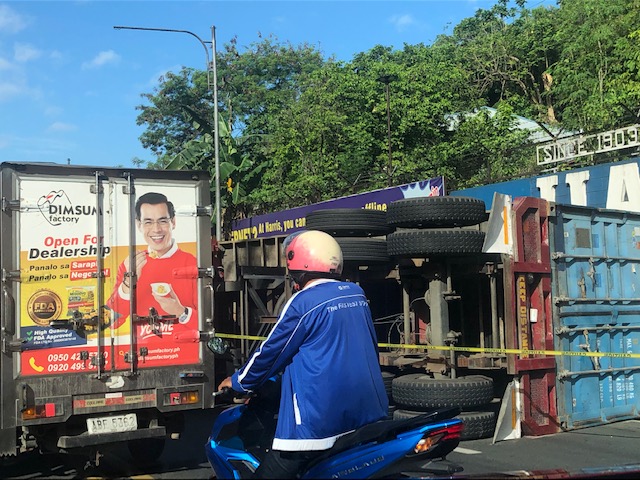
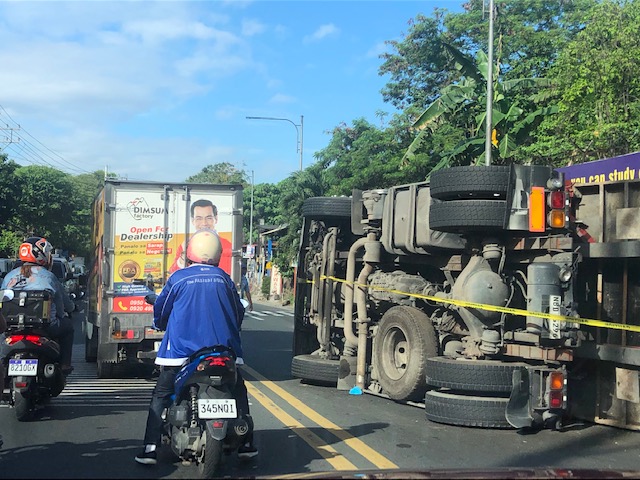
It is fortunate that this did not result in any fatality but from the photos one can surmise the potential or likelihood of serious injuries if not death/s. Such underlines the importance of both proper maintenance and operations of these vehicles including how they are loaded. Shifting or unbalanced loads on moving trucks negotiating turns or maneuvering, for example, will result in loss of control and overturning that also leads to traffic congestion. Are the drivers competent, awake, alert? Or are they sleep or perhaps driving under the influence of alcohol or other substances?
–
On ways to make streets safer
Here’s a quick share of an article suggesting a simple way to make streets safer:
Berg, N. (April 27, 2022) “The ridiculously simple way to make streets safer for pedestrians,” Fast Company, https://www.fastcompany.com/90745296/the-ridiculously-simple-way-to-make-streets-safer-for-pedestrians [Last accessed 5/1/2022]
To quote from the article: “Art projects painted onto streets and intersections significantly improve safety, reducing the rate of crashes involving cars and pedestrians by up to 50% and all crashes by 17%, according to the study.”
The article’s sub title states that you only need a bucket of paint rather than expensive new traffic signals or road blocks to keep pedestrians safe. I remember there were similar attempts to do the same in Antipolo prior to the pandemic. A group painted on the pedestrian crossings along major roads in the city. These, however, appeared to be somewhat invisible to most motorists and did not succeed to slow down traffic. Perhaps, as the article states, the artwork needs to be more visible or conspicuous in addition to its being comprehensive for intersections as the examples in the article show. These cannot be piecemeal or appear as publicity stunts for them to influence driver behavior and help improve safety.
–
Early morning commuting
Early morning commutes are not new to me as I’ve been doing this since I started to commute by myself decades ago. My usual trip between home and school consisted of two jeepney rides or one jeepney ride and a tricycle ride, depending on whether I carried a lot of items or if I didn’t feel like walking the so-called last mile between the jeepney stop and my home. While traffic wasn’t as bad in the 1980s and 1990s as it is today, it was still difficult to get a ride. Little has improved with public transport even though there are air-conditioned vans, P2P and additional railway option for me now along my usual routes to the office.
Back in the day, I liked to enlist in the 7:00 – 8:30 AM classes at UP Diliman as it was easy to get a ride at 6:00AM. That allowed for some time to spare before class and in the rare cases when UP-Katipunan jeepney drivers were on strike, you can walk the length of Katipunan and arrive in time for class. It was later when my classes were mostly in the afternoon that I had to delay my trips so I wouldn’t have to travel during the peak periods. It was difficult to get a ride and travel times were longer. When I was already working, I often traveled early if we had field work scheduled. That meant traveling before 6AM. There were fewer jeepneys but most were not full and it was easy to get a ride.
I took a couple of photos of a bus plying the Antipolo-Cubao route at around 5:30 AM one Friday morning. This was before the return to work order was issued to many workers so perhaps it does not show the current situation for the same time.
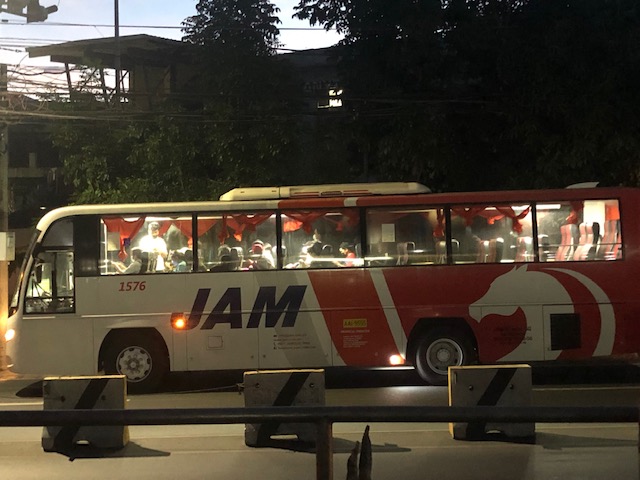
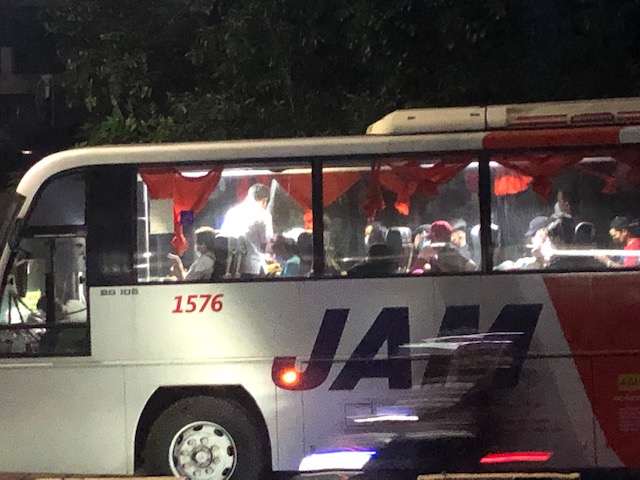
I now go to the office twice or thrice per week. On my way at 7:30 AM, I see many people lined along the streets at the typical loading/unloading areas along my routes. People would have to travel earlier if they want to easily get a ride and if their travel distances are relatively far (i.e., many people live outside of Metro Manila and have to travel 10+ kilometers one way).
–
Road safety history – first fatality and crash
Have you ever wondered when the first road crash involving a motor vehicle occurred? Or who was the first person to die (i.e., fatality) in a car crash? Here’s a brief but informative article on this topic:
Sal (April 15, 2022) “Who Was the First Person Ever to Die in a Car Crash?” Medium.com, https://sal.medium.com/who-was-the-first-person-ever-to-die-in-a-car-crash-8385add6cbcb [Last accessed: 4/20/2022]
Were you surprised about the 3 mph speed of the car that ran over the first fatality involving a car? That’s really slow considering the speeds of vehicles these days and how high speed limits are along streets where there are many pedestrians. Meanwhile, the circumstances about the first crash appears to be similar to what we still have now. That is, reckless driving, increasing speed limits and (truth be told) pedestrians not being aware of their surroundings (say what you will but the car was traveling at 4 mph and there was a claim that the driver tried to get the attention of the victim to no avail). I agree though with the author that this was a portent of worse things to come as road crashes has become a top killer and health concern.
–
History: article on how jaywalking came to be
I am sharing this article on the invention of jaywalking. It is a very informative articles and gives context to the current situation where cars dominate streets and car-centric policies and infrastructure diminish pedestrians and walking. I’ve always said that history should enlighten us about how it was, how it came to be and what we need to change now if we are to attain a more sustainable transport system that will contribute to improving safety and ultimately, quality of life.
Thompson, C. (March 29, 2022) “The invention of ‘Jaywalking’,” Marker, https://marker.medium.com/the-invention-of-jaywalking-afd48f994c05 [Last accessed: 4/2/2022]
To quote from the article:
“It’s not totally clear who invented the phrase, but it was a fiendishly clever portmanteau. In the early 20th century, the word “jay” mean an uncultured rube from the countryside. To be a “jaywalker” thus was to be a country bumpkin who blundered around urban streets — guileless of the sophisticated ways of the city…
Ever after, “the street would be monopolized by motor vehicles,” Norton tells me. “Most of the children would be gone; those who were still there would be on the sidewalks.” By the 1960s, cars had become so dominant that when civil engineers made the first computer models to study how traffic flowed, they didn’t even bother to include pedestrians.”
The article showed photos of pre-automobile times in the US. Here’s a photo of pre-automobile Manila for context:

And here’s Manila during the American period but with most people walking or taking public transport in the form of the tranvias:

Chaotic as the scenes appear to be, these streets were definitely safer and perhaps saner than what he have now. The challenge is how to re-orient our streets and reclaim it to favor people instead of cars.
–
Take a hike or a walk?
Here’s an interesting article calling for people to go out and spend some time with nature.
https://www.inverse.com/mind-body/doctors-free-nature-prescriptions-treat-chronic-diseases
The prescriptions mentioned are not at all new, content-wise but the article does mention that people tend to follow prescriptions from their doctors. Perhaps the prescription will be treated or perceived as a more serious matter compared to verbal ones that are interpreted as suggestions and not really all that serious? No matter, the important thing is to be active and keep walking, hiking, jogging or cycling.

–
More frequent road crashes?
My personal observations during my commutes lead to a conclusion that there is indeed an increase in the number of road crashes and perhaps this is attributable to the conditions during this pandemic. During my almost daily trips the past weeks, I have witnessed or passed by road crash incidents. These mostly involved motorcycles but last Friday, there was severe congestion along Ortigas Avenue due to a large truck that slammed into a post and ended up blocking most of the westbound lanes of the road. Yesterday, my wife sent me photos of a truck on its side after also being involved in a crash where it was reported that the driver lost control of the vehicle. Also involved, based on the Taytay report posted on their social media page, was a tricycle whose passengers sustained minor injuries. The incident could easily have been fatal to those involved considering the truck hitting the tricycle.


So are these incidents to be called accidents like how media and local governments still label them? These appear to be preventable. For one, vehicle-related problems could have been addressed by proper maintenance of the vehicle. But then there is also the question of whether the drivers or riders involved in these crashes were practicing safe driving or riding. Were they speeding or doing any risky maneuver? Were they aggressive or reckless? These are but a few factors that come into play and that led to a crash such as the one shown in the preceding photos.
–
On the increase of road crash fatalities during the pandemic
The general observation has been that roads have become less safe as drivers and riders have tended to speed up their vehicles during this pandemic. Speeding up apparently is just part of a bigger picture and even bigger concern considering what is perhaps also an issue related to mental health. We’ve read, heard or watched something about people’s transformation once they are behind the wheel or riding their motorcycles. I remember a Disney cartoon showing how Goofy transforms from being mild-mannered to somewhat demonic once behind the wheel of the car. The article below reinforces that and relates this behavior with the pandemic.
To quote from the article:
Art Markman, a cognitive scientist at the University of Texas at Austin, said that such emotions partly reflected “two years of having to stop ourselves from doing things that we’d like to do.”
“We’re all a bit at the end of our rope on things,” Dr. Markman said. “When you get angry in the car, it generates energy — and how do you dissipate that energy? Well, one way is to put your foot down a little bit more on the accelerator.”
Roadside bike repair stations
Walking along 38th Street at the Uptown side of Bonifacio Global City (BGC) in Taguig, I came along this mini bike repair station conveniently located along the bike lane and just across from the schools along the street. It had some tools and a pump. Typical of what a cyclist or biker may need in case some quick repairs, adjustments or tire inflation are required. The first time I saw something like this was along Commonwealth Avenue; provided by a bicycle group that helped promote bike-to-work along that corridor and Quezon City.

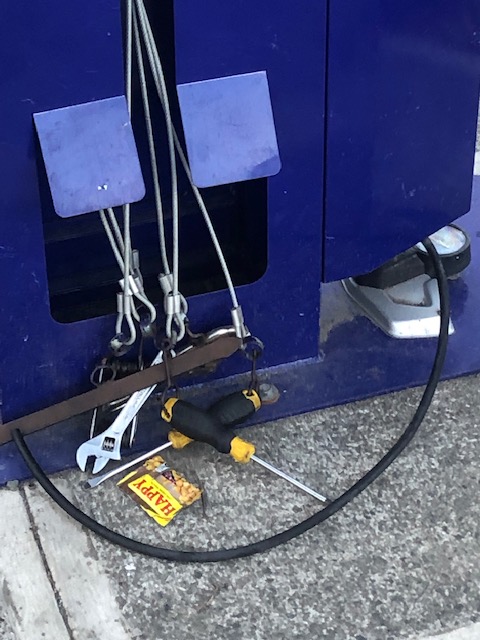

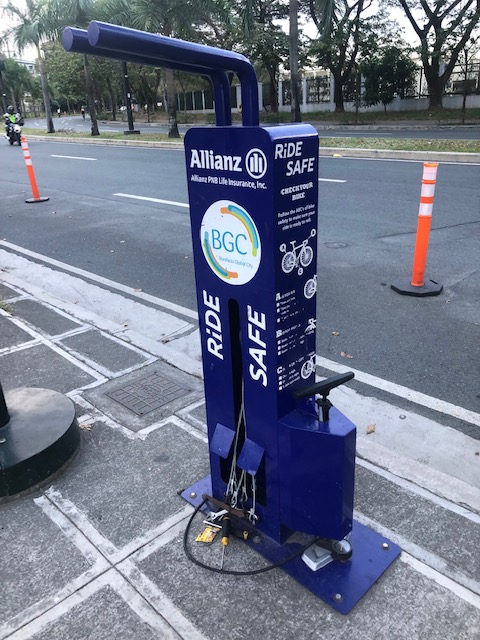
We need more of these especially along the major roads used by cyclists; especially those who bike to work. Granted that there are many bike shops and perhaps the vulcanizing shops as well as cyclists bringing their own tools and pumps but you never know when you will need some tools or perhaps a pump to inflate tires. Of course, these will need to be secured as there are people who have the propensity to steal, damage or vandalize tools.
–
Cities and Automobile Dependence: What Have We Learned?
We end the year with an article from Todd Litman via Planetizen. The topic is something that we really need to ponder on as we or if we are to move towards more sustainable transportation for our cities and municipalities. The experiences during this Covid-19 pandemic should have provided us glimpses of how it could be if we put active and public transport above automobile dependence or car-centricity.
Source: Cities and Automobile Dependence: What Have We Learned?
The main article may be found here (in proper citation for academic/researchers reading this):
–
 Caught (up) in traffic