
Home » Behavior (Page 23)
Category Archives: Behavior
On child-friendly cities
Here’s another article that I want to share. This time it is about child-friendly cities. Here is an article that present many good practice examples in other cities. Many are easily replicable in our towns and cities, and should be considered by local governments in order to enhance safety and health aspects in their jurisdictions.
Laker, L. (2018) “What would the ultimate child-friendly city look like?”, theguardian.com, https://www.theguardian.com/cities/2018/feb/28/child-friendly-city-indoors-playing-healthy-sociable-outdoors [Last accessed 3/9/2018]
–
On the Pasig HOV lane experiment, again
I recently wrote about some thoughts on Pasig City’s HOV lane experiment along Julia Vargas Avenue. Here are a few more considering the experiment didn’t push through last February 28.
 Screen cap (courtesy of ABS CBN) showing the starting date for the HOV lane experiment. I think ‘HOV’ is more appropriate than ‘carpool’ since the requirement is for vehicles using the lane to have 4 or more passengers. Having only 2 passengers still qualify as a carpool.
I learned recently that the experiment has been put off to March 26, 2018:
 [Photo courtesy of Dulce Justiniani]
The current set-up has 2 lanes for motorised vehicles including a wide lane for HOV’s (including public utility vehicles like buses and vans). HOV’s here also include cars but those with at least 4 occupants. Here are a couple of photos showing us what could possibly happen should enforcement be weak given the configuration of the lanes along Julia Vargas:
 Private van running along the lane designated for HOV’s alongside a solitary cyclist on the bike lane.
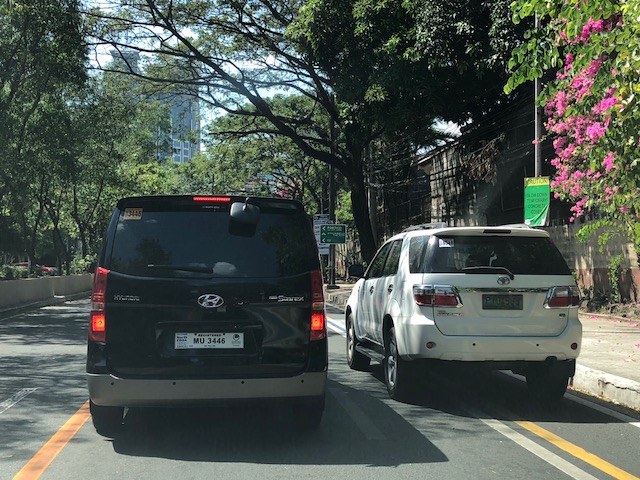 An SUV overtaking the van via the bike lane and the extra space of the HOV lane.
Wide lanes generally encourage higher speeds. I believe the way to go would be to have narrower lanes. And should these be considered, it would be possible to have 3 lanes for motorised traffic with one assigned for HOV’s and another for motorcycles. These are aside from the bicycle lane that I think should also be a protected lane. Protection here may be through the provision of “forgiving” physical dividers in the form of, say, rubber bollards.
Here’s how the Julia Vargas carriageway could be laid out:

Again, these are just suggestions for whoever are in-charge of the experiment-to-be along Julia Vargas Avenue. I hope that they are able to make some assessments even prior to the experiment. Such can be done using simulation software in order to have a handle on traffic related issues that may crop up during the implementation. Still, a big factor would be the enforcement aspects of the proposed policy for motor vehicles. Strict, firm and sustained enforcement would be necessary in order for this to succeed.
–
On prioritising pedestrians and promoting walking
We begin March with an excellent article that came out from curbed.com:
Walker, A. (2018) The case against sidewalks and how cities can create new avenues for pedestrians, curbed.com, https://www.curbed.com/2018/2/7/16980682/city-sidewalk-repair-future-walking-neighborhood [Last accessed 2/23/2018].
How do we improve the environment (i.e., facilities) to encourage people to walk? Do we simply clear up sidewalks? Widen them? Build overpasses and underpasses? What should be the context for improving pedestrian facilities for our cities and municipalities? What are the implications to planning and design?
–
Another walkability tool: Pedestrians First
The ITDP recently came out with a new walkability tool called Pedestrians First. Here’s the link to their site where you can download the tool. The tool was released in the recently concluded World Urban Forum held in Malaysia.
https://www.itdp.org/publication/walkability-tool/
Of course, there are other tools out there including one developed by Clean Air Asia, material on which may be found through the following links:
http://cleanairasia.org/walkability-study-in-asian-cities-4/
Our technical staff and my students are currently using the methodology developed by Clean Air Asia and have covered several major thoroughfares in Metro Manila and a highly urbanized city in studies that have been undertaken in the last 6 years. I already asked them to take a look at the new tool and see how this compares with the ones we are using.
–
On learning from the experiences of others about transit ridership
I again share an article; this time on transit ridership (or on the passengers using public transportation).
Buchanan, M. (2018) Lessons on Ridership, from the National Literature, transitcenter.org, http://transitcenter.org/2018/01/29/lessons-on-ridership-from-the-national-literature/ [Last accessed 2/21/2018]
Perhaps we can learn from the experiences of other cities in as far as public transport use is concerned? For example, what impacts emerging technologies and the sharing economy (e.g., ridesharing) have on public transport ridership and how to meet these challenges to retain a majority of public transport users over low capacity modes.
–
Another crash along NLEX – losing control?
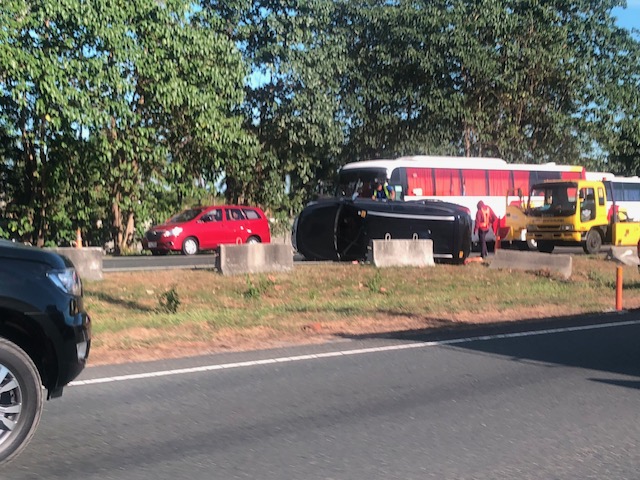
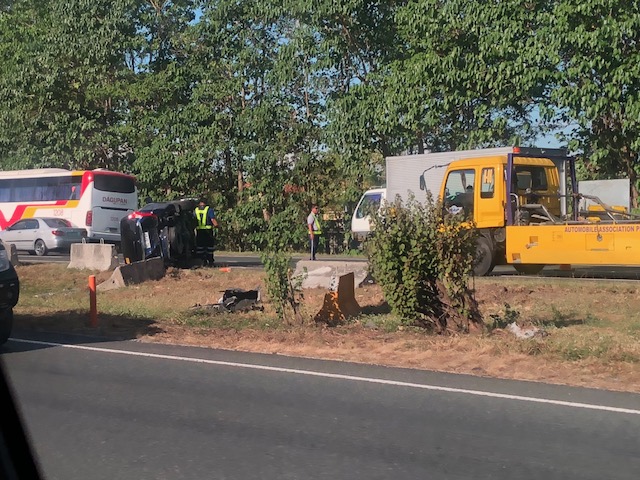
We were returning from Clark last week when we chanced upon a crash site along the North Luzon Expressway (NLEX). We already suspected this as we approached a build-up of traffic along the southbound direction where there is usually free-flowing traffic. Here are some photos of an overturned vehicle on the median. It seems like it is the only vehicle involved as there were no other vehicle in the vicinity that could have been involved. However, it is possible that there was another vehicle involved in a situation where the overturned vehicle’s driver lost control after interacting with the other vehicle. Obviously both vehicles could have been traveling at high speeds (they are on an expressway) so this could have been an example where the combination of speeding and weaving in traffic led to an overturned vehicle (i.e., one lost control).

–
Emphasising safety during these holidays
Here are a couple of articles that I thought should reiterate the importance of safety whenever we travel. This is especially true during this holiday season when a lot of people are going around – shopping, heading to their hometowns or simply vacationing.
Rey, A. (2017) “Holiday rush can lead to road crashes – expert”. Rappler.com. December 28, 2017. https://www.rappler.com/move-ph/issues/road-safety/192411-holiday-rush-road-crash-incident-expert?utm_source=facebook&utm_medium=social&utm_campaign=move-ph (Last accessed: 12/29/2017).
Merez, A. (2017) “Holidays heighten road accident risks: analysts”. ABS CBN News. December 28, 2017. http://news.abs-cbn.com/focus/12/28/17/holidays-heighten-road-accident-risks-analysts (Last accessed: 12/29/2017).
–
Transport safety during the holidays
I was having a late morning haircut when I overheard from the TV news reports of many road crashes occurring over the last 3 days including Christmas Day. One incident involved a jeepney that apparently veered away from its lane and crashed head-on to a provincial bus. It was ironic that the passengers of the jeepney were bound for the town of Manaoag in Pangasinan province, likely to give thanks for blessings they received in 2017 and pay homage to the Blessed Virgin whose image in Manaoag is regarded as miraculous. Not reported were the many other crashes that probably occurred all over the country over the same period but were considered minor incidents as no one perished and likely only involved property damage.
There was also an incident a few days ago involving a ferry traveling between Infanta, Quezon and Polilio Island.The ferry was carrying 251 passengers, of whom at least 5 reportedly perished. The incident again raised old but lingering issues on maritime safety including those pertaining to seaworthiness of vessels especially those plying the regular, frequent routes connecting the many islands in the country.
A lot of people travel during this season in the Philippines. Many travel to their hometowns for the typical homecomings, reunions people have during Christmas and New Year. Most trips are on the road (the mode share is dominant even considering the popularity of air travel and the sizeable number of trips on maritime transport) and the combination of road conditions, driver behaviour and other factors often lead to situations that may result in road crashes. We cannot overemphasise the importance of taking extra care when we travel, whether as a driver, a passenger or even a pedestrian walking along the road. A friend who is also an official of the transport department once gave passengers of buses advice to tell their drivers to slow down and drive more safely if and when they feel they are driving recklessly. You don’t lose lives by slowing down and driving more carefully (probably with the exception of drivers of emergency vehicles like ambulances), and this applies, too, to passengers of private vehicles who need to tell their drivers (likely relatives) to slow down or drive more safely. One does not want some joyride transform almost immediately into a nightmare much less a last trip for everyone.
Keep safe everyone!
–
On car following
We teach our students about car-following theory and applications in our transportation engineering courses at the undergraduate, graduate and post-graduate levels. This is an important part of traffic flow theory and essential in understanding and modelling traffic flow/ behaviour. Among its applications is in the development of simulation models such as those that are now commercially available like VISSIM and CUBE-DynaSim and the older but still very useful TRAF-NetSim. Car-following theory allows for a more accurate simulation of real-world traffic behaviour considering the many parameters describing traffic flow as well as the assumptions that need to be in place for various scenarios.
Here’s an interesting article that’s basically about car-following, specifically mentioning the proper (ideal?) spacing between vehicles and how such discipline can lead to less congestion along our roads.
Simon, M. (2017) Math says you’re driving wrong and it’s slowing us all down, Wired, https://www.wired.com/story/math-says-youre-driving-wrong-and-its-slowing-us-all-down/?CNDID=37243643&mbid=nl_121517_daily_list3_p4 (Last accessed: 12/17/2017).
–
On “phone zombies” and road safety
You see a lot of people these days who are always on their smart phones. Many are walking while doing something with their phones whether making a call, typing away, listening to music or perhaps attending to social media. Many are not aware of what are happening around them and this puts them in a situation where that increases their vulnerability. There are those who cross streets without checking for oncoming traffic. There are those walking along the roadside who are not mindful of the likelihood of being sideswiped by vehicles. As such, there is a need to address this behavioral concern to reduce the occurrence of incidents that could lead to deaths if not injuries.
There is a nice article I read recently about an initiative in the Netherlands where they installed pavement traffic lights:
Scott, G.L. (2017) “Dutch City Installs Pavement Traffic Lights to Help ‘Phone Zombies’,” Inverse, https://www.inverse.com/article/38472-dutch-city-installs-pavement-traffic-lights-to-help-phone-zombies?utm_source=newsletter&utm_medium=culture&utm_campaign=photo, (Last accessed 11/19/2017).
The assessment for this initiative is quite limited – one day as mentioned in the article – but is promising especially from the perspective of innovation. We need such innovative thinking in order to address the issues about safety. This is but one example of many aimed at curbing road crashes that lead to injuries and deaths particularly with respect to the most vulnerable among us.
–
 Caught (up) in traffic