
Home » EST (Page 18)
Category Archives: EST
Infographics: Infection Risk Classification of Transport Modes Post-ECQ
The infection risk table I posted a few days ago was improved into the following infographics:
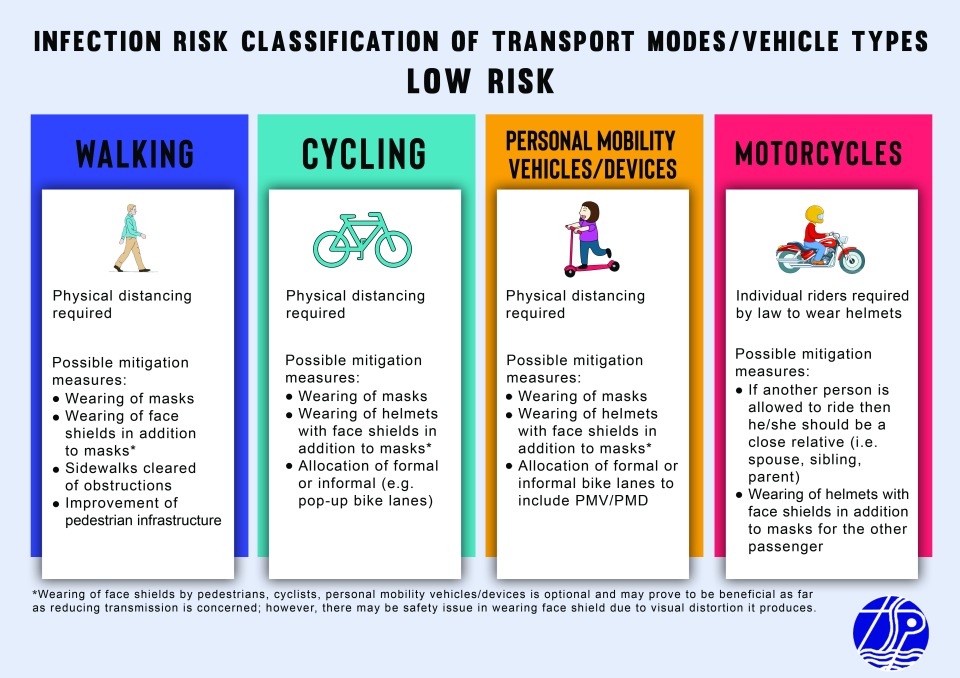
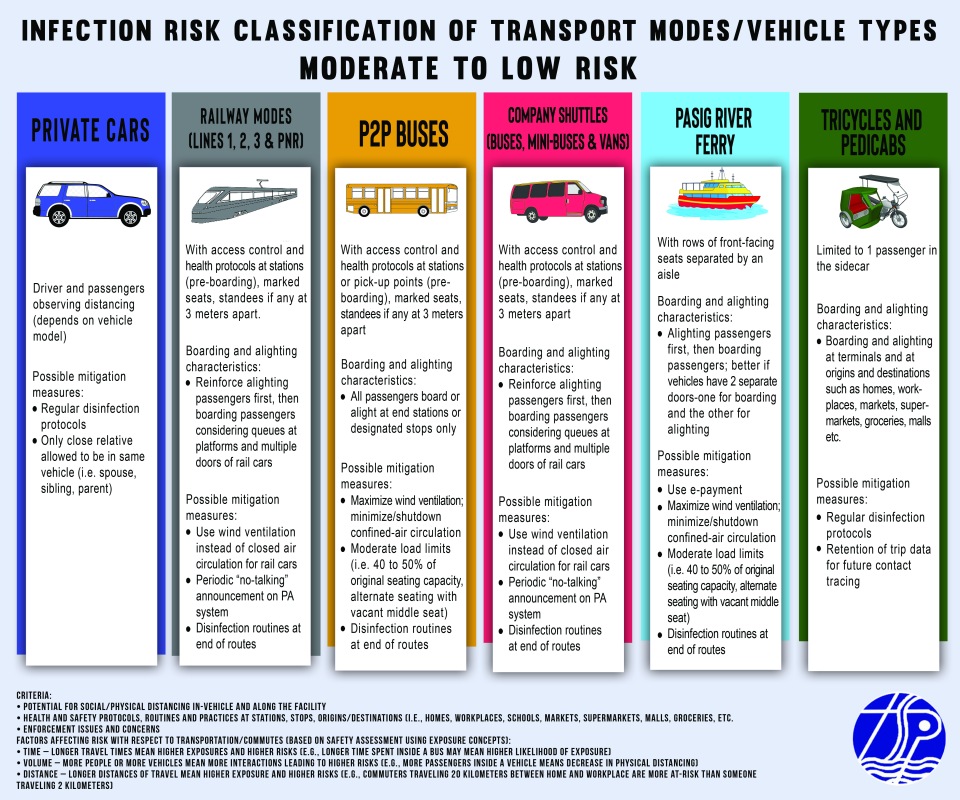
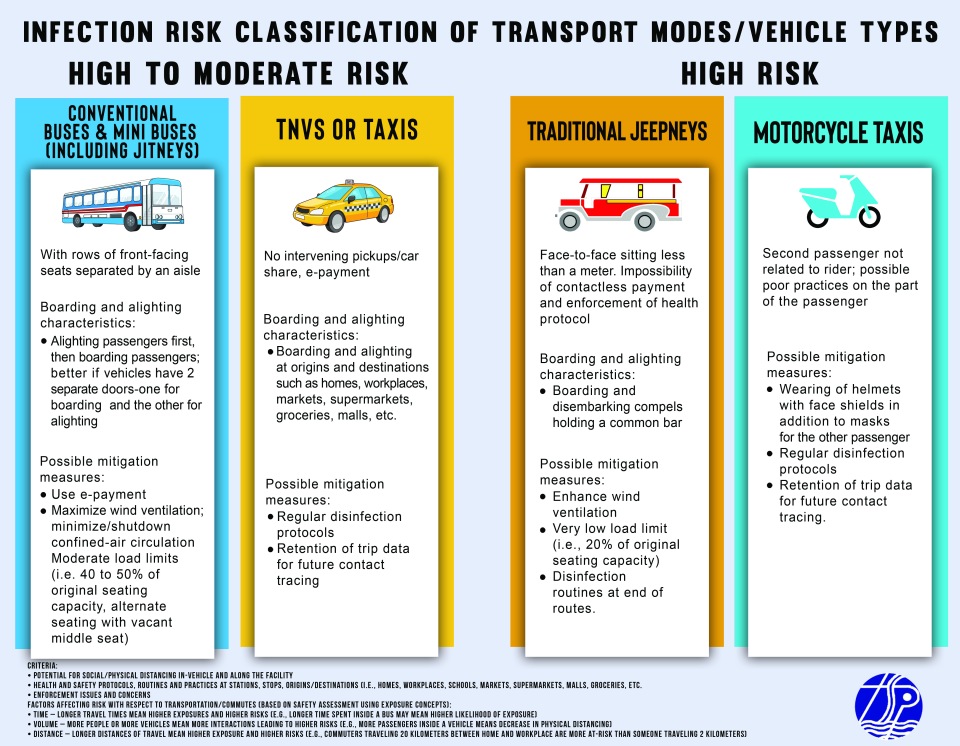
–
COVID-19 Infection Risk Assessment of Transport Modes
I posted about the work we have been doing to assess the infection risk (i.e., spread of COVID-19) for various modes of transport considering the transition of many areas including the National Capital Region (NCR) to the General Community Quarantine (GCQ). The work was undertaken through the Transportation Science Society of the Philippines (TSSP), which is under the umbrella of the Eastern Asia Society for Transportation Studies (EASTS). Here is the outcome in the form of an “Infection Risk Classification of Transport Modes or Vehicle Types” developed by a core group of public transportation and road safety specialists among its members:
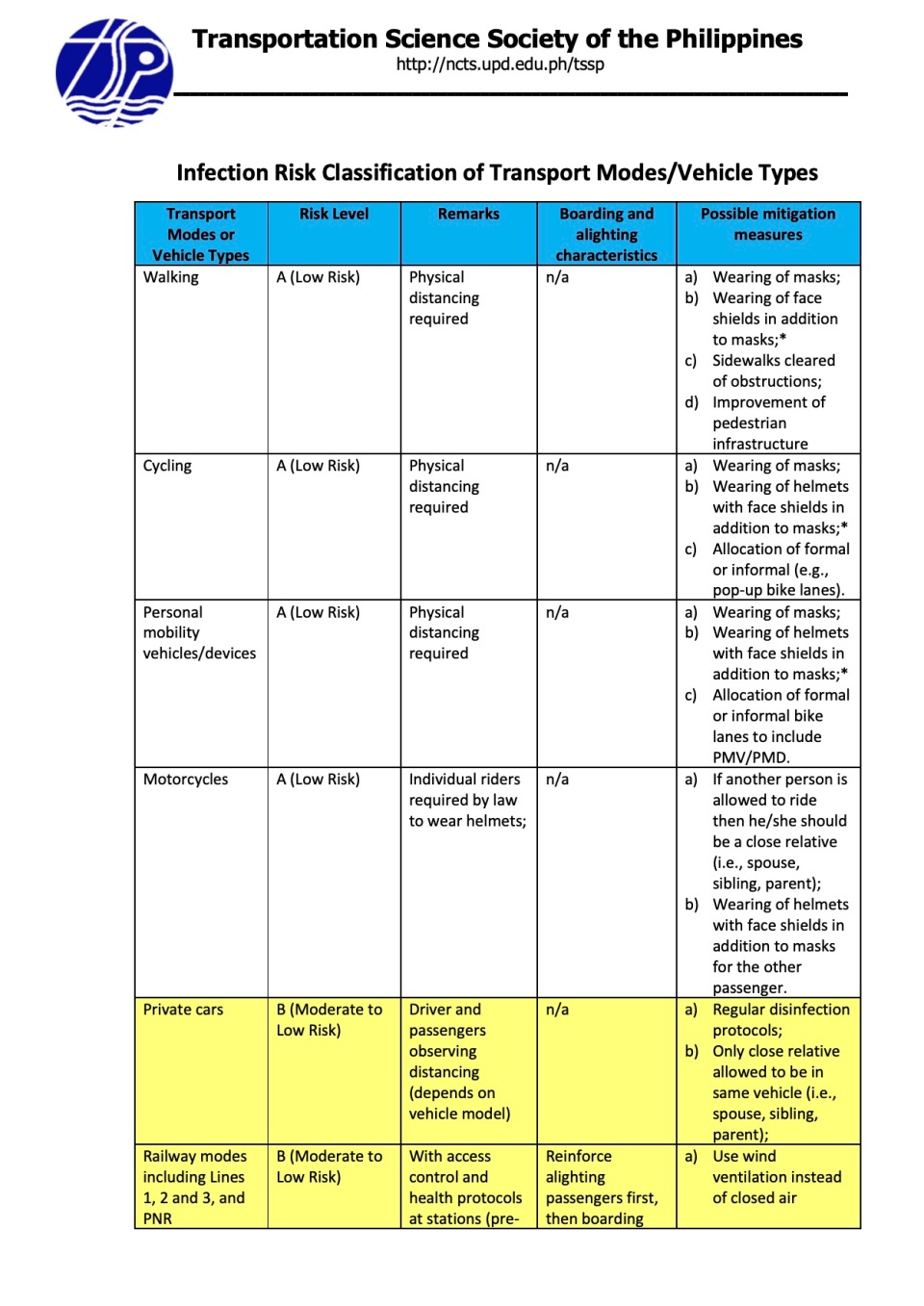
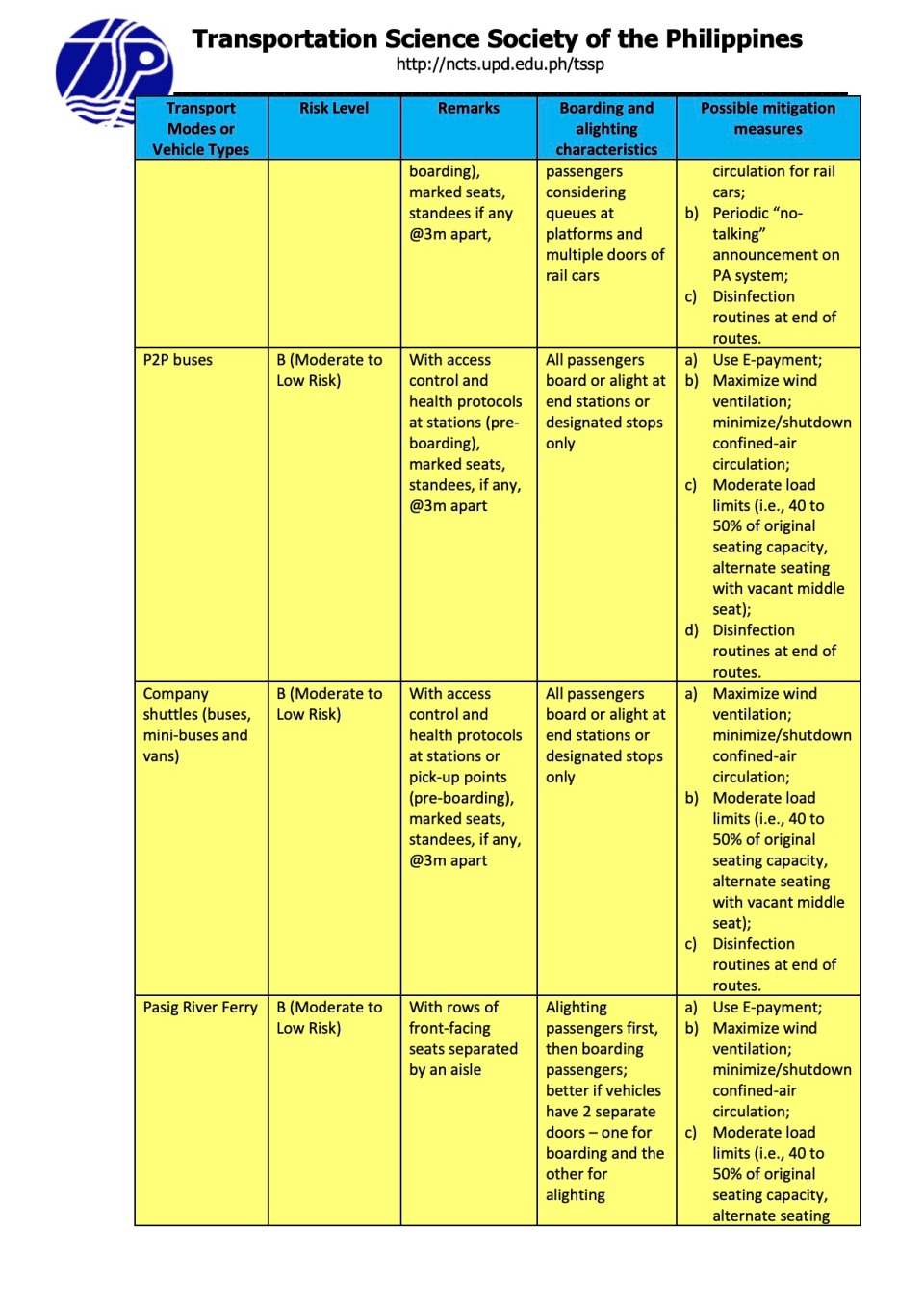
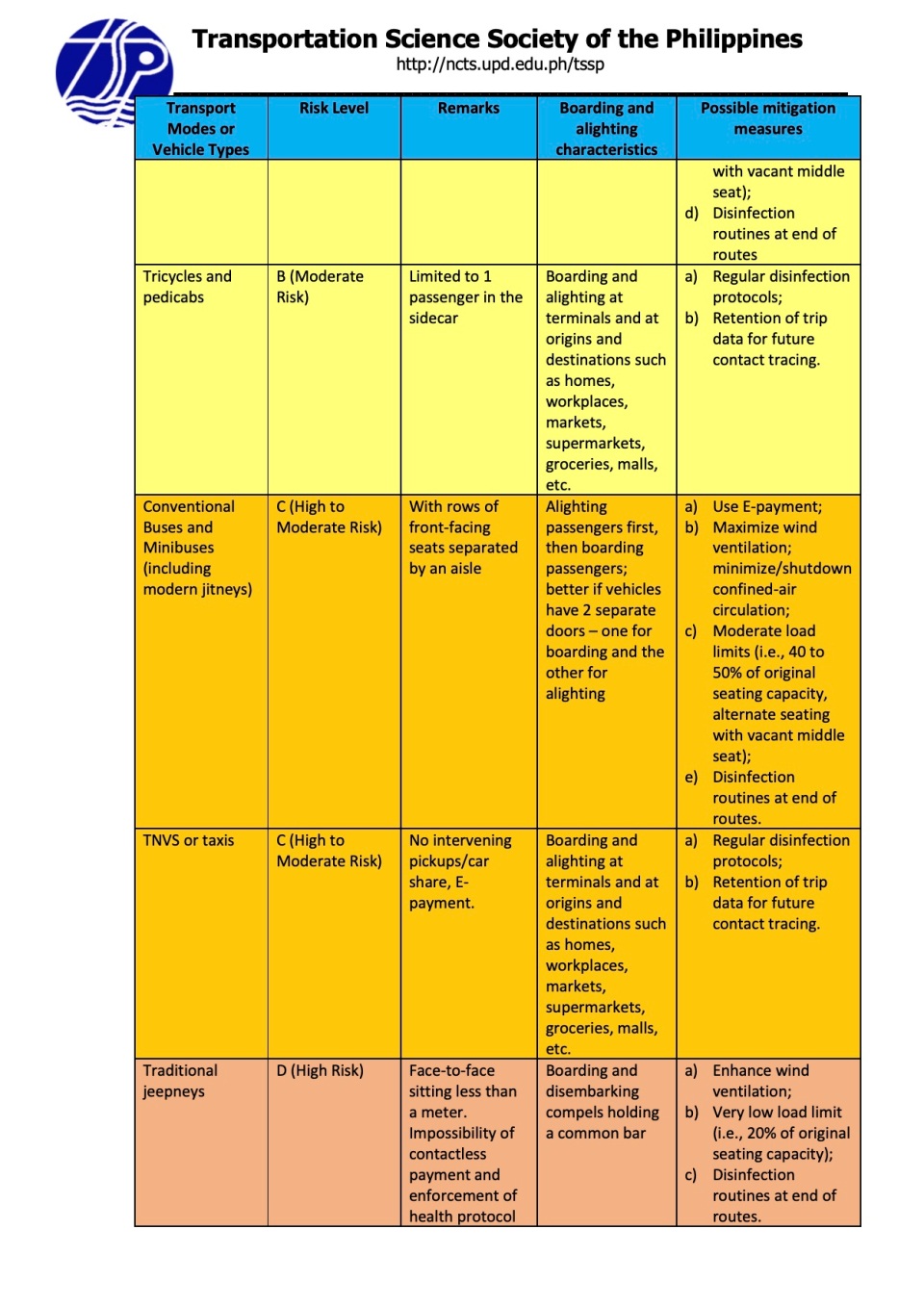
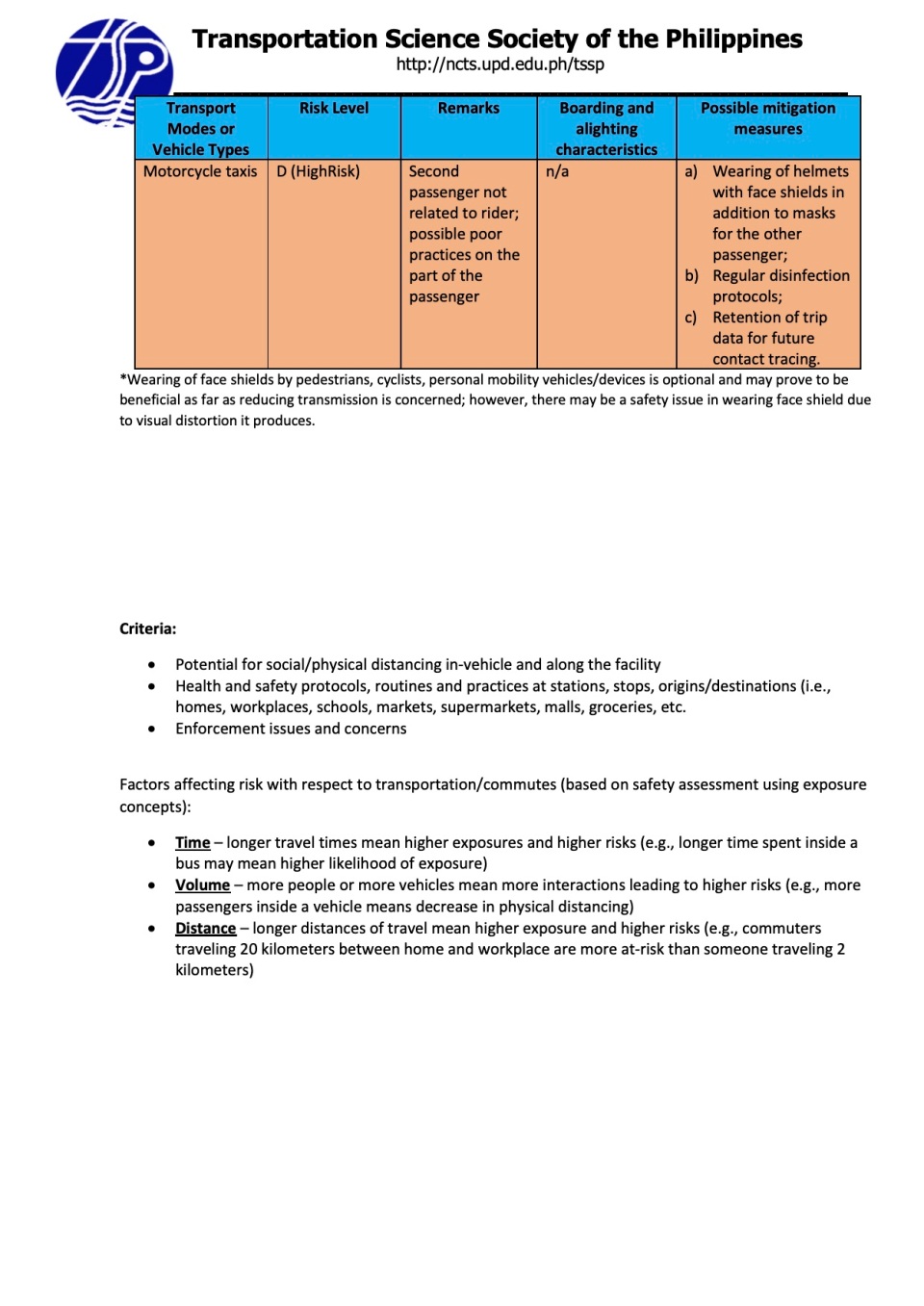
Note again that this is the product of a rapid assessment using the mentioned criteria and factors. It is a qualitative assessment and a quantitative one, given the data, would obviously been preferred. Moreover, this is an assessment for risk of infection rather than for road safety. In the “old normal”, for example, cycling and motorcycle use may have a higher risk in traffic given traffic mix, human behavior and lack of facilities to make these modes safe.
–
Reference on Bicycle Facility Preferences and Increasing Bicycle Trips
There are many references that are free for downloading. These include the latest publications from the National Academies Press that includes outputs from the National Academies of Sciences, Engineering and Medicine. I am sharing here and posting also as a reference for me to return to a new publication from the National Cooperative Highway Research Program:
NCHRP Research Report 941: Bicyclist Facility Preferences and Effects on Increasing Bicycle Trips by Watkins, Clark, Mokhtarian, Circella, Handy and Kendall.
The research was supported by the American Association of State Highway and Transportation Officials (AASHTO) in cooperation with the Federal Highway Administration (FHWA).
–
On car-shaming and reducing car use
Here is another article I am sharing (re-sharing?). I have seen or read a lot of posts on social media about how we should not go back to the car-centric traffic before the Enhanced Community Quarantine (ECQ) and its variations. I do agree with this point. However, I take reservation about how some people seem to be resorting to car-shaming rather than be more proactive and progressive about coming up with strategies and/or plans that I hope would be evidence-based or supported by valid data. As the article states, “it takes more than car-shaming to change car use”:
Jaffe, E. (2020) “It takes more than car-shaming to change car use”, Medium, https://medium.com/sidewalk-talk/it-takes-more-than-car-shaming-to-change-car-use-107e28ccb2cf [Last accessed: 4/29/2020]
A key message from the article: “People are most open to changing their travel habits during major life events, such as a move. But even a well-timed message isn’t enough.” Perhaps the opportunity is here now to reform our transportation system. But that will take a lot of will or effort from all sectors most especially the national agencies (e.g., DOTr, DPWH) and local governments who have the authority and responsibility to implement changes. These changes include the assignment of exclusive lanes for bicycles, public transport and logistics while restricting car use. There are also other elements that need to be in place as we transition into the so-called “new normal” and so there will be a lot going on among the sectors or parties collaborating or interacting for transportation. Hopefully, there are context-sensitive strategies that will be adopted and implemented in order for everyone to transition more efficiently and effectively. And as they say…life goes on.
–
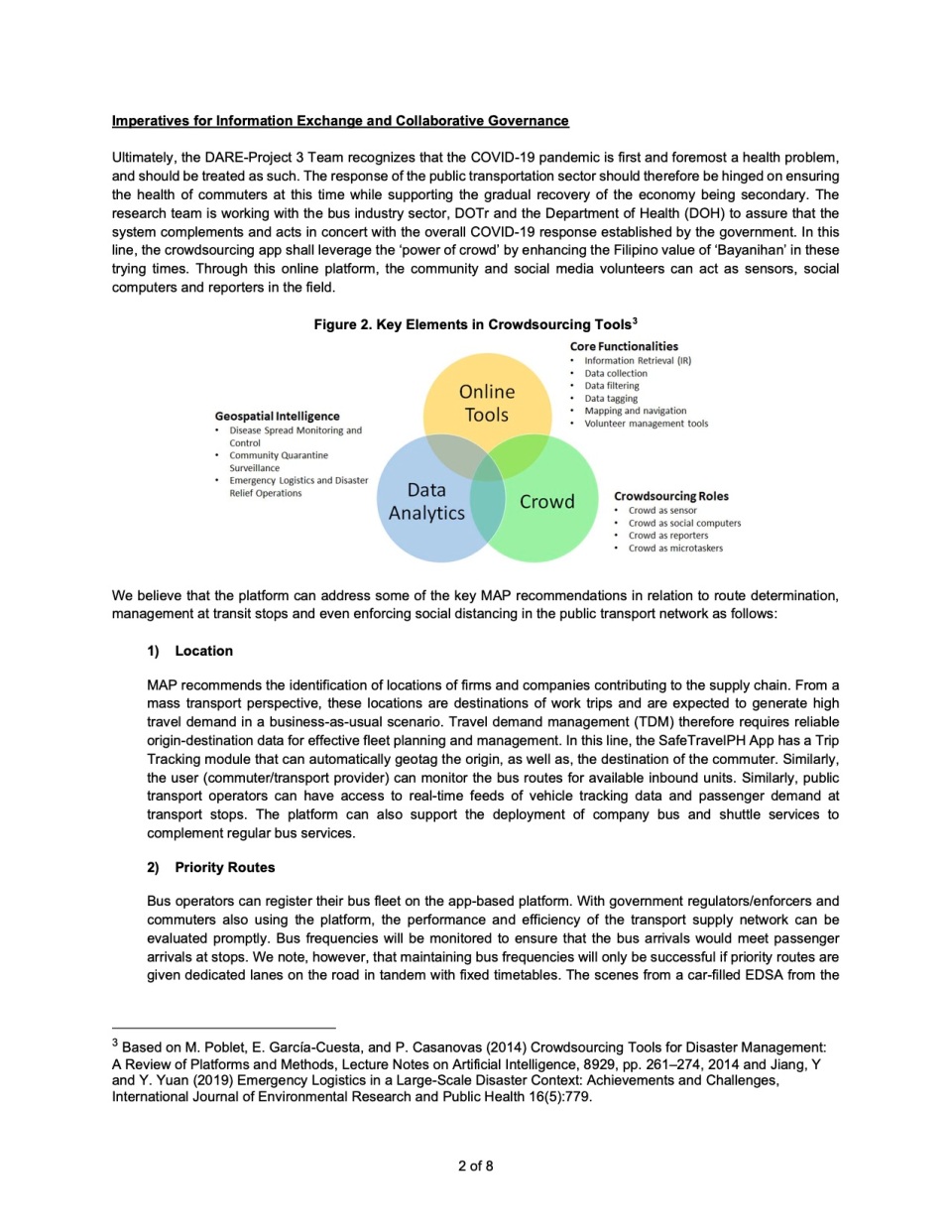
Public Transport Recommendations of the UP COVID-19 Pandemic Response Team
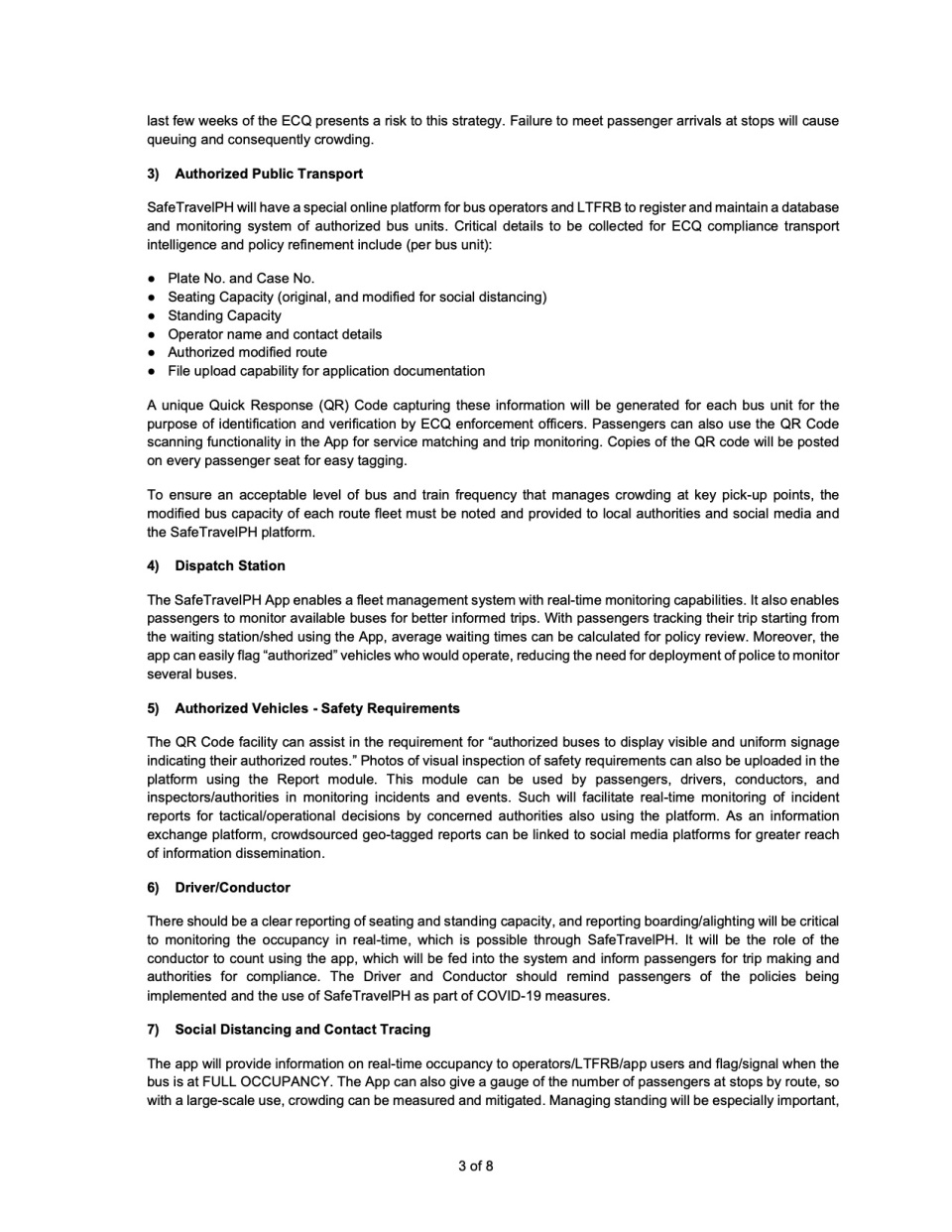
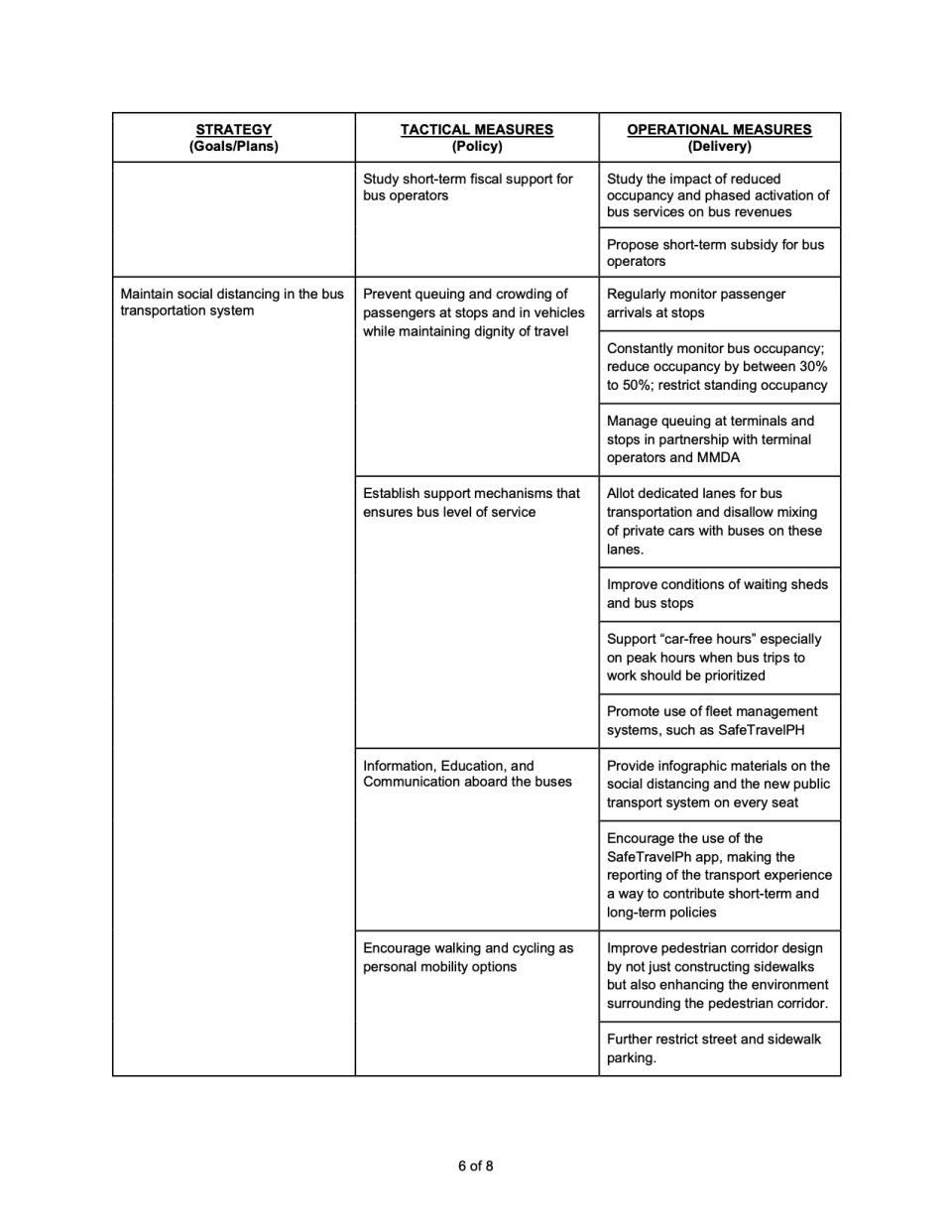
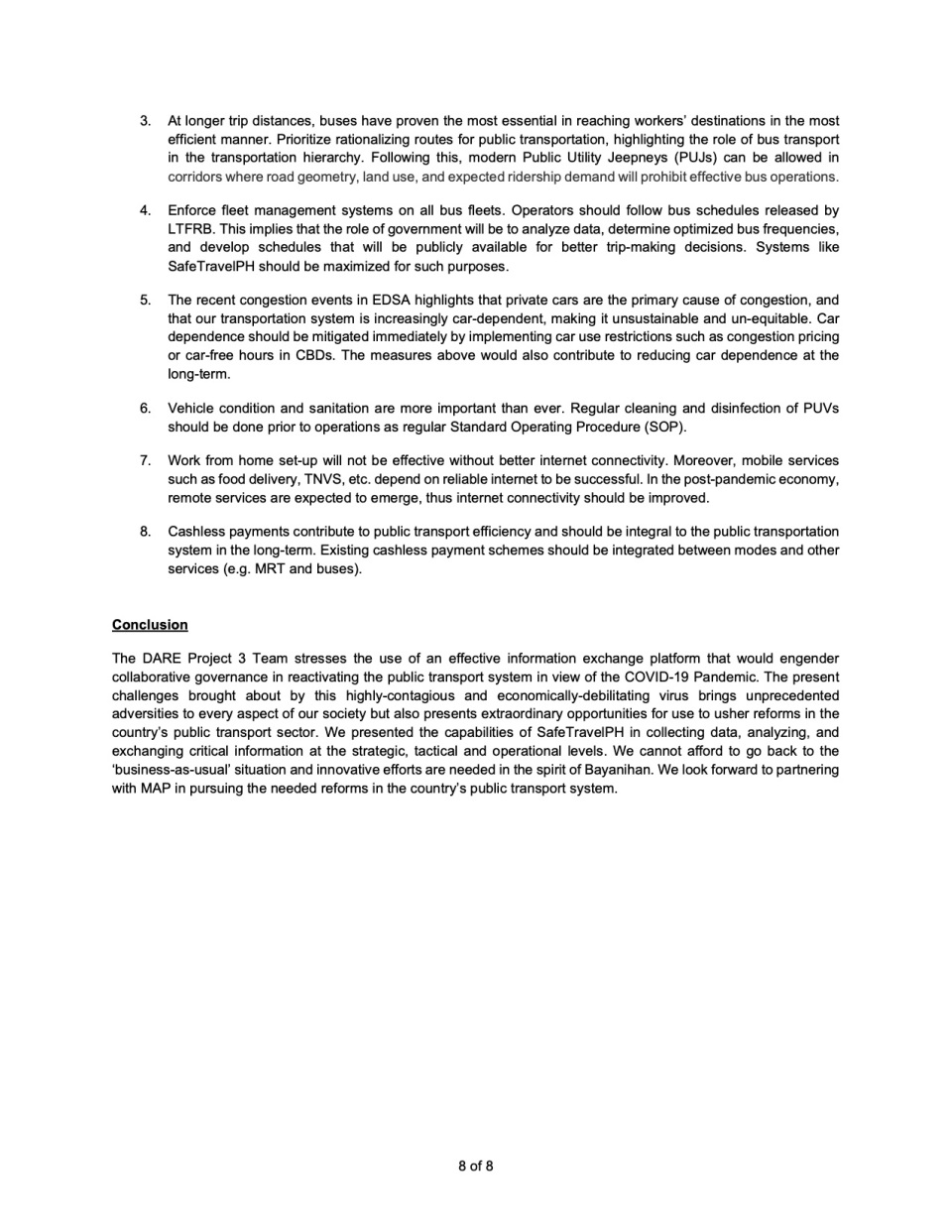
Here are the recommendations of UP COVID-19 Pandemic Response Team: “Effective Reactivation of Public Transport Operations for the New Normal through an Information Exchange Platform for Collaborative Governance”




–
On public transport services during the pandemic
I’ve read a lot of discussions and recommendations pertaining to public transportation services (mainly its lack thereof) during the Enhanced Community Quarantine aka lockdown in most parts of the Philippines. Problem is, a lot of people had their mobility curtailed as most people did not have their own private vehicles (cars or motorcycles) to do essential trips (i.e., for groceries, market, drugstores, hospitals, etc.). These include so-called frontline workers, most especially those working in hospitals or clinics. Even the use of tricycles on a limited basis while adhering to physical distancing guideline was not allowed in many cities and municipalities. What do we really need to do now and in transition to address the lack of public transport services?
Here is a concise yet very informative article on transit:
Walker, J. (2020) “Cutting Transit Service During the Pandemic: Why? How? And What’s Next?”, Human Transit, https://humantransit.org/2020/04/cutting-transit-service-during-the-pandemic-why-how-and-whats-next.html [Last accessed: 4/23/2020]
Most of the points discussed and recommendations presented are applicable to our case in the Philippines. We should also accept the fact that we cannot go back to the situation prior to the ECQ, and that the new normal calls for a reduction in car use. Meanwhile, we still have to address the pressing issues and come up with a plan or maybe strategies for public transport that involved not just buses and trains but other modes as well like the jeepneys, vans and tricycles.
–
On Pasig’s ordinance promoting and supporting the use of bicycles
I am posting a couple of LGU issuances that would be good references to other LGUs as we all tread along through these quarantines, curfews and lockdowns (or whatever it is they call it these days). First off is the Ordinance from Pasig City. The city has been in the news quite frequently for the very progressive, responsible and active handling of the situation led by its popular mayor Vico Sotto. His policies and programs are claimed to be based on data or information on his constituents that his team is using with much efficiency. This shows us how data analytics can prove useful in times of crisis such as the Covid-19 pandemic. The ordinance also shows a grasp of realities for transport and the so-called “new normal” that people have been talking about once we transition out of the quarantines and lockdowns.


I guess it begs the question if Pasig is also coming out with a formal policy or statement regarding other modes of transport such as tricycles, jeepneys and buses. They did allow tricycles for a while until national government told them to cease tricycle operations citing health issues while not really delving into details to find a way to improve people’s mobility during these times. Meanwhile, other LGUs specifically one that is close to the President’s heart has defied the very same orders from national agencies to restrict tricycle operations as public transport. I will post that issuance next…
–
On pollution due to ride shares
We close February with another article I share about ride sharing and its environmental impacts:
Hawking, A.J. (2020) Uber and Lyft generate 70 percent more pollution than trips they displace: study, The Verge, https://www.theverge.com/2020/2/25/21152512/uber-lyft-climate-change-emissions-pollution-ucs-study [Last accessed 2/29/2020]
I guess, this sort of validates our suspicion of ridesharing becoming unsustainable. Again, we note its origins when it had the potential to reduce car ownership and car use. The original ride shares were closer to carpooling as well as took advantage of under-utilized vehicles while giving extra income to people who could share their vehicles on-demand. Eventually, the ride shares morphed into taxis with people purchasing cars to get into the business. Soon, a lot of them were roaming the streets as they awaited bookings and this type of operations generated a lot of emissions. They might not have required more parking spaces like the conventional car users but this benefit was eventually overcome by the pollution they produced.
–
National Transport Policy is out!
The National Transport Policy is out and there’s a lot of buzz about the wording of the policy. NEDA released the following infographics on their official Facebook page:
 Definition of what the policy is about
 Hierarchy of transport modes (note the emphasis on walking and cycling)
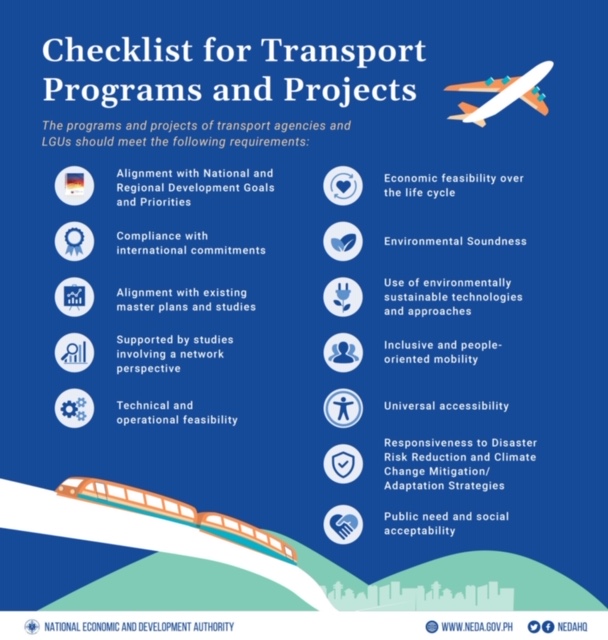 Checklist for programs and projects: I am already anticipating what proponents will be writing to justify projects according to this checklist.
I will reserve my commentaries for future blogs. There is really a lot to discuss about this policy and how it will implemented (properly or improperly), There are lots of different ideas, advocacies, interests and agendas on transportation that come into play here. And we can only hope that the policy and its implementing rules and regulations will be clear enough (not vague as to have so many loopholes) for this policy to effect transformation and inclusive and sustainable development.
–
Comments on current transport issues – Part 3: On the obstacles to the PNR trains
2) On the obstacles to the PNR operations
We have done studies before when studies on the PNR were not considered fashionable. People who did research on rail transport were more interested in Lines 1, 2 and 3, and dismissed the PNR as a lost cause. There were many transportation experts who ridiculed it and even taunted PNR about their poor service. And yet we did our studies because we had an appreciation of the importance of this line and how it could play a major role in commuting if given the resources to improve their facilities. It was shown that the line could be more advantageous for commuters particularly those traveling between the southern parts of Metro Manila and Makati and Manila. These would be both workers and students who will benefit from the shorter travel times and less expensive fares. The downside then (and still at the present time) was the long headways between trains. That is, you can only catch a train every 30 minutes.
 This photo taken more than a decade ago show the typical conditions along many sections of the PNR. It is pretty much the same today and the agencies involved (DOTr and PNR) have done little to reduce the informal settlers along the line. No, they didn’t just appear now, and are throwing garbage, rocks and other debris on the trains. This was already happening years ago.
Fast forward to the present and they seem to be getting a lot more resources than the last 30+ years. A Philippine Railway Institute (PRI) has been created. New train sets have just been delivered and went into operation. Unfortunately, the new trains were met with rocks and other debris as they traveled along sections occupied by informal settlers. The incident damaging the new trains puts further emphasis on the need to the need to address the squatter problem along the PNR line. Should fences be built to protect the trains and passengers? Should people be relocated? I think both need to be done in order to secure the line and in preparation for service upgrades including more frequent train services (i.e., shorter intervals between trains). And we hope to see the DOTr and PNR working on this as they attempt to attract more passengers to use their trains.
–
 Caught (up) in traffic