
Home » EST (Page 22)
Category Archives: EST
On healthier cities and encouraging walking
It’s a Sunday and the sun is up after days of rain so it would be a good time to be outdoors. Here is a nice article for the fitness buffs out there. Many of us have sedentary lifestyles and this has come as no surprise with the how we work and study as well as the influence of tech in our everyday activities. Even as I write this, I am sitting in front of my desk and have only my fingers and hands working. The rest of me is inactive except perhaps my senses and my brain. 🙂
Merle, A. (2018) “The Healthiest People in the World Don’t Go to the Gym,” medium.com, https://medium.com/s/story/the-healthiest-people-in-the-world-dont-go-to-the-gym-d3eb6bb1e7d0 [Last accessed: 8/1/2018].
I miss the times when I was living in Japan and when we were living in Singapore mainly because I was able to have a more active lifestyle in the cities where I lived. I walked and biked a lot when I was in Yokohama, Tokyo and Saitama, and later walked a lot around Singapore. I/we didn’t need a car as the public transportation was excellent and so were the pedestrian infrastructure. I recall walking between our laboratory at Yokohama National University and the dormitory, and later the Sotetsu Line Kami-Hoshikawa Station almost everyday. And then climbing up and down the hills of Yamate on Sundays. I can walk around Tokyo on my own and finding my way through shopping streets especially in Akihabara and Ueno. Of course, my favourite places would always include Kamakura, which can be reached via a train ride from Yokohama Station. The wife and I loved walking around Singapore and exploring places on foot. Indeed, you can be healthy and have a workout everyday without being too conscious about it!
–
Increasing the number of TNVS units? Not so fast!
The Land Transportation Franchising and Regulatory Board (LTFRB) is planning to increase the number of TNVS units (i.e., rideshare vehicles) in Metro Manila to meet what is perceived as the demand for them based on the numbers provided by TNCs like Grab. The problem with this number they want to eventually achieve, 65,000 units supposedly, is that this is based on current transport conditions in the metropolis. Also, this is based on data that is biased for the interests of TNCs, which obviously want to increase their driver and vehicle base in order to maximise profits. Here is a nice article that should provide some context from abroad where rideshare vehicles are actually generating more car traffic and taking people away from public transport.
Fried, B. (2018) “Uber and Lyft Are Overwhelming Urban Streets, and Cities Need to Act Fast,” Streetsblog, https://nyc.streetsblog.org/2018/07/25/uber-and-lyft-are-overwhelming-urban-streets-and-cities-need-to-act-fast/ [Last accessed: 7/26/2018]
Currently under construction are the Line 7 and Line 2 Extension projects and soon there will also be the Line 1 Extension. Also, in the pipeline are the proposed subway and rehabilitation of PNR that is supposed to revitalise its commuter line. These are examples of projects that will likely be game changers in terms of commuting with the objective of drawing people away from car use. In the bigger scheme of things, perhaps there is a need to rethink numbers for TNVS and instead focus on improving taxi services in Metro Manila. The same can be said for other cities as well where there is already a need for better public transport services to avert a transport future similar to what Metro Manila is already experiencing now.
–
On the matter of parking
Here’s another nice read that I’m sure is worth the while particularly if you are interested in parking
Litman, T. (2018) Parking Planning Paradigm Shift, planetizen.com, https://www.planetizen.com/blogs/99462-parking-planning-paradigm-shift [Accessed: 7/7/2018].
An acquaintance recently forwarded to me a position paper of sorts calling for the removal of parking minimums in the Philippines. The document constantly dropped the name of UC Irvine Professor Donald Shoup and others in order to justify his proposal. This was supposed to be addressed to those who are doing the revisions of the National Building Code (NBC) of the Philippines. First off – I didn’t know that the minimum parking requirements are being reviewed now and that there is another revision project that is ongoing. The last revisions I was aware of was the project that sought to include resilience items in the NBC. That was done through the University of the Philippines Diliman with UP’s Building Research Service (BRS) as lead and involving, among others, its Colleges of Architecture and Engineering.
–
A compilation of studies on walkability in the Philippines
My students have been engaged in studies on walkability (and related topics) the past few years. These have been a mix of published and unpublished work that I have compiled at list below:
Unpublished works:
- Capalar, M.A.M. and Garma, F.A.A. (2018) Assessment of Walkability Along Taft Avenue, Unpublished Research Report, Institute of Civil Engineering, University of the Philippines, Diliman
- Pajarin, J.B., Soriano, C.M. and Regidor, J.R.F. (2017) Assessment of Mobility of Persons with Disabilities (PWDs) in Cainta, Rizal, Unpublished Research Report, Institute of Civil Engineering, University of the Philippines, Diliman.
- Cortez, E.H.D. and Razon, J.V.DV. (2017) Assessment of Walkability Along Katipunan Avenue, Unpublished Research Report, Institute of Civil Engineering, University of the Philippines, Diliman.
- Marcelo, K.R.S. and Salvador, J.P.B. (2015) Assessment of Pedestrian Facilities Along Marcos Highway, Unpublished Research Report, Institute of Civil Engineering, University of the Philippines, Diliman.
Published works:
• Pajarin, J.B., Soriano, C.M. and Regidor, J.R.F. (2018) “Assessment of Mobility of Persons with Disabilities (PWDs) in Cainta, Rizal,” Philippines Transportation Journal, Vol. 1, No. 1, pp. 60-80.
• Pajarin, J.B., Soriano, C.M. and Regidor, J.R.F. (2017) “Assessment of Mobility of Persons with Disabilities (PWDs) in Cainta, Rizal,” Proceedings of the 24th Annual Conference of the Transportation Science Society of the Philippines, Quezon City, July 21, 2017.
• Regidor, J.R.F., Marcelo, K.R.S. and Salvador, J.P.B. (2016) “Assessment of Pedestrian Facilities Along Marcos Highway,” Proceedings of the DPWH Research Symposium 2016, Quezon City, September 2016.
Here’s a paper based on a comprehensive study our centre conducted for the City of Olongapo in the Province of Zambales:
• Palmiano, H.S.O., Javier, S.F.D. and Regidor, J.R.F. (2015) “An Assessment of Walkability in a Medium-Sized Philippine City,” Proceedings of the Eastern Asia Society for Transportation Studies, Vol. 10, December 2015.
We hope to continue such studies with future advisees who perhaps can tackle other corridors or even areas. Among those on my Wishlist would be Espana Avenue, Ortigas Avenue, Intramuros, Recto Avenue, and even EDSA or Circumferential Road 5.
–
Park and ride near the Line 2 Santolan Station?
These days when there are heavy rains and the threat of flooding, the Marikina river and its riverbanks come to mind. In the Santolan area, where a former Mayor of Marikina has invested a lot in developing a bus terminal, he seems to be stretching it in terms of trying to make the area a major intermodal terminal and maximising utility of the land. The latest venture is described by the sign below:
 “Park and ride” sign along the Marcos Highway Bridge crossing the Marikina River
A closer look at the sign shows what’s written at the lower part. That is, that the parking spaces are “walking distance” from the Line 2 Santolan Station. I’m not sure if they measured the actual walking distance and what it would take to walk that distance between this parking area for the “park and ride” and the Line 2 Santolan Station. A quick measurement using Google Maps indicate that the distance between these two are more than 400m, and this is not an ‘easy’ walk considering that you would have to ascend from or descend to the riverbanks level and there is no shelter from the elements for what would be regular walks if one is to commit to this “park and ride” arrangement. If I were to walk such a distance, then I would likely choose to park at the mall and use the long footbridge connecting it to the station.
I still maintain that the best location for a “park and ride” would be one near the station similar to the Trinoma mall parking lot being practically adjacent to the Line 3 North EDSA station. And that is what LGUs, the railway authorities or the private sector should look into for projects like the Line 2 Extension and Line 7. The area around the future Line 2 Masinag Station presents a lot of possibilities in terms of parking facilities including perhaps a redevelopment of the existing SM City Masinag to be integrated with the station. As for Line 7, the areas around another SM City (Fairview) also presents opportunities for “park and ride” facilities.
–
On Quezon City’s Kalayaan Avenue bike lanes
Another example of what can be called “pwede na iyan” bike lanes are those found along Kalayaan Avenue in Quezon City. To be fair, the city made an effort to paint the bicycle lane and put up signs for this. However, one will observe that there is poor enforcement in relation to the bike lane as you would find vehicles parked on the lane. There is also the question of bicycle traffic as there doesn’t seem to be many cyclists along Kalayaan, making the space fair game for other vehicles including tricycles and motorcycles. Then there is the matter of connectivity. The Kalayaan bike lane seems to be isolated and does not have a connection to any other bike lane. The lane around the Elliptical Road, for example, is in the inner side of that road. Teacher’s Village does not have bicycle lanes but perhaps it is not (yet) necessary to have exclusive lanes in the still predominantly residential area (note: commercial establishments are still on the rise along major roads in the village).
 Vehicles parked on the Kalayaan Avenue bike lane
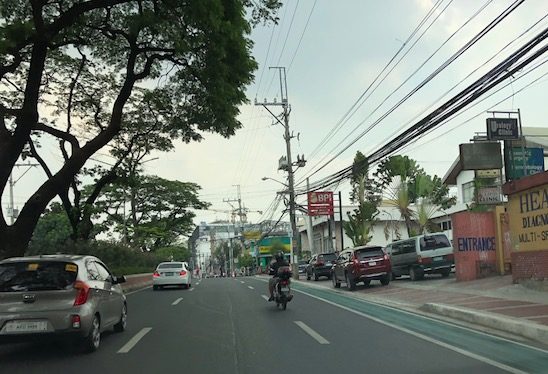 Free flowing traffic along Kalayaan – notice the vehicles parked on the sidewalk?
One big question comes to mind with regards to such bike lanes: How do we improve the situation in order to encourage more people to bike? There are many answers to this question and the answers branch out to the infrastructure, policy, social and even societal, and other aspects concerning cycling. What we should bear in mind and what Quezon City and perhaps MMDA should work on is a strategy for promoting non-motorised transport (NMT) that includes walking and cycling that can be implemented metro-wide with safety and efficiency (incl. connectivity) as the main objectives rather than have piecemeal projects for show or demonstration.
–
On illegal parking
The following photo pretty much sums up the topic for this post:
 How many violations do you see here? The driver of the dark coloured vehicle had three outstanding violations – parking on the pedestrian crosswalk, blocking a fire hydrant, and blocking a PWD ramp.
The penalty for such violations as shown above used to be a paltry 500 pesos. However, a third violation will lead to a suspension of revocation of the driver’s license of the offender. That is, if authorities such as the Land Transportation Office (LTO) are able to track these violations. The fines have been updated recently to 1,000 pesos. Illegal on-street parking is perhaps among the most frequently committed violations that usually contributes to traffic congestion as it occupies space and reduces road capacities. It also blocks the typical paths of cyclists. A variation of on-street parking where parts of the vehicles are on the sidewalk is also problematic as it deprives pedestrians walking space and may lead to road safety issues especially if pedestrians are forced to use the road.
How do we address such issues? These are matters that can easily be addressed by enforcement. Yes, the catch all for many of our transport and traffic ills happens to be enforcement or rather the lack of it in many instances such as what’s shown in the photo above. This is an enduring and perhaps festering issue among those tasked with enforcing traffic rules and regulations. And we can only hope that they are up to the challenge.
[Note: The photo above was taken in the University of the Philippines Diliman campus along the Academic Oval and just after the intersection with Apacible Street. UP people like to say that what happens on campus is a microcosm of society. I cannot but agree in the case of the situation shown.)
–
On the old overnight parking rates at NAIA
I found a couple of old parking tickets from the Ninoy Aquino International Airport. Both are for overnight parking, which shows how cheaper overnight rates were before. The amounts to be paid then were also simpler to calculate since an overnight is automatically computed as either 40 or 300 pesos. Note that the 40-peso overnight fee was for the open parking lots of NAIA T2 and T3. The 300-peso fee was for the multi-level building of T3. I’ll just put these photos here for reference and those throwback moments.

–
On the opposition to “complete streets”
I recently read an article about the opposition to road diets in California, USA:
Tinoco, M. (2018) “How to Kill a Bike Lane”, http://www.citylab.com, https://www.citylab.com/transportation/2018/05/how-to-kill-a-bike-lane/559934/?utm_source=SFTwitter [Last accessed: 5/20/2018]
So far, we know that at least three cities are progressive enough to implement road diets including Marikina City, Pasig City and Quezon City. Iloilo doesn’t count yet since their bike lane was constructed along the very wide Diversion Road. Our recommendations for Tacloban, if implemented by the city, will probably result in the second most comprehensive application of road diets/complete streets in the Philippines after Marikina, which implemented their bikeways network almost 2 decades ago. There are sure to be many who would be opposed to such schemes as many still have the view that streets are for motor vehicles. This car-oriented thinking is something that will be a challenge to advocates of people-oriented transportation systems. Hopefully, many can learn from experiences here and abroad on how to reclaim space for people leading to safer and more inclusive transport for all.
–
In support of bike lanes
Here is another interesting article about bike lanes but from the perspective of a non-cyclist. I believe this (support for bike lanes) is a view shared by many but not much articulated. The assumption is usually that car-owners would like to have less of other’s cars on the road so they could benefit from the presumed reduction in congestion should more people take up cycling. But then the same can be said for public transportation and its users as well. That is, car-users would want others to take public transport so as to also reduce road congestion; allowing them faster trips/drives.
Lewyn, M. (2018) “A Non-Cyclist’s Case for Bike Lanes,” planetizen.com, https://www.planetizen.com/node/97632?utm_source=newswire&utm_medium=email&utm_campaign=news-03152018&mc_cid=0e22636014&mc_eid=9ccfe464b1 [Last accessed: 3/17/2018]
–

