
Home » Governance (Page 11)
Category Archives: Governance
A brief history of transport strikes – Part 2: reasons for a strike
The current transport strike is not about fare hikes or the rising prices of fuel. Those are the most common reasons for jeepney drivers and operators going on strike. It’s quite simple for these reasons: Drivers protest when government refuses to increase fare rates amidst rising costs of operations and maintenance. And they don’t when fares are reduced as fuel prices are going down.
The Department of Transportation (DOTr) through its Land Transportation Franchising and Regulatory Board (LTFRB) is tasked with evaluating operations and maintenance costs of public utility vehicles and prescribe the minimum and incremental fares for these services. Fare hikes (and reductions) are the consequence of fuel price increases (or decreases) but are not set as dynamic or automatic. Fuel prices, as can be observed, can fluctuate and currently change every week. Fares are not automatically adjusted whether fuel prices are increasing or decreasing and are heavily regulated by government in part to supposedly protect the interests of the riding public. As such, fare matrices or the structured fares according to the various routes and the distances covered by public utility vehicles
The reason for the current transport strike is generalized as a jeepney phaseout. The term ‘phaseout’ actually refers to the PUV Modernization Program (PUVMP) of the government that seeks to replace all conventional jeepneys with ‘modern’ or ‘modernized’ units. The latter include mini-bus types as well as those that retain the conventional jeepney form but usually larger and with newer engines and interior layout. This is not necessarily a phaseout like the one I described in Part 1 along the LRT Line 1 corridor.
Again, much of the opposition cites the high cost (and therefore unaffordable) of a modern jeepney. The financing schemes currently available as well as the requirement for jeepney operators and drivers to be part of a transport cooperative to avail of these financing schemes are still considered unacceptable by many. And yet, government seems unwilling to extend resources in order for operators and drivers to be able to afford a new vehicle. The old jeepneys would still have some value but definitely not near a substantial down payment needed for low monthly payments. These monthly payments cannot be covered by the typical boundary (basically rent) for operators or the daily income for drivers.*
What is the cost of replacing conventional jeepneys with new, ‘modernized’ vehicles? Well, let’s assume that a new vehicle costs 2.4M pesos. Also, perhaps cover only the ones operating in the urban setting (i.e., exclude for now those serving provincial routes especially those used also for freight (e.g., top loads)), say 50% of the estimated 250,000 units need to be replaced. That goes up to 300 billion pesos. If we were to replace only Metro Manila jeepneys, that will be 132 billion pesos. These numbers can be compared to the cost of major projects like the Metro Manila Subway (488 billion), the Bataan-Cavite interlink bridge (175 billion) and the New Manila International Airport in Bulacan (735 billion). Would it be worth it (benefits-wise) to invest in new jeepneys?
–
*Of course, this also indicates a flawed business model for jeepney operations. But that’s another story.
A brief history of transport strikes – Part 1: introduction
A nationwide week-long transport strike by jeepney operators and drivers From a CNN news report yesterday, it was stated that an estimated 4 out of 10 or 40% of jeepney drivers will be going on strike and halting operations for a week. These are supposedly members of the group Manibela, which claims to have over 100,000 members nationwide (Aren’t you curious how many jeepneys there actually are nationwide? There are supposedly more than 250,000 public utility jeepneys operating across the country with about 55,000 in Metro Manila.). The other 40% are certain that they will not be going on strike and these include members of the more established groups like PISTON, ACTO and Pasang Masda as well as those who belong to the many transport cooperatives that were formed the last so many years in part for the purposes of modernization. The remaining ones are undecided and include those also affiliated with those groups and those who claim to not have any affiliations.
If media companies like GMA, the defunct ABS CBN and even government station PTV have archives dating back to the 1970s, they will probably see that similar interviews have been conducted of jeepney drivers. Libraries like the National Library or perhaps those of leading universities like the University of the Philippines and Ateneo de Manila University would likely have archives of newspapers from way back. I remember UP Diliman having microfiche facilities but I am unsure to what year they have archives. You will likely read similar reports and interviews about jeepney operations during those times. The idea and initiatives for phasing out the conventional jeepneys is not a new thing or topic. It has been out there for quite some time but in different forms and contexts.
For example, there was a proposal to phase out jeepneys along the corridor of the LRT Line 1 in the Feasibility Study for the railway line as well as in the Metro Manila-wide studies that were conducted in the late 1970s and early 1980s. Jeepneys plying the Monumento-Baclaran and Monumento-Harrison Plaza routes were among those identified for phasing out. Careful reading of the reports though will also show that ‘phase out’ actually meant ‘rationalizing’ or ‘rerouting’ the jeepney services so they will complement the mass transit line. That never happened and the jeepneys still operate today (probably many are still the same jeepneys from the 1970s and 1980s!). Do passengers ride them from Monumento to Harrison (or vice versa)? Probably not as the travel will be too long compared to riding the train. They survive because of the short trips, usually less than 4 kilometers, by passengers who probably should be walking or cycling instead if we were in a Japanese, Korean, Singaporean or European city.
Fast forward today, the call apparently is for a phase-out in favor of the “modern” jeepneys (many are actually mini-buses). Jeepney operators and drivers are also being called to join or form cooperatives under which they can be part of programs that will replace their conventional jeepneys with a ‘modern’ unit. One issue here are the terms for the replacement or the acquisition of a new vehicle. The cost of a new vehicle varies and can be more expensive than a new SUV (e.g., more expensive if not as expensive as a new Montero, Fortuner or Everest) depending on the model and the size of the vehicle. This is apparently the most significant concern among others that is being cited by those opposing or resisting modernization, which they equate to a ‘phase out’.
 One of the ‘modern’ jeepney models currently operating in Metro Manila
More in the next article for this series…
–
On the need to change mindsets about bike lanes
Public acceptance of bike lanes has grown during the pandemic. Prior to the pandemic, there were few supporters especially among local government units and national agencies that seem to be comfortable with the status quo. Few like Iloilo and Marikina had any bike facilities worth mentioning. The pandemic was supposed to change that and it did for many. However, the acceptance and the gains seem to be eroding as we return to face-to-face activities and the ‘old’ normal situation.
I’m sharing below an article on the need to change mindsets about bike lanes and cycling in general:
Thompson, C. (January 24, 2023) “The Battle Over Bike Lanes Needs a Mindset Shift,” Wired, https://www.wired.com/story/the-battle-over-bike-lanes-needs-a-mindset-shift/ [Last accessed: 1/27/2023]
To quote from the article:
“Maybe bike lanes will always be fraught, until enough of the public is finally in a true lather about climate change—and it seems reckless to not have them.
Crises, after all, have a way of opening people’s eyes to possibilities. During Covid, restaurants and cafés lost so much business that cities nationwide began allowing them to build curbside seating areas where people could sit, safely, in the open air. It greatly reduced parking—but because, well, crisis, shop owners didn’t see any way around it. Patrons loved the outdoor seating so much that cities are making it permanent: A New York City study of several streets closed during Covid found storeowners making more than before, and diners digging the al fresco lifestyle. If data won’t change minds, customers might.”
There are two opposing sides on this matter. On one side are advocates who naturally will push for bike lanes and will promote them as The solution (emphasis mine) rather than one of a cocktail to address the transport mess we are in. On the other side are conservative, status quo types (or car-lovers as bike advocates will call them) who believe cars should have the roads to themselves. Unfortunately, many in government and particularly in transport agencies are with the latter. Perhaps they should be the first ones that need to be converted to favor active transport?
–
Some takeaways from a lecture
I lecture from time to time at the Philippine Public Safety College. This is the counterpart of the National Defense College. In the latter graduates are conferred a Masters in National Security Administration (MNSA) while in the former, graduates are conferred a Masters in Public Safety Administration (MPSA). It is no wonder that many who take these courses are military or police officers seeking graduate degrees that may later be useful for them after their typically early retirement (military and police officers retire at 56 years old instead of the typical 65 years mandatory retirement for other government employees). There are many civilians who take these programs, too. The MNSA degree actually promotes a person to a high rank as a military reservist. I am not sure about the MPSA degree but graduate degrees like these are useful for promotions in their respective offices.
I lectured recently to a class consisting of two batches of their MPSA program. Each batch consists of uniformed (mostly senior police officers with a rank equivalent to at least a Lt. Col.) and non-uniformed personnel (from various offices and professions including public and private universities, private companies, etc.). I get a lot of questions and comments regarding transport and traffic during my lectures. Some can be out of context or perhaps posed in a smart-aleck fashion but most are well-intentioned. After all, who doesn’t want to “solve” traffic? Among the more notable comments during my recent lecture are as follows (not in any order):
- There is a need to have better urban planning for our cities;
- Investments for transportation infrastructure need to be shared by government and the private sector;
- A holistic approach is required and we cannot isolate transportation or traffic;
- There is a need to have a law restricting vehicle ownership (mostly related to parking);
- There is a need to invest or allocate more resources to develop other cities to help decongest the larger cities.
Based on my experience having lectured at the PPSC over 5 years, these two batches had more listeners and were more sensible when they posted their comments and opinions on the chatbox (the lecture was via Zoom). There were only a couple of comments with ideas I did not agree with:
- Transferring the capital to another location – this seems to be a trendy (read: “nakikiuso”) topic and a very tempting one for discussion but it is not a simple task and has had mixed results in other countries that tried it (e.g., Brazil, Pakistan and Malaysia). Is it worth exploring? Probably.
- Cable cars for Metro Manila – I explained that this is still band-aid solution that does not address the roots of the transport problems experienced by Metro Manila. It is not suitable as for one, it will not have the capacity required for regular commutes and, to me at least, it is more a novelty than a solution. Resources would be better allocated elsewhere such as active transport.
Overall, I thought that this most recent lecture generated the best feedback so far from my students. I look forward to more lectures and interactions like this. And perhaps the next one will be face to face.
–
On getting started on bike commuting
Here is another article on bike commuting. It really is a challenge to get people into bike commuting even if their workplaces or schools are close to their homes. What more for people who have to travel longer distances between their homes and workplaces or schools?
Bassett, E. (December 1, 2022) “The No B.S. Guide to Getting Started Bike Commuting,” Medium, https://erikbassett.medium.com/the-no-b-s-guide-to-getting-started-bike-commuting-5dd0cbb87e5b [Last accessed:
To quote from the article:
“Assume you’re invisible until proven otherwise.
Like every city I’ve lived or ridden in, yours probably paints pictures on the ground and calls them “bicycle infrastructure.” Road designs encourage excess speed; vehicles aren’t meaningfully separated from cyclists and pedestrians; there are conflicting rights-of-way at intersections, driveways, and so forth.
And that is not right. It’s a sad commentary on urban “planning” in most places that anything but car use requires this degree of paranoia. It points to a profound dysfunction that few (with any serious influence) are willing or even interested to change…yet.
But unless or until it improves, the only viable response is to assume you don’t exist in the eyes of whoever’s driving nearby. “If I weren’t here, would they gun it to make a right turn on red?” Well, assume they will. “If I weren’t here, would they merge up there?” You guessed it: assume they will.
This is unquestionably the worst aspect of bike commuting, and if it’s too stressful in your situation, that’s perfectly fine. But in the spirit of a “no-B.S.” guide, I’d be remiss not to drive home a life-saving lesson that all these years of cycling have so deeply ingrained in me.”
The author also states the difference between bike commuting and sports biking including noting the differences in the objectives or goals for each.
–
Why do we keep widening roads?
I’m just going to share this article here. The article from The NY Times asks a question that has been bugging planners and engineers, particularly those who are in government and perhaps under the agencies like the DPWH, DOTr and NEDA. This also applies to planners, engineers and those from other disciplines involved in transportation infrastructure development and particularly roads or highways.
–
Examples of legislative actions in support of active transport
While the Philippine government and various local government units seem to be reneging on their commitments to support active transport, other countries have been building on their gains during the pandemic. Here are examples of legislations in New York State that will support active transport through funding of complete streets projects and institutional arrangements for representation of transit dependent individual:
The article is about two legislations:
Legislation (S.3897/A.8936-A) Provides Funding for “Complete Streets” Projects Inclusive of a Holistic Approach to Street Design
Legislation (S.3959-B/A.7822-C) Adds Board Seats to NFTA, RGRTA, CDTA, and Central New York Regional Airport Authority Dedicated to a Transit Dependent Individual
We hope to see something like these at least at the local level. Perhaps if LGUs are able to legislate and implement these, there will be more good practice examples that will compel national government to support active transport development. The latter is actually ironic considering that many plans are supposed to spell out the national government’s commitment to active transport. There are still live memorandum orders and department orders supporting and promoting active transport. Are these also being waylaid? That will be tragic for transportation if we didn’t learn or gain anything from the experiences during this pandemic.
–
On the future of bike lanes in Metro Manila and other cities and municipalities in the Philippines
My friends and I were talking about the current buzz about the bike lanes including statements made by certain personalities (influencers, advocates, government officials, etc.) about biking and bike lanes. There were many recent pronouncements of motorcycles being allowed to use bike lanes or the outright removal of bike lanes. We all agreed this was backward and the way forward is to build on the current network and facilities. What we have in our cities and municipalities are not perfect and far from ideal but they are a start and perhaps the foundation for a bikeway network that can eventually make a dent on the car-centric transportation we have.
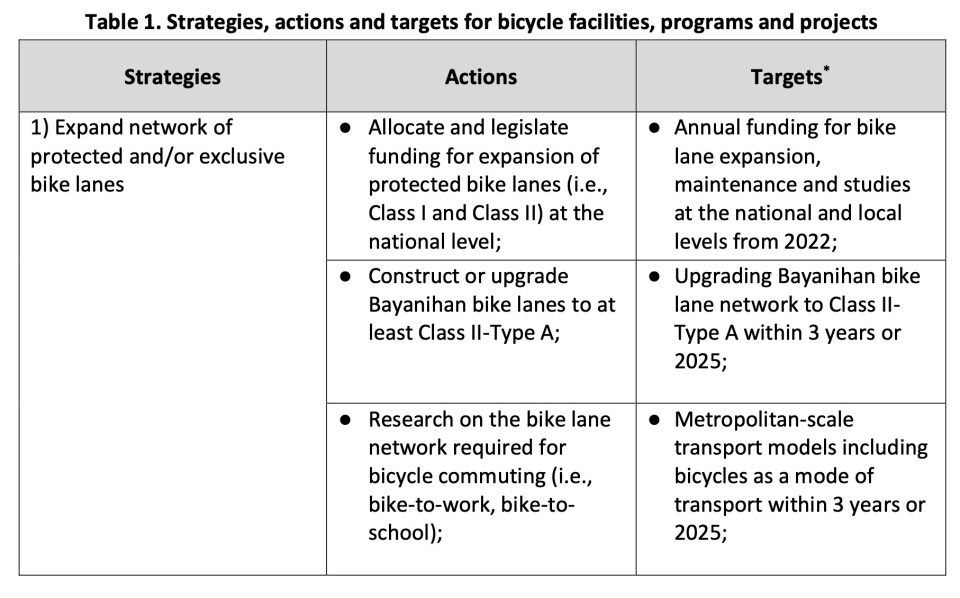
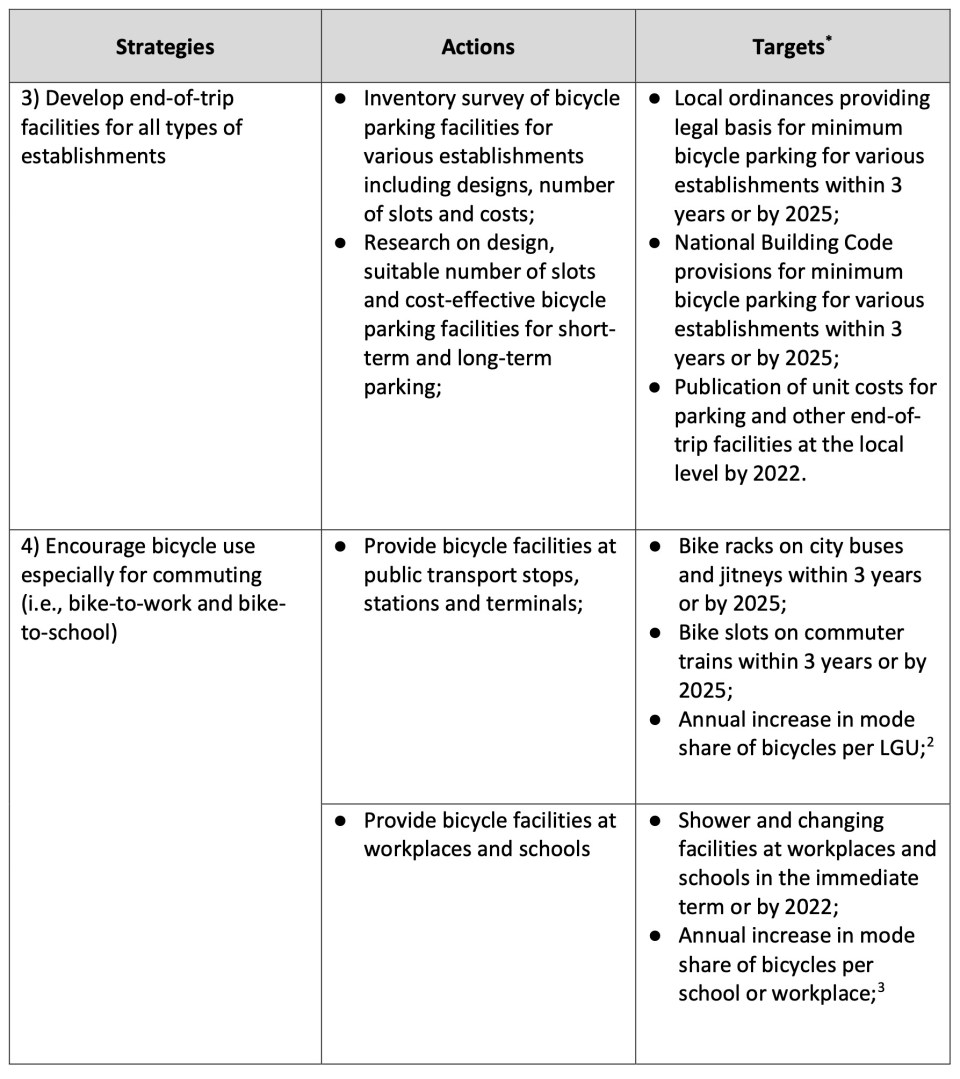
I share below the strategies, actions and targets for bicycle facilities, programs and projects from the Network Planning for the Establishment of Bike Lanes in Metro Manila, Metro Cebu and Metro Davao that was completed middle of 2022. The project is DOTr’s with support from the UNDP. The table is from the Final Report of the project.


A Happy Christmas to all!
–
On Metro Manila having one of the worst transit systems in the world
This is a follow-up to the previous post on the UC-Berkeley Study. Here is an example of how media featured the study outcomes:
https://www.facebook.com/CNNPhilippines/videos/1089453421728393
I didn’t see whether there was a response from government. These studies end up as features and nothing more if these do not prompt or push authorities to act on the problem. Even experts from academe or industry are reduced to being commentators or even pundits providing context, assessments and opinions, even recommendations that are perceived to fall on deaf ears. Perhaps government is already desensitized about these issues and will just trudge along at its own pace? In the end, it is the commuters mostly taking public transportation who continue to suffer and lose productive time to their daily travels.
–
On the best public transit systems in the world
Manila’s poor ranking in recent study conducted by the University of California Berkeley’s Institute of Transportation Studies with think tank Oliver Wynam on public transit systems caught the attention of a lot of people. Media was quick to feature this in the news and I am aware of at least GMA and CNN Philippines doing features of this in their news programs. Here is the article on the same that mentions the UC Berkeley ITS study:
Pollard, A. (November 21, 2022 ) “These Cities Have the Best Public Transit Systems,” Bloomberg CityLab, https://www.bloomberg.com/news/articles/2022-11-21/these-cities-have-the-best-public-transit-systems [Last accessed: 12/11/2022]
Manila, or Metro Manila to be exact, placed only 56th in public transit while ranking 48th in sustainable mobility and 58th in urban mobility readiness. I leave it to the readers to go read the UC Berkeley report rather than depending on media or social med influencers for their takes on the ranking. The report can be downloaded from the link I provided above.
Perhaps there should be an assessment of cities (at least the highly urbanized ones) in the Philippines to see how they are ranked. There should be a criteria (UC Berkeley and Oliver Wynam used distance to public transit, affordability, operating hours, crowding and commute speeds among others in their study) to be agreed upon where experts can score cities using a simple-enough scale, say 1 to 10 with 10 being the highest score. What are your top 5 Philippine cities in terms of public transportation?
–
 Caught (up) in traffic