
Home » Governance (Page 20)
Category Archives: Governance
On the transformation from car-oriented to people-oriented streets
I saw this article shared by a friend on social media and share it here as an interesting piece providing ideas and the thinking or attitude required if we are to transform our streets:
Jaffe, E. (2020) “4 ways to go from “streets for traffic” to “streets for people”, Medium, https://medium.com/sidewalk-talk/4-ways-to-go-from-streets-for-traffic-to-streets-for-people-6b196db3aabe [Last accessed: 9/30/2020]
It is actually interesting to see how this plays out in Philippine cities. The ‘honeymoon’ or ‘grace’ period from the lockdown to the ‘normalization’ (read: going back to the old normal) of traffic might just have a window and this is closing for active transport. National and local officials, for example, who seemed enthusiastic and quickly put up facilities for active transport have slowed down efforts or even stopped or reneged on their supposed commitments. The next few weeks (even months) will show us where we are really headed even as there are private sector initiatives for active transport promotion and integration.
–
What if our government officials used bicycles for their commutes?
Here’s another quick share of an article about cycling:
Reid, C. (2019) ‘Cherish The Bicycle’ Says Dutch Government — Here’s That Love In Map Form, Forbes, https://www.forbes.com/sites/carltonreid/2019/01/08/cherish-the-bicycle-says-dutch-government-and-heres-that-love-in-map-form/#2951914e2726 [Last accessed: 9/29/2020]
The Dutch have perhaps the densest bikeway network in the world as shown in the article and the link below showing bike lane maps. They also have a government that is pro-bicycle. You wonder what transportation and infrastructure would look like if our government officials biked to work or used public transport on a regular basis. Perhaps these will affect how they make policies and decisions pertaining not just to transport but on housing and health as well? It would be nice to see a counterfactual discussion or paper on this and other scenarios that could help us improve transport and quality of life. This is a big “what if” that many people are actually clamoring for so government can be grounded in the way they make plans and decisions.
Here is the link to Open Cycle Map, which is affiliated with Open Street Map:
–
References for improvements for active transportation
Here’s a nice link to a National Academies of Science, Engineering and Medicine pointing to the wealth of researches supporting improvements for active transportation:
Paths to Biking, Walking Improvements Supported by Wealth of Research
Link: https://www.nationalacademies.org/trb/blog/paths-for-walking-and-biking
The references listed should aid researchers, practitioners, advocates and policymakers in their work towards realizing a people-oriented vs car-centric transportation.
–
On solving the inequality problem in cities
Here is another quick share of an article that is timely and relevant not just now but for years (maybe decades?) to come:
Grossman, D. (2020) “New Study Proposes a Mathematical Solution to Big Cities’ Inequality Problem,” Inverse, https://www.inverse.com/science/a-new-study-shows-why-building-more-equal-cities-could-save-lives?link_uid=15&utm_campaign=inverse-daily-2020-09-14&utm_medium=inverse&utm_source=newsletter [Last accessed: 9/15/2020]
I will just leave it here for future reference but to summarize, the article explains how cities should be planned or replanned based on the distribution or redistribution of certain facilities like hospitals, banks, schools, supermarkets, and parks. It argues that there is an optimum location for these in relation to where people live and work. If properly planned, travel distances and times can be significantly reduced.
–
Some takeaways from a UNICEF webinar
The UN together with its partners recently launch a Second Decade of Action for Road Safety (2021-2030). I will share the statement in a subsequent post. For now, I will share some slides from the recent webinar organized by UNICEF that focuses on safe and healthy journeys for children. Those of us who are working directly with UN agencies have been working on safe journeys for children particularly as they travel between their homes and schools. The recent launch and pledges or commitments of support from partner organizations will surely reinforce efforts to ensure the safety of children whether or not they return to school.
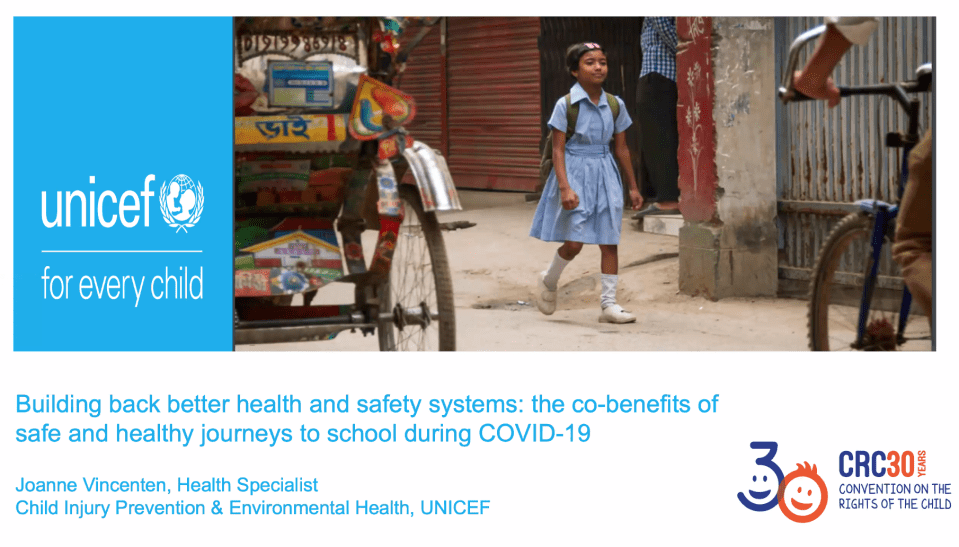
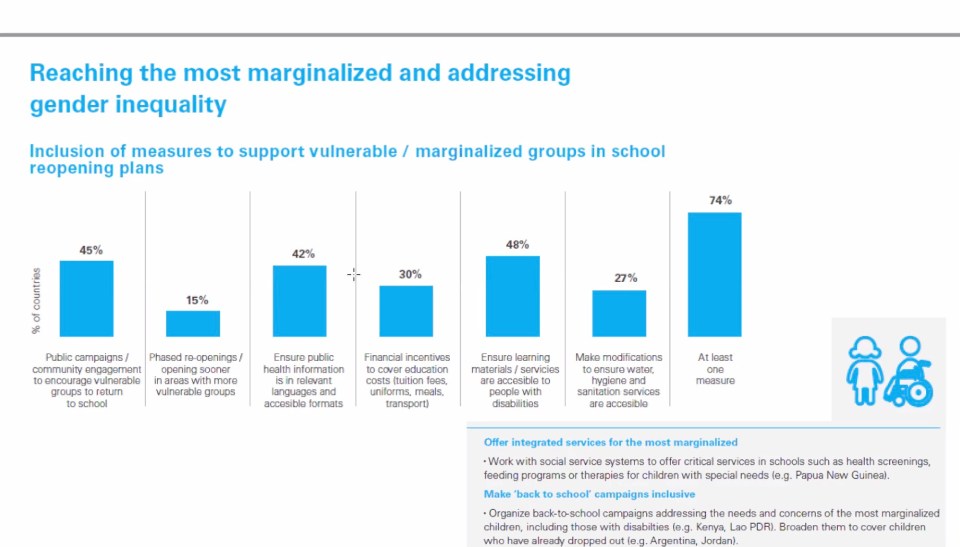 Context setting or rationale for UNICEF’s initiatives
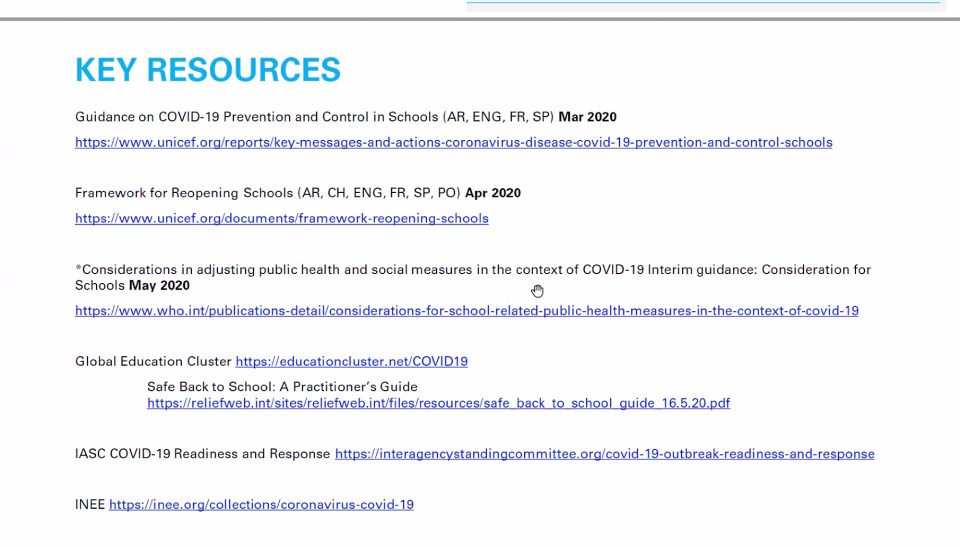 Key resources or references shared by the webinar host
 The term ‘co-benefits’ reminded me of a past project I worked on that was about low carbon transport. We also did assessment using co-benefits of low carbon transport. Among these were road safety.
 The slide and the table speaks for itself – examples of effective strategies
 There were several presentations during the webinar. However, the most interesting and informative for me was this one about the guidance for safe and healthy journeys to school.
 Ten (10) points to consider as guidance for safe and healthy journeys to school
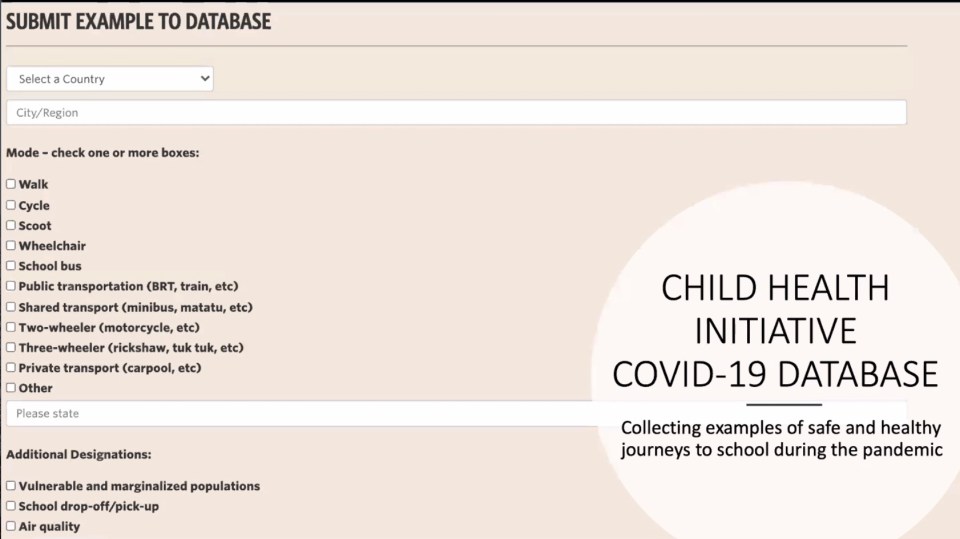 Database initiative in support of the guidance (I will get the link to this and share it in a future post.)
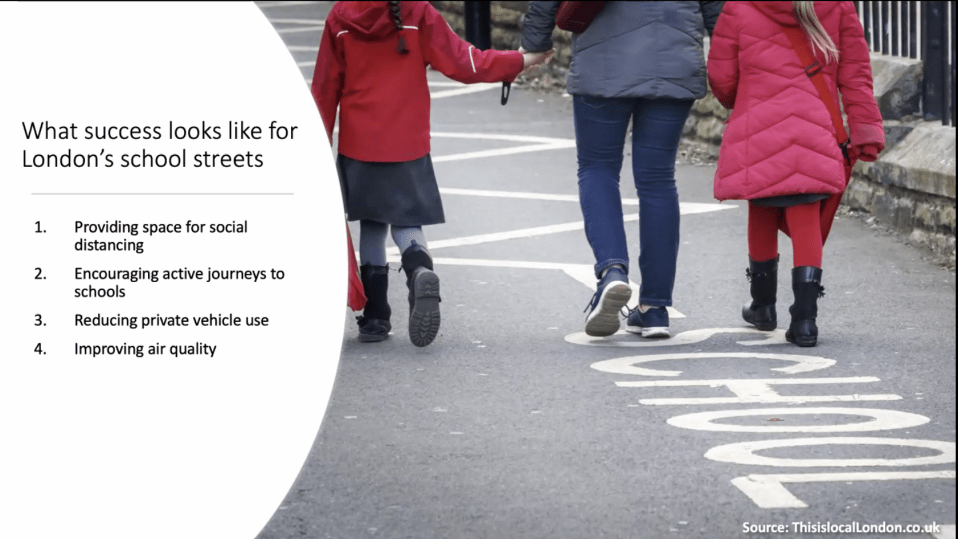 An example from London’s experience
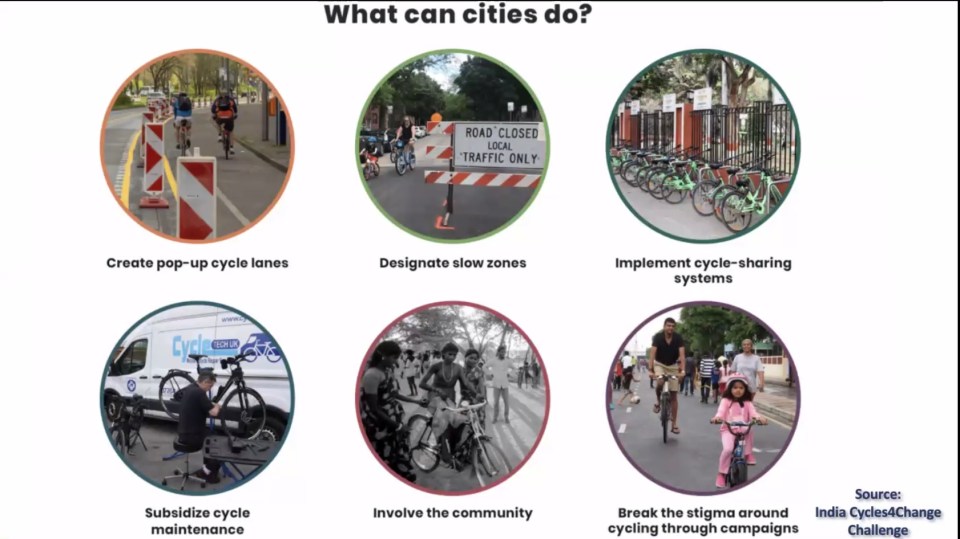 This is a slide on what cities can do to promote active transport among children.
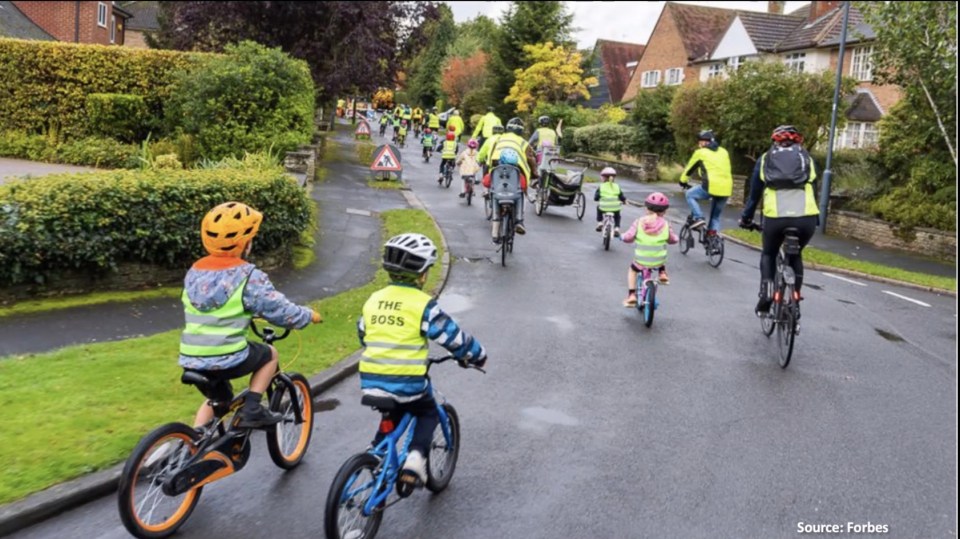 The photo shows what is termed as a “bicycle school bus”. This and “walking school bus” are real options for children and their guardians when traveling between their homes and schools. Such underlines the option of not using motor vehicles (i.e., reduction in motor vehicle trips).
I will try to elaborate on these in future posts, particularly on the 10-point guidance.
–
Of inequitable allocations and accessibility
In the news recently were figures released supposedly by Philhealth showing the top hospitals receiving reimbursements from the agency for claims relating to COVID-19. Southern Philippines Medical Center, a hospital in Davao City received 326M pesos while UP-PGH got 263.3M pesos. I was not surprised that my social media newsfeed included posts from both sides of the fence (The fence sitters among my friends on social media were not commenting about these anymore and seem content in just posting on food or whatever activity they were in.). Each were posting information divulged by the whistleblowers in the ongoing hearings on the issues pertaining to PhilHealth funds.
I will not go into the political aspect of this controversy but will just focus on the transportation aspects of the issue. I will just compare the top two hospitals in the list to simplify the assessment while mentioning others in general.
The claim that the hospital in Davao was the equivalent of PGH in Mindanao doesn’t hold water as the hospital does not treat even 10% of the cases that PGH is handling and for a much smaller geographical area. While UP-PGH is accessible to a larger population and for less travel times, SPMC is not as accessible to say people coming from other major cities like Cagayan De Oro or Zamboanga City. Yes, there are other major cities on the same island that have sizable populations with ‘catchment’ or influence areas comparable to Davao City. They, too, probably need funds to be able to treat COVID-19 patients. It is true that there are many other hospitals in the National Capital Region (NCR) that have the facilities to treat COVID-19 patients. However, many of these are private hospitals that tend to incur more costs for the patient and are not generally accessible (read: affordable) to most people who are of middle and low incomes. Thus, UP-PGH can be regarded as the frontliner among frontline hospitals.
What? There are other public or government hospitals in Metro Manila and surrounding provinces? True, but many of those have very limited capacities in terms of facilities and Human Resources. The same applies to Davao’s case as well because there are also medical centers and hospitals in surrounding provinces. And to round-out the resources available to these hospitals, local government units have also (over) extended their resources to hospitals. Perhaps the allocations and proportions can be explained in another way that is not the “apologist” but based on actual numbers pertaining to cases handled by the hospitals?
–
On the benefits of shared roads during the pandemic
There is evidence, and they are increasing, for the benefits of shared roads. Here is another quick share of an article supporting that:
Brown, M (2020) “Shared-use roads improve physical distancing, research shows,” Medical Xpress, https://medicalxpress.com/news/2020-07-shared-use-roads-physical-distancing.html%5BLast accessed: 7/30/2020]
With the situation in the Philippines and particularly in Metro Manila appearing to be worsening rather than improving, national and local governments should take heed of the evidence for shared-use roads and the importance of active transport to ensure people’s mobility will not be hampered. This is particularly important for our frontliners and other essential workers if we are to survive this pandemic.
–
On data on mobility trends
There are actually a lot of data available on mobility if you know how to look for them. One good source is Apple. Yes, Apple has access to thousands of smart phones that allow them to track individuals (oh you didn’t know that?) movements. Here is the link to Apple’s data:
https://www.apple.com/covid19/mobility
And here is a graph showing mobility trends in the Philippines from that resource:


Some politicians and political appointees are now saying that we are in this predicament about COVID-19 because of a lack of discipline. That is bullshit. Many stayed home and/or reduced their movements. And then there’s that study showing 90% wore masks when they go out. No, it’s not lack of discipline that’s the problem but the lack of essential services and goods that are supposed to be delivered by those who are suppose to govern and the deficiencies from the start in addressing the spread of the virus especially from abroad. Perhaps these people criticizing Filipinos should look at their mirrors more closely and look left, right and across from they comfy seats to see what’s wrong with the way government has been handling the pandemic?
–
On tricycle capacity in the time of COVID-19
With the current rationalization and modernization of public transport vehicles and services being implemented by the national government, many jeepneys, mostly the conventional or traditional ones, have been unable to ply their routes again. Along some routes, buses have taken over but have been limited in the number of passengers they could carry due to physical distancing restrictions. But these are mostly for routes and roads that carry people between their residences and workplaces that typically are longer distance trips (e.g., more than 4 kilometers one way). For shorter distance trips, the more relevant mode of motorized transport is the tricycle. The conventional trike in the Philippines is one involving a motorcycle with a side car. Side car designs vary around the country with some seating 4 people (e.g., back to back with 2 facing backward) but usually with only two seats inside the cab. one or two passengers can be accommodated behind the driver on the motorcycle.
New model trikes include the models endorsed by the Asian Development Bank for the e-trike project that is laid out like a small jitney with benches seating 3 to 4 people on one side (total 6 to 8 passengers) and the popular tuktuk designs that seat 3 people at the back. With the quarantine restrictions in place, conventional trikes can only take one passenger inside the sidecar and none behind the driver. Tuktuks can seat 2 behind the driver but with a barrier (usually a plastic curtain) between the passengers.
 Conventional or traditional trike with plastic sheet between the driver and the passenger (in the side car).
 Tuktuk-type trike with plastic sheet between the driver (in front seat) and passengers in back seat. The back seat allows for 3 people seated together but due to distancing requirement
I have been informed by a former student that certain e-trike models (e.g., BEMAC model e-trikes) are allowed to carry 4 passengers, 2 each on the benches behind the driver who is on the front seat. That still means less passengers than they could usually carry. This would seem to be part of the new normal and will be the set-up for the foreseeable future until perhaps a vaccine for COVID-19 is approved and people get vaccinated. Then, health protocols may be eased to allow for the full seating capacities of public transport vehicles.
–
Alternatives for the delivery of public transport services in the new normal
No, this is not a dissenting opinion on service contracting as proposed by a coalition of transport advocates. Rather, I write about other options or alternatives that can be taken on by the government in collaboration with the different sectors or players involved in transportation. Other options have not been discusses as extensively as would have been desired and ultimately weighed for application.
Allow me to rattle off a few options stated in the position paper by the Transportation Science Society of the Philippines (TSSP):
- Service contracting – which some groups have proposed and lobbied Congress for Php110 billion funding. This implies a government selecting a few among hundreds of bus operators and thousands of jeepney operators – a process that is bound to be controversial; whilst needing the mobilization of a performance audit and monitoring unit in a government agency. Economic literature is replete with studies that subsidy to producer (i.e., operator) produce bad outcomes over direct subsidy to consumers (i.e., commuter). In this regime, financial risks are borne by the government or authority.
- Fuel subsidy – the government was already implementing the Pantawid Pasada Program before ECQ. It incurred Php2.372 billion subsidies in 2019, up by 243% from Php0.977 billion in 2018. At the pump, the fuel subsidy equates to Php1.00/liter discount. Now, the DoTr is proposing a 30% subsidy which it estimates to be Php1,152/PUB and Php366/PUJ. These amounts are NOT commensurate to the theoretical drop in revenues at 50% load limit. Worse, free fuel leads to bad outcomes, as it would encourage higher fuel use and siphoning off to other modes.
- Free Fare – this proposal is intertwined with the service contracting model and may be counterproductive to the objective of social distancing. It is a policy that encourages unnecessary travel and crowding – which the distancing rule seeks to minimize. The government needs only to look on ridership on LRT/MRT on free-fare days against regular working days.
- Direct Subsidy to Commuter – in this scheme, the operator is allowed to increase its tariff by an amount sufficient to compensate for the 50% volume cut. However, the passenger only pays the same fare level that he paid before ECQ. The government pays the difference. When paired with the Automated Fare Collection System (which LTFRB has required under MC-2020-019 dated 14-May 2020), it is the most efficient method, and is immediately implementable. Subsidy is targeted, rather than all-encompassing. It promotes the wider adoption of AFCS on all public transport, not just on MRT/LRT. Senate Bill No.1417 seeks to fund, among others, for transportation vouchers; this could be disbursed rapidly via the AFCS card
Another idea is the purchase of new model jitneys to replace old jeepneys – this is an idea that I have posted and have discussed with former and current officials of the DOTC/DOTr before (matagal na itong idea na ito). You purchase say 1 modern jitney at 1.6million pesos/vehicle (note: other models are more expensive, exceeding 2M per unit) and replace the old, conventional jeepneys. It will not be free but payment for the vehicle will be deferred until after the transport crisis brought about by the pandemic clears out. The old jeepneys would be part of the collateral and perhaps still have some utility in them to be used for other purposes (freight?). Think about it. How much pork does your typical congressman and senator have? They could probably use this to modernize public transport in their respective constituencies!
It is important to have a lot of ideas out there instead of just one that is being pushed as the only option. In truth, there should be a combinations of solutions as there will not a be single one applicable and effective to all cases and situations. At this time, I am not sure that these options are being considered by the DOTr. The agency and the LTFRB are proceeding with rationalization and modernization simultaneously, at their own pace and at their own terms, taking advantage of the conditions and situations brought about by the pandemic. While it seems to be the ‘perfect’ opportunity to do rationalization and modernization, it might be immoral and inappropriate given the circumstances that doomed a lot of families who depend on public transport operations for their livelihood.
–
 Caught (up) in traffic