
Home » Governance (Page 33)
Category Archives: Governance
Some thoughts on transport for President-elect Duterte
My colleagues and I were talking about the not so surprising results of the recent national elections in the Philippines. I say not so surprising because people have been clamouring for change for quite some time now. It did not help the current administration and its standard bearer were hounded by the transport and traffic problems experienced by the country especially in Metro Manila. Here are some thoughts for the President-elect and whoever will be part of his transportation team:
- Come up with a framework for developing transportation in the country. The framework should contain both soft and hard measures. On the soft side would be strategies and policies like those promoting sustainable transport especially low carbon transport systems. This many include promoting walking, cycling and public transport at the local level. Hard measures would include infrastructure for all modes of transport including railways, airports and ports. Local roads development might be something President-elect Duterte’s team should look into as local roads basically provide accessibility for rural areas and contribute to development. The framework will serve as a guide for the next 6 years for whoever will be in-charge of transport-related agencies. He should have a sound game plan so as to be systematic in the approach to address transport and traffic issues.
- Watch out for and appreciate low hanging fruits. I think the current administration has already initiated solutions to pressing problems but mostly in Metro Manila in the form of the LRT Line 2 Extension and the MRT Line 7. There is also the new rolling stock for MRT Line 3. Pres.-elect Duterte’s team should already look into the mass transit needs of other highly urbanized cities such as Cebu, Iloilo and his hometown of Davao. Whether these will be road or rail-based systems should be the subject of studies to determine what can be completed immediately and within the term of the President and which need substantial investments and perhaps engagement with the private sector. The mention of “paralysis by analysis” by critics of the outgoing administration can be traced to the latter’s seeming disregard of the accomplishments of its predecessor, which could have been implemented early on during the term. The next administration should not make the same mistake.
- Just do it. That was the mantra of the late Sen. and former DOH Sec. Juan Flavier, which he got from Nike. Transport and traffic problems in this country has worsened over the years due to the slow development of infrastructure coupled with issues on land use planning. These two actually go hand-in-hand. Metro Manila is already at a stage where indeed it will take long-term planning and infra development to solve (i.e., significantly reduce) congestion (note: You cannot eliminate congestion for a megalopolis like the NCR). Meanwhile, it is not too late for other major cities so investments and infra development should start under his watch. For starters, completing the proposed Cebu BRT and building a mass transit system for Davao should serve as inspiration for other cities to follow. Already there is a need for sophisticated public transport in emerging metropolitan areas like Iloilo, Bacolod, CDO and Angeles-Clark-Mabalacat. These do not require 12 years but perhaps with urgent action be addressed within 6 years. This, of course, should go together with the building infrastructure for walking and cycling where applicable and in relation to transit development.
–
How did Mar Roxas lose? Top 10 transport-related reasons
I started writing this days before the national elections and if we are to base our forecast of Monday’s results on surveys and what’s circulating in mainstream and social media, then “change” will most likely be coming. Whether this change is a breath of fresh air or something that stinks and is just being masked by people around and behind him we will only know once he and his team starts working on rebuilding this country from what seems to be a most tumultuous and divisive campaign.
While it is possible to list down a lot of reasons from different aspects of his campaign, I would like to think that the administration’s standard bearer lost in large part because of his and the administration’s failures in transportation. Here’s my top ten transport-related reasons for why the Liberal Party’s presidential bet lost his bid to become the Philippines’ President:
- MRT-3 mess – the new coaches of the EDSA MRT-3 went into service today. People associate the current administration’s failures with images of long lines at MRT-3 stations and people walking as they leave stalled or defective trains. These are powerful images even as government claimed they were working on solutions to acquire new rolling stock and provide the maintenance the line needed.
- Paralysis by analysis – despite having many “low-hanging fruits” (i.e., projects ready to be implemented) from the previous administration and his predecessor at DOTC, Roxas and his people embarked on their own studies that seemed to take forever to finish. Many of these were with the PPP Center and it seemed that the government didn’t want to have any part in infrastructure development but passed this responsibility to the private sector.
- LRT-1 Cavite extension – this is a PPP project that also until now has not been implemented. Add to that the alleged circumstances for this project and the privatization of Line 1 where one company was most favored over others. Incidentally, the same company seems to have bagged a lot of projects under the current administration.
- BRT – Bus Rapid Transit (BRT) projects in Cebu City and Metro Manila are examples of projects that were developed by the previous administration and were ripe for implementation but are yet to take off.
- NAIA controversies – “tanim bala,” “malas,” delayed flights, blackouts, dirty toilets, the list goes on…you name it and they have it at the NAIA terminals.
- DOTC Sec. EA Abaya – the face of DOTC after Roxas and one who has come to be associated with what is perceived as a poorly performing agency. He should have been fired from the job years ago but for one reason or another he has stayed on at the agency and brought much damage unto the Roxas campaign. One has to wonder why Roxas refused to do some self examination and call for Abaya’s resignation. Hindi ba siya nakahalata na yung mga taong dapat sana ay kakampi ay nakasira ng husto sa chances niya maging Pangulo?
- NAIA Manager Honrado – the capital airport manager’s boo-boos including the “tanim bala” controversies and the bungled renovation of Terminal 1 easily put the manager as a symbol of ineptness. His being associated to the President as a former classmate did not help his cause as “classmate” had become synonymous with being “favored” despite failures.
- PNR – the only remaining long distance railway line in the country is still in a state of disrepair. There have been opinions that this was to government could sell it cheap to the private sector.
- North EDSA common station – the most appropriate location for the common station or grand terminal for LRT-1, MRT-3 and the future MRT-7 is in front of the SM City North EDSA Annex. Elsewhere would not be optimal and yet that is what Roxas started at DOTC, after reneging on an agreement with SM pertaining to the design of the station.
- Transport planning and infrastructure framework – few people seem to know that prior to 2010, there have been studies that led to a proposed National Transport Plan and Policy but this was not adopted by the Roxas DOTC with one Assistant Secretary even claiming that there was no framework. Fortunately, NEDA took the responsibility to develop one with little help coming from the DOTC.
–
Progress in promoting and realizing sustainable transport in the Philippines
There is a very good article that came out of Rappler last March 28, 2016:
Creating sustainable transport systems: PH’s progress so far
The article caught my attention as I have lost track of what should be the monitoring of sustainable transport initiatives anchored on the pillars of EST as described in the National EST Strategy and the article. The formulation of the national EST strategy started under the administration of President Gloria Macapagal-Arroyo (DOTC Secretary Leandro Mendoza) and was completed under President Benigno C. Aquino III (DOTC Secretary Jose Dela Cruz). The formulation was initiated and supported by the United Nations Centre for Regional Development (UNCRD) and is unique partly because it is the only one to be completed among similar projects across ASEAN. The other countries like Indonesia, Vietnam and Cambodia were only able to get to the baseline and consultations stages of their own national EST strategy formulations. The Philippines National EST Strategy document eventually became an input for the formulation of the National Transport Policy Framework (supported by AusAID) as well as the National Transport Infrastructure Framework (supported by the WB).
–
Candidates for national positions in the Philippines using public transportation
There was a clamour for public officials to take public transportation in order for them to experience what commuters regularly go through when taking public transport. This was especially the challenge to officials of the Department of Transportation and Communications (DOTC) after what seemed to be an endless sequence of breakdowns involving trains in Metro Manila. While some officials and politicians were quick to respond, most if not all were only for photo opportunities (masabi lang na nag-MRT or nag-jeepney or nag-bus). The DOTC Secretary himself also rode the train but with many alalays and was apparently given special treatment judging by the conditions when he rode the train. I remember one senator who was presidential-candidate-to-be at the time fall in line (a very long line at that) at an MRT3 station in Quezon City to experience it herself and declared it was so the experience could help her frame legislation to improve public transport in the country. That was rare and apparently never repeated by the politician despite the praises she received for her doing so without any bodyguards or alalays (assistants).
Some people have been saying that one Vice Presidential candidate is so desperate that she’s taking public transport and having herself photographed doing so. I happen to know for a fact that the said VP hopeful takes public transportation regularly and even from the time when she was not yet congressman. She almost always takes the bus between her hometown in Bicol and Metro Manila. That is not a desperate act but a natural thing for her that few if any of our national officials, elected or appointed, can claim they also practice. This is the VP-candidate in her natural self with no pretensions and no sense of self-entitlement (compared with others who ride their chauffeured vehicles complete with escort vehicles). We need more people like her if we are to address transport and traffic issues cities and the entire country is now facing. These problems hinder development and is something experienced by most people including those who can afford to have their own vehicles for their commutes. We need leaders with first-hand knowledge and experience of how it is to be someone who takes public transport regularly.
–
Bus fixation and quick fixes
The mainstream news and social media have featured a lot about buses recently. These were mostly government initiatives:
- P2P bus services – are operated by a tourist transport company (and now also by a large bus company that operates some routes for Bonifacio Global City). P2P stands for ‘point-to-point’, referring to the end points of a fixed route. For example, buses run non-stop between Trinoma in Quezon City and Glorietta in Makati. These are express buses that offering services that regular bus companies should be providing their passengers in the first place. Since these are non-stop (no pick-ups or drop-offs in between origin and destination, the main advantage is of course reduced travel times. They still operate in mixed traffic so travel times can still be reduced significantly if they had their exclusive ROW. That would make them operate like a BRT.
- Airport premium bus services – are offered by a logistics company owned by a controversial government official heading a sensitive post. At 300 PhP per passenger, a close friend made the observation that you can get a decent enough taxi for that price. And if you were part of a group, then you can probably pool your money to get Uber instead.
There is also the Department of Science and Technology’s (DOST) Road Train, which is an exaggeration of sorts for a multi-articulated vehicle. Typical ‘stretched’ vehicles are the articulated and bi-articulated buses commonly used in BRT systems. The DOST’s Road Train prototype seems to be a combination of 5 buses. Thus, there is the allusion to a train.
The fixation on special buses seems like a stop gap measure (and some state they are), an attempt to address problems due to the government’s failure to deliver any major mass transit projects during its 6-year term. The LRT Line 2 extension doesn’t count as it only began construction a few months ago and won’t be operational until more than a year from now when there is already a new administration in power. The MRT-7 also doesn’t count as an accomplishment of this administration as it is a project that’s been in limbo for over a decade and only has also started work the past two weeks. Actually, these two rail projects were part of the list of low hanging fruits transport consultants and development agencies have identified at the start of the current administration. Hopefully, there are no major snags towards their completion in the next 2 years or so in order to open up opportunities to rationalize road public transport especially along Commonwealth Avenue and Marcos Highway where the impact of high capacity, quality mass transport will be felt once the Line 2 Extension and Line 7 are operational.
–
Curiosities of transport services in Metro Manila
There are a few interesting observations we can make out of transport services in Metro Manila and chief among them is the poor quality of service that we can generalize among most if not all modes of public transport available to commuters. This poor quality of service of public transport is what drives many people to aspire to own and drive or ride their own vehicle. Already there has been a surge in motorcycle ownership in Metro Manila and its neighboring towns and cities (collectively Mega Manila) and car ownership is also on the rise. These trends have led to increased congestion along many roads. And we will probably not see a significant improvement until the mass transit projects have all been completed. These include the Line 2 Extension to Masinag, the MRT 7 along Commonwealth, the Line 1 Extension to Cavite, and yes, the capacity improvement of MRT 3. Hopefully, there will also be BRT lines along C-5 and Quezon Avenue to complement the rail transport projects.
The UV Express is actually a response to poor public transport services as it evolved out of the FX taxi services of the 1990s that later mixed with informal van and AUV services. These are actually a precursor of today’s ride sharing modes. Only, in those days when the FX service was born, you didn’t have tools like apps to facilitate your ride. People had to agree about the fares and the destinations from terminals like those in Cubao (Quezon City) and Crossing (Pasig/Mandaluyong).
But let us focus on three services that would not have been attractive if only services by their conventional counterparts were (very) satisfactory and if there was a comprehensive and efficient mass transit network in the metropolis. These are Uber, P2P buses and airport express buses.
Uber offers services much like that of the conventional taxi. Its advantages are mainly having recent model vehicles (not dilapidated ones), a better driver (this attribute is quite subjective), and an app-based system for availing services. Fares are generally more expensive than those for regular taxis. And there is a surge pricing for when congestion is really bad. It has a very good feedback mechanism that allows passengers to evaluate their drivers. However, this wouldn’t have been necessary if taxi drivers in general were more disciplined and courteous to their passengers.
P2P buses operated by Froehlich Tours offers services much like that of conventional buses. Its current advantages over conventional buses are that it operates express services, buses are new, well-maintained, and with drivers that appear to be more disciplined than the typical public utility bus driver. A friend’s take is that P2P’s are the bus equivalent of UV Express. It is not at all necessary if the quality of service of regular buses were much better than it is right now. And I am referring to the practically stop anywhere, recklessly driven and poorly maintained regular buses.
Premium airport buses have recently been introduced and these are operated by Air21, which is a freight forwarding company. It is a service that’s long overdue given the many difficult experiences of people to and from NAIA’s passenger terminals. While an airport limousine bus service should have been provided many, many years ago it also is a reflection of the poor quality of airport taxi services. Airport taxis are expensive and according to many stories circulating can be predatory.
What I am driving at, if it is not yet so obvious, is that many ‘new’ services are actually borne out of crappy services of conventional modes. There are many lessons to be learned here in and lest I be accused of neglecting other Philippine cities, I should mention that Metro Manila presents so many lessons to be learned by other rapidly growing and urbanizing areas in the country. At this time we can mention Cebu, Davao, Iloilo, Cagayan de Oro and perhaps Clark/Angeles as metropolitan areas to watch in terms of transport system development. Hopefully, there’s a kind of reverse psychology in their approaches to address their transport needs in that they avoid what has been done in Metro Manila. Surely, transport services in these other cities can do better than Metro Manila’s.
–
EDSA MRT 3 chronicles
A friend referred an article to me today and I thought it would be a very good read to a lot of people interested in what has happened and what is happening to the EDSA MRT 3. I think that this article is so far the most comprehensive, not-necessary-legal treatment of events leading to what we now have as a mass transit system along arguably the country’s busiest thoroughfare:
On a clear day you can see the MRT
It’s a must read for a lot of people who want to know about the dealings related to MRT 3 and perhaps understand how complex this has become. I would also recommend people read the very good discussions in the comment section of the article. It’s good to see the healthy exchange of opinions rather than have trolls ruin them.
–
Emergence of motorcycle taxis in Metro Manila and other cities
Motorcycle taxis operate in many Asian cities. In Southeast Asia, in particular, there are formal and legal motorcycle taxi services in cities like Bangkok and Jakarta. These motorcycle taxis are called “habal-habal” in many parts of the Philippines and are accepted modes of public transport particularly in rural areas where roads are not the same quality as those in urban areas. Motorcycles and motor tricycles are the most preferred modes of transport and their characteristics are usually most suitable for such roads.
In Metro Manila, there are motorcycle taxis operating in many locations including Bonifacio Global City, Eastwood City and White Plains. These are basically discrete operations and providers are low key so as not to attract the attention of authorities. Services though are worst kept secrets considering they have a steady clientele. In Pasig City, and I assume other Metro Manila cities as well, there are ‘formal’ habal-habal terminals. I took a photo of one in a low income residential area that was designated as a relocation site for many informal settlers around the metropolis.
 Habal-habal terminal in Pasig City near the Napindan Channel where the Pasig River meets Laguna de Bay
A friend at the Cebu City Traffic Operations Management (CCTO or CITOM) told us that there is a growing number of motorcycle riders offering transport services in their city. These are illegal but are being tolerated in many cases due to the growing demand for their services particularly during unholy hours late at night or in the early morning. I also saw many of these operating in Tacloban and even crossing the San Juanico Bridge to Samar Island from Leyte.
There are also many habal-habal in tourism areas including in island resorts where there is a lack of formal public transport services. This mode is a necessity and so far, there are only rare reports of these vehicles and their riders being involved in road crashes. This is the case despite their being perceived as unsafe modes of transport. I guess they will continue to be popular in rural areas and will quickly become popular should they be mainstreamed in urban areas just like their counterparts in neighboring countries in Southeast Asia. In fact, the demand is already there and just waiting to be tapped given the horrendous traffic jams that will drive people towards modes they think can allow them to escape traffic congestion.
–
Sudden intended acceleration? Intended ones are more dangerous!
The motoring community in the Philippines has been in rather heated discussions regarding the Mitsubishi Montero’s alleged defect that causes what has been termed as ‘sudden unintended acceleration’ or SUA. This term refers to the vehicle suddenly, and without the driver doing anything, rapidly accelerating, forward or backward, and hitting anything in its path. The proofs to these alleged incidences are supposed to have been documented by many including videos that have been uploaded to YouTube and even shared or used by mainstream media. The vehicle’s manufacturer itself denies that there is a defect in the model(s) being cited for SUA. They have also released a new model of the vehicle in the market and most people not paranoid about SUA seem not to mind the buzz about the alleged defect. The new model, after all, is supposed to be free of that particular defect considering the manufacturer, despite its denials, should have been aware of the complaints and concerns.
Defect or none, I think what’s more dangerous is not the ‘sudden unintended acceleration’ of vehicles. In fact, I am not aware of any fatalities attributed to this and all the videos I’ve seen alleging the defect happened in parking lots and driveways. These have caused only minor injuries and, surely, damage to properties. What is more dangerous and should be the concern by all is the intended acceleration leading to speeding (or over-speeding) that is so common in our roads regardless of whether these are expressways or city streets. Such behaviour are almost always intended and therefore the drivers are very much aware of their actions and in control of their vehicles. In control, that is, until they hit something or, worse, someone. Such irresponsible and often reckless behavior plague our roads and one person’s folly can be the doom of others as is usually the case in road crashes involving (over)speeding.
–
Towards safer roads: design, respect and education
Fatal crashes involving cyclists have been posted in social media including a recent one involving a mother of two who was run over by a garbage truck that encroached on the on-street/painted bike lane in, of all places, Marikina City. Emphasis on Marikina is made here because it is a city well-known for its comprehensive bikeways network. The network is comprised of segregated and on-street bikeways.
Following are some photos showing examples of good and bad practices pertaining to bikeways design in the Philippines:

Example of segregated bikeway at the University of the Philippines Diliman campus. Cyclists actually share the carriageway lane allocated from the Academic Oval with pedestrians and joggers. They are not physically protected from motor vehicles that can encroach on the bike lane.

Example of segregated and protected bikeway along Marcos Highway in Pasig City (similar design for the sections in Marikina, Cainta and Antipolo) – bikeway is on the sidewalk and cyclists essentially share space with pedestrians despite delineations.

Example of segregated and protected bikeway/walkway along EDSA in Makati City – note that space to be shared by pedestrians and cyclists is very constricted.

Example of poor design along White Plain Avenue – the MMDA seems to have designated the entire sidewalk space for cyclists.
Three examples from Marikina’s bikeways are shown below:
 Painted, segregated bikeways on the carriageway on either side of a two-way road [Note: This is basically the design along the street where the crash in Marikina occurred.]
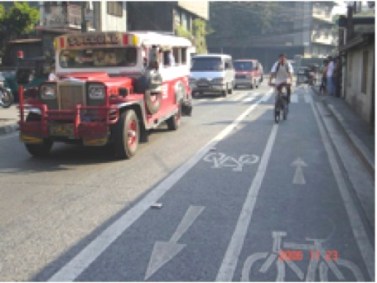 Painted, segregated bikeways on the carriageway along a one way road
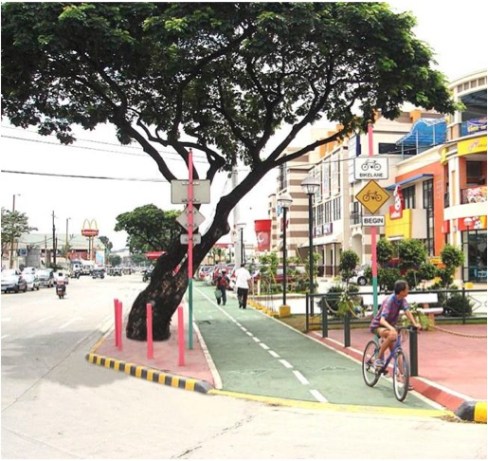 Segregated and protected bikeway off the carriageway along Sumulong Highway
Granted that the ideal set-up would have segregated or protected bikeways that are designed properly, we take a look at two other very important elements that are not at all as technical as design and planning of bikeways – respect and education.
Education is an important aspect of driving. Many Filipino drivers are poorly educated in terms of traffic rules and regulations, road design as well as local policies pertaining to transport and traffic. As such, there is a tendency for many drivers to disregard rules and drive/ride aggressively and recklessly. This must change and it starts with reforms in the way licenses are issued to all types of drivers including perhaps stricter certification systems for truck drivers and public utility vehicle drivers. Traffic education should also be integrated into the academic curricula of schools starting at a very young age. Road safety parks are one way to promote traffic education for kids.
Respect is partly derived from education but is also related to attitude. No matter how much driver or road user education or skill you get if you have a bad attitude, you will still have the tendency to be reckless or irresponsible with your actions on the road. One way to curb bad attitudes on the road and to educate road users (particularly errant drivers and riders) is strict traffic enforcement. Many cities already have CCTVs installed at major intersections that allow law enforcement units to be able to monitor traffic behavior and perhaps zoom in to determine driver and vehicle information including license plate numbers.
The crash that killed the single parent in Marikina is not so much as an issue one whether we need segregated and protected bikeways but is more an urgent need to assess the state of traffic education and enforcement in this country.
–
Articles on the crash and calls for reforms may be found in this link.
 Caught (up) in traffic