
Home » Governance (Page 32)
Category Archives: Governance
Evidence from Montreal: Building bike lanes to reduce car use
I just wanted to share this article showing evidence of car use reduction (and therefore, car traffic along roads) with the provision of bicycle lanes.
Building Bike Lanes Really Does Get More People Out of Their Cars
The article though cautions readers against generalising or assuming great improvements. Some figures mentioned in the article including the following (I took the liberty of copying and pasting):
- “A 10% increase in bike accessibility resulted in only a 3.7% increase in ridership.”
- “…cycling infrastructure also reduced greenhouse gas emissions from cars by 1.7%, a reduction equivalent to converting transit buses to hybrids and electrifying commuter trains.”
These numbers are for the case of Montreal, Canada. Not mentioned are the number of cyclists, vehicle traffic volumes and other pertinent data that are useful in analysis. The article correctly points out the importance of using science (e.g., sound analysis based on good data) in order to convince governments to put up bicycle infrastructure. I would even add that this approach should also be applicable to pedestrian facilities.
–
On cable cars as a solution to Metro Manila transportation problems
I was asked about my take on the pronouncement about cable cars being a potential solution to Metro Manila’s traffic woes. I say pronouncement because careful qualification of the news articles on this clearly show that this is not yet a proposal. I leave it to the reader to Google these articles on cable cars for Metro Manila.
The first thing that came to my mind are capacity and demand. What would be the capacity for such a system and what could be the demand given that you would have to determine where stations would be. There’s also the fear factor as many people would not be comfortable riding a vehicle so high up in the air and then of course, there’s the wind that will obviously have to be factored in the operation of such cable cars. Suitability is very much an issue here. Perhaps cable cars like the one featured in the news articles are more appropriate for cities like Baguio, Antipolo and Tagaytay? There are very limited applications for Metro Manila even including perhaps possibilities for Ortigas and perhaps Loyola Heights.
I like what my friend, Rene Santiago, said about the cable being one possible answer but not The Answer to Metro Manila’s traffic problems. I am aware of and quite amused by the comments posted on social media about the so-called ‘cable car solution’ as it is definitely not going to make a big impact on Metro Manila transport. I like comments proposing instead improved river transport as well as protected bicycle lanes around the metropolis. These are well-grounded proposals that have been proven elsewhere to be very effective in reducing congestion while mass transit projects are under construction and to be operational in 2 to 3 years time. I think it would be wiser to put your money on bike lanes and even bike bridges than in cable cars.
I was also asked about what should be the first project the new Department of Transportation Secretary Art Tugade should take on. Metro Manila is still very much a “battleground” for transport and traffic, and there are already projects lined up for implementation like the much delayed MRT 7 and the extension of LRT1. The new administration should strongly support such efforts, whether its via Public Private Partnership (PPP) or public funded. That said, I think the incoming Department of Transportation Secretary should work on an urban mass transport project in one of our major cities. Either Cebu or Davao come to mind as these cities are already also congested and would need to have an urban transit system (rail?) very soon in order to avoid becoming another Metro Manila. There are low-hanging fruits in these cities, for example, with the Cebu BRT ready to be taken on by the new administration for full implementation and Davao already being the subject of public transport studies pointing to it being ripe for a rail transit system.
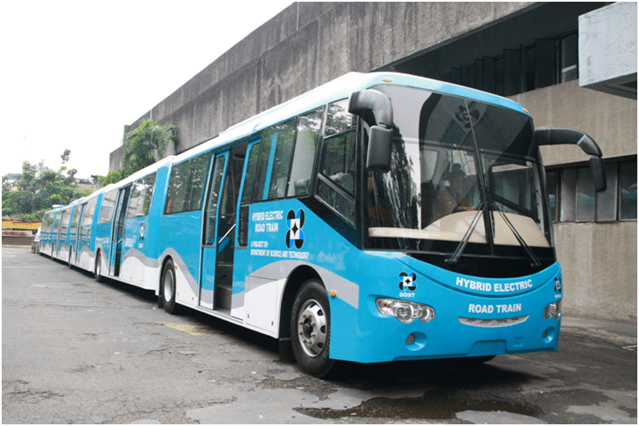
Finally, there are also the outcomes of research & development work by the Department of Science and Technology (DOST). I am referring to the DOST-MIRDC’s road train, AGT and hybrid train projects. The road trains, for example, may be used for Bus Rapid Transit (BRT) lines that are proposed for C5 and Quezon Avenue. I also think it is worth considering for EDSA. BRT is not technology-specific as far as buses go so why not use Philippine-made buses for this? While these are still subject to third party safety and technical certifications, the Transportation Department could lend a helpful hand towards this certification and this could perhaps ultimately lead to building an industry out of these buses and trains.
–
Metro Manila Skybridge: for cars or bicycles?
I was browsing over a not so old, pre-election issue of Top Gear magazine and came upon an article that featured then Senatorial candidate and already former Metro Manila Development Authority (MMDA) Chair Francis Tolentino. The article stated the former MMDA Chair’s frustration that his pet project didn’t get approval from NEDA. The Skybridge he was proposing was basically an elevated road that was to be built on top of Metro Manila rivers. This is in part to save on RROW costs and supposedly to also reduce traffic impacts of construction (note the traffic congestion due to the Skyway Stage 3 construction).
I think that such a Skybridge could have had a positive impact on traffic congestion but for a short time only. The sheer number of vehicles in Metro Manila will only lead to congestion elsewhere being transferred here and, under equilibrium conditions that will eventually be attained as some time in the near future, will ultimately be congested. The concept of tollways is for people to pay for the use of a facility in return for high level of service (read: faster travel). Skyways and other elevated highways cost a lot and the NEDA probably didn’t see a free use elevated structure like the Skybridge having much in terms of ROI.
There is, however, something that may be worth it in terms of potential congestion reduction as well as enhancement of traffic safety and quality of life – a Skybridge for bicycles and pedestrians. This should encourage people to cycle as travel via such mode will be much safer and could possibly be faster. Friends and acquaintances who are cyclists often post about similar facilities in Europe and how these are able to reduce congestion as people opt to cycle and leave their cars at home during the weekdays.
–
Addressing congestion due to school traffic congestion
There are two important traffic news stories yesterday:
- MMDA successfully clears parked vehicles outside La Salle Greenhills
- MMDA sets drop off, pick-up points for Ateneo students
For some reason that’s a bit surprising for many, the MMDA seems to have solved two of the most enduring issues on traffic congestion along two major thoroughfares. LSGH is along Ortigas Avenue while Ateneo is along Katipunan Avenue (C-5). Both have high trip generation rates and a significant percentage of their trip gen is comprised of private vehicles. While, Ateneo’s trip generation has led to traffic congestion due to the sheer number of trips the university attracts, the congestion due to La Salle is due to the poor traffic management and lack of parking spaces for vehicles attracted by the school.
I only wonder why it took so much time to address these problems considering the solutions mentioned in the articles are basically ones that could have been implemented years ago. In the case of La Salle, good old fashioned traffic enforcement apparently did the trick. But then, the MMDA even with the LGU constraint could have been stricter before whether when they were under Bayani Fernando (BF) or any of his successors as MMDA Chair. With Ateneo, the scheme is very similar if not the same as what BF proposed over a decade ago when he was MMDA Chair. At that time though a touchy issue was the U-turn scheme he installed along Katipunan that cost trees and the former service road on the west side of the avenue. We can only hope that these claimed ‘successes’ will be sustained and ensure smoother flow of traffic along the major roads they directly affect.
–
On the worsening state of road safety in Metro Manila and adjoining areas
Recent days have seen some serious road crashes occurring along major roads to the east of Metro Manila. A friend posted about a crash along Marcos Highway last June 10 at the still incompletely paved Marcos Bridge. No one was killed in the crash though the driver and passengers sustained serious injuries. However, there was a high potential for this to have been a fatal crash.
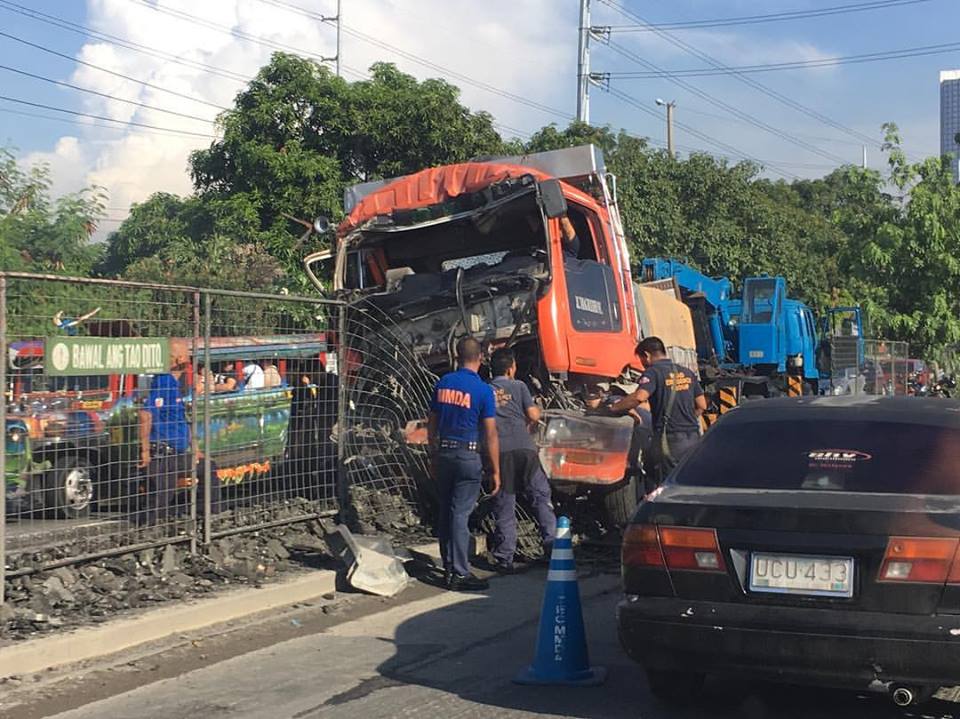 Crash involving a truck plowing into the steel fence and median of Marcos Highway near the Marcos Bridge along the eastbound direction of the highway. Both directions of the bridge’s carriageway’s asphalt overlay had been scraped off and remained neglected for several months until this morning when I observed workers laying out asphalt concrete along the eastbound lanes of the bridge.
An even more ugly crash occurred yesterday in Taytay, Rizal when a truck plowed into the tiangge are of Tatay’s public market killing scores of people and injuring more. Here is a link to some photos and videos about the Taytay crash. These two are but examples of what is happening along national and local roads all over the country with many not even being reported on mainstream or social media.
As I have mentioned in previous posts these crashes were all preventable. Truck operators and drivers need to regularly perform maintenance checks on their vehicles. Brakes are among the critical or essential parts that need to be checked especially with safety in mind. How many fatal road crashes have been reported involving brake failure? In the Marcos Bridge crash, there is also the need to make sure roads are well-maintained and projects not left out for months. In fact, poor road pavement conditions also contribute to traffic congestion as vehicles tend to slow down because of the roughness of the road (e.g., too many potholes). How can the next administration reinforce the enforcement of traffic rules and regulations as well as testing of private and public utility vehicles for these to be certified safe for driving along our roads? Will the Department of Transportation (DOT), the Department of Public Works and Highways (DPWH) and other allied agencies (e.g., LTO and LTFRB), local government units and private entities come up with a more aggressive effort to curb what seems to an increasing trend in road crashes? We hope so and look forward to positive change coming to our roads.
–
Road crashes in Antipolo
I open June with a post on road safety. Last week, I passed by many road crash scenes along my route between my home in Antipolo and my office in Quezon City. Many were the now common crashes involving motorcycles. And there were those involving vehicles that got too close to each other in heavy traffic (e.g., tailgating vehicles eventually bumping the vehicle ahead of them). I was able to get photos of the site of the more serious crashes.
 Head on collision of a car and owner-type jeepney along Marcos Highway near the junction with Amb. Neri Road. These crashes are largely preventable if drivers kept to their lanes and refrained from violating the rule of the double yellow line separating opposing flows of traffic. I’ve written about counter flowing before but focused on it leading to traffic congestion. A more serious repercussion would be crashes like this.
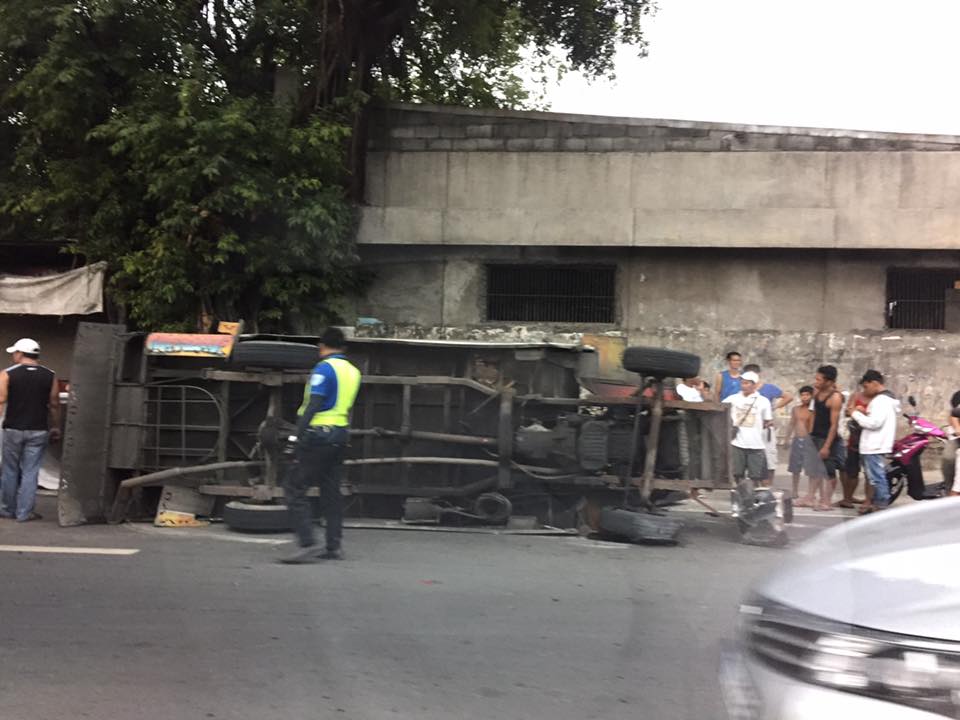 Overturned passenger jeepney along Marcos Highway in Mambugan, Antipolo. Speeding and unnecessary manoeuvres along this highway often has led to drivers losing control of their vehicles and, in this case, the vehicle turning over and likely hurting (hopefully not killing) passengers. This is again a very preventable crash considering it can be addressed by proper (read: safe) driving as well as enforcement.
 Final ‘resting place’ of a truck that apparently lost control along the Tikling bound side of Ortigas Ave. Extension in Barangay Dolores, Taytay. I’ve noticed many breakdowns and crashes involving trucks along this highway as well as Sumulong Highway and Marcos Highway. Many, it seems, involve poor maintenance of these vehicles as well as overloading. Poorly maintained vehicles may lose control with or without their loads and lead to such crashes that in many cases are fatal to innocent bystanders.
With the onset of the rainy season, many roads will be slippery and this will tend to make them more dangerous. In the cases I mentioned above, most crashes are not the fault of the roads or the infrastructure but of the drivers and/or operators of the vehicles. Most crashes are preventable and are caused by driver error, negligence or aggressive behaviour. It is often the nut behind the wheel who is responsible for such crashes rather than the vehicle or the road.
–
Better indicators than GDP
A friend shared this article on social media:
Five measures of growth that are better than GDP
The article explains in clear and simple terms five better indicators of growth and development than what is regarded as the conventional and traditional measure that is gross domestic product (GDP). There is an analogy in the article using speed, a parameter in traffic, to explain how GDP is insufficient in describing growth in a more complete manner. For example, in the Philippines, the significant increase in GDP over the last 6 years has been mentioned as proof of economic growth. While this is true, many people could not appreciate this growth since there is the perception is that it is not inclusive. That is, economic development is not felt by many who are in the lower income classes.
Speed, indeed, is not enough to describe the transport situation along a road considering that there are other metrics needed to have a more complete picture of transport and traffic conditions. I will talk about this in another posting soon.
–
A new Department of Information
The big news today is the creation of a new Department by virtue of a new law signed by the outgoing President. The news article describing this new Department may be found in the following link:
Department of Information and Communications Technology created
This is a significant development as the next President of the Philippines already named his man for the Department of Transportation and Communications (DOTC) and now he has to deal with a new Department and more appointments.
With the DOTC (or DOT?) now reduced to dealing only with transportation, perhaps it can be more focused on the issues it needs to address immediately, over the next 6 years and beyond (i.e., from a strategic perspective). Also, perhaps the next administration can take a look at the possibility of having a merger of the transportation department and DPWH. Of course, such a merger would require a really good person on top to lead. This person should not only be an excellent manager but also a master strategist, with a clear and progressive vision for a modern, efficient transportation system for this country.
–
Questionable choice for DPWH Secretary?
I had only recently written about appointments to top government posts when I learned about the offer of the DPWH top position to a politician who is also the son of power couple of former and present senators. Their core business is real estate development so there is definitely going to be conflicts of interest whenever certain infrastructure are built that will favour the development of their lands. This is basically the issue for the controversy regarding the Circumferential Road 5 Extension more than 6 years ago, which alleged that former Sen. Manny Villar (then running for President) influenced the DPWH to construct the highway that mainly benefited lands his company developed.
Having a politician at the helm of the DPWH is not a good idea. While apologists for the President-elect want us to give the guy a chance and explain that the soon-to-be-President probably saw something in the congressman that makes him qualified for the job, I must disagree with them given what I’ve seen up close with the DPWH. Here are a few arguments against a politician being DPWH Secretary:
- A politician as head of the DPWH will be more likely to give in to politicians (e.g., congressmen) requesting the appointments of ‘more favourable’ District Engineers (i.e., those who will do their bidding). This is basically going back to the ‘padrino’ system that is undesirable for such posts as they become prone to abuse and anomalies particularly in contracting.
- The DPWH Secretary chairs the Road Board, which is in-charge of funds collected from Motor Vehicle Users Charge (MVUC). This means the Secretary will have a say on how funds will be allocated and disbursed under the difference special funds (e.g., Special Road Safety Fund and Special Vehicle Pollution Control Fund). A politician will have no qualms approving requests for projects proposed by his allies or party-mates regardless of the merits or justification (weak?) of a program or project. This position requires objectivity and insulation against political pressure that may lead to questionable decisions.
- Governance-wise, the DPWH Secretary is expected to have a clear vision for the agency and must be an imposing figure to an organization where everyone under him including Undersecretaries and Assistant Secretaries will be organic staff. This is unlike other agencies where the Secretary gets to bring in his/her own people to appoint as senior officials (e.g., DOTC). And DPWH will only perform as good as its head. Outgoing Sec. Singson has shown how good and efficient DPWH can be under an excellent Secretary. Past heads have already shown how bad DPWH can be.
A couple of friends also mentioned that the DPWH Secretary sits on the National Water Resources Board (NWRB) and the Metropolitan Waterworks and Sewerage System (MWSS) is basically under the DPWH. There is conflict of interest here because the Villars own a water concessionaire in Primewater. The DPWH Secretary will also sit on the Infrastructure Committee (Infracom) that screens and approves major infrastructure projects around the country.
Since the next President has already decided on his choice for DPWH Secretary and the nominee has already accepted this, then we can only cross our fingers and hope that his appointee will be doing a good job and will uphold the current mantra of the DPWH: right projects, right cost, right quality, right on time and right people.
–
On critical government posts related to transportation
The camp of President-elect Duterte has been busy the past week trying to determine, among others, who will be secretary of which agency. As far as I am concerned, my interest is in who will be assigned to agencies that have a lot to do about transportation. Thee include the Department of Transportation and Communications (DOTC), Department of Public Works and Highways (DPWH), National Economic Development Authority (NEDA) Department of Environment and Natural Resources (DENR), Department of Energy (DOE) and the Metropolitan Manila Development Authority (MMDA). DOTC, of course, is the main agency and has under it several front line agencies like the Land Transportation Office (LTO), the Land Transportation Franchising and Regulatory Board (LTFRB), the Philippine Ports Authority (PPA), the Maritime Industry Authority (MARINA), the Civil Aviation Authority of the Philippines (CAAP), the Light Rail Transit Authority (LRTA) and the Philippine National Railways (PNR).
So far, what we know is that the DOTC portfolio will be given to Arthur Tugade, the former head of the Clark Development Corporation (CDC). Tugade has the confidence of Duterte as they are good friends and were classmates at the San Beda Law School. I’ve met Tugade once when we presented the outcomes and recommendations of a traffic study for a project at the Clark Freeport only a few months ago. The National Center for Transportation Studies (NCTS) of the University of the Philippines Diliman has had a productive relationship with Clark from the time the Center came up with a comprehensive transport and traffic master plan for the free port back in 2010. Tugade has been very productive in expanding businesses at Clark and has been quite an astute figure in his dealings with various political leaders in the region especially with respect to the local governments of Angeles City and Mabalacat. I wish him well at DOTC and hopefully, he can harness its much maligned organic staff like what he has done at CDC. There are so many challenges at DOTC including assigning good people at the LTO and LTFRB.
I hope Duterte retains Sec. Rogelio Singson as head of the DPWH . I had made the observation before that the DPWH is only as good as its head and Singson has been an excellent DPWH Secretary, introducing and institutionalizing many reforms to the agency so much so that it has been performing way above expectations and corruption has been curbed in many areas. In terms of e-governance and open data, the DPWH has been a bright spot in the past administration so much so that its performance in implementing infrastructure projects including those convergence programs with other agencies has made the DOTC look really bad.
As for the other agencies, I can’t think of any names yet as I am not very familiar with Duterte’s inner circle but based on what his camp has already announced, there will be people from the administrations of former Presidents Ramos and Arroyo, a throwback perhaps to the once powerful Lakas party than Duterte’s PDP-Laban. I am anxious to know who will be the next NEDA Director General. NEDA has a big role being the agency consolidating infrastructure plans and projects and the convenor of the very influential Infrastructure Committe (InfraCom) that approves projects for implementation. Very interesting, too, would be the appointee to the position of MMDA Chair. The nation’s capital needs a good administrator with an excellent vision for the megalopolis and the skill set to get things done. Hopefully, we will know who these people will be in the next few days.
–
 Caught (up) in traffic