
Home » Governance (Page 34)
Category Archives: Governance
On the uncommon sense on license plates
The issuance of new license plates has been a very “painful” process and experience to a lot of people and it is not without serious issues. For one, there is still a backlog in license plates as evident from Strictly speaking, these vehicles shouldn’t be operating or not allowed to be driven even considering they are technically registered with the Land Transportation Office (LTO). The proliferation of vehicles without license plates allows for the abuse of such by owners of relatively new vehicles who can remove their plates in order to be able to take their cars on their coding days. It is also possible to be involved in a road crash or incident where the driver of a vehicle without a license plate can make an escape (the details on the conduction sticker are not easy to spot and memorize) or evade apprehension.
Among the most problematic is the issuance of plates of the same design as that used by private vehicles to public utility vehicles like UV Express and taxis. This creates a lot of opportunities for abuse especially private vehicles masquerading as PUVs. These are without the proper franchises and are illegal (i.e., colorum). What the LTO claims as security features on the plate are meaningless as the uniform color of the plates defy the simple logic behind the old policy of having a specific color to quickly distinguish among vehicles bearing different color plates. This makes it easier for traffic officers including the Philippine National Police (PNP) to spot vehicles with mismatched or inappropriate license plates.
 Taxi cab bearing plate with the same design as that used by private vehicles.
 UV Express van bearing license plate for private vehicles
The purpose of having plates with different colors is for quick identification and distinction of vehicles. A plate with yellow background has always been associated with public utility vehicles. Those with blue lettering or background are those for diplomatic plates. Those with red lettering or background are for government plates. Fortunately, the LTO has reverted to the original policy pertaining to the license plate colors and new plates to be issued to PUVs will once again be a distinctive yellow. Perhaps corrections are due for those legitimate PUVs that were issued inappropriate design (i.e., color) plates.
–
End game: flyover frenzy
The Manila Bulletin featured news on the Japanese government extending a loan to the Philippines for road projects in Metro Manila that include the construction of several major interchanges. An excerpt from the article is as follows:
The Japanese government will be providing some P4 billion to the Philippines for road projects aimed at decongesting monstrous traffic jams in Metro Manila.
Noriaki Niwa, chief representative of the Japan International Cooperation Agency (JICA), said the loan will cover major interchanges to address traffic congestion in Metro Manila, including flyovers, and road links.
Among them are the interchanges on EDSA/Roosevelt/Congressional, EDSA/West/North, and C-5/Green Meadows and North/Mindanao Avenue.
“This is to help Metro Manila sustain growth and develop it as an attractive investment destination,” said Niwa.
While these interchanges have been recommended many years ago and are also reiterated in the recent transport roadmap for Mega Manila, one cannot help but make the observation that these projects will not alleviate congestion over the long term. Instead, it will likely encourage more vehicle traffic (with the availability of more road space – part of a vicious cycle).
Other major projects that are ongoing in Metro Manila include the NAIA Expressway, which is an elevated tollway connecting to the Skyway. A friend commented that this is basically a glorified flyover project as I will explain later in this post.
 NAIA Expressway construction in full swing – a column rises near NAIA Terminal 3
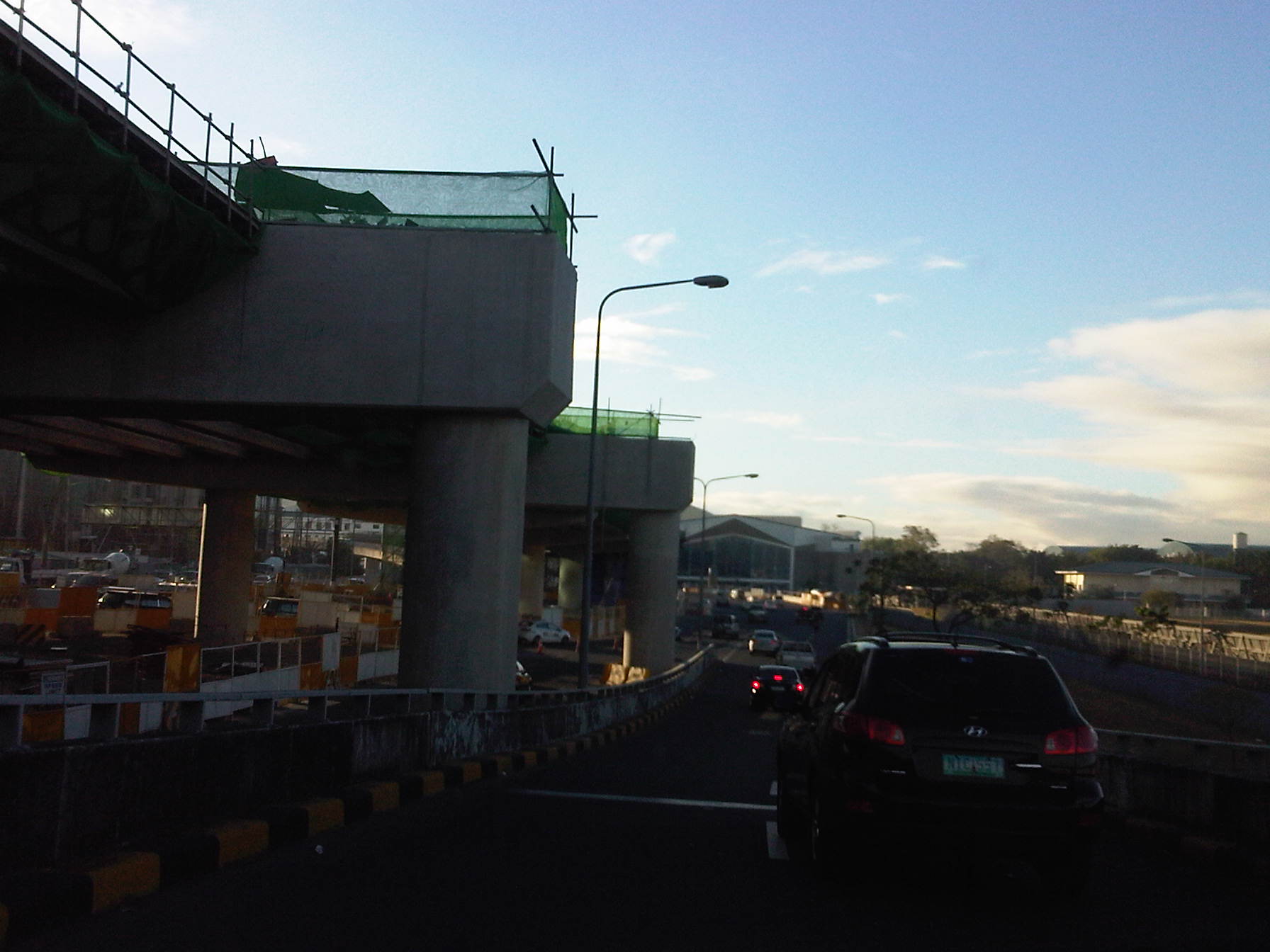 NAIA Expressway elevated sections nearing completion across from Terminal 3
The term of the current administration concludes next year (2016) and so we are almost in the endgame, to borrow a term from chess. What seems to be a frantic move for the government to build all these flyovers (and elevated tollways) can be interpreted as a way to compensate for the underspending and underachieving ways of the government in putting up the necessary infrastructure to address transport and traffic problems in urban areas. Unfortunately, all the funding (public and private) seems to be going to road projects instead of to mass public transport systems like rail and BRT that should be the priority because these could provide the positive impacts over a longer term than what road projects could deliver in terms of mobility and sustainability.
A friend reminded me of a similar situation back in 1991/92 when government embarked on a slew of flyover projects in an effort to leave a legacy in transport. That administration’s excuse for failing to deliver any mass transit project was that it was transitioning from a dictatorship. However, it also failed to deliver on power projects, which led to the energy crisis that had to be solved quickly (but with costly PPP power plant projects). There is a looming energy crisis now but more worrying is a transport crisis as we continue to procrastinate about public transport infrastructure. Should we be hopeful of transport with the next administration? That is still a big question as of now.
–
“Gatong” comments by traffic enforcers
Friends who have been involved in a road crash have noted that traffic enforcers seem to have the propensity for making unnecessary remarks while attending to a crash scene. I have experienced this first hand. Some of the more common comments that enforcers make include:
– How crash or accident-prone an area is (citing issues in the area);
– How certain motorists are more likely to be involved in crashes (often referring to one of the parties involved); and
– How one party’s behavior leads or led to a crash (essentially blaming one party for the incident).
[You’re free to add a comment you heard yourself or someone else got from a crash scene.]
Traffic enforcers or police should not make such comments at the scene of a crash especially in front of the parties involved. It is not about whether they have the right to do so but whether it is appropriate coming from a person of authority who should first and foremost be neutral in such circumstances. For one, such unnecessary comments could affect how people involved in a crash could behave. Generalized statements could wrongly favor one party over the other simply because a person of authority made a comment to the contrary of how things really happened. Enforcers should be neutral and go about their business in getting the facts about an incident and proceed in making the formal report for the crash. Even the investigator assigned to the scene should be as objective as possible in order to have a fair assessment of the incident.
–
Legit or kabit? Follow-up
I wrote about the “kabit” system last February. I mentioned that the EMBC bus I saw was actually operated by another company (RRCG) that seems to have also engaged another company (Jasper Jean) to provide bus units operating the EMBC routes. Unfortunately, I was not able to get a photo showing information on the original operator of this bus company and its lines to Rizal and Laguna via the eastern route through Antipolo. I was finally able to get a photo of an EMBC bus bearing information on the original operator/company for comparison with the information on the bus in the previous post. It clearly states here that EMBC is the operator of this bus.
 Information printed on the bus as required by law
–
The Philippines Anti-Drunk Driving Law
It’s a Friday and another weekend is here. It’s also payday weekend and so it’s expected that restaurants, cafes and bars will be full tonight and the weekends with people dining, lunching, having coffee, and likely for many – drinking. For many years, the latter has resulted in too many road crashes, a significant number of which have had fatal outcomes – usually cars or motorcycles crashing into one another or by themselves. It’s even more dangerous (and highly likely to be fatal) for motorcycle riders who need to balance themselves on two wheels after getting inebriated. Meanwhile, a lot of driving under the influence (DUI) that in many other countries including the US and Japan don’t get apprehended primarily due to the absence of laws and guidelines for their capture and evaluation. There was no way to test their blood alcohol content (BAC) in the field and traffic personnel couldn’t force people to go to hospitals to be tested.
There’s good new, however, especially for road safety advocates. The Philippines is finally implementing Republic Act No. 10586 – An Act Penalizing Persons Driving Under the Influence of Alcohol, Dangerous Drugs, and Similar Substances, and for other Purposes, which was signed into law in May 27, 2013. Under the law, private vehicle drivers can be arrested and penalized for BAC of more than 0.05% while truck and public transport drivers and motorcycle riders can be apprehended for a BAC of more than 0.0%. For comparison, Japan requires a BAC of 0.0% for ALL motorists.
The Implementing Rules and Regulations for the law may be found here: PH Anti Drunk Driving Law2013 Rules. The Land Transportation Office (LTO) and the Metro Manila Development Authority (MMDA) have already acquired equipment to help them evaluate apprehended persons. These include breath analyzers and staffs of both agencies have already undergone training to be able to implement the law. Unfortunately, traffic enforcers cannot randomly test people on the road but would have to apprehend them first for violating other traffic rules and regulations. But I am sure our traffic law enforcers can be quite creative in how to catch these people who pose dangers to all other road users by their being irresponsible for driving or riding under the influence of alcohol or dangerous drugs. And with the national elections coming up next year, there will be a lot of checkpoints sprouting up along major roads that will also open opportunities for testing and apprehensions.
–
If you build it, will they come?
There seems to be a belief among the more zealous advocates of sustainable transport that if “you build it, they will come.” It seems cliche but this saying is not necessarily applicable to many things especially when referring to transport infrastructure. There are examples of roads, terminals and other transport facilities that have been built but sadly are underutilized mainly due to the demand just not being there and taking much time to attain. The last is usually due to the fact that certain conditions or prerequisites have not been satisfied. One such example of this is the case of the Subic-Clark-Tarlac Expressway (SCTEX), whose payment for the loan that covered the construction costs was premised on a very high traffic demand forecast. It took some time for more people to use the expressway as the traffic from the major developments (Clark, Subic, Tarlac and Bataan industrial and commercial developments) just didn’t happen as immediately as assumed in the forecast. Still, there is a strategic value to such major infrastructure considering it as an investment and something that will cost a lot more in the future if not built today.
In Metro Manila, the MMDA has allocated or designated lanes for cycling along several major roads. These included the lanes they created out of painting existing pedestrian sidewalks and marking these as bikeways. One section is between Magallanes and Ayala while another is from Ortigas to White Plains. These are poorly designed, “pwede na yan” types of bikeways that people on bicycles would find very difficult to use because the course is full of obstacles. And how about the plight of pedestrians who would have to share these narrow paths with cyclists? Such mixed signals on providing for the needs of pedestrians and cyclists are not necessary unless of course the main objective of this exercise is just to get the attention of a wider audience that is the general public, which I would strongly agree is needed to advocate for sustainable transport. Focus on the ultimate goal, however, should not be lost for what appears as small victories. Perhaps an even stronger initiative should be towards having the DPWH revise road design guidelines to incorporate walking and cycling requirement especially for national roads.
 Bicycle lane along Julia Vargas Ave. in Pasig City
Cebu City enacted an ordinance essentially promoting cycling through the planning and implementation of bikeways, bike lanes or shared lanes. However, initial efforts seem to be following the MMDA’s “pwede na yan” approach. I think Cebu could do better and come up with a better plan for integrating and mainstreaming bikeways into the transport network. But of course, a lot still needs to be done for pedestrian facilities.
In conclusion, building transport infrastructure is not an assurance that it will generate its intended benefits at once. However, some infrastructure are more strategic than others as perhaps they form part of a network. Expressways in Luzon are among these strategic investments. High standard highways in Mindanao are also essential. Rail rehab and building in Luzon is strategic. The same in Mindanao perhaps is not. Mass transit systems in highly urbanized cities are required but perhaps many should start with buses rather than rail. Bridges across islands are not urgent. International-standard airports in major cities are necessary but not all provinces require such airports. Its not a simple task to determine what will work and what wouldn’t. While it is easy to attribute so many benefits in order to justify a project, such practice would usually result in white elephants that few people benefit from.
–
Legit or kabit?
Traveling one morning from Antipolo, I spotted a bus with a familiar company name – EMBC. The last time I saw these buses operating as public transport was when I was in college, and I thought that the company folded up after losing money. However, I have seen some of their buses being used as shuttle services. It seems that the company has been revived but how is a bit unclear. EMBC stands for Eastern Metropolitan Bus Corporation, which was an old company that served the towns of Rizal along with the Antipolo Bus Co., G-Liner and CERT buses during the 1970’s and 1980’s. EMBC buses competed with the Antipolo Buses with their routes overlapping between Tikling Junction in Taytay, Rizal and Divisoria via Ortigas Avenue, E. Rodriguez Ave. (C-5), Pasig Blvd., Shaw Blvd., and Aurora Blvd. These two had overlapping routes with G-Liner and CERT, which plied the Taytay/Cainta to Quiapo route via the same Ortigas Ave. Extension.
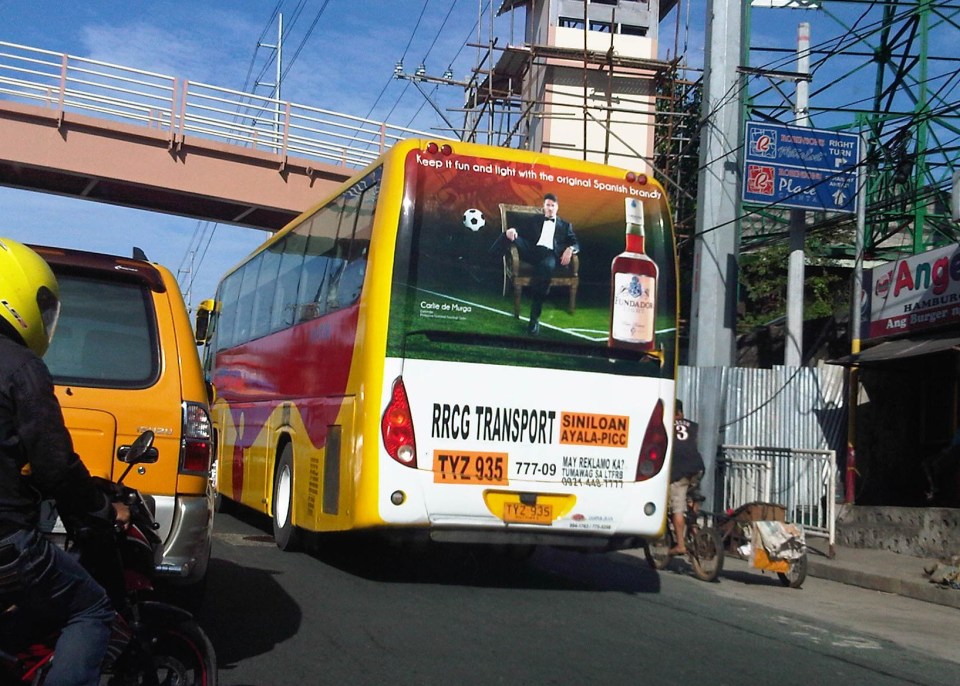 The back of the EMBC bus states that it is run by RRCG Transport with a route connecting Siniloan, Laguna and Ayala Avenue-PICC (it probably turns around at the PICC, where Gil Puyat/Buendia Ave. terminates).
 Closer inspection reveals that the bus is operated by Jasper Jean, another bus company that is better known for its Fairview-Alabang services.
EMBC is an old company and one that has been dormant if not extinct for quite some time. Was its franchise resurrected like what allegedly happened to another old bus company, BLTBCo. a few years ago? In this latter case, certain LTFRB officials were supposed to have been axed as they were allegedly behind the revival or “resurrection” of the franchise. I think it is not a “resurrection” case as I have also seen what looked like legitimate EMBC buses with information on the bus body showing EMBC as the operator of the bus unit. Unfortunately, I haven’t had the opportunity to take a photo of such examples. Thus, it is likely that the bus in the photo above is a case of “kabit.”
The concept of “kabit” (literally “connect” in English) in public transportation is not a new one. It has been used (and abused) in many cases) where the existing franchise holder(s) along a specific route could not deploy the number of vehicles necessary to address the demand for transport. In such cases, the franchisee (an operator) enlists other entities to provide the vehicles. And so there is an agreement among the formal franchise holder/operator and the “kabit” entities outside the contract between the government and the franchisee.
This is one reason why it is not necessarily the main company (franchise holder) that can be the guilty party in an incident involving one bus. However, the penalties (e.g., suspension and fines) are imposed on the franchisee and not necessarily to the “kabit” operators. The latter’s vehicles in turn continue to operate despite the suspension being technically applicable to ALL vehicles bearing the company’s name. Such are among the many issues concerning “kabit” and perhaps also among the strongest arguments to put a stop to this practice that is detrimental to the interests of people taking these buses.
–
On the new vehicle plates in the Philippines
A lot has been written about the new license plates being issued by the Land Transportation Office (LTO) for vehicles. I have read and heard many opinions or explanations from officials, experts and pundits about how the current license plates were better than the old ones due to its security features. As well, I have heard the opposite – criticisms by similar officials, experts and pundits usually focusing on the flaws of the new plates compared to the previous ones. They do agree on one thing, that the 4 numbers now appearing on the new vehicle plates issued to vehicles registered from January 2014 (5 numbers for the new motorcycles) are a necessity due in part to the rapidly increasing number of registered vehicles in the Philippines. Of course, the delays in the actual issuance of the plates themselves for new vehicles is another story.
Green plates are for private vehicles (not for hire). Red plates are for government vehicles. Blue plates (with only numbers and no letters) are diplomatic plates. Orange plates are the newest type of plates and were issued to electric vehicles. These solid orange plates and not of similar design to those bearing the Rizal Monument. Yellow plates are for “for hire” vehicles including public utility vehicles like buses, jeepneys, taxis and vans-for-hire. Recently, there were actually two types of yellow plates. One type used the design with the Rizal monument in the middle and these were issued to limousines such as those operated by hotels and tour companies. The other is the solid yellow plates (no Rizal Monument) that were issued to PUVs.
 UV Express vehicle with the solid yellow plate.
The new plates issued by the LTO are black and white – basically black lettering on white plates. Recently, friends have been telling me about their seeing the new black and white plates on taxis. I had thought that this shouldn’t be the case since PUVs like taxis are supposed to have distinctive color (yellow) plates in order for illegally (so-called colorum) operating vehicles to be spotted easily by authorities. It turned out that the LTO under the previous head of the agency did away with the yellow plates in favor of what they claimed to be more sophisticated new plates. My reaction was that this was absurd and visual identification (i.e., seeing the color of the vehicle’s plate) is still the easiest was to spot colorum vehicles. I had wondered, too, how the LTO came up with that obviously flawed decision and if they consulted among law enforcement agencies like the PNP who would be tasked to apprehend illegally operating road transport.
 Such incidence of green plates on public utility vehicles were a no-no (illegal) in previous administrations. I assume that this one is “temporary” in the absence of what were phased out yellow plates.
Fortunately, the LTO led by its current chief has decided to bring back the yellow plates. These will probably follow the new plate design but with yellow instead of a white background. Hopefully, all legitimate PUVs will have these yellow plates instead of the “temporary” private plates many have been issued. These will aid in the enforcement of regulations pertaining to PUVs and will help weed out colorum vehicles.
–
A tale of two consultants
I attended a seminar last November where there were two foreign consultants who gave talks about public transport and the reforms required for Metro Manila. One consultant had extensive experience in public transport, having worked in Hong Kong and Singapore, and is currently a consultant in Jakarta. The other appeared to have the more limited experience but claimed credit (I think partial at best) for public transport reforms in a major Asian city. I was impressed by the first in part because he was very honest with his statements especially as he explained a list of prerequisites for fixing public transport in Metro Manila (and other large cities). The bottomline from his presentation was that it was not possible to have a quick fix and there are no easy paths towards solving public transport problems in Metro Manila and elsewhere in the Philippines.
The second consultant was more on the patronizing side – promising a lot and a little too optimistic to be realistic or practical in his presentation on how to solve Metro Manila’s public transport woes. His material was hodge-podge at best with lots of visuals but not really getting to the point in terms of concrete solutions. It only betrayed his very limited if not unfamiliarity with transport and traffic in the metropolis despite his being a consultant with the office of the highest official of the transport department. There is a saying that if something seems to good to be true, it probably is. I think the same applies to what the second consultant presented to us that morning.
We need more of the first type of consultants who will tell us how it really is with regards to the “challenges” we face in solving transport and traffic problems in this country. The second type just lets us into a false sense of confidence or a feeling that the problems are not so big or complicated and that we are not in a big, deep hole that we need to climb out of. Its one thing to throw caution to the wind and another to have oneself firmly grounded in terms of the understanding of the problem at hand. Understanding the problem is the first step in the formulation of suitable alternatives and allows for the elimination or at least the minimisation of non-practical and non-realistic options.
–
Challenges concerning pedestrian overpasses
A photo went viral over social media last year about power lines jutting out of a pedestrian overpass in Metro Manila that also happened to be a steel structure. There are others like it that were constructed with the implementors not paying attention to the details, that is referring to the power and communication lines or cables that are practically everywhere in Metro Manila and other cities. I give the designers the benefit of the doubt as they likely did the designs assuming there were no constraints such as the overhead cables and wires.
Over the holidays, we observed some very crowded overpasses along Commonwealth Avenue particularly those at the Fairview and Litex market areas. Here’s a photo of one very crowded overpass where pedestrians seem to be walking single file in two directions:

It is clear in the photo that the main reason for the very crowded overpass is the presence of vendors on the overpass itself. This seems to be the case in many other overpasses in other commercial areas (e.g., Quiapo, Ortigas, Cubao, etc.) where vendors practically occupy half of the area along the overpass thereby constricting the space people can use to cross the road beneath it.
Who is in-charge of these overpasses? Do local governments or the MMDA tolerate such practices by vendors? I already answered the first question – the MMDA and local government units are in-charge and are responsible for keeping these facilities clear of other activities other than pedestrians using the overpass to cross the road. I recall that there are actually ordinances with the MMDA and the respective LGUs pertaining to the proper use of overpasses and there are actually penalties for vendors and others setting up shop on these facilities. Judging from the scenes atop the overpasses that we see every day (e.g., the photo above), it is clear that the people in-charge are neglecting their work (surrender na?) and this is clearly an inconvenience to pedestrians, many of whom can also be seen crossing the wide Commonwealth Avenue and risking their lives and limbs as they evade motor vehicles including zooming buses along the highway.
These are examples of challenges that pedestrians face everyday and something authorities should be urged to act on and immediately and decisively. Such action should not only be for the case of overpasses but to sidewalks and other pedestrian facilities as well. These have significant implications to road safety as well as the efficient use of transport facilities and improvements will surely enhance quality of life as well. We cannot claim to promote walkable communities if we fail to deliver on the spaces that are supposed to be for walking. And we cannot promote healthy cities without having such spaces for people to be encouraged to walk.
–
 Caught (up) in traffic