
Home » Health (Page 13)
Category Archives: Health
On airline travel in the time of Covid-19
I haven’t been on a plane since February 2020. That is almost one year next month. I have friends though who have traveled by air recently. They had to follow certain protocols before departing and upon arrival at their destination. These include testing for the virus and observing quarantine especially upon their return to Metro Manila and prior to returning to their respective homes. Fortunately, all have been testing negative for Covid-19 and were able to come home safely.
Here is an interesting article on air travel, particularly how airlines and airports are handling passengers during this time when processes need to consider the prospects of getting infected by Covid-19:
Marshall, A. (January 21, 2021) “The Art and Science of Boarding an Airplane in a Pandemic,” Wired, https://www.wired.com/story/art-science-boarding-airplane-pandemic/ [Last accessed: 1/26/2021]
I am anxious about being required to travel for a project we are currently doing for a major city in Mindanao. While our clients have been very understanding about our health concerns, it might be inevitable for some of us in the project team to travel by March 2021 to present the findings and recommendations of our study. I will continue to update myself about travel guidelines in preparation for that likely travel.
–
On the plastic barriers for jeepneys
The minimum requirements for conventional jeepneys prior to their returning to operations include the installation of barriers so as to have physical separation between passengers. Ideally, such separation should be a distance of at least one meter, which was initially relaxed to ‘one seat apart’, and then further relaxed to just the barrier separating passengers. You see various designs installed in jeepneys. I posted a couple in an earlier post showing examples of customized and DIY barriers. Here is another that looks like there was more effort involved in the making of the plastic barriers:
 Specially made plastic barriers with messages and graphics on social distancing printed on them.
 Jeepney drivers are obliged to reject or unload passengers not adhering to the protocols including those refusing to wear face masks and shields while commuting using public transportation modes. I assume that they are really doing this for their and their passengers’ safety and well-being.
–
On congested tollways during the pandemic
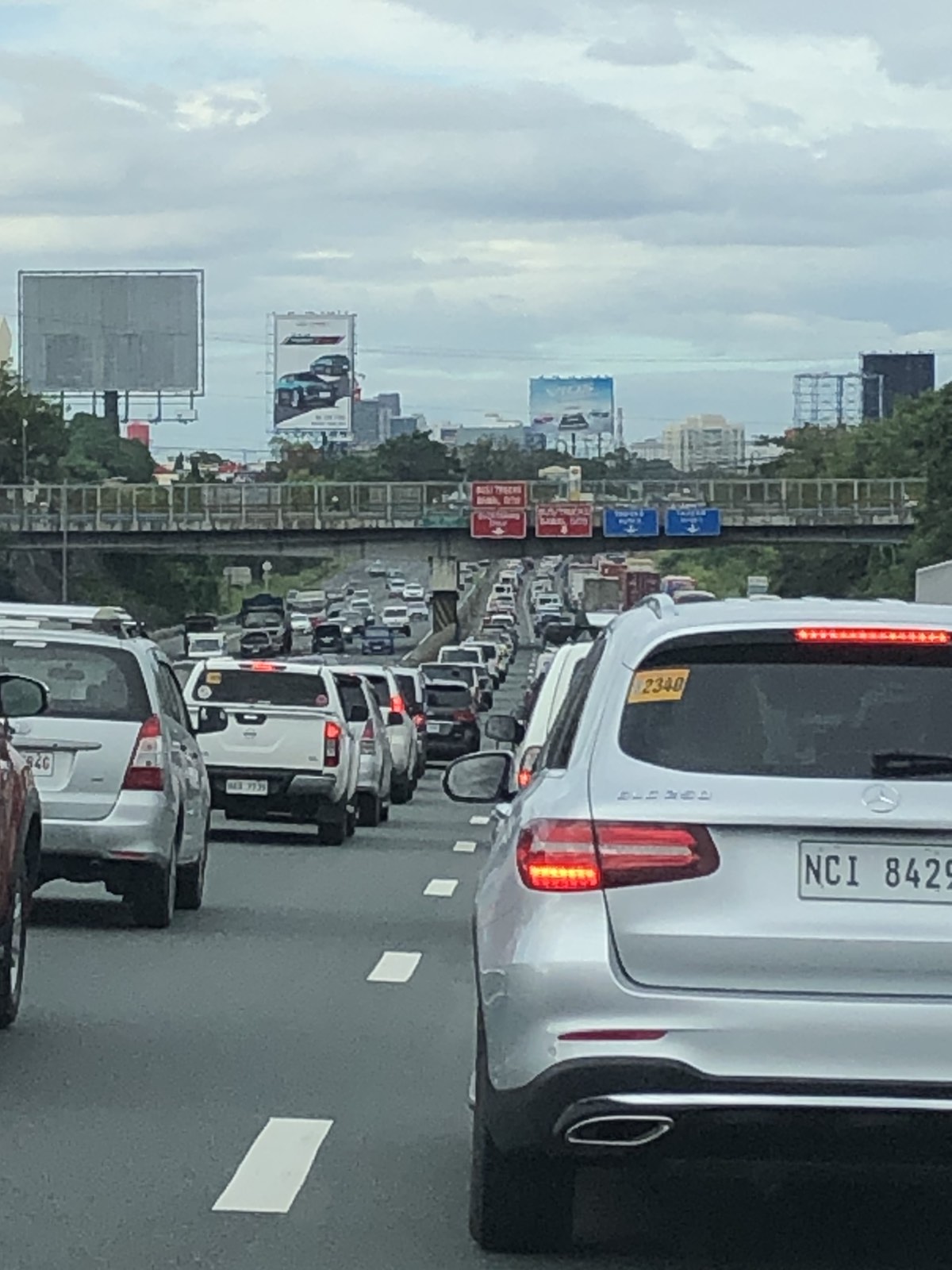
I finally was able to go on a long road trip yesterday as friends invited us to go on an excursion to Quezon to a prominent pottery artist’s place in the town of Tiaong. I first thought we would be going via the backdoor of Rizal since we were already in Antipolo but it turned out that it would be faster via the tollways route. Both Google and Waze recommend our route via C-6, SLEX and STAR to get to our destination. It could have been longer via the Manila East Road but which is a more scenic route. While it took us only 2.5 hours to get to our destination, it took an additional hour on the way back. Part of it was the congestion along the national highway between Tiaong and Sto. Tomas, Batangas but I was also a bit surprised about the congestion along SLEX on the way back (photo below) but saw that this was mainly due to vehicles filing towards the Skyway ramp in Alabang.
There was the expected congestion at the toll plazas as vehicles still need to slow down. It is not like the seamless, structure-less system in Singapore where their sensors can detect vehicles running at high speeds. The toll barriers are still there and the channels for one are relatively narrow. Then, there are travelers that seem hard in understanding that there are specific booths for cash payments. Also, there were occasions when the barriers did not lift immediately for one reason or another. That tends to slow down the processing of queued vehicles – a problem that my undergraduate students could probably take on after their lessons in queuing theory.
–
On housing and transport
I am always amused about discussions and posts about transport and traffic where people appear to isolate the traffic as what needs to be solved, and where people criticize the latter and state that it is a transport and not a traffic problem. Both do not have the complete picture if that is what we want to start with. Land use, land development and the choices people make based on various other factors (including preferences) are among the other ingredients of the proverbial soup or dish that need to be included in the discussion. Remember land use and transport interaction? That’s very essential in understanding the big picture (macro) before even going into the details at the micro level. Why are there many car users or those who prefer to use private modes over public transport modes? Why do people prefer motorized over non-motorized modes? Maybe because people live far from their workplaces and schools? Why is that? Maybe because of housing affordability and other factors influencing choices or preferences?
Here’s a nice recent article on housing and transportation to enrich the discourse on this topic:
Litman, T. [January 7, 2021] “Housing First; Cars Last”, Planetizen, https://www.planetizen.com/node/111790?utm_source=newswire&utm_medium=email&utm_campaign=news-01112021&mc_cid=2985a82f48&mc_eid=9ccfe464b1 [last accessed: 1/13/2021]
–
On cycling fatalities and the way forward
I’ve read a few articles and social media posts about how its become more dangerous or risky for cyclists during the pandemic. The statistics and observations show that there is an increase in the number of cyclists. I am not even considering here the recreational ones (and I have observed that there are a lot more of them). I focus rather on those who use bicycles to commute between their homes and workplaces; or those who cycle to market or do their groceries. The danger lies mainly from motorists who have little or no regard for cyclists and pedestrians; choosing to hog the roads for themselves. And there seem to be more of these motorists these days, too, as people owning cars have opted to use these instead of taking public transportation.
Here’s a recent article about safety in the US. Those stats and assessments can be replicated here given the availability of data on kilometers traveled and crashes that are usually employed for risk assessments.
Marquis, E. (December 22, 2020) “Cars have killed almost 700 cyclists in 2020,” Jalopnik.com, https://jalopnik.com/cars-have-killed-almost-700-bicyclists-in-2020-1845934793
The only solution for our case really is to put up protected bike lanes. Local standards or guidelines need to evolve and the people behind these should be of progressive thinking rather than relying on “what has been done” or “what they have been doing”. That attitude will only give us poorly planned and designed infrastructure for cycling and walking. The coming year offers some opportunities for active transportation as the DOTr and the DPWH (plus the MMDA in the case of Metro Manila, and perhaps the LGUs where applicable) are supposed to implement major projects intending to produce the bike lanes and walkways for Metro Manila, Metro Cebu and Davao. The budget is in the billions of pesos so much is expected about these projects. Will they become models for other Philippine cities and municipalities to follow? Or will these be like going through the motions just to appease those calling for active transport facilities?
–
On the burdens of car dependence
Here is a quick share today. This is another excellent article from Todd Litman who makes a great argument for why planning should move away from its being car-centric and contribute towards a significant reduction in society’s dependence on cars.
Litman, T. (December 15, 2020) “Automobile Dependency: An Unequal Burden,” Planetizen.com, https://www.planetizen.com/node/111535?utm_source=newswire&utm_medium=email&utm_campaign=news-12212020&mc_cid=e746a044a3&mc_eid=9ccfe464b1 .
Much have been said and written about this topic in many platforms including social media but in many of these, I noticed that the discussion often deteriorated into hating or shaming exercises rather than be convincing, constructive arguments for reforms in planning and behavior and preference changes in transport modes. Litman is always very fair and comprehensive and employs evidence or facts in his articles that should be clear for most people to understand. I say ‘most people’ here because there are still many who are among those considered as “fact-resistant”. Happy reading!
–
On travel restraint and transport options in the time of COVID-19
Previous to the lockdowns associated with the COVID-19 pandemic, there were typically a lot of trips being made that many can regard as unnecessary. These are not the typical “to work” or “to school” trips that are being made on a regular basis (e.g., every week day). With the easing of the quarantine everywhere around the country, it seems a lot of people who felt they’ve been cooped indoors or have been limited in their activities have gone out. Many seem to have thrown caution to the wind, too, as evidenced from the many photos being shared showing people doing mass (bike or motorcycle) rides, shopping in crowded streets, etc. It becomes even more worrying now that Christmas is fast approaching when more people are going out to shop or visit relatives and friends. The following are quite basic while we are still experiencing the pandemic:
a. Required/imposed travel restraint – reimposition of the number coding scheme implemented by the MMDA with variations in certain LGUs such as Makati City (no mid-day coding windows) and those in the periphery (longer coding windows during mid-day), and limited implementation of the truck ban for certain roads (these of course will have certain exemptions for vital goods);
b. Increased number of public utility vehicles – the DOTr and LTFRB have been proceeding so slowly (but surely?) in re-establishing or resuming public transport services as they realized there will be no other opportunities like this to implement their rationalization and modernization plans simultaneously. However, the pandemic necessitates physical distancing and other measures to reduce if not eliminate the risks of infection
c. Making all modes available and viable as an option for commuters – Needless to say but all options must be provided for safe travel (esp. commuting). By ‘all’ I mean both motorized and non-motorized modes must be given as options to commuters, whichever they choose must be a safe option for them. That means providing the necessary facilities for walking and cycling, and, as mentioned, adding or augmenting public transport supply where necessary. By ‘commuters’ I mean those who really require traveling. These include our front liners and essential workers. Despite the push for local tourism, I personally believe this should be limited and LGUs need to discourage excursions that have the potential for spreading the virus.
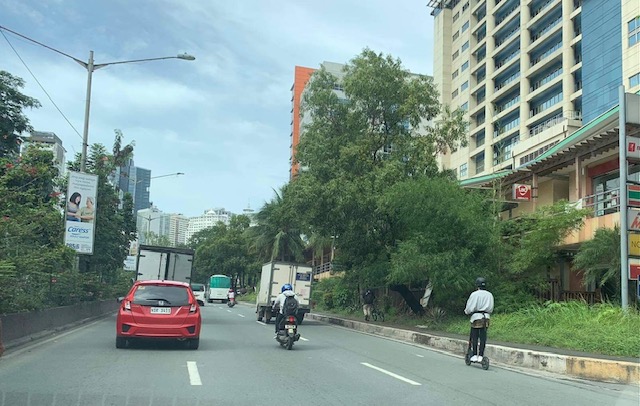
d. Voluntary travel restraint – this is for everyone to consider rather than set aside. I guess given the easing of quarantine restrictions, many people have already had their fare share of going out including children and senior citizens who can now go out for some fresh air. Those opportunities should have already contributed to easing mental health issues, too. However, with the impending (if not yet here) increase in the infections once again, perhaps we should exercise self restraint during these holidays. This self-restraint can also be considered as sacrifices not just for one’s sake but for others especially loved ones we don’t want to get sick with COVID-19.
We still do not know who among us are or can be carriers and who can pick-up the virus and become very ill. As such, we should still be very careful, and adopt and practice measures to reduce infection risks. This goes very well with the spirit of the season. Let’s make the necessary sacrifices to beat this pandemic. Do not ‘gift’ your loved ones with Covid-19!
–
On maximizing seating capacities of public transport
The restrictions for physical distancing for public transport seems to be easing. The reason for this statement is the observation that passengers of public utility vehicles are no longer one seat apart (less than the ideal 2m distance between people but deemed sufficient with physical barriers installed in the vehicles). If allowed to be seated next to each other (of course with some sort of physical barrier between them), the set-up will increase the allowed passenger capacities of PUVs to at least their seating capacities. Conventional jeepneys will be able to seat the 16 to 20 passengers their benches are designed for and buses, depending on their sizes and seating configurations may seat perhaps 40 to 60 passengers. That doubles or even triples the number of passengers that can be carried by each vehicle from the time these were allowed to resume operations after the lockdowns.
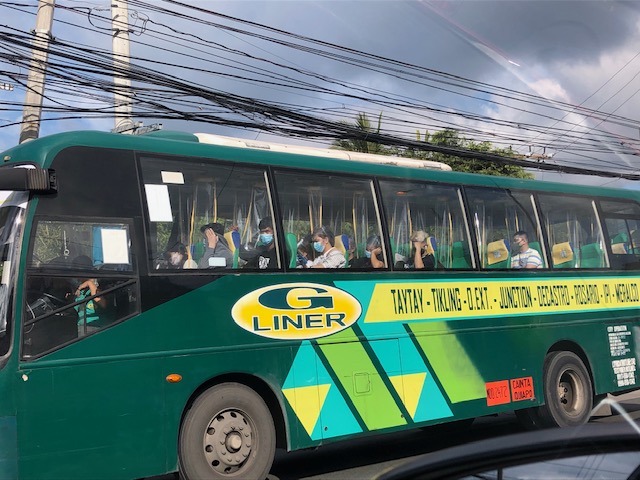
Plastic barriers separate passengers seated beside each other
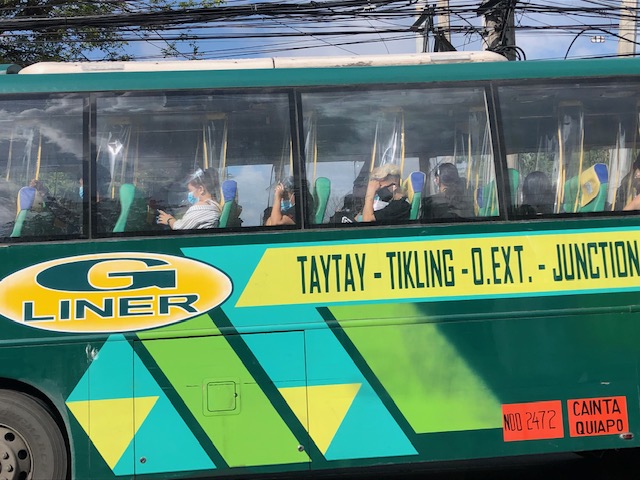
Not all physical barriers are designed and installed to provide whatever protection passengers can get from them. The photos above for a G-Liner bus seems to be the more desirable design as the barriers are practically like curtains. I have seen token plastic barriers installed in jeepneys. I wonder if these even went through some approval process of the DOTr, LTFRB or local government unit. Such inferior designs do not help the cause of promoting public transport use over private vehicles.
–
The FVR Road and Bridge after Typhoon Ulysses
This is a continuation of the feature on the aftermath of Typhoon Ulysses (Vamco). I am posting this here as part of my archives on the floods in the Marikina Valley.
There’s a road branching off from Marcos Highway that links to a bridge crossing the Marikina River and connects with the FVR Road along the Marikina Riverbanks. The following photos speak for themselves in as far as the mud and garbage that was left after the floods subsided.
 Descending from Marcos Highway, only one of two lanes are passable after heavy equipment moved tons of mud and garbage to the roadsides. The fences trapped a lot of garbage, too, as seen in the photo.
 Piles of mud and garbage at the service road leading to the east bank of the Marikina River and the SM Marikina access road.
 Under the Marcos Highway Bridge, garbage, mostly plastics, remain on the wire fences. This area was totally submerged during the height of the floods with water reaching the underside of the bridge. Fortunately, the bridge seems undamaged.
 Even lamp posts and electric poles caught a lot of garbage.
 The Olandes housing development was surely affected by the swelling of the river.
 The FVR Road leading to C-5 is already clear for 2-lane traffic but you can see the mud and garbage all around. The dried mud has turned into dust (alikabok) that blows away as vehicles pass through the road. There is also mud on the plants in the median planters as this area was also submerged during the height of the typhoon.
–
More parks and trees = longer lives
Here is an article about a topic that seems unrelated to transportation but is actually strongly related to it. We already know about the benefits of tree-lined boulevards and parks as lungs of a town or city. The following article discusses the benefits and advantages of having more parks and trees.
Yanez, E. (November 19, 2020) “More Parks, Longer Lives,” Parks and Recreation, https://www.nrpa.org/parks-recreation-magazine/2020/december/more-parks-longer-lives/
I suddenly recall what were tree-lined national highways across the country. Many of these trees were cut down to give way to road-widening projects of the national government through the Department of Public Works and Highways (DPWH)., Nevermind that the widening was not really required in many if not most cases, and that the trees were never replaced or was there ever an effort to do so. The results have been disastrous in terms of the environments along these roads. Transport systems can also be developed with parks and trees in mind; especially if active transport were the focus of the development. Surely parks and trees will enhance the environment and encourage more people to walk or cycle. This should translate into better overall health and wellness for people.
–
 Caught (up) in traffic