
Home » Health (Page 16)
Category Archives: Health
The return of the conventional jeepneys during GCQ and MGCQ
I spotted more jeepneys along my commuting route yesterday and took photos while we were stopped in traffic (yes, roads are again congested as they were before the lockdowns). Here are the photos showing the barriers required for the vehicles to be allowed to operate. Most jeepneys also have signs at the doorway vs. passengers not wearing face masks and shields. These are required for public transport users, and drivers have to reject people not wearing masks and shields.
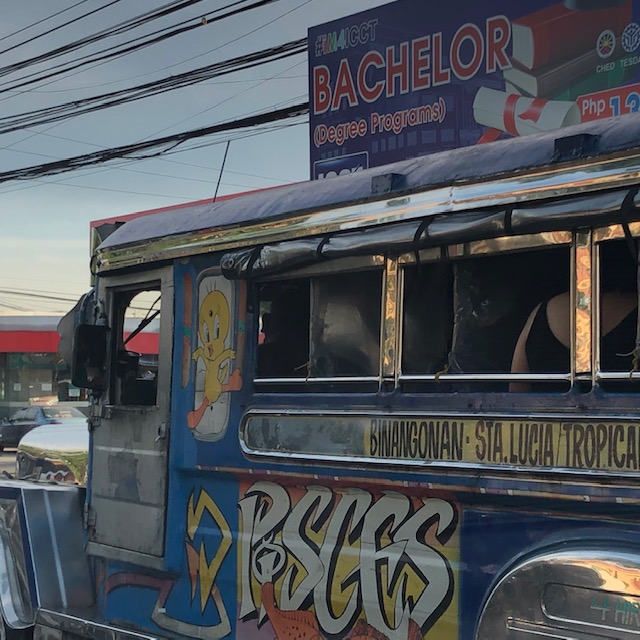 Plastic sheets dividing the seating spaces and serving as physical barriers between passengers
 Plastic sheets attached to wood frames on this jeepney
 Another example of plastic sheets defining the passenger spaces.
Some jeepney seat barrier configurations seem more sturdy or offer more physical separation or protection from others. I have seen versions with metal (wire) and wood frames. And then there are the customized “trapal” types similar to the window covers that are folded for air to flow in the jeepneys and unfolded when it is raining. Instead of passengers being one seat apart though, they are practically beside each other with only sheets of plastic dividing them. For precautions sake, this does not seem to be the recommendation of the medical community. While the open windows allow for better ventilation and air flow compared to the closed, aircon vehicles, the physical distancing is not practiced as it should be, with or without the face masks and shields required when riding public transport. This may pose a problem considering we are not over the hump, so to speak, in as far as COVID-19 infections are concerned.
–
Of inequitable allocations and accessibility
In the news recently were figures released supposedly by Philhealth showing the top hospitals receiving reimbursements from the agency for claims relating to COVID-19. Southern Philippines Medical Center, a hospital in Davao City received 326M pesos while UP-PGH got 263.3M pesos. I was not surprised that my social media newsfeed included posts from both sides of the fence (The fence sitters among my friends on social media were not commenting about these anymore and seem content in just posting on food or whatever activity they were in.). Each were posting information divulged by the whistleblowers in the ongoing hearings on the issues pertaining to PhilHealth funds.
I will not go into the political aspect of this controversy but will just focus on the transportation aspects of the issue. I will just compare the top two hospitals in the list to simplify the assessment while mentioning others in general.
The claim that the hospital in Davao was the equivalent of PGH in Mindanao doesn’t hold water as the hospital does not treat even 10% of the cases that PGH is handling and for a much smaller geographical area. While UP-PGH is accessible to a larger population and for less travel times, SPMC is not as accessible to say people coming from other major cities like Cagayan De Oro or Zamboanga City. Yes, there are other major cities on the same island that have sizable populations with ‘catchment’ or influence areas comparable to Davao City. They, too, probably need funds to be able to treat COVID-19 patients. It is true that there are many other hospitals in the National Capital Region (NCR) that have the facilities to treat COVID-19 patients. However, many of these are private hospitals that tend to incur more costs for the patient and are not generally accessible (read: affordable) to most people who are of middle and low incomes. Thus, UP-PGH can be regarded as the frontliner among frontline hospitals.
What? There are other public or government hospitals in Metro Manila and surrounding provinces? True, but many of those have very limited capacities in terms of facilities and Human Resources. The same applies to Davao’s case as well because there are also medical centers and hospitals in surrounding provinces. And to round-out the resources available to these hospitals, local government units have also (over) extended their resources to hospitals. Perhaps the allocations and proportions can be explained in another way that is not the “apologist” but based on actual numbers pertaining to cases handled by the hospitals?
–
On the benefits of shared roads during the pandemic
There is evidence, and they are increasing, for the benefits of shared roads. Here is another quick share of an article supporting that:
Brown, M (2020) “Shared-use roads improve physical distancing, research shows,” Medical Xpress, https://medicalxpress.com/news/2020-07-shared-use-roads-physical-distancing.html%5BLast accessed: 7/30/2020]
With the situation in the Philippines and particularly in Metro Manila appearing to be worsening rather than improving, national and local governments should take heed of the evidence for shared-use roads and the importance of active transport to ensure people’s mobility will not be hampered. This is particularly important for our frontliners and other essential workers if we are to survive this pandemic.
–
The plight of commuters during GCQ
I write this on the eve of the imposition of Modified Enhanced Community Quarantine (MECQ). It is another unfinished article that was intended to be a quick post showing the typical conditions for commuters during the GCQ. Public transport supply was slow to return to adequate levels as the government took advantage of restrictions to impose route rationalization and modernization programs. The following scenes were common along my commuting routes:
 Commuters waiting for a ride near the provincial capitol
 The rains of the wet season added to the misery of the wait.
 Long queue at the public transport terminal at Robinsons Antipolo, which is the terminus for buses connecting Antipolo with Cubao and Ortigas Center.
 The queue reaches beyond the shaded areas of the terminal.
I think national government should be the one to provide for the public transport needs of frontliners (i.e., health care workers including doctor, nurses, medical technologists, pharmacists, etc.) and other essential workers. My definition of the latter are those required for logistics to function as well as those to ensure the required production or manufacturing for the rest of us who need to stay at home. Not everyone has the same, fair circumstances as there are those who can afford to stay at home and those who need to work for them to live, often on a day-to-day basis.
The pandemic has taken a toll not only on the physical but the mental health of many of us. Government rants and retorts are unnecessary and uncalled for given its dismal performance. I dare say dismal as the evidence shows certain local government units and the Office of the Vice President doing much, much more despite their limited resources. We are not in this quandary because government performed well and to the best of their people’s abilities. If that was their best then they have no business staying in their positions. If our health care system fails, then there is nothing to stop this pandemic from claiming much more than lives.
–
On bike shares and the pandemic
We begin August 2020 with another article I want to share. Here is another article on cycling, this time on bike share:
Kanik, A. (2020) “The decisions cities made about coronavirus had a big impact on bikeshare ridership,” citymetric.com, https://www.citymetric.com/transport/decisions-cities-made-about-coronavirus-had-big-impact-bike-share-ridership-5218[Last accessed: 7/29/2020]
Our university’s bike share program currently dedicated their bikes for the use of frontliners. Outside UP Diliman, only the City of Pasig has a bike share program. Is it somewhat surprising that these are the only bike shares we know in the country? It should be, considering the potential of bike shares and cycling as a mode of transport for mobility. In fact, two cities, Marikina and Iloilo, which pride themselves having formal bikeways (Marikina even has an extensive bikeway network that began 20 years ago.) have no bike share programs. Is the concept or perhaps the lack of facilities to encourage people to bike safely that is absent and therefore need to be provided? With the surge of bike users post-lockdown, there should be evidence that bike shares can work but only if cities work on it, too.
 File photo of Iloilo City’s bikeway along the Benigno Aquino Jr. Ave. (formerly Diversion Road) taken in 2015.
–
On tricycle capacity in the time of COVID-19
With the current rationalization and modernization of public transport vehicles and services being implemented by the national government, many jeepneys, mostly the conventional or traditional ones, have been unable to ply their routes again. Along some routes, buses have taken over but have been limited in the number of passengers they could carry due to physical distancing restrictions. But these are mostly for routes and roads that carry people between their residences and workplaces that typically are longer distance trips (e.g., more than 4 kilometers one way). For shorter distance trips, the more relevant mode of motorized transport is the tricycle. The conventional trike in the Philippines is one involving a motorcycle with a side car. Side car designs vary around the country with some seating 4 people (e.g., back to back with 2 facing backward) but usually with only two seats inside the cab. one or two passengers can be accommodated behind the driver on the motorcycle.
New model trikes include the models endorsed by the Asian Development Bank for the e-trike project that is laid out like a small jitney with benches seating 3 to 4 people on one side (total 6 to 8 passengers) and the popular tuktuk designs that seat 3 people at the back. With the quarantine restrictions in place, conventional trikes can only take one passenger inside the sidecar and none behind the driver. Tuktuks can seat 2 behind the driver but with a barrier (usually a plastic curtain) between the passengers.
 Conventional or traditional trike with plastic sheet between the driver and the passenger (in the side car).
 Tuktuk-type trike with plastic sheet between the driver (in front seat) and passengers in back seat. The back seat allows for 3 people seated together but due to distancing requirement
I have been informed by a former student that certain e-trike models (e.g., BEMAC model e-trikes) are allowed to carry 4 passengers, 2 each on the benches behind the driver who is on the front seat. That still means less passengers than they could usually carry. This would seem to be part of the new normal and will be the set-up for the foreseeable future until perhaps a vaccine for COVID-19 is approved and people get vaccinated. Then, health protocols may be eased to allow for the full seating capacities of public transport vehicles.
–
On mass transit and active transport
I recently gave a talk on transport in the new normal. There are a lot of materials that you can refer to if you want good visuals for a presentation. It helps to capture the attention and maybe the imagination of your audience, which in this case was varied. While I assume many to be in the physical, chemical & social sciences, and engineering, I knew that there were also people from media and those who were just interested in the topic. And so I made sure there were a lot of infographics mixed in with bullet points to drive the message clear about mass transit systems being the backbone of transport in highly urbanized cities, conventional transit like buses and jeepneys supplementing and complementing these, and active transport enabled and encouraged as a safe option for many.
I wasn’t able to include the following graphic shared by a friend advocating bicycle use especially for work and school trips. The following graphic comes from TUDelft, which is among the major universities in the forefront of research in transit and cycling. Clicking on the graphic will take you to their Facebook page and more links to their programs.

Note the essential information relating bicycles and transit in the graphic. Do we have similar data in the Philippines (or at least for the National Capital Region)? I hope this stirs interest for research work. There are a lot of topics to take on including even data collection to capture the information required for substantial studies on cycling, transit and their relationship.
–
Why cycling or bicycles are good for the economy?
You saw that meme shared in social media where they say “why bicycles are bad for the economy”? There’s some humor there but it doesn’t necessarily convince many people to support cycling or biking over motor vehicle use.
Here goes one and note the logic:
“Cycling or bicycles are good for the economy because…it helps reduce car use/dependence. That means less dependence and expenses to fossil fuels. That means more money available to the household for more important stuff like food, homes and education.”
Can you come up with something like that?
 Workers on bicycles crossing the Marcos Highway bridge from Marikina towards Quezon City.
–
On people’s apprehension to use public transport
Public transport supply issues aside, there is also an apprehension to use public transport in the Philippines because of the perception that using public transportation will expose you to COVID-19 and lead to an infection. So far, this is far from the truth, which is that if proper precautions or countermeasures are applied (including physical distancing), public transportation can be safer than taking a car to move about.
Here is an article from the US co-written by Janette Sadik-Khan, who presided over the complete streets transformation in New York City. Aside from explaining how public transport can be safe, COVID-19-wise, the authors state that one must be most worried about conditions in places they go to including their workplaces, markets and yes, homes.
Sadik-Khan, J. and Solomonow, S. (2020) “Fear of Public Transit Got Ahead of the Evidence,” The Atlantic, https://www.theatlantic.com/ideas/archive/2020/06/fear-transit-bad-cities/612979/ [Last accessed: 6/25/2020].
Several groups have already called for jeepneys to resume services. Unfortunately, DOTr and LTFRB have other plans to implement; opting for a hard-push of the modernization and rationalization programs of the government. As such, despite the demand for public transport, the latter’s unavailability meant that many commuters had to take private vehicles to go to their workplaces. That meant those who usually could leave their cars home or at least opt for public transport most days reverted to their vehicles (note: the number coding scheme is still suspended for Metro Manila). Tricycles could only carry one passenger each; effectively making them 3-wheeler taxis. While train and bus operations have resumed, both have limited passenger capacities due to the physical distancing requirements.
Again, there are precautions and countermeasures that can be applied in order to ensure the reduction or minimization of infection risks. Public transport providers need to follow these guideline to prevent infections that can be attributed to public transport use, and help people trust in using these modes over cars.
–
On people’s reactions to the pandemic – more cars?
There is this article that argues that one result of the pandemic and the scare that it caused to a many is that people have resorted to car use during and after the lockdowns:
Vanderbilt, T. (2020) “People Are Buying Cars Because of the Pandemic. Cities May Change as a Result,“ Medium, https://gen.medium.com/people-are-buying-cars-because-of-the-pandemic-cities-may-change-as-a-result-e0657584f45e [Last accessed: 6/20/2020]
It was amusing for me to read the reference to cars as a sort of PPE but it comes as no surprise. It is psychologically like a suit of armor to some people and I guess this affects them the same way as some people’s personalities change when behind the wheel.
Whether this is true for the Philippines’ case we are now seeing somewhat but I say ‘somewhat’ because of the deficiencies in public transportation especially in Metro Manila. Government agencies in-charge of transportation seem to have found the perfect situation to roll out and push for both route rationalization and modernization. Major public transport routes have resumed operations but with buses instead of jeepneys. And slowly but somehow surely the “modern jeepneys” are being allowed but following the terms and conditions of the DOTr and the LTFRB.
–

