
Home » Health (Page 8)
Category Archives: Health
On making streets safer through woonerfs
One of the new things I learned when I was taking up transportation planning as an undergraduate student in the 1990s was about the woonerf. Our teacher then was a Visiting Professor from the Tokyo Institute of Technology. He introduced to us many concepts in that elective course that paved the way to a number of us proceeding to specialize in transportation. What is a woonerf? Well, here’s a nice article defining the woonerf and providing some examples:
Ionescu, D. (October 6, 2022) “What is a Woonerf?” Planetizen, https://www.planetizen.com/definition/woonerf?utm_source=newswire&utm_medium=email&utm_campaign=news-10062022&mc_cid=9d60b3d668&mc_eid=9ccfe464b1 [Last accessed: 10/10/2022]
To quote from the article:
“Translated as “living street,” a woonerf employs strategies like traffic calming devices and low speed limits to force drivers to slow down and safely share street space with pedestrians, cylists, and others, often without raised curbs separating cars and pedestrians. In the Netherlands, where the woonerf originated in the 1960s, motorized traffic within woonerf zones is limited to walking speed…
…A woonerf is not a pedestrianized street, but rather one where multiple users and vehicles co-exist. However, a woonerf can be converted to car-free uses using bollards or other barriers. The woonerf maintains utilitarian uses like loading docks and parking while making the roadway safer and more accessible to non-drivers.”
There should be many applications to the woonerf in the Philippines especially in areas where the dominant land use is residential and through traffic should be discouraged. This is goes well with the complete streets concept that is now being promoted and in fact pre-dates the concept and was well ahead of its time.
–
On having daily walks to improve health and wellness
We begin October with an article about walking, health and wellness. I can relate to this article as we take daily walks, usually in the mornings. One positive outcome of the COVID-19 pandemic and the shift to more hours from home (rather than at the workplace) is that we have been able to schedule and increase time for our walks. And this has led to a healthier lifestyle for us.
To quote from the article:
“When it comes to brisk walking, “at these moderate levels of effort, you are able to increase your aerobic capacity,” Dr. Singh said. In addition to the long-term health benefits, such intensity would also lower blood pressure, moderate blood sugar levels and lower the risk for heart attacks and strokes.
The key is to walk at an intensity that is manageable but also slightly pushes the boundaries of what is a comfortable pace.
“That constant slow stress on your body is what leads to fitness gains,” Dr. Singh said. “If you’re just getting started, this is probably the easiest way to get started and stay committed, consistent and injury-free.””
On the air that you breathe when inside aircraft
I am sharing a different kind of article this time. It is still on transportation but more health-related in the sense that the article’s topic is about the air passengers breathe when inside a plane. This is very relevant as we continue to grapple with COVID-19 and other diseases such as influenza, while also trying to get back to our normal activities including traveling whether for family affairs, work, recreation or other reasons.
McGee, W.J. (September 20, 2022) “How clean is the air on planes?” Condé Nast Traveler, https://www.cntraveler.com/story/how-clean-and-safe-is-a-planes-cabin-air?utm_source=nl&utm_brand=spotlight-nl&utm_campaign=aud-dev&utm_mailing=thematic_spotlight_092122_2&utm_medium=email&bxid=5bd6761b3f92a41245dde413&cndid=37243643&hasha=cf6c402001bc473063a8744033fe9be3&hashb=ec2bb753c2e6299f5107823241955221da67bd1f&hashc=09f65c608bfb62050199733de500e3cd82827631b36d537ce8386d41a3bd1ff7&esrc=FYL_SEG_APR18&sourcecode=thematic_spotlight&utm_term=Thematic_Spotlight [Last accessed: 9/21/2022]
Obviously, there are concerns about the air inside the cabin. But there are other items that one needs to be mindful of if you are truly concerned with the risk of infection.
To quote from the article:
“But some experts have expressed more doubt about the ability to completely scrub the air for zero chance of spreading flu and COVID. “Transmission of infection may occur between passengers who are seated in the same area of an aircraft, usually as a result of the infected individual coughing or sneezing or by touch,” WHO warns. Cabin crew members agree with this assessment. “It’s naive to think an airline can protect passengers 100 percent because you’re in an enclosed space for however long the flight is,…””
The article also provides the following recommendations to travelers (quoted directly from the article and highlights mine):
- If you’re concerned about aircraft cleanliness, try booking the earliest flight possible that day, as most airlines do a deep-clean each night. And if your itinerary allows it, consider nonstops rather than connecting flights, to limit your exposure to multiple dirty cabins.
- Wipe down your airline seat and surrounding area with a sanitizing wipe to kill any lingering flu virus; pack an alcohol-based hand sanitizer and wash your hands often.
- The CDC recommends that most travelers get a flu vaccine in September or October; it also advises to get up-to-date with your COVID vaccines and boosters before any travel.
- Practice social distancing throughout your journey—at check-in, security screening, boarding, baggage claim, etc. Select seats apart from other passengers (often in the rear) and ask to be moved if possible.
- Although there is no longer a mask mandate for air travel in the U.S., the CDC still advises travelers ages 2 years and older to opt to wear a face mask in indoor areas of public transportation—such as airplanes, trains, buses, ferries—and in transportation hubs like airports.
There seems so many of what are being termed as revenge travel these days. Many people were not able to travel particularly for family (visits, homecomings) or recreation (vacations) the past 2 years. They are now traveling again as more countries open up for tourism and more people have been vaccinated or gained immunity from the virus. The recommendations above should be heeded as there’s really nothing to lose if we follow them and particularly continue good practices to avoid infection.
–
On the impacts of bicycle use
I’ve probably read a lot of posts on social media advocating for bicycle use. Here is another article that provides us with evidence about the impacts of cycling on travel, emissions and health:
Timmer, J. (August 20, 2022) “Here’s What Happens When Countries Use Bikes to Fight Emissions,” Wired, https://www.wired.com/story/bike-more-curb-global-emissions/ [Last accessed: 8/24/2022]
To quote from the article:
“Globally, adopting a Danish level of bicycle use would reduce annual emissions of CO2 by 414 million metric tons, approximately equivalent to the UK’s emissions in 2015. Boosting that to a Dutch level would eliminate nearly 700 million metric tons, or most of the emissions from Germany in that year.
The researchers also noted that countries like the Netherlands and Denmark have much lower rates of obesity than their peer countries. Based on the known health risks there, they estimate that, globally, we’re already avoiding 170,000 deaths annually due to cycling. Expanding this globally, they found that Denmark-equivalent bicycle use would prevent 430,000 deaths per year. Dutch levels of cycling would prevent 780,000 deaths.
That said, the vulnerability of cyclists to cars poses its own lethal risks. But these aren’t anywhere close to outweighing the benefits from exercise and lower obesity. (They’d add about 90,000 and 160,000 additional deaths per year for the two levels of use.) And if fewer drivers are using cars, there’s a chance that those numbers would come in even lower.
It’s worth noting that these numbers almost certainly underestimate the benefits of shifting to bikes. Bicycles use far fewer resources to produce, and they last longer than most cars. Maintenance is likely to be far less resource-intensive as well. So simply focusing on the use of the bike omits a lot of things that would show up in a detailed life-cycle analysis.
The researchers are certainly correct that there are a lot of locations where weather makes cycling a less-than-ideal option—and the range of places where heat makes it a positively dangerous option is expanding in our changing climate.
But some of the other issues are less severe than they might appear at first. For example, the advent of bicycles with electric assist means that hilly locales aren’t necessarily the barrier they might have been a decade ago. And while a number of countries have large open spaces where cars will remain a necessity, the trend toward urbanization means that most people in those countries will live in places where cycling can be made an option.
So, the biggest barrier is likely to remain the social will to rethink transportation.”
Indeed, social will (as well as political will) is perhaps the biggest barrier in our country. Many people may not agree but the evidence for this is so clear and obvious that one has to be naive or oblivious to not see it. How else will one explain people sticking to their cars and more readily shifting to motorcycles rather than the bicycle. Of course, there are other factors to be considered and the article actually cites wealth and geography as strong prerequisites in developing a cycling culture. We need to do much more to determine where interventions are needed including land use planning and land development as well as the provision of affordable housing closer to workplaces, schools, shops and other places of interest (Hello 10- or 15-minute cities!).
–
Free public transportation services?
We start August with an article share. Much has been said and written about public transportation being a basic right for people. And the experiences during this Covid-19 pandemic have shown us just how efficient and adequate public transportation can help make our lives better in terms of addressing our commuting or travel needs. Here is a very informative article that should make sense from the perspective of the general commuting public:
Konbie, N. (July 29, 2022) “The Case for Making Public Transit Free Everywhere,” Wired, https://www.wired.com/story/free-public-transit/?bxid=5bd6761b3f92a41245dde413&cndid=37243643&esrc=AUTO_OTHER&source=EDT_WIR_NEWSLETTER_0_DAILY_ZZ&utm_brand=wired&utm_campaign=aud-dev&utm_content=WIR_Daily_072922&utm_mailing=WIR_Daily_072922&utm_medium=email&utm_source=nl&utm_term=P7 [Last accessed: 8/1/2022]
To quote:
“Free fares might not get everyone out of cars, but will convert some journeys, which benefits everyone in terms of carbon reduction and improving local air quality—and even helps drivers by calming traffic. Free fares won’t pull low-income people out of poverty, but will keep money in their pockets and ensure everyone can travel when they need to. Ditching fares comes at a cost, but there are savings to be had by not investing in expensive ticketing systems and wider logistical and societal benefits…
Public transport should be considered a human right, alongside access to health and education.”
Of course, service quality is a major concern here in the Philippines but isn’t it everywhere else? The question of sustainability should be a rather complex one considering we haven’t truly understood and translated the benefits that can be obtained from providing high quality public transport services vs. being car-oriented. Congestion pricing, for example, could very well provide the funds to improve, upgrade and maintain desirable public transport services (i.e., desirable from the perspective of most commuters and not just the lower and middle income people who more regularly or likely to take public transport than other modes of transport).
What do you think?
–
On the benefits of developing and investing in active and public transportation
Here is another quick share of an article with a very relevant and timely topic – the business case for multimodal transport planning:
Litman, T. (July 2022) “The Business Case for Multimodal Transportation Planning,” Planetizen, https://www.planetizen.com/blogs/117697-business-case-multimodal-transportation-planning?utm_source=newswire&utm_medium=email&utm_campaign=news-07142022&mc_cid=03c159ebcf&mc_eid=9ccfe464b1 [Last accessed: 7/15/2022]
To quote from the article:
“Conventional planning tends to undervalue non-auto mode improvements by assuming that each additional mile of their travel can reduce, at best, one vehicle mile traveled. In fact, in many situations they can leverage much larger reductions in vehicle travel, meaning that each additional mile of walking, bicycling, or public transit can reduce more than one vehicle mile … As a result, walking, bicycling and public transit improvements can provide much larger vehicle travel reductions and benefits than is commonly recognized.”
There is a box referred to in the preceding quote. I will not reproduce it here so I leave it up to the reader to go to the original article by Litman to find out how active and public transport can leverage additional travel reductions. Understanding these and the extend by which we can be independent of car-use (referring to non-car travel demand) will allow for a better appreciation, travel-wise and economics or business-wise, of the advantages of developing and investing in active and public transportation infrastructure and services.
–
A Bike Master Plan for Metro Manila, Metro Cebu and Metro Davao
Before Active Transport Week concludes this weekend, I would just like to share this collage from one of our staff at the National Center for Transportation Studies of the University of the Philippines Diliman. It is about the Master Plan developed for the three metropolitan areas in the country – Metro Manila, Metro Cebu and Metro Davao. I will share more details about this soon including a link or links to where you can download a copy of the plan.

The project concluded recently with the submission of the Final Report but most important is the Master Plan document that can serve as a reference for further development of bike lanes in the metropolises. I’ve seen the Master Plan and many of its provisions and recommendations can easily be adopted or is replicable in other cities and municipalities in the country. Perhaps, there should be a National Master Plan?
–
Bike lanes at Bonifacio Global City
After settling down at our new ‘tambayan’ at BGC, I decided to take my regular morning walk around the area to familiarize myself with the environs and to establish a route that I and the wife would likely be taking for our constitutionals whenever we are staying at BGC. I took the following photos of the bike lanes along 38th Street where most of the locators are international schools.
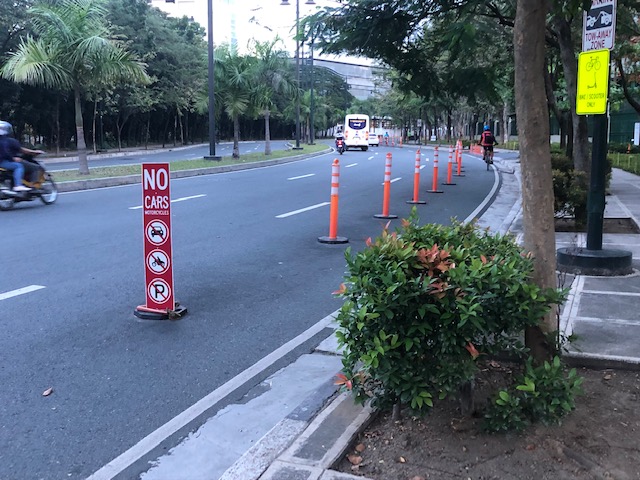
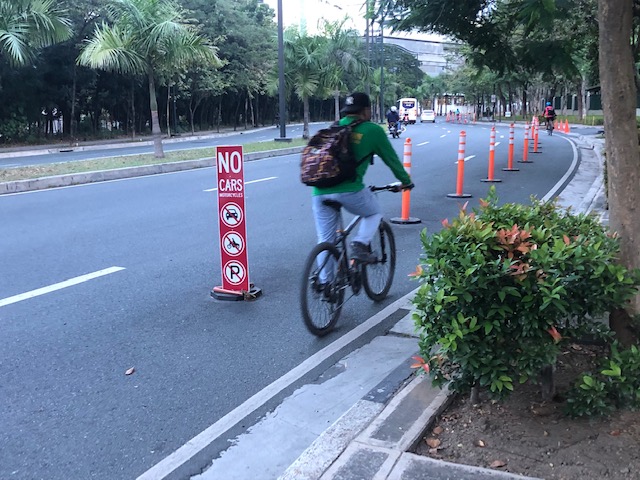
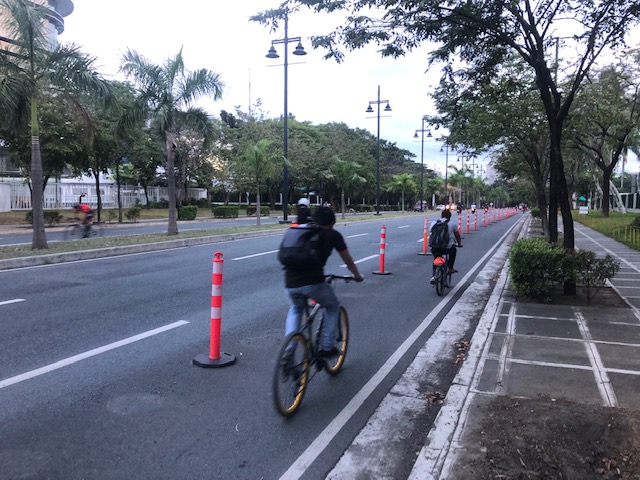
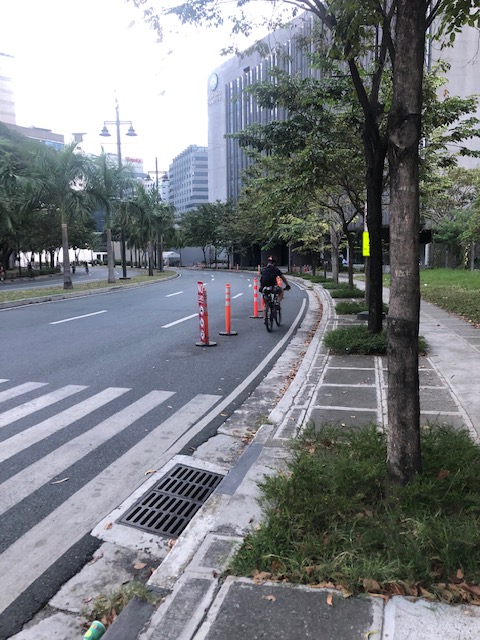
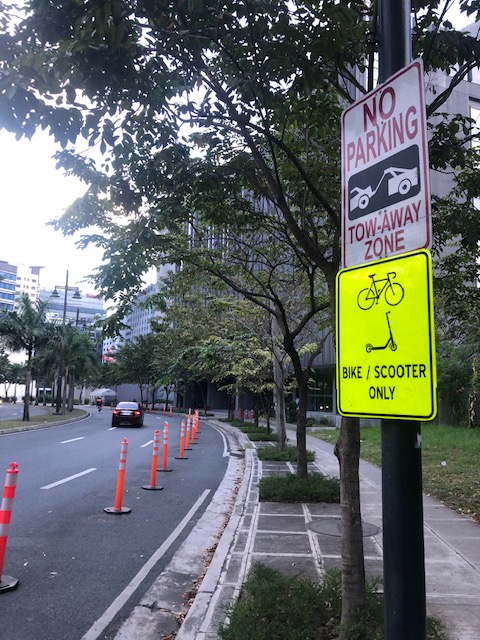
During Saturday and Sunday mornings, the bollards are moved to the sidewalk as many cyclists use 38th Street for laps. I wonder if the bike lanes will be retained once the schools resume face-to-face classes. That would mean a tremendous number of private vehicles generated by the international schools and colleges here. My opinion is that the bike lanes need to be retained as it is a step in the right direction for transport and encourages people to cycle or take PMDs to work and perhaps to school. These and others like it in Metro Manila and around the country need to be sustained and further developed to be attractive and viable to many seeking another option for mobility and their regular commutes.
–
Star ratings for bicycles
I just wanted to do a quick share of a new method for evaluating road and bicycling infrastructure – cycleRAP. This was developed by the International Road Assessment Program (iRAP), which has established a star rating system as the international standard for road safety assessments. We currently use their Star Ratings for Schools (SR4S) to evaluate the school environment towards ensuring safe journeys for school children. Here’s the link to their website:
To quote from the site: “CycleRAP is an easy, affordable and fast method of evaluating road and bicycling infrastructure for safety. It aims to reduce crashes and improve safety specifically for bicyclists and other light mobility users by identifying high risk locations without the need for crash data.”
–
How can e-scooters become a safer way to travel?
I’ve shared some articles and opinions about electric scooters. Here is another one that delves into the safety about these vehicles that have become quite popular in the US. Here in the Philippines, they still seem to be in infancy in terms of popularity and to some, are seen as more a novelty and touristy rather than a mode of transport for the typical work trips.
Donahue, B (June 11, 2022) “How to Make Electric Scooters Become a Safer Way to Travel,” Bloomberg, https://www.bloomberg.com/news/features/2022-06-11/how-to-make-electric-scooters-safer [Last accessed: 6/18/2022]
To quote from the article:
“Dediu believes that in time micromobility will attain critical mass, as other modes of transit have already done, and that infrastructure will come as the user base grows. “We didn’t build airports and then have airplanes show up,” he’s said. “I’m confident, given the history, that we’ll see things like more safe roadways for micromobility vehicles.” “
 Scoot-to-work at BGC, Taguig, Metro Manila
It is not really about the vehicle but the environment in which it is being used. One can say a lot about walking, for example, being dangerous but without touching on the why and the how its become a dangerous or risky mode of travel. It’s the lack of infrastructure or facilities as well as the car-oriented environment (that includes archaic laws and other regulations) that make active mobility and micro mobility modes dangerous or risky. If we can address these basic issues, then perhaps we can entice more people to use these modes more often and for the most trips we make everyday.
And don’t forget that these modes are the most fuel efficient! Saves you from the every increasing prices of fuel!
–
 Caught (up) in traffic