
Home » NMT (Page 10)
Category Archives: NMT
Why cycling or bicycles are good for the economy?
You saw that meme shared in social media where they say “why bicycles are bad for the economy”? There’s some humor there but it doesn’t necessarily convince many people to support cycling or biking over motor vehicle use.
Here goes one and note the logic:
“Cycling or bicycles are good for the economy because…it helps reduce car use/dependence. That means less dependence and expenses to fossil fuels. That means more money available to the household for more important stuff like food, homes and education.”
Can you come up with something like that?
 Workers on bicycles crossing the Marcos Highway bridge from Marikina towards Quezon City.
–
On the importance of public transportation post-pandemic
I am sharing another article from Todd Litman that appear yesterday:
Litman, T. (2020) “Lessons from Pandemics: Valuing Public Transportation,” Planetizen, https://www.planetizen.com/blogs/109584-lessons-pandemics-valuing-public-transportation?fbclid=IwAR2jduFuYoyf_MoksI2Th4UoWtQYMQVOdwHuiih8JM9NxMN5pT_e1lwhgDQ [Last accessed: 6/13/2020]
The article contains material derived from previous work by the author and provides a list (and links to) resources or references related to this topic.
–
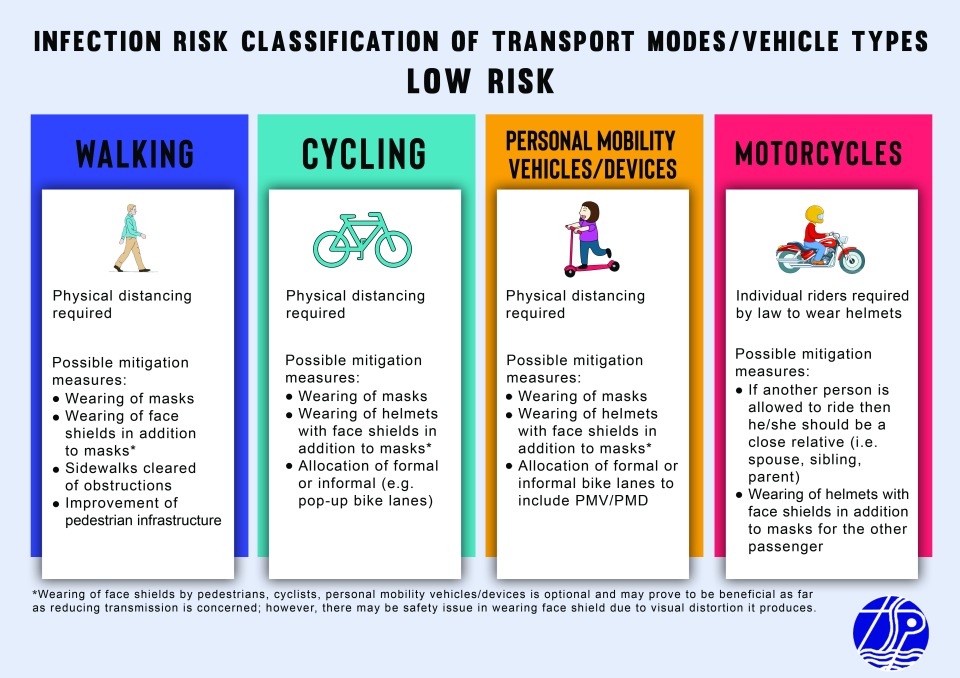
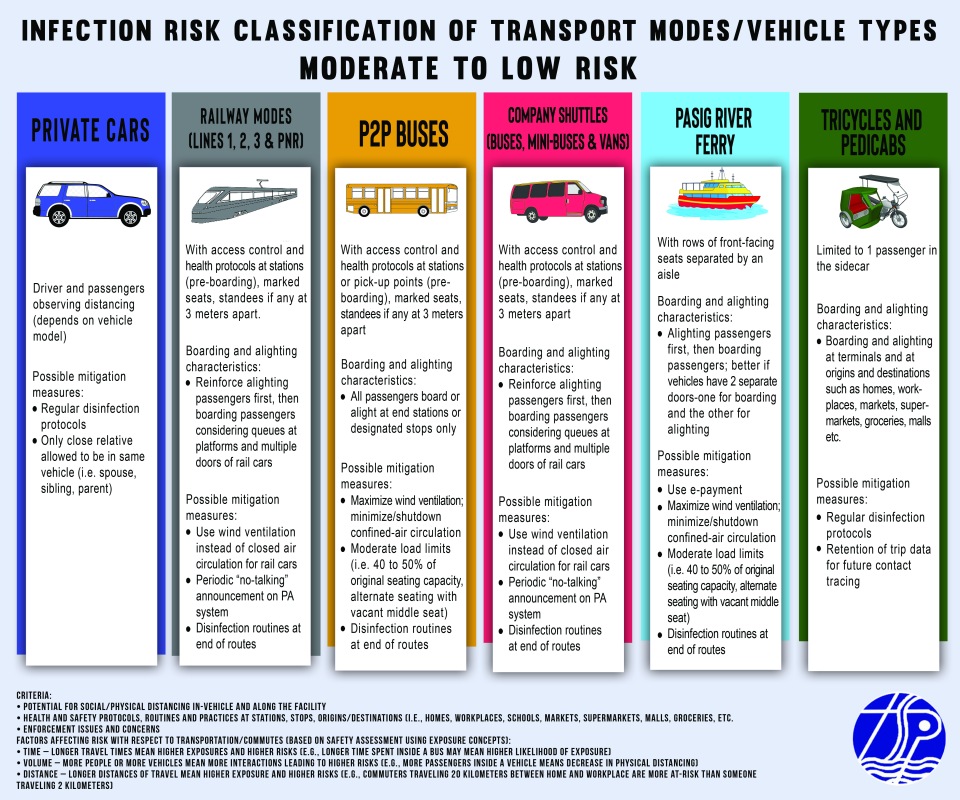
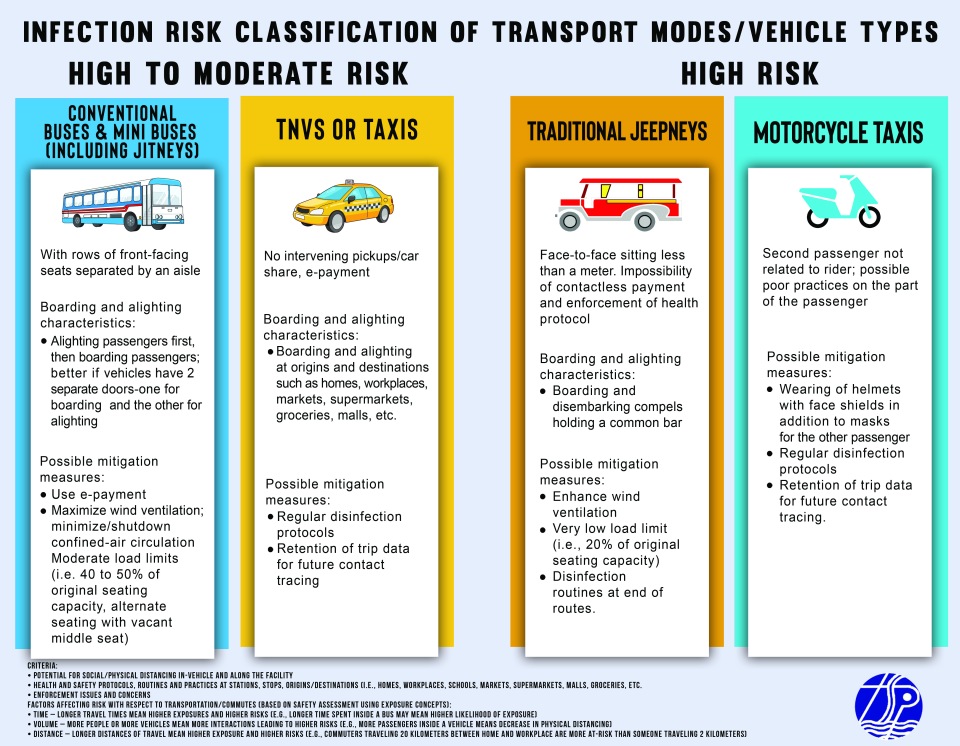
Infographics: Infection Risk Classification of Transport Modes Post-ECQ
The infection risk table I posted a few days ago was improved into the following infographics:
–
COVID-19 Infection Risk Assessment of Transport Modes
I posted about the work we have been doing to assess the infection risk (i.e., spread of COVID-19) for various modes of transport considering the transition of many areas including the National Capital Region (NCR) to the General Community Quarantine (GCQ). The work was undertaken through the Transportation Science Society of the Philippines (TSSP), which is under the umbrella of the Eastern Asia Society for Transportation Studies (EASTS). Here is the outcome in the form of an “Infection Risk Classification of Transport Modes or Vehicle Types” developed by a core group of public transportation and road safety specialists among its members:
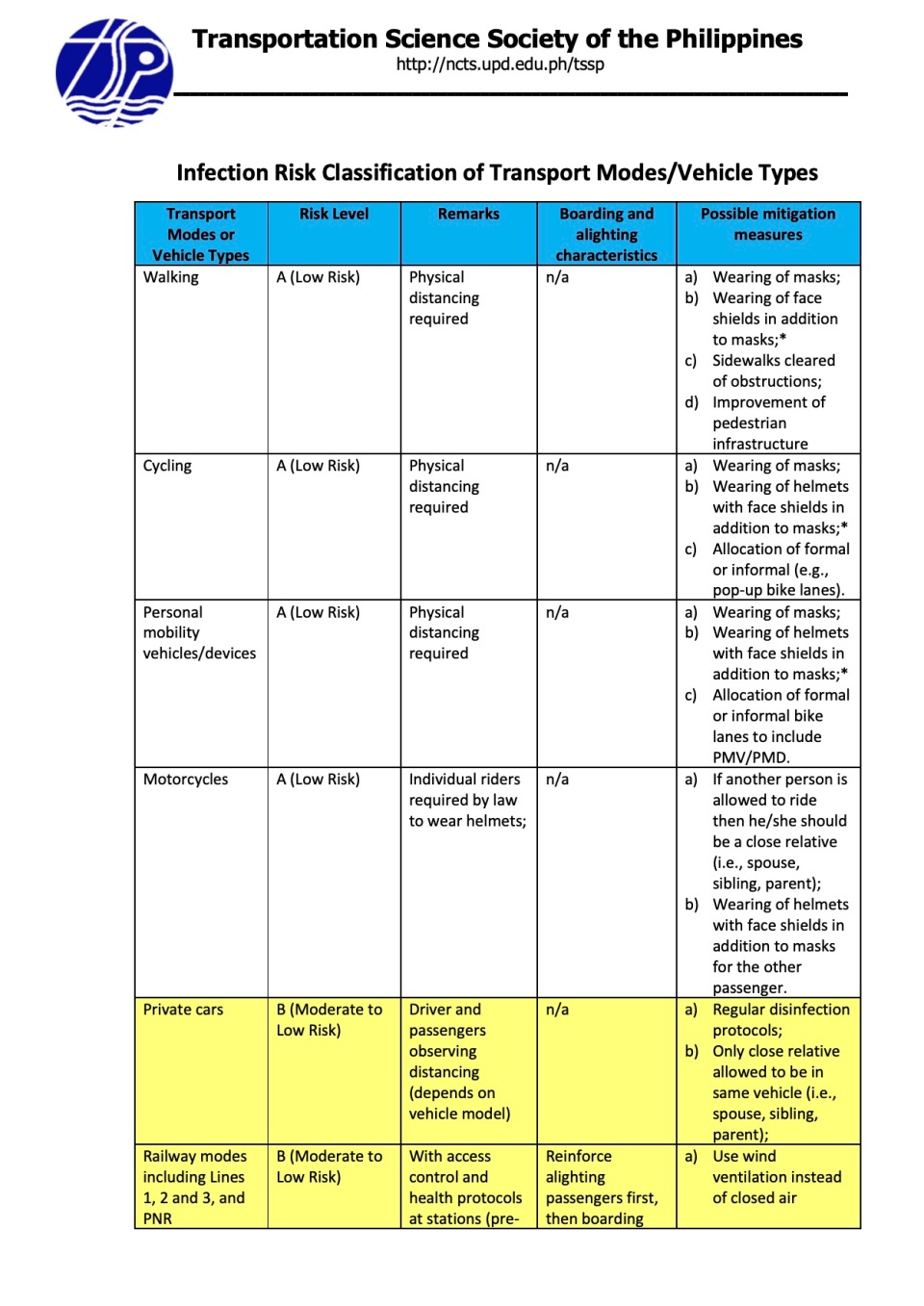
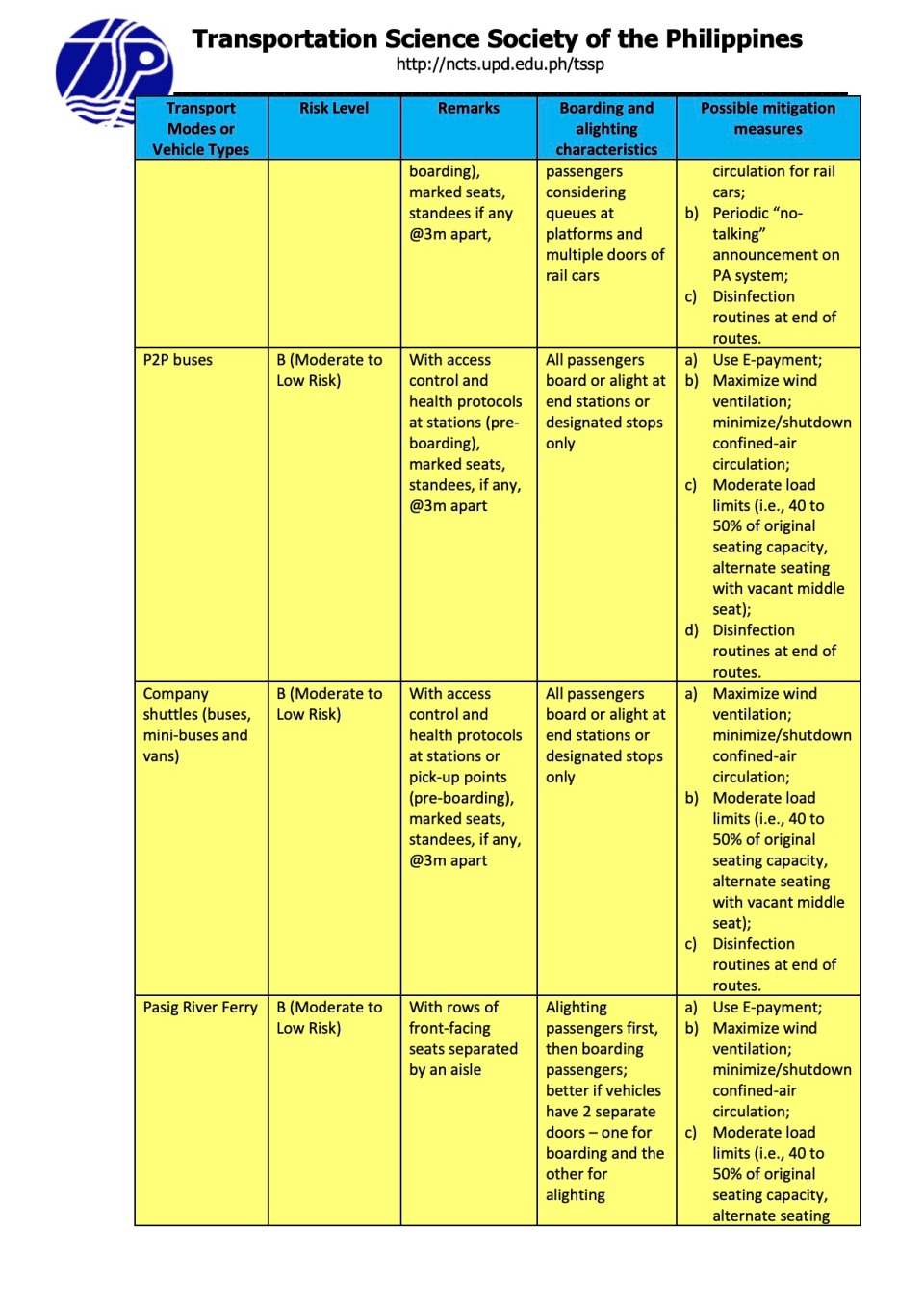
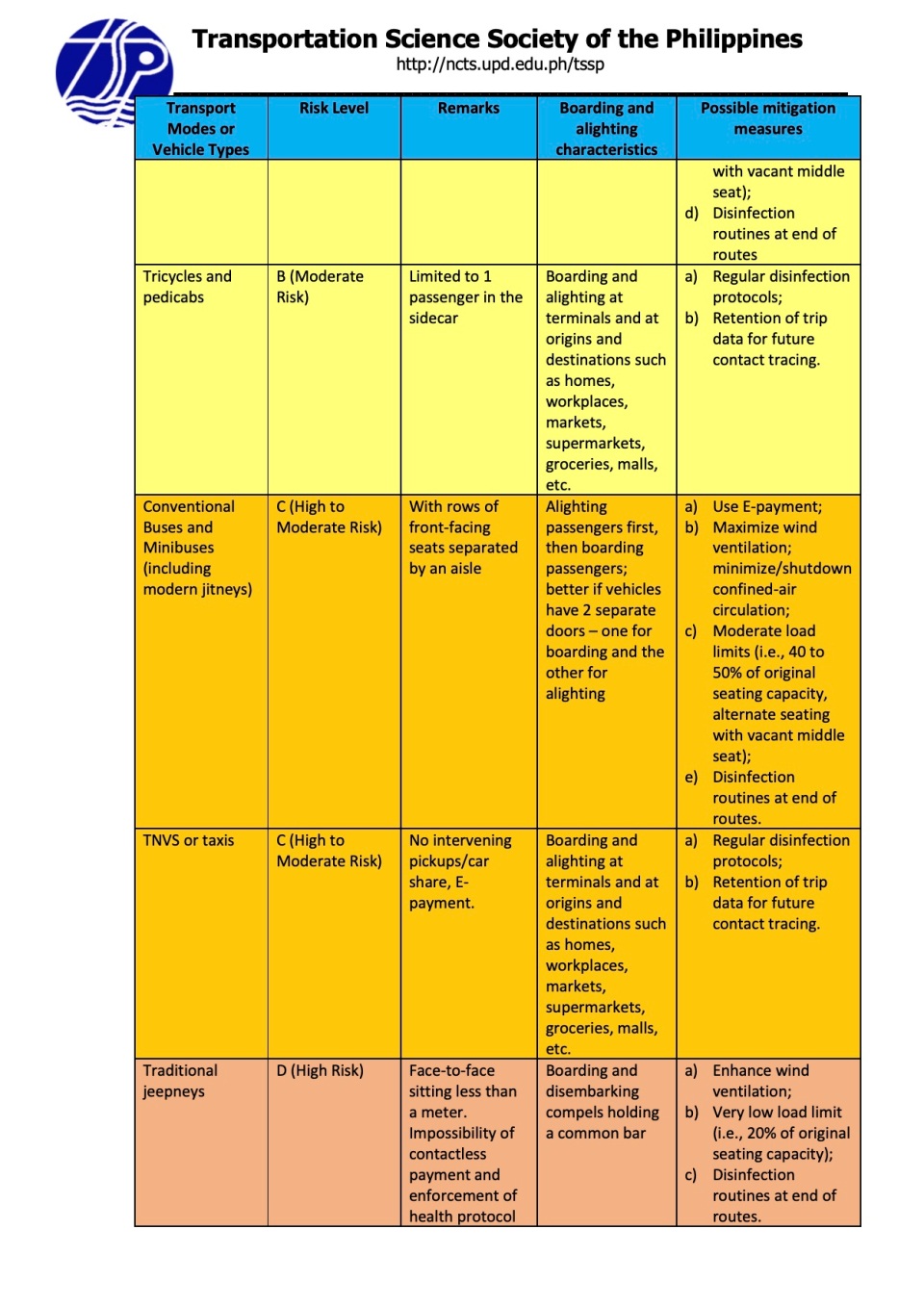
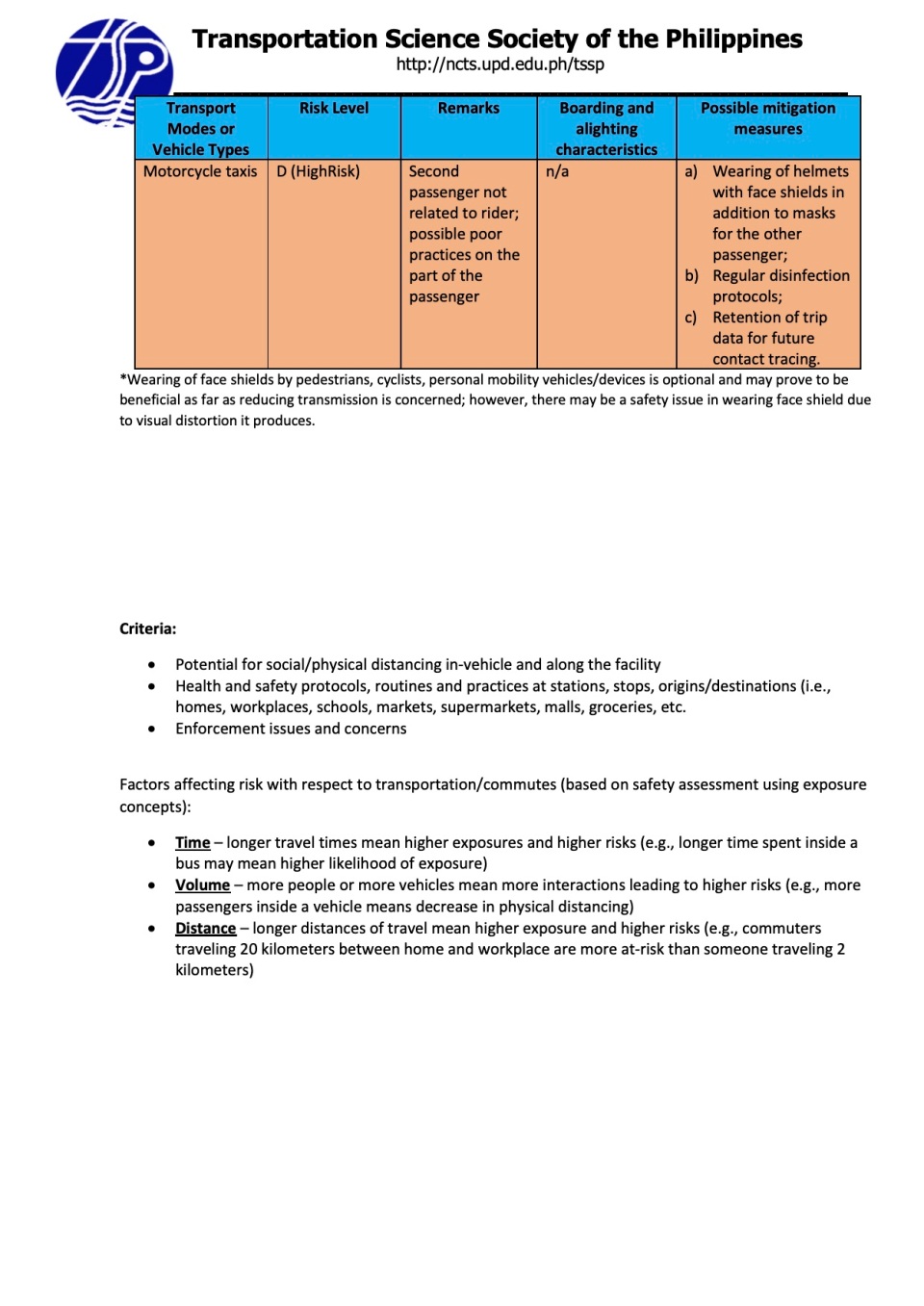
Note again that this is the product of a rapid assessment using the mentioned criteria and factors. It is a qualitative assessment and a quantitative one, given the data, would obviously been preferred. Moreover, this is an assessment for risk of infection rather than for road safety. In the “old normal”, for example, cycling and motorcycle use may have a higher risk in traffic given traffic mix, human behavior and lack of facilities to make these modes safe.
–
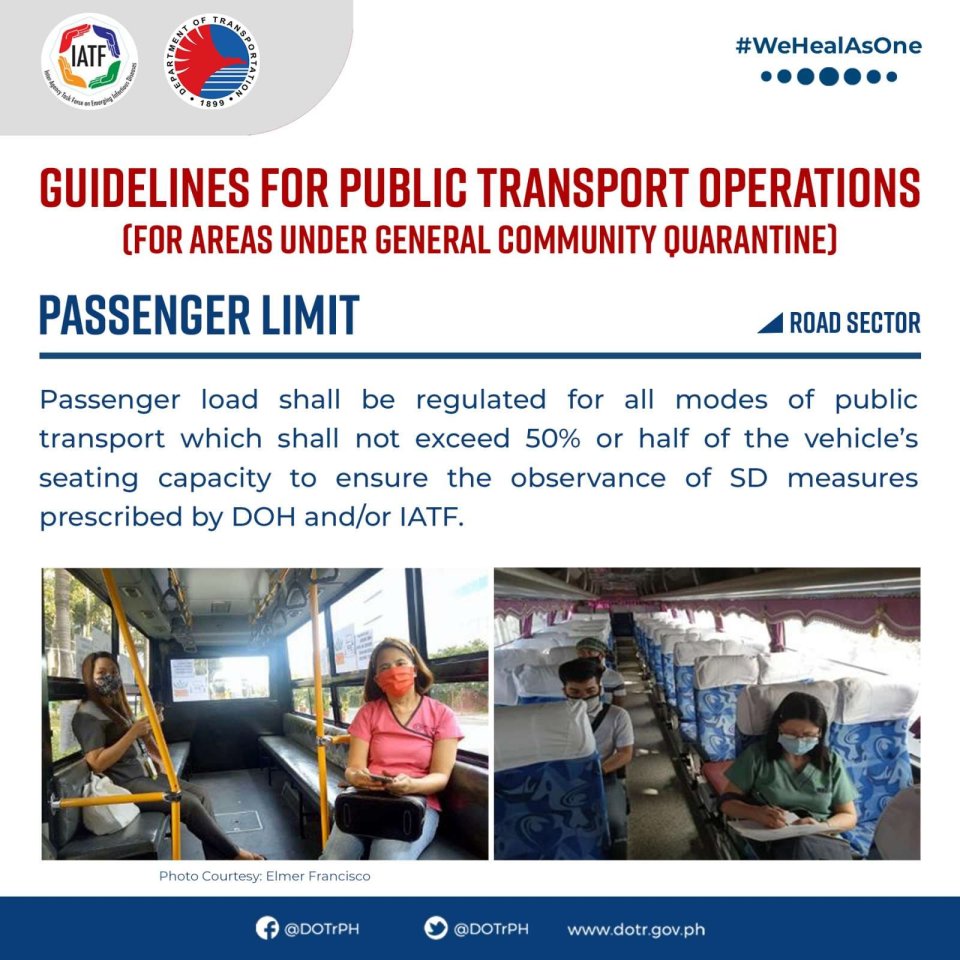
On the DOTr GCQ Guidelines for Public Transportation – Road Sector
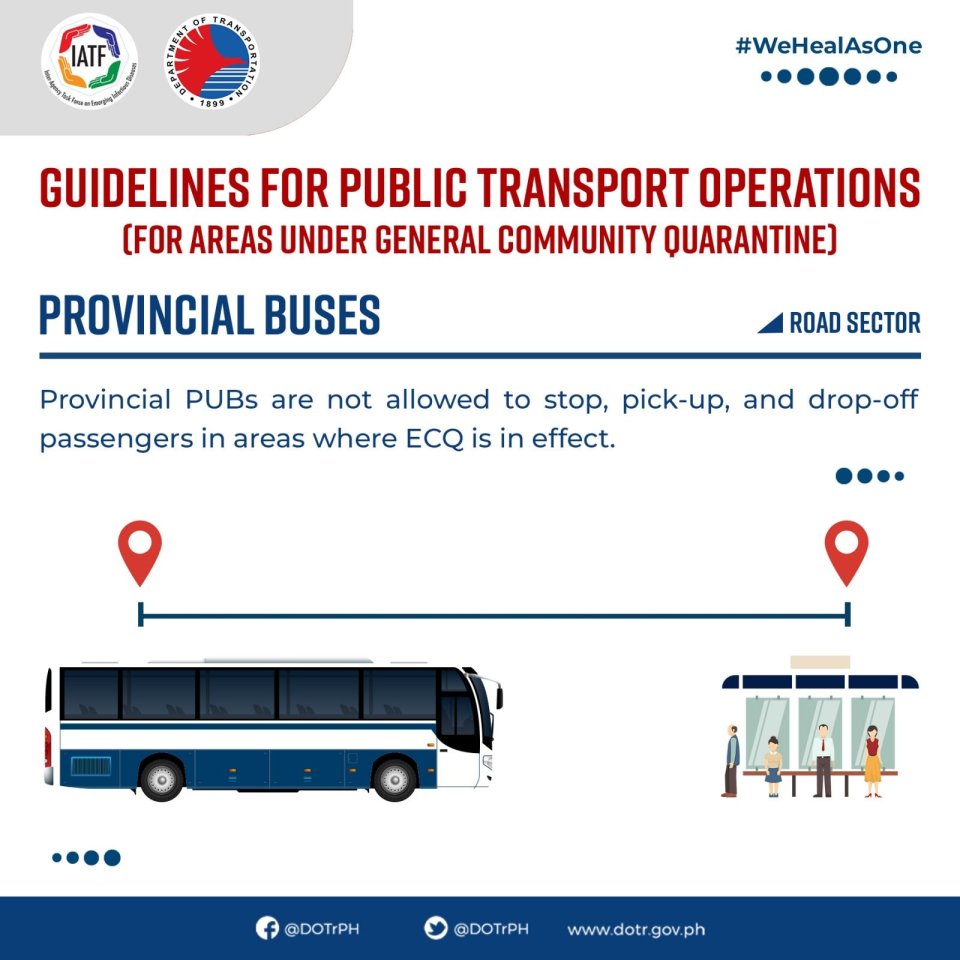
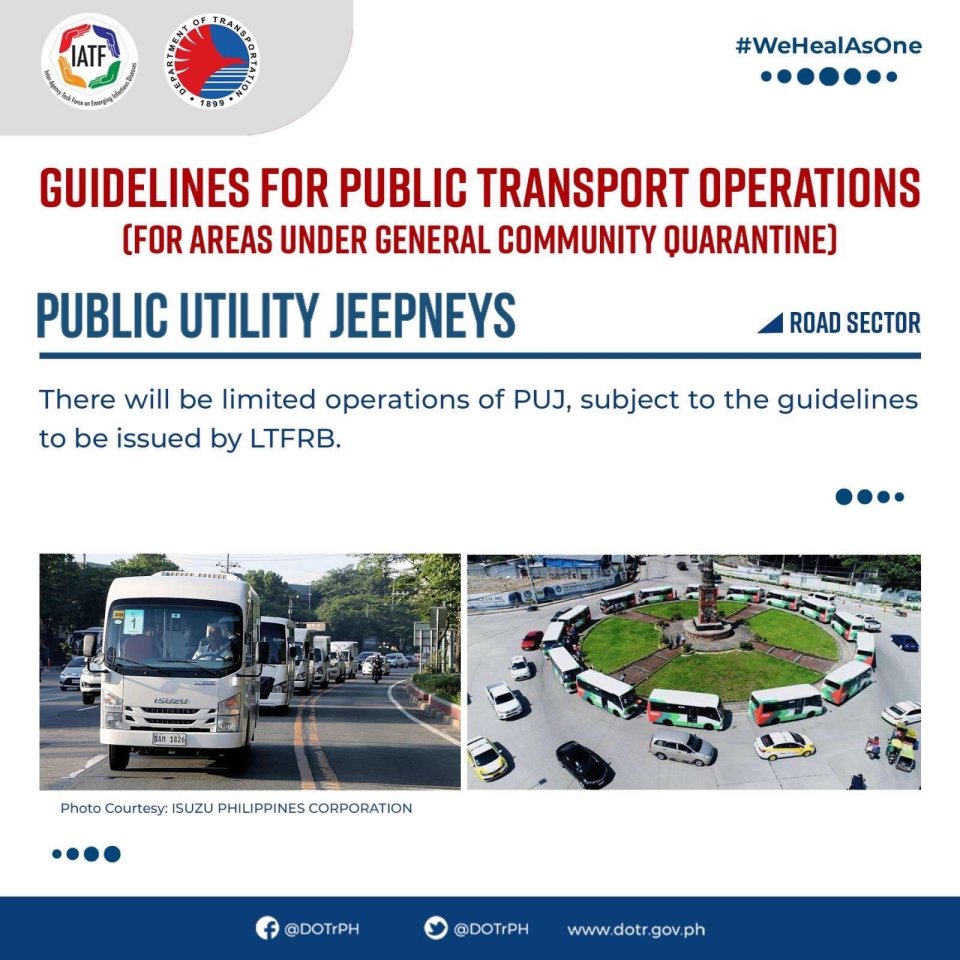
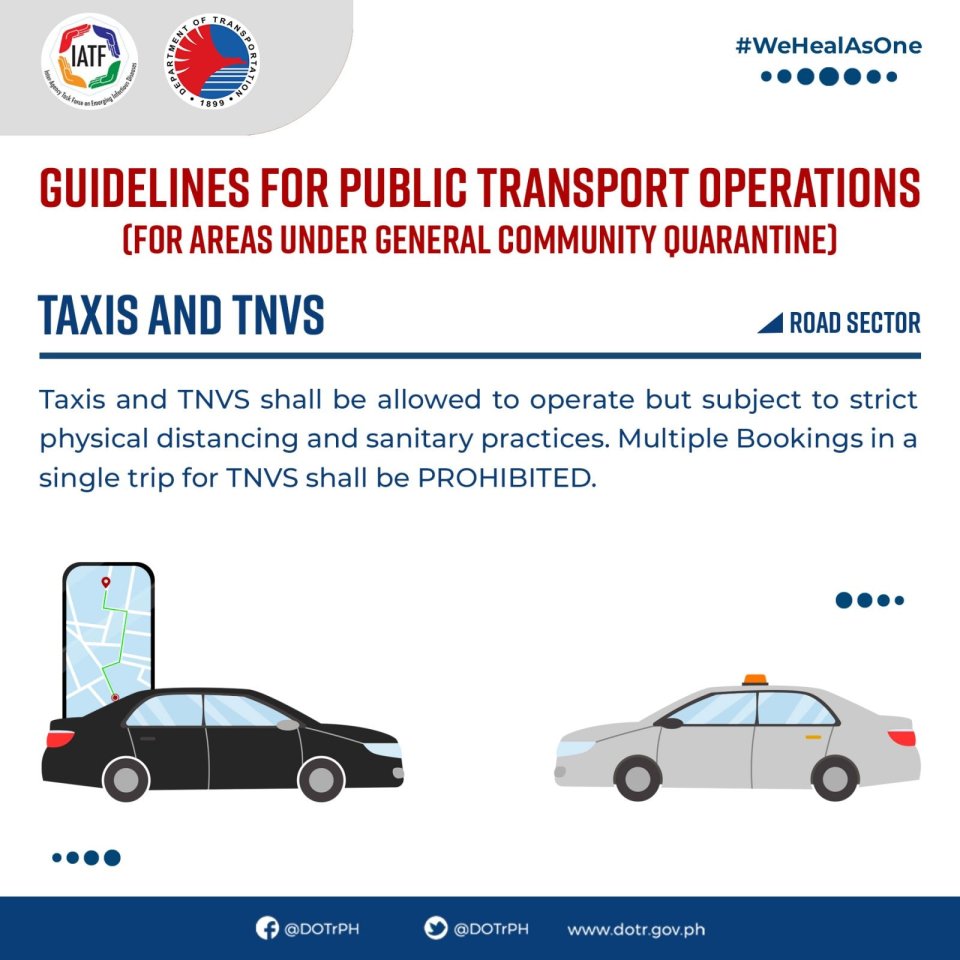
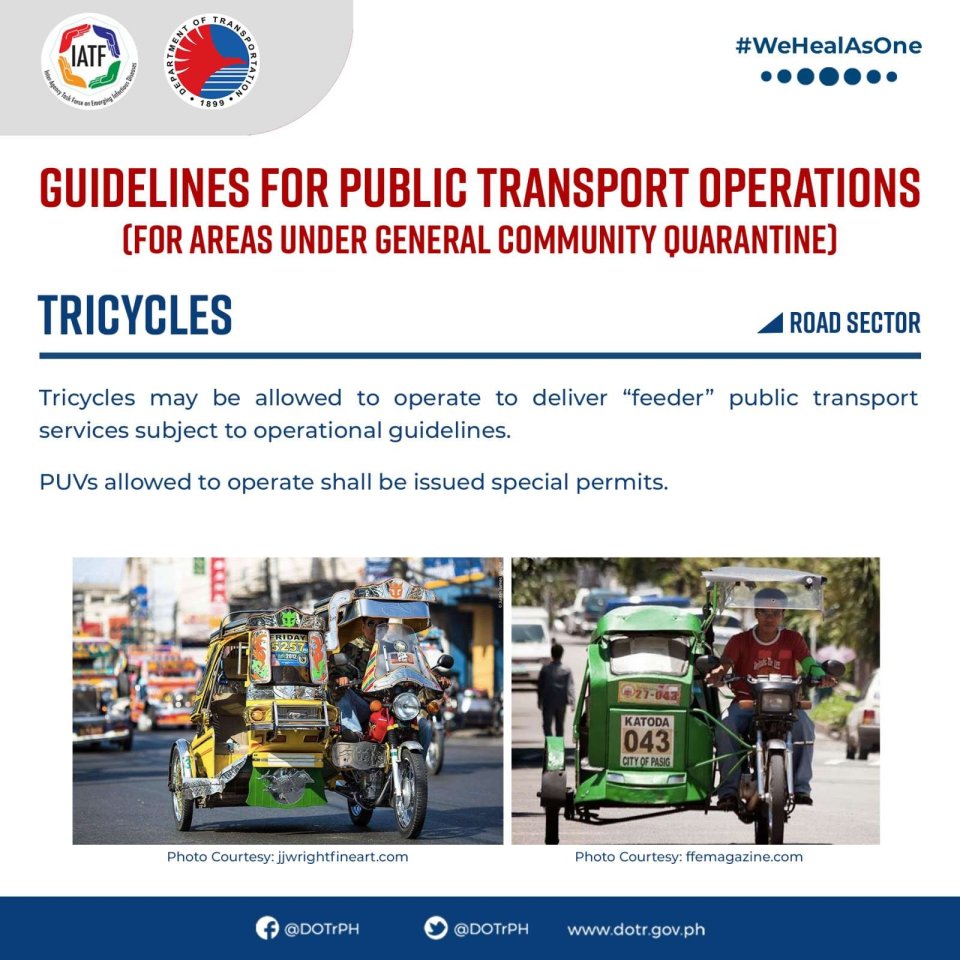
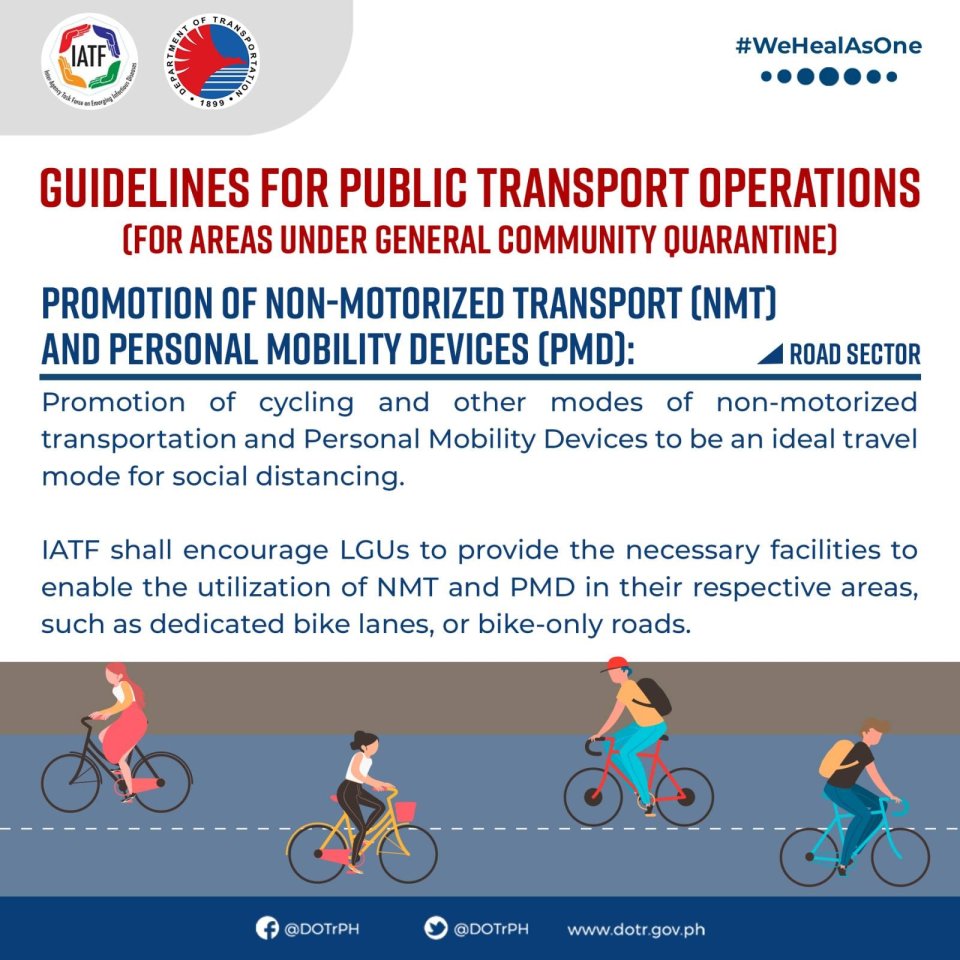
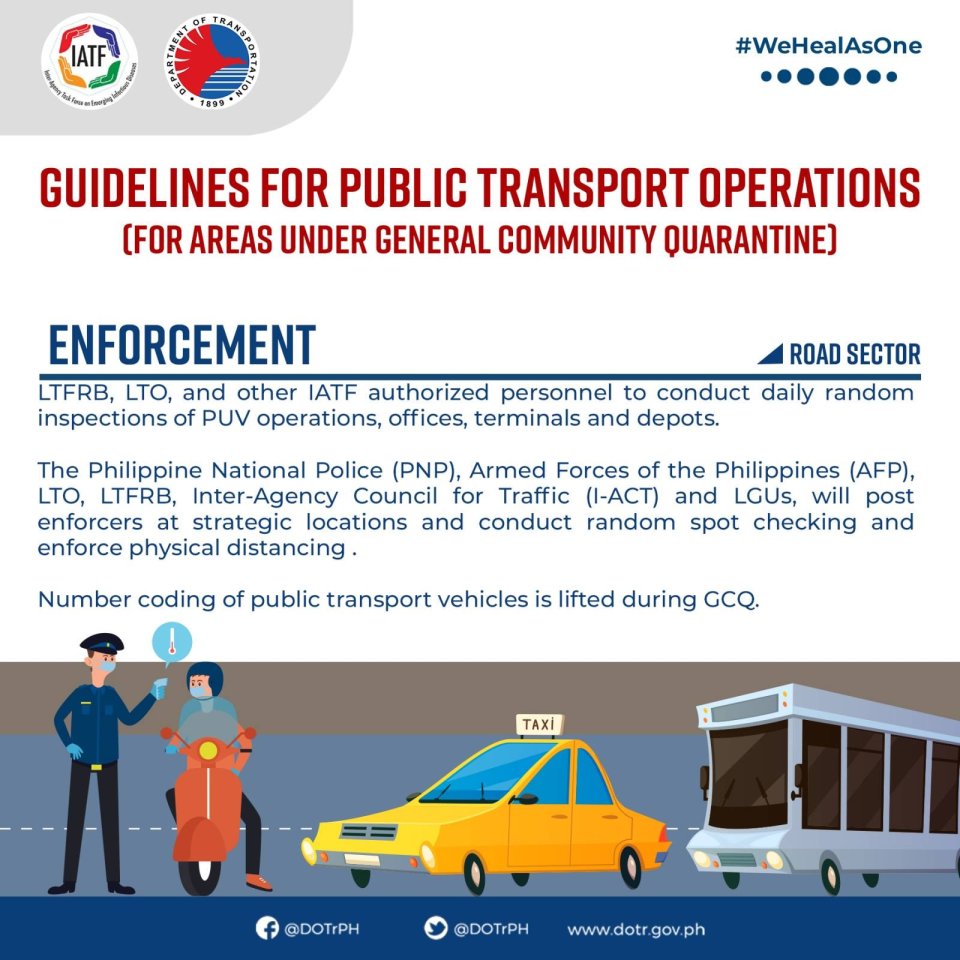
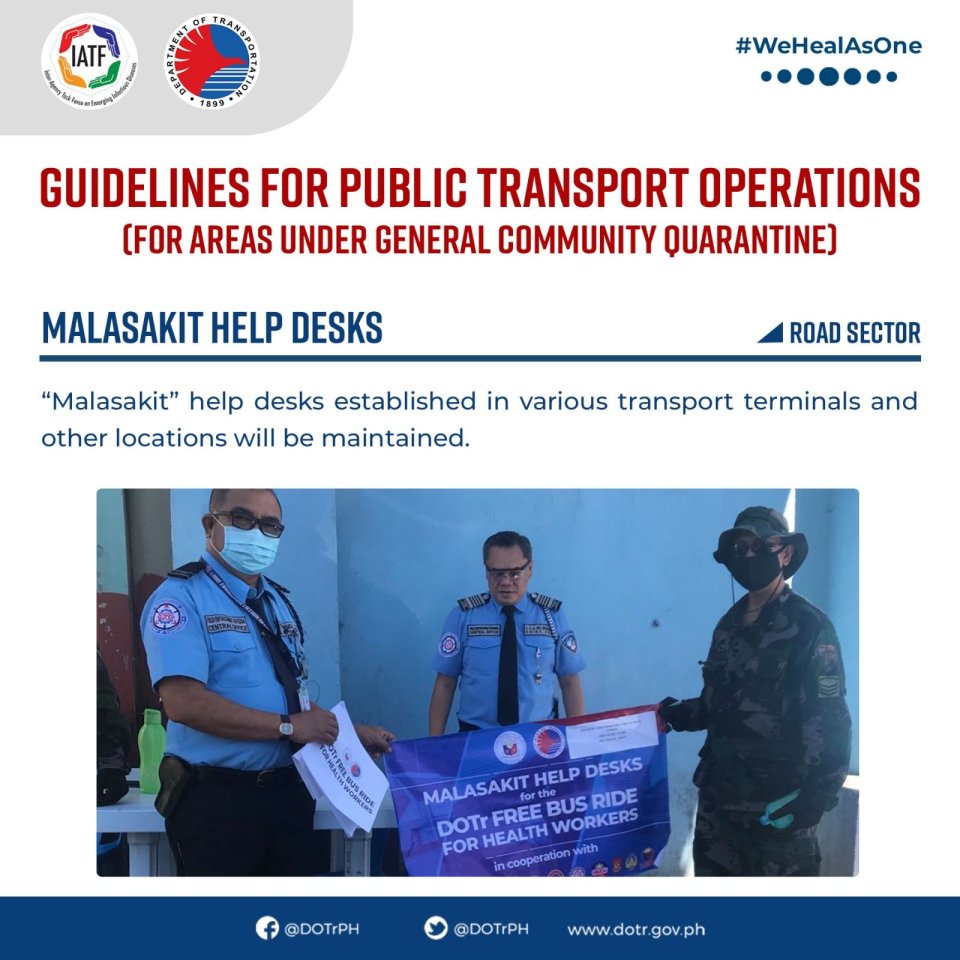
I just wanted to post, share and document here the DOTr’s Guidelines for Public Transport Operations for areas under General Community Quarantine (GCQ). The images are self explanatory so I will not discuss these nor will I offer a critique at this point. The following are public and posted on DOTr’s social media pages (i.e., Facebook) and have been shared and circulating among the public. I also post it here for future reference as I do to many other references like articles and infographics.






–
Reference on Bicycle Facility Preferences and Increasing Bicycle Trips
There are many references that are free for downloading. These include the latest publications from the National Academies Press that includes outputs from the National Academies of Sciences, Engineering and Medicine. I am sharing here and posting also as a reference for me to return to a new publication from the National Cooperative Highway Research Program:
NCHRP Research Report 941: Bicyclist Facility Preferences and Effects on Increasing Bicycle Trips by Watkins, Clark, Mokhtarian, Circella, Handy and Kendall.
The research was supported by the American Association of State Highway and Transportation Officials (AASHTO) in cooperation with the Federal Highway Administration (FHWA).
–
On walking, running and cycling for exercise during the Covid-19 pandemic
We had been walking in the early mornings prior to the so-called “total lockdown” implemented by our Barangay. There were others like us in our community who walked, jogged or cycled during the same time we took our walks. However, we all practiced physical distancing and used masks while outdoors. We could afford to do this because the village where we resided in had relatively wide streets and there were few houses and residents compared to other residential areas. In our case, we usually walked in areas where there were even fewer houses and people. It is highly unlikely we could get Covid-19 during our morning walks. Afternoons were different as we observed more people going around including those who appear to be joyriding with their motorcycles.
Is there actual evidence that walking, jogging, running or cycling actual aid the spread of Covid-19? So far, there isn’t and what we have are mostly simulations. Yes, simulations like those that appear in articles that are going around the internet; often shared in social media. Here is a more informative and objective article about this topic that articulates more the importance of physical activity (i.e., in the form of walking, jogging, running or cycling) in combatting the virus while also emphasizing the need for social or physical distance and the use of masks:
Niiler, E. (2020) “Are Running or Cycling Actually Risks for Spreading Covid-19?”, Wired, https://www.wired.com/story/are-running-or-cycling-actually-risks-for-spreading-covid-19/?bxid=5bd6761b3f92a41245dde413&cndid=37243643&esrc=AUTO_OTHER&source=EDT_WIR_NEWSLETTER_0_DAILY_ZZ&utm_brand=wired&utm_campaign=aud-dev&utm_mailing=WIR_Daily_041420&utm_medium=email&utm_source=nl&utm_term=list1_p4 [Last accessed 4/15/2020]
I appreciate the efforts of those in our Barangay to make sure no one gets infected (there are zero incidents so far). However, sometimes the overeagerness seem to trump the need to practice common sense in these times. I believe there is a need to make an even bigger effort to ensure people are able to maintain physical and mental wellness through exercise or activity. I believe we are in a community where people are educated, aware and responsible enough to make this work.
–
On Pasig’s ordinance promoting and supporting the use of bicycles
I am posting a couple of LGU issuances that would be good references to other LGUs as we all tread along through these quarantines, curfews and lockdowns (or whatever it is they call it these days). First off is the Ordinance from Pasig City. The city has been in the news quite frequently for the very progressive, responsible and active handling of the situation led by its popular mayor Vico Sotto. His policies and programs are claimed to be based on data or information on his constituents that his team is using with much efficiency. This shows us how data analytics can prove useful in times of crisis such as the Covid-19 pandemic. The ordinance also shows a grasp of realities for transport and the so-called “new normal” that people have been talking about once we transition out of the quarantines and lockdowns.


I guess it begs the question if Pasig is also coming out with a formal policy or statement regarding other modes of transport such as tricycles, jeepneys and buses. They did allow tricycles for a while until national government told them to cease tricycle operations citing health issues while not really delving into details to find a way to improve people’s mobility during these times. Meanwhile, other LGUs specifically one that is close to the President’s heart has defied the very same orders from national agencies to restrict tricycle operations as public transport. I will post that issuance next…
–
Comments on current transport issues – Part 2: On motorcycle taxis
I continue with my comments on current and persistent transport issues. This time, I focus on one of two hot topics – motorcycle taxis or “habal-habal”.
1) On motorcycle taxis:
I am not a member of the Technical Working Group (TWG) that’s supposed to be evaluating the trial operations. I know one or two of the key members of the TWG and am surprised that they have not referred to the academe for studies that may have already been done about this mode of transport. I know there have been studies about it in UP and DLSU. Perhaps there are more from other universities in the country. Motorcycle taxis or “habal-habal”, after all, are practically everywhere and would be hard to ignore. Surely, researchers and particularly students would be at least curious about their operations? Such is the case elsewhere and many studies on motorcycle taxis have been made in the region particularly in Vietnam, Thailand and Indonesia, where these modes also proliferate.
The terms “trial”, “experimental” or “pilot” are actually misleading because motorcycle taxis have been operating across the country for so many years now. They are supposed to be illegal and yet they serve a purpose in the areas where they are popular. What is often referred to as an informal transport mode is ‘formal’ to many people who are not being served by so-called formal modes including the tricycle. Of course, one can argue that these terms (i.e., trial, experimental and pilot) refer to the app that are supposed to enhance the existing habal-habal operations.
I would strongly endorse motorcycle taxis but companies need to be held accountable should there be fatal crashes involving their riders. They are supposed to have trained and accredited them. The companies should also have insurance coverage for riders and passengers. LGUs tolerant of these should be watchful and do their part in enforcing traffic rules and regulations pertaining to motorcycle operations in favor of safe riding. This is to reduce if not minimize the incidence of road crashes involving motorcycle taxis.
I think one of the problems with motorcycle taxis is not really their being a mode of choice but the behavior of their drivers. While companies like Angkas and Joyride conduct training sessions with their riders, many revert to reckless on-road behavior including executing risky maneuvers in order to overtake other vehicles on the road. This is actually a given with many ‘informal’ motorcycle taxis (i.e., those not affiliated with the recognized app companies). But then this is also an enforcement issue because we do have traffic rules and regulations that are poorly enforced by authorities. Thus, there is practically no deterrent to reckless riding except perhaps the prospect of being involved in a crash.
I will refrain to include the politics involved in the issue of motorcycle taxis. I will just write about this in another article.
Coming up soon: hot topic #2 – Obstacles to the PNR operations
Comments on current transport issues – Part 1
I end the year with commentaries on transport issues. I recently responded to a request for an interview. This time, it was not possible to do it in person so we corresponded through email. Here are my responses to the questions sent, which are mainly about the public utility vehicle modernization program of the government.
· Will old-school jeepneys finally disappear on Philippine roads before the term of President Rodrigo Duterte ends, barely three years from now? What is a more realistic timeline of jeepney modernization?
Old school jeepneys won’t disappear from Philippine roads. For one, the modernization program has slowed down a bit and even the DOTr and LTFRB have stated and admitted that it is not possible to have 100% modernization before the end of term of the current administration. It’s really difficult to put a timeline on this because of so many factors that are in play including social, political, institutional and economic ones. The technical aspects are not issues here as there are many models to choose from and suitable for replacing jeepneys in terms of capacity.
· What are the bumps on road to jeepney modernization?
As mentioned earlier, there are many factors in play here. Economic/financial-related bumps pertain mainly to vehicle prices. The new models are quite pricey but it should be understood that this is also because the new ones are compliant with certain standards including technical and environmental ones that most ‘formally’ manufactured vehicles must pass unlike so-called customized local road vehicles (CLRV) like the conventional jeepneys. The financial package is not affordable to typical jeepney operators/drivers. The cost of a modern jitney (the technical term for these vehicle types) is close to an SUV and revenues may not be able to cover the combination of down payment, monthly payments, and operations & maintenance costs of the vehicle.
· Should local government units dictate the pace of jeepney modernization, not national agencies such as the Department of Transportation and the Land Transportation Franchising and Regulatory Board? Why?
I think the word “dictate” may be too strong a term to use. Instead, I prefer the word “manage”. After all, LGUs are supposed to capacitate themselves to be able to rationalize and manage public transport operations. That is why the DOTr and the LTFRB are requiring them to formulate and submit for evaluation and approval Local Public Transport Route Plans (LPTRP). Though the deadline was supposed to be 2020, the agencies have relaxed this deadline after few submissions from LGUs. Few because there were only a few who were capable or could afford consultants to prepare the plans for the LGUs. These plans should be comprehensive covering all modes of public transport including tricycles and pedicabs that are already under the LGUs. Buses, jeepneys, vans and taxis are still under the LTFRB. Plans may also contain future transport systems that are being aspired for by LGUs such as rail-based mass transit systems and other such as monorail or AGT.
· Transport groups like PISTON are against drivers and operators merging into cooperatives. Is consolidation into cooperatives unworkable? Why?
I think consolidation into cooperatives is workable and should be given a chance. Unfortunately, there are still few examples of successful transport cooperatives. And the success also depends on the routes served by their vehicles. And that is why there is also a need to rationalize transport routes in order to ensure that these are indeed viable (i.e., profitable) for drivers and operators.
Another angle here is more political in nature. Note that while PISTON and other like-minded transport groups oppose cooperativism, there are others that have embraced it and even went corporate to some extent. Perhaps there is a fear of a loss in power that the leaders of these opposition transport groups have wielded for a long time? Perhaps there’s a fear that success of cooperatives means the drivers and operators will turn to cooperativism and leave those transport groups? Surely there are pros and cons to this and groups should not stop being critical of initiatives, government-led or not, that will affect them. This should be constructive rather than the rant variety but government should also learn to accept these rather than dismiss them or be offended by them as is often the case.
–
More comments in the next year!
–

