
Home » NMT (Page 20)
Category Archives: NMT
Pedicab regulations
With the proliferation of non-motorized transport (NMT) as public transport, there are questions raised pertaining to their regulation or management. Perhaps most pedicab, padyak, sikad or trisikad services around the country a regulated in some way. I use the term “some way” since there will always be either or both formal and informal rules for these services to be provided and patronized by people. These rules or regulations include the setting of pedicab fares that are most likely based on travel distance though not necessarily similar in structure to those of buses and jeepneys. Pedicab fares are practically similar to those for tricycles in that they operate within areas or zones. The rough locations of an origin and destination (i.e., rough distance between origins and destinations or distances between zones) would be the basis for fares.
Private exclusive residential subdivisions or villages would have their own homeowners’ or residents’ associations. These will likely have a say in tricycle or pedicab regulations. Otherwise, many would probably have the power to restrict or prevent tricycles from entering and operating within the subdivision or village. Most if not all tricycles are organized as Tricycle Operators and Drivers Associations (TODA) and so might have some say or bargaining power when dealing with barangays or associations where many operators or drivers may be residing. In the case of pedicabs, there are also pedicab associations with similar compositions where operators or owners of cabs are residents of an area or village. In well-organized subdivisions, however, the associations hold sway over pedicab operators and drivers and enforce rules through contracted, private security staff.
Pedicab rules are not very complicated. In fact, the rules can be provided or posted for every cab such as the example shown in the following photo. I took this as I was riding a pedicab to get home one afternoon.
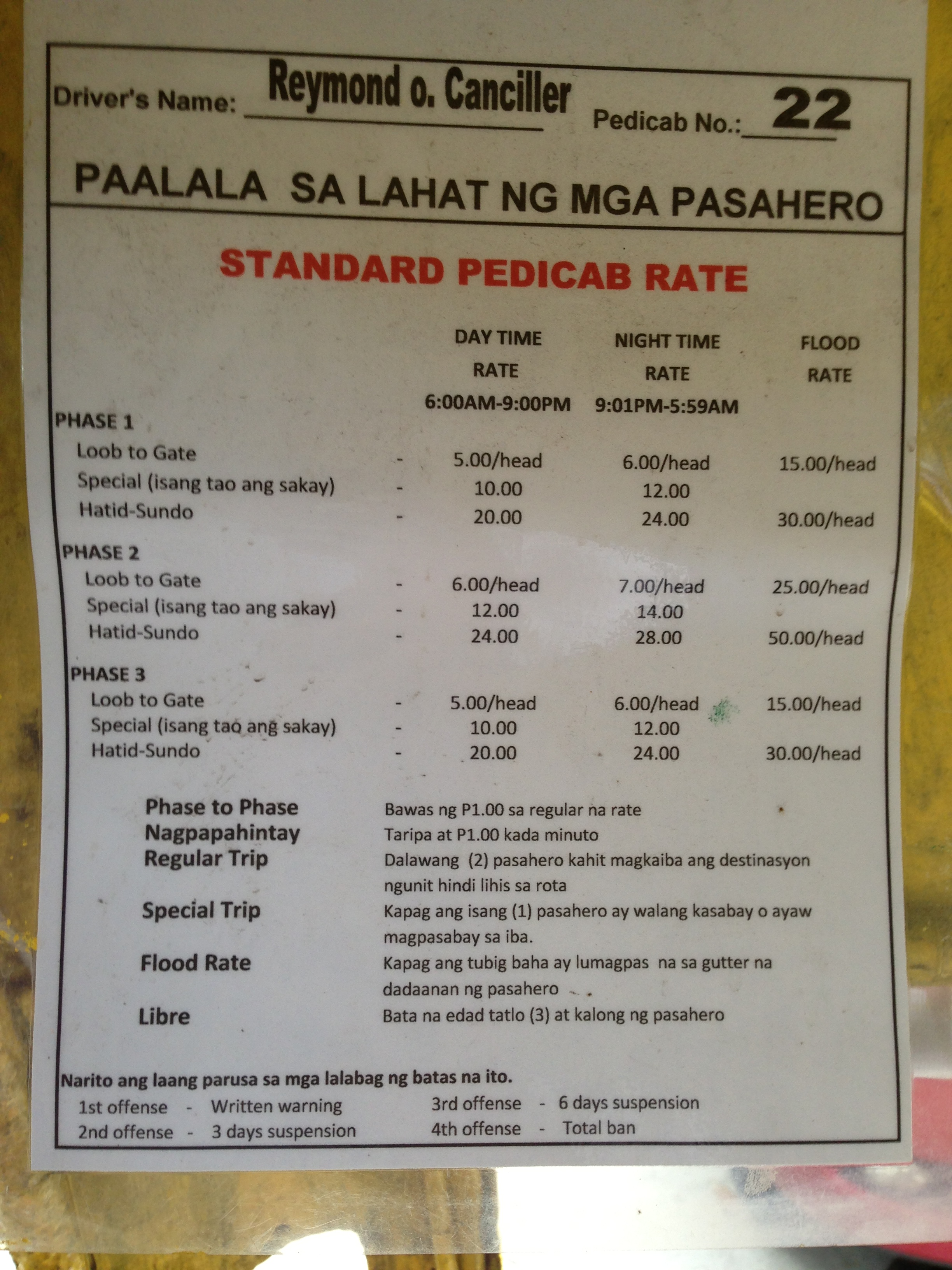
In the laminated reminder (paalala) to passengers, the fares as set with respect to the phases of the subdivision, which serve as zones of operation for pedicabs. There is a daytime rate, a nighttime rate and even rates for when there’s flooding along the streets! Penalties for pedicab drivers violating the rules are stated at the bottom of the announcement with four offenses resulting in a total ban of the driver. I assume the ban is also enforced by security and is aided by the fact that all drivers are issued IDs by the village homeowners association. In our neighborhood, the number of pedicabs operating at late nighttime to the early hours of the morning are regulated and there is a list of drivers providing services during these times of the day. This was a measure passed years ago in part to address the lack of public transport during the nighttime but more so to combat burglaries that involved pedicab drivers who might have become familiar with the routines of residents.
These rules can easily be replicated and implemented elsewhere as long as residents are able to organize themselves. Perhaps in other cases they would also need to coordinate with barangay officials in residential areas where there is no exclusivity like that of a gated subdivision. That way, the rights and interests of passengers are well represented and can be articulated more effectively with respect to tricycle and pedicab associations who might just be exercising too much of their prerogative on passengers. After all, the interest and rights of passengers including their safety should be the priority here as in all other public transport because these are services being provided, and not just any business where revenue seems to be the only end.
–
Pedicab fares
Tricycle and pedicab fares are set quite variably depending on the service areas and those regulating the services. In many cases, it is the pedicab association comprised of drivers-operators who set the fares, which are then supposed to be approved by local officials like those in the barangay or municipal/city hall. I say “supposed” here since most rates are not formally regulated in the manner like how the Land Transportation Franchising and Regulatory Board (LTFRB) sets fares for buses, jeepneys and taxis. While the principles of “willingness to pay” is applied to some extent, pedicab and tricycle fares are usually imposed (to use a strong word) by tricycle and pedicab associations with very rough estimates of operating costs or, in the case of NMTs, the equivalent of physical effort, required to convey people.
In residential subdivisions or villages, associations may have a say in the fare rates. Where I live, the association sets the standard rates and these go to the extent of differentiating between day time and night time rates. There is even a rate for when streets are flooded! There is also a definition for regular and special trips and rates are according to the general distance traveled by pedicab. That is, fares to Phase 2 are generally higher than those for Phases 1 and 3 because Phase 2 streets are generally farther from the reference origin/destination, which is the village gate. Given the effort of pedicab drivers to transport passengers, I think the rates are just right. The only part there that seems unusual is the rate of PhP 1/minute for waiting time, which to me seems to high. Nevertheless, there is nothing to stop passengers from showing their appreciation for hard work in the form of tips. And there is no limit to the generosity of some passengers who choose to pay more to the (pedi)cabbie.
 Tariff sheet displayed inside the sidecar of every pedicab of our village. The information is useful especially to guests or visitors who are not familiar with pedicab rates in the area.
–
All weather transport
The flooding brought about by heavy rains around the country rendered many roads impassable to motor vehicles. This meant traffic congestion in many areas and so many commuters being stranded due to the lack of public transport vehicles available to them. In these times, the only modes for traveling are reduced and limited to walking and non-motorized tranport (NMT). While cycling is an option for some people, a more popular mode in many areas and local roads are pedicabs. Known by various names in the vernacular such as padyak, trisikad, sikad, etc., these three wheelers are found providing transport services particularly in residential areas. These tend to use national roads and busy streets in cities, and such often causes conflicts with motor vehicles as the NMTs slow down traffic. During times of heavy rains due to typhoons or the monsoon, pedicabs become the mode of choice for many who need to get to their workplaces, schools or home despite flooded streets.
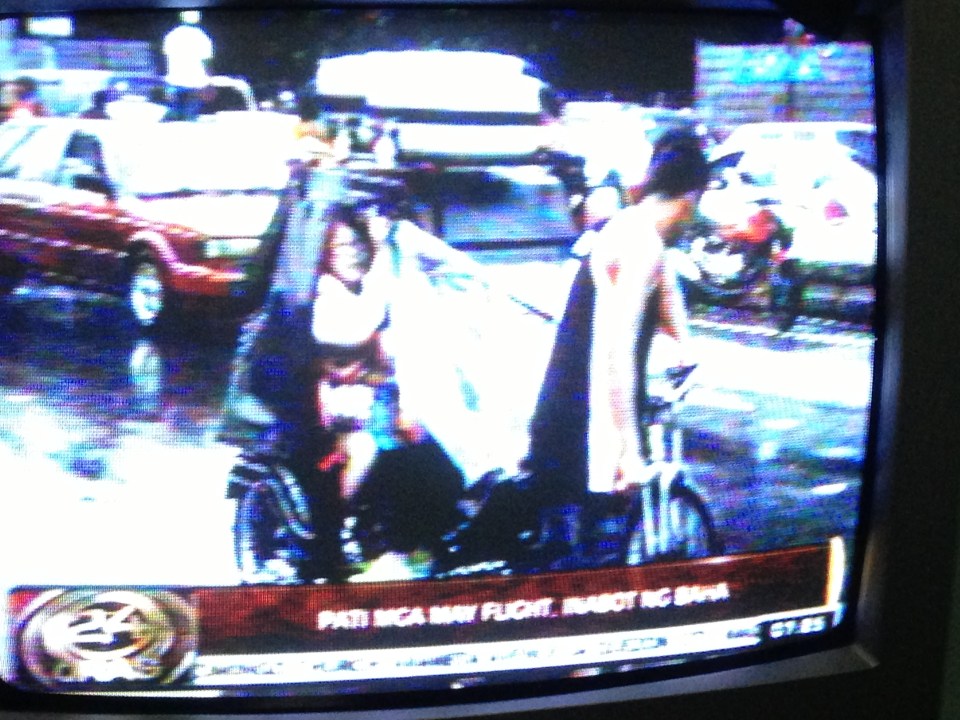 Photo of TV news report (GMA News’ 24 Oras) on air passengers taking pedicabs in order to get to the airport and catch their flights. Traffic was terrible due to floods along airport roads and only the non-motorized transport could navigate the flood waters. Interviews of passengers including tourists and foreigners showed their appreciation of the alternative mode of transport they had to take to catch their flights.
 Pedicab service along a flooded residential road – special rates are often charged by pedicab drivers during the rainy season and when go into flooded streets. Regulated fares are charged in areas like residential subdivisions where homeowners associations have a say in fare rates. In other places, fares can be arbitrary or according to the willingness to pay of prospective passengers.
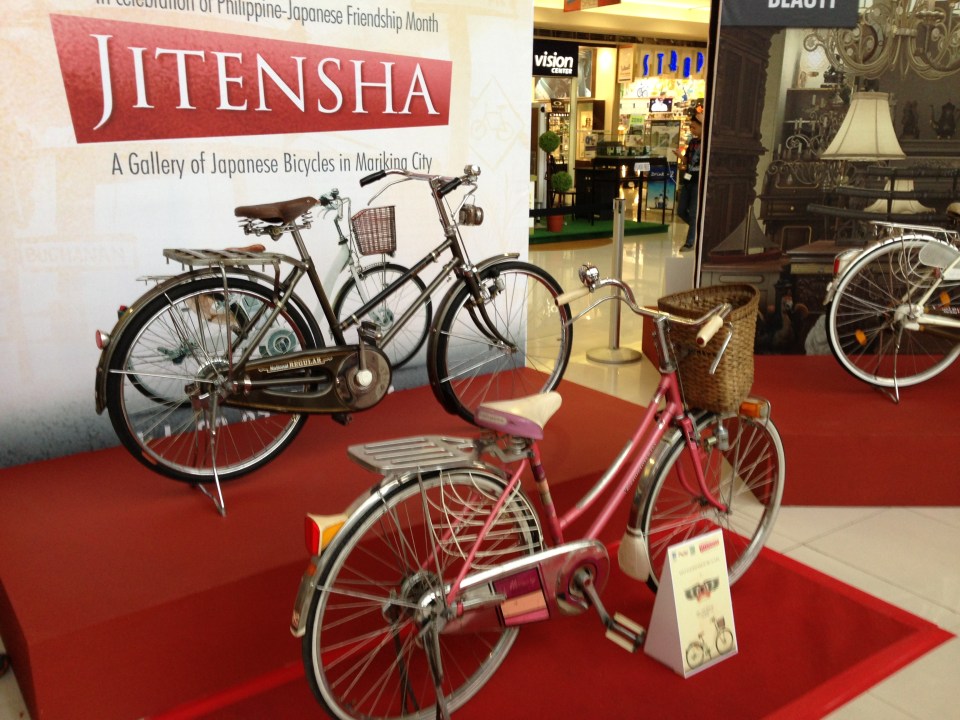 Bicycles are becoming popular for commuting not especially due to floods but more because of increasing fuel prices and fares. There is also an influx of second-hand or used bicycles from Japan (Note: Jitensha is bicycle in Japanese). These have become collectibles but are in actual use by their owners like the bikes shown in the photo that were exhibited at a mall recently.
–
More bikeways please!
After the construction of a bikeways network in Marikina City, the city became a poster child for sustainable transport in the Philippines. The bikeways was initiated with assistance from the World Bank for the pilot route and was later expanded by the city under the leadership of its Mayors, the former MMDA Chair Bayani Fernando and his wife Marides Fernando. The bikeways were promoted as a good practice example for non-motorized transport (NMT), with the National Center for Transportation Studies (NCTS) of the University of the Philippines Diliman involving the Marikina City Bikeways Office (MCBO) in its studies and advocacy work on Environmentally Sustainable Transport (EST).
 Bikeways between pedestrian walkway (red pavement) and parking slots in Marikina City.
 Bike lane along the Academic Oval at UP Diliman in Quezon City.
 Bike lane integrated into the sidewalks along Marcos Highway in the cities of Marikina, Pasig and Antipolo.
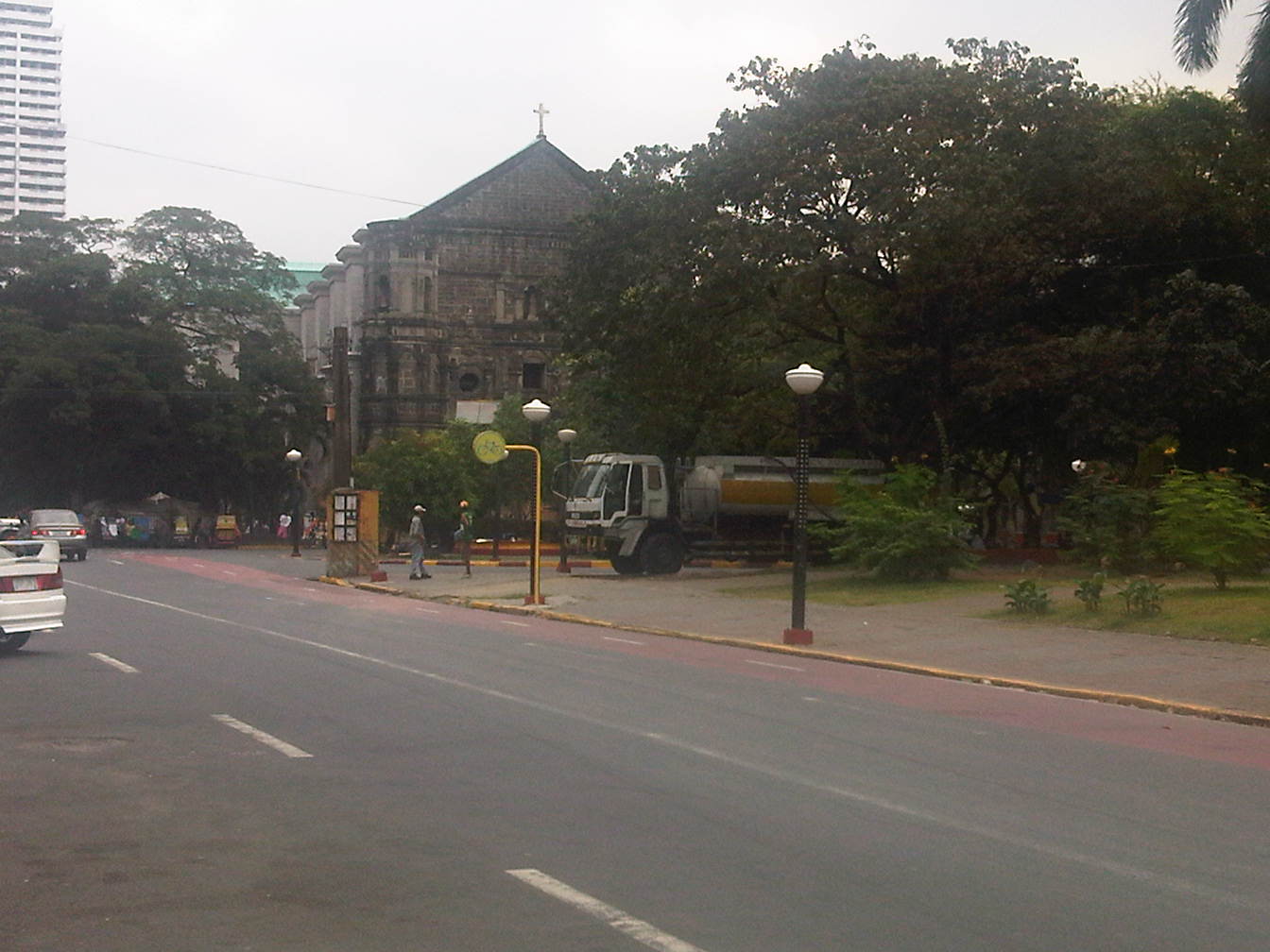 Bike lanes (red pavement) in Malate, Manila.
 Bike lanes integrated with the sidewalks along Commonwealth Avenue in Quezon City.
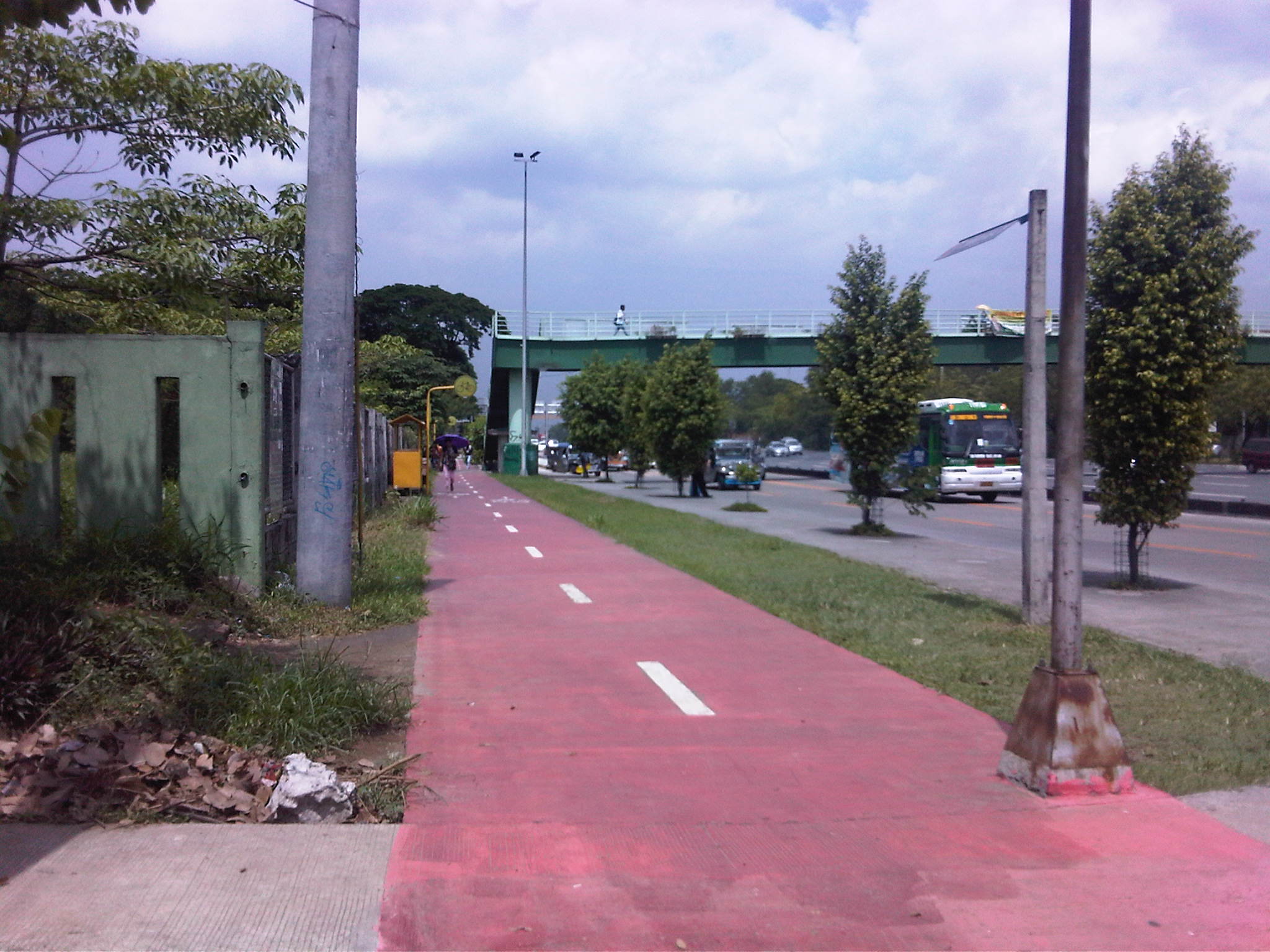 Bike lanes integrated with the sidewalks along Commonwealth Avenue in Quezon City.
This is obviously not a comprehensive list of bike lanes and bike ways in the Philippines. I am sure there are similar projects in other cities and I am aware that cycling is becoming more popular around the country. These are but examples of what has been accomplished so far and it is clear that we need to do more to promote cycling not just as a sport or for recreation but, more importantly, as a means for commuting. Integrating cycling into one’s daily routine is a healthy and money-saving option, and segregated bikeways and bike lanes ensure the safe travels for cyclists. This, of course, is in consideration of the little respect cyclists (and pedestrians) get from motorists who believe road space is theirs alone.
–
Pedicabs at your service
Pedicabs are among the most common modes of public transport around the country. These are usually found in residential areas including subdivisions or villages where they provide services to people who find it far to walk between their homes and the village gate. However, in many other places, particularly in the rural areas, pedicabs along with tricycles represent the main public transport mode for short trips. And because the main roads connecting barangays or barrios may be national roads, one will find these non-motorized transport traveling along national roads and clearly violating a law prohibiting such transport from using the national highways.
Pedicabs serving rural areas are often tolerated because of a lack of convenient public transport services in barangays. Many communities that happen to be located along national highways are often served by pedicabs (and/or motor tricycles) since jeepneys or buses come along quite sporadically, especially during the off-peak hours. Their drivers and passengers though are often at risk from motor vehicles, especially buses and trucks, that travel at higher speeds and with which crashes are highly likely to result in fatalities.
 This guy earns 10 pesos for a special (single passenger only) ride from the national highway to the Leyte Landings monument in Palo. Normal fare is 6 pesos per passenger if you share the ride with others. It’s a decent job and the man earns an honest living pedaling his pedicab to ferry people to and from government offices around the area.
 Pedicab queue at the junction of national roads are quite common in the rural areas.
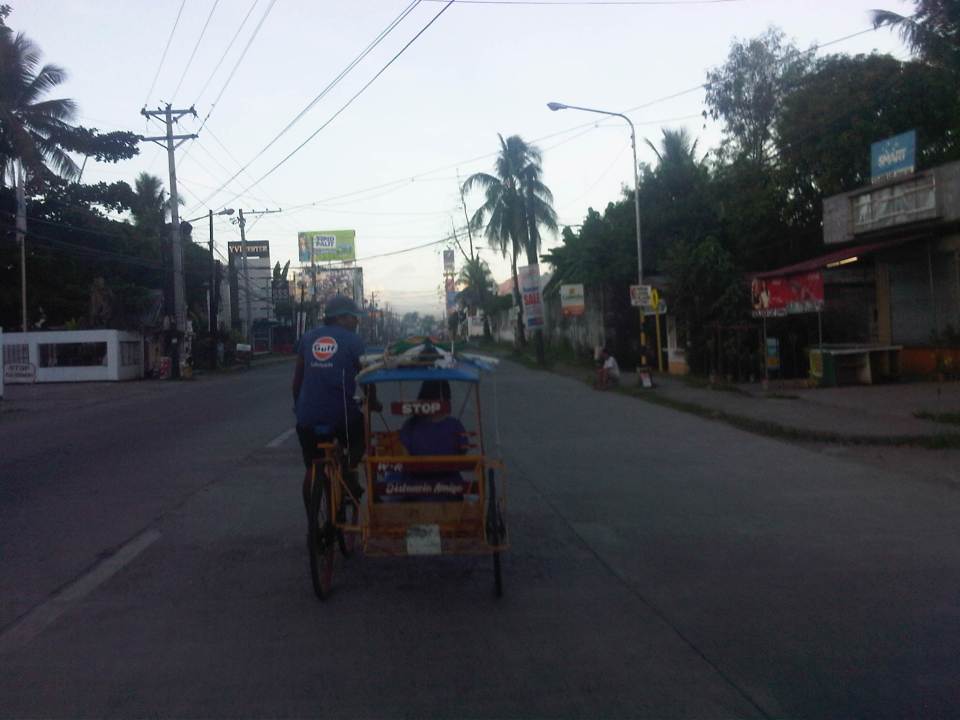 Pedicab traveling along a national highway in Leyte.
In the urban setting, pedicabs operate in many streets and in many cases travel along major roads. Many are considered nuisances in traffic as they are slow moving and do risky maneuvers. In certain cases, like Intramuros and Pasay, they are just too many and may cause congestion simply by their numbers in general traffic. One can also wonder why they are necessary in many places if the walking environment can be improved for pedestrians so that they would not need to take short rides via pedicabs. While we are aware of the social dimensions of pedicab services (i.e., mainly their being the source of income or livelihood for a lot of people), there is the view that many of these same people are misguided in their being allowed to operate so many pedicabs and thereby making many believe it is the “only” livelihood they can depend on. The local governments should be made answerable to these questions regarding pedicab proliferation where they are not suitable.
 Pedicabs along a Manila street near Tutuban and the PNR station.
 Pedicabs in Intramuros, Manila near Mapua Institute of Technology.
 Pedicabs operating along a section of EDSA in Pasay City near the provincial bus terminals.
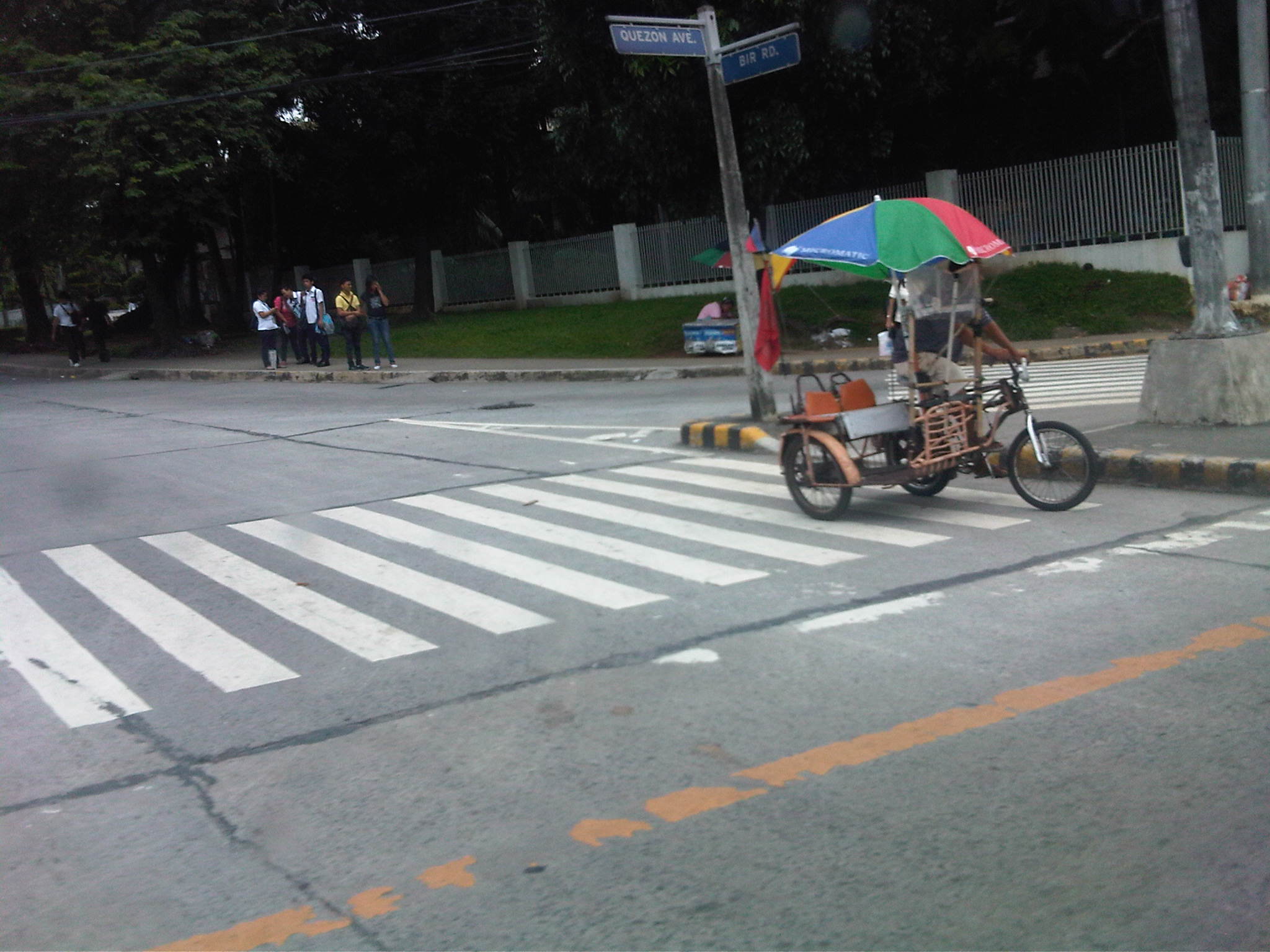 Pedicab along Quezon Avenue in Quezon City near the BIR Road and Agham Road, ferrying people from the EDSA MRT station to offices along the said roads.
Then, of course, there are the pedicabs serving the private or gated residential subdivisions. While tricycles have been the ones to first establish services for these villages, pedicabs have become the choice for many where noise and emissions from tricycles have become irritants and serious issues to residents. The slower-moving pedicabs pose less risks to children playing on the streets or pedestrians walking on village carriageways.
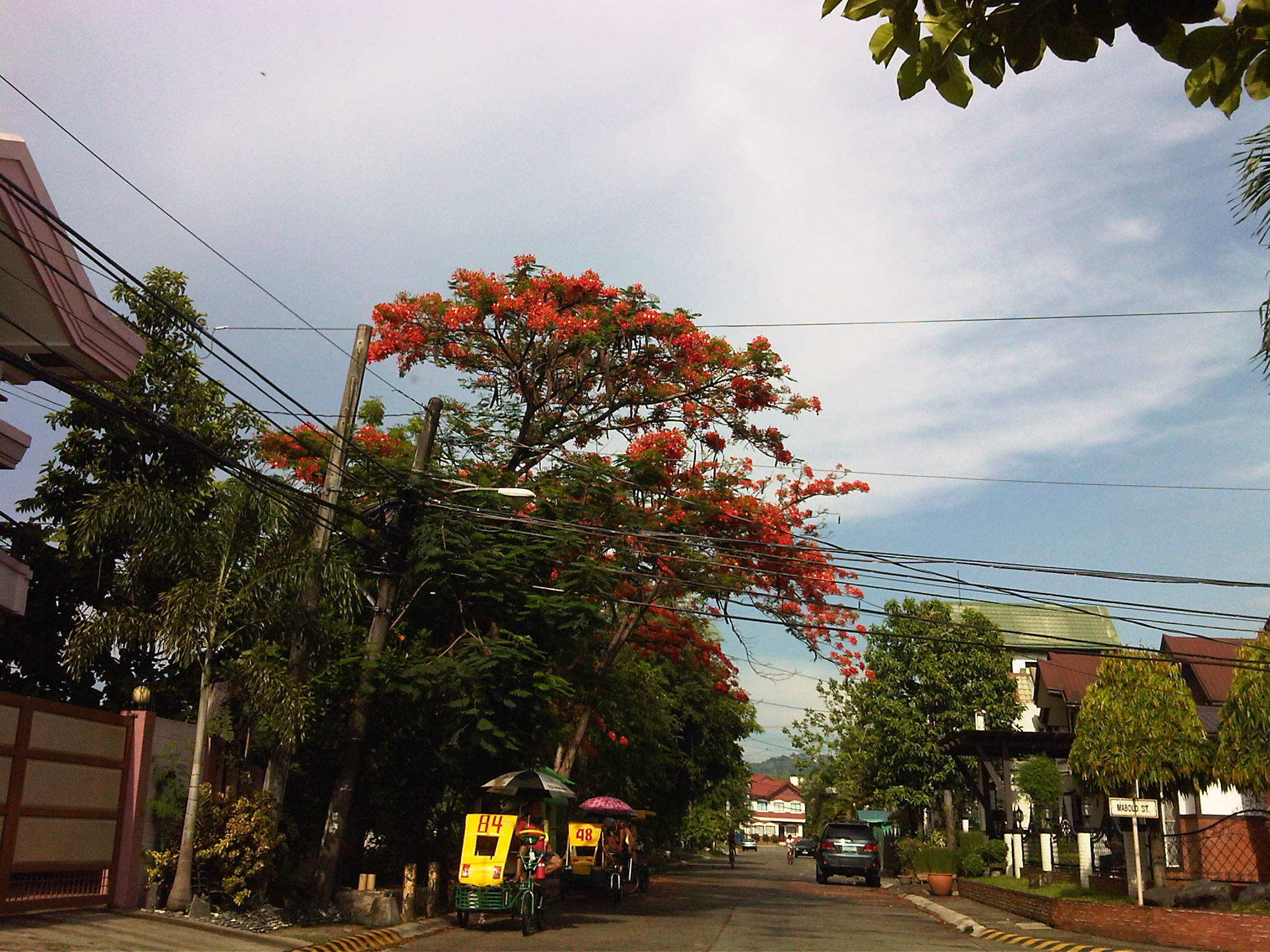 Pedicabs at an exclusive residential subdivision – depending on the fare policies set by local governments, barangays or village associations, pedicabs may charge somewhere between 5 to 10 pesos per passenger depending on the distance traveled, and in some cases the weather conditions (i.e., in many areas, pedicabs charge more when its rainy and especially when streets are flooded).
–
The Streets of Intramuros: Muralla Street
Intramuros is known as the “old” Manila as the enclave was practically The City when the Philippines was under Spain. Streets are generally narrow as they were designed at a time when there were no motor vehicles like automobiles, jeepneys, buses or trucks. People walked or rode on horses. Luxury vehicles were carriages while goods were carried by carts or people. The following photos show the stretch of Muralla Street from the Victoria Street (Bayleaf Hotel) to Real Street (Lyceum University).
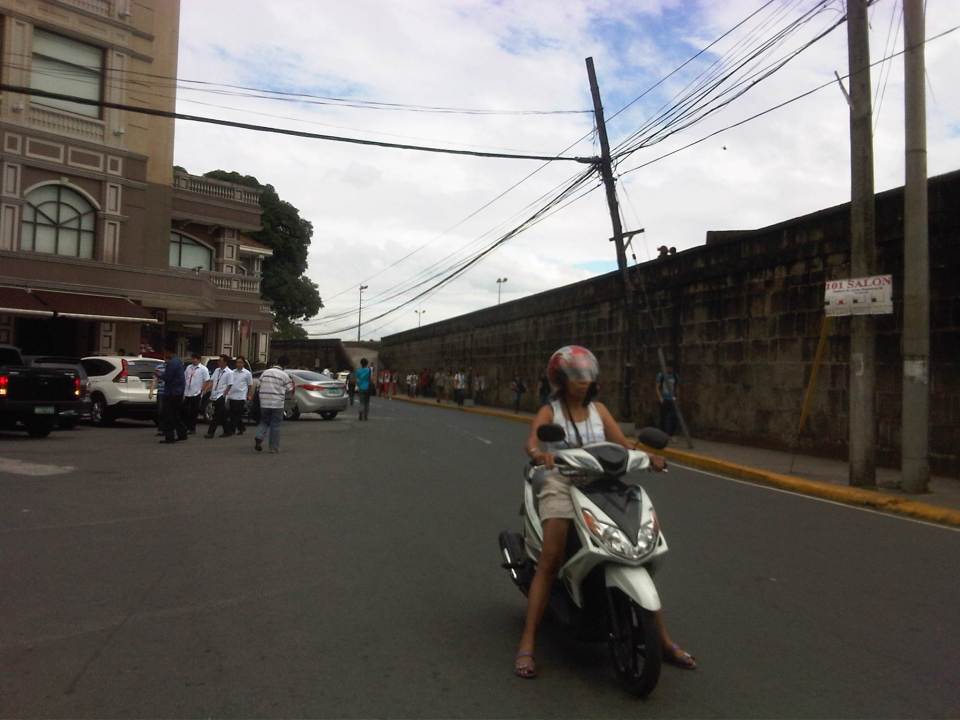 Entrance to Muralla Street with the Bayleaf Hotel at left, which is run by Lyceum University
 Muralla Street runs along the eastern wall of Intramuros. It is a one way street and so the photo shows a pedicab (also called padyak or sikad), a non-motorized tricycle, running counter to the flow of traffic.
 These streets were made for walking – Intramuros has narrow streets and can barely accommodate two way traffic so many have been designated for one-way flow.
 There are schools along the left side of the road including the Mapua Institute of Technology, Lyceum University and Colegio de San Juan de Letran. As such, there are usually many students in the area walking around, having their meals at the nearby canteens/eateries (right side) or perhaps just sitting and admiring the view from the top of the wall.
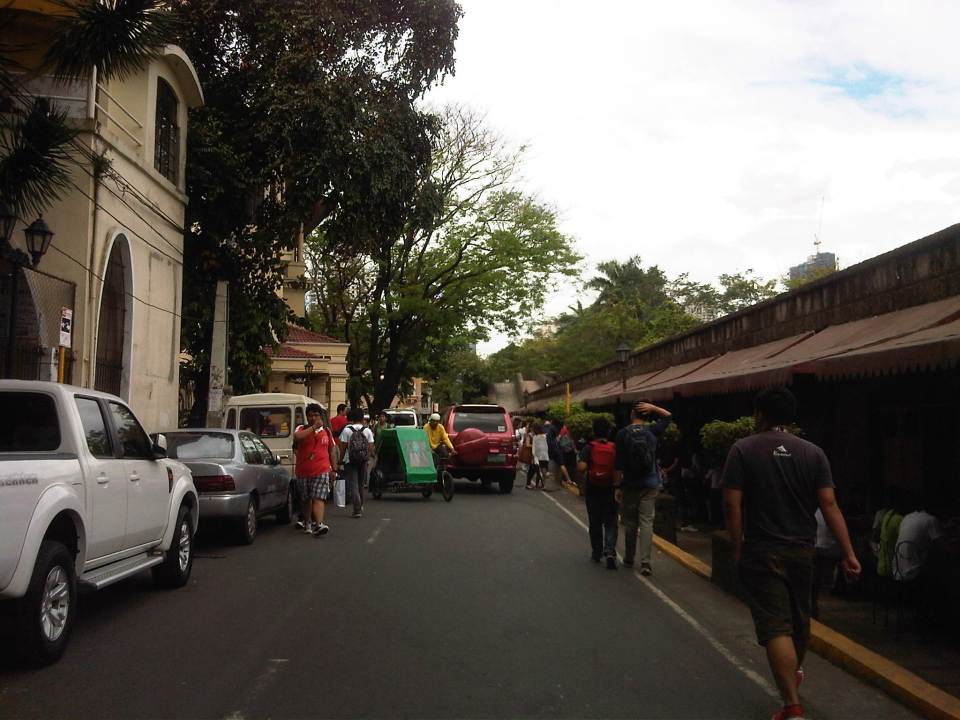 Parking is a major problem in Intramuros and one would see vehicles parked along one side of the street (evident in most of the photos in this post), obviously taking valuable space away from people and other motor vehicles (i.e., reduced road capacity).
 There are many eateries or small restaurants along Muralla St. and just under the wall. These are patronized mainly by students so meals are inexpensive.
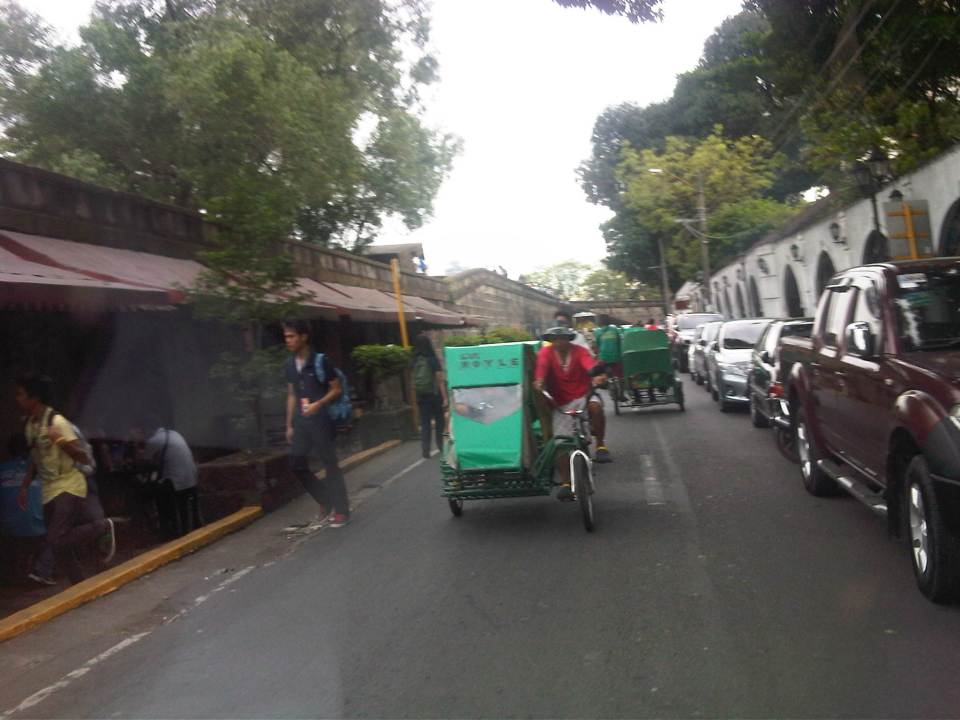 There are many pedicabs in the area with long queues at the gate waiting for passengers coming from the general direction of Padre Burgos Ave., where people can transfer to and from jeepneys serving the area. Frankly, I think there is an excessive number of pedicabs in Intramuros considering roads in the enclave can be transformed into walkable streets, just like they were during the Spanish and American periods. Notice again the on-street parking along one side of the road.
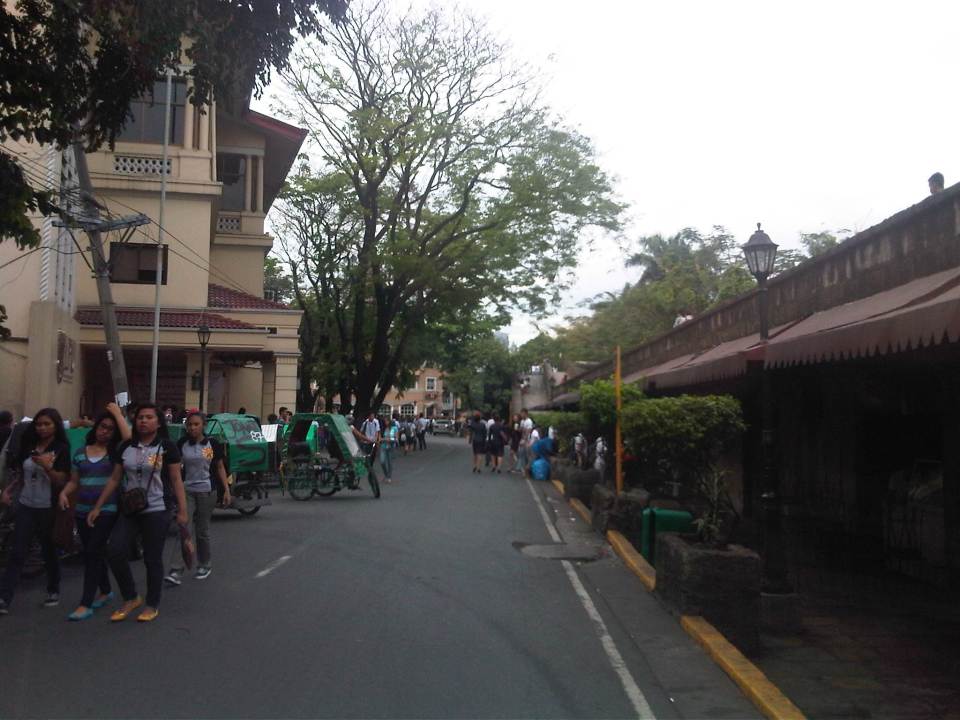 More students and more pedicabs along Muralla Street. People are used to traffic mix and generally stay clear of the space allocated for motor vehicles.
 Security personnel posted along the walls are appropriately dressed as Katipuneros or Rayadillos (honor guards). The building down the street is a dormitory just beside the buildings of Lyceum University, whose buildings are split up by public streets making it tricky to define a campus for the university.
 Junction of Muralla Street and Real Street with a private dormitory building at the center of the photo. Muralla Street continues along the side of the wall and proceeds all the way to Plaza Espana and the old Intendencia. Meanwhile, Real Street proceeds to the left of the dormitory. Also shown at the left is the entrance to one of the buildings comprising Lyceum University. Other buildings are behind the dorm.
–
Rizal Avenue – Part 2: Tayuman to Pampanga Street
In the last post on Rizal Avenue, the featured photos show conditions under the LRT Line 1, which included visual evidence of certain issues like on-street parking, poor lighting and even sanitation (i.e., garbage) along the corridor. This post features more of the same and perhaps worse in some cases that are used as proof of the blight caused in part by the LRT superstructure. I say in part because LRT Line 1 is not wholly to blame for problems under and around it. Local governments and the private sector share responsibility for the decline of the areas within the direct influence of the rail line. Napabayaan. But of course, this does not absolve proponents of the LRT Line 1 for poor station design.
 Approach to Tayuman Station along the northbound side of Rizal Avenue.
 Tayuman Station – shown in the upper part of the photo is one end of the northbound platform.
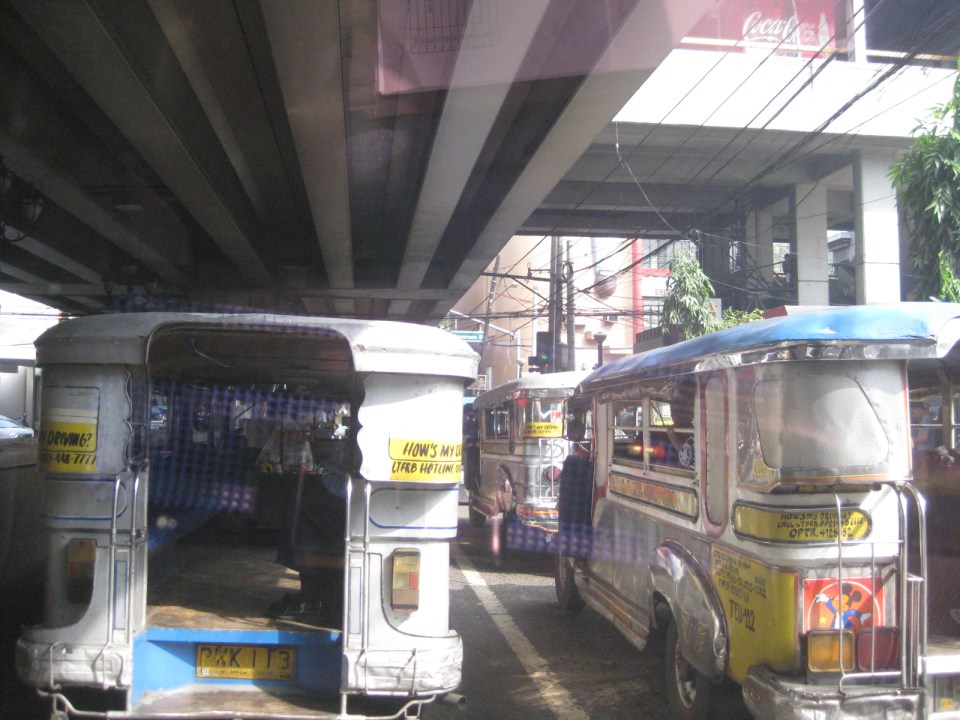 Underneath the station, jeepneys clog the lanes as they load/unload passengers. LRT Line 1 stations are poorly designed for intermodal transfers (e.g., LRT to jeepney, LRT to bus, etc.).
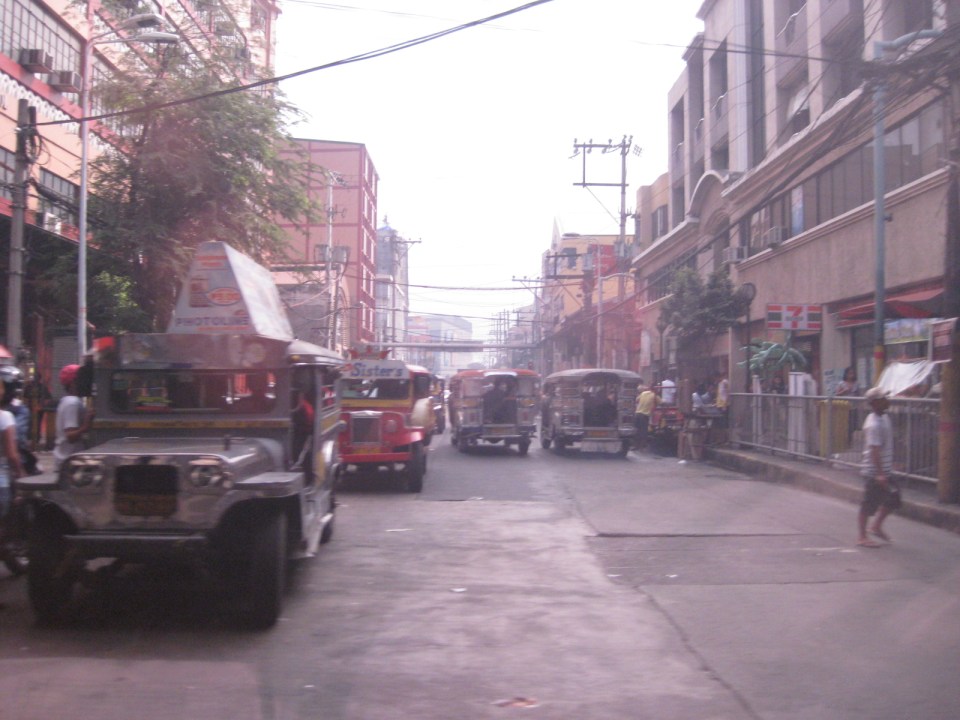 Tayuman Road is a busy street in Manila that’s served by jeepneys connecting to major streets like Lacson Avenue to the east and Abad Santos and Juan Luna to the west. The photo shows a view to the east of the LRT Tayuman Station.
 Approach to the junction with Herrera Street
 Approach to Blumentritt Station – the station is named after Ferdinand Blumentritt, an Austrian who was a close friend of the national hero Jose Rizal. The street leads to a large public market close to the station (near the intersection) that is also named after the fellow and one of the more crowded markets in the metropolis. There are many jeepney lines with Blumentritt as part of their routes.
 Birds and other creatures being sold as pets around Blumentritt – many have been painted to attract children and other buyers curious at the colored birds.
 Vendors line the Rizal Avenue, Blumentritt and the other side streets in the area, which is usually crowded no matter what day of the week it is.
 Angry birds? A closer look reveals the birds as chicken chicks colored by the vendors to attract interest. Sadly, many of these do not survive to become full grown chickens and children (and adults) will be disappointed to discover later that the color comes off pretty quick when the chicks come in contact with water.
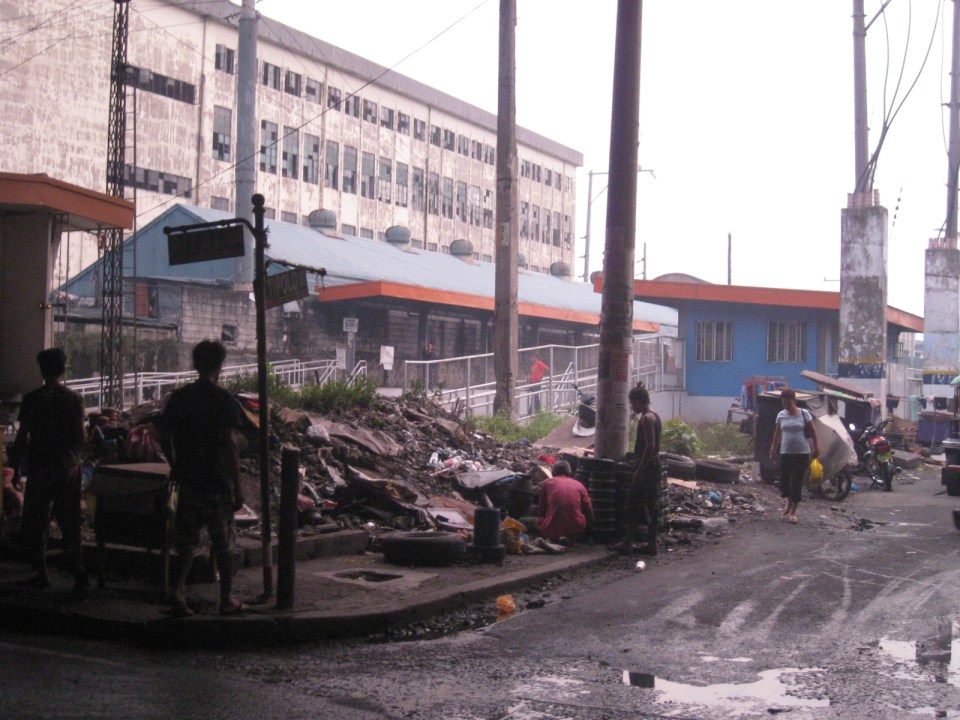 There is a PNR Blumentritt Station and unless there’s been some radical clean-up of the area, this is pretty much what you’d see around the station – garbage, dirt, informal settlers and other characters. The building behind the station is a public school.
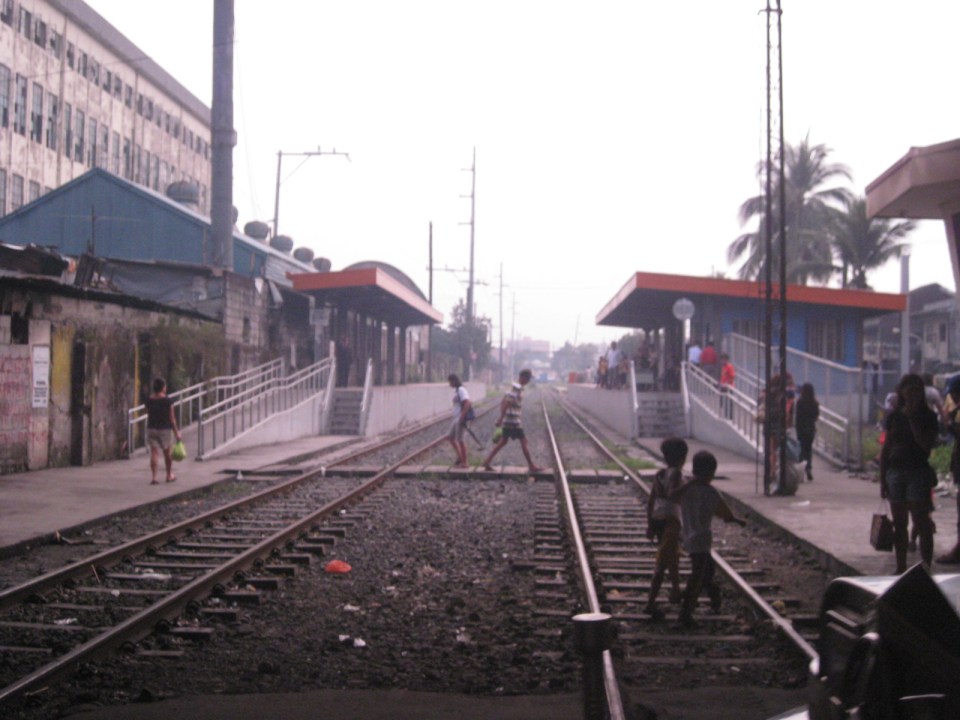 The PNR Blumentritt Station has two platforms on either side of the double track. Security is quite lax and people, including children, cross the tracks freely. Fortunately, train service frequencies are quite low (about 1 per hour) so the risk of getting hit by a train is also low. The photo shows the view to the east of Rizal Avenue.
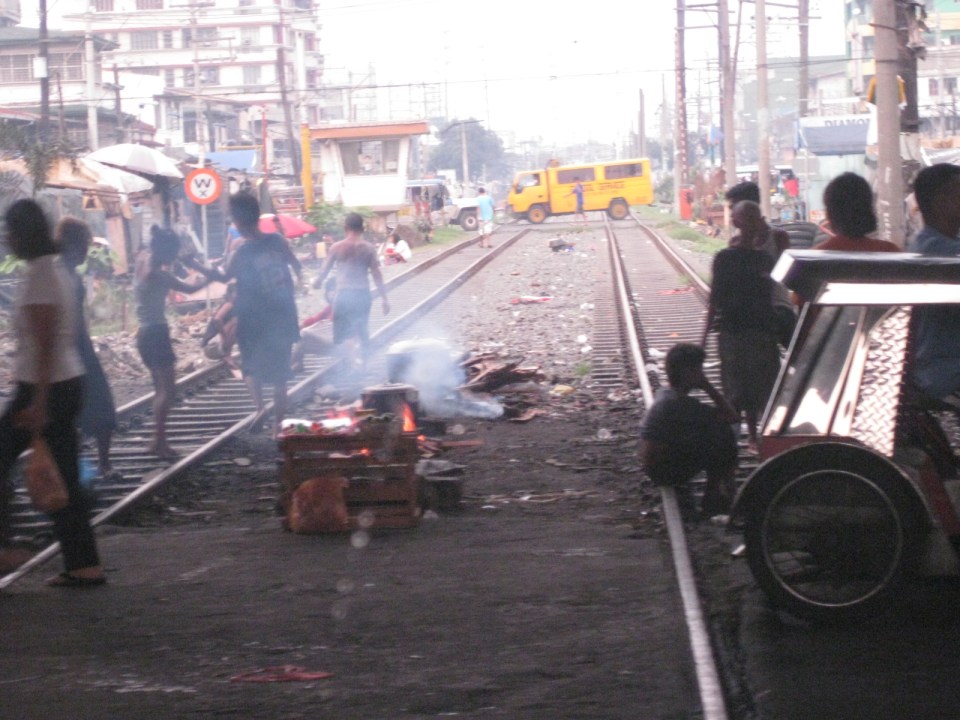 On the left side of Rizal Avenue is a scene where people are oblivious to the railways with some even doing their cooking between the tracks.
 Blumentritt Avenue is a very crowded street with a public school (building at right) just across the public market (at left). There are many vendors lined along the street and people as just about everywhere and without regard to vehicular traffic.
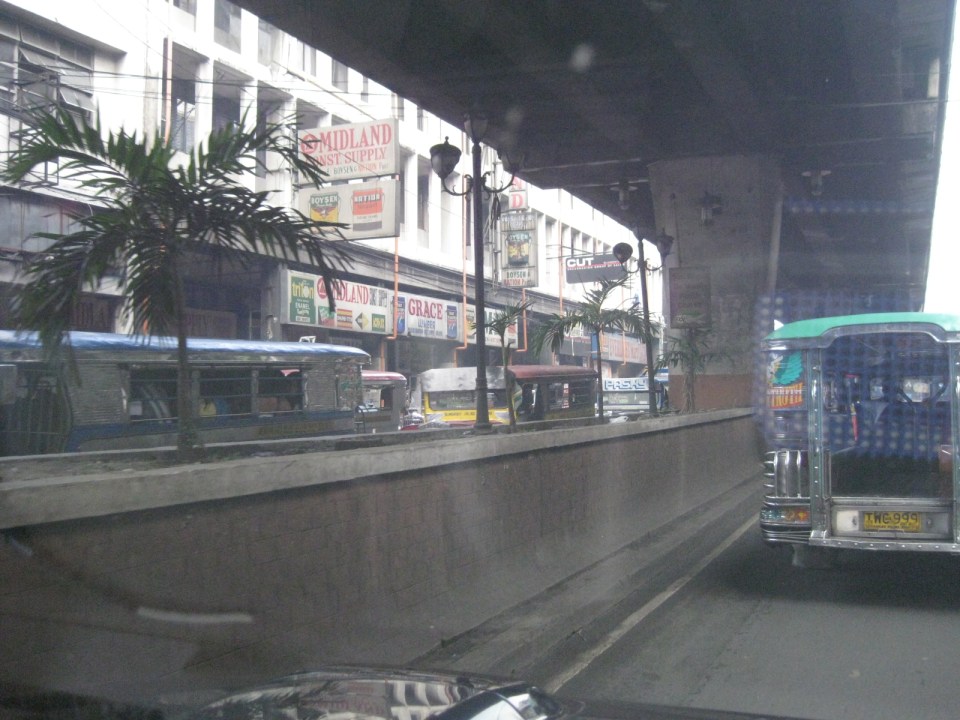 Traffic congestion along Rizal Avenue is attributed mainly to the market and median barriers were constructed to reduce pedestrian crossings anywhere along the road. Commercial establishments line either side of Rizal Avenue, basically contributing to congestion in the area.
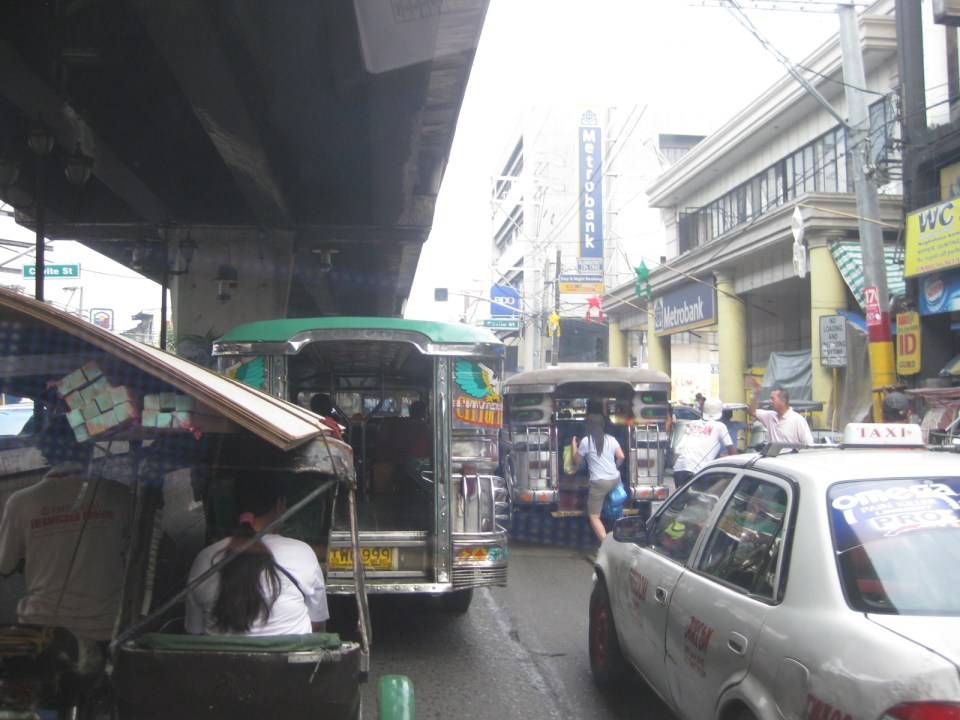 Commercial establishments plus customers plus paratransit equal to traffic congestion
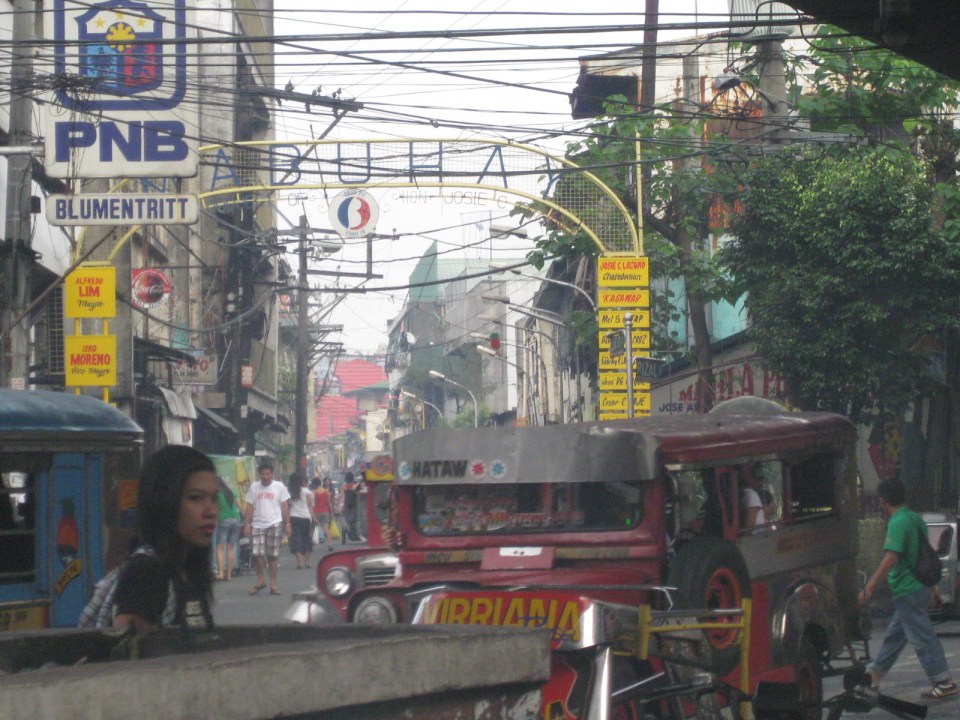 16A busy side street in the Blumentritt area – there are no sidewalks so pedestrians and motor vehicles mix it up along the road.
 Bulacan Street serves as an informal terminal for jeepneys. The road appears to be newly paved but there are no sidewalks and tents are found along the road often bearing the names of politicians sponsoring the tents for various purposes such as wakes and parties.
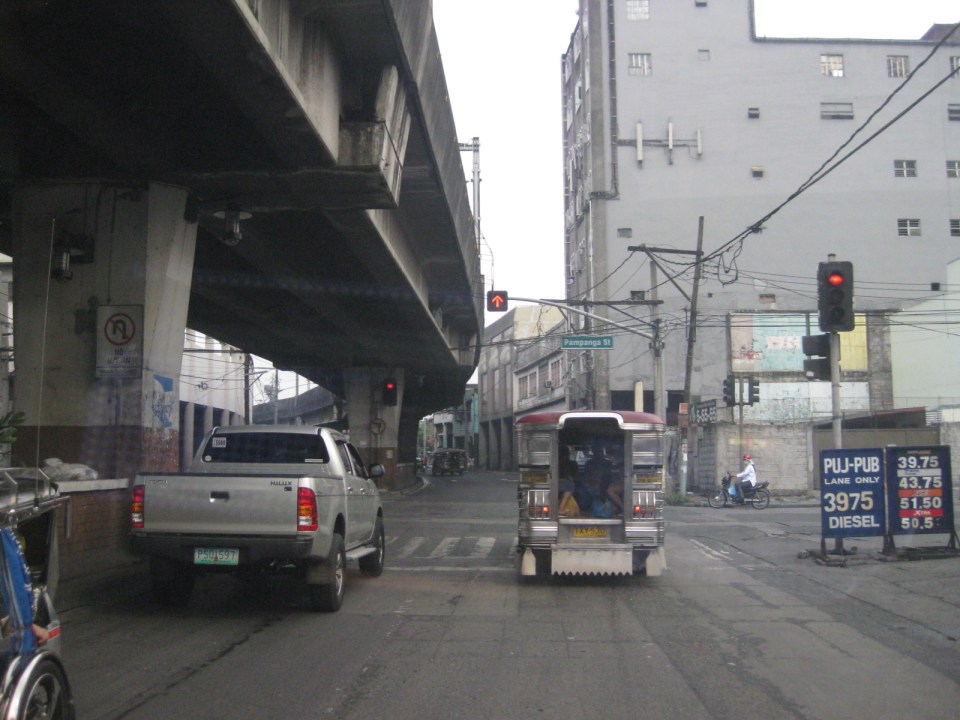 Intersection with Pampanga Street, just before Rizal Avenue and the LRT line turns towards Aurora Boulevard and proceed to Caloocan City and Monumento.
More on Rizal Avenue in future post…
–
Streets of Olongapo: Rizal Avenue
Olongapo City is located in the Province of Zambales, the only city in that province, and beside the Subic Freeport. It is a pioneer in public transport service innovations in the form of the first initiative on the color-coding of jeepneys according to their routes. Despite what seemed to be forever being linked to the Freeport in terms of economic development, the city has enjoyed continued growth and is currently experiencing more challenges attributed to this growth. Among these challenges are those pertaining to traffic congestion and public transport services for the city. A Transportation and Traffic Management Plan Study was conducted by UP Diliman through the National Center for Transportation Studies and is up for formal adoption of the city.
Following are photos taken along the city’s main street, Rizal Avenue, where many of the city’s transport and traffic problems are manifested.
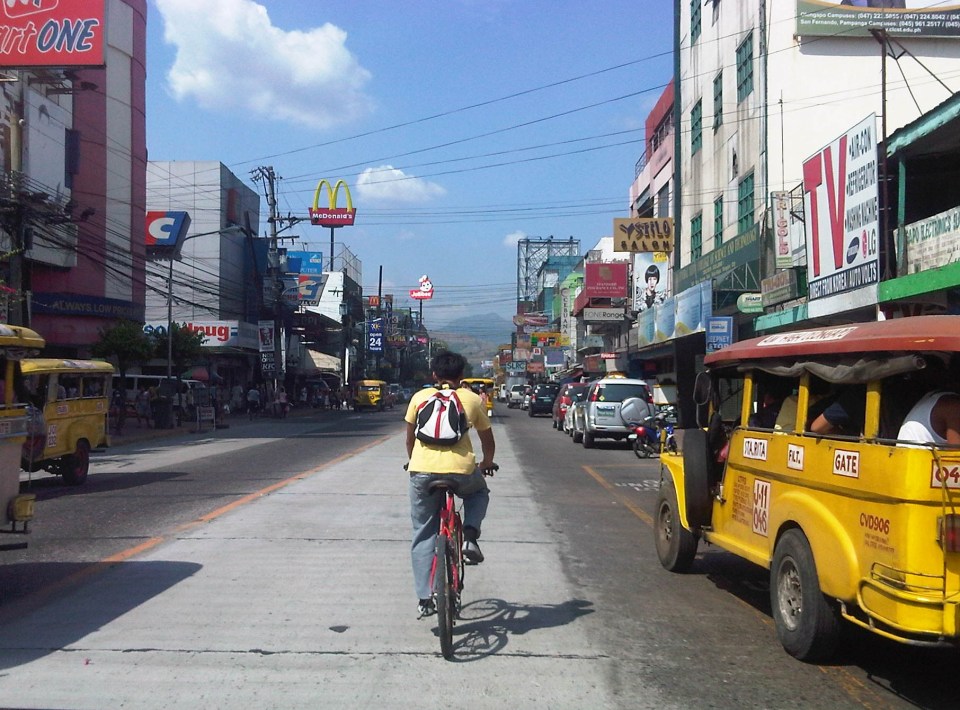 Cyclist pedaling along Rizal Avenue beside a yellow jeepney taking passengers at the designated stop at curbside. Downstream are parked vehicles along the road.
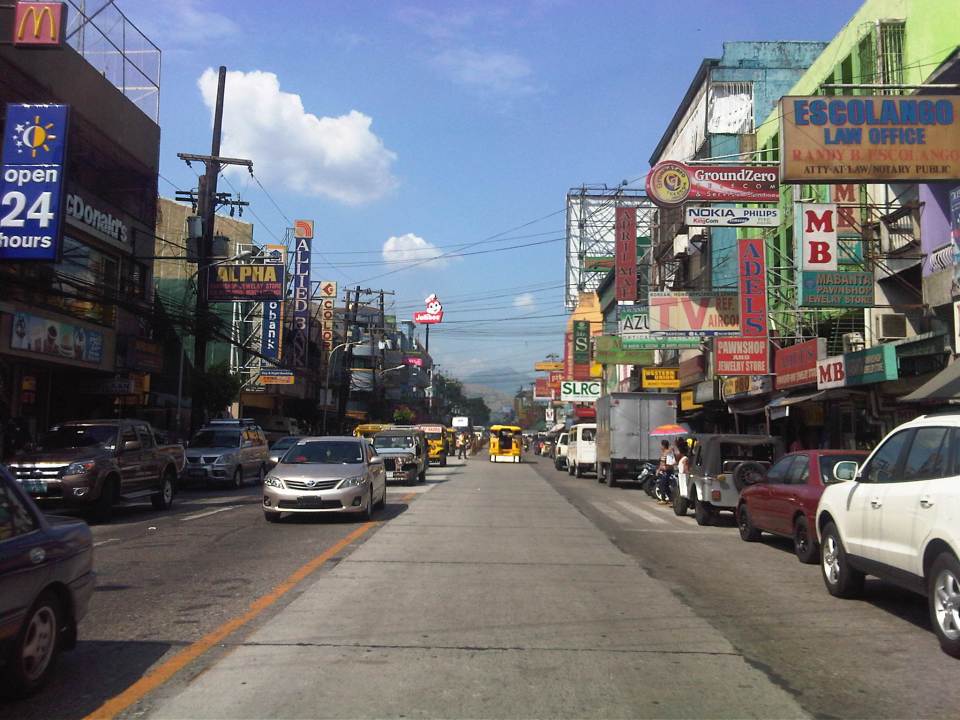 More parked vehicles at either side of Rizal Avenue effectively reducing road capacity for the 4-lane street.
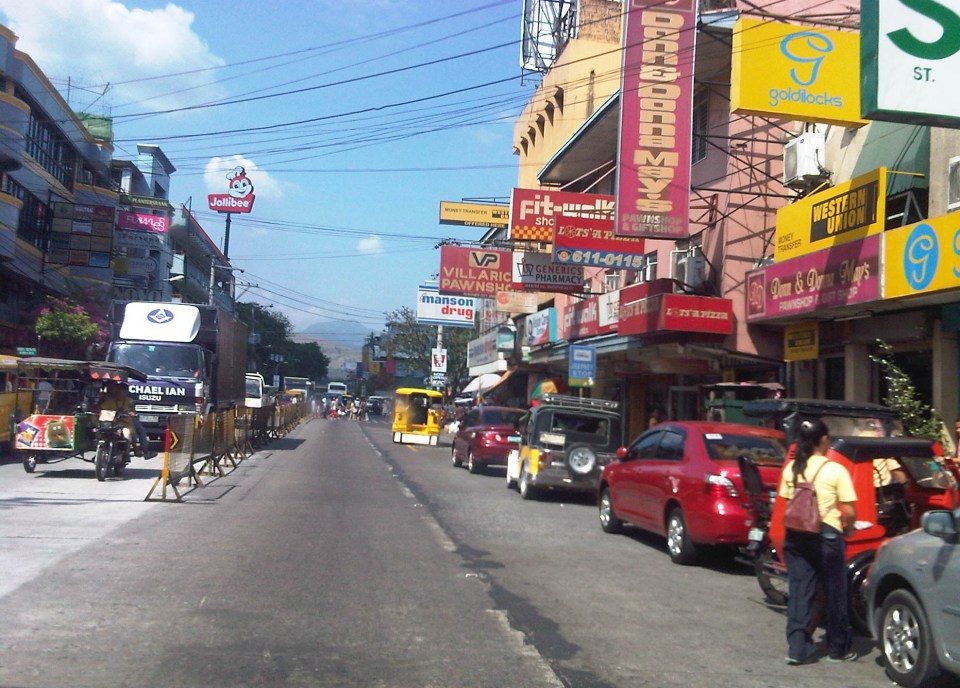 On-street parking is a problem for the city as there are few, if any, off-street parking facilities in the city. On-street parking turnover is quite low since many of the parked vehicles are not clients or customers but establishment owners or managers.
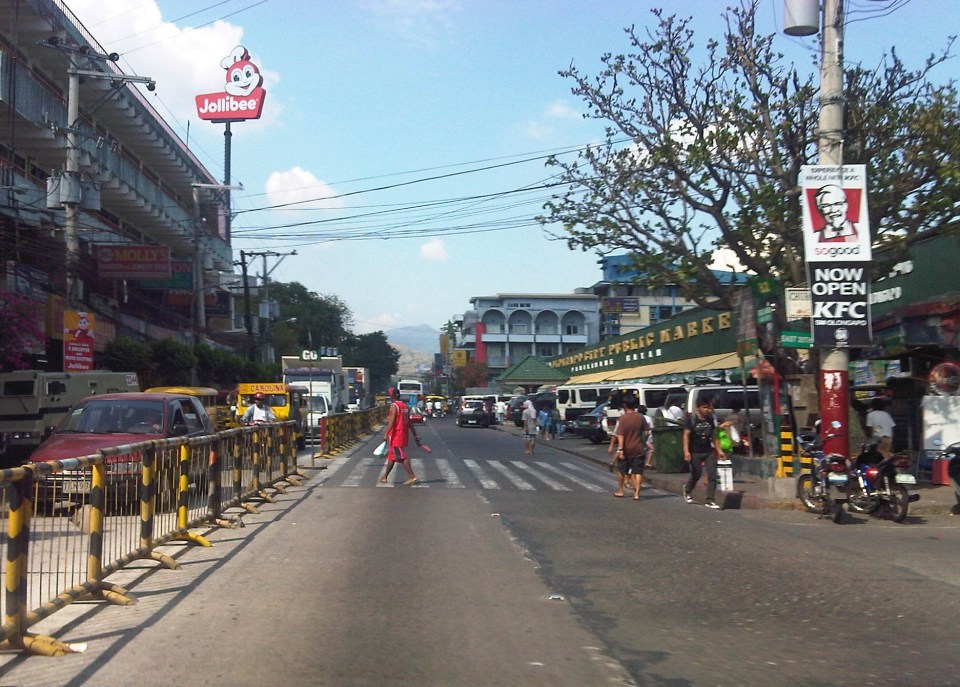 Most of Rizal Avenue is undivided but there are median barriers along the section in front of the public market to reduce jaywalking among pedestrians.
 The section in front of city hall – just across are many commercial establishments and on-street parking.
 Another view of the Rizal Avenue, this time along the westbound side, with the the market on the left side. The yellow jeepneys are quite conspicuous and remind me of the UP Ikot jeepneys.
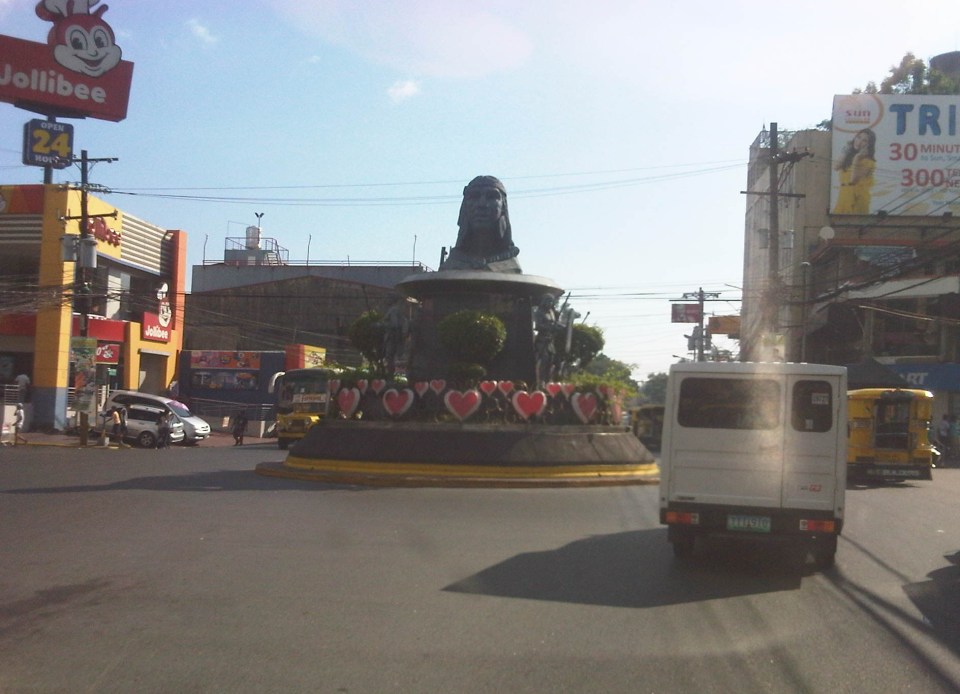 A monument to the Ulo ng Apo, from which the name of the city is said to be derived from, is right in the middle of a rotunda at a major intersection along Rizal Avenue. Around the rotunda are commercial establishments and a major provincial bus terminal.
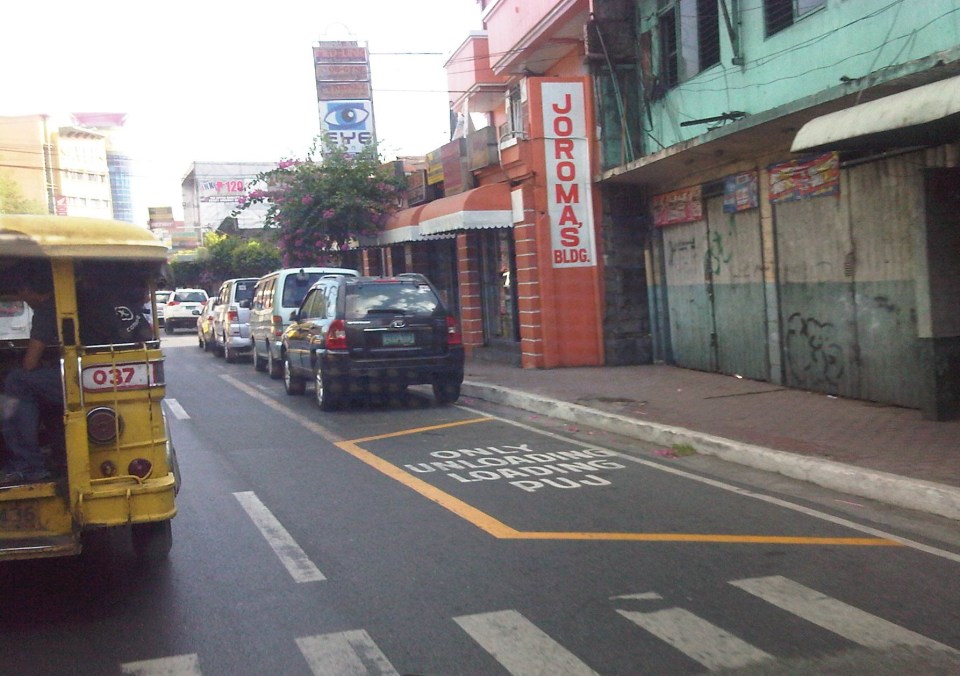 There are designated stops for jeepneys along the avenue but these are often crowded out by parked vehicles. As a result, jeepneys could not maneuver properly and end up unloading/loading passengers in the middle of the road.
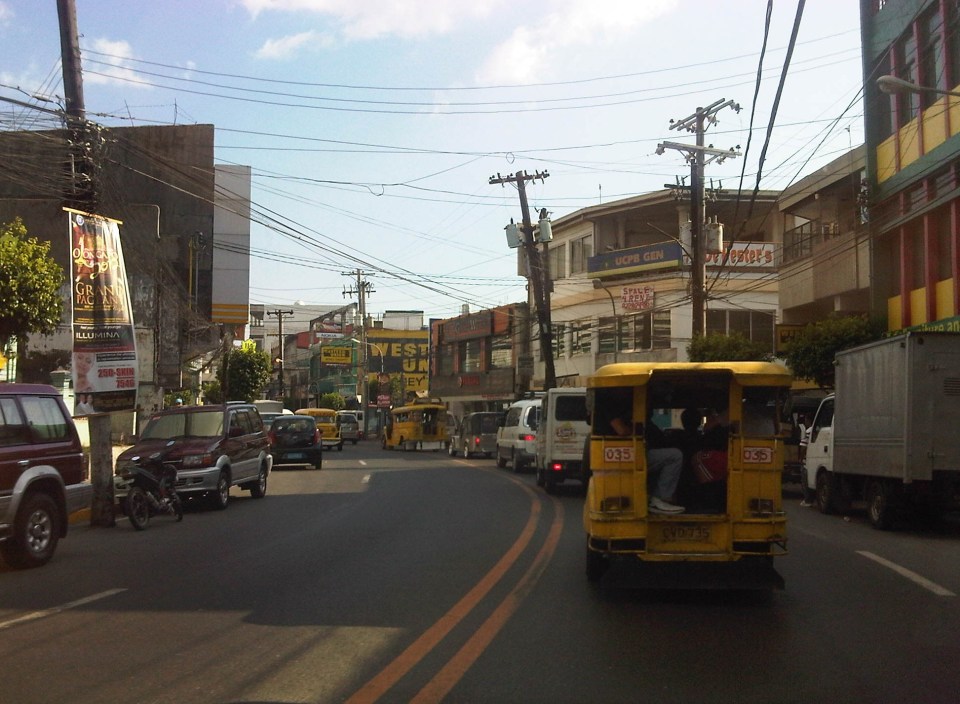 On-street parking along curves tend to impede the flow of traffic. There are also issues where electric posts like the one shown in the photo have not been transferred, posing risks to vehicular traffic.
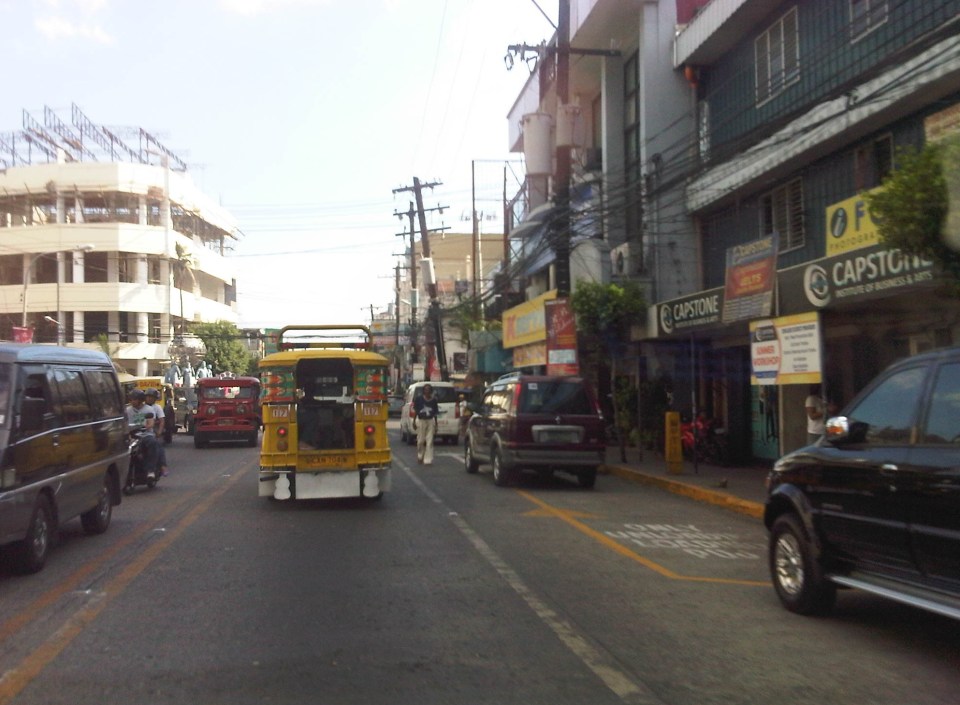 Another example of a designated jeepney stop along the avenue where parked vehicles constrict maneuvering space for jeepneys.
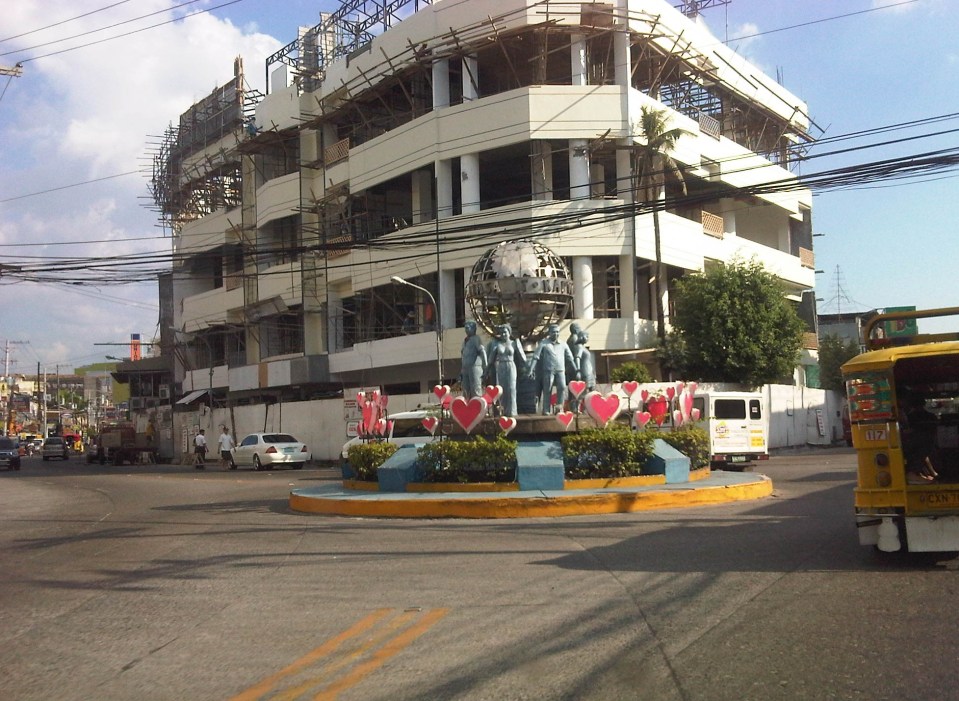 A monument to the volunteers of Olongapo during the Mt. Pinatubo episode after the closure of the U.S. Naval Base in what is now a Freeport. I wonder if the building under construction in the photo has enough parking spaces for the traffic it generates.
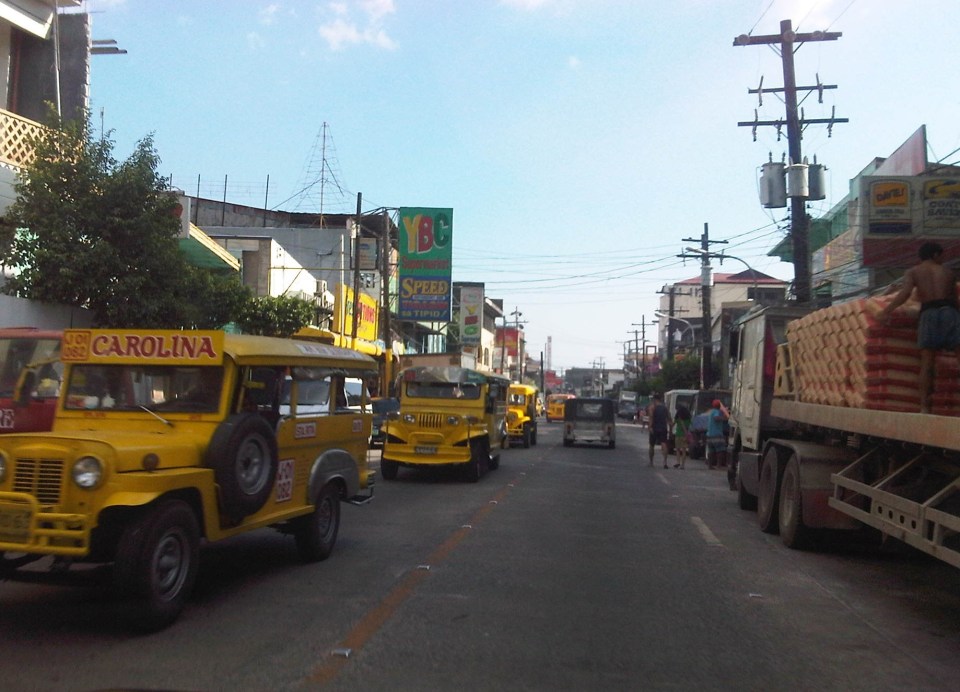 More jeepneys and more on-street parking – there is a perception that there are too many (oversupply) of jeepneys. Note though that most PUJs in Olongapo are not the bigger 20 to 24 seater jeepneys we see in Metro Manila but the older, 16 to 18 seaters like the ones shown in the photo.
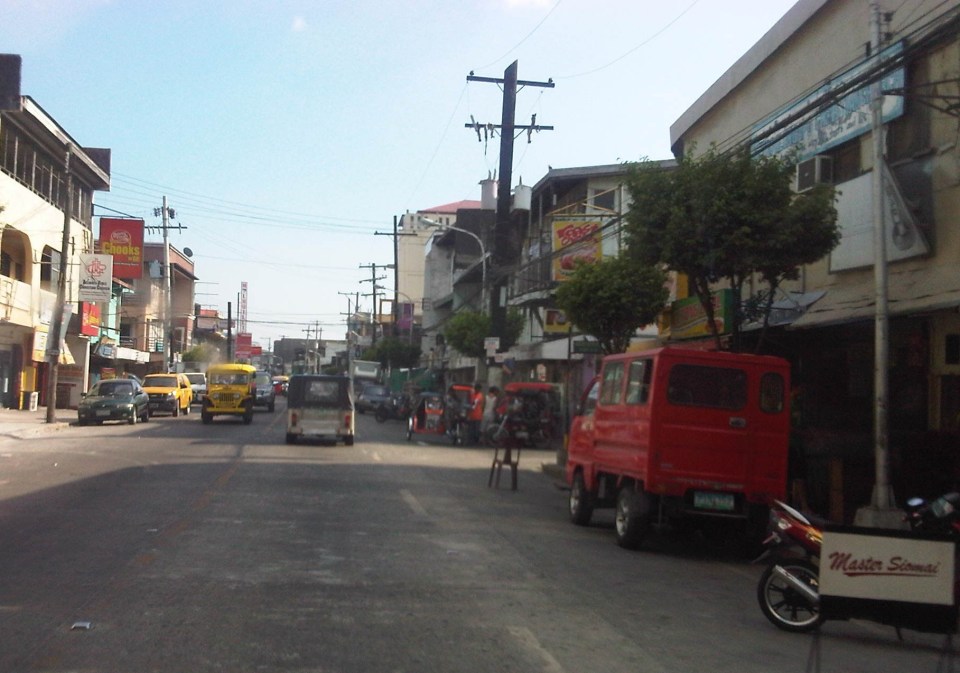 Some on-street parking spaces are “reserved” by establishments. I didn’t mention that on-street parking is free of charge and such situation probably encourages longer parking durations. Perhaps the city should seriously consider parking fees to reduce long-term parking and ensure smoother flow of traffic along its streets. There are examples of these parking schemes in other cities including Makati City that Olongapo can adopt and adjust.
–
Rizal Avenue – Part 1: Carriedo – Bambang
Rizal Avenue stretches from Manila northward to Caloocan city from Carriedo to Monumento. What used to be one of the more cosmopolitan streets in Manila was transformed (some say blighted) by the construction of the elevated LRT Line in the early 1980’s. Carriedo, for example, used to be a popular shopping street along with Escolta. Those were times when there were none of the huge shopping malls now scattered in Metro Manila and people came to Manila to shop.
The following photos were taken while we traversed Rizal Avenue as part of a recon we were conducting for a project with the Department of Transportation and Communications (DOTC) back in 2011. I’m not sure if there have been any significant changes along Rizal Avenue and I am not aware of any recent programs to improve conditions under the LRT Line 1.
 Approaching the LRT Line 1 Carriedo Station from the McArthur Bridge
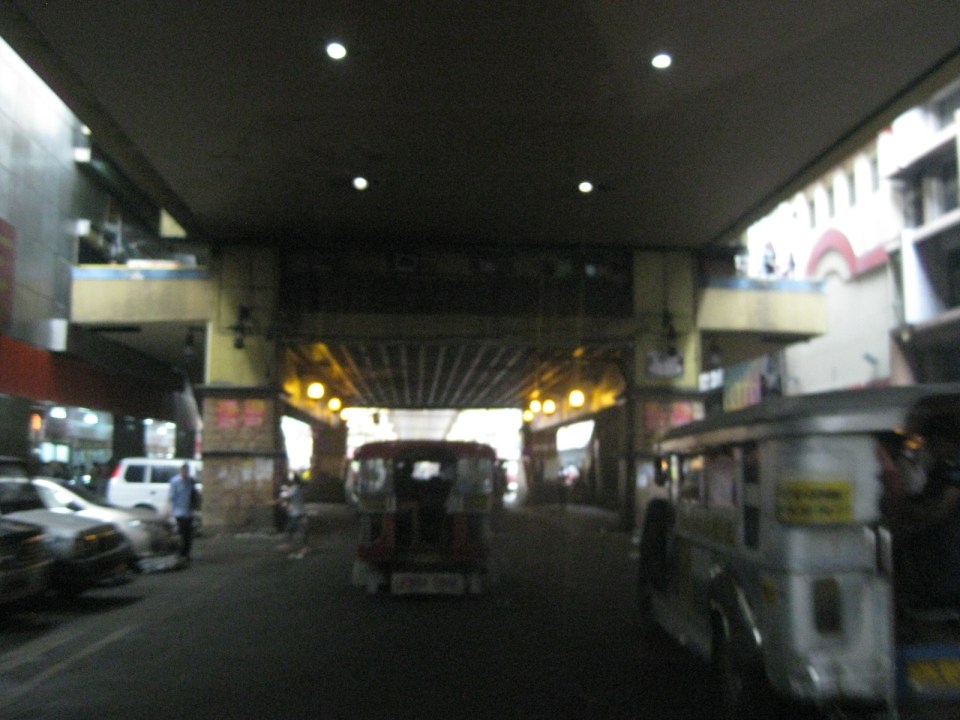 Under Carriedo Station, one experiences first-hand what people have been saying about the area being blighted by the LRT 1 structure
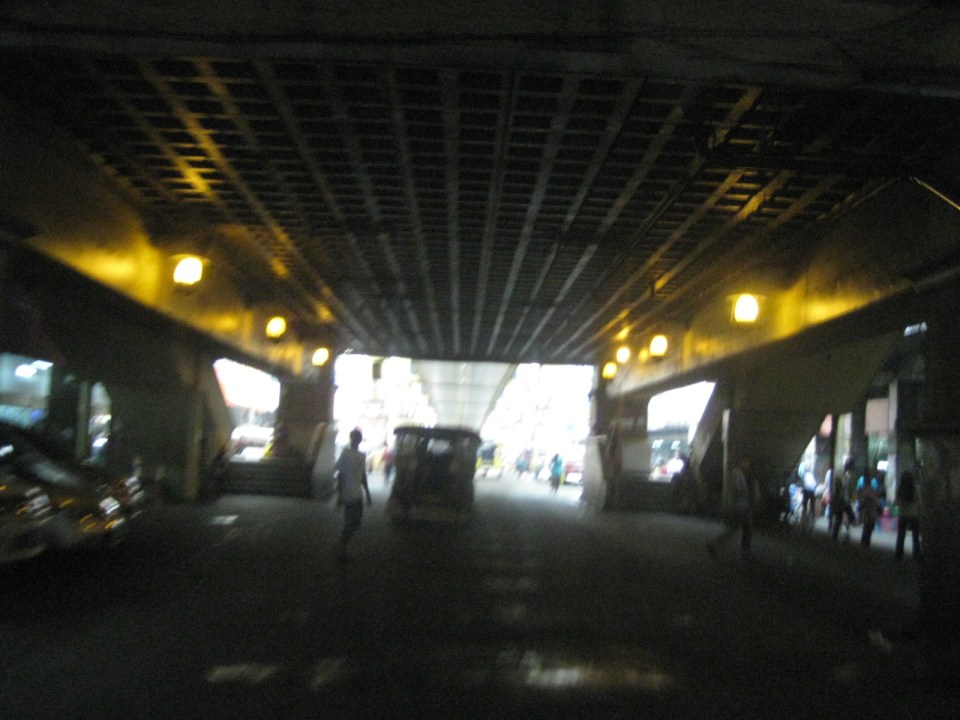 Poorly lighted? It was broad daylight outdoors when we conducted the recon but underneath an LRT 1 Station it can get quite dark. Of course, aside from the need to improve illumination, perhaps authorities can also improve the environment including the cleanliness of the area under the station. A common complaint is garbage and there are those saying the area smells of piss (i.e., mapanghi).
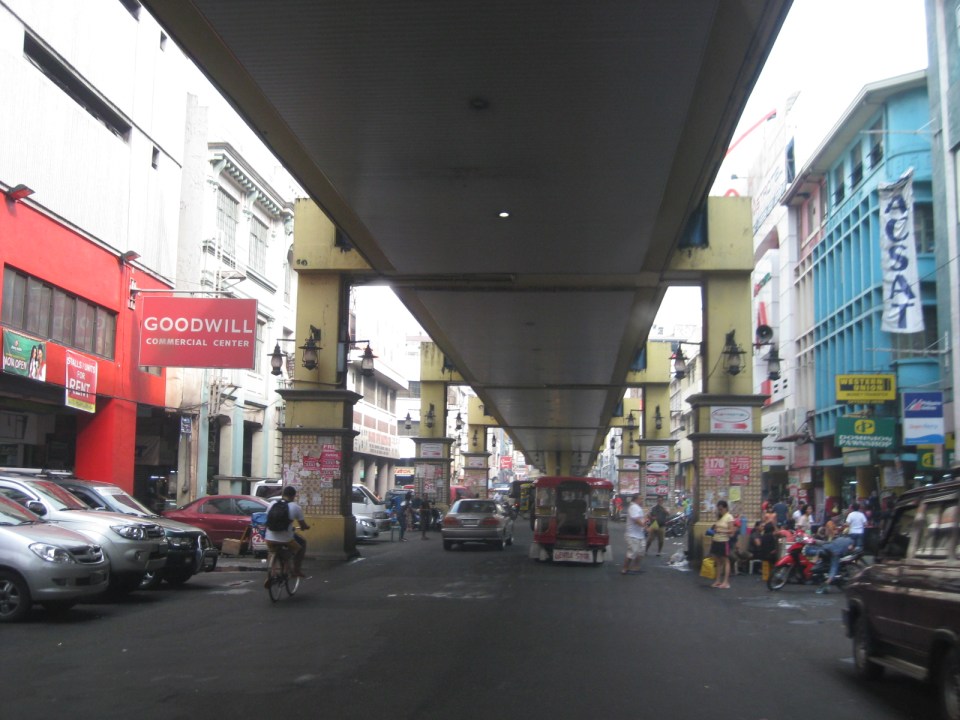 Past Carriedo Station, it was brighter and perhaps the area can be developed so that stretches can be pedestrian friendly. Maybe there should also be restrictions on vehicle parking, which tends to make the area look congested. It would be good to have a strategically located multilevel facility in the area where most vehicles can park instead of along the streets as shown in the photo.
 5More roadside parking plus the presence of tricycles contribute to traffic congestion in the area. People are everywhere walking and crossing anywhere. The arcades where they are supposed to walk along are mainly occupied by vendors or merchandise of stores/shops occupying the ground floors of the buildings along the street.
 Each side of Rizal Avenue is surprisingly wide with 3 lanes per direction. One lane is effectively used for on-street parking while the other two are for general traffic. There are no lane markings at the time we passed by the area so there can be confusion as to lane assignments.
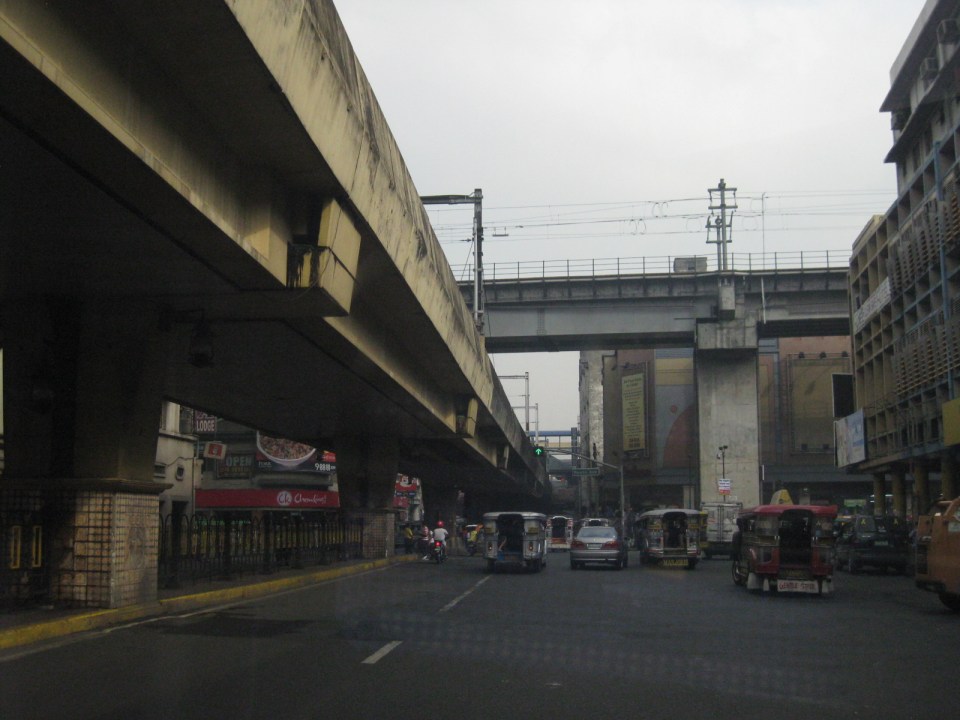 Approach to the junction with Recto Ave. and the LRT Line 2, which is also elevated and at the 3rd level as shown in the photo.
 Rizal Ave.-Recto Ave. intersection – visible downstream in the photo is Doroteo Jose Station
 Provincial bus terminal between Doroteo Jose and Bambang Stations
 The Sta. Cruz district and particularly the Bambang area is well-known for shops selling medical equipment and supplies. Medical, nursing and other students of allied medical professions as well as professionals come to Bambang to purchase equipment and supplies from these shops, which offer items at lower prices.
 LRT 1 Bambang Station
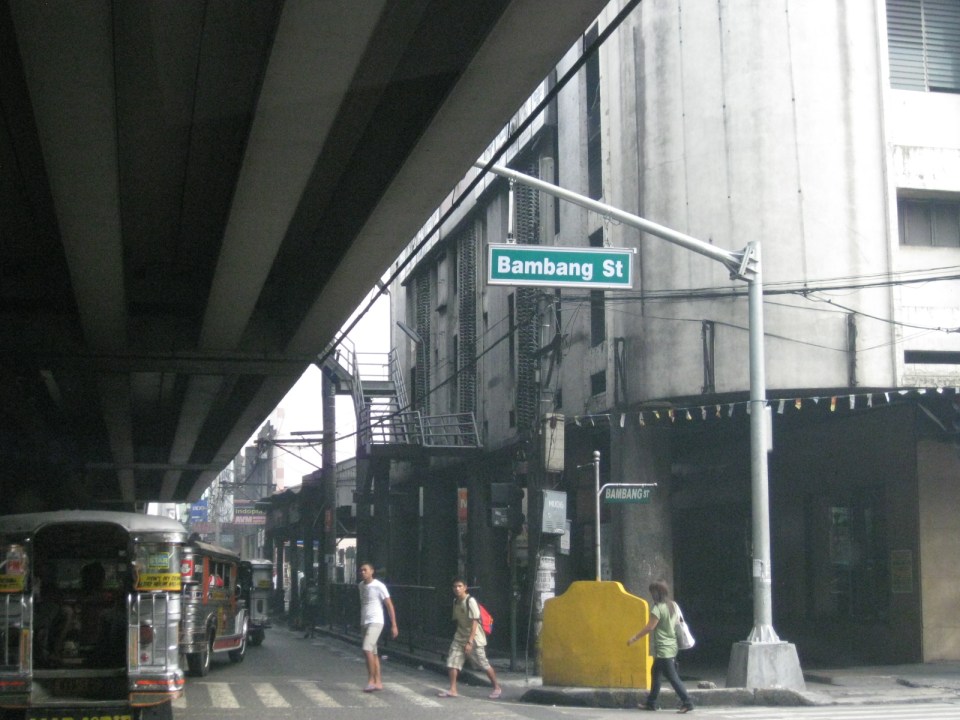 Rizal Ave.-Bambang St. intersection beneath the station
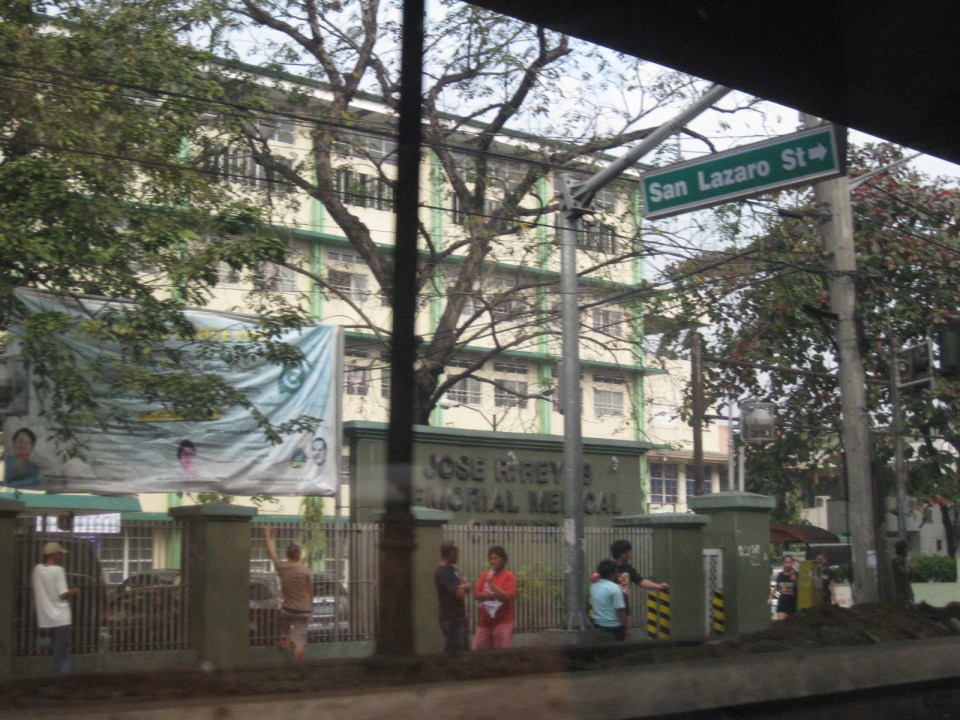 Two large government hospitals are located in the area between Bambang Station and Tayuman Station – San Lazaro Hospital and Jose Reyes Memorial Medical Center. Both are run by the Department of Health (DOH), which is located beside Jose Reyes.
–
Informal transport at PNR Bicutan Station
On our way to a meeting at the Department of Science and Technology (DOST) in Bicutan, Taguig City, we crossed the PNR line running parallel to the SLEX. I quickly took a photo of the scene to the right of our vehicle that showed an informal market and terminal. The informal market or talipapa is one you would usually finally elsewhere in many other places in the city and likely caters to mostly informal settlers residing along the PNR ROW. On our return trip from the DOST, we took the same route and again I quickly took a photo of what was on the other side of the road along the same PNR line. On the other side was the PNR Bicutan Station and what appears to be a clear ROW northbound towards Manila. Much has been accomplished in the clearing of the PNR’s ROW over the past years and the efforts included the relocation of many informal settlers in coordination with the local governments along the PNR line.
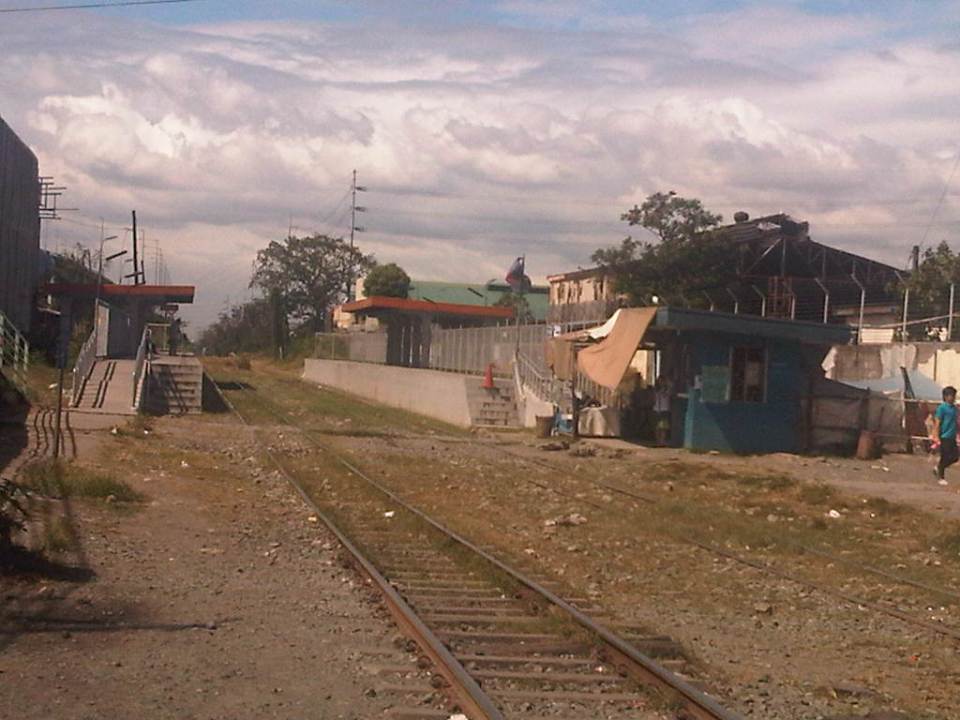 The PNR Bicutan Station on the north side of Gen. Santos Ave. near the SLEX Bicutan interchange
 Non-motorized trolleys on the south side of Gen. Santos Ave. near the SLEX Bicutan Exit
The trolleys are informal transport vehicles serve people living along the PNR ROW including many informal settlements within and without the PNR property. Some of the buildings or structures of these informal settlers are visible in the photo downstream of the railroad crossing. There are similar cases in Manila and elsewhere along the PNR ROW including motorized trolley services in the provinces of Quezon and Camarines Sur, where trolleys are also utilized for public transport and are the means for livelihood by some of the same informal settlers.
There are increasing safety concerns for these vehicles, their operators and their passengers. The trolleys are lifted from the tracks an people clear the way once a train approaches. They return after the train has passed. With the PNR currently experiencing a revival of sorts, and if resources continue along with an increase in ridership, train frequencies should also be expected to increase. As such, there should come a time when trolleys would have to be banned along the entire line in order to minimize the chances for crashes involving trains and trolleys that will surely lead to fatal consequences. Perhaps the local governments along the PNR line should already look into this eventuality and initiate programs to address this issue, which can be associated with livelihood and residential concerns.
–

