
Home » Policy (Page 31)
Category Archives: Policy
On the Grab – Uber merger
A couple of weeks ago, I received a message from Uber confirming what was in the news for some time then, and what was rumoured a longer while back. Uber Philippines was closing shop after merging with main competitor Grab, while the mother company also acquiring a stake in Grab. Later, I also received a message from Grab (I use either depending on availability and cost.) welcoming Uber users to Grab.

The result so far has been frustrating if not disappointing to many who have relied on Uber for commuting and the typical trips that you usually associate with taking a taxi.
Recent news revealed that Grab is using an even more punitive pricing scheme compared to Uber’s surge pricing. While the LTFRB moved to scrap this, Grab has been apprehensive, stating that this was an incentive for their drivers. There is actually another side to the concept of surge pricing that LTFRB does not or seems to refuse to understand. That is, that dynamic and more expensive fares related to congestion (or road conditions) is something that’s actually related to the concept of congestion pricing. This actually penalises the use of vehicles like private cars or taxis in favour of higher capacity transport like buses or, if available, trains.
Even more recent is the news that Grab is suspending about 500 of its drivers for excessive cancellation and/or rejection of trips. Unlike Uber before, Grab drivers have the “luxury” of knowing where a potential passenger is heading. That gives the driver the option to accept or reject a proposed fare. Uber drivers didn’t know where the potential passenger was heading and to my knowledge, was stricter with penalising their drivers. The only caveat I know is that passengers can also be penalised if the driver requests for a cancellation and the passenger obliges out of good faith (e.g., An Uber driver in Cebu requested me to cancel the request as he claimed he was caught in traffic and would be penalised if he canceled. I ended up protesting Uber penalising me 100 pesos for my cancellation. Uber did not act on it in my favour.).
The issues surrounding the Grab/Uber merger though should not be there in the first place if we had good taxi services. When I say good I am referring to the quality of service provided by taxis in Singapore and Japan. Of course, they also have good public transportation there so there’s also a case for what most people will likely be taking instead of cars and taxis (which operate similarly as cars). One wonders how and why LTFRB seems to be so strict vs TNCs while being lax with taxis. Meanwhile, DOTr is scrambling on the desperate catch-up work it has to do about mass transit lines and public transport rationalisation. Good luck to us commuters!
–
Incomplete rationalisation of public transport?
The current initiative to rationalise road public transport services is not as comprehensive as necessary or as some people want us to believe. The drive appears to be mainly on (some say against) jeepneys while little has been done on buses and UV Express vehicles. Most notable among the modes not covered by rationalisation are the tricycles.
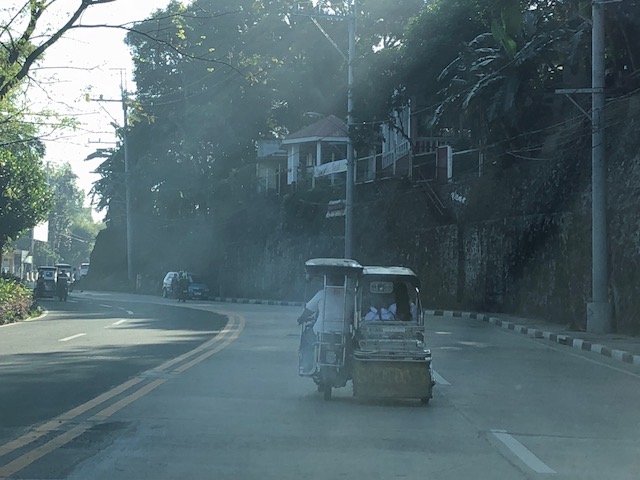 A smoke-belching tricycle along Daang Bakal in Antipolo City
What really should be the role and place of tricycles in the scheme of themes in public transportation? Are they supposed to provide “last mile” services along with walking and pedicabs (non-motorised 3-wheelers)? Or are they supposed to be another mode competing with jeepneys, buses and vans over distances longer than what they are supposed to be covering? It seems that the convenient excuse for not dealing with them is that tricycles are supposed to be under local governments. That should not be the case and I believe national agencies such as the DOTr and LTFRB should assert their authority but (of course) in close cooperation with LGUs to include tricycles in the rationalisation activities. Only then can we have a more complete rationalisation of transport services for the benefit of everyone.
–
On the negative social impacts of ridesharing/ridesourcing
I have shared a few articles before about the impacts of ridesharing/ridesourcing to taxi drivers. In the Philippines, taxis where ridesharing/ridesourcing services are available are plenty are supposed to have experienced a significant drop in their business. Yet, there has been little improvement in taxi services in Metro Manila. The Department of Transportation (DOTr) and the Land Transportation Franchising and Regulatory Board (LTFRB) have not put pressure on taxis to improve so operators and drivers are pretty much the same in terms of practices and service quality. Here is a recent article that appeared on Wired about New York taxi drivers:
Katz, M. (2018) “Why are New York taxi drivers killing themselves?”, wired.com, https://www.wired.com/story/why-are-new-york-taxi-drivers-committing-suicide/?CNDID=37243643&mbid=nl_032918_daily_list1_p4 (Last accessed 3/30/2018).
Admittedly, the set-up for New York taxis is quite different from those in the Philippines. The medallions referred to in the article are limited and carries with it prestige and perhaps honour, considering the commitment and pride attached to them. Franchises in the Philippines are quite different and drivers will usually work for multiple operators/employers. Those who own their taxis are not so many and can be flexible in the way they conduct their business. Perhaps a significant number of drivers have even left the taxi business and now drive for TNCs like Grab and Uber.
With Uber’s sale of their business in Southeast Asia to main rival Grab, it seems now that there is suddenly and practically a monopoly of the ridesharing/ridesourcing business. Upstarts have not had a significant share of the market and by all indications will not get a bigger share in the near future. I still think that there should be pressure for taxi services to be improved and a good chance for people to shift back to taxis. But this requires effort on both sides (regulator and operator). I still mention examples of taxi operators in Cebu and Iloilo who appear to be unscathed by the entry of ridesharing/ridesourcing in those cities. Good quality taxi services will promote itself and will be patronised by commuters.
–
On child-friendly cities
Here’s another article that I want to share. This time it is about child-friendly cities. Here is an article that present many good practice examples in other cities. Many are easily replicable in our towns and cities, and should be considered by local governments in order to enhance safety and health aspects in their jurisdictions.
Laker, L. (2018) “What would the ultimate child-friendly city look like?”, theguardian.com, https://www.theguardian.com/cities/2018/feb/28/child-friendly-city-indoors-playing-healthy-sociable-outdoors [Last accessed 3/9/2018]
–
On prioritising pedestrians and promoting walking
We begin March with an excellent article that came out from curbed.com:
Walker, A. (2018) The case against sidewalks and how cities can create new avenues for pedestrians, curbed.com, https://www.curbed.com/2018/2/7/16980682/city-sidewalk-repair-future-walking-neighborhood [Last accessed 2/23/2018].
How do we improve the environment (i.e., facilities) to encourage people to walk? Do we simply clear up sidewalks? Widen them? Build overpasses and underpasses? What should be the context for improving pedestrian facilities for our cities and municipalities? What are the implications to planning and design?
–
Another walkability tool: Pedestrians First
The ITDP recently came out with a new walkability tool called Pedestrians First. Here’s the link to their site where you can download the tool. The tool was released in the recently concluded World Urban Forum held in Malaysia.
https://www.itdp.org/publication/walkability-tool/
Of course, there are other tools out there including one developed by Clean Air Asia, material on which may be found through the following links:
http://cleanairasia.org/walkability-study-in-asian-cities-4/
Our technical staff and my students are currently using the methodology developed by Clean Air Asia and have covered several major thoroughfares in Metro Manila and a highly urbanized city in studies that have been undertaken in the last 6 years. I already asked them to take a look at the new tool and see how this compares with the ones we are using.
–
On learning from the experiences of others about transit ridership
I again share an article; this time on transit ridership (or on the passengers using public transportation).
Buchanan, M. (2018) Lessons on Ridership, from the National Literature, transitcenter.org, http://transitcenter.org/2018/01/29/lessons-on-ridership-from-the-national-literature/ [Last accessed 2/21/2018]
Perhaps we can learn from the experiences of other cities in as far as public transport use is concerned? For example, what impacts emerging technologies and the sharing economy (e.g., ridesharing) have on public transport ridership and how to meet these challenges to retain a majority of public transport users over low capacity modes.
–
On the PUV modernisation program – Part 1
Much has been written about the government’s PUV (or jeepney?) modernization program so I wouldn’t really be reposting about these. Instead, I will be featuring some opinions, insights and observations about its implementation.
Following are photos of one e-jeepney model that the government appears to be promoting. This is the e-jeepney produced by Star8 that they claim to be have solar panels for charging while they are on the road. Of course, we know they are not wholly dependent on solar power and have to be charged the conventional way through an adaptor that’s plugged into a regular outlet. These e-jeepneys were supposed to supplement the reduced supply of public transport to mainly UP students, staff and faculty members when the i-ACT (Inter-Agency Committee on Traffic) conducted their “Tanggal Bulok, Tanggal Usok” campaign in the UP Diliman area. First-hand reports revealed otherwise as the e-jeepneys spent more time on stand-by and just charging at one of the buildings on campus.

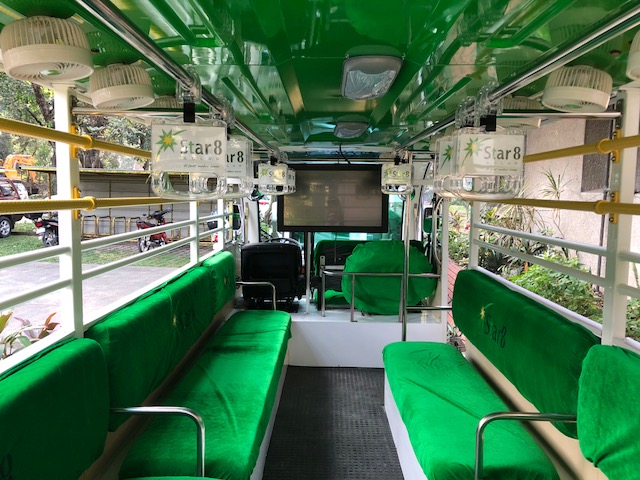


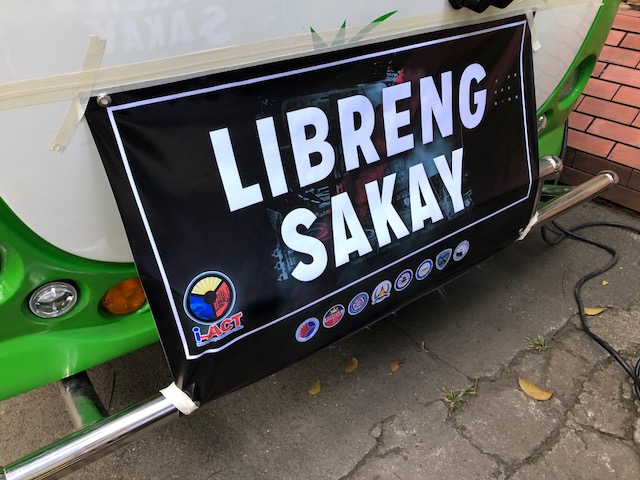
These are the same e-jeepneys that have been deployed and currently roaming around Tacloban City (promoting themselves?). The intent was for these to be the vehicles plying the new routes approved by the LTFRB/DOTr, which they claim was in response to the request made by Tacloban. The new routes though overlapped with many existing jeepney routes, clearly in violation of the general rule regarding overlapping routes, but allowed nonetheless by the regulating authority.
There are many allegations going around about e-jeepneys being forced upon operators and drivers given what has been regarded by progressive groups as unrealistic (read: unaffordable) financing schemes for the new vehicles. These are certainly not cheap, and double to triple the price of a ‘newer’ conventional jeepney. There are also suspicions about the strong motivation for the phaseout in favour of what are peddled as the successor (or replacement) to the jeepney. That includes a possible collusion among officials and the companies behind these vehicles and allegations (again) of some people likely gaining financially from the set-up. The DOTr and LTFRB PR machine, however, deny this and will gang up on anyone posting about this in their social media page.
–
On the future of city streets
Here is another article, this time on the future of city streets. I had been sharing many of the ideas related in the article in the Transportation Engineering courses that I handle including those pertaining to the Complete Streets concept and road diets. The article is good reading material for my students who need to get out of the box (so to speak) of traditional civil engineering thinking regarding highways and streets. That is, we need to do more people-centred rather than car-centric designs.
Davidson, J. (2018) “What Is a City Street? And What Will It Become?”. New York Magazine. http://nymag.com/daily/intelligencer/2018/01/what-is-a-city-street-and-what-will-it-become.html [Last accessed: 2/2/2018].
Here is a photo I took in Iloilo City a couple of years ago showing the bikeway along the Diversion Road. The facility then was underutilized but was supposed to represent, along with the Promenade along the river and the redevelopment of the old airport site in Mandurriao, the revitalisation of the city. Meanwhile, there have been little done for the downtown streets.

Iloilo City provides a good example of the need to have a more holistic transformation rather than have some exhibition or demonstration pieces for inclusive transport here and there.
–
Overnight parking rates at NAIA T3 – some updates
I recently posted about the new parking rates at NAIA Terminal 3. I took this photo last night as we exited the Terminal 3 parking lot after our delayed arrival from a domestic trip.

There’s no mention in the signs about overnight rates. When asked about the latter, the staff at the booth simply replied that the information posted are their new parking rates. I assume this is just for Terminal 3 as that is what the signs stated and perhaps because only T3 has a multi-level parking facility. The other three terminals only have open parking lots. It’s easy to calculate your parking fees should you opt to leave your vehicles at the T3 multi-level building. If you find it expensive then perhaps you can just take public transport or have someone drop you off (and pick-up later).
–

