
Home » Policy (Page 39)
Category Archives: Policy
Sudden intended acceleration? Intended ones are more dangerous!
The motoring community in the Philippines has been in rather heated discussions regarding the Mitsubishi Montero’s alleged defect that causes what has been termed as ‘sudden unintended acceleration’ or SUA. This term refers to the vehicle suddenly, and without the driver doing anything, rapidly accelerating, forward or backward, and hitting anything in its path. The proofs to these alleged incidences are supposed to have been documented by many including videos that have been uploaded to YouTube and even shared or used by mainstream media. The vehicle’s manufacturer itself denies that there is a defect in the model(s) being cited for SUA. They have also released a new model of the vehicle in the market and most people not paranoid about SUA seem not to mind the buzz about the alleged defect. The new model, after all, is supposed to be free of that particular defect considering the manufacturer, despite its denials, should have been aware of the complaints and concerns.
Defect or none, I think what’s more dangerous is not the ‘sudden unintended acceleration’ of vehicles. In fact, I am not aware of any fatalities attributed to this and all the videos I’ve seen alleging the defect happened in parking lots and driveways. These have caused only minor injuries and, surely, damage to properties. What is more dangerous and should be the concern by all is the intended acceleration leading to speeding (or over-speeding) that is so common in our roads regardless of whether these are expressways or city streets. Such behaviour are almost always intended and therefore the drivers are very much aware of their actions and in control of their vehicles. In control, that is, until they hit something or, worse, someone. Such irresponsible and often reckless behavior plague our roads and one person’s folly can be the doom of others as is usually the case in road crashes involving (over)speeding.
–
Helmet or no helmet when biking?
We were at the Department of Science and Technology – Philippine Council for Industry, Energy and Emerging Technology Research and Development (DOST-PCIEERD) this morning to help defend our proposal for a bike sharing system. UP Bike Share is an initiative coming out of a group of students from various programs in their respective colleges at the University of the Philippines Diliman.
One question that was raised among the technical panel to whom the proposal was presented for evaluation was concerning safety of people participating in the bike share. One panelist asked if cyclists were required to wear helmets. We replied that those participating in the bike share were not required to wear helmets and that despite helmets being available few, if any, borrowed the available helmets. I mentioned that there was an article I came upon before that stated the requiring people to wear helmets discourage biking. It seems a coincidence that as I browsed my Facebook just now, I found a link to that very same article I mentioned in a meeting earlier today:
To encourage biking, cities lose the helmets [by Elisabeth Rosenthal from The New York Times, Sunday Review, September 29, 2012]
The article makes a lot of sense especially the observation that requiring helmets seem to send the message that it is dangerous to bike. People associating danger with biking with helmets tend to opt out of biking. I recall that in Japan before, I didn’t have a problem biking in urban areas and helmets were not required. Of course, drivers of vehicles in are very admirable by the way they drive safely and respecting other road users’ right to the road. Instead of having a campaign to require helmets for bikers perhaps efforts should be focused on how to make our roads safer for all users including bikers and pedestrians.
–
Towards safer roads: design, respect and education
Fatal crashes involving cyclists have been posted in social media including a recent one involving a mother of two who was run over by a garbage truck that encroached on the on-street/painted bike lane in, of all places, Marikina City. Emphasis on Marikina is made here because it is a city well-known for its comprehensive bikeways network. The network is comprised of segregated and on-street bikeways.
Following are some photos showing examples of good and bad practices pertaining to bikeways design in the Philippines:

Example of segregated bikeway at the University of the Philippines Diliman campus. Cyclists actually share the carriageway lane allocated from the Academic Oval with pedestrians and joggers. They are not physically protected from motor vehicles that can encroach on the bike lane.

Example of segregated and protected bikeway along Marcos Highway in Pasig City (similar design for the sections in Marikina, Cainta and Antipolo) – bikeway is on the sidewalk and cyclists essentially share space with pedestrians despite delineations.

Example of segregated and protected bikeway/walkway along EDSA in Makati City – note that space to be shared by pedestrians and cyclists is very constricted.

Example of poor design along White Plain Avenue – the MMDA seems to have designated the entire sidewalk space for cyclists.
Three examples from Marikina’s bikeways are shown below:
 Painted, segregated bikeways on the carriageway on either side of a two-way road [Note: This is basically the design along the street where the crash in Marikina occurred.]
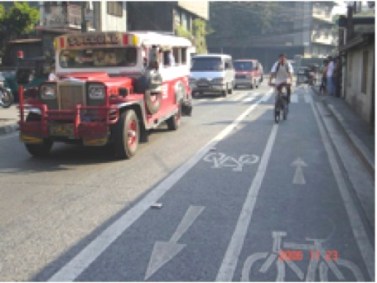 Painted, segregated bikeways on the carriageway along a one way road
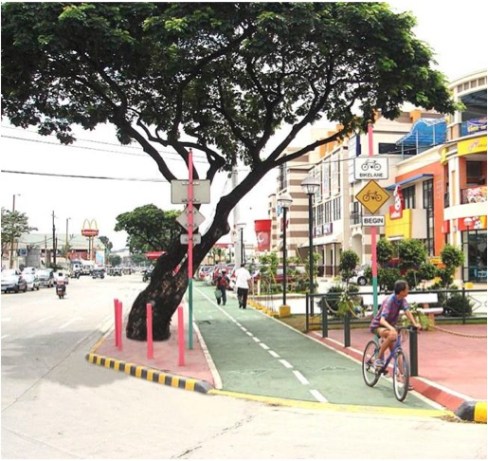 Segregated and protected bikeway off the carriageway along Sumulong Highway
Granted that the ideal set-up would have segregated or protected bikeways that are designed properly, we take a look at two other very important elements that are not at all as technical as design and planning of bikeways – respect and education.
Education is an important aspect of driving. Many Filipino drivers are poorly educated in terms of traffic rules and regulations, road design as well as local policies pertaining to transport and traffic. As such, there is a tendency for many drivers to disregard rules and drive/ride aggressively and recklessly. This must change and it starts with reforms in the way licenses are issued to all types of drivers including perhaps stricter certification systems for truck drivers and public utility vehicle drivers. Traffic education should also be integrated into the academic curricula of schools starting at a very young age. Road safety parks are one way to promote traffic education for kids.
Respect is partly derived from education but is also related to attitude. No matter how much driver or road user education or skill you get if you have a bad attitude, you will still have the tendency to be reckless or irresponsible with your actions on the road. One way to curb bad attitudes on the road and to educate road users (particularly errant drivers and riders) is strict traffic enforcement. Many cities already have CCTVs installed at major intersections that allow law enforcement units to be able to monitor traffic behavior and perhaps zoom in to determine driver and vehicle information including license plate numbers.
The crash that killed the single parent in Marikina is not so much as an issue one whether we need segregated and protected bikeways but is more an urgent need to assess the state of traffic education and enforcement in this country.
–
Articles on the crash and calls for reforms may be found in this link.
Some interesting (and required) readings on traffic engineering
Christmas breaks allow me to catch up on a lot of reading. The previous months comprising our university’s semester were spent preparing for lectures though I had to do some readings related to researches I am involved in. Browsing the net and social media, I came across 2 articles shared by an acquaintance. He is a very progressive planner who has extensively studied and written about the most relevant issues in urban planning, focusing on transport. A third article I found while reading one of the two. These were very interesting for me in part because they are thought provoking in as far as traffic engineering is concerned.
- What traffic engineers can learn from doctors
- As traffic deaths rise, blame engineering dogma
- The new science of traffic engineering
The author seems to call out traffic engineers in general but these articles should also be contextualized properly. The situations mentioned in the articles are to be found in cities in the United States and may not be applicable in other cities in other countries. Traffic engineers in Europe, for example, have been working on exactly the solutions being mentioned in the articles that would make streets inclusive and safe especially for pedestrians and cyclists. The same with Asian cities like Singapore and Tokyo.
In the Philippines, however, there is so much that we can learn from the articles. The mere mention of the design guidelines being used in the US betrays the flaws of highway and traffic engineering in the Philippines. The Philippines’ highway planning manual and other guidelines used by the Department of Public Works and Highways (DPWH) are heavily drawn from US references. Most highway and traffic engineers in the country are educated using curricula that use US textbooks and references. There are even civil engineering programs that use licensure exam review materials as their references! These exam materials are also known to be based on DPWH guidelines and manuals aside from problems “outsourced” or patterned after the Professional Engineer (PE) exams in the US. Few schools have progressive curricula that look to best practices that take into account the complexities of roads especially in the urban setting. Such ‘copying’ of American standards and practices in many cases do not consider Philippine (local) conditions and blind applications to our roads instead of proper adaptation often have lead to unsafe and inequitable roads.
–
On Iloilo’s taxis
The talk about Uber vs taxi is a hot topic in many cities around the world and also in Metro Manila where Uber has gained a foothold and a strong following among mostly ‘former’ taxi goers. Many have stated that Uber provides the service that taxis should have been providing. Uber vehicles are supposed to be of newer models and drivers are supposed to be screened carefully. Uber even has a feedback mechanism not just for drivers but for passengers as well. Basically, Uber provides the quality of service everyone wants to have on regular taxis. The irony of course is that regular taxis are supposed to provide a higher quality of service compared to other public transport modes considering it is basically a for hire car short of a limousine service. But then this begs the question: If you had good taxi services in your city, would you still consider Uber? Or perhaps would Uber have a lot of demand in a city with good taxi services? Perhaps there will still be a demand for Uber but the clamor will not be like that in Metro Manila. And there are few cities with ‘good enough’ taxi services that can compare with Uber in terms of quality of service.
A good example of where there are ‘good enough’ taxis and there is a healthy competition not between Uber and conventional taxis but among taxi operators themselves is in Iloilo City. We have discovered many years ago that Iloilo City had one Light of Glory taxi company that is very popular among Ilonggos and visitors as the drivers were generally more honest than others and they had an efficient dispatching system including desks at the airport and a major shopping mall.
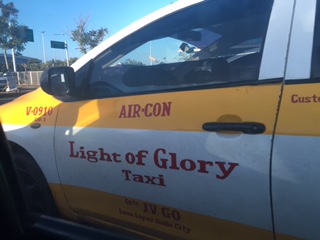 Light of Glory Taxi at the airport parking lot
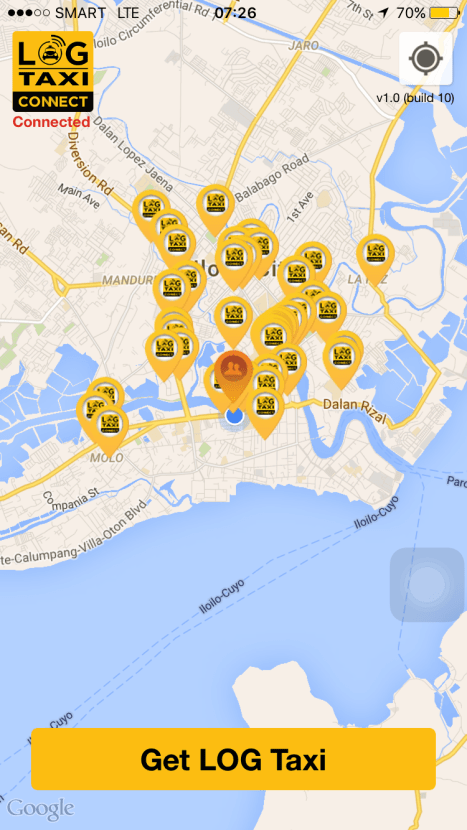 Light of Glory has its own app, which you can get for free and install on your smartphone. It is not as sophisticated as Uber’s or Grab’s apps in terms of features but it gets the job done (i.e., getting you a taxi).
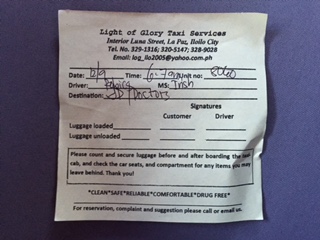 Dispatch sheet – note the attributes the company is trying to promote among its taxis: “Clean, Safe, Reliable, Comfortable, Drug Free” These are attributes we all want of our public utility vehicles whether these are taxis, jeepneys, buses or tricycles.
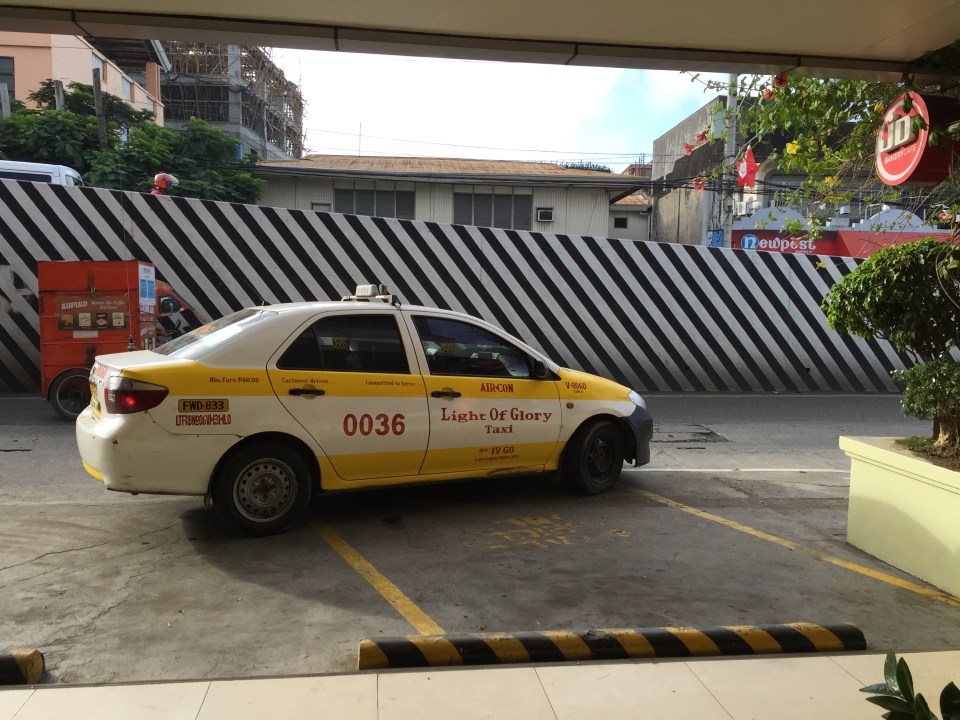 Light of Glory taxi that dropped us off at the venue of our meeting straight from the airport
The Light of Glory taxis is a well run company. Their drivers seem to be treated very well by the operator (drivers claim they have a better compensation system) and generally drive better than other taxis. Their vehicles are also seem to be better maintained compared to others except a few of the larger companies like GDR. Everyone knows about the best taxi company in Iloilo and would most likely prefer their taxis over others if the choice is given to the taxi-going commuter. To compare, I remember the Comfort taxis of Singapore and how many Singaporeans and foreigners living in SG prefer these taxis over others. Comfort taxis have a good dispatching system and you can make reservations for trips in advance. Of course, there are additional fees for on-demand services including arrangements for pick-ups and drop-offs (e.g., your residence to the airport).
–
Tricycle fares in Antipolo City
Tricycles in Antipolo City practically have no defined or restricted areas of operations. Unlike other cities, say Quezon City or Manila, tricycle operations in Antipolo is practically free ranging. You can get a tricycle in Mambugan and ride it directly to the National Shrine of Our Lady of Peace and Good Voyage (Simbahan ng Antipolo); a distance of 8 to 10 kilometers depending on the route taken. As such, there has been a tendency for tricycle drivers to overcharge passengers even though fares were subject to negotiations and there have bee established average or usual fares for certain trips. Nevertheless, there have been and are still lots of complaints about tricycle fares in the city. This is evidenced from the queries posted on the city’s social media accounts.
This situation begs an important question on whether Antipolo City has official tricycle fare rates. The answer is yes, it does have official rates and this is stated under City Ordinance No. 2009-316. I assume that ‘2009’ here refers to the year the ordinance was signed into law by the City Council. Here’s a graphic from Antipolo City’s Facebook page showing official tariffs and warnings against negotiating fares as well as the maximum number of passengers a tricycle can carry.
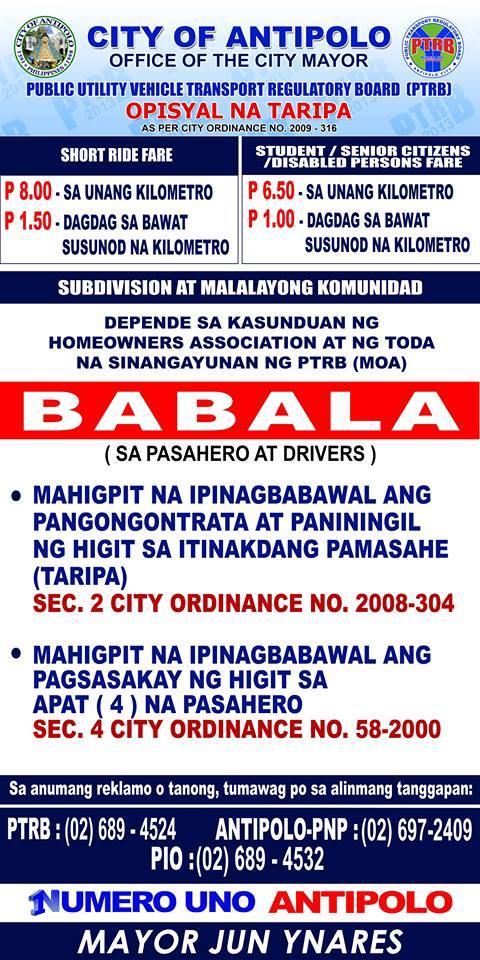 Tricycle fares based on official tariffs under City Ordinance No. 2009-316
Those two other ordinances seem to be among the most abused by tricycle drivers and likely very difficult to enforce considering the ranges of tricycles. According to netizens, many tricycle drivers still tend to negotiate fares for long trips and tricycles carrying more than 4 passengers is a common sight in the city especially tricycles that are used as school service vehicles. I tend to wince myself whenever I see a tricycle overloaded with school children negotiating Ortigas Ave Extension or Sumulong Highway. These are unsafe and put a lot of young lives at risk.
Below is an example fare matrix for tricycles posted at the New Public Market along Sumulong Highway and across from the new Robinsons mall in the same area:
 Illustrative fares to/from the New Antipolo Public Market
I think there should be similar information posted in other areas around Antipolo City. This is so that people will not be confused about the tricycle fares and so as to minimize the instances when tricycle drivers take advantage of passengers not familiar with trip distances and the fare rates.
The Antipolo City Government is working towards improving transport and traffic in this highly urbanized city. I think this should include regulating tricycle services so that the city could reduce their numbers along national roads like Marcos Highway, Sumulong Highway and Ortigas Ave. Extension. Tricycles have become a nuisance in traffic and not just for motorists but for cyclists and pedestrians as well. They shouldn’t be traveling long distances and along rolling and mountainous terrains. They tend to be noisy and, perhaps most problematic, are smoke belchers. Hopefully, this can be addressed in the next years as the city continuous to grow and become more progressive. This only means that the city should strive towards a modern, efficient and people & environment-friendly transport system.
–
Differences: pro-walking vs. anti-car
I came across this article posted at the Planetizen site entitled Pro-Walking, or Anti-Car. It is a good article that heads-on addresses the the differences of being pro-walking to that of being anti-car in terms of transport policies in cities. I think these concepts including the “nuts to crack” list provided by the author is relevant not only to cities that want to promote walking and cycling over car use, but to individuals and groups as well who seem to be following a hard line when in comes to their advocacy to recover road space in favor of pedestrians and cyclists.
Working with big data on transportation
There have been a few initiatives working on big data from government agencies whose responsibilities are primarily on transportation. Among them are past projects implemented by the University of the Philippines Diliman (UPD) and current projects being implemented by UPD, Ateneo de Manila University (ADMU) and De La Salle University (DLSU) with support from the Department of Science and Technology (DOST). While these projects are more oriented towards some specific objectives often linked to research & development (mandates of DOST and these academic institutions), there are still a lot of data out there that needs to be digitized, processed and analyzed. UPD has done this to some extent through its National Center for Transportation Studies (NCTS), which had been a repository for data and reports from DOTC and DPWH. However, the center does not have a funded program to undertake that repository or archival function it is expected to do. Despite much lip service from DOTC, DPWH and NEDA, no support has been extend by these agencies in the past many years.
I recently came upon this excellent work from a private firm specializing in data science. Here’s a link to one of their recent ‘stories’ showing us relevant statistics on road safety in Metro Manila:
http://stories.thinkingmachin.es/road-danger-pedestrians/
Their website says the data set the stats and graphs are based from are from the Metropolitan Manila Development Authority (MMDA), which maintains the Metro Manila Accident Reporting and Analysis System (MMARAS). This is good work and something road safety experts can use to be able to come up with programs and projects to improve safety in Metro Manila. I hope they could also get a hand of the DPWH’s Traffic Accident Reporting and Analysis System (TARAS) data that covers national roads. Unfortunately, the DPWH has stopped encoding TARAS data recently (the PNP still collects data though) so I am not sure how recent their data set is.
We need more of such work on a lot of data our agencies are producing including data from the Land Transportation Office (LTO) and the Land Transportation Franchising and Regulatory Board (LTFRB). Such information could be used to understand our transport systems including determining how to optimise supply and demand when combined with other data sets such as geographical information systems (GIS) and socio-economic data from the census.
–
Looking back at EST social marketing
With all that are happening today that are related to sustainable transport, I tend to pause and look back with a smile on how it was more many years ago when we were struggling to promote environmentally sustainable transport (EST). At that time, most local government units were not yet into sustainable transport and were unaware of the principles. There were a few who already had a project or program in place but didn’t know that these were classified as EST.
CAPACITY-BUILDING AND SOCIAL MARKETING FOR ENVIRONMENTALLY SUSTAINABLE TRANSPORT
Under the project, we identified several local good practice examples for EST and invited representatives of those LGUs to spread the word to other LGUs. Those who regularly went with us to promote EST were representatives of the Marikina City Bikeways Office, and San Fernando, La Union’s City Planning Office who shared their experiences in phasing out 2-stroke motorcycle-run tricycles.
I recall that one major Visayan city wasn’t so receptive at the time as the City Planning Coordinator seemed more interested in international trainings and foreign assisted projects than the city actually developing sustainable programs and projects on its own. The irony now is that despite his being not so excited about sustainable transport that city now has good examples for EST including a bicycle corridor and pedestrian and bike-friendly riverside developments.
But there was the case of the very receptive and progressive City Planning Coordinator of another major Visayan city who helped us immensely in promoting EST. His eagerness, particularly for public transport options, paved the way for Bus Rapid Transit (BRT) to gain a foothold in the discussions paving the way for more efficient transit systems to be considered (and now planned and designed) for his city. That interest led to his city getting the attention of an international agency that brought in then former mayor and now the recently re-elected Mayor of Bogota, Colombia, Enrique Penalosa, to do talks about his city’s Trans Milenio BRT system. I remember a couple of visits of Mr. Penalosa including a series of dinner meetings sponsored by the private sector in Makati City who were interested in the Bogota’s transport success story.
We always wondered who, when and how EST would be advocated by others and particularly by a younger generation who would turn out to be more outspoken and aggressive in promoting EST. These include those calling for better public transport systems, those advocating for pedestrian and bicycle facilities, those pushing for safer roads, and those lobbying for clean air. With all that we are seeing now around us (Congratulations Firefly Brigade for a very successful Tour of the Fireflies last Sunday!) and on various media platforms, I strongly believe that we are on the right path towards achieving better quality, sustainable and equitable transport for everyone.
–
Trip cutting with respect to the LRT Line 2
Trip cutting is one of the undesirable behaviors of public utility vehicle drivers. It is most common with jeepneys and UV Express than with buses.
The findings of the study completed by our students last June 2015 are the following:
- It was proven that trip-cutting behavior is a common practice by both jeepney and UV Express drivers with routes along Marcos Highway and Aurora Boulevard, covering parts of Pasig City, Marikina City and Quezon City.
- The underlying factors involving trip-cutting behavior by PUV drivers were found to be the following:
- Jeepneys and UV Express unload most of their passengrs during peak hours at the LRT Santolan and Katipunan Stations – there was a higher likelihood for passengers to ride the Line 2 from these stations to their destinations including Cubao and the University belt. A lot of passengers are students and trying to keep their schedules. Road transport can be very unpredictable and the trains offer more reliable travel times.
- Drivers can maximize profit by having shorter trips and at the same time having passengers at full capacity – jeepney and UV express drivers unloading most of their passengers at the stations and turning around there (i.e., cutting their trips) means they avoid the congestion along Aurora Boulevard and faster turnarounds translate to their being able to carry more passengers thereby earning more revenues.
- It was observed that the top trip-cutting routes for PUVs along Marcos Highway and Aurora Boulevard are as follows:
- For jeepney vehicles:
- Cogeo – Cubao and Antipolo – Cubao routes in relation to the LRT Santolan Station;
- Calumpang – Cubao and SSS Village – Cubao routes in relation to the LRT Katipunan Station.
- For UV Express vehicles:
- SSS Village – Cubao and Cogeo – Cubao routes in relation to the LRT Santolan Station;
- Marikina – Cubao and Rodriguez/Montalban – Cubao routes in relation to the LRT Katipunan Station.
- For jeepney vehicles:
The following recommendations were made in relation to the findings of the study:
- Route modification of top trip-cutting routes to take into account the realities with respect to the current demand.
- Study on supply of PUVs with respect to the Cubao terminal station in relation to trip-cutting violations.
- In the future, when the construction of the LRT Line 2’s Masinag and Emerald stations is completed, it is recommend to that further route modifications be made relative to these new stations.
Such studies are important especially in light of the construction of railway lines including this case of the extension of Line 2 from Santolan, Pasig to Masinag, Antipolo. There is an opportunity here for the rationalization of jeepney routes to complement the obviously higher capacity and more efficient trains of Line 2. Rationalization here translates to the shortening of jeepney routes with many units terminating at Line 2 stations. ‘Cogeo-Cubao’ jeepneys would become Cogeo-Masinag jeepneys while ‘Antipolo-Cubao’ jeepneys will become either ‘Antipolo-Masinag’ or ‘Antipolo-Emerald’ jeepneys. A Masinag route end would apply to ‘Antipolo-Cubao via Sumulong Highway’ jeepneys while the Emerald route end would apply to ‘Antipoli-Cubao via Junction’ PUJs. Such will reduce the travel distances covered by the jeepneys as well as reduce their travel and turnaround times. Also, such a rationalization will lead to a better structured public transport system following a hierarchy among modes.
–
 Caught (up) in traffic