
Home » Public Transport » Bus (Page 3)
Category Archives: Bus
Congestion near bus terminals during the Christmas season
I attended a formal event yesterday at the Philippine International Convention Center (PICC) in Pasay City. Along the way and back, I already noticed the congestion along Gil Puyat Avenue (formerly Buendia Avenue) as well as the congestion or how crowded the bus passenger terminals were. In fact, the buses at the JAC Liner terminal along Gil Puyat were all on the streets. The terminal itself was filled with passengers, many of whom were queued as they waited to board their buses. Others I assumed were in line to purchase tickets there. The latter apparently have not done so online, which is already an available and more convenient option for provincial travel.
 |
| Buses lined along the Makati-bound side of Gil Puyat Avenue. These are queued towards to the U-turn slot that will take them to the bus terminals on the other side and near Taft Avenue. |
 |
| Other buses are lined along the Pasay-bound side of Gil Puyat Avenue. These come from the South Superhighway where these buses eventually head to after boarding passengers en route to Southern Luzon, Bicol and even Visayas and Mindanao destinations. |
Then as now, the junction of Gil Puyat and Taft Avenues is a major convergence area for transportation especially provincial routes. Even before the construction of the LRT Line 1 (which has a station at Gil Puyat) there have been a number of bus terminals here. Currently, I am aware of the JAC Liner and DLTB bus terminal near the junction. There are others including small terminals or garages for provincial buses. These generate much traffic particularly during this Christmas, which is considered peak season for travel in the country.
–
On concert and sports event venues being accessible to transit
Among the major concert or sports event venues in the Philippines, perhaps the Araneta Coliseum is the most accessible to public transportation. Others like the SM Mall of Asia Arena in Pasay City is accessible to public transport but only for road-based modes. The Philippine Arena in Bulacan is accessible only by private transport or shuttle vehicles (basically also private as they are leased or rented). Compare this to say Singapore’s National Stadium, Tokyo Dome or Saitama Arena, which are all served by mass transit systems. It was so easy to go to the U2 concert in Singapore or Japan because of this. It was difficult for the same when they came to the Philippines because going to the Philippine Arena required a long drive both ways.
With all the fuss about Taylor Swift’s concert tour, I found this article about how fans or Swifties as they are called get to the concerts – they take public transportation:
Brady, T., Caldera, L. and Worthington, P. (July 14, 2023) “Transit Funding Problems Too Big Even for Taylor Swift to Solve,” Next City, https://nextcity.org/urbanist-news/transit-funding-problems-too-big-even-for-taylor-swift-to-solve?utm_source=Next+City+Newsletter&utm_campaign=c480374b80-DailyNL_2023_07_14&utm_medium=email&utm_term=0_fcee5bf7a0-c480374b80-44383929 [Last accessed: 7/19/2023]
To quote from the article:
“And how did the nation’s Swifties get to these concerts? As a recent Crain’s article explains, transit.
Fans took buses and trains to see superstar Swift, adding 43,000 bus and rail rides in Chicago and tripling the number of weekend riders in Atlanta. Her Philadelphia concerts in mid-May brought an estimated 27,000 additional riders to SEPTA’s (Southeastern Pennsylvania Transportation Authority) subway line next to Lincoln Financial field.”
If she held at least one concert here, I’m afraid that concert will generate more car traffic than transit ridership if held at the Philippine Arena. NLEX will definitely generate a lot of toll revenue but traffic will be hell for the event.
–
Commuting from/to Antipolo via the public transport terminal at Robinsons Antipolo
I was at the Robinsons Antipolo public transport terminal to take a P2P bus to Ortigas. I took a few photos before boarding the bus. The bus no longer terminates at Robinsons Galleria but instead goes to Greenhills. This is very convenient for people who need to go to Virra Mall or somewhere in its vicinity (e.g., Cardinal Santos Medical Center, LSGH, etc.).
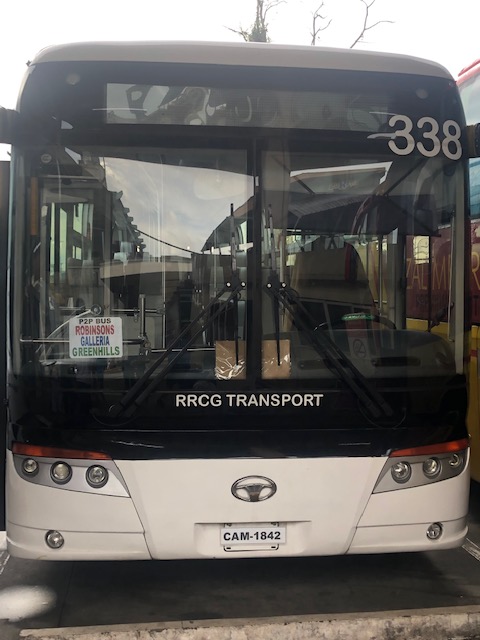
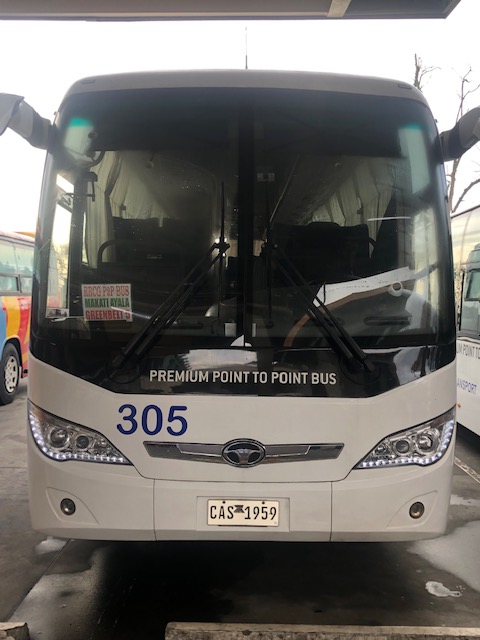
Then there are the buses plying the Antipolo-Cubao route via Sumulong Highway-Marcos Highway-Aurora Boulevard. These are regular aircon buses (not P2P) operated by various companies including G-Liner, RRCG, Jayross, etc. Below are photos of Diamond Star buses loading passengers bound for Cubao.
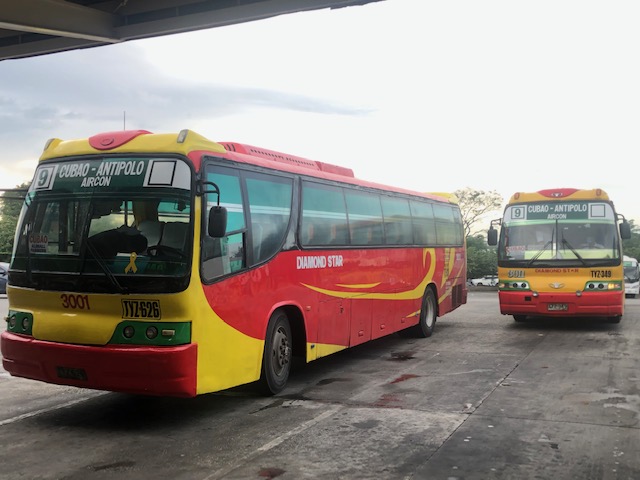
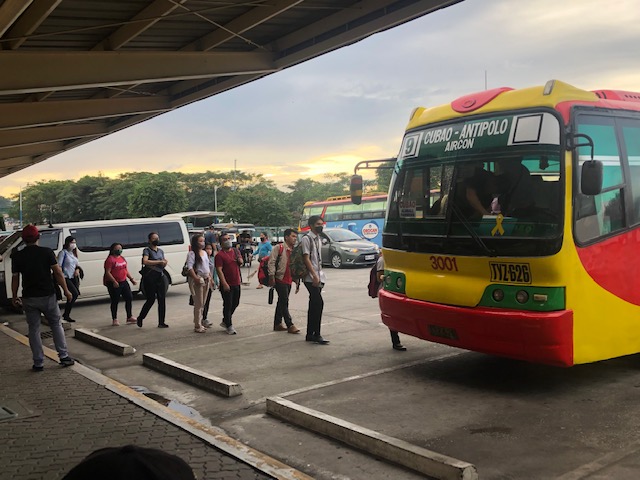
The lines can be very long depending on the time in the morning but I guess the assurance of a seat makes it worthwhile to go to the terminal rather than wait for the bus along its route. Passengers loads are practically back to pre-pandemic levels and with some jeepneys back, that means competition for the buses.
–
Provincial bus services via the transport terminal at Robinsons Antipolo
Robinsons Antipolo recently announced the daily trip schedule for provincial destinations for the transport terminal at the mall. These are for destinations in the Bicol region and the Visayan Islands of Samar, Leyte and Bohol. These will likely travel via Rizal’s “backdoor” through Teresa, Morong, Tanay and Pililla and proceed through the Laguna towns of Pangil, Pakil, Paete, Lumban and Pagsanjan, before going through Quezon province via Luisiana, Lucban towards Lucena, where there is a major bus. From Lucena, the trip will then take the usual routes through Bicol. Here is the posting from the Robinsons Antipolo Facebook page:
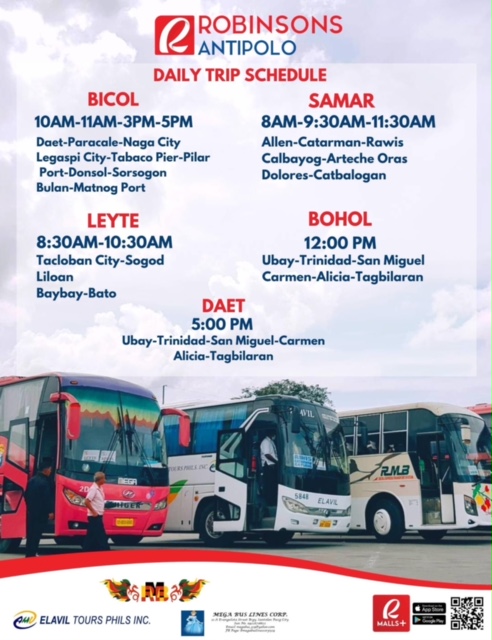
There are three bus companies serving the routes mentioned above and as shown at the bottom of the poster. While I am familiar with the routes in Bicol (I have experienced traveling by bus all the way to Gubat, Sorsogon, which is my mother’s hometown and where we have many close relatives.), I have not experienced crossing to Samar via Matnog. I have been to both Samar and Leyte and have crossed the San Juanico Bridge many times so I know how long those trips can be. The highways now are better and I assume the buses offer more comfortable rides so its the ferry (RORO) crossing between Matnog and Allen that will be the slowest and perhaps most uncertain part of the trip. I say uncertain because if the weather is not good, the coast guard will halt the ferry services. I was surprised there was a connection to Bohol. That is not a short trip from Leyte to Bohol. And I was expecting a service to Cebu instead, which was closer and had regular ferry services between Leyte and Cebu islands.
I don’t know about the demand for these services or routes. I hope these are sustainable and sustained as it offers an alternative for people residing in Rizal and nearby areas who want to go to Bicol, Samar, Leyte or Bohol via these routes.
–
On school bus services and the return to face-to-face classes
I did an interview last August with a major business daily but I couldn’t find it as published as part of an article. The topic was a very timely one as children return to schools for face-to-face (F2F) classes. Here are the questions sent to me and my responses as I remember them:
1. How will the transport sector cope with the expected increase in demand as more schools resume face-to-face classes?
For schools located in the cities, what we see is people opting to take private transportation in the form of cars or motorcycles to take their children to school. This is because public transportation supply is still not back to pre-pandemic levels while at the same time, parents and guardians and even students who commute by themselves (e.g., high school and college levels) may be hesitant to take public transportation as well as school service vehicles. The latter may be attributed to concerns about the safety particularly with regards to health (i.e., getting infected or exposed to Covid-19 if they take public transport or a vehicle where they share the ride with many other people). We need more public transportation capacity to be able to address the increased demand brought about by students coming back for face-to-face classes. We also need to have other options or alternatives for their safe journeys including walking and cycling for their commutes.
For schools in the rural areas, there may be little adjustment concerning transport since most schoolchildren walk or take motorcycles or tricycles to school. This is perhaps because most schoolchildren reside within the school district and do not have long commutes like what we have in many cities (e.g., most schoolchildren who study at schools like Ateneo, LaSalle, etc. likely live in another city or town rather than near the schools).
2. How many school buses are expected to resume operations? How many of them have permanently closed?
I currently don’t have the data on that but LTFRB should have reference or baseline data. School service vehicles are required to register with the LTFRB and perhaps a look at the number registered before and during the pandemic could show how many can be expected to resume operations nationwide and per region. LTO doesn’t have these numbers as they only register by vehicle type. We will not know from LTO data which jeepneys, vans or buses are used for school service. Most school service are tied to the schools the student of which they provide transport services to. If the school closed, then chances are that the school service may apply to other schools. That said, the last two years where schools operated online were a backbreaker to many school service and only the registered numbers with LTFRB can tell us just how many are not returning at least for this school year.
3. How does the surge in fuel prices affect the operations of those involved in school transportation? Will this affect the ability of teachers, schools staff and students to travel on-site?
School services might increase their rates, which are usually monthly or semi-monthly. This is to make up for the increase in fuel prices and vehicle maintenance as well. This will likely only affect students’ travel rather than those of their teachers or school staff. The latter group will likely take public transport or their own vehicles for their commutes. In their case, their travel may be affected by transport fare increase or their own fuel expenses if they use their own vehicles. They have little choice though because they have to travel to work. Student though may still enjoy some respite as many schools are adopting blended or flexible schedules that will only require students to do face-to-face classes on certain days of the week.
4. What’s the long term impact of the pandemic on the school bus industry?
People will remain to be apprehensive in letting their children share a school van or bus ride due to the pandemic. We can only promote vaccination and compliance with health protocols to ensure that schoolchildren will have safe journeys as far as Covid-19 is concerned. The return to face-to-face classes this school year will perhaps help determine if the pandemic will have a long term effect on the industry or if people’s (parents and guardians) trust to school bus services will return within the short term.
5. How can school bus drivers and operators cope with the challenges posed by the pandemic and rising fuel prices?
LTFRB issued Memorandum Circular 2022-066, which adds health protocols for school service:
• Regular examination of the drivers and conductors’ fitness to work by checking their body temperature and screening for symptoms related to COVID-19.
• Regular disinfection of frequently-touched surfaces, such as but not limited to seats, armrests, and handles.
• Mandatory wearing of face masks at all times by drivers and conductors, including passengers.School transport services must comply with these protocols and demonstrate the safety of their mode to convince people to return to using or subscribing to school service vehicles. Meanwhile, there is really no escaping rising fuel prices but collective transport in the form of school service vehicles are still more efficient and cheaper per passenger compared to using private vehicles; not to mention contribute to reducing traffic congestion along school routes. This must also be promoted (i.e., people made aware of the advantages) vs. private vehicle use.
–
Quezon City’s bus services
One of the projects of the Quezon City (QC) government during the pandemic and which they continued to the present was transport-related. QC deployed buses to provide free transport for its residents.
Here are the routes (source: QC FB page):
Route 1 – Quezon City Hall to Cubao (and vice versa)
Route 2 – Litex / IBP Road to Quezon City Hall (and vice versa)
Route 3 – Welcome Rotonda to Aurora Blvd. / Katipunan Avenue (and vice versa)
Route 4 – General Luis to Quezon City Hall (and vice versa)
Route 5 – Mindanao Ave. cor. Quirino Highway to Quezon City Hall (and vice versa)
Route 6 – Quezon City Hall to Robinsons Magnolia (and vice versa)
Route 7 – Quezon City Hall to Ortigas Avenue Extension (and vice versa)
Route 8 – Quezon City Hall to Muñoz (and vice versa)
See their UPDATED Bus Route & Schedule:
https://m.facebook.com/story.php?story_fbid=273192358328744&id=100069139452704
https://www.facebook.com/photo/?fbid=273192031662110&set=pcb.273192358328744
Here are some photos of the buses along the Elliptical Road. These are air-conditioned and have WiFi for the comfort and benefit of the commuters.


With the fresh mandate (second term) of the QC Mayor Joy Belmonte, it is expected that they will continue with this public service. I am not sure if it should be strictly for QC residents. Perhaps those who work or study in QC should also benefit from the service. These people may show proof in the form of valid IDs like school or employee IDs.
–
Early morning commuting
Early morning commutes are not new to me as I’ve been doing this since I started to commute by myself decades ago. My usual trip between home and school consisted of two jeepney rides or one jeepney ride and a tricycle ride, depending on whether I carried a lot of items or if I didn’t feel like walking the so-called last mile between the jeepney stop and my home. While traffic wasn’t as bad in the 1980s and 1990s as it is today, it was still difficult to get a ride. Little has improved with public transport even though there are air-conditioned vans, P2P and additional railway option for me now along my usual routes to the office.
Back in the day, I liked to enlist in the 7:00 – 8:30 AM classes at UP Diliman as it was easy to get a ride at 6:00AM. That allowed for some time to spare before class and in the rare cases when UP-Katipunan jeepney drivers were on strike, you can walk the length of Katipunan and arrive in time for class. It was later when my classes were mostly in the afternoon that I had to delay my trips so I wouldn’t have to travel during the peak periods. It was difficult to get a ride and travel times were longer. When I was already working, I often traveled early if we had field work scheduled. That meant traveling before 6AM. There were fewer jeepneys but most were not full and it was easy to get a ride.
I took a couple of photos of a bus plying the Antipolo-Cubao route at around 5:30 AM one Friday morning. This was before the return to work order was issued to many workers so perhaps it does not show the current situation for the same time.
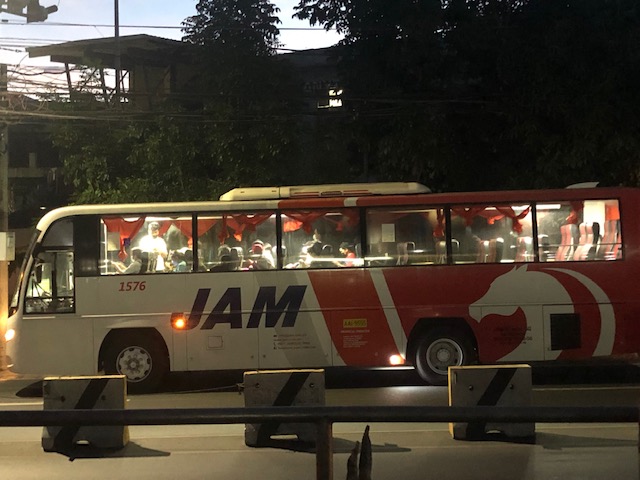
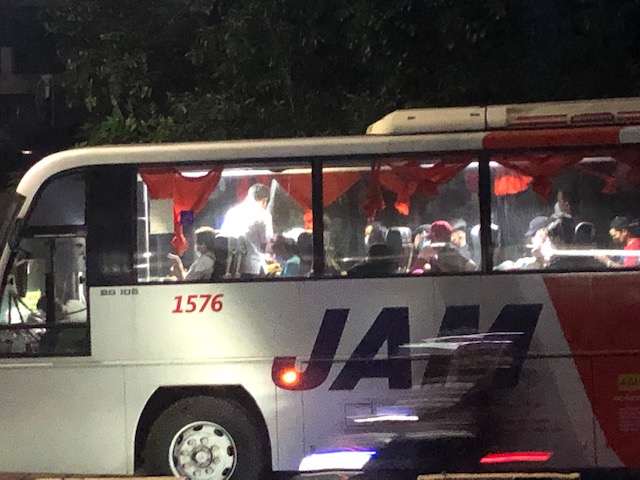
I now go to the office twice or thrice per week. On my way at 7:30 AM, I see many people lined along the streets at the typical loading/unloading areas along my routes. People would have to travel earlier if they want to easily get a ride and if their travel distances are relatively far (i.e., many people live outside of Metro Manila and have to travel 10+ kilometers one way).
–
Why not rationalize other routes now?
There is an enduring discussion in various forums and platforms about the lack of supply of public transportation. I can’t help but notice though that many discussions consciously or unconsciously leave out the part of public transport rationalisation that calls for phasing out lower capacity vehicles in favour of higher capacity ones. I have written about this and explained the necessity particularly along corridors with high transport demand. Delaying what is required (not necessarily what is inevitable) means we fall short of transforming public transport services in this context.
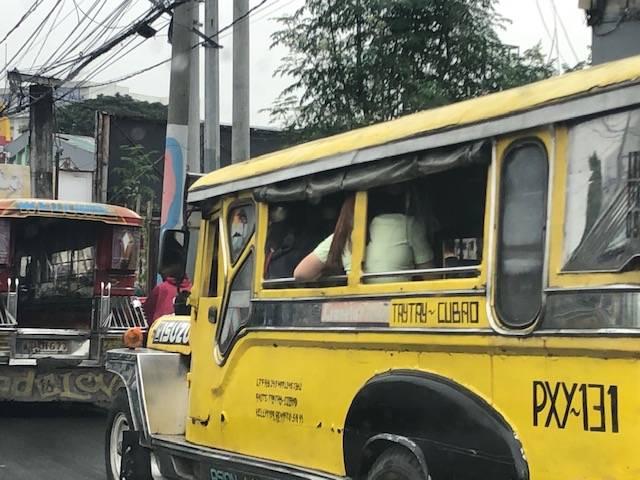
There are definitely missed opportunities here but the current discussions and proposed resources for 2021 including funds for service contracting seems to suggest a status quo in terms of vehicles with the exception of the modernisation part. Perhaps this is because we are still in pandemic mode and survival is still the name of the game? Nevertheless, there should be initiatives and continued dialogue about ‘graduating’ from lower capacity vehicles to higher capacity ones. Of course, this discussion is more urgent for highly urbanised cities than smaller ones.
–
On priority lanes for public transport
I am currently part of an International Research Group (IRG) involved in studies on bus priority. Yesterday, we had a meeting where one professor mentioned the importance of being able to clearly explain the advantages of having priority lanes for buses in order to improve their performance (i.e., number of passengers transported and improved travel times). There was a lively discussion about how the perception is for bike lanes while transit lanes have also been implemented for a long time now though with mixed results.
There are very familiar arguments vs. taking lanes away from cars or private motor vehicles and allocating them for exclusive use of public transport and bicycles. It may sound cliche but ‘moving people and not just cars’ is perhaps the simplest argument for priority lanes.
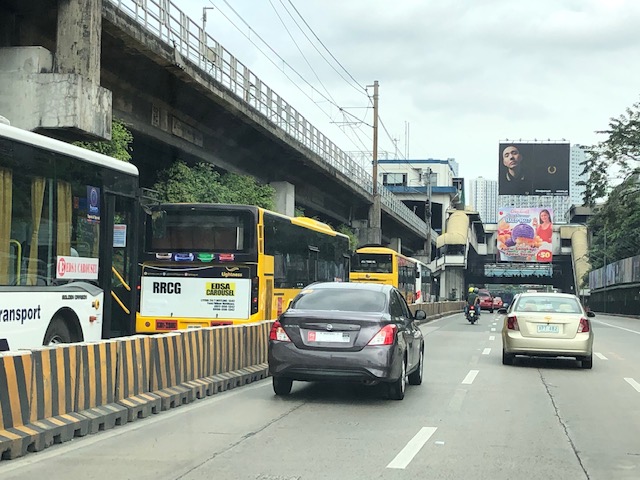 EDSA carousel buses lining up towards a station
 Bike lane along Katipunan Avenue – is this a temporary thing? a fad because traffic is really not back to the old normal? Katipunan is infamous for being congested with cars generated by major trip generators in the area such as schools/universities and commercial establishments.
 The bike lane along Commonwealth Avenue proves there’s just too much space for private motor vehicles. And with the Line 7 in the horizon, perhaps more lanes can be taken and made exclusive to road public transport. [Photo credit: Cenon Esguerra]
–
On the BRT gaining popularity
Bus rapid transit or BRT has been around at least since the 1970s when the first ‘real’ BRT systems went into operation in Curitiba, Brazil. Here’s an article presenting the current state of deployment of these systems in the US:
Duncan, I. (July 23, 2021) “Cities are turning to supercharged bus routes to more quickly and cheaply expand transit services,” The Washington Post, https://www.washingtonpost.com/transportation/2021/07/23/bus-routes-public-transit-brt/
“There are indications that BRT lines can promote some of the density long associated with rail routes. A new analysis of job and residential growth by researchers at the University of Arizona examined areas around BRT stations in 11 cities between 2013 and 2019. In each case, they found areas close to the stations accounted for a significant share of regional growth.”
The Philippines should have had its first BRT line more than a decade ago if the government had been decisive about it. The first opportunity was under the administration of Macapagal-Arroyo when it was first conceptualized for Cebu City under a UNDP project and picked up by the WB for implementation.* The next opportunity came under the Aquino administration when the Cebu BRT could have been one of those low-hanging fruits for public mass transportation. Now, the same project is nowhere near completion as the Duterte administration has less than a year before it bows out. Meanwhile, there are proposed BRT’s in Metro Manila and Davao that have yet to see the proverbial light of day. The EDSA carousel is supposed to morph into a BRT but has not become so and requires more tweaking for it to be one.
*[Note: The BRT that was supposedly implemented by the MMDA under its then Chair Bayani Fernando was not a BRT or even a BRT light. It is not even at the scale of the current EDSA carousel.]
 Caught (up) in traffic