
Home » Public Transport (Page 33)
Category Archives: Public Transport
On the East Metro Transport Terminal in Marikina
This site has been visited a lot the past few days by people searching for information on the eastern transport terminal that’s being developed in Marikina City just across from SM City Marikina. I wonder if its for a study (i.e., students doing research) or perhaps some folks curious about the signs they’ve seen while crossing the Marcos Highway bridge across the Marikina River.
 Signs informing people about the existence of a transport terminal beneath the bridge
The sign also states BFCT, the first part of which are the initials of the former MMDA Chair/Marikina Mayor. CT probably means ‘city transport’, ‘city terminal’ or ‘central terminal’? I haven’t been to SM Marikina lately so I haven’t had the opportunity to see how complete the facility is and if it is already operational. However, one can see from the bridge, as you travel along the outermost eastbound lane, that work is ongoing and there are vehicles (mostly vans, jeepneys and small trucks) that are parked there.
Is this a good location for a public transport terminal? I believe so; considering that there is a railway station nearby and the area is a convergence point for a lot of people (not only those residing in Marikina and Pasig). Do I think this should be a provincial bus terminal of the same level as the ones proposed for the north and south of Metro Manila? Yes, but only for trips bound for the east (e.g., Rizal and Infanta, Quezon) and south (e.g., Quezon, Laguna, Bicol) via the eastern route (Marcos Highway, Antipolo-Teresa Road or Manila East Road). I don’t think it is appropriate for trips heading to Boracay, Baguio or Ilocos. Buses headed for the latter destinations should terminate at the proposed north and south terminals. Buses to/from those places that would be terminating in Marikina would mean they would have to travel along C-5 in order to get to this eastern terminal. If these are in significant numbers then the traffic generated by such a terminal will contribute to congestion along C-5 and Marcos Highway. Of course, such proposed terminals should be subject to rigorous studies as these facilities can be major traffic generators and some mitigating measures must be in place to address potential issues.
–
MRT 7 on the way
The construction of the much-delayed Line 7 is underway. Hopefully, this project will be completed and be operational (or at least partly) before the end of the current administration. This would be one of the game-changers in terms of commuting along a corridor that has steadily increased in population and therefore travel demand. The ultimate end of the line in San Jose del Monte, Bulacan also means it will be serving relocation communities, many of whom are employed in Metro Manila and have to travel every weekday using buses, jeepneys and vans. Following are photos we took along the Commonwealth in the Fairview and Litex areas.
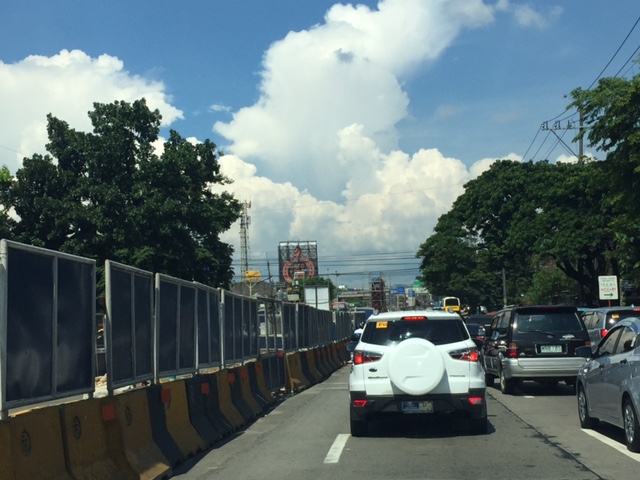 Construction is underway and this means traffic congestion as the number of lanes along either direction of Commonwealth Ave. has been reduced to provide space for the staging areas of the project.
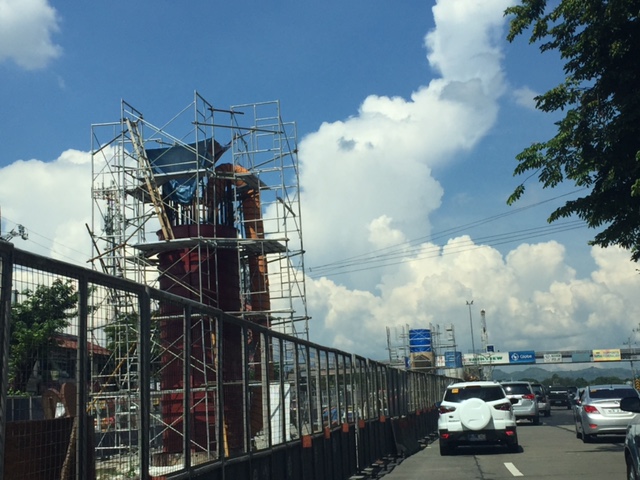 A column going up near the rotunda near Litex Market
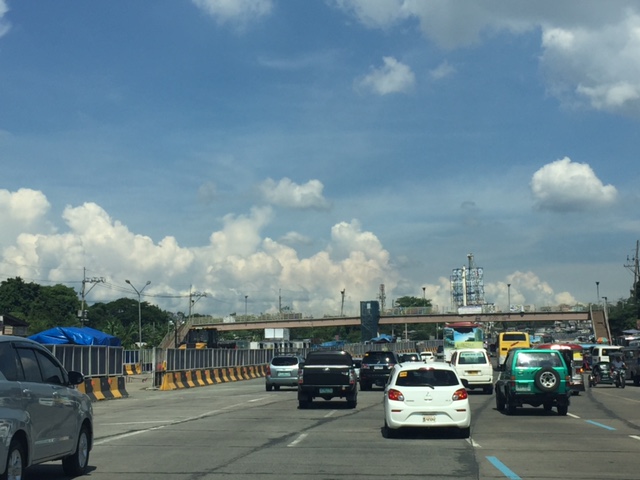 MRT Line 7 worksite along the Commonwealth Avenue median is secured by lines of barriers cum fences on either side of the median.
 These full-grown trees in the middle of Commonwealth will be or already removed
 What has been a green row in the middle of Commonwealth Avenue will give way to an elevated railway line. I sure hope the proponents do some landscaping after the structure is built to restore the greenery.
More updates on the project soon…
–
TSSP 2017 Conference
The Transportation Science Society of the Philippines (TSSP) holds its 24th Annual Conference tomorrow, July 21, 2017. It will be held at the National Center for Transportation Studies at the University of the Philippines Diliman, Quezon City. More than a hundred participants are expected to attend this 1-day affair.
The final program for the conference may be found in the following link:
http://ncts.upd.edu.ph/tssp/index.php/2017/07/17/tssp-conference-program/
The theme for this year’s conference is “Improving Quality of Life in Urban and Rural Areas Through Inclusive Transportation.” This is also the theme for the panel discussion in the morning. The afternoon will feature four parallel technical sessions where 18 papers will be presented.
The keynote lecture will be delivered at the start of the conference by Prof. Tetsuo Yai of the Tokyo Institute of Technology, who is also the current President of the Eastern Asia Society for Transportation Studies (EASTS) under whose umbrella the TSSP is part of. TSSP is a founding member of EASTS and actually preceded EASTS by a year.
–
On the Uber and Grab predicament
A lot has been said and written for or against Uber and Grab. Social media made sure the more popular but not necessarily the truthful ones are spread. One popular personality associated with motoring has even led an online petition against the rulings by the Land Transportation Franchising and Regulatory Board (LTFRB). An objective check of the facts reveal that LTFRB is not solely at fault here. Uber and Grab should not have promoted themselves and took in additional drivers (nagpaasa ng mga drivers) after the agency issued a moratorium last year. Estimates vary but it seems they have taken in tens of thousands of drivers (20.000? 30,000? 40,000?) and earned revenues along the way to what is now an historic penalty levied upon Uber and Grab by the LTFRB.
Perhaps the most level-headed article I’ve seen online is the following:
The thing about Grab, Uber and the LTFRB [by Vince Pornelos, July 18, 2017, https://www.autoindustriya.com/editors-note/the-thing-about-grab-uber-and-the-ltfrb.html]
It seems all is well, for now, as meetings were held between the DOTr, LTFRB and the concerned parties (Uber and Grab). In one of the meetings, a couple of Senators seem to have brokered a deal to resolve what appeared to be an impasse that a lot of people on social media reacted to. There are definitely a lot of vested (and veiled) interests involved here including those by various “operators” in the transport sector on both the sides of government and private sector. One takeaway though that I observed is that many appear to be against LTFRB even though the agency was truthful about their statements regarding the illegally operating transport vehicles. They seem to have made up their minds about the LTFRB and this is not surprising as transport problems have been festering for decades with little progress in terms of improving transport, conventional or innovative. Most people seem to have lost their patience about transport services and regulation, and perhaps this is a good thing if it translated to demanding for mass transit, too.
–
Public transport’s importance to a city
I found an “old” article on public transportation and its importance to cities:
Public Transport is Worth Way More to a City Than you Might Think, [by Eric Jaffe in http://www.citylab.com, August 14, 2013]
While much attention has been on walking and cycling, which are essential modes of transport, I believe public transport has an even much more value especially given the land use in many cities. This is particularly true in the Philippines where land use planning is basically a term since implementation is generally weak. This is very much evident in the case of residential development and the limited choices for transport. Many people, for example, reside in the periphery of Metro Manila and its surrounding areas. They often commute over long distances and incur long travel times due to congestion roads. Mass transit infrastructure could have made commutes faster, saving precious time that translates into economic value.
–
On the transportation aspects of Antipolo’s pitch for the senate to relocate there
I was browsing Facebook the other day and found an interesting post by the Antipolo City Government’s official account. They posted about the presentation made by the current mayor to the staff of the Philippine Senate, selling the idea for the Senate to relocate from its current location in Pasay City. There are currently two options known to us: Fort Bonifacio in Taguig City and Antipolo City in Rizal Province.
The Antipolo government’s post stated that it only takes 25 minutes between the the Batasan Complex and the proposed site, which is on land owned by the Antipolo City Government. This was probably based on travel time estimate using a tool such as Open Street Map. This though is inaccurate since travel times are affected by various factors and will vary according to time of day, day of the week and even month.
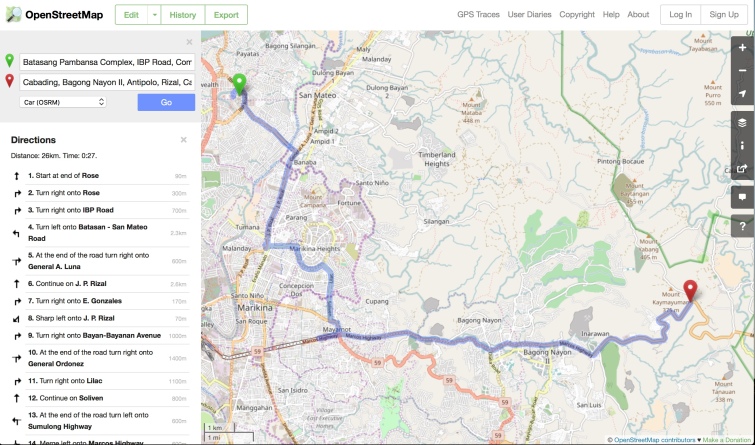 Open Street Map visualization of travel route and time between Batasan Complex and the proposed site for the Senate
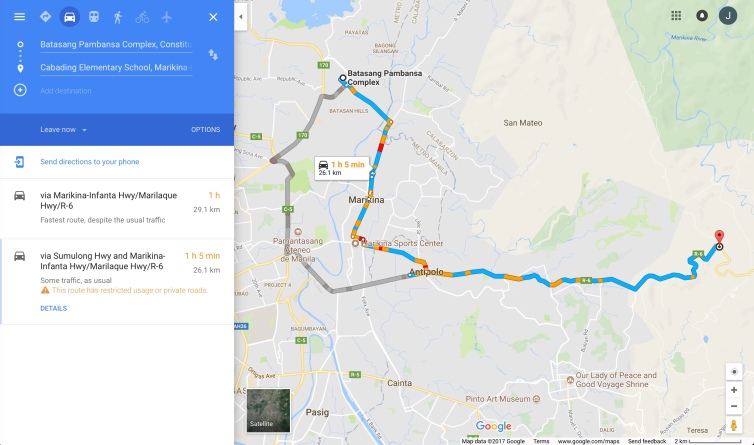 Google Maps visualization of alternative routes and typical travel times
I took the preceding screen captures at 10:00 AM on June 23, 2017 (Friday). Open Street Map’s version can be misleading because it states a travel time assuming practically no traffic (~26 km in 27 minutes or about 58 km/hr in terms of travel speed). Google Maps version is better as it accounts for typical traffic during a certain time of travel (i.e., 10AM). Thus, there’s the more realistic 1 hour travel time for the same distance (about 26 km/hr travel speed). Google’s is based on crowdsourced data and can be customized based on the day and time of travel (e.g., 8:00 AM on a Monday). And I wouldn’t even want to get into the discussion of the accuracy of the claimed 40-45 minutes to/from the airport (i.e., NAIA). Again, anyone with Waze or Google Maps can get more realistic travel time estimates for such trips.
What would be the transport impacts of such a relocation. For one, employees of the Senate (and I am not even considering the Senators and their closest staff here) would have to travel from their residences to the proposed site in Cabading, Antipolo City. Where do these staff live? If they were from Manila and they take public transport, that probably means they would have to take the LRT Line 2 to Masinag and then take a jeepney from Masinag to the site. Line 2 would present the most efficient option in terms of travel time and cost compared to taking a jeepney or van via Cubao. I am not aware of any direct transport services for them although we can speculate that perhaps new routes can be established. The Senate has shuttle buses so these would also be an option for those taking public transport. Car owners will have to travel and converge along Marcos Highway. It is uncertain when the extension to Cogeo will be decided and constructed, if at all.
There is also mention of the plans for Circumferential Road 6 (C-6). However, the reality is that government is taking its time in upgrading the existing sections in Taguig, Pasig and Taytay. The Taguig sections are in a very bad state now after the onset of the wet season. Dealing with the ROW acquisitions necessary for planned C-6 sections is already a big challenge as the areas are already built up or developed (mostly residential subdivisions).
Having the Senate complex in Antipolo will have repercussions on land use/development as well as land prices and rent. It will be located at a relatively undeveloped part of the city and will likely encourage urbanization there. Antipolo should be careful in regulating land development so that the area will not become another Batasan with all the informal settlements and the low density developments around it. There are many opportunities here to develop the area into a showcase government center and that should include planned development for residential, commercial and institutional uses. The housing options should include affordable walk-up apartments as well as medium rise buildings like those by DMCI and Filinvest. It is important to emphasize that options for affordable housing near the workplace cannot be provided in Fort Bonifacio since land and residential unit prices there are already very expensive; forcing most Senate staff to live outside and away from their offices. Such a situation necessitates long commutes and contributes to congestion.
To be fair, there is a good potential for congestion reduction if the Senate relocates to Antipolo. Perhaps the concept of a “New Town” in the proposed site can be developed in more detail. But questions arise: Will this attract major schools, for example, as well as offices such as BPOs? What is definite is that Antipolo will not be the only LGU that will benefit (economically) here but perhaps much of the Province of Rizal, too, as well as the nearby cities of Marikina and Pasig.
Decongestion can happen if:
a) Senate staff decide to move to Antipolo and environs (e.g., Marikina, Cainta, Tanay, etc.).
b) A significant number of staff reside at the proposed dormitories during much of the weekdays, and go home only for the weekends and holidays.
c) Efficient public transport is provided for them and Antipolo constituents along the corridor to be served.
d) Sustainable transport facilities like walkways and bikeways be developed to reduce dependence on motorized transport especially for short distance travel.
In the end, though, I think it will be the Senators who will be making the decision on this matter. Will they be more practical, pragmatic, or insensitive to the consideration of their staffs? Abangan!
–
Praise and criticism about Uber
I found a couple articles on Uber. These are by the same author and are interesting because of some changes in perspectives considering the more than 1 year separating the two.
In Praise of Uber [by Jean-Louis Gassee in mondaynote.com, Medium, May 9, 2016]
Uber’s Complicit Board [by Jean-Louis Gassee in mondaynote.com, Medium, June 26, 2017]
I’m posting these here as additional references on ridesharing/ridesourcing. Such perspectives are also invaluable for us doing research on these topics. I am not so much interested in the personalities but on the operations and the experiences and preferences of passengers.
–
Challenges for Uber, and ridesharing in general
Uber was in a crises of sorts after several leading to its controversial head stepping down a few days ago. Several articles came out including one from Wired that provided some details to some of the significant stumbling blocks or obstacles Uber had to go through the past years (even recent months). There’s an even better article by one of Uber’s co-founders, which I found and regard as “even better” because it appears to be a self assessment, a reflection of how the company should move forward.
Following are the two articles, one from Wired and another from Uber (via Medium):
- A Short History of the Many, Many Ways Uber Screwed Up [by Davey Alba in Wired, June 21, 2017]
- Uber’s path forward [by Garrett Camp in Medium, June 21, 2017]
These are important to us who are doing studies on ridesharing/ridesourcing. I believe Uber and its kind including Grab has revolutionized transport and contributed in significantly improving mobility among a lot of people who have been marginalized by what we have termed as conventional transport. Senior citizens and persons with disabilities, for example, who have had difficulties getting rides can (if they can afford it) get Uber or Grab vehicles to take them where they need to be. There are indeed issues but as the article by Camp states, these can be resolved or addressed to improve the services provided by ridesharing/ridesourcing companies.
–
Some articles on walking, biking and transit for wellness
Here are a couple of recent articles on walking, biking and transit:
Walk, bike, and transit benefits boost people of all incomes [McAnaney, P. in Greater Greater Washington, June 13, 2017]
“Bikes are happiness machines.” Behind the Handlebars with cyclist extraordinaire Joe Flood [Maisler, R. in Greater Greater Washington, June 7, 2017]
I posted these partly for future reference but also to promote walking, biking and public transport. These are essential elements for mobility anywhere and governments should ensure that people have these as options for traveling about and not be dependent on automobiles for transport.
–
Back to school – concerns about congestion and safety
Many roads again are expected to become more congested as school resumes in most parts of the country especially in cities. But while congestion is usually the top issue along roads near many schools, one concern that usually takes a back seat to congestion is safety. Many public schools in the provinces are located along national highways. Many if not most of their students walk to and from school, usually on the carriageway when the shoulders are too rough, dusty or muddy. This situation for students increase the likelihood of their being hit by vehicles using the road. The risk increases because of their exposure to the dangers posed by motor vehicles. Following are a couple of photos showing typical cases at public schools along national roads. Both are in Antipolo City.
 Typical at-grade pedestrian crossing in front of a school. Students in most public schools often commute by walking or taking public transport like jeepneys or tricycles.
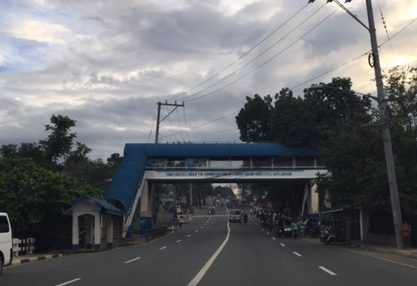 Despite this pedestrian overpass across a public school along Sumulong Highway, most students still prefer to cross on the road rather than go up and down the overpass.
Oftentimes, the seemingly obvious solution of constructing overpasses for safer crossings for students does not pan out as planned or intended. There are many underutilized pedestrian bridges since the natural way is still to cross at-grade. Then there is the issue of providing them safer walking paths or walkways. In both photos above, the sidewalks are only token (“puwede na iyan”) and insufficient for the pedestrian traffic supposed to use them. We need to plan, design and provide such facilities for our pedestrians, especially children, who are marginalized compared to those who have their own vehicles for travel.
–
 Caught (up) in traffic